JU_CSE: A Conditional Random Field (CRF) Based Approach to
Aspect Based Sentiment Analysis
Braja Gopal Patra, Soumik Mandal, Dipankar Das and Sivaji Bandyopadhyay
Department of Computer Science & Engineering,
Jadavpur University, Kolkata, India
[email protected], [email protected],
[email protected], [email protected]
Abstract
The fast upswing of online reviews and their
sentiments on the Web became very useful
information to the people. Thus, the
opin-ion/sentiment mining has been adopted as a
subject of increasingly research interest in
the recent years. Being a participant in the
Shared Task Challenge, we have developed a
Conditional Random Field based system to
accomplish the Aspect Based Sentiment
Analysis task. The
aspect term
in a sentence
is defined as the target entity. The present
system identifies
aspect term
,
aspect
catego-ries
and their sentiments from the
Laptop
and
Restaurants
review datasets provided by
the organizers.
1
Introduction
In recent times, the research activities in the areas of Opinion Mining/Sentiment Analysis in natural language texts and other media are gain-ing ground under the umbrella of subjectivity analysis and affect computing1. The reason may be the huge amount of available text data in So-cial Web in the forms of news, reviews, blogs, chat and twitter etc. Majority of research efforts are being carried out for the identification of pos-itive or negative polarity from the textual con-tents like sentence, paragraph, or text span re-gardless of the entities (e.g., laptops, restaurants) and their aspects (e.g., battery, screen; food, ser-vice).
This work is licensed under a Creative Commons At-tribution 4.0 International Licence. Page numbers and pro-ceedings footer are added by the organisers. Licence details: http://creativecommons.org/licenses/by/4.0/
1
http://www.saaip.org/
Aspect is a multinomial distribution over words that represent a more specific topic in re-views (Jo and Oh, 2011). For example, in case of Laptop reviews, “touchpad” is considered an aspect. Similarly, given a predefined entity, an aspect term describes a specific aspect of that entity (e.g., for the entity “restaurant”, “wine” can be an aspect term). Aspect term can be ap-peared as a single word (e.g., “menu”) or multi-ple words (“side dish”).
It is observed that for a particular entity, one or more number of aspect terms can be grouped into a single category (e.g., aspect terms “drinks”, “main course” belongs to the same cat-egory, “food”).
The main goal of the Aspect Based Sentiment Analysis (ABSA) (Pontiki et al., 2014) task is to identify the aspect terms and their categories from the given target entities as well as to identi-fy the sentiments expressed towards each of the aspect terms. The datasets provided by the shared task organizers consist of customer re-views with human-annotations.
We have participated in all of the four tasks. A combination of Conditional Random Field (CRF) based machine learning algorithm and rule based techniques has been adopted for identifying the aspect term, aspect category and their senti-ments. We have used several features like Part of Speech (POS), Stanford dependency relations2, WordNet information, and sentiment lexicon (SentiWordNet3) to accomplish these tasks.
The rest of the paper is organized in the fol-lowing manner. Section 2 provides the details of previous works. Section 3 provides an elabora-tive description of the data used in the task. Fea-tures used in these experiments are described in Section 4. The detailed setup of experimentation and analysis of the results are described in
2
http://nlp.stanford.edu/software/lex-parser.shtml
3
http://sentiwordnet.isti.cnr.it/
tion 5. Finally, conclusions and future directions are presented.
2
Related Work
It has been observed that most of the previous works on aspect detection were based on infor-mation extraction, to find the most frequent noun phrases (Hu and Liu, 2004). This approach is generally useful in finding aspects which are strongly associated with a single noun. But, one principal disadvantage of this approach is that it cannot detect the aspect terms which are of low frequency and noun phrases (e.g., different names of dishes like Biryani, Dosa and Uttapam etc. for the aspect category, “food”). The pro-posed work of such problem involves semantic hierarchy, rule-based or combination of both (Popescu and Etzioni 2005). More recent ap-proaches of aspect detection are based on topic modelling, that use Latent Dirichlet Allocation (LDA) (Brody and Elhadad, 2010). But, the standard Latent Dirichlet Allocation (LDA) is not exactly suitable for the task of aspect detec-tion due to their inherent nature of capturing global topics in the data, rather than finding local aspects related to the predefined entity. This ap-proach was further modified in Sentence-LDA (SLDA) and Aspect and Sentiment Unification Model (ASUM) (Jo and Oh, 2011). Similarly, the identification of focussed text spans for opinion topics and targets were identified in (Das and Bandyopadhyay, 2010).
Snyder and Barzilay (2007) addressed the problem of identifying categories for multiple related aspect terms appeared in the text. For instance, in a restaurant review, such categories may include food, ambience and service etc. In our task, we call them as aspect or review cate-gories. The authors implemented the Good Grief decoding algorithm on a corpus collected on res-taurant review4, which outperforms over the fa-mous PRank algorithm (Crammer and Singer, 2001).
Ganu et al., (2009) have classified the restau-rant reviews collected from City search New York5 into six categories namely Food, Service, Price, Ambience, Anecdotes, and Miscellaneous. Sentiment associated with each category has also been identified and both the experiments were carried out using Support Vector Machine classi-fiers. Finally, they implemented the regression based model containing MATLAB regression
4
http://people.csail.mit.edu/bsnyder/naacl07/
5
http://www.citysearch.com/guide/newyork-ny-metro
function (mvregress) to give rating (1 to 5) to each review.
To determine the sentiment or polarity of the aspect term and aspect category, we need a prior sentiment annotated lexicon. Several works have been conducted on building emotional corpora in different English languages such as SentiWord-Net (Baccianella et al., 2010), WordSentiWord-Net Affect (Strapparava and Valitutti, 2004) (Patra et al., 2013) etc. Among all these publicly available sentiment lexicons, SentiWordNet is one of the well-known and widely used ones (number of citations is higher than other resources6) that has been utilized in several applications such as sen-timent analysis, opinion mining and emotion analysis.
Several works have been performed on the au-tomated opinion detection or polarity identifica-tion from reviews (Yu and Hatzivassiloglou, 2003; Hu and Liu, 2004). Yu and Hatzivass-iloglou (2003) has focused on characterizing opinions and facts in a generic manner, without examining who the opinion holder is or what the opinion is about. Then, they have identified the polarity or sentiment of the fact using Naive Bayes classifier. Hu and Liu, (2004) has summa-rized the customer review and then identified the sentiment of that review. They have achieved promising accuracy in case of identifying polari-ty of the reviews.
3
Data
The sentences collected from the customer re-views of Restaurants and Laptops are used in these tasks. The training data of Restaurant re-views contains 3041 English sentences annotated with aspect terms and aspect categories along with their polarity. The training data of Laptop reviews contains 3045 sentences annotated with aspect terms along with their polarity. The test data contains 800 sentences from each of the re-view sets.
An example extracted from the corpus is as follows:
But the staff was so horrible to us.
Here, "staff" is the aspect term and its polarity is "negative". The aspect category is "service" and polarity of the aspect category is also " nega-tive".
6
4
Feature Analysis
In general, the feature selection always plays an important role in any machine learning framework and depends upon the data set used for the experiments. Based on a preliminary in-vestigation of the dataset, we have identified some of the following features. Different combi-nations of the features have also been used to get the best results from the classification task.
Parts-of-Speech (POS): the aspect terms are basically represented by the noun phrases. On the other hand, the POS tag plays an important role in aspect term identification (Hu and Liu, 2004; Brody and Elhadad, 2010). Thus, we have used the Stanford CoreNLP7tool to parse each of the review sentences to find out the part-of-speech tag of each word and included them as a feature in all of our experiments.
POS Frequency: We have observed that the aspect terms surrounded by a noun or adjective are also denoted as aspect terms. Therefore, we have utilized this information in our system. For example, in the phrase “external_JJ mouse_NN”. Here the word “mouse” is an object and aspect term. The word “external” is also tagged as as-pect term.
Before be verb: We have observed that the nouns occur before the “be” verbs denote the aspect terms in most of the cases. e.g. “The hard disk is noisy”. Here “hark disk” is an aspect term and is followed by the “be” verb "is".
Inanimate words: In case of the Restaurant and Laptop reviews, we observed that many of the inanimate nouns occur as aspect terms. We have used the hyponym tree of RiTa.WordNet8 to identify the inanimate words. For example, in the following sentence, the words food, kitchen and menu are inanimate nouns occurred as aspect terms.
“The food is uniformly exceptional, with a very capable kitchen which will proudly whip up whatever you feel like eating, whether it's on the menu or not.”
Dependency Relation for finding Object: We have identified the object based dependency rela-tions from parsed sentences, as we have observed that the words occupied in such relations are rep-resented as aspect terms in many cases. “dobj”, “obj” and “xobj” are considered as the probable candidate relations for identifying the aspect
7
http://nlp.stanford.edu/software/corenlp.shtml
8
www.rednoise.org/rita/reference/RiWordNet.html
terms. Here, the Stanford Parser9has been used to get the dependency relations.
Ontology Information (Liu, 2012): We have counted the aspect terms in the training data. The aspect terms occurred more than five times in the corpus are considered during our experiments. At first, we have tested this ontology information on the development set and observed that the aspect terms with frequency five or more also give bet-ter results in the test set.
Sentiment Words: We have used the senti-ment words as a feature for the sentisenti-ment identi-fication tasks (Liu, 2012; Brody and Elhadad, 2010). Words are identified as positive, negative or neutral using SentiWordNet10.
WordNet Information: The RiTa.WordNet package has been used to extract different prop-erties of the words.
For aspect category identification, we have matched the hypernym tree of each word with the four categories (service, price, food, and am-bience). If the hypernym tree does not contain any of such words, we check the next level hy-pernym tree of the words derived from hyhy-pernym of previous word. We have checked up to the second degree hypernym tree. We also searched hypernym tree of the synset of each word.
Number of Sentence: It has been found that many reviews contain more than one sentence. Therefore, we have included the number of sen-tence as a feature based on the output of Stanford Parser. We have split the output of Stanford Parser by the mark, “(S”.
In case of our experiments, the stop words are excluded. Total of 329 stop words was prepared manually.
5
Experimentation and Result Analysis
We have used the CRF++ 0.5811, an open source tool for implementing the machine learn-ing framework for our experiments. CRF is well known for sequence labeling tasks (Lafferty et al., 2001). Similarly, in the present task, the as-pect terms use the context information and are represented in sequences. Many of the aspect terms are multiword expressions such as “hard disk”. We have created different templates for different subtasks to capture all the relations be-tween different sequence related features.
9
http://nlp.stanford.edu/software/lex-parser.shtml
10
http://sentiwordnet.isti.cnr.it/
11
a. Classification of Aspect Term
Features used in case of identifying aspect terms are POS, POS Frequency, Before be verb, Inanimate word, objects of the sentence, ontolo-gy information. We have used several rules to identify these features. Then, we have used the CRF++ to identify the aspect terms. Some post processing techniques are also used in order to get better accuracy. The present system identifies only single word aspect terms. But it is found in the training data that many aspect terms consist of multiple words. Therefore, if there is a stop word in between two system identified aspect words, the stop word is also considered as a part of the aspect term. We have joined the aspect words along with the stop words to form a single but multiword aspect terms.
Precisions, Recalls and F-scores are recorded for our system in Table 1. The maximum F-scores achieved in the aspect term identification task for Laptop and Restaurant are 0.7455012 and 0.84012544, respectively. Our system per-forms better on Restaurant reviews than Laptop reviews.
Laptop Restaurant
Precision 0.4938838 0.6481481
Recall 0.7442396 0.8184855
[image:4.595.307.522.160.205.2]F-score 0.59375 0.72342515
Table 1: JU_CSE system result for aspect term identification.
b. Classification of Aspect Category
Features used in this experiment are POS, De-pendency relations for object and a few semantic relations of WordNet. In this subtask, we have also used aspect term knowledge as a feature. We identified the POS of the words using Stan-ford CoreNLP tool and used the words which are not listed in our stop-word list. The objects are identified from the dependency relations. The hpernym trees of these words are searched up to second degree to find four aspect categories (service, price, food, and ambience). If we don’t find these four categories in the hypernym tree, we increase the frequency of anecdotes/ miscel-laneous category. Frequency counts of these matched words are listed as a feature. The accu-racy of the system for aspect categories in the Restaurant reviews are shown in Table 2.
Maximum F-score achieved in this aspect cat-egory identification is 0.8857715. The main
problem faced in this task was to assign the an-ecdotes/ miscellaneous category to the respective reviews. There are many cases in which the an-ecdotes/miscellaneous categories occurred with other categories. In these cases, our system fails to identify the anecdotes/miscellaneous category.
Restaurant
Precision Recall F-score
[image:4.595.64.294.399.454.2]0.7307317 0.68029064 0.7046096
Table 2: JU_CSE system result for aspect category identification.
We have also observed that every review has at least one category. If any word of the review does not belong to any of the four categories, we assign these reviews with anecdotes/ miscellane-ous category at the time of post processing.
c. Classification of Sentiment of Aspect term and category
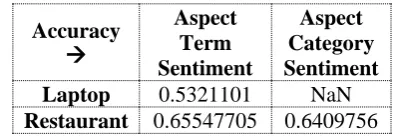
Features used in these experiments are POS, Positive, Negative and Neutral words and num-ber of sentences. Some reviews with multiple sentences contain different sentiments associated with different aspect terms. This observation also leads to conflict sentiment. Therefore, we have also included the aspect term and aspect catego-ry information during sentiment identification. The accuracy of the system is given in the Table 3.
Accuracy
Aspect Term Sentiment
Aspect Category Sentiment
Laptop 0.5321101 NaN
Restaurant 0.65547705 0.6409756
Table 3: JU_CSE system result for aspect term and category sentiment identification.
[image:4.595.314.512.490.558.2]6
Conclusion
In this paper, we have presented a CRF based system for identifying the aspect terms, aspect categories and their sentiments. We believe that this problem will become increasingly important for common people. This task will not only be useful to common shoppers, but also crucial to product manufacturers and restaurateurs.
Overall accuracies of our system were moder-ate. In future, we will include more suitable fea-tures to improve accuracy of our system. We also intend to explore different machine learning al-gorithms for these tasks in future.
Reference
Benjamin Snyder and Regina Barzilay. 2007. Multi-ple Aspect Ranking Using the Good Grief Algo-rithm. In Proceedings of the Human Language Technologies: The Annual Conference of the North American Chapter of the Association for Computa-tional Linguistics (NAACL-HLT 2007), pp. 300-307.
Bing Liu. 2012. Sentiment Analysis and Opinion Mining. Synthesis Lectures on Human Language Technologies 5, no. 1 (2012): 1-167.
Braja G. Patra, Hiroya Takamura, Dipankar Das, Manabu Okumura, and Sivaji Bandyopadhyay. 2013. Construction of Emotional Lexicon Using Potts Model. In Proceedings of the 6th Internation-al Joint Conference on NaturInternation-al Language Pro-cessing (IJCNLP-2013), Nagoya, Japan, pp. 674– 679.
Carlo Strapparava, and Alessandro Valitutti. 2004. WordNet Affect: an Affective Extension of Word-Net. In LREC, vol. 4, pp. 1083-1086.
Dipankar Das and Sivaji Bandyopadhyay. 2010. Ex-tracting emotion topics from blog sentences: use of voting from multi-engine supervised classifiers. In Proceedings of the 2nd international workshop on Search and mining user-generated contents, pp. 119-126.
Ganu Gayatree, Noemie Elhadad, and Amelie Marian. 2009. Beyond the stars: Improving rating predic-tions using review text content. In Proceedings of the 12th International Workshop on the Web and Databases, Providence, Rhode Island.
Hong Yu and Vasileios Hatzivassiloglou. 2003. To-wards answering opinion questions: Separating facts from opinions and identifying the polarity of opinion sentences. In Proceedings of the Confer-ence on Empirical Methods in Natural Language Processing (EMNLP-2013), pp. 129-136.
Koby Crammer and Yoram Singer. 2001. Pranking with ranking. In NIPS, vol. 14, pp. 641-647.
John Lafferty, Andrew McCallum, Fernando C.N. Pereira. 2001. Conditional Random Fields: Proba-bilistic Models for Segmenting and Labeling Se-quence Data. In Proceedings of the 18th Interna-tional Conference on Machine Learning (ICML 2001), pp. 282-289.
Minqing Hu and Bing Liu. 2004. Mining and summa-rizing customer reviews. In Proceedings of the 10th ACM SIGKDD International Conference on Knowledge Discovery and Data Mining, pp. 168-177.
Ana-Maria Popescu and Oren Etzioni. 2005. Extract-ing product features and opinions from reviews. In proceedings of the Human Language Technology Conference: Conference on Empirical Methods in Natural Language Processing (HLT-EMNLP). Morristown, NJ, USA, pp. 339–346.
Samaneh Moghaddam and Martin Ester. 2010. Opin-ion digger: an unsupervised opinOpin-ion miner from unstructured product reviews. In Proceedings of the
19th ACM international conference on Information and knowledge management, pp. 1825-1828.
Samuel Brody and Noemie Elhadad. 2010. An unsu-pervised aspect-sentiment model for online re-views. In Proceedings of the Human Language Technologies: The 2010 Annual Conference of the North American Chapter of the Association for Computational Linguistics (HLT-NAACL).
Soo-Min Kim and Eduard Hovy. 2006. Extracting opinions, opinion holders, and topics expressed in online news media text. In Proceedings of the
Workshop on Sentiment and Subjectivity in Text,
pp. 1-8.
Stefano Baccianella, Andrea Esuli, and Fabrizio Se-bastiani. 2010. SentiWordNet 3.0: An Enhanced Lexical Resource for Sentiment Analysis and Opinion Mining. In LREC, vol. 10, pp. 2200-2204.
Yohan Jo and Alice H. Oh. 2011. Aspect and senti-ment unification model for online review analysis. In Proceedings of the fourth ACM international conference on Web search and data mining.
Zhongwu Zhai, Bing Liu, Hua Xu, and Peifa Jia. 2011. Clustering product features for opinion min-ing. In Proceedings of the fourth ACM internation-al conference on Web search and data mining, pp. 347-354.