DCU-UvA Multimodal MT System Report
Iacer Calixto ADAPT Centre School of Computing Dublin City University
Dublin, Ireland
Desmond Elliott ILLC
University of Amsterdam Science Park 107 1098 XG Amsterdam
Stella Frank ILLC
University of Amsterdam Science Park 107 1098 XG Amsterdam
Abstract
We present a doubly-attentive multimodal machine translation model. Our model learns to attend to source language and spatial-preserving CONV5,4 visual fea-tures as separate attention mechanisms in a neural translation model. In image de-scription translation experiments (Task 1), we find an improvement of 2.3 Meteor points compared to initialising the hidden state of the decoder with only the FC7 fea-tures and 2.9 Meteor points compared to a text-only neural machine translation base-line, confirming the useful nature of at-tending to the CONV5,4features.
1 Introduction
Our system learns to translate image descriptions using both the source language descriptions and the images. We integrate an attention-based neu-ral network for machine translation and image de-scription in a unified model, in which two sep-arate attention mechanisms operate over the lan-guage and visual modalities. We believe that this is a principled approach to learning which source words and which areas of the image to attend to when generating words in the target description.
We are inspired by recent successes in using at-tentive models in both neural machine translation (NMT) and neural image description. Originally, in non-attentive NMT models, the entire source sentence is encoded into a single vector which is in turn used by the decoder to generate a transla-tion (Cho et al., 2014; Sutskever et al., 2014). In a similar vein, image description models can use a vector encoding the image as input for the descrip-tion generadescrip-tion process (Vinyals et al., 2015; Mao et al., 2015,inter-alia).
Bahdanau et al. (2014) first proposed a NMT model with an attention mechanism over the source sentence. Their model is trained so that the decoder learns to attend to words in the source sentence when translating each token in the tar-get sentence. Xu et al. (2015) introduced a similar attention-based neural image description model. In this case, the attention mechanism learns which parts of the image to attend to while generating words in the description.
When translating image descriptions, given both the source description and the source image (i.e., the setting for Task 1), we believe that both modalities can provide cues for generating the tar-get language description. The source description provides the content for translation, but in cases where this may be ambiguous, the image features can provide contextual disambiguation. The sys-tem we propose is a first step towards integrating both modalities using attention mechanisms.
Previous work has demonstrated the plausibility of multilingual multimodal natural language pro-cessing. Elliott et al. (2015) showed how to gen-erate descriptions of images in English and Ger-man by learning and transferring features between independent neural image description models. In comparison, our approach is a single end-to-end model over the source and target languages with attention mechanisms over both the source lan-guage and the visual features.
2 Model Description
We represent the source language with a bi-directional recurrent neural network (RNN) with a gated recurrent unit (GRU) that computes, for each word, forward and backward source annota-tion vectors−→hi and←h−i. The final source annotation vector for a word hi is the concatenation of both
[−→hi;←h−i].
We use the visual features released by the shared task organisers, extracted from the pre-trained VGG-19 convolutional neural network (CNN) (Simonyan and Zisserman, 2015).
The organisers release two types of visual fea-tures according to the layer they were extracted from: FC7 features are extracted from the fi-nal fully-connected layer (FC7), which encode information about the entire image in a 4096-dimensional feature vector; and CONV5,4 fea-tures, extracted from the final convolutional layer (CONV5,4), namely a 196 x 512 dimensional ma-trix where each row (i.e., a 512D vector) repre-sents features from a specific spatial ‘patch’ and therefore encodes information about that specific ‘patch’ (i.e., area) of the image.
2.1 FC7-initialised model
In this model, we use visual features extracted from the final fully-connected FC7 layer from the pre-trained VGG-19 CNN. These features rep-resent an abstract summary of the entire im-age and crucially are not spatially aware, unlike the CONV5,4 features we use in the subsequent double-attention model. We integrate the FC7 fea-tures into the initial state of the decoder.
We first affine-transform the 4096D FC7image feature vector iinto the source language
bidirec-tional RNN hidden states dimensionality, where the affine transformation parameters (WI, bI) are
trained jointly with the model:
iproj =i·WI+bI. (1)
We then simply sum these projected image fea-tures iproj with the first source language context
vector h1, obtained by the encoder bidirectional RNN, and use the resulting vector as input to a feed-forward neural networkfinitused to initialise
the decoder hidden state:
s0 =finit(h1+iproj) (2)
2.2 Doubly-attentive model
The goal of the doubly-attentive model is to in-tegrate separate attention mechanisms over the source language words and visual features in a sin-gle decoder. Similarly to the FC7 model, we rep-resent the source language using a bi-directional RNN with GRUs. We use visual features extracted from the CONV5,4 layer of the VGG-19 CNN alongside the FC7 features. The CONV5,4 fea-tures consist of a 196 x 512 dimensional matrix,
where each row represents features from a specific spatial ‘patch’. Analogous to how the attention mechanism for the source language can focus on specific words or phrases in the source description, the image attention mechanism can focus on spe-cific parts of the image (Xu et al., 2015).
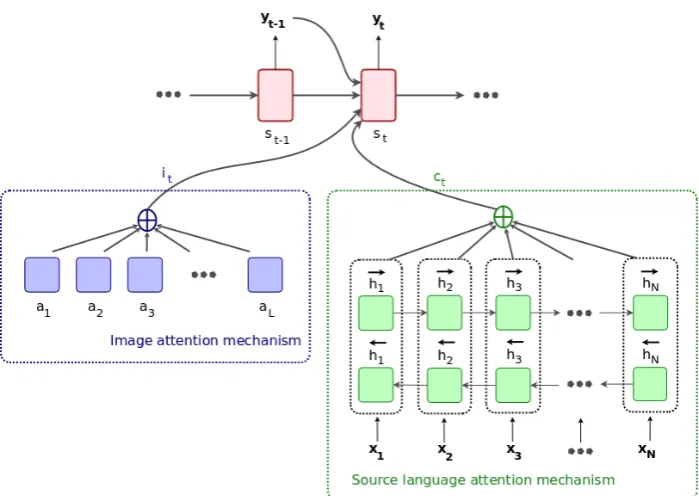
Our doubly-attentive decoder is conditioned on the source sentence and the image via the two sep-arate attention mechanisms, as well as the previ-ous hidden state of the decoder and the previprevi-ously emitted word. Therefore, in computing the de-coder hidden state st at time step t, the decoder has access to the following information:
• it – the image context vector for the current time step obtained via attention over the im-age representation;
• ct – the source language context vector for the current time step obtained via attention over the source sentence representation;
• st−1– the decoder’s previous hidden state;
• yt−1– the target word emitted by the decoder in the previous time step.
Figure 1 illustrates the computation of the de-coder hidden state st according to our doubly-attentivemodel.
2.3 Source sequence context vector
To compute the time-dependent source sentence context vector, we follow Bahdanau et al. (2014) and use a single-layer feed-forward networkfscores
for computing anexpected alignmentest,i between
each source annotation vectorhi — computed as the concatenation of forward and backward source annotation vectors −→hi and ←h−i — and the target word to be emitted at the current time stept.
est,i =fscores (hi, st−1, yt−1), (3)
wherefscores uses all source annotation vectors h,
the decoder’s previous hidden state st−1 and the
previously emitted wordyt−1in computing the ex-pected alignments for the target word at current time step t. In Equation 4, these alignments are
then normalised and converted into probabilities.
αt,i =
exp (est,i)
PN
j=1exp (est,j)
Figure 1: A doubly-attentive decoder learns to independently attend to image patches and source lan-guage words when generating translations.
where αt,i are weights representing the attention over the source annotation vectors. The final time-dependent source context vectorct is a weighted sum over the source annotation vectors, where each vector is weighted by the attention weight
αt,i:
ct= N X
i=1
αt,ihi. (5)
2.4 Image context vector
The time-dependent image context vectors are based on the “soft” visual attention mechanism (Xu et al., 2015). As outlined above, the image annotation vectors are the features extracted from CONV5,4layer, resulting in 196 vectors (each cor-responding to one of the 14 ×14 patches in the image) of 512 dimensions each. These annotation vectors are denoted al (with l = 1. . .196) and are used analogously to the hidden stateshiof the source sentence encoder.
The expected alignments eit,l over the image
features are computed by a single layer feed-forward networkfscorei :
eit,l =fscorei (al, st−1, yt−1), (6)
wherefscorei uses all image annotation vectorsa,
the decoder previous hidden statest−1and the
pre-viously emitted word yt−1 in computing the
ex-pected image–target word alignments at current time step t. In Equation 7 these expected
align-ments are further normalised and converted into probabilities, as in the source context vector.
αit,l= exp (e
i t,l) PL
j=1exp (eit,j)
, (7)
where αit,i are the model’s image attention
weights. A time-dependent image context vec-tor it is then computed by using these attention weights.
it= N X
l=1
αit,lal. (8)
Ideally, this image context vectoritcaptures the image patches that are relevant to the current state of the decoder and for generating the next word.
3 Experiments
We report results for Task 1, which uses the trans-lated data in the Multi30K corpus (Elliott et al., 2016). English and German descriptions in the Multi30K were normalised and tokenized, and compounds in German descriptions were further split in a pre-processing step1.
Meteor
Moses 52.3
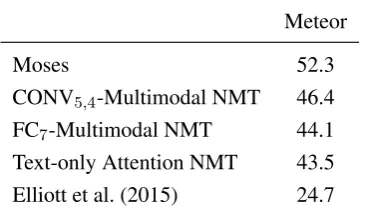
[image:4.595.91.275.64.170.2]CONV5,4-Multimodal NMT 46.4 FC7-Multimodal NMT 44.1 Text-only Attention NMT 43.5 Elliott et al. (2015) 24.7
Table 1: Results for our models on Task 1. We find that attending over the source language and CONV5,4 visual features is better than not using image features (text-only, attentive NMT model) and also just initialising an attention-based de-coder with FC7features.
Throughout, we parameterise our models us-ing 300D word embeddus-ings, 1000D hidden states, and 1000D context vectors; the source and tar-get languages are estimated over the entire vo-cabularies. Our non-recurrent matrices are ini-tialised by sampling from a Gaussian distribution (µ = 0, σ= 0.01), recurrent matrices are orthog-onal and bias vectors are all initialised to zero. We apply dropout on the source language words (en-coder) and before the readout operation (de(en-coder) with probability of 0.3 and apply no other
regu-larisation. We apply early stopping for model se-lection based on Meteor scores (Denkowski and Lavie, 2014), and if it has not increased for 20 epochs on a validation set, training is halted. The models are trained using the Adadelta optimizer (Zeiler, 2012) with an initial learning rate of 0.005. In Table 1 we compare our models — CONV5,4 and FC7-Multimodal NMT — against a text-only, attention-based NMT baseline, the Moses transla-tion baseline (Koehn et al., 2007) and the multi-lingual image description baseline (Elliott et al., 2015). First, it is clear that the Moses SMT base-line is very strong, given that it is only trained over the parallel text without any visual informa-tion. Our models are unable to match the perfor-mance of Moses, however, we do see a substantial increase of20-22Meteor points compared to the
independent image description models (Elliott et al., 2015). The magnitude of the difference shows the importance of learning the source and target language representations in a single joint model.
We also observe improvements in Meteor when we compare our double-attentive CONV5,4model against the FC7 initialised model (2.3points) and
against a text-only NMT model (2.9points). Our results indicate that incorporating image features in multimodal models helps, as compared to our text-only NMT baseline. Even though our neural models — both text-only and multimodal models — fall short of the SMT baseline perfor-mance, we believe that the use of neural architec-tures for this task is more principled, due to the ability to incorporate images and translations in one network that is trained end-to-end.
4 Conclusions and Future Work
We present a model which incorporates multi-ple multimodal attention mechanisms into a neu-ral machine translation decoder. Source language and visual attention mechanisms have been well-studied in the recent literature, but our results indi-cate that multimodal attention appears to be more complex than simply combining two independent attention mechanisms. In particular, we hoped to find a greater improvement from adding vi-sual features, relative to text-only models. How-ever, the Multi30k dataset is relatively small, with a small vocabulary and simple syntactic struc-tures (Elliott et al., 2016). Whereas SMT models can be trained effectively on such datasets, neural models usually perform best when a large amount of data is available. We believe that as the amount of data in multimodal translation datasets increase, neural models will become more competitive.
In future work we plan to study why the source language attention mechanism contributes more to the model than the visual attention. We believe that using the source language context vector ct may help when computing the image context vec-torit. We also plan to investigate other attention
mechanisms, for instance the “hard” attention as proposed by Xu et al. (2015). Soft attention may be too diffuse in this setting, especially over the large set of image context vectors.
Acknowledgements
References
Dzmitry Bahdanau, Kyunghyun Cho, and Yoshua
Bengio. 2014. Neural machine translation by
jointly learning to align and translate. CoRR,
abs/1409.0473.
KyungHyun Cho, Bart van Merrienboer, Dzmitry Bah-danau, and Yoshua Bengio. 2014. On the properties of neural machine translation: Encoder-decoder
ap-proaches. CoRR, abs/1409.1259.
Michael Denkowski and Alon Lavie. 2014. Meteor universal: Language specific translation evaluation for any target language. InProceedings of the EACL 2014 Workshop on Statistical Machine Translation.
Desmond Elliott, Stella Frank, and Eva Hasler. 2015. Multi-language image description with neural
se-quence models. CoRR, abs/1510.04709.
Desmond Elliott, Stella Frank, Khalil Sima’an, and Lu-cia SpeLu-cia. 2016. Multi30k: Multilingual
english-german image descriptions. CoRR, abs/1605.00459.
Philipp Koehn, Hieu Hoang, Alexandra Birch, Chris Callison-Burch, Marcello Federico, Nicola Bertoldi, Brooke Cowan, Wade Shen, Christine Moran, Richard Zens, et al. 2007. Moses: Open source toolkit for statistical machine translation. In Pro-ceedings of the 45th annual meeting of the ACL on interactive poster and demonstration sessions, pages 177–180. Association for Computational Linguis-tics.
Junhua Mao, Wei Xu, Yi Yang, Jiang Wang, Zhiheng Huang, and Alan Yuille. 2015. Deep caption-ing with multimodal recurrent neural networks
(m-RNN). InICLR.
Karen Simonyan and Andrew Zisserman. 2015. Very deep convolutional networks for large-scale image recognition. InICLR.
Ilya Sutskever, Oriol Vinyals, and Quoc V. V Le. 2014. Sequence to sequence learning with neural
networks. InAdvances in Neural Information
Pro-cessing Systems 27, pages 3104–3112.
Oriol Vinyals, Alexander Toshev, Samy Bengio, and Dumitru Erhan. 2015. Show and tell: A neural
im-age caption generator. InThe IEEE Conference on
Computer Vision and Pattern Recognition (CVPR), June.
Kelvin Xu, Jimmy Ba, Ryan Kiros, Kyunghyun Cho, Aaron C. Courville, Ruslan Salakhutdinov, Richard S. Zemel, and Yoshua Bengio. 2015. Show, attend and tell: Neural image caption generation
with visual attention. In International Conference
on Machine Learning.
Matthew D. Zeiler. 2012. ADADELTA: an adaptive