Proceedings of the Workshop on Figurative Language Processing, pages 110–114
Neural Metaphor Detecting with CNN-LSTM Model
Chuhan Wu1, Fangzhao Wu2, Yubo Chen1, Sixing Wu1, Zhigang Yuan1and Yongfeng Huang1
1Tsinghua National Laboratory for Information Science and Technology,
Department of Electronic Engineering, Tsinghua University, Beijing 100084
2Microsoft Research Asia
{wuch15,ybch14,wu-sx15,yuanzg14,yfhuang}@mails.tsinghua.edu.cn [email protected]
Abstract
Metaphors are figurative languages widely used in daily life and literatures. It’s an im-portant task to detect the metaphors evoked by texts. Thus, the metaphor shared task is aimed to extract metaphors from plain texts at word level. We propose to use a CNN-LSTM model for this task. Our model combines CNN and LSTM layers to utilize both local and long-range contextual information for identi-fying metaphorical information. In addition, we compare the performance of the softmax classifier and conditional random field (CRF) for sequential labeling in this task. We also incorporated some additional features such as part of speech (POS) tags and word cluster to improve the performance of model. Our best model achieved 65.06% F-score in theall POS testingsubtask and 67.15% in theverbs testing subtask.
1 Introduction
A metaphor is a type of conceptual mapping to represent one thing as another (Lakofi and John-son, 1980). They are widely used in verbal and written languages to convey rich linguistic and sentiment information (Steen et al., 2010). De-tecting the metaphors in texts are important to mine the semantic and sentiment information bet-ter, which is beneficial to many applications such as machine translation, dialog systems and senti-ment analysis (Tsvetkov et al.,2014).
However, detecting metaphors is a challenging task. The semantic differences between metaphor-ical and non-metaphormetaphor-ical texts are often subtle. For example, the sentence Her hair is a white snowflakeis metaphorical, while the sentenceHer hair is white doesn’t contain metaphors. In ad-dition, detecting metaphors can be influenced by subjective factors, and may need specific domain knowledge (Tsvetkov et al.,2014).
Existing computational approaches to detect metaphors are mainly based on lexicons (Mohler et al., 2013; Dodge et al., 2015) and supervised methods (Turney et al.,2011;Heintz et al.,2013; Klebanov et al., 2014, 2015, 2016). Lexicon-based methods are free from data annotation, but they are unable to detect novel metaphorical us-ages and capture the contextual information. Su-pervised methods such as logistic regression clas-sifier (Klebanov et al., 2014) can capture richer metaphor information. However, they need so-phisticated hand-crafted features.
To improve the collective techniques on detect-ing metaphors, the metaphor shared task1 aims to detect both metaphorical verbs and metaphors with other POS. Given a sentence and their words with specific POS tags, systems are required to de-termine whether each word is a metaphor. We pro-pose a CNN-LSTM model with CRF or weighted softmax classifier to address this task. Our model can take advantage of both long-range and local information by utilizing both LSTM and CNN lay-ers. We propose to use a weighted softmax clas-sifier to predict the label sequence of sentence, which outperforms the CRF method. We apply a model ensemble strategy to help our model predict more accurately. In addition, we incorporated ad-ditional features such as POS tags and word cluster features to further improve our model. Our best model achieved 65.06% F-score on the test data in theall POS testingsubtask, and 67.15% in the
verbs testingsubtask.
2 CNN-LSTM Model with CRF or Softmax Inference
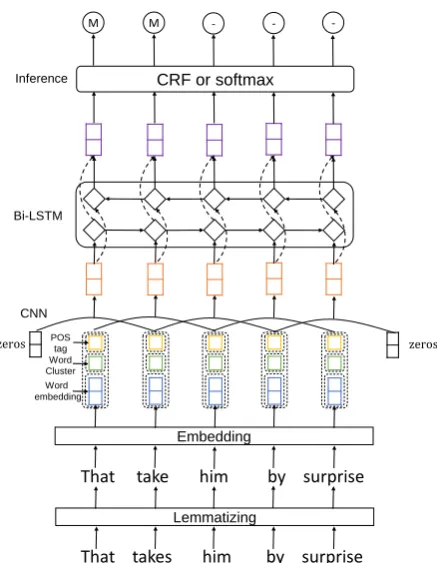
We model this task as a sequential labeling task and the input is a sentence with a sequence of words. The framework of our CNN-LSTM model
1https://competitions.codalab.org/competitions/17805
That takes him by surprise
Lemmatizing
That take him by surprise
Word embedding
POS tag
Embedding
zeros zeros
Bi-LSTM
CNN
CRF or softmax
M M - -
-Inference
[image:2.595.74.293.60.342.2]Word Cluster
Figure 1: The architecture of our method. The final metaphor labels will be predicted by a CRF or softmax inference layer.
is presented in Figure1. We will introduce the de-tails of modules in our model from bottom to top. We follow the approach proposed by Klebanov et al. (2016) to use the lemmatizing strategy. The first module in our model is a lemmatizer. This module is used to lemmatize the verbs in texts via a dictionary. The input is a text with a sequence of word, and output is the text with lemmatized words. Since verbs with different forms can share the same lemmas, using the lemmatized verbs in texts can simplify the semantic information and re-duce the number of out-of-vocabulary words. We use the NLTK package (Bird et al.,2009) to trans-form the verbs into their lemmas.
The second module is an embedding layer. It will convert sequences of words in sentences into sequences of low-dimension dense vectors via a lookup table. The embedding weights of words are obtained by the pre-trained word2vec model and they will be fine-tuned during model train-ing. POS tags are useful in metaphor detecting task (Klebanov et al., 2014). Therefore, we also incorporate the one-hot encoded POS tags as addi-tional features into our neural model, and
concate-nated them with the word embeddings. We use the Stanford parser2tool to obtain the POS tag of each word in texts. Since similar words may have simi-lar metaphor information, we also incorporate the word cluster features. They are obtained by clus-tering the word embedding vectors via k-means method. They are also one-hot encoded and com-bined with the word embeddings as the final word representations to input the neural network.
The third module in our model is a convolu-tional neural networks (CNN) to extract local con-textual information. Motivated by the multiple kernels CNN used for sequential labeling (Chen et al.,2016), we also apply such CNN with differ-ent window sizes to this task.
The fourth module in our model is a bidirec-tional long short-term memory (Bi-LSTM) layer. This layer is used to extract the long-range infor-mation from the CNN feature maps. It will com-bine the previous and future context information to output the hidden statehiat time stepi.
The last module is an inference layer. We im-plement it with two alternatives and compare their performance via experiments.
CRF: We use CRF to predict the metaphor labels of each words. Given the matrix of hidden rep-resentationsh = [h1,h2, ...,hN], the conditional
probability of the output sequence of labelyis
for-mulated as follows:
p(y|h;θ) = N
Q
i=1
ψ(hi, yi, yi−1)
P
y0∈Y(s)
N
Q
i=1
ψ(hi, y0i, y0i−1)
, (1)
where Y(s) is the set of all possible label
se-quences, θ is the parameters, and ψ(hi, yi, yi−1) is the potential function. In our model, we use a simple potential function which is formulated as:
ψ(hi, yi, yi−1) = exp(yiTWThi+yiT−1Tyi),
(2) whereWandTrepresent the linear transform
pa-rameters. The CRF loss function we use is the negative log-likelihood over all training samples, which is formulated as follows:
LCRF =−X
s∈S
log(p(ys|hs;θ)), (3)
whereSis the training set, andhsandys are the
Softmax: We use a dense layer with softmax acti-vation function to predict the metaphor label se-quences. Motivated by the cost-sensitive cross-entropy (Santos-Rodr´ıguez et al., 2009; Yang et al.,2014;Muller et al.,2014), the loss function of our model is formulated as follows:
LSof tmax=−X
s∈S
N
X
i=1
wyiyilog( ˆyi), (4)
yi is the metaphor label of ith word, yˆi is the
predicted score, and wyi is the loss weight of
metaphor label yi. Since there are much more
non-metaphorical words than metaphors, we as-sign larger loss weight to the positive class. Since the prediction is generated from the lemmatized texts, optimizing the loss in Eq. (4) can tune all pa-rameters in the embedding, CNN and LSTM lay-ers.
Ensemble strategy is usually useful to improve the performance of neural network (Wu et al., 2017). We train our model for 20 times on ran-domly selected 90% training data. For CRF-based model, the prediction of each token will be ob-tained by voting. For softmax-based model, the output probability is the averaged logits of all model predictions.
3 Experiment
3.1 Dataset and Experimental Settings The dataset for this task is the VU Amsterdam Metaphor Corpus (VUA)3. There are 12,122 sen-tences for training, and 4,080 sensen-tences for test. We tune the hyper-parameters of our model via cross validation.
The pre-trained word embeddings are the 300-dim Google embedding4 released by Mikolov et al. (2013). They were trained by the skip-gram model on about 100-billion words on Google News. These word embedding were fine-tuned during model training.
The hyper-parameters in our model were tuned via cross-validation. The dimension of Bi-LSTM hidden states is 200, the window sizes of CNN fil-ters are 3, 5, 7 and 9 respectively. The number of CNN filters is 100. We set the dropout rate to 0.2 for each layer. The loss weightswpandwnof
metaphors and non-metaphorical words are set to 3http://ota.ahds.ac.uk/headers/2541.xml
4https://code.google.com/archive/p/word2vec/
2.0 and 1.0 respectively. The class number of word cluster is set 50. The batch size is 50, and the max training epoch is set to 15. The optimizer we use is RMSProp in our experiment. The performance of bothall POS testingandverbs testingsubtasks is evaluated by precision, recall and F-score as a standard binary classification task.
3.2 Performance Evaluation
We compare the performance of the variants of our model and several baseline methods.
The methods to be compared include: 1)
CNN+CRF, using CNN to extract local in-formation and CRF for word-level metaphor detection; 2) LSTM+CRF, using Bi-LSTM to obtain the text representation and CRF inference
layer; 3) CNN+LSTM+CRF, using the
com-bination of LSTM, CNN and CRF inference
layer; 4) CNN+LSTM+CRF+ensemble, adding
ensemble strategy to the CNN+LSTM+CRF
model; 5) CNN+Softmax, using CNN and
weighted softmax classifier for
sequen-tial labeling; 6) LSTM+Softmax, using
Bi-LSTM and softmax inference layer; 7)
CNN+LSTM+Softmax w/o lemma, using the com-bination of LSTM, CNN and softmax inference layer, but without the lemmatizing process; 8)
CNN+LSTM+Softmax, using the combination of LSTM, CNN and softmax inference layer;
9) CNN+LSTM+Softmax+ensemble, adding
ensemble strategy to the CNN+LSTM+Softmax model. Our official submissions are obtained by model 3), 4), 8), 9) and the different combinations of additional features, which will be discussed in the next subsection.
Model PVerbs TestingR F All POS TestingP R F CNN+CRF* .628 .611 .619 .605 .589 .597 LSTM+CRF* .633 .609 .621 .604 .586 .595 CNN+LSTM+CRF .644 .615 .629 .617 .597 .607 CNN+LSTM+CRF+ensemble .664 .626 .645 .610 .627 .619 CNN+Softmax* .575 .716 .638 .585 .644 .613 LSTM+Softmax* .588 .710 .643 .591 .659 .623 CNN+LSTM+Softmax w/o lemma* .585 .702 .638 .601 .669 .633 CNN+LSTM+Softmax .593 .734 .656 .611 .677 .643 CNN+LSTM+Softmax+ensemble .600 .763 .671 .608 .700 .651
Table 1: The performance of different methods. *The results of these baseline methods were not submitted due to the limited submission time. We evaluate their performance using the labels of testing data after the competition.
in both tasks. It may be because the lemmatized verbal metaphors are more simple, and there will be fewer out-of-vocabulary words in the embed-ding look-up table. (4) the ensenmble strategy can also help our model identify metaphors more ac-curately. It validates that using a series of models to predict can reduce the data noise and improve the generalization ability of our model.
3.3 Influence of Additional Features
Features PVerbs TestingR F All POS TestingP R F None .584 .717 .644 .583 .665 .621 +POS .588 .729 .651 .606 .662 .633 +cluster .589 .723 .649 .606 .665 .634 +POS+cluster .593 .734 .656 .611 .677 .643
Table 2: The influence of additional features on our best-performance model.
The influence of the POS tags and word clus-ters is shown in Table 2. Here we use the
CNN+LSTM+Softmaxmodel to investigate the in-fluence of features. The results show that both POS tags and word cluster features can help im-prove the performance of detecting metaphors. It proves that POS tags contain useful information to identify the metaphors, since metaphors usually have specific POS tags and they can be easier to be identified by incorporating POS information. Thus, combing the POS tag features is beneficial. Incorporating the word cluster features is also use-ful to improve the performance. It may be because words with similar semantic information have some inherent relatedness and they share similar metaphor information. Our model can identify such information better if word cluster features are incorporated. In addition, it can also enrich the
in-formation of out-of-vocabulary words, which can improve the generalization ability of our model. Thus, incorporating the word cluster features is also beneficial to detect metaphors.
3.4 Influence of Loss Weight
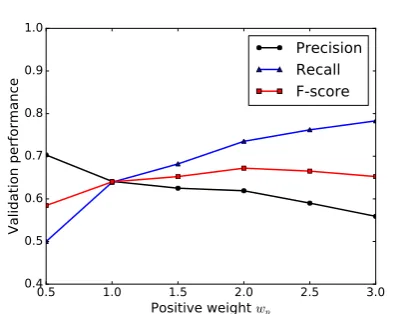
Since the metaphors are less frequent than normal words, the selection of loss weight is important. We investigate the influence of the loss weightwp
of positive label on the softmax classifier, which is illustrated in Figure2. The results indicate that us-ing largerwpcan improve the recall score, but the
precision will be lower. It proves that controlling the loss weights can improve the F-score perfor-mance in this unbalanced classification task. To achieve a better performance, we choosewp = 2
since the F-score performance is best as shown in this figure.
0.5 1.0 1.5 2.0 2.5 3.0
Positive weight wp
0.4 0.5 0.6 0.7 0.8 0.9 1.0
Validation performance
Precision
Recall
F-score
Figure 2: The validation performance of our model us-ing differentwp.
4 Conclusion
[image:4.595.312.522.504.661.2]shared task to detect metaphors in texts. We combine CNN and LSTM to capture both local and long-distance contextual information to rep-resent the input sentences with lemmatizing pre-processing. We compare the performance of us-ing CRF and softmax classifier with weighted loss. In addition, we incorporate additional features in-cluding POS tags and word cluster features, and use the ensemble strategy to improve the perfor-mance. The experimental results validate the ef-fectiveness of our model on detecting metaphors.
Acknowledgments
The authors thank the reviewers for their in-sightful comments and constructive suggestions on improving this work. This work was sup-ported in part by the National Key Research and Development Program of China under Grant 2016YFB0800402 and in part by the National Nat-ural Science Foundation of China under Grant U1705261, Grant U1536207, Grant U1536201 and U1636113.
References
Steven Bird, Ewan Klein, and Edward Loper. 2009. Natural language processing with Python: analyz-ing text with the natural language toolkit. ” O’Reilly Media, Inc.”.
Xinchi Chen, Xipeng Qiu, and Xuanjing Huang. 2016. A feature-enriched neural model for joint chi-nese word segmentation and part-of-speech tagging. arXiv preprint arXiv:1611.05384.
Ellen Dodge, Jisup Hong, and Elise Stickles. 2015. Metanet: Deep semantic automatic metaphor anal-ysis. In Proceedings of the Third Workshop on Metaphor in NLP, pages 40–49.
Ilana Heintz, Ryan Gabbard, Mahesh Srivastava, Dave Barner, Donald Black, Majorie Friedman, and Ralph Weischedel. 2013. Automatic extraction of linguis-tic metaphors with lda topic modeling. In Proceed-ings of the First Workshop on Metaphor in NLP, pages 58–66.
Beata Beigman Klebanov, Ben Leong, Michael Heil-man, and Michael Flor. 2014. Different texts, same metaphors: Unigrams and beyond. InProceedings of the Second Workshop on Metaphor in NLP, pages 11–17.
Beata Beigman Klebanov, Chee Wee Leong, and Michael Flor. 2015. Supervised word-level metaphor detection: Experiments with concreteness and reweighting of examples. InProceedings of the Third Workshop on Metaphor in NLP, pages 11–20.
Beata Beigman Klebanov, Chee Wee Leong, E Dario Gutierrez, Ekaterina Shutova, and Michael Flor. 2016. Semantic classifications for detection of verb metaphors. InProceedings of the 54th Annual Meet-ing of the Association for Computational LMeet-inguistics (Volume 2: Short Papers), volume 2, pages 101–106.
George Lakofi and Mark Johnson. 1980. Metaphors we live by. Chicago, IL: University of.
Tomas Mikolov, Kai Chen, Greg Corrado, and Jef-frey Dean. 2013. Efficient estimation of word representations in vector space. arXiv preprint arXiv:1301.3781.
Michael Mohler, David Bracewell, Marc Tomlinson, and David Hinote. 2013. Semantic signatures for example-based linguistic metaphor detection. In Proceedings of the First Workshop on Metaphor in NLP, pages 27–35.
Philippe Muller, C´ecile Fabre, and Cl´ementine Adam. 2014. Predicting the relevance of distributional se-mantic similarity with contextual information. In 52nd Annual Meeting of the Association for Com-putational Linguistics-ACL 2014, pages 479–488.
Ra´ul Santos-Rodr´ıguez, Dar´ıo Garc´ıa-Garc´ıa, and Jes´us Cid-Sueiro. 2009. Cost-sensitive classifi-cation based on bregman divergences for medi-cal diagnosis. In Machine Learning and Applica-tions, 2009. ICMLA’09. International Conference on, pages 551–556. IEEE.
Gerard J Steen, Aletta G Dorst, J Berenike Herrmann, Anna A Kaal, and Tina Krennmayr. 2010. Metaphor in usage. Cognitive Linguistics, 21(4):765–796.
Yulia Tsvetkov, Leonid Boytsov, Anatole Gershman, Eric Nyberg, and Chris Dyer. 2014. Metaphor detec-tion with cross-lingual model transfer. In Proceed-ings of the 52nd Annual Meeting of the Association for Computational Linguistics (Volume 1: Long Pa-pers), volume 1, pages 248–258.
Peter D Turney, Yair Neuman, Dan Assaf, and Yohai Cohen. 2011. Literal and metaphorical sense iden-tification through concrete and abstract context. In Proceedings of the Conference on Empirical Meth-ods in Natural Language Processing, pages 680– 690. Association for Computational Linguistics.
Chuhan Wu, Fangzhao Wu, Yongfeng Huang, Sixing Wu, and Zhigang Yuan. 2017. Thu ngn at ijcnlp-2017 task 2: Dimensional sentiment analysis for chi-nese phrases with deep lstm. Proceedings of the IJCNLP 2017, Shared Tasks, pages 47–52.