Proceedings of the Workshop on Computational Models of Reference, Anaphora and Coreference, pages 97–103
Event versus entity co-reference:
Effects of context and form of referring expression
Sharid Lo´aiciga1 Luca Bevacqua2 Hannah Rohde2 Christian Hardmeier3 1CLASP, University of Gothenburg
2Department of Linguistics and English Language, University of Edinburgh 3Department of Linguistics and Philology, Uppsala University
[email protected] [email protected]
[email protected] [email protected]
Abstract
Anaphora resolution systems require both an enumeration of possible candidate antecedents and an identification process of the antecedent. This paper focuses on (i) the impact of the form of referring expression on entity-vs-event preferences and (ii) how properties of the passage interact with referential form. Two crowd-sourced story-continuation exper-iments were conducted, using constructed and naturally-occurring passages, to see how par-ticipants interpret It and This pronouns fol-lowing a context sentence that makes avail-able event and entity referents. Our partici-pants show a strong, but not categorical, bias to use This to refer to events and It to refer to entities. However, these preferences vary with passage characteristics such as verb class (a proxy in our constructed examples for the number of explicit and implicit entities) and more subtle author intentions regarding subse-quent re-mention (the original event-vs-entity re-mention of our corpus items).
1 Introduction
A challenge in discourse interpretation is the res-olution of referring expressions, particularly those whose meaning is compatible with many potential antecedents. To take an example like (1), a pas-sage may introduce a number of entities and situ-ations that a subsequent sentence might refer to.
(1) Everybody who is involved with this debate has been struggling over me and my personality. [ParCorFull]
For a sentence following (1), certain expressions would be resolved unambiguously to a unique en-tity (e.g., to the speaker for a 1st person singu-lar pronoun I) or would easily be linked to the only compatible referent in the context (e.g., to the group of relevant individuals described as Ev-erybody for a 3rd person plural pronoun They). Other expressions are compatible with more than
one entity (e.g., the debate or the personality for a pronounIt) and therefore create potential ambigu-ity. Making matters worse, the antecedent of some expressions can be either an entity or something more abstract: an event or situation or idea. Such expressions include personal pronouns likeItand demonstrative pronouns likeThis/That.
Given the complexity of identifying a set of can-didate abstract antecedents in a given context and then determining whether a particular expression is re-mentioning one of those abstract antecedents or a more concrete entity, many co-reference sys-tems focus only on nominal antecedents (e.g., BART, Stanford’s sieve-based, HOTCoref ( Vers-ley and Bj¨orkelund, 2015)). However, event in-stances are also referential.1
This paper asks when and to what degree event instances serve as antecedents when a competing entity referent is also available. The goal is to model human choices as a baseline to inform co-reference systems. We report two psycholinguistic studies that use a story-continuation task to mea-sure participants’ resolution of pronouns It and
This.
Improving our understanding of the interpreta-tion of the “difficult” anaphoric cases is a step to-wards better anaphora and co-reference systems. It has been noted that current systems struggle to identify this type of reference and that anaphoric-ity determiners have poor performance ( Heinzer-ling et al.,2017). It, This andThat are also fre-quent in dialogue data for which co-reference
sys-1 Here we call event what is more commonly known
asabstract anaphora (cf. Dipper and Zinsmeister (2010);
Nedoluzhko and Lapshinova-Koltunski(2016)). We take as aneventany non-nominal relationship for the pronounsItand Thisand atextualantecedent in the form of a text span of vari-able length (e.g., a word, a clause, several sentences).Textual means that anaphoric relations for which some type of infer-ence is necessary are not included, e.g., bridging or extra-textual reference. The termevent referenceis founded upon
Webber(1986), and we set on the nameeventfor the sake of consistency with the annotation in the corpus used in the second study presented here.
tems’ performance is particularly low (Eckert and Strube,2000;M¨uller,2007). In addition, pronoun function is relevant to the evaluation of machine translation systems since different functions entail different translations according to the constraints of the language pair and can thus affect perfor-mance (Guillou,2016).
2 Related Work
Both corpus-based and psycholinguistics works on the interpretation of anaphoric expressions con-centrate on the identification of the antecedents of nominal expressions. Abstract anaphora— anaphora that involve reference to abstract entities such as events or states (Asher, 1993)—is much less studied from both fields, as evidenced by the little amount of annotated data available (Dipper and Zinsmeister,2010;Poesio,2015).
Corpus-based studies of pronouns are often done in relationship to the texts on which co-reference resolution systems will be trained and tested. With the clear aim to improve preci-sion, the authors of these systems have an interest in quantifying “non-anaphoric” pronouns for pre-venting their resolution. We know for instance, that about 5% of referential pronouns and 71% of demonstratives in dialogue data refer to events (M¨uller, 2007; Poesio, 2015), whereas about 3% of referentialitpronouns in written text of various genres refer to events (Evans,2001).
In psycholinguistic research, on the other hand, the focus has been on using theoretical constructs of complexity, salience, and focus to capture co-reference patterns. The demonstratives This and
That have been grouped together, assuming that they behave in the same manner, but potentially differently from It. Brown-Schmidt et al. (2005) analyzeItvsThatand report a preference forThat
if what is referred to is a composite (e.g.,I’ll have the hamburger and fries. I’ll have that, too.), in-dependent of other metrics of the salience of the referent. Building on the Centering co-reference model (Grosz et al.,1995), Passonneau (1989) an-alyzes intra-sentential instances ofItvsThatwith an explicit NP antecedent. She reports that It is used to refer to the center (most often the subject), whereasThatfavors non-centers.
Corpus-based studies offer insights about lan-guage use, since the written texts they are based on are, after all, natural passages. They offer bet-ter estimates for building systems that will be used
on those texts. Corpus-based studies, on the other hand, do not offer any explanation as to why a particular item follows a certain distribution, and they grant little control over the confounding vari-ables responsible for that distribution. In this re-spect, psycholinguistics studies provide more suit-able methods for capturing the cognitive processes behind naturally occurring phenomena. We there-fore start the next section with a study using con-structed passages to allow for careful control over format and content.
3 Study 1: Constructed passages
A story-continuation experiment was conducted to establish a baseline rate at which participants assign It/This pronouns to entity vs event an-tecedents. By varying a property of the con-text sentence, we test how malleable the two pro-nouns’ respective co-reference preferences are. A 2x2 design manipulated the context sentence (alternating/non-alternating verb) and the pronoun prompt (It/This, as in(2)-(3)).
(2) The train from the Highlands arrived promptly. It/This
(3) The balloon with the red hearts popped noise-lessly. It/This
The availability of entities for anaphoric resolu-tion is dependent on the argument structure of the previous predicates. Alternating verbs can have an intransitive as well as a transitive use: the first usu-ally describes a change of state(4-a), and the latter specifies, in subject position, which entity brought on the change(4-b). Conversely, non-alternating verbs do not allow a transitive use(5).2
(4) a. The snow melted.
b. The heat melted the snow. (5) a. The battery died.
b. * The heat died the battery.
Manipulating the verb in the context sentence af-fects the argument realization options associated with the predicate: Non-alternating verbs like ar-rivepermit only a single realization with the entity that arrives always in subject position; alternat-ing verbs likepopare compatible with realizations
2 Jespersen(1927) collects verbs undergoing alternation
where the entity that pops appears in subject posi-tion or object posiposi-tion. For alternating verbs, an explicit agent entity can be introduced (I popped the balloon) or left implicit, as in(3).
One hypothesis is that alternating verbs could make available an additional (implicit) agent who might provide more entity co-reference opportuni-ties and thereby increase entity co-reference and reduce event co-reference. Another hypothesis is that non-alternating verbs may make salient one single (explicit) entity by eliminating com-petition from other (implicit) entities and thereby yield more entity reference and less event co-reference. The existence of an external, un-specified argument in the syntax of alternating verbs is still controversial (Embick,2004;Sch¨afer, 2009), but the cognitive accessibility of a possible agentive entity arises from the very fact that the causative alternation exists.
Although differences have been observed be-tween the use of proximal and distal demonstra-tivesthisandthat(C¸okal et al.,2014), we targeted only one demonstrative pronoun in order to sim-plify the design. This is in keeping with observa-tions about the functional grouping of a number of pronouns (zeros, demonstratives, and personal pronouns) when used deictically (Webber,1990).
3.1 Materials
The 24 experimental items consisted of a context sentence and a pronoun prompt, as in(2)-(3). Par-ticipants saw all items, with eitherItorThis. Sub-ject NPs were modified (8 nouns with pre-nominal adjectives, 8 nouns with post-nominal preposi-tional phrases, 8 nouns with post-nominal rela-tive clauses). The verb used an adverbial or par-ticle predicate (roughly half alternating, half non-alternating). The head of the subject NP was al-ways the only singular entity, with any other men-tioned entities being incompatible with 3rd person singular co-reference (e.g.,weorthe red hearts).3
The 24 experimental items were interleaved with 40 filler items. These included 20 passages with a context sentence mentioning one or two en-tities, followed by a discourse adverbial prompt (e.g.,As a result,Then), 16 passages for an unre-lated experiment involving mentions of companies and other organisations, and 4 catch trials with an obvious correct response (e.g., Caleb did all the 3 The data to reproduce our experiments and the
full models can be found on https://github.com/ sharidloaiciga/event_vs_entity.
cooking for the BBQ even though he hates BBQ.
He prefers mac ’n ).
3.2 Participants
Twenty-seven monolingual English-speaking par-ticipants aged 19-63 (mean age 36, σ=11.2; 15
male) were recruited from Amazon’s Mechanical Turk (Munro et al.,2010;Gibson et al.,2011) and received $4 for an estimated 30-minute task.
3.3 Procedure
Continuations were collected via a web-based in-terface that participants could access from their own computer. Each item was presented on a page by itself with a text box for participants to use for writing their continuation.
3.4 Annotation and analysis
Continuations for experimental items were anno-tated for type of co-reference (entity vs event). The four authors of this paper shared the annota-tion such that all target continuaannota-tions were coded by two annotators. To be conservative, annota-tors were blind to theIt/Thisprompt condition and agreed to err on the side of annotating a pronoun as ambiguous if the pronoun could be interpreted plausibly as coreferential with an event or an entity (e.g.,The brand new siren sounded loud. [omitted pronoun]startled some people).
Using mixed-effects logistic regression, we modeled the binary outcome of entity or event co-reference with fixed effects for prompt type, verb class, and their interaction, with maximal random effects structure when supported by the data (Barr et al., 2013). Where a model did not converge, we removed random correlations. All factors were centered. Reported p-values are from glmer model output using the lme4 package (Bates et al.,2015) in R (R Development Core Team,2008).
3.5 Results
glmer models are understood to be robust against datasets that are not perfectly balanced.
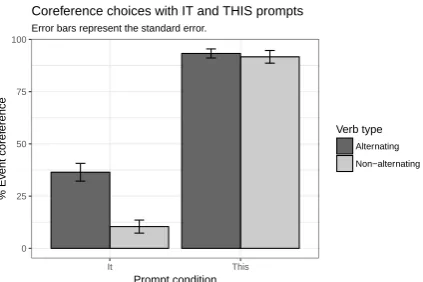
The results (see Figure1) show a strong, but not categorical, bias to useIt to refer to entities and
Thisto refer to events. In addition, verb type im-pacts co-reference, whereby verbs that permit al-ternations yield more event co-reference than non-alternating verbs. This is in keeping with our sec-ond hypothesis that the salience of the single argu-ment of non-alternating verbs may have attracted more entity co-reference.
0 25 50 75 100
It This
Prompt condition
% Ev
ent coref
erence Verb type
Alternating Non−alternating
Error bars represent the standard error.
[image:4.595.76.288.224.365.2]Coreference choices with IT and THIS prompts
Figure 1: Study 1 results by prompt and verb type.
The prompt type × verb type model of
co-reference choice confirms a main effect of prompt type (β=5.100, p<0.001) and a main effect of verb
type (β=1.437, p<0.05). There was no prompt×
verb type interaction (β=-1.350, p=0.22).4
4 Study 2: Corpus passages 4.1 Materials
The 48 target passages are minimally edited sentences extracted from the ParCorFull corpus (Lapshinova-Koltunski et al., 2018). This is a German-English parallel corpus annotated with full co-reference. Although the corpus is designed for nominal co-reference, it includes annotations of two types of antecedents: entities and events. Entities can be either pronouns or NPs, whereas events can be VPs, clauses or a set of clauses.
ParCorFull includes texts from TED talks tran-scripts and also newswire data.5 Since pronouns
4 Inspection of Figure1suggests a possible interaction
whereby the effect of verb type looks stronger in theIt condi-tion than in theThiscondition. The lack of a significant inter-action in the model may reflect the fact that the co-reference rate for non-alternating verbs in theThiscondition is already near ceiling and there may be little room for (measuring) a further increase.
5Specifically, the ParCorFull corpus includes the datasets
are generally more frequent in the TED talks genre than news, we concentrated on this portion of the corpus only. Twelve examples of each It-entity,
It-event,This-entity, andThis-eventwere selected. In comparison to the sentences from Study 1, the corpus sentences were relatively long; therefore, simplified or shortened versions were used.
Additionally, the target passages were inter-leaved with 52 filler items. From these, 24 were extracted from ParCorFull sentences with no an-notation and a continuation starting with an ad-verbial expression was prompted (e.g., The en-cyclopedia business in the days of leatherbound books was basically a distribution business. Even-tually, ). 24 other fillers were extracted from the OntoNotes corpus (Pradhan et al., 2013) for a dataset for an unrelated experiment involving mentions of companies and other organisations, as in Study 1. A final 4 fillers repeated the catch trials from Study 1.
4.2 Participants
Nineteen monolingual English-speaking partici-pants aged 23-44 (mean age 30, σ=6.5; 13 male) were recruited from Amazon’s Mechanical Turk and received $7 for an estimated 50-minute task.
4.3 Procedure, annotation, and analysis The procedure was identical to that in Study 1. The annotation followed that described for Study 1. As an illustration, example (6) shows a pas-sage whose original co-reference relation was one between an it pronoun and an entity antecedent. The continuations in (7)were annotated as event co-reference (7-a), entity co-reference (7-b), and no co-reference when theItprompt was classed as being used pleonastically(7-c).
(6) You carry a phone. It knows where you are. [original co-reference: entity∼it]
(7) a. You carry a phone. This is something that just about everyone does these days. b. You carry a phone. It is capable of
con-necting you to others and the world around you.
c. You carry a phone. It wouldn’t hurt you to call once in a while.
was again modeled with a logistic regression. We included fixed effects for prompt type, original passage co-reference (entity/event), original pas-sage referring expression (it/this), and the 2-way and 3-way interactions. All factors were centered.
4.4 Results
Of the 788 total continuations, we excluded 94 that were judged by one or more annotators to be am-biguous (or for which the annotators gave conflict-ing annotations) as well as 98 that used the prompt in another way (e.g.,This noun). This left 596 con-tinuations with either entity or event co-reference.
0 25 50 75
It This
Prompt condition
% Ev
ent coref
erence Original
passage type Entity Event
Error bars represent the standard error.
[image:5.595.75.288.253.393.2]Coreference choices with IT and THIS prompts
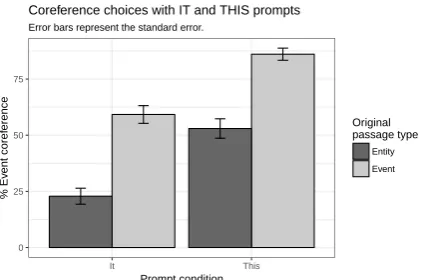
Figure 2: Study 2 results by prompt and original co-reference (collapsing over originalit/thispronoun type)
The results (see Figure2) follow those of Study 1 for the prompt manipulation: Event co-reference is higher withThisthanIt. Event co-reference fur-ther increases when the original passage contained event co-reference. The model (prompt type ×
original passage type×original passage pronoun) confirms a main effect of prompt type (β=2.529,
p<0.001) and a main effect of original passage
type (β=3.053, p<0.001), with no effect of
orig-inal pronoun or any significant interactions.
5 Discussion
The two studies show divergent co-reference dis-tributions for the personal pronoun It and the demonstrative This: a bias towards entity co-reference for It and a bias for event co-reference forThis. As far as we know, this pattern has been proposed (Dipper and Zinsmeister,2010), but not properly measured. Given the oft-assumed divi-sion of labor between these two pronouns, what is notable is their flexibility. Neither form was found to be used categorically in Study 1 or Study 2.
Interestingly, the study with the constructed
passages showed that verbs which permit an agent alternation as either an implicit or explicit argu-ment are more prone to trigger an event co-referent than an entity one. This finding is potentially use-ful as an additional feature for anaphoricity detec-tion or event mendetec-tion identificadetec-tion in co-reference resolution systems.
Furthermore, we saw a bias towards event co-reference for the corpus passages in Study 2 that were known to have yielded event co-reference in their original passages. This suggests that there are properties of the context sentence that may make salient an event over an entity. If there are event-favoring properties of the context sen-tence that human participants are sensitive to, it is a tractable task to build automatic classifiers that learn to recognize such properties. This supports the idea that the task of differentiating anaphoric and pleonastic instances ofIt(Evans,2001;Boyd et al., 2005; Bergsma and Yarowsky, 2011; Lee et al., 2016; Lo´aiciga et al., 2017) could poten-tially improve performance.
Although presumably (machine) learnable, the question of what exactly constitutes an event re-mains unanswered. A number of ambiguous ex-amples which were excluded from our analysis in-cluded entities that are close to their entailed event (e.g.,The bomb that the arsonists had planted ex-ploded violently) or that were very abstract (e.g.,
The greatest opportunity materialized unexpect-edly. It/This was almost like magic.).
6 Conclusions and Future Work
This paper reports an investigation on abstract anaphora. Specifically, two studies targeted the ambiguity that occurs when entity and event an-tecedents are available for the pronouns It and
This. A clear pattern emerged whereby It fa-vors entity co-reference andThisfavors event co-reference. This pattern is also affected by the num-ber of arguments that the main verb can take. Al-though further investigation is needed regarding the properties of events, their salience, and the gray area between events and entities, our results take a first step towards disentangling the behavior of less well-understood anaphoric relations.
Acknowledgments
Christian Hardmeier was supported by the Swedish Research Council under grant 2017-930,
References
Nicholas Asher. 1993. Reference to Abstract Objects in Discourse. Springer, Netherlands.
Dale J. Barr, Roger Levy, Christoph Scheepers, and Harry J. Tily. 2013. Random effects structure for confirmatory hypothesis testing: Keep it maximal.
Journal of memory and language, 68(3):255–278.
Douglas Bates, Martin M¨achler, Ben Bolker, and Steve Walker. 2015. Fitting linear mixed-effects mod-els using lme4. Journal of Statistical Software, 67(1):1–48.
Shane Bergsma and David Yarowsky. 2011. NADA: A robust system for non - referential pronoun detec-tion. In Iris Hendrickx, Sobha Lalitha Devi, Ant´onio Branco, and Ruslan Mitkov, editors,Anaphora Pro-cessing and Applications: 8th Discourse Anaphora and Anaphor Resolution Colloquium (DAARC), Lecture Notes in Artificial Intelligence, pages 12– 23. Springer, Faro, Portugal.
Ondˇrej Bojar, Rajen Chatterjee, Christian Federmann, Yvette Graham, Barry Haddow, Shujian Huang, Matthias Huck, Philipp Koehn, Qun Liu, Varvara Logacheva, Christof Monz, Matteo Negri, Matt Post, Raphael Rubino, Lucia Specia, and Marco Turchi. 2017. Findings of the 2017 conference on machine translation (wmt17). In Proceedings of the Second Conference on Machine Translation, Volume 2: Shared Task Papers, pages 169–214, Copenhagen, Denmark. Association for Computa-tional Linguistics.
Adriane Boyd, Whitney Gegg-Harrison, and Donna K. Byron. 2005. Identifying non-referential it: a machine learning approach incorporating linguisti-cally motivated patterns. In Proceedings of the ACL Workshop on Feature Engineering for Machine Learning in Natural Language Processing, pages 40–47, Ann Arbor, Michigan. Association for Com-putational Linguistics.
Sarah Brown-Schmidt, Donna K. Byron, and Michael K. Tanenhaus. 2005. Beyond salience: Interpretation of personal and demonstrative pronouns. Journal of Memory and Language, 53(2):292–313.
Derya C¸okal, Patrick Sturt, and Fernanda Ferreira. 2014. Deixis:ThisandThatin written narrative dis-course.Discourse Processes, 51(3):201–229. Stefanie Dipper and Heike Zinsmeister. 2010. Towards
a standard for annotating abstract anaphora. In Pro-ceedings of the LREC Workshop on Language Re-source and Language Technology Standards state of the art, emerging needs, and future developments, LREC10-W4, pages 54–59, Valleta, Malta. Euro-pean Language Resources Association (ELRA).
Miriam Eckert and Michael Strube. 2000. Dialogue acts, synchronising units and anaphora resolution.
Journal of Semantics, 17(1):51–89.
David Embick. 2004. Unaccusative syntax and verbal alternations. In Artemis Alexiadou, Elena Anag-nostopoulou, and Martin Everaert, editors,The Un-accusativity Puzzle: Explorations of the Syntax-Lexicon Interface, pages 137–158. Oxford Univer-sity Press, Oxford, New York.
Richard Evans. 2001. Applying machine learning to-ward an automatic classification of it. Literary and Linguistic Computing, 16(1):45–57.
Edward Gibson, Steve Piantadosi, and Kristina Fe-dorenko. 2011. Using mechanichal turk to obtain and analyze english acceptability judgments. Lan-guage and Linguistics Compass, 5(8):509–524. Barbara J. Grosz, Aravind K. Joshi, and Scott
Wein-stein. 1995. Centering: A framework for modelling the local coherence of discourse. Computational Linguistics, 21(2):203–225.
Liane Guillou. 2016.Incorporating Pronoun Function into Statistical Machine Translation. Ph.D. thesis, University of Edinburgh, Scotland, UK.
Liane Guillou, Christian Hardmeier, Aaron Smith, J¨org Tiedemann, and Bonnie Webber. 2014. ParCor 1.0: A parallel pronoun-coreference corpus to support statistical MT. InProceedings of the 9th Interna-tional Conference on Language Resources and Eval-uation, LREC 2014, pages 3191–3198, Reykjavik, Iceland. European Language Resources Association (ELRA).
Christian Hardmeier, J¨org Tiedemann, Preslav Nakov, Sara Stymne, and Yannick Versely. 2016. DiscoMT 2015 Shared Task on Pro-noun Translation. LINDAT/CLARIN digital library at Institute of Formal and Applied Linguistics, Charles University in Prague.
http://hdl.handle.net/11372/LRT-1611. Martin Haspelmath. 1993. More on the typology of
inchoative/causative verb alternations. In Bernard Comrie and Maria Polinsky, editors,Causatives and transitivity, pages 87–120. John Benjamins, Amster-dam.
Benjamin Heinzerling, Nafise Sadat Moosavi, and Michael Strube. 2017. Revisiting selectional pref-erences for coreference resolution. InProceedings of the 2017 Conference on Empirical Methods in Natural Language Processing, pages 1332–1339, Copenhagen, Denmark. Association for Computa-tional Linguistics.
Otto Jespersen. 1927. Modern English grammar on historical principles, Part III: Syntax (Second Vol-ume). Allen and Unwin, London.
Timothy Lee, Alex Lutz, and Jinho D. Choi. 2016. QA-It: classifying non-referential it for question answer pairs. InProceedings of the ACL 2016 Student Re-search Workshop, pages 132–137, Berlin, Germany. Association for Computational Linguistics.
Sharid Lo´aiciga, Liane Guillou, and Christian Hard-meier. 2017. What is it? disambiguating the dif-ferent readings of the pronoun “it”. In Proceed-ings of the 2017 Conference on Empirical Methods in Natural Language Processing, pages 1325–1331, Copenhagen, Denmark. Association for Computa-tional Linguistics.
Christoph M¨uller. 2007. ResolvingIt,This, andThat
in unrestricted multi-party dialog. In Proceedings of the 45th Annual Meeting of the Association for Computational Linguistics, ACL07, pages 816–823, Prague, Czech Republic. Association for Computa-tional Linguistics (ACL).
Robert Munro, Steven Bethard, Victor Kuperman, Vicky T. Lai, Robin Melnick, Christopher Potts, Tyler Schnoebelen, and Harry Tily. 2010. Crowd-sourcing and language studies: the new generation of linguistic data. In Proceedings of the NAACL HLT 2010 Workshop on Creating Speech and Lan-guage Data with Amazon’s Mechanical Turk, pages 122–130. Association for Computational Linguis-tics.
Anna Nedoluzhko and Ekaterina Lapshinova-Koltunski. 2016. Abstract coreference in a multilingual perspective: a view on czech and german. In Proceedings of the Workshop on Coreference Resolution Beyond OntoNotes, COR-BON 2016, pages 47–52, Ann Arbor, Michigan. Association for Computational Linguistics.
Rebecca J. Passonneau. 1989. Getting at discourse ref-erents. InProceedings of the 27th Annual Meeting of the Association for Computational Linguistics, pages 51–59, Vancouver, British Columbia, Canada. Association for Computational Linguistics.
Massimo Poesio. 2015. Linguistic and cognitive evi-dence about anaphora. In Massimo Poesio, Roland Stuckardt, and Yannick Versley, editors, Anaphora Resolution: Algorithms, Resources and Application, pages 23–54. Springer-Verlag, Berlin Heidelberg.
Sameer Pradhan, Alessandro Moschitti, Nianwen Xue, Hwee Tou Ng, Anders Bj¨orkelund, Olga Uryupina, Yuchen Zhang, and Zhi Zhong. 2013. Towards ro-bust linguistic analysis using OntoNotes. In Pro-ceedings of the Seventeenth Conference on Com-putational Natural Language Learning, pages 143– 152, Sofia, Bulgaria. Association for Computational Linguistics.
R Development Core Team. 2008. R: A Language and Environment for Statistical Computing. R Foun-dation for Statistical Computing, Vienna, Austria. ISBN 3-900051-07-0.
Florian Sch¨afer. 2009. The causative alternation. Lan-guage and Linguistics Compass, 3(2):641–681.
Yannick Versley and Anders Bj¨orkelund. 2015. Off-the-shelf tools. In Massimo Poesio, Roland Stuckardt, and Yannick Versley, editors, Anaphora Resolution: Algorithms, Resources and Applica-tions, pages 237–266. Springer-Verlag, Berlin Hei-delberg.
Bonnie Webber. 1986. Findings of the 2016 WMT shared task on cross-lingual pronoun prediction. In
Theoretical Issues in Natural Language Processing, TINLAP-3, pages 158–163, Las Cruces, New Mex-ico. Association for Computational Linguistics.