S Bandyopadhyay, D S Sharma and R Sangal. Proc. of the 14th Intl. Conference on Natural Language Processing, pages 513–522, Kolkata, India. December 2017. c2016 NLP Association of India (NLPAI)
Notion of Semantics in Computer Science
A Systematic Literature Review
Gollapudi VRJ Sai Prasad
Software Engineering Research Center IIIT-Hyderabad
Gachibowli, Telangana, India [email protected]
Venkatesh Choppella
Software Engineering Research Center IIIT-Hyderabad
Gachibowli, Telangana, India [email protected]
Abstract
In this paper we report on a Systematic Literature Review where we explored the notion of semantics in Computer Science (CSE) literature. Our goal was 1) to sur-face how the idea of semantics has been used and represented, and 2) to surface its publication pattern in CSE. Our automated search in 5 CSE repositories yielded 653 relevant papers, emerging from multiple disciplines and geographies, spanning a period from year 1967 to 2017. We short-listed 50 representative samples to study. This literature review was motivated by an external Web Accessibility effort in which we wanted to understand how to influ-ence the various meanings that a variety of human end-user could derive by varying the computer rendering of a given content. The results of the SLR indicate that 44% of papers do have their own definition, al-most all are formal in their presentation, and 94% of them have a notion of seman-tics that favors the computer as a proces-sor. We observe the limited human ori-ented focus on semantics in CSE, and sug-gest such semantics focus as an area of po-tential study.
1 Introduction
In the scenario of a human interacting with a com-puter, meaning is getting produced and processed. We are interested in impacting the notion of this
meaningthat is getting created in the human. Philosophers and Linguists have routinely used the term ”Semantics” to represent the notion of meaning. Now, this notion of semantics has been carried over to Computer Sciences where it has been applied in Natural Language
Process-ing, Programming Languages, Web, Software En-gineering etc.
Motivated by impacting human meaning and human sense-making, we are therefore transitively interested in the notion of semantics. However, even for a contained area like Computer Science (CSE), this term has not been unambiguously de-fined for similar and consistent use universally. Many disciplines within CSE have all made use of this notion of Semantics, but in their own way.
1.1 Goal of this Paper
The goal of this paper is to conduct a Systematic Literature Review on the notion of semantics in CSE. In particular we aim to study the use of this term in the CSE, at least in such disciplines as Pro-gramming Languages (PL), Software Engineering (SE), Compilers, Web and NLP. The overall goal being, 1) to surface how the term of semantics has been used and represented in these said dis-ciplines, and 2) to surface the publication pattern on this topic.
1.2 Background, Context & Motivation In human computer interaction, there is obviously 1) a human, 2) a computing system and 3) an gagement or interaction between the two. The en-gagement could either be passive (as in brows-ing or viewbrows-ing), or active, as in querybrows-ing or se-lecting something on the system. In such scenar-ios, humans are said to be deriving meaning from the representation presented by the computer. The modality for representation can be text, image, au-dio, video etc. More interactive representation(al experiences) can be animation, video, user inter-faces etc. In the case of interaction (as in inputting or programming by the human), the computing system is also processing data to derive meaning. Apparently, both the human and the system can be seen as two processing agents.
The notion of meaning and semantics can, therefore, be applied to either of the two agents. Our interest, however, is on the human formulat-ing meanformulat-ing. From an information delivery point-of-view, the idea of how meaning is extracted, constructed or possessed by the human is studied by Psychologists, Cognitive Scientists and Infor-mation Processing researchers. On this side, top-ics like Sense-making (Russell et al., 1993), User Experience, Semantic Interaction (Endert et al., 2012) etc. emerge.
As a compliment to the human sense making experience, on the computing side, we may also look at how something can be constructed to de-liver a particular meaning. Web Accessibility re-searchers, claim that currently web content is pri-marily designed for a majority in mind (Prasad et al., 2014). And that it may not suffice for the in-dividualized needs of a minority of users (Prasad, 2017).
A color blind person, for example, may not ben-efit in the same way as a non-body disabled user. So, in this regard, on the computing system side of the human computer interaction, does there ex-ist a platform that would enable the creation and simultaneous co-existence of multiple representa-tions for the varying needs of a diverse human end users? Is there sufficient motivation for a system that canrenarrate and simultaneously have mul-tiple representations of some source text (Prasad, 2017)? That is, a system equally being able to produce colorful content for the majority of users, high contrast and appropriately rendered visuals for the color blind, braille for the visually im-paired, in vernacular for the non-English speakers, in tables, diagrams and scientific explanations for the learned etc. These questions form the back-ground context and motivation for our study of se-mantics in CSE.
1.3 Semantics as ”Meaning”
Online dictionary1 describes Semantics as ”the
meaning, or an interpretation of the meaning, of a word, sign, sentence, etc.” From a linguistic point of view, it relates Semantics to ”the study of mean-ing”. Webster’s dictionary2 too shares a similar
explanation, and calls semantics as ”the study of meanings”.
From a human computer interaction point view,
1http://www.dictionary.com/browse/semantics?s=t 2https://www.merriam-webster.com/dictionary/semantics
the study of semantics can be related to the study of meaning for either the human or the computer. We are keen to uncover how semantics research in CSE has defined and explored this topic.
1.4 SLR - A Research Tool
As already stated, our larger goal is to understand how best to represent either information or data on the system so that it may create the right meaning to the human. To that end we wanted to conduct an exploratory Literature Review for such a social applicable, human oriented web application space. SLRs have been popularized as a Evidence Based Software Engineering (EBSE) research tool by Kitchenham et al. in a seminal paper (Kitchen-ham et al., 2004) presented at ICSE 2004, which is a prominent conference for Software Engineers. In particular SLRs have been suggested as a sys-tematic way of exploring a problem space and thus have been suggested as valuable first step in a PhD research effort (Kitchenham et al., 2004).
While SLRs have been popular in the fields of medical sciences, their use in CSE has been limited. However, we are now beginning to find SLRs in various areas of CSE. SLRs are now be-ing published in Information Systems (Okoli and Schabram, 2010), Software Engineering (Kitchen-ham et al., 2009), Programming Languages (Ma-jor et al., 2012), Web (Do˘gan et al., 2014), Model Driven Engineering (Santiago et al., 2012) etc.
2 Research Method
This SLR follows the guidelines given in (Keele and others, 2007) and is also informed by DARE3
criteria for SLR.
2.1 Research Questions
The research questions put forth for the documents surfaced by our search strategy (given in section 2.2) include:
RQ1: Was there a definition for semantics in the paper?
RQ2: Was the notion of semantics general, or did it have some sub categories? What where they?
RQ3: Is the notion of semantics oriented towards the human or the computer?
RQ4: What sort of precision did it have in its def-initions?
3Database of Abstracts of Reviews of Effects (DARE):
https://www.ncbi.nlm.nih.gov/pubmedhealth/about/DARE/
RQ5: Which research domain did the paper repre-sent within CSE?
RQ6: When was the research published?
2.2 Search Strategy
For the SLR we conducted an automated search, which included five of the most commonly used CSE bibliography repositories. See Table 1. Each of the databases were searched, in the stated or-der of priority, on the following aspects: 1) the queried records must be CSE papers, 2) they must have the word ”semantic” in their title, and 3) they must have the term ”definition of semantics” in their body of text. Table 1 lists the exact string and the restrictions that were used for our auto-mated search.
2.3 Paper Selection
Paper selection was based on a set of inclusion, exclusion and quality criteria. Theinclusion cri-teria required the document to fulfill the search string, be a peer reviewed primary study, and be an accessible document on the web. Papers with zero citations, papers that were essentially Patents, papers that were on non-CSE topics (like biol-ogy/genome) were excluded. Quality criteria consisted of only selecting papers that were con-sidered long publications (i.e. had to be more than 4 pages), had to be peer reviewed, and had to have some citations.
2.3.1 Selection Process
Once a paper fulfilled our inclusion, exclusion and quality criteria, it was entered into our initial cor-pus for individual selection. The initial corcor-pus was maintained as Bibtex files in Microsoft Ex-cel worksheet. We expected our initial corpus to be quite large, we planned on manually shortlist-ing it into a handlable size for evaluation. This shortlisting process was done on Excel by two out-side judges. Our aim was to reduce the initial cor-pus into a more practical size of 50 representa-tive samples. These set of shortlisted records were then to be fed into a document manager to surface the full length documents from the web. For PDF management we used Qiqqa tool9, and for Bibtex
management, we used JabRef tool. This set of 50 shortlisted records, complete with their full body content were then positioned on the Qiqqa tool for data collection.
9Desktop v.79s for Windows; source:http://www.
qiqqa.com/
The data that was used for filtering was Title, Keywords, publication meta-data (like the pub-lisher, journal name, issue details etc), and in some cases Abstracts as well.
2.4 Data Extraction
The intent of this phase is to ensure that we col-lect appropriate data from each earmarked paper to answer our earlier stated SLR research ques-tions. Here is the criteria that was used for each questions:
RQ1: We used the document management tools10 to search for various definitions found in
the papers. If there were any definitions on the topic related to semantics then we took it as aYES
count. Else, it was counted as aNO.
RQ2: We searched the surfaced papers to un-cover the various contexts11in which the word
se-mantic was used. If there were any repeatedly used
sub-conceptsof semantics then we recorded it. At the end we expected to have a bag of semantics re-lated concepts and ideas that would form the base for where the CSE research was headed.
RQ3: One key differentiation we wanted to make was to whom the semantics was being made relevant to. Was it the human(as a processor of rendered information), or was it the computer12
(as a processor of the input information)? We scanned papers to see how the definitions of se-mantics were oriented, and incremented the rele-vant ”H” or ”C” count as appropriate.
RQ4: Through this question we wanted to see if the papers presumed an earlier (elsewhere) de-fined notion, or if they took the trouble to define their own working definition. In some cases we expected to also have some loosely defined ter-minology. So, our measure was on the precision: Was the definition formal(with logic and mathe-matics)? Or, was itinformal- as in just by English text? Or (as in RQ1) was therenodefinition at all? This was checked and recorded.
RQ5,6: For the last two questions we collected meta data on the publications. Here we wanted to see where the research was emerging from. We wanted to understand whichdomains were active in this research and theyearof publication.
In addition to the above highlighted data, we
10which, in our case, was Qiqqa Desktop
11The word context is refers to the research narrative and
not the context of corpus within some research.
12We treated these two as mutually exclusive even though
they need not be.
Databases Search String Restrictions Hits ACM Digital Library4 acmdlTitle:(+semantics) AND
con-tent.ftsec:(+”definition of semantics”) 282
IEEE Xplore5 ((definition of semantics) AND ”Publication
Ti-tle”:semantics) 67
Science Direct6 TITLE(semantics) and (definition of seman-tics) AND LIMIT-TO(topics, ”theoretical com-puter,logic program,program,definition”).
Advanced Search/Expert Search tag; used no theoretical, no books filters 342
SpringerLink7 ”definition of semantics” ”definition of semantics” anywhere and ”semantics” in title; used Articles, Computer Science, English filters 61
Wiley Inter Science8 definition of semantics in All Fields AND
se-mantics in Publication Titles Advanced Search 33
[image:4.612.105.512.35.157.2]total 790
Table 1: The CSE bibliographic repositories that were used in the automated search.
also collected such publication related meta data as: Title, Keywords, Author names, Publication, Year, and in some cases, even the Abstract. We used Bibtex for the extraction of this information from the online bibliographies.
Essentially, through this data collection, we sought to surface how computer science research viewed semantics with respect to their own work, and to see how these ideas tallied with our idea of influencing meaning in the minds of an end user.
3 Results
Our initial automated search extracted 790 records, of which 5 records were malformed and irretrievable. In this initial corpus we were able to identify 21 repeat records, 87 with no ”seman-tics”, and 32 short papers. That is, overall 140 were eliminated from this initial corpus, resulting in 653 retrievable pruned set of records.
In studying the initial corpus we found that our collection was indeed quite diverse: For ex-ample, the publication dates ranged from 1967 to 2017. The locations of publications at least included USA, UK, Germany, Australia, South Africa, Netherlands, Switzerland and Canada. The covered disciplines included Theoretical CSE, Knowledge Engineering, Formal Methods, Pro-gramming Languages, Logic ProPro-gramming, Se-mantics, Web, Linguistics, Systems, Multimedia, Software Engineering, Artificial Intelligence etc. Even Biology/genome related publications were captured.
From this diverse sample set of 653 records, as per our selection process, we then needed to shortlist a smaller sample size of just 50 records. We used two external judges to help us identify 50 representative samples from the original list of 653. While the choice was somewhat arbitrary, it was still ensured that the reduced set too was
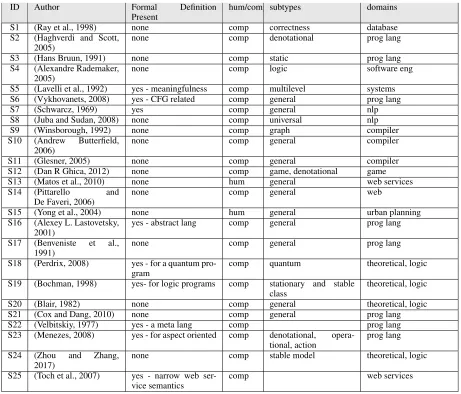
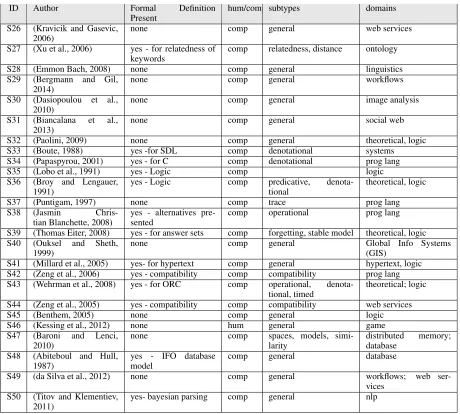
suf-ficiently diverse and indicative of the larger set of 653. Tables 2 and 3 provide a listing of these fi-nalized studies.
The earmarked 50 records were converted into a shortlisted bib file by use of the JabRef tool13.
The bib file was used by our document manager, Qiqqa, to import the full content. The files were imported from online document repositories given by Table 1. Finally, for subsequent steps involving data extraction, the same Qiqqa tool was then used to manage the 50 uploaded PDFs.
Here is a brief summary of what was uncovered through our data collection process:
3.1 RQ1: Definition
In the first RQ1 we wanted to understand how many, if any, actually even bothered to define the notion of semantics in their research. Our initial presumption was that while the idea of semantics and usage of the term was rampant, the definition was most likely ambiguous and perhaps not suffi-ciently formal.
The results of our SLR contradicted our as-sumptions. The data informed us that while 56% (that is, 28 out of 50) papers were indeed assum-ing a pre-existassum-ing notion and definition of seman-tics, there were also the other 44% that indeed con-tained definitions. That is, 22 of the 50 samples actually had expressed their notion of semantics.
Upon investigation we found that most of them were either having special applications or were defining niche terms related to semantics. For ex-ample, S514 for these references. defined the
no-tion of ”meaningfulness”, S6 had Context Free Grammar (CFG) related semantics, S16 had
defi-13Our JabRef tool was part of our TexStudio Latex
docu-ment editor, and was supported by Qiqqa.
14See Tables 2, 3 for listing of 50 sample studies we used
in our SLR. Due to the long length, it has been divided into two parts.
ID Author Formal Definition
Present hum/comp subtypes domains
S1 (Ray et al., 1998) none comp correctness database
S2 (Haghverdi and Scott,
2005) none comp denotational prog lang
S3 (Hans Bruun, 1991) none comp static prog lang
S4 (Alexandre Rademaker,
2005) none comp logic software eng
S5 (Lavelli et al., 1992) yes - meaningfulness comp multilevel systems S6 (Vykhovanets, 2008) yes - CFG related comp general prog lang
S7 (Schwarcz, 1969) yes comp general nlp
S8 (Juba and Sudan, 2008) none comp universal nlp
S9 (Winsborough, 1992) none comp graph compiler
S10 (Andrew Butterfield,
2006) none comp general compiler
S11 (Glesner, 2005) none comp general compiler
S12 (Dan R Ghica, 2012) none comp game, denotational game
S13 (Matos et al., 2010) none hum general web services
S14 (Pittarello and
De Faveri, 2006) none comp general web
S15 (Yong et al., 2004) none hum general urban planning
S16 (Alexey L. Lastovetsky,
2001) yes - abstract lang comp general prog lang
S17 (Benveniste et al.,
1991) none comp general prog lang
S18 (Perdrix, 2008) yes - for a quantum
pro-gram comp quantum theoretical, logic
S19 (Bochman, 1998) yes- for logic programs comp stationary and stable
class theoretical, logic
S20 (Blair, 1982) none comp general theoretical, logic
S21 (Cox and Dang, 2010) none comp general prog lang
S22 (Velbitskiy, 1977) yes - a meta lang comp prog lang
S23 (Menezes, 2008) yes - for aspect oriented comp denotational,
opera-tional, action prog lang S24 (Zhou and Zhang,
2017) none comp stable model theoretical, logic
S25 (Toch et al., 2007) yes - narrow web
[image:5.612.79.540.36.430.2]ser-vice semantics comp web services
Table 2: Listing of 50 sample studies we used in our SLR. Due to the long length, it has been divided into two parts. This represents the first part.
nitions to be used in an abstract language, S23 ap-plied semantics to Aspect Oriented Programming concepts etc. Again, the existence of such defini-tions confirmed to us that work with semantics is not as arbitrary as we had initially presumed.
3.2 RQ2: Subcategories
The intent here was to understand how generic was the application of semantics. Our results suggest that there are indeed many research works and dis-ciplines that discuss semantics at a very high level, but there are also those that sufficiently focused in on the sub topics within semantics.
In our collection, the subtopics that were ex-plored included: denotational semantic (S2), static semantic (S3), logic semantics (S4), multilevel mantics (S5), universal semantics (S8), graph mantics (S9), game semantics (S46), quantum
se-mantic (S18), stationary sese-mantic (S19), stable class (S19), operational semantics (S23), action semantics, stable model semantics (S24), trace se-mantics (S37) etc. Other notion of sese-mantics in-clude: semantic correctness (S1), semantic relat-edness (S27), semantic distance (S27), semantic forgetting, semantic compatibility (S42,44), timed semantics, semantic spaces, semantic models, se-mantic similarity etc.
ID Author Formal Definition
Present hum/comp subtypes domains
S26 (Kravicik and Gasevic,
2006) none comp general web services
S27 (Xu et al., 2006) yes - for relatedness of
keywords comp relatedness, distance ontology
S28 (Emmon Bach, 2008) none comp general linguistics
S29 (Bergmann and Gil,
2014) none comp general workflows
S30 (Dasiopoulou et al.,
2010) none comp general image analysis
S31 (Biancalana et al.,
2013) none comp general social web
S32 (Paolini, 2009) none comp general theoretical, logic
S33 (Boute, 1988) yes -for SDL comp denotational systems
S34 (Papaspyrou, 2001) yes - for C comp denotational prog lang
S35 (Lobo et al., 1991) yes - Logic comp logic
S36 (Broy and Lengauer,
1991) yes - Logic comp predicative,tional denota- theoretical, logic
S37 (Puntigam, 1997) none comp trace prog lang
S38 (Jasmin
Chris-tian Blanchette, 2008) yes - alternatives pre-sented comp operational prog lang S39 (Thomas Eiter, 2008) yes - for answer sets comp forgetting, stable model theoretical, logic S40 (Ouksel and Sheth,
1999) none comp general Global Info Systems(GIS)
S41 (Millard et al., 2005) yes- for hypertext comp general hypertext, logic S42 (Zeng et al., 2006) yes - compatibility comp compatibility prog lang S43 (Wehrman et al., 2008) yes - for ORC comp operational,
denota-tional, timed theoretical; logic S44 (Zeng et al., 2005) yes - compatibility comp compatibility web services
S45 (Benthem, 2005) none comp general logic
S46 (Kessing et al., 2012) none hum general game
S47 (Baroni and Lenci,
2010) none comp spaces, models, simi-larity distributeddatabase memory; S48 (Abiteboul and Hull,
1987) yes - IFO databasemodel comp general database
S49 (da Silva et al., 2012) none comp general workflows; web
ser-vices S50 (Titov and Klementiev,
[image:6.612.80.540.35.449.2]2011) yes- bayesian parsing comp general nlp
Table 3: Part two, or the remaining listing of 50 sample studies we used in our SLR.
agent.
Upon further investigation, these 3 were either using a specialized concept of semantics or were geared towards a social application. For example S15 had to use human understandable terms like Roof, Window, Gate, Shell, Wall etc to link the graphics to urban planning. S13 used a cell com-ponent ontology, and S46 focused on real world physics on game word entities.
This exposed a potential bias for us. It appears that in CSE, most of the ideas related to semantics have indeed been largely designed for computers, and not humans as the processing agent.
3.4 RQ4: Precision in Definition
In continuation of RQ1, we wanted to understand the level of definition precision one could expect out of these papers. For instance, if the papers
were formal in their content, then we could ex-pect to see formal term definitions for semantics as well.
Our results indicate that while 42 of the 50 were papers had lot of logic and formalisms in them, only 44% (or 22 papers) had definitions for (por-tions of) semantics. 5 were informal in their def-initions. And 3 assumed that semantics were de-fined elsewhere. So, we could see the pattern that most of the Logic Programming, Formal Methods and Theoretical CSE works perhaps already had a notion of semantics formally defined elsewhere that they could leverage in these documents. And that there very few documents discussing seman-tics from scratch.
Figure 1: Year-wise histogram of all 653 pub-lished papers.
need a more formal definition of semantics – a hu-man oriented sehu-mantics – in their publication.
3.5 RQ5: Computer Science Domains
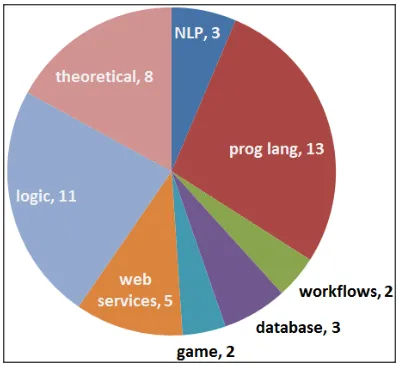
Our goal in RQ5 was to understand which sub ar-eas within Computer Science were actively dis-cussing semantics. Our results indicate that se-mantics was discussed in multiple sub-areas in-cluding: NLP with 3 papers, Programming Lan-guages with 13 papers, Workflows having 2, Databases having 3, Games having 2, Web Ser-vices having 5, Logic related papers having 11 and theoretical being 8. Of course, these topics were not mutually exclusive and did overlap. See Fig-ure 2 for a distribution of topics.
The conclusion, therefore, is that notion of se-mantics is not just restricted to one or two niche areas – like Linguistics, or Programming Lan-guages. There appear to be quite a few emerging areas where semantics – and that too human se-mantics – can be relevant. For example, mobile web and social web applications has a lot of scope for social and human related content.
3.6 RQ6: Publication History
In RQ6 we wanted to see how hot semantics re-search has been in the past. We wanted to look at the publication history to draw some context, and from that extrapolate the future outlook for this work.
[image:7.612.91.289.37.100.2]When we look at the overall corpus of 653 pa-pers, the publications on semantics started in 1967 and continued with just a few publications a year till early 80s. See Figure 1. In the decade of 90s there was a wave of publications for each year con-tributing to about 10-20 publications each. While 2001-5 was relatively low (with just less than 10 publications a year), the year starting 2005 saw a huge leap in publications: 2006-2011 saw 50-60 publications a year. Starting 2011 to date (2017) we again see a decline in number of papers fo-cused on this topic.
Figure 2: Sub-areas of CSE which published the 50 shortlisted papers.
It appears that semantics had its hayday in the second half of 2005. From 2007 to 20011, that is in the last decade, we could see over 222 publi-cations in this space. However, this number has reduced considerably. In the past five years we could only see 45 publications in this space.
One may interpret this reduction trend to mean that interest in semantics is now waning. However, we take a different stand. We suggest that what is reducing is not interest in semantics, but rather re-duction in publications with ”definitions of seman-tics” in them. This could mean two things for us: 1) There is considerable computer oriented, formal definition of semantics already out there that could be leveraged, and 2) there is an excellent opportu-nity ahead to further define more human oriented semantics for upcoming mobile and web applica-tions.
3.7 Threats to Validity
We recognize that our study sample is (n=)50 and only represents 8% of our excavated corpus of (n=)653. This sample size does indeed effect our results. In addition, we realize that we only fo-cused on papers that used the word ”semantic” in their title, or on those that had ”definition of se-mantics” in their body. This also reduces our input corpus.
tails, but it may only be marginally different infor-mation to the pattern of findings a smaller study could feasibly uncover.
4 Discussion & Insights
From our study we gather that semantics is not merely a study of meaning, but it is study of mean-ing for humans as well as computers (RQ3), both in natural language as well as in technical lan-guages, both in context (as in usage by a hu-man context) or in context-independent hu-manner (as with lexical analysis in linguistics).
In a computing situation, it appears that there are both 1) theoretical studies that explore the for-malism (RQ4), the logic – as in (S18-20,24,32,36 – and 2) application studies, that apply it to web (as in Semantic Web), or to Web Services (S13, 25-26,44), or to Work Flows (S29,49). The theo-retical studies tend to be formal and use significant logic (RQ4). Apparently they have contributed to design and development of robust programming languages (S2-3,6,16-17, 21-23,34, 37-38,42) and compilers (S9-11).
In the context of Programming Languages, there is Denotational (S2,12,23,33-35,43), Op-erational (S23,38,43) and Axiomatic Semantics. Also, the Denotational work was supported with Action Semantics (RQ2).
We also saw that there was application of game theory principles to semantics (S12,46), and, on the other side, application of semantics to graphs (S), images (S30), urban planning (S15), genome studies, databases (S47-48), ontologies (S13), se-mantic web (S14), web services (S13,25-6,49), Hypertext (S41) etc. Semantics seems to have been used to study similarity (S42-44), distance (S27), tuples, stability. It was applied to systems (S5) as well as for forgetting (S39).
We realize that while the generic term is some-what ambiguous, in CSE, the term is mostly re-lated to the computer as an processing agent model. Only when it comes to social (as in, bio-logical or urban studies) or web applications level (for example with Ontologies) we found a human interpretation to this term.
From a logic and formalism point of view, se-mantics has been receiving lot of research atten-tion. However, going forward, there seems to be scope to interpret semantics from the point of view of a human processor. Cognitive Linguistics, Psy-chology, Information Processing might be able to
address the emerging need to make processing as a tool to help the human manage and make sense of the information rendered for her.
5 Conclusions
We undertook the SLR study to systematically ex-plore the notion of semantics, as it is applied in CSE. We presumed that the term Semantic was ambiguously or variedly defined in different sub-areas of CSE research. What we discovered in-stead is that the notion of semantics is not ill fined. But, however, it seems to be narrowly de-fined. Working definitions and application spe-cific definitions seem to exist (S5-6,16,18-19,22-23,27,33-36,38-39,41-44,48-49). Moreover, we found that, in the human computer interaction re-lationship, most of the focus of the semantics is geared towards the computer being able to process the information(S34,50), to present the informa-tion (S41), to access the informainforma-tion (S1,47).
Human semantics (influenced by a computing system) has been, in our opinion, under empha-sized (S13,15,46). We see this as an opportunity to develop systems, content and architectures to focus on enhancing meaning for the human. No doubt, semantic models and analysis is needed for the back-end computing processor agent. How-ever, such models and analysis should also ac-count for and accommodate a better semantic or easier sense-making ability for the human end user as well. That exploration will be our future work.
References
Serge Abiteboul and Richard Hull. 1987. Ifo: A formal semantic database model. ACM Trans. Database Syst., 12(4):525565.
christiano Braga Alexandre Sztajnberg Alexan-dre Rademaker. 2005. A rewriting semantics for a software architecture description language.
Sergey S. Gaissaryan Alexey L. Lastovetsky. 2001. An algebraic approach to semantics of programming languages.
Jim Woodcock Andrew Butterfield. 2006. A hardware compiler semantics for handel-c.
Marco Baroni and Alessandro Lenci. 2010. Distri-butional memory: A general framework for corpus-based semantics. Comput. Linguist., 36(4):673721.
Johan Benthem. 2005. Guards, bounds, and gen-eralized semantics. J. of Logic, Lang. and Inf., 14(3):263279.
Albert Benveniste, Paul Le Guernic, and Christian Jacquemot. 1991. Synchronous programming with events and relations: the signal language and its semantics. Science of Computer Programming, 16(2):103 149.
Ralph Bergmann and Yolanda Gil. 2014. Similarity assessment and efficient retrieval of semantic work-flows.Inf. Syst., 40:115127.
Claudio Biancalana, Fabio Gasparetti, Alessandro Mi-carelli, and Giuseppe Sansonetti. 2013. Social se-mantic query expansion. ACM Trans. Intell. Syst. Technol., 4(4):60:160:43.
Howard A. Blair. 1982. The recursion-theoretic com-plexity of the semantics of predicate logic as a programming language. Information and Control, 54(12):25 47.
Alexander Bochman. 1998. A logical foundation for logic programming ii” semantics of general logic programs.
Ray Boute. 1988. Systems semantics: Principles, ap-plications, and implementation. ACM Trans. Pro-gram. Lang. Syst., 10(1):118155.
Manfred Broy and Christian Lengauer. 1991. On de-notational versus predicative semantics. Journal of Computer and System Sciences, 42(1):1 29.
Philip T. Cox and Anh Dang, 2010.Semantic Compar-ison of Structured Visual Dataflow Programs, page 11:111:9. VINCI 10. ACM.
Laryssa Machado da Silva, Regina Braga, and Fer-nanda Campos. 2012. Composer-science: A semantic service based framework for workflow composition in e-science projects. Inf. Sci., 186(1):186208.
Nikos Tzeyelekos Dan R Ghica. 2012. A system-level game semantics.
Stamatia Dasiopoulou, Ioannis Kompatsiaris, and Michael G. Strintzis. 2010. Investigating fuzzy dls-based reasoning in semantic image analysis. Multi-media Tools Appl., 49(1):167194.
Serdar Do˘gan, Aysu Betin-Can, and Vahid Garousi. 2014. Web application testing: A systematic lit-erature review. Journal of Systems and Software, 91:174–201.
Barbara H. Partee Emmon Bach, 2008. Anaphora and Semantic Structure, page 122152. Blackwell Pub-lishing Ltd.
Alex Endert, Patrick Fiaux, and Chris North. 2012. Semantic interaction for visual text analytics. In Proceedings of the SIGCHI Conference on Human Factors in Computing Systems, CHI ’12, pages 473– 482, New York, NY, USA. ACM.
Sabine Glesner. 2005. A proof calculus for natural semantics based on greatest fixed point semantics. Electronic Notes in Theoretical Computer Science, 132(1):73 93. Proceedings of the 3rd International Workshop on Compiler Optimization Meets Com-piler Verification (COCV 2004)ComCom-piler Optimiza-tion Meets Compiler VerificaOptimiza-tion 2004.
Esfandiar Haghverdi and Philip Scott. 2005. From geometry of interaction to denotational semantics. Electronic Notes in Theoretical Computer Science, 122:67 87. Proceedings of the 10th Conference on Category Theory in Computer Science (CTCS 2004)Category Theory in Computer Science 2004.
Bo Stig Hansen Flemming Damm Hans Bruun. 1991. An approach to the static semantics of vdm-sl.
Olaf Owe Jasmin Christian Blanchette. 2008. An open system operational semantics for an object-oriented and component-based language.
Brendan Juba and Madhu Sudan, 2008. Universal Se-mantic Communication I, page 123132. STOC 08. ACM.
Staffs Keele et al. 2007. Guidelines for performing systematic literature reviews in software engineer-ing. In Technical report, Ver. 2.3 EBSE Technical Report. EBSE. sn.
Jassin Kessing, Tim Tutenel, and Rafael Bidarra, 2012. Designing Semantic Game Worlds, page 2:12:9. PCG12. ACM.
Barbara A Kitchenham, Tore Dyba, and Magne Jor-gensen. 2004. Evidence-based software engineer-ing. InProceedings of the 26th international confer-ence on software engineering, pages 273–281. IEEE Computer Society.
Barbara Kitchenham, O Pearl Brereton, David Budgen, Mark Turner, John Bailey, and Stephen Linkman. 2009. Systematic literature reviews in software engineering–a systematic literature review. Infor-mation and software technology, 51(1):7–15.
Milos Kravicik and Dragan Gasevic, 2006. Adaptive Hypermedia for the Semantic Web, page 310. APS 06. ACM.
Alberto Lavelli, Bernardo Magnini, and Carlo Strappa-rava, 1992.An Approach to Multilevel Semantics for Applied Systems, page 1724. ANLC 92. Association for Computational Linguistics.
Jorge Lobo, Arcot Rajasekar, and Jack Minker. 1991. Semantics of horn and disjunctive logic programs. Theoretical Computer Science, 86(1):93 106.
Louis Major, Theocharis Kyriacou, and O Pearl Brere-ton. 2012. Systematic literature review: teaching novices programming using robots. IET software, 6(6):502–513.
Ely Edison Matos, Fernanda Campos, Regina Braga, and Daniele Palazzi. 2010. Celows: An ontology based framework for the provision of semantic web services related to biological models.J. of Biomedi-cal Informatics, 43(1):125–136, feb.
Luis Menezes. 2008. Aspect-oriented action seman-tics descriptions.
David E. Millard, Nicholas M. Gibbins, Danius T. Michaelides, and Mark J. Weal, 2005. Mind the Se-mantic Gap, page 5462. HYPERTEXT 05. ACM.
Chitu Okoli and Kira Schabram. 2010. A guide to con-ducting a systematic literature review of information systems research.
A. M. Ouksel and A. Sheth. 1999. Semantic interop-erability in global information systems. SIGMOD Rec., 28(1):512.
Luca Paolini. 2009. Logical semantics for stability.
Nikolaos S. Papaspyrou. 2001. Denotational seman-tics of ansi c. Computer Standards & Interfaces, 23(3):169 185.
Simon Perdrix. 2008. A hierarchy of quantum seman-tics.
Fabio Pittarello and Alessandro De Faveri. 2006. Se-mantic description of 3d environments: A proposal based on web standards. In Proceedings of the Eleventh International Conference on 3D Web Tech-nology, Web3D ’06, pages 85–95, New York, NY, USA. ACM.
Gollapudi Vrj Sai Prasad, TB Dinesh, and Venkatesh Choppella. 2014. Overcoming the new accessibility challenges using the sweet framework. In Proceed-ings of the 11th Web for All Conference, page 22. ACM.
Gollapudi VRJ Prasad. 2017. Renarrating web con-tent to increase web accessibility. In Proceedings of the 10th International Conference on Theory and Practice of Electronic Governance, pages 598–601. ACM.
Franz Puntigam. 1997. Types for active objects based on trace semantics.
Indrakshi Ray, Paul Ammann, and Sushil Jajodia. 1998. A semantic-based transaction processing model for multilevel transactions1.Journal of Com-puter Security, 6(3):181–217.
Daniel M. Russell, Mark J. Stefik, Peter Pirolli, and Stuart K. Card. 1993. The cost structure of sense-making. InProceedings of the INTERACT ’93 and CHI ’93 Conference on Human Factors in Comput-ing Systems, CHI ’93, pages 269–276, New York, NY, USA. ACM.
Iv´an Santiago, Alvaro Jim´enez, Juan Manuel Vara, Va-leria De Castro, Ver´onica A Bollati, and Esperanza Marcos. 2012. Model-driven engineering as a new landscape for traceability management: A system-atic literature review. Information and Software Technology, 54(12):1340–1356.
Robert M. Schwarcz, 1969. Towards a Computational Formalization of Natural Language Semantics, page 153. COLING 69. Association for Computational Linguistics.
Kewen Wang Thomas Eiter. 2008. Semantic forgetting in answer set programming.
Ivan Titov and Alexandre Klementiev. 2011. A bayesian model for unsupervised semantic parsing. In Proceedings of the 49th Annual Meeting of the Association for Computational Linguistics: Human Language Technologies - Volume 1, HLT ’11, pages 1445–1455, Stroudsburg, PA, USA. Association for Computational Linguistics.
Eran Toch, Avigdor Gal, Iris Reinhartz-Berger, and Dov Dori. 2007. A semantic approach to approx-imate service retrieval. ACM Trans. Internet Tech-nol., 8(1).
I. V. Velbitskiy. 1977. Metalanguage for formal defini-tion of semantics of programming languages. V. S. Vykhovanets. 2008. Description of the
seman-tics of context-free languages by the mathematical induction method. 42(4).
Ian Wehrman, David Kitchin, William R. Cook, and Jayadev Misra. 2008. A timed semantics of orc. Theoretical Computer Science, 402(23):234 248. Trustworthy Global Computing.
Will Winsborough. 1992. Multiple specialization us-ing minimal-function graph semantics. The Journal of Logic Programming, 13(23):259 290.
Jianbo Xu, Zhonglin Xu, and Jiaxun Chen, 2006. Se-mantic Retrieval System Based on Ontology, page 124129. ISP06. World Scientific and Engineering Academy and Society (WSEAS).
Liu Yong, XU Congfu, Pan Zhigeng, and Pan Yunhe. 2004. Semantic modeling project: Building vernac-ular house of southeast china. InProceedings of the 2004 ACM SIGGRAPH International Conference on Virtual Reality Continuum and Its Applications in Industry, VRCAI ’04, pages 412–418, New York, NY, USA. ACM.
Liangzhao Zeng, Hui Lei, and Badrish Chandramouli, 2005. Semantic Tuplespace, page 366381. IC-SOC05. Springer-Verlag.
Liangzhao Zeng, Boualem Benatallah, Guo Tong Xie, and Hui Lei, 2006. Semantic Service Mediation, page 490495. ICSOC06. Springer-Verlag.
Yi Zhou and Yan Zhang. 2017. A progression seman-tics for first-order logic programs. Artificial Intelli-gence, 250:58 79.