A Review on Cloud Computing
Simranjeet Kaur
M.Tech Scholar
Amritsar College of Engineering & Technology,
Amritsar, India
Tejinder Sharma
Associate Professor
Amritsar College of Engineering & Technology
Amritsar, India
ABSTRACT
In the expanse of few years, Cloud Computing has experienced phenomenal growth. On the demand or on pay per use of assets like: network, storage, and server these all prerequisite are provided by cloud computing through internet is called cloud computing. Whilst cloud computing is mollifying the Information Technology industry, the evolution and exploration in this realm is yet to be passable. My beneficiation in this paperwork is an proceeded contemplates pivoting on cloud computing notion and most approaching matter. This paperwork proffer a superior ken of the cloud computing and recognizing predominant research affair in this boom of computer science arena. Section .1 contains the introduction, in section 2 provide an overview of cloud computing, Section 3 contains complications in cloud manifesto and Section 4 and 5 will focus on load equalizing algorithms. In section 6 and 7 used existing load techniques further on with comparison section 8. Consist of Comparison graph Whereas in section 9and 10. persuaded with gap in literature along with conclusion..
Keywords
Cloud computing, Algorithms, Load Balancing
1.
INTRODUCTION
Cloud computing is an architecture that paramount server recommendation on a expansible stage so as to provide on encroachment of computing merits and services. Due to the peculiar achievement of internet around couple of years aback , computing reserves is now more, far and wide available . The concept of awareness of a current summation it entitles as cloud computing. Cloud Computing climate requires the time- honored service providers to have in multilateral ways. These are infra-structure and service providers. Infrastructure contributor charter deep pockets according to consumption and manages cloud platforms whereas Service providers charge resources from infrastructure providers to fulfill the end user. Cloud infrastructure had beckon the colossus companies like Google, Microsoft, and Amazon and have surveyed with a notable impact in now a days information Technology field. Computing abstraction of various attributes is enticed to trade possessors. These are as follows:-Lower initial speculation, Easier to manage, Scalability, Deploy swiftly, Location individualistic, Reliability, Security, Device individualistic [11].
Although cloud computing has shown us significant opportunities to the industry nowadays, but still there are various challenges that requires to be cautiously inscribed. In my paper, I would site a view of cloud computing. My aim is to provide a superior perception of cloud computing and
anchor on the existent scrutiny in flourishing arena of computer science.
2.
CLOUD COMPUTTING OVERVIEW
Cloud computing is an agenda of gripping the internet to devour software or other IT services on demand. Users allocate software processing potential, storage expanse, bandwidth and memory bank. With cloud computing the cost is reposed and so are the amenities. Users can restore as they advances and only use what they require at any hour, retaining value to the user down. Contributor of cloud reckoning results, whether they are hardware, software, platform, or storage mainstays, deliver their offerings over the internet. Cloud donors typically charge monthly recurring payment based on your utilization [11].
2.1
Cloud Computing Models
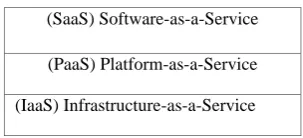
[image:1.595.352.504.491.560.2]The blue print of the software packages and application that uses internet approach on demand service is the Cloud simplistic design. Cloud architecture are essential on infrastructure that is used only when it is vital resources on demand and achieve a particular job, then renounce the unneeded resources and then discard them after the job is done. The cloud service model is shown below.
Table 1: Cloud Service Models
(SaaS) Software-as-a-Service
(PaaS) Platform-as-a-Service
(IaaS) Infrastructure-as-a-Service
2.1.1
Software-as-a-Service
SaaS is a multi-occupant platform using ordinary resources along with a obscure case of the two entity cipher of an request weight reduction and the latent database to allow for multiple consumers simultaneously. The central users of SaaS are Sales Force, Oracle, IBM, and Microsoft.
2.1.2
Platform-as-a-Service
PaaS provides developers with declaration incorporating every one of the frameworks and contexts composing the end-to-end existence cycle of advancing, positioning, testing and sorting of melding network plea. Microsoft Azure is an example of PaaS.
2.1.3
Infrastructure-as-a-Service
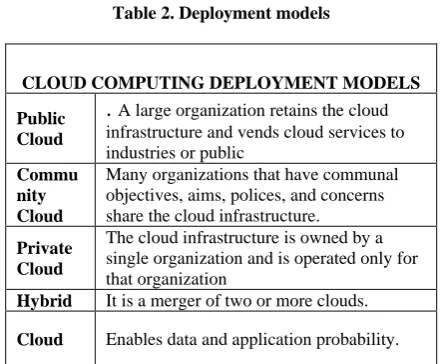
Table 2. Deployment models
CLOUD COMPUTING DEPLOYMENT MODELS
Public Cloud
.
A large organization retains the cloud infrastructure and vends cloud services to industries or publicCommu nity Cloud
Many organizations that have communal objectives, aims, polices, and concerns share the cloud infrastructure. Private
Cloud
The cloud infrastructure is owned by a single organization and is operated only for that organization
Hybrid It is a merger of two or more clouds.
Cloud Enables data and application probability.
3.
ISSUES IN CLOUD PLATFORM
The list of affairs in cloud computing incorporates Load balancing, certainty, consistency, possession, statistics assistance, statistics transference, multiplatform support, and intellectual property. Current issues concerned are as follows:-
3.1
Load Balancing
This is usually automate way to enact failover–the continuity of a service when there is failure of one or additional of its parts. Energy conservation and resource consumption don’t seem to be repeatedly attentive once considering cloud computing; but with accurate load leveling in place of resource consumption is frequently unbroken to a minimum.
3.2
Certainty
Preeminent extremity of cloud services provider will employ data storage and transferal encryption, user authentication and authorization. Many people worry about the risk of remote data to such criminals as hackers, thieves and aggrieved employees.
3.3
Consistency
Some people worry about whether a cloud service provider is financially stable and trustworthy. Most providers attempt to appease this concern by using redundant storage techniques, but still the service could crash or go out of business, leaving users with limited or no ingress of data.
3.4
Data Assistance
Cloud providers employ inessential servers and practice data backup processes, but some people agonize about being able to control their own backups. Many providers are now contributing data dumps onto media.
3.5
Possession
Once the data has been given rank, people worry that they could lose some or all of their rights or be unable to protect the virtueness of their customers.
3.6
Data Transference and Conversion
Some people are apprehensive that, should they desire to shift donor, they may have trouble relocating data. Porting and converting data is extremely dependent on the behavior of the
cloud provider data recoup format, especially in cases where the design cannot be definitely recognized[7].
3.7
Multiplatform Support
Further a drawback for IT departments utilizing administered services is how the cloud based service amalgamates across various platforms and operating systems, e.g. OS X, Windows, Linux and thin clients.
3.8
Intellectual Property
A firm originate something new and it utilizes cloud services as chunk of the innovation.. Is the contrivance still patentable? Does the cloud contributor have any assert on the creation? Can they supply same services to contender? [7]
4.
LOAD BALANCING IN CLOUD
COMPUTING
Load balancing is a method for reallocating whole workload to separate nodes for a variety of systems, in order to make the time more efficient and deploy the resources in efficient manner. For scaling out server framework, Load balancing is the primary technique. As request demand expands, contemporary servers can be appended to the resource pool, where the load balancer will straightway start sending traffic to the new server[17]. An activity of reallocating an integral load to each nodes of the unified system with better retort phase of the position, synchronously abolishing a state in which few of the junctions are hampered while some others are under loaded this make resource utilization effective. The crucial artifact to deal with while developing algorithm are : estimation of load, stability of different system, interaction between the nodes, analogy of load, performance of system, nature of work to be transferred, selecting of nodes,etc. The cost, pliability, scalability and availability to the end– users is the principal interest of utilizing cloud computing Load balancing heads towards expanding requests by dynamic effort issuance to any or all nodes as a crucial cover.[25] This load can be expressed in terms of quantity of memory used, CPU load, delay or Network load[4]. The balancing is scheduling class which is either stable or vigorous scenario concerned with computing. The cleavage of the traffic is uniformly send to the servers by unchanged algorithm. These algorithms need foregoing awareness of structured amenity so that resolution do not gets dependant upon the contemporary state. The vital algorithms takes resolution based upon factual ongoing structures condition and authorized to proceed from inhibit mechanism to underutilized mechanism in factual phase. Varied load balancing algorithm emphasis mostly on consistent supply with allocated computing task and curtailing relay value of dispensing computing nodes. To recognize that cloud computing drops under dynamic abode in order to focus on dynamic load balancing algorithms. This algorithm can be categorized into two kinds. The one is called batch mode scheduling, i.e. after gathering arrival of tasks they are allocated to suitable amenity further-more another is named as immediate mode scheduling which propose the task and are allotted to resources forthwith found on minimum completion time and minimum execution time. A perfect scheduling algorithm should effect the succeeding attributes: Minimum waiting time, Minimum response time, Maximum throughput, Maximum CPU utilization [24]. There are two varieties of algorithm in load balancing:-static and dynamic algorithm.
4.1
Static Approach
among all the users. This algorithm needs a foregoing knowledge of perspective resources, so that they no longer depend upon the existing state of system for the conclusion of shifting of the load.
4.2
Dynamic Approach
The dynamic approach considers only the current condition of the system during load balancing decision [25].
5.
LOAD BALANCING ALGORITHMS
In Cloud computing there are number of algorithms of load balancing which achieve high throughput, high resource usage and better efficiency.
5.1
Static Algorithms
5.1.1
Task Scheduling
This algorithm can be either static or dynamic. It is a practice by which the task enumerated is allotted to the resources that completes the work by some resources. All scheduling actions are transferred out by this scheduler.The notion of task scheduler makes feasible to have multitasking computer with a sole CPU, an inner component of the execution model of a system, and an computation is a fundamental to scheduling. [24].
5.1.2
Opportunistic Algorithm
This is one of the static algorithms, which do not contemplate the accessible VM’s burden. It usually keeps each and every node active. It provides a load balancing schedule but does not produce a better result. The tasks are processed in a moderate manner, where the recent execution time of the node is not measured [17].
5.1.3
Min-Min algorithm
It is a static scheduling algorithm. Min-Min algorithm starts with a group of un-scheduling jobs. In this algorithm the jobs having minimum execution time, initially identifies and these jobs are scheduled foremost in this algorithm. Problem of this algorithm is that it chooses small tasks to be finished firstly, which in turn lengthy task delays for very prolong time[26].
5.1.4
Max-Min Load Balancing Algorithm
It is a static scheduling algorithm. In Max-Min every unscheduled job is computed by its completion time. The job is determined with utmost completion time. The server which provides minimal resolution time job is nominated to that server only. This procedure repeatedly continues for the following unscheduled job where organised time of all the servers is upgraded appropriately .[11]
5.1.5
Round Robin Algorithm
This algorithm comes under a static load balancing. Master junction issues jobs evenly to all slave processors. All jobs are allocated to a processor and is executed in a series and will be reared to the first processor if the last processor has been reached. The advantage of this algorithm is that it does not cause overhead in the system because it does not require inter process communication [28]
5.1.6
Central Manager Algorithm
This is a static load balancing algorithm. In this particular algorithm, a central processor determines the host for current process. All the minimally jam-packed processor unanticipated upon the complete heap is undoubtedly chosen whenever course of action is done. Load manager selects absolutely new processes so that the processor confirms to make sure you matching place is though possible. From that
knowledge relating to the product stress condition, core stress broker makes all the stress evaluating judgment. This information is new by simply remote processors, which often transmit a communication each time and energy to the load manager for changes. This information will be able to rely on primed in parent's operation of realization it has the children's operation, conclude in analog execution.[9]
5.2
Dynamic Algorithms
5.2.1
Ant Colony Optimization Based Load
Balancing Algorithm
It is a dynamic algorithm designed to pursue out the optimal path among the food and colony of ant, according to its actions. Each ant is unique and is naïve insect. With great constancy and uniformity ants administer a variety of complicated tasks. Conditionally when travelling from food to nest or vice versa ants spill pheromone trails and these trails are tracked with a fidelity between distinct variables which is a purpose of series of power.[5].
5.2.2
Honeybee Foraging Algorithm
This algorithm comes under dynamic load balancing. Where they are outlined and are based on the conduct of honey bees. Honey bees have been categorized into two types: - finders and reapers. The finder honeybee assists in locating the honey source. Once honey source is found, they do the jiggle dance to specify the quality and quantity of accessible honey. After that, the reapers assemble the honey from the source [17].
5.2.3
Equally Spread Current Execution
This is an algorithm of dynamic load balancing, which holds the technique with prioritization It selects the requirements by inspecting the scale of the method. This closely escalate existing execution algorithm distribute the load randomly by examining the expanse of the system after then relocating load to a VM (Virtual Machine). This algorithm load balancer broadens the load on to different nodes, so it is familiar to spread spectrum methodology [26].
5.2.4
Throttled Load Balancer (TLB)
The throttled load balancer (TVLB) is categorized dynamic load balancing algorithm. It safeguards an index table of Virtual Machines additionally their conditions (Busy/Available) of Virtual Machines. All machines are approachable in the inception. The data center controller (DCC) undergoes a firm supplication from client/server to perceive a worthy virtual mechanism to demeanor the endorsed situation. The statistics hub explodes the load balancer for the upcoming proportion of VM. The load balancer substantiates the allotment bench from pinnacle until the initial accessible VM is developed or the table is checked completely [12].
5.2.5
Game Theory Algorithm
5.2.6
Genetic Load Balancing Algorithm
This is categorized under dynamic load balancing environment. Soft computing approach is used. It is exploratory from the natural development. As compared to FCFS and RR algorithms it yields superior rendition. The interest of this algorithm is easily administered as a broad forage leeway, appropriate to compound impartial task and may evade being russed into community optimal panacea [25].
5.2.7
Central Queue Algorithm
It is a dynamic algorithm. It works out for the process with forceful distribution. This sites innovative exercises and unfulfilled requests in the form of cyclic FIFO queue for the most important host. Each new actions coming with the queue administrator is appended within the queue. Then simply, every time request for an activity is usually obtained by simply the queue administrator, the following erases the initial actions on queue and then redirects the following in the requester. If perhaps none are organised actions with any queue up, the appeal is normally buffered, unless an innovative action is normally available. If perhaps an innovative action gets there on the queue manager while there are un answered needs during the queue up, the primary appeal is normally taken off and new action is allocated. [9]
5.2.8
Local Queue Algorithm
This algorithm is dynamic in nature. This Available notion of the local queue formula is the steady allocation of all current processes with action migration is initiated simply by a host when its load is categorized less than verge extremity, a good user-defined parameter of the algorithm. The actual parametric quantity specifies that negligence variety of prepared tasks, it weight the load manager effort to present concerning just about every processor. [14]
6.
EXISTING LOAD BALANCING
TECHNIQUES IN CLOUDS
Pursuing load stabilizing approaches are contemporarily prevalent around clouds.
6.1
Decentralized Content Aware
Mehta et al. [13] suggested a fresh written content by careful by load stabilizing scheme, named simply work-load and also prospect careful scheme (WCAP). It utilizes a parameter namely USP to be able to indicate any distinct and noteworthy belonging of the requests including working out nodes. USP help any scheduler decide on the perfect node meant for processing any requests. This strategy is accomplished during a decentralized way through cheap overhead.By means of together with the material facts to narrow down all the browse, it again changes all the seeking operation over-all operation involving all the system.
6.2
CARTON
R. Stanojevic et al. [13] suggested a technique CARTON pertaining to swarm control the fact that unifies using LB as well as DRL. LB (Load Balancing) is used in order to likewise send these projects to different computers in order that the linked charges could be decreased in addition to DRL (Distributed Rate Limiting) is pre-owned to make certain that these resources will be given away during a method to maintain a good power source allocation.
6.3
Compare and Balance
Y. Zhao et al. [13] attended to the trouble about intra-cloud weight handling involving physical features through adaptive live migration about electronic machines.
7.
COMAPRSION OF DIFFERENT
LOAD BALANCING TECHNIQUES IN
VIEW OF VARIOUS AUTHORS
ref no
Author
Year
Technique
Features
Limitations
[1]
Bhathiya Wickremasinghe2010 Visualize Modeling
with increment in response time the cloud configuration decreases.
[2]
Jinhua Hu 2010 Genetic algorithms increase of computingcost of virtualization software and some unpredicted load wastage there is increase of VM
monitoring and analyzing mechanism is not taken
[4]
Ram Prasad Padhy2011 Divisible load scheduling theorm
resource utilization and job response time
other approaches are not taken into consideration
[5]
Ratan Mishra 2012 Ant colony optimization, Swarm intelligenceto minimize the make span of the cloud computing based services and portability of servicing the request
fault tolerance issues is not taken into account
ratio, the CPU utilization ratio, the network bandwidth,
strategies are not taken
[7]
Suriya Begum 2013 VectorDot, Server-based LB for Internet distributed servicesresponse time and processing time is fairly less
reducing energy consumption and carbon emission to an extent which will help to achieve Green computing is not considered .
[8]
Yongqiang Gao 2013 Multi objectiveoptimization Ant colony optimization
(MGGA and VMPACS) and then comparing these with algorithms wrt power consumption and resource wastage with correlation coefficient it is observed that in power consumption both algorithms remains constant but and with increase in resource mgt the correlation coefficient decreases.
[13]
Rafiqul Z. Khan 2014 diffusion algorithm Worst case and optimaloverheads becomes fairly less
Response time is not considered
[14]
Suneeta Mohanty 2014 point queuing
used to reduce the waiting time by increasing number of servers.
CPU utilization is not taken into action.
[15]
Aarti Singh 2015 Autonomous AgentBased Load Balancing Algorithm (A2LB)
Data centre, CPU Utilization, Wait time
Here , the Overhead problem is ignored.
[16]
Akanksha Tripathi 2015 IntelligenceWater Drop model, Ant colony optimization,
Minimize the makespan of given set of tasks.
Consideration of Fault Tolerence is ignored.
[18]
Geethu Gopinath P P2015 Min-Min and Max-Min algorithm.
increase the number of tasks the makespan also gets increased .
Fault tolerance is ignored
[19]
Prabjot kaur 2015 Virtualizationtechnology
resource utilization gets increased
The problem of servers and deadlocks is not considered
[21]
Abhishek Kumar Tiwari2016 Swarn Intelligence efficiency of throughput.
Resource utilization remains uncovered
[22]
Gagandeep Kaur 2016 ACCLBant colony and complex load balancing
Reduce energy consumption
Overload on resources is avoided
[23]
Palak Shrivastava 2016 Ant colonyoptimization
Highly efficient More traffic and time utilization
[25]
R. Rajeshkannan 2016 Various loadbalancing algorithms used
maximizes throughput, minimizes response time
8.
COMPARISON GRAPH
9.
GAP IN LITERATURE
Various techniques have been used along with various algorithms. Proceeding with a literature gap, after reviewing various papers of multiple authors implementation of load balancer algorithm on the optimized priority function by analyzing the parameters on transfer cost, data centre service time and throughput is somewhere lagging or not taken for analysis. A future scope can be focused onto the given priority function with the above specified parameters.
10.
CONCLUSION
Computing proffers an actions atop of the lattice. In cloud computing the salient complication is load balancing. Load balancing in cloud is the process of distributing the work load among various nodes in a distributed system.. Load balancing ensures that all the processor in the system or every node in the network does approximately perform the equal amount of work at any instant of time. It is a process of assigning the total load to the individual nodes of the collective system to make resource utilization effective and to improve the response time of the job, simultaneously removing a condition in which some of the nodes are over loaded while some others are under loaded. . In this paper examination and variations of different algorithms of load balancing are compared. It is concluded that no resource wastage could only be possible if selection of better machine is taken into,with the decrement in the parameters. Further leading to cost effective results.
11.
REFERENCES
[1] B. Wickremasinghe, R. N. Calheiros, and R. Buyya, "CloudAnalyst: A CloudSim-Based Visual Modeller for Analysing Cloud Computing Environments and Applications," 2010,pp. 446-452.
[2] Jinhua Hu and jianhua Gu “A Scheduling Strategy on Load Balancing of Virtual Machine Resources in Cloud Computing Environment “3rd International Symposium on Parallel Architectures, Algorithms and Programming 2010
[3] Shu-Ching Wag, Kuo-Qin Ya *(Corresponding author), Wen-Pin Liao and Shun-Sheng Wang” Towards a Load Balancing in a Three-level Cloud Computing Network” ©2010 IEEE
[4] Ram Prasad Padhy andP Goutam Prasad Rao “LOAD BALANCING IN CLOUD COMPUTING SYSTEMS” Department of Computer Science and Engineering
National Institute of Technology, Rourkela Rourkela-769 008, Orissa, India May, 2011.
[5] R. Mishra, "Ant colony Optimization: A Solution of Load balancing in Cloud," Int. J. Web Semantic Techno!., vol. 3, no. 2, pp. 33-50, Apr. 2012.
[6] G. Xu, J. Pang, and X. Fu, "A load balancing model based on cloud partitioning for the public cloud," Tsinghua Sei. Technoi., vol. 18,no. 1,pp. 34-39,2013. [7] Suriya Begum and Dr. Prashanth C.S.R “Review of Load
Balancing in Cloud Computing” IJCSI International Journal of Computer Science Issues, Vol. 10, Issue 1, No 2, January 2013
[8] Y. Gao,H. Guan,Z. Qi,Y. Hou, and L. Liu, "A multi-objective ant colony system algorithm for virtual machine placement in cloud computing," J. Comput. Syst. Sei., vol. 79,no. 8,pp. 1230-1242,Dec. 2013. [9] Asitha Micheal and Jalpa Mehta “Load Balancing
Techniques in Cloud Computing” International Journal on Recent and Innovation Trends in Computing and Communication
Vol. 2 Issue: 10, pp.3038 – 3044, October 2014
[10]Rajeshwari, B. S., and M. Dakshayini. "Comprehensive Study on Load Balancing Techniques in Cloud."
Compusoft 3, no. 6 (2014).
[11]Gajendar pal , Kuldeep kumar and Munish kumar “A review paper on cloud computing”(IJRASET) . vol 2 Issue IX, September 2014
[12]Harvinder singh and Rakesh Chandra Gangwar “Comparative Study of Load Balancing Algorithms in Cloud Environment” IJRITCC | October 2014
[13]Rafiqul Z. Khan and Md F. Ali “An Efficient Diffusion Load Balancing Algorithm in Distributed System” I.J. Information Technology and Computer Science, 2014, 08, 65-71 Published Online July 2014 in MECS. [14]Suneeta Mohanty, Prasant Kumar Pattnaik and Ganga
Bishnu Mund” A Comparative Approach to Reduce the Waiting Time Using Queuing Theory in Cloud Computing Environment” International Journal of Information and Computation Technology. ISSN 0974-2239 Volume 4, Number 5 (2014)
[15]Aarti Singha, Dimple Junejab, Manisha Malhotra “Autonomous Agent Based Load Balancing Algorithm in Cloud Computing” International Conference on Advanced Computing Technologies and Applications (ICACTA- 2015)
[16]A. Tripathi and S. Raghuwanshi, "Cloud Task Scheduling in Hybrid Environment using Ant Colony Optimization. 2015
[17]D. Saranya, L. Sankara Maheswari “Load Balancing Algorithms in Cloud Computing: A Review” Volume 5, Issue 7, July 2015 International Journal of Advanced
Research in
Computer Science and Software Engineering
[19]Prabjot kaur and pankaj deep kaur”Efficient and enhanced Load Balancing algorithms in cloud computing “ international journal of grid distribution computing volume 8 no. 2 (2015)
[20]M. Berwal and C. Kant,"Load Balancing in Cloud Computing," vol. 6,no. 2,pp. 52-58,2015
[21]Abhishek Kumar Tiwari and Sreeja Nair” A Review of Load Balancing Technique of Cloud Computing Using Swarm Intelligence” (IJCSIT) International Journal of Computer Science and Information Technologies, Vol. 7 (2) , 2016
[22]Gagandeep kaur and Er. Sushil kamboj “A REVIEW ON BALANCING THE LOAD ON CLOUD USING ACCLB HYBRID LOAD BALANCING TECHNIQUE” INTERNATIONAL JOURNAL OF TECHNOLOGY AND COMPUTING (IJTC) ISSN-2455-099X, Volume 2, Issue 7 July 2016.
[23]Palak Shrivastava1 Sudheer Kumar Arya2 , Dr. Priyanka Tripathi “Various Issues & Challenges of Load Balancing Over Cloud: A Survey” International Journal Of Engineering And Computer Science ISSN: 2319-7242 Volume 5 Issues 8 Aug 2016
[24]Razaque A, and N, Janapati GS.“Task scheduling in cloud computing. InLong Island Systems, Applications and Technology Conference (LISAT), (pp. 1-5), 2016 IEEE 2016 Apr 29.
[25]R. Rajeshkannan1* and M. Aramudhan Comparative Study of Load Balancing Algorithms in Cloud Computing Environment “I ndian Journal of Science andTechnology,Vol9(20),DOI:10.17485/ijst/2016/v9i20/ 85866, May 2016
[26]Shyam Singh Rajput and Virendra Singh Kushwah “A Review on Various Load Balancing Algorithms in Cloud Computing” (IJARCSSE) Volume 6, Issue 4, April 2016
[27]Yongwen Liu, Moez Esseghir, Leila Merghem Boulahia “Evaluation of Parameters Importance in Cloud Service Selection Using Rough Sets” Published Online March 2016 .