ISSN Print: 2157-944X
DOI: 10.4236/fns.2018.96051 Jun. 19, 2018 676 Food and Nutrition Sciences
Influence of Sex Differences on Temporal
Sequence of Sensations after Ingesting
Fruit-Flavored Tea—A Preliminary Study
Eimi Sato
1, Emi Tamagawa
1, Kumi Naito
1, Mao Nirasawa
1, Ichiro Ashida
1, Satomi Miyaoka
2,
Yozo Miyaoka
11Department of Health and Nutrition, Niigata University of Health and Welfare, Niigata, Japan
2Department of Mental Health Science, Graduate School of Rehabilitation, Niigata University of Rehabilitation, Murakami, Japan
Abstract
The goal of this preliminary study was to examine the effect of participants’ sexes on the temporal sequence of dominant sensations elicited by fruit-flavored teas. Twelve healthy young adults were assigned to male (n = 6) and female (n = 6) groups. Both groups were evaluated for four sensations using four fruit-flavored teas with 0.05 M sucrose using the temporal domin-ance of sensations (TDS) method. Only two sensations, sweetness and fruiti-ness, were consistently reported in the two groups. The male group first re-ported fruitiness and then sweetness as the dominant sensation following in-gestion of the samples. Conversely, the female group reported these two do-minant sensations in the reverse order. Significant dodo-minant durations be-tween the two sensations largely varied among the samples in both groups. These results suggest that there are sex-based differences in the temporal se-quence of dominant sensations elicited by fruit-flavored teas as evaluated by the TDS method.
Keywords
Flavor, Tea, Sweetness, Fruitiness, Temporal Dominance of Sensations, Sex Differences
1. Introduction
Investigation of interactions between taste and smell is a keystone for under-standing of flavor perception, since the term “flavor” as a sensation resulting from interactions of taste, smell (aroma), and trigeminal sensations [1] [2]. The intensity of sweetness can be enhanced by adding some odorants to sweet solu-How to cite this paper: Sato, E.,
Tamaga-wa, E., Naito, K., NirasaTamaga-wa, M., Ashida, I., Miyaoka, S. and Miyaoka, Y. (2018) Influ-ence of Sex DifferInflu-ences on Temporal Se-quence of Sensations after Ingesting Fruit-Flavored Tea—A Preliminary Study. Food and Nutrition Sciences, 9, 676-682. https://doi.org/10.4236/fns.2018.96051
Received: May 16, 2018 Accepted: June 16, 2018 Published: June 19, 2018
Copyright © 2018 by authors and Scientific Research Publishing Inc. This work is licensed under the Creative Commons Attribution International License (CC BY 4.0).
DOI: 10.4236/fns.2018.96051 677 Food and Nutrition Sciences tions [3] [4]. Previous studies have evaluated this enhancement using magnitude estimation methods and have paid little attention to temporal aspects of the en-hancement. Recently, temporal dominance of sensations (TDS) method has been used to understand temporal sequence of the perception of sensory attributes of drinks and foods [5]. Di Monaco and colleagues examined the temporal aspects of the enhancement of six sensations, including sweetness and fruitiness (straw-berry flavor) in four model beverages using TDS [6]. On the other hand, con-centrations of the used samples were much higher (up to 1.2 M in [3] and 0.56 M in [4]) than those in everyday beverages. Actually, a survey analyzed the sac-charides in 42 sweet snacks and beverages in Japan and reported that three sweet teas contained an average of 0.05 M to 0.18 M sucrose [7]. Although the sex of study participants considerably affects various sensory functions [8], no previous studies have considered the participants’ sex when examining temporal aspects of these flavor enhancements [5] [9] [10] [11]. In this study, we examined the effect of participants’ sex on temporal sequence of flavor sensations elicited by fruit-flavored teas with an average level of sugar (0.05 M) preliminarily.
2. Materials and Methods
2.1. Participants
Twelve healthy young adults (6 males and 6 females, 20.7 ± 1.2 years old) parti-cipated in this study after providing informed consent. The participants were as-signed to male and female groups according to their sex. All of the participants had no subjective problems in gustatory and olfactory functions and passed both gustatory (Taste Test Kit-PRO, Delico co., Ltd., Osaka, Japan) and olfactory (Five Standard Odors for selection of panel members set of center concentra-tions, Daiichi Yakuhin Sangyo Co., Ltd., Tokyo, Japan) acuity tests. The Ethics Committee of Niigata University of Health and Welfare approved the experi-ments (#17859-170711).
2.2. Samples
Based on previous studies [3] [4], four fruit-flavored teas were used as samples in this study. The fruit-flavored teas were prepared by adding commercially available lemon, strawberry, peach, and vanilla flavors to non-flavored tea (Mu-tou koucha (Non-sugar tea), Kirin Beverage Company, Limited, Tokyo, Japan). Sucrose at a concentration of 0.05 M was added to all four samples. Three con-centrations (0.5, 1.5, and 3.0 µl/ml) of the flavors were added to the tea and it was served at around 31˚C to the participants. Only data collected from the highest concentration (3.0 µl/ml) were analyzed in the present study as this con-centration yielded the most consistent results.
2.3. Recording Tools
differ-DOI: 10.4236/fns.2018.96051 678 Food and Nutrition Sciences ent sensations, i.e., sweetness, sourness, astringency, and fruitiness, were utilized for sensory evaluation. The sensation of “flavorlessness” was also utilized to cla-rify the situation that the participant selected none of the four items. The re-cording system consisted of a base unit and four cordless extension units of tab-let terminators, so maximum four participants could use the system at the same time.
2.4. Procedures
After training participants on the TDS system, each participant was instructed to properly rinse their mouth with tap water. For practice purposes, they were pre-sented a non-flavored sample (10 ml). This was followed by 12 (four flavors × three concentrations) flavored samples (10 ml each). The 12 samples were pre-sented in a random order, but each flavor was prepre-sented in an increasing con-centration from low (0.5 µl/ml) to high (1.5 µl/ml and 3.0 µl/ml). The partici-pants were instructed to drink, taste, and swallow each sample and to press one of the five buttons for evaluation items on a tablet device that recorded their responses. The time of swallowing was measured from the moment of ingestion. An interval of 30 s was set from the start to the end of each evaluation, and the participants were instructed to rinse their mouths with tap water at the end of each trial. A one-minute interval was allowed between trials. Participants were asked not to discuss their evaluations with each other.
2.5. Data and Statistical Analyses
Comma separated values (CSV) formatted data were obtained from the TDS system and the CSV data were processed using the “R” programming language to calculate basic statistics, such as averages and standard deviations [12]. Two sensations, sweetness and fruitiness, were subjected to the following analysis, since only these two sensations were consistently reported at significant levels in both the groups and across the four flavored samples. First, the TDS curves of the male and female groups were obtained by the following two steps: i.e., 1) calculation of the average dominance values at each time point by di = Σsij/n, where di is an averaged dominance at ith second (i = 0, 1, ···, 30), sij is a response of jth participant (j = 1, 2, ···, n) at ith second, and n is the number of participants in the male or female group, and 2) smoothing of the averaged dominance points using the spline interpolation [13]. Second, differences in the dominance ratios between the two sensations were calculated in the same sample. Third, the differences in dominance ratios were compared based on two binomial propor-tions [14]. Only significant differences were plotted on a scatter diagram, which we called a TDS difference curve (TDS-DC). Finally, the first time-points at which the two sensations significantly differed were compared between the male and female groups for the individual samples.
3. Results and Discussion
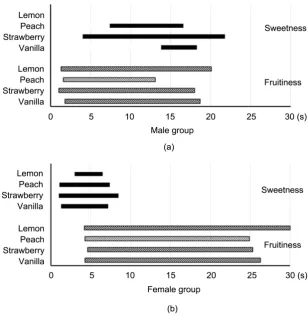
DOI: 10.4236/fns.2018.96051 679 Food and Nutrition Sciences showed consistent and statistically significant responses to the used samples. Figure 1 presents average TDS curves of these two sensations reported from the beginning of sample ingestion to the end of the 30 s-duration for the evaluation of sensations in the male and female groups. The sensation of fruitiness ap-peared first and was followed by that of sweetness in the male group (Figure 1(a)). This order of appearance was reversed in the female group (Figure 1(b)). A t-test showed that the average beginning time of fruitiness in the male group across the four samples was significantly earlier than in the female group (P < 0.005). The t-test also showed that the average duration of the sensation of frui-tiness in the male group was significantly shorter than in the female group (P < 0.05). Since the male group did not reach a significant level of sensation for sweetness in the lemon-flavored sample (Figure 1(a)), we were unable to per-form statistical examinations on this sensation.
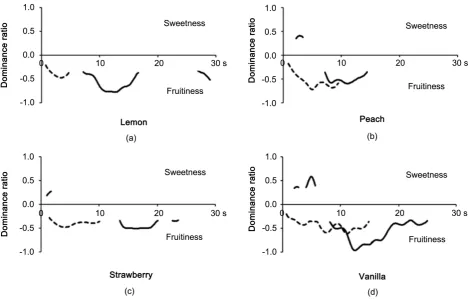
Figure 2 depicts TDS-DC curves for the four samples in the male and female groups. There were significant differences in the duration of the fruitiness and sweetness sensations between the two groups. The TDS-DC curves revealed that fruitiness was more dominant than sweetness in all four samples and in both
DOI: 10.4236/fns.2018.96051 680 Food and Nutrition Sciences Figure 2. TDS difference curves for the four samples (a)-(d) in the male and female groups. TDS difference curves for the lem-on-flavored tea (Lemon; (a)), for the peach-flavored tea (Peach; (b)), for the strawberry-flavored tea (Strawberry; (c)), and for the vanilla-flavored tea (Vanilla; (d)). Broken lines indicate the male group and solid lines indicate female group. Positive values on the vertical axis imply “sweetness” dominance, while negative values imply “fruitiness” dominance. Only significant differences were plotted on the TDS difference curves.
groups. The basic features of sweetness and fruitiness in the TDS-DC curves were consistent among the samples, but there were some differences between them. For example, both the maximum dominance ratio (around −0.5) and the dominant duration (6.7 s) of the strawberry-flavored tea in the female group (Figure 2(c)) were less than half of the vanilla-flavored tea (close to −1.0 and 17 s; Figure 2(d)). However, any statistical examinations were not applicable for the TDS-DC curves, since there were only two curves without variation of data by twice experimental repetitions in the present study.
DOI: 10.4236/fns.2018.96051 681 Food and Nutrition Sciences strawberry flavor (50 µl/l vs. 3.0 ml/l) between these studies are likely to be re-sponsible for this inconsistency. It is also worth noting that the study by Di Mo-naco and colleagues [5] used a mixed group consisting of male and female par-ticipants, whereas the present study divided the participants into male and fe-male groups. This study also compared the times at which the two sensations first reached significant levels and the durations for which the sensations sus-tained between the two groups. As a result, the findings of this study strongly suggest that sex differences affect temporal sequence of flavor perception of the tea samples (Figure 1 and Figure 2).
A previous study [10] suggested that more than 16 participants were needed for the experiment of twice repetition, like the present study (n0 > 5/(p0 (1 − p0) r, where n0 is minimum number of participants,p0is inverse of number of sensa-tions including flavorlessness, and r is number of repetition). Although the small number of participants (12 in the two groups) is the first and biggest limitation of this study, the differences in temporal sequence shown between the male and female groups in this study (Figure 1 and Figure 2) are clear and might be un-affected by increasing the number of participants. In the near future, however, it is necessary to confirm actually the present finding by experiments using more participants. The mechanism for the present finding that sex-based differences in the temporal sequence of dominant sensations elicited by fruit-flavored teas remains unclear, which is the second limitation of this study. Sex hormones, like oestrogen, may be related to the finding [8] [15]. To examine the relation, using postmenopausal, instead of the young, women as participants is likely to be va-lid. Besides, it is also necessary to clarify the effect of basic sucrose concentration on the finding, since there is a wide distance between previous (e.g., 0.56 M, [4]) and present (0.05 M) studies in the concentration.
4. Conclusion
In conclusion, two sensations, sweetness and fruitiness, dominantly appeared after ingesting four fruit-flavored teas (lemon, peach, strawberry, and vanilla) by a TDS method in both male and female groups. The male group perceived frui-tiness first and sweetness second, while the female group reported in the reverse order.
Acknowledgements
This study was partially supported by Grants-in-Aid for Scientific Research from the Ministry of Education, Science and Culture of Japan (No. 26350106 to SY and No. 16K00830 to YM).
References
DOI: 10.4236/fns.2018.96051 682 Food and Nutrition Sciences
[2] Small, D.M. and Prescott, J. (2005) Odor/Taste Integration and the Perception of Flavor. Experimental Brain Research, 166, 345-357.
https://doi.org/10.1007/s00221-005-2376-9
[3] Frank, R.A. and Byram, J. (1988) Taste-Smell Interactions Are Tastant and Odorant Dependent. Chemical Senses, 13, 445-455. https://doi.org/10.1093/chemse/13.3.445
[4] Green, B.G. Nachtigal, D. Hammond, S. and Lim, J. (2012) Enhancement of Retro-nasal Odors by Taste. Chemical Senses, 37, 77-86.
https://doi.org/10.1093/chemse/bjr068
[5] Di Monaco, R., Miele, N.A., Volpe, S., Picone, D. and Cavella, S. (2014) Temporal Sweetness Profile of MNEI and Comparison with Commercial Sweeteners. Journal of Sensory Studies, 29, 385-394. https://doi.org/10.1111/joss.12119
[6] Di Monaco, R., Su, C., Paolo, M. and Cavella, S. (2014) Temporal Dominance of Sensations: A Review. Trends in Food Science & Technology, 38, 104-112.
https://doi.org/10.1016/j.tifs.2014.04.007
[7] Yamamoto, S., Taniguchi, H., Sarukura, N., Tsao, H., Tseng, A. and Takeichi, H.(2009) Development of a Food Composition Database of Mosaccharides and Disaccharides in Sweet Snacks and Beverages (In Japanese with English Abstract).
Journal of the Japan Dietetic Association, 52, 22-25.
[8] Velle, W. (1987) Sex Differences in Sensory Functions. Perspectives in Biology and Medicine, 30, 490-522. https://doi.org/10.1353/pbm.1987.0015
[9] Labbe, D., Schlich, P., Pineau, N., Gilbert, F. and Martin, N. (2009) Temporal Do-minance of Sensations and Sensory Profiling: A Comparative Study. Food Quality and Preference, 20, 216-221. https://doi.org/10.1016/j.foodqual.2008.10.001
[10] Pineau, N., Schlich, P., Cordelle, S., Mathonniere, C., Issanchou, S., Imbert, A., Ro-geaux, M., Etievant, P. and Koster, E. (2009) Temporal Dominance of Sensations: Construction of the TDS Curves and Comparison with Time-Intensity. Food Qual-ity and Preference, 20, 450-455. https://doi.org/10.1016/j.foodqual.2009.04.005
[11] Barron, D., Pineau, N., Matthey-Doret, W., Ali, S., Sudre, J., Germain, J.C., et al. (2012) Impact of Crema on the Aroma Release and the In-Mouth Sensory Percep-tion of Espresso Coffee. Food & Function, 3, 923-930.
https://doi.org/10.1039/c2fo30046j
[12] Ihaka, R. and Gentleman, R. (1996) R: A Language for Data Analysis and Graphics.
Journal of Computational and Graphical Statistics, 5, 299-314.
[13] Crawley, M.J. (2002) Statistical Computing: An Introduction to Data Analysis using S-Plus. Wiley, UK.
[14] Kiemele, M.J. (1997) Basic Statistics: Tools for Continuous Improvement. Air Academy Press, Colorado Springs, USA.