
Software Defined Networks – OpenFlow Channel
Security and Efficiency
Matthew West
Illinois State University School* of IT Normal, IL 61790-5150
Jihad Qaddour
Illinois State University School of IT Normal, IL 61790-5150
ABSTRACT
This paper assesses the resource costs of TLS in OpenFlow and puts forth a header format for channel communication that is more efficient and partially backwards-compatible. Resource usage is shown to be reduced by up to 19.36% with a TLS flag added to the OpenFlow header.
General Terms
Software Defined Networking, Control Plane, Protocols, Transport Layer Security, Encryption
Keywords
SDN, OpenFlow, channel, security, efficiency, TLS, header, southbound, SSL, PKI, DS, xid, Mininet, encryption
1.
INTRODUCTION
In software-defined networking (SDN), communication between the controller and hardware devices forwarding network traffic is described as southbound traffic. While there are more options for this medium besides OpenFlow, this paper will deal only with the OpenFlow channel (southbound) and switch specification (run on each forwarding device), as well as resource usage of the controller. As with the selection of OpenFlow above, many controllers exist, but Ryu was used for this study due to using a low-overhead Python environment.SDN and network function virtualization (NFV) are a natural match. A quick test of an SDN virtualized environment finds line speeds upwards of 18 gigabits per second. Once switches running OpenFlow are run within an NFV framework, concerns about bandwidth between virtual devices on the same physical server are reduced greatly. The limiting factor of switched network functionality (the data link layer of SDN) in these environments then becomes processing and memory. Memory usage is outside the scope of this paper but is worth examining. As the code driving new networking technologies goes through consecutive version releases, it is possible that some of the code becomes memory inefficient due simply to the number of people and the span of time on which it has been worked.The OpenFlow Switch Specification version 1.5.1 documentation from the Open Networking Foundation (ONF) defines the southbound interface of SDN when it pertains to OpenFlow communications as the OpenFlow channel [1]. In Section 6 of the documentation, channel messages are specified to be sent either directly via TCP (in the clear) or encrypted using Transport Layer Security (TLS). This version of OpenFlow details TLS encryption under subsection 6.3.6: connection Uniform Resource Identifiers (URI) may specify TLS as the protocol to be used for communication when a switch first connects to the controller, but there are mechanisms to opt for TLS encryption which may be initiated by either the switch or controller. Optional to TLS is the use of one or more Certificate Authorities (CA) and Certificate Revocation Lists (CRL), an approach which is recommended to minimize some
2.
PREDICTIONS
2.1
Research Questions
So, if controllers and hardware are sharing the same server resources and bandwidth has become less of a concern due to the gains in performance from SDN and NFV, then a main concern of traffic between them becomes how can network engineers reduce resource usage while maintaining secure connections? This paper seeks to answer the following questions:
1. What is the approximate processing overhead of TLS in SDN?
2. What traffic needs to be secured in the OpenFlow channel?
3. If TLS has a noticeable processing overhead and not all traffic needs to be encrypted, the research question becomes
4. What is a possible solution to improve OpenFlow channel efficiency without sacrificing security?
2.2
Hypotheses
H0: There will be a negligible difference between using TLS encryption on all OpenFlow channel traffic versus encryption only on necessary traffic (less than 5% processing overhead).H1: There will be a difference between using TLS encryption on traffic as in H0 (5% overhead or more).
3.
RELATED WORK
Previous work has been done on encryption overhead in network traffic, most of it focused on network overhead (additional bandwidth usage). A portion of this work relates to SSL, and a large portion of that relates to HTTPS traffic and servers, as mentioned in the introduction. Cornett et al. [9] identified increases in processor (CPU) efficiency for larger buffer sizes when network security functions were offloaded to another device. This implies some sort of performance cost when using security functions. Unfortunately, if the purpose of SDN is to have network hardware forward traffic and little else, it cannot expect to offload cryptographic functions to those devices (which is not to mention the security issues involved in such an approach).Researchers Lal and Garg [6] also delved into the possibility of offloading SSL in a different manner. Citing slowdowns of HTTPS servers due to TLS processing, they identified one of the large resource usage sources in encryption to be the passing of data between the software (user space) and operating system (kernel), described as system call overhead. Their proposed solution gave the cryptographic software engine direct access to the security engine (SEC) driver, bypassing the kernel. Until companies start equipping servers with SEC hardware to offload cryptographic processing to, their findings are useful
to SDN insofar that they pinpoint one of the larger consumers of system resources: the kernel.
Callegari et al. [7] studied the block cipher and hash functions used in TLS and DS. Of the block ciphers, only AES is worth considering, as 3DES requires twice as many cycles per byte as AES-128, which is still considered to be a secure algorithm. AES-256 took roughly 33% more processing effort (747 versus 562) for double the key length (the numbers in AES designations telling the length of the key). Hash functions perform a different role than block ciphers and are more efficient because they do not need to be reversible. SHA-1 was found to use about 16 cycles per byte. SHA-3 is the newest version of the hash and is known to use more processing power per security bit. Even with conservative estimates for SHA-3, it requires ten times fewer cycles than AES-128.Finally, Shen et al. [8] studied the impact of implementing TLS on a SIP server. Their tests started with UDP and ended with TLS using 3DES with proxy authentication. Since OpenFlow operates using TCP only, the TCP NoAuth, TCP Auth, and TLS 3DES Auth are the most interesting points of the article. Each was broken down into the total number of CPU events caused by each part of the SIP forwarding process. The proportions of these and analysis of the data are discussed in Findings.
4.
METHODOLOGY & RESOURCES
Figure 1: Packets captured by message type
5.
FINDINGS
The total number of packets of each type was tallied after each 10-minute test and can be found in Figure 1. PMP messages involve flow hit messages and port usage messages, and therefore only appeared in the test with a simple OpenFlow switch monitor. FLOW_MOD and PACKET_OUT messages were identical in both tests, and ECHO and HELLO messages differed by 0.0083%, which can be considered statistically insignificant. Message types with fewer than 100 occurrences were not included in the data. These types were FEATURES_REPLY (13 and 21), SET_CONFIG (13 each), PMP_PORT_DESC (13 and 52) and PORT_STATUS (7 and 11).
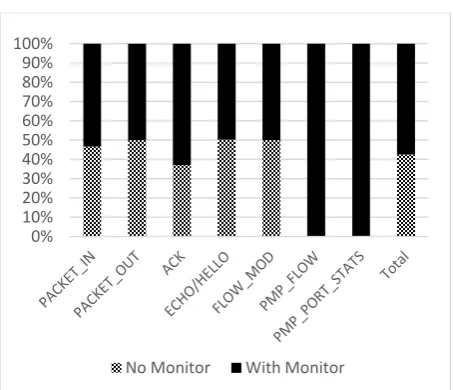
Figure 2: Packet proportions captured across tests by message type
The test with monitor generated 14.6% more PACKET_IN messages than the test without a monitor, as well as 69.65% additional ACK messages. With all message types combined, the controller with monitor caused 35.43% additional OpenFlow channel traffic compared to the controller without over the same period. There were 3874 additional messages of PMP_PORT_STATS and PMP_FLOW types combined, comprising slightly more than half of the extra southbound traffic.Figure 2 compares message types by percentage. One can use this and Figure 1 to conclude PACKET_OUT, ECHO/HELLO, and FLOW_MOD messages are not affected by additional controller monitoring features where metadata is involved. PACKET_IN messages are a way for a switch to request forwarding instructions from the controller, and simply contain the packet necessitating a flow update. These messages do not need to be encrypted, as the encapsulated packet will already have been encrypted if it needs to be. Notably, the reply message (FLOW_MOD) from the controller will require TLS, as it can contain forwarding table rules or other information relevant to the operation of the network and requires the requesting switch have a trusted certificate. Additionally, one can assume that the additional ACK messages generated were due to the PMP messages sent to the controller when using the monitor. If PMP messages can be sent in the clear, these ACKs can be sent in the same manner, but this is not the case for all ACK messages. Therefore, the focus of the following discussion on TLS efficiency in the OpenFlow channel will focus on PACKET_IN, PACKET_OUT, and PMP messages. HELLO/ECHO messages in OpenFlow currently only have a header, so cannot be encrypted in a meaningful way.
0 1000 2000 3000 4000 5000 6000 7000 8000 9000
Pa
ckets
Cap
tu
re
d
No Monitor With Monitor
0% 10% 20% 30% 40% 50% 60% 70% 80% 90% 100%
[image:3.595.54.281.448.643.2]Figure 3: Reference [8] outbound proxy CPU events with SIP filtered
Setting aside the above tests, Figure 3 uses data from [8], which were introduced in the Related Work section. These data support the findings of Lal and Garg involving increased usage of the kernel in operating systems performing encryption functions. Application core and modules were combined from [8]’s data, with cryptographic functions left as separate entities on the Figure. Proxy, database, and other system-specific processes were also removed. The difference between TCP and TLS in this instance is 67%. Although SIP shares some attributes with the OpenFlow channel, the specific differences in both application performance and traffic behavior require caution. Therefore, it is assumed the difference in performance is two thirds that of the SIP system, or 43%.At this point, concise answers to the first two research questions are available. The approximate CPU usage increase of TLS over TCP in SDN is 43%, and FLOW_MOD, PACKET_OUT, and ACK messages need to be encrypted. While PACKET_IN messages can be sent in the clear, the PACKET_OUT response should have some form of authentication, lest an attacker use it to insert packets into a pipeline to which they should not have access (packets from PACKET_OUT use the input port ID, rather than the port receiving the message from the controller). A possible alternative to full encryption for PACKET_OUT will be discussed later. This solution is unlikely to be helpful for sending ACK messages without opening the OpenFlow channel up to man-in-the-middle and replay attacks.Assuming the above, the 10-minute test without monitor in Figure 1 would need 23.11% of its messages to be encrypted with TLS, while the test with a monitor would need 26.43% encryption. This shows that as metadata sent to the controller for administrator use increases, proportion of traffic that requires TLS increases due to a higher volume of ACK packets. This is true even if the packets being generated due to the monitoring function do not need to be encrypted.Using the 10-minute test without monitor, the reduction in CPU usage between
from [7], the best-case scenario for using hashes for authentication over TLS is a reduction of 90% CPU usage. Assuming hashing takes twice as many resources due to the new SHA-2 and SHA-3 algorithms, hashing will take 20% of the resources of TLS. This yields a 19.36% resource usage reduction over always-on TLS, assuming no digital signing of HELLO/ECHO messages. Thus, H1 is supported due to a meaningful difference in resource usage. This approach has the added benefit of adding authentication and integrity to
messages (PACKET_IN, PMP_FLOW,
PMP_PORT_STATS) that could otherwise be sent without. Version
8 bits
Type 8 bits
Length 16 bits TLS
1 bit
[image:4.595.310.548.428.504.2]xid 31 bits
Figure 4: Proposed OpenFlow header with TLS flag
Figure 4 contains a proposed header format for OpenFlow messages to indicate whether the message is sent via TLS and requires decryption, or via TCP with DS and requires hashing. This header borrows 1 bit from the xid (transaction identifier) field and uses it as a TLS flag. This reduces the number of possible xid values by half, to 2,147,483,648. Older versions of OpenFlow would still be able to process these headers while also allowing devices using the new header format to operate in the same environment. Combined with the version field, anything at the current OpenFlow version of 1.5.1 (0x06) or below would see the TLS flag field as simply an xid of 2,147,483,648 or higher, while newer versions (0x07 and onward) would treat it properly as a flag, ensuring full backwards-compatibility for TLS. DS would not operate for versions 1.5.1 or earlier, however. The best approach due to the above attributes would be for newer versions of OpenFlow
0 200 400 600 800 1000 1200 1400
TCP TLS
CPU events (in thousands)
6.
CONCLUSION
The OpenFlow channel mandates security to prevent attackers from gaining an understanding of or altering the function of the network. Which message types need to be encrypted by the current method of TLS is up for discussion. Current OpenFlow specifications allow for either always-on TCP or always-on TLS, with no middle ground between the two options. Some type of flag (Figure 4) that specifies whether TLS is used could improve southbound efficiency by 19.36% and be partially backwards compatible. The way to authenticate and ensure integrity of packets sent via TCP would be to use a DS.
Table 1: Resource usage of OpenFlow TLS options
Packet Encryption
Type Security
Percent TLS encryption
CPU usage
TCP Only Poor 0% 100%
TLS Only Good 100% 143%
TLS flag (Figure 4) Good 23.11% 115.3%
Findings are noted in Table 1. An overall reduction in block cipher usage leads to a decrease in CPU usage, even when a DS is added to messages sent via TCP to allow for authentication and integrity verification. Security with ACK and TABLE_MOD messages encrypted is considered to be good, as all other messages aside from HELLO/ECHO have a DS built from the shared session key established during TLS handshaking.
7.
LIMITATIONS
Some assumptions were made in this study, most of which were noted in the Findings section. Data on TLS efficiency over TCP were gathered from a SIP implementation rather than an SDN environment. These data were also from 2010, and CPU efficiency regarding block cipher encryption may have improved compared to unencrypted data over the past 8 years more than the 33% performance increase controlled for (this is different than overall available CPU resource, which have certainly increased).The worse of the two 10-minute tests was used as the baseline for the findings on efficiency, but this is only for traffic on a particular network size and structure. Other SDN constructions and implementations may yield different proportions of packets when compared to this data. Additionally, as FLOW_MOD traffic increases (more than 1 table update every 10 minutes) efficiency of the proposed solution decreases. This is unlikely in most networks; newer controllers may have dynamic table updating features, however, which create additional OpenFlow channel overhead (again reducing overall efficiency). Table 2 contains an analysis of the data without the assumptions listed in Findings. The differences on this table are mainly that TLS takes 66% additional resources over TCP and hashing is
expected to use 10% of the resources of block cipher encryption (6.6% more than TCP in this case.
Table 2: Resource usage of OpenFlow TLS options best case
Packet Encryption
Type Security
Percent TLS encryption
CPU usage
TCP Only Poor 0% 100%
TLS Only Good 100% 166%
TLS flag (Figure 4) Good 23.11% 119.39%
8.
REFERENCES
[1] A. Nygren et al., “OpenFlow switch specification version 1.5.1 (protocol version 0x06),” Open Networking Foundation, March 2015.
[2] S. Gowda, “Public certificates vs private certificates vs self-signed certificates, in MSDN Blogs, August 2017, https://blogs.msdn.microsoft.com/shreyasgowda/2017/08 /18/public-certificates-vs-private-certificates-vs-self-signed-certificates/
[3] B. Laurie, “Certificate Transparency,” in Communications of the ACM, vol. 57, iss. 10, pp. 40-46, October 2014.
[4] A. Boldberg, “A comparison of HTTP and HTTPS performance,” Computer Measurement Group, CMG98 8, 1998.
[5] B. Jackson, “Analyzing HTTPS performance overhead,”
keycdn, January 2017,
https://www.keycdn.com/blog/https-performance-overhead/
[6] N. Lal and V. Garg, “Accelerating OpenSSL operations offloaded to hardware crypto accelerator,” in International Journal of Knowledge Based Computer Systems, vol. 4, iss. 1, pp. 30-33 Publishing India Group, 2016.
[7] C. Callegari, R. G. Garroppo, S. Giordano, and M. Pagano, “Security and delay issues in SIP systems,” in International Journal of Communications Systems, vol. 22, pp. 1023-1044, May 2009.
[8] C. Shen, E. Nahum, H. Schulzrinne, and C. Wright, “The impact of TLS on SIP server performance,” in IEEE/ACM Transactions on Networking, vol. 20, no. 4, pp. 1217-1230, August 2012.
![Figure 3: Reference [8] outbound proxy CPU events with SIP filtered](https://thumb-us.123doks.com/thumbv2/123dok_us/9295849.427022/4.595.54.542.69.286/figure-reference-outbound-proxy-cpu-events-sip-filtered.webp)
