Adaptive Proportional Fair Parameterization Based
LTE Scheduling Using Continuous Actor-Critic
Reinforcement Learning
Ioan Sorin Comşa, Sijing Zhang, Mehmet Aydin
Institute for Research in Applicable ComputingUniversity of Bedfordshire Luton, LU1 3JU, United Kingdom {Ioan.Comsa,Sijing.Zhang,Mehmet.Aydin}@beds.ac.uk
Jianping Chen, Pierre Kuonen, Jean-Frederic Wagen
Institute for Complex SystemsUniversity of Applied Sciences of Western Switzerland Fribourg, CH-1705, Switzerland
{Jianping.Chen, Pierre.Kuonen, Jean-Frederic.Wagen}@hefr.ch
Abstract—Maintaining a desired trade-off performance between
system throughput maximization and user fairness satisfaction constitutes a problem that is still far from being solved. In LTE systems, different tradeoff levels can be obtained by using a proper parameterization of the Generalized Proportional Fair (GPF) scheduling rule. Our approach is able to find the best parameterization policy that maximizes the system throughput under different fairness constraints imposed by the scheduler state. The proposed method adapts and refines the policy at each Transmission Time Interval (TTI) by using the Multi-Layer Perceptron Neural Network (MLPNN) as a non-linear function approximation between the continuous scheduler state and the optimal GPF parameter(s). The MLPNN function generalization is trained based on Continuous Actor-Critic Learning Automata Reinforcement Learning (CACLA RL). The double GPF parameterization optimization problem is addressed by using CACLA RL with two continuous actions (CACLA-2). Five reinforcement learning algorithms as simple parameterization techniques are compared against the novel technology. Simulation results indicate that CACLA-2 performs much better than any of other candidates that adjust only one scheduling parameter such as CACLA-1. CACLA-2 outperforms CACLA-1 by reducing the percentage of TTIs when the system is considered unfair. Being able to attenuate the fluctuations of the obtained policy, CACLA-2 achieves enhanced throughput gain when severe changes in the scheduling environment occur, maintaining in the same time the fairness optimality condition.
Keywords- LTE-A, TTI, CQI, throughput, fairness, scheduling rule, GPF, MLPNN, RL, policy, CACLA-1, CACLA-2.
I. INTRODUCTION
The optimal allocation of channel and rate resources under a given set of Quality of Service (QoS) requirements constitutes an important throughput maximization task of the scheduling procedure. In particular, the fairness-guaranteed scheduling becomes a complex problem to solve since multiple active users are connected to the base station through the fast fading radio channels and LTE schedulers are designed in the opportunistic manner intended to exploit the multiuser diversity. Hence, by using simple scheduling rules, near Pareto optimal user throughputs should be obtained under a given fairness performance requirement among multiple users. The fairness target selection and the modalities of applying the best scheduling rules in order to satisfy the considered requirement
become the main concerns in designing a self-learning LTE scheduler. The Channel Quality Indicator (CQI) feedback as achievable user rate information should be considered in the fairness performance evaluation metric in order to avoid the unfair treatment of some users with unfavorable channel conditions. For this study, the Next Generation Mobile Networks (NGMN) fairness requirement is considered as a fairness criterion in such a way that a system is considered fair if and only if at each TTI t at least (100-x)% of active users achieve at least x% of each normalized user throughput [1]. The fairness criterion can be achieved by using a satisfactory parameterization of the GPF scheduling rule [2].The objective function of the current study is designed to maximize the system throughput under the NGMN fairness constraints. With a given input state at each TTI, the scheduler should be able to find the best policy of GPF parameters set to be applied in the current TTI in order to meet the grand NGMN objective.
The continuous and multidimensional scheduler state space is modeled by using the Markov Decision Process (MDP) in which the selected CACLA-2 actions are rewarded based on the transition performance from previous to the current state. Based on given MDP problems, CACLA-2 criticizes each action set in order to localize much faster the optimal scheduler state [3]. The experiments show that CACLA-2 performs much better in comparison with other RL algorithms by maximizing the mean user throughput and minimizing, at the same time, the percentage of TTIs when the system stays unfair. The rest of this paper is organized as follows: Section II promotes the relevant techniques proposed in the literature. Section III presents the optimization problem. Section IV presents the architecture of the novel self-learning scheduler. Section V shows the results, and the paper concludes with Section VI.
II. RELATED WORK
a) Jain Fairness Index vs. Mean User Throughput b) CDF distribution
Fig.1. Fairness evaluation criteria (benchmarks) for a 60-user scenario equally distributed from ENodeB base station to the edge of cell under uniform power allocation and FDD downlink transmission with a system bandwidth of 20MHz
the fairness limit regardless of the channel conditions makes the approach impractical for the real time schedulers. For this reason, the qualitative fairness measures based on channel statistics, rather than the quantitative fairness thresholds are preferred to be used in practice. The NGMN qualitative fairness measure adaptation techniques in LTE systems were first elaborated in [8] in which the cumulative distribution function (CDF) of the normalized user throughputs is adjusted by using a simple parameterization of the GPF scheduling metric. The CDF curve adaptation to the fairness requirement is achieved at each 1sidealing with the waste of system capacity, especially when the traffic load varies drastically TTI-by-TTI. A slightly improved method proposed in [7] is introduced in [9], in which the JFI constraint is replaced by the NGMN fairness requirement in the CDF domain (continuous oblique black line from Fig. 1.b.).
A set of RL algorithms that are able to match at each TTI the CDF curve under the NGMN fairness constraint (Fig.1.b) is proposed in [9]. The CACLA-1 actor critic algorithm outperforms any of the methods proposed in [7], [8] and other RL algorithms by maximizing the percentage of TTIs when the system respects the NGMN fairness requirement. It is important to notice that all the proposed methods being illustrated above use a simple parameterization of the GPF scheduling rule. The method proposed in this paper uses the double parameterization of GPF scheduling discipline. It is proved that by using CACLA-2 with two continuous GPF parameters, the obtained policy is able to converge much better to the optimal scheduler state when compared with CACLA-1.
III. GPFOPTIMIZATION PROBLEM
The GPF scheduling metric proposed in [2] exploits two parameters in order to obtain near optimal user throughputs and to adjust the fairness performance in such a way that the NGMN requirement is accomplished. The system model
considers a set t of preselected users with an infinite buffer model with the minimum requested bit rate of 0kbps. At each TTI t a set of orthogonal sub-carriers called Resource Blocks (RBs) [10] should be shared among the active users in order to solve the GPF integer linear programming optimization problem subject of convex set of constraints as shown by Eq. 1:
1
0 1
t t
i , j t t
i i , j i , j
b i j
i , j t i
i , j t
max b t r t / T t
b t , i s.t.
b t , , i
(1)
where bi , j
t represents the RB allocation decision for user i and RB j, ri , j
t is the achievable user rate determined based on the instantaneous CQI reports, and T ti
denotes theachieved user throughput averaged with the exponential moving filter. By using a fine tuning of t [0,1] and
[0,1]
t
1
max
. Obviously, it is expected that CACLA-1 requires more time to optimize tthan CACLA-2 which explores for a more restrictive domain of parameters. However, the double parameterization learning technique should adapt the set of
t, t
parameters TTI-by-TTI in order to reach the optimal or feasible scheduler state (green tradeoff values from Fig. 1. a) such that:1 1
t t t t t t
(2)
wheret
t, t
is the MLPNN output space or the RL algorithm action space. For CACLA-2, the action space is
2 1,1
t
whereas for CACLA-1, the simple
parameterization involvest
t
1,1. For other RLalgorithms with discrete action spaces exposed and analyzed in this paper, the action at TTI t becomes t
k
where k1,..,t . Let us define S t
the continuous and
multidimensional scheduler state at TTI t. The scheduler evolves to the next state tS1 when the discrete or continuous action t is applied for the scheduling procedure.
The role of the RL approaches is to drive the scheduler in the feasible state
tS1
, where 1 1, represents the collection of multi-dimensional data points when the scheduler meets the feasible state for different channel and network conditions. When the applied action moves the throughput-JFI domain on the left side of
zone, the scheduler is declared unfair (MT scheduling rule case) and
S1
t
, where
1 1,
denotes the region of
unfair states. Otherwise, the scheduler is considered to be over-fair (MF scheduling rule case) and
S1
t
. By translating
the quantitative tradeoff evaluation (Fig.1.a.) to qualitative NGMN fairness evaluation (Fig.1. b.), the scheduler state space status is decided based on the NGMN Objective Function
(NOF)T ti
, where the sub-space
Si t
T t represents the normalized user throughput (NUT) for i 1,..,t . Let us define
Ti as the CDF function when all observations
T ti are log-normal distributed. If Re q
Ti represents theNGMN fairness requirement (continuous oblique black line), then the aggregated NOF function is calculated based on Eq. 3:
1
t
S Re q
i i t t
i
/ T T
(3)
where Re q
i iT T
if Ti 1, and otherwise Re q
Ti 1.Based on NGMN specifications [1], the scheduler state is fair
1
S t
only and only if S 0
t
, where the fairness
region is
=
. The delimitation between feasible area and over-fairness area is given by the superior CDF limit Max(oblique dot black line in Fig. 1.b) such that:
1 1 1 Re q i i Max i iT , if T T
,, if T
(4)
where 0 1, is the confidence parameter that can guarantee
the feasible region detection during the exploration period. For a larger parameter, the
region can be detected much faster by degrading the system throughput whereas when the confidence parameter is small enough, more exploration time is required for CACLA-2 to localize the feasible state. The scheduler state status is decided based on Eq. 5:
1 1 1 1 Re qi i t S Req Max
t i i i t
Max
i i t
, if , i ,.., , if , i ,.., , if , i ,..,
(5)
The purpose of CACLA-2 is to find the feasible state
1
S t
based on action t applied at TTI t and to keep this desirable state as long as possible. Other regions such as
or
are considered undesirable for the learning procedure.IV. THE SELF-LEARNING LTE-ASCHEDULER ARCHITECTURE
The proposed actor-critic RL algorithm learns the optimal policy of
t, t
actions based on the interaction between the conventional LTE scheduler and the novel controller. At each TTI t, the controller receives from the scheduler a new
1 1
S S
t t, t , t, t
MDP problem, where :
constitutes the reward function which is a modified version of aggregated NOF function. For eacht , the LTE controller has to decide based on RL approach which action t should be applied at the current TTI t (Fig. 2). In other words, the controller has to learn how to behave for many problems. In this sense, the controller requires the state value function
S t tV where Vt :1 1,
and the action-state value
S t tA whereAt :1 1,1 1,. When RL approaches with discrete actions are used, different action-state values Qtk are requested for each k
t
action. The idea is to upgrade these values based on an infinite number of iterations by using the temporal learning principles [11]. The way how the
tuple
V , A Qt t
t
is updated TTI-by-TTI based on t MDP problems determines the RL algorithm type. The time period when
V , At t
values are updated is called training stage andFig.2 The architecture of the self-learning LTE-A scheduler
value functions are directly applied to the new , then the exploitation stage is performed. The purpose of the training stage is to find the optimal policy ( S, )
t t
which can
provide the largest amount maximum rewards averaged over the number of training epochs or number of training TTIs. In order to reduce the MLPNN structure complexity and to speed up the convergence in the region, the initial scheduler state space has to be aggregated by using a special pre-processing stage.
A.LTE Controller State Space
Due to the continuous and high dimensionality characteristics of the original scheduler state spacetS , the MLPNN non-linear function is used in order to offer good
generalizations for the
V , A Qt t
t
values. In order to avoid the state dependency on the number of active radio bearers, the initial state space St
is converted into a more
representative and compacted state such as tC by keeping only the relevant information which can affects the action selection for the scheduling procedure. Then, the proposed controller state space becomes:
tC
t1, t1, Tt, tT, dtR, t , t
(6) where Tt
and T t
are the mean and the standard deviations, respectively for the log-normal distribution of NUT observations, R
t
d is the minimum/maximum difference between iand Re q
i
percentiles when the system is fair/unfair
as indicated in [9], andtrepresents the system status flags which indicates that t 1 when C
t
, t 0 when C
t
and finally t 1 for the feasible state. Basically, the distance dtRdecides the state tCstatus such that: if i ,R Re q 0
t i i
d ,
i t then C
t
and the
distance is R
i ,R
t t
d max d , and when i ,R 0
t t
d , i the controller is declared fair tCanddtR min d
ti ,R
. For theparticular case whentC and dtR
0,
then the state becomes Ct
. It is important to point out that all the above calculations are performed for the CDF domain of interest of i
0 0 7, .
. Beyond this interval, the CDF percentiles are not able to decide the controller state status.B.Reward Function
The objective function from Eq. 3 is not suitable as a reward function due to the oscillated characteristics of the LTE scheduling procedure. Then, the particularities of GPF-2 should be highlighted for the reward function computation. Compared with CACLA-1 [9], CACLA-2 reveals the existence of multiple optimal solutions
opt, opt
t t
whentC. In Fig. 1, the feasibility is reached when let us say
opt 0.5, opt 1
t t
. If
topt,t
, then C t ;
when
t,t 1
, then the system tends to become over-fair Ct
. Based on these principles, the feasibility can be reached for multiple optimal set of parameters
when
t ,t
. Then the reward function for GPF-2 can be divided as indicated in Eq. 7:
1
1
1
, , , ,
1, , , ,
, , , ,
UF C C
t t t
C C
t t t
OF C C
t t t
if if
if
(7)
When C t
, the reward function tUF can be modeled by using the tuple of
t1,t1,t1,t1
. If the feasibilityis reached, then the previous action should be granted with the maximum reward. The necessary conditions for the region convergence are: t10 andt10. The decision can be further divided into two situations: when
1 1
t t
the reward function should contain a weighted sum
of
t1,t1
; whent1t1 , the role of t1 is notimportant anymore and the reward should focus only ont1. In the opposite case whent10 andt10,
the action should be severely punished since the state moves farer away from zone. Therefore, when C
t
, the reward function is calculated based on Eq. 7.a.:
1 1 1 1 1 1
1 1 1 1 1
1 1 1 1 1
1 1 1 1 1
1 1
0.5 , 0, 0,
0.5 1 , 0, 0,
0.5 1 , 0, 0,
, 0, 0,
1, 0, 0
t t t t t t
t t t t t
UF
t t t t t t
t t t t t
t t
if
if
if
if
if
(7.a)
Fig.3. The CDF curve of the proposed policies
1
t
and t1 must be compared in order to determine whethert1 can help or not in reaching of the feasible state.
Equation 7.b. highlights the proposed reward model for the particular situation whentC.
1 1 1 1 1 1
1 1 1 1 1
1 1 1 1 1
1 1 1 1 1
1 1
0.5 , 0, 0,
0.5 1 , 0, 0,
0.5 1 , 0, 0,
, 0, 0,
1, 0, 0
t t t t t t
t t t t t
OF
t t t t t t
t t t t t
t t
if
if
if
if
if
(7.b)
During the training stage, the role of CACLA-2 RL algorithm is to collect the maximum rewards TTI-by-TTI and to select based on the MDP problem t such actions tin order to improve and to refine the final policy of GPF-2 parameters.
C.CACLA-2 RL Algorithm
Based on CACLA principles, two MLPNN functions are used for the approximations of state and action-state values. Let us define AtF MLPA
tA, tC
and VtF MLPV
tV, tC
the forwarded action-state and state values respectively, where
A V
t , t
are the trained MLPNN weights at TTI t. The MLPNN weights are updated according to the gradient-descent principle which aims to minimize the mean-square
errors EtAand V t
E based on Eq. 8.a and Eq.8.b, respectively: EtA
tA1, tC1
A AtT
tC1
AtF
tC1
(8.a)
1 1
1
1
V V C T C F C t t t V t t t t
E ,
V V (8.b)
where AtT
tC1
and VtT
tC1
are the target values, A andV
are the learning rates, and is the total number of hidden nodes for all MLPNN layers. The errors from (8.a) and (8.b) are back-propagated layer-to-layer for each MLPNN node. The target state value is updated at TTI t when the reward value is received as a result of applying the previous action
Fig.4. Obtained policies
1
t
in the previous state tC1 according to Eq. 9:
VtT
tC1
t
t1,tC1
VtF
tC (9) where
0 1, is the discount factor that indicates the importance of future scheduler rewards.In order to find the best policy of GPF parameters, the training procedure uses a combination of exploration and exploitation stages which permit to select greedy actions with
a probability of
1
t
such as:
2 1 1
1
1
F C
t t t Th t
t , t Th
A if a
if b
(10)
where tis the two-dimensional real random number and
Th
is the greedy threshold which decides if there is policy evaluation (10.a) or policy improvement (10.b). Equation 10 is entitled actor scheme for the CACLA-2 algorithm. The critic scheme updates the action target value in state C1
t
based on:
1
1
1
T C F C T C F C t t t t t t t t
A A if V V
(11)
According to Eq. 11, the target action value for the state C1 t
is updated at TTI t only and only if the reward
1 1
C t t, t
value can improve the state tC1value. The same principles are applied to CACLA-1[9].
D.Other RL Candidates
Fig.5. Measured min/max distances from the NGMN requirement
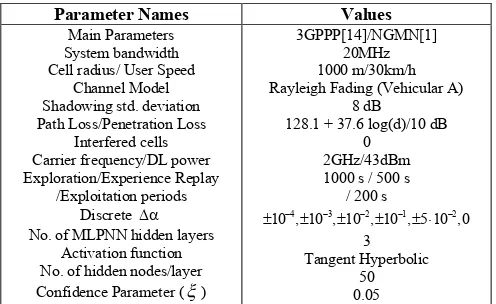
TABLE I. LTESCHEDULER PARAMETERS
action and state values and differs from the original QV-learning from the MLNN error functions point of view [12]. QVMAX and QVMAX2 algorithms are off-line RL procedures in the sense that they combine the state, action-state values and error function computation based on QV2 and Q learning approaches [13]. The RL candidates use discrete action sets by adjusting the GPF-1 parameterization problem.
V. SIMULATION RESULTS
[image:6.595.45.289.87.262.2]In order to prove the eligibility of CACLA-2 actor-critic RL algorithm in comparison with other methods, the considered scenario fluctuates at each 1s the number of active users based on the -greedy probability in the interval of [10,120], and the user mobility is considered to be random walk with 30kmph speed. The evaluation of each scheduling algorithm is achieved by using the same conditions for interference, path loss, shadowing and fast fading. Each base station transmits with the same power which is equally distributed for all RBs. The best effort traffic type is considered for the downlink transmission purpose. The CQI feedback which is sent in the uplink direction is considered to be errorless. The rest of the parameters of the LTE scheduler can be found in TABLE I.
Fig.6. JFI –Mean user throughput tradeoff
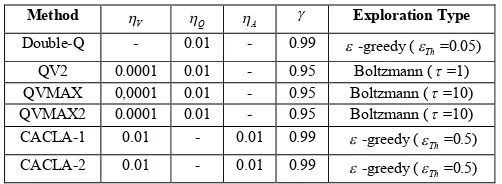
The LTE controller trains each RL algorithm for 1000s. Then, the resulted policy is exploited for 200s. Due to the fact that Double-Q-learning algorithm spends too much time in the irrelevant state-space regions, after the exploration period, the controller is decoupled from the LTE scheduler and is re-trained based on the visited MDP problems for a duration of about 500s. Except CACLA-1, CACLA-2 and Double-Q algorithms, the other candidates use the Boltzmann policy for the action selection procedure [13]. The rest of the parameters for LTE controller can be found in TABLE II.
As shown in Fig.3, CACLA-2, CACLA-1, QVMAX, QXMAX2 and Double-Q RL algorithms satisfy the NGMN fairness requirement when the number of active users remains constant. From the CDF perspective, the PF scheduling metric and QV-2 RL algorithm localize the scheduler in the region. The evolution of learned policies times is depicted in Fig. 4 based on the number of bearers in the active state. QV-2, Double-Q and QVMAX learning algorithms provide the highest fluctuations of t parameter with the lowest policy revenue capacity to the optimal value. On the other side, CACLA-1 and CACLA-2 exploit the critic scheme advantage by keeping the policy oscillations in acceptable limits. By using two continuous actions, CACLA-2 is able to recover the state much faster when the traffic load is varying. By increasing t and decreasing t when the number of users increases from 12 to 115 (Fig. 4), the policy stabilizes in less than 10ms by recovering the stability of the policy. A significant system throughput gain can be achieved by minimizing in the same time the percentage of TTIs when the scheduler is located in the operating area.
When the minimum/maximum NGMN distance dtR is considered (Fig. 5), CACLA-2 outperforms the main candidate CACLA-1 by maintaining the system in the minimum distances range of [0, 0.03]. The result of the policy fluctuations of other candidates is directly impacted in Fig. 5 where the NGMN distances converge much slower than the actor-critic schemes. The PF scheduling rule indicates the highest NGMN distance for all transmission period. These concepts explain the higher throughput gain from Fig. 6 of actor-critic schemes when compared against the other candidates. In particular, CACLA-2 indicates a throughput gain
Parameter Names Values
Main Parameters System bandwidth Cell radius/ User Speed
Channel Model Shadowing std. deviation Path Loss/Penetration Loss
Interfered cells Carrier frequency/DL power Exploration/Experience Replay
/Exploitation periods Discrete
No. of MLPNN hidden layers Activation function No. of hidden nodes/layer Confidence Parameter ()
3GPPP[14]/NGMN[1] 20MHz 1000 m/30km/h Rayleigh Fading (Vehicular A)
8 dB 128.1 + 37.6 log(d)/10 dB
0 2GHz/43dBm 1000 s / 500 s
/ 200 s
4 3 2 1 2
10 , 10 , 10 , 10 , 5 10 ,0
3 Tangent Hyperbolic
[image:6.595.43.291.316.468.2]Fig. 7 Percentage of TTIs when the scheduler seats on the UF/FEA/OF states regions
TABLE II. LTECONTROLLER PARAMETERS
when compared with CACLA-1 of about 0.2Mbps. The PF metric shows the worst performance even when the JFI-mean user throughput tradeoff is considered leading to the waste of system capacity when the NGMN fairness requirement is considered. From the percentage of TTIs when the system state is , or (Fig. 7) in the exploitation state, the static parameterization of PF scheduling rule shows the highest amount of TTIs when the scheduler is over-fair and the lowest percentage of TTIs when the system is feasible. When the simple parameterization is used, QV2-learning constitutes the worst choice when the scheduler state is C
,
t
= . From the view point of the number of TTIs when the scheduler is over-fair, the best performance is obtained by using the QVMAX policy. CACLA-1 algorithm outperforms the other candidates with the simple parameterization scheme when the feasible region is met. When the proposed GPF-2 parameterization is used, CACLA-2 outperforms any of other RL methods. CACLA-2 gains more than 3000 TTIs from the region which are valued by the zone. In the same time, CACLA-2 gains around 6% feasible TTIs when compared with the main candidate CACLA-1 algorithm. From other perspective, by increasing the number of feasible TTIs, the number of reward punishments
t 1
in the exploitation stage is strongly reduced. This concept highlights the quality of the proposed policy and the ability of recovering the desired feasible state in less than 10 TTIs when severe changes in the traffic load and user channel conditions appear.VI. CONCLUSIONS
The current work shows that the use of the double GPF parameterization increases the percentage of TTIs with 6% when the scheduler is feasible in comparison with the simple parameterization technique. The percentages of TTIs when the system is considered or indicate a real improvement of about 1.32% and 4.71%, respectively, when CACLA-2 is performed. By using double action space, the resulted policy indicates lower fluctuations when the traffic load drastically changes. In conclusion, the double parameterization of the GPF scheduling rule presents real improvements in terms of system throughput gains and percentages of TTIs when the system is considered feasible.
REFERENCES
[1] R. Irmer, Radio Access Peiformance Evaluation Methodology, Next Generation Mobile Networks Std. V 1.3, January 2008.
[2] C. Wengerter, J. Ohlhorst, and A. von Elbwart, “Fairness and throughput analysis for generalized proportional fair frequency scheduling in OFDMA,” in Proc. IEEE Veh. Tech. Conf., VTC-Spring, vol. 3, Stockholm, Sweden, May 2005, pp. 1903 – 1907.
[3] H. van Hasselt and M. Wiering, "Reinforcement Learning in Continuous Action Spaces, " in Proceedings of IEEE International Symposium on Approximate Dynamic Programming and Reinforcement Learning (ADPRL07), Honolulu, HI, USA, pp. 272-279, 2007.
[4] I.S. Comşa, M. Aydin, S. Zhang, P. Kuonen and J. F. Wagen, “Reinforcement Learning based Radio Resource Scheduling in LTE-Advanced,” in 17th International Conference on Automation and Computing (ICAC), pp. 219 – 224, Sept. 2011.
[5] I.S. Comşa, M. Aydin, S. Zhang, P. Kuonen and J. F. Wagen, “Multi Objective Resource Scheduling in LTE Networks Using Reinforcement Learning,” in International Journal of Distributed Systems and Technologies (IJDST), vol. 3(2), pp. 39-57, April 2012.
[6] I.S. Comşa, S. Zhang, M. Aydin, P. Kuonen, and J. F. Wagen, “A Novel Dynamic Q-Learning-Based Scheduler Technique for LTE-Advanced Technologies Using Neural Networks, ” in 37th Annual IEEE Conference on Local Computer Networks (LCN), pp. 332-335, Oct. 2012.
[7] S. Schwarz, C. Mehlführer, and M. Rupp, “Throughput Maximizing Multiuser Scheduling with Adjustable Fairness,” in IEEE International Conference on Communications, pp. 1-5, June 2010.
[8] M. Proebster, C. M. Mueller, and R. Bakker, “Adaptive Fairness Control for a Proportional Fair LTE Scheduler, ” in IEEE 21st International Symposium on Personal Indoor and Mobile Radio Communications (PMIRC), pp. 1504-1509, Sept. 2010.
[9] I.S. Comşa, M. Aydin, S. Zhang, P. Kuonen, J. F. Wagen and L. Yao, “Scheduling Policies Based on Dynamic Throughput and Fairness Tradeoff Control in LTE-A Networks,” in 39th Annual IEEE Conference on Local Computer Networks (LCN), Sept. 2014.
[10] L. Zou, R. Trestian and G.-M. Muntean, “A Utility-based Priority Scheduling Scheme for Multimedia Delivery over LTE Networks,” in
IEEE International Symposium on Broadband Multimedia Systems and Broadcasting (BMSB), pp. 1-7, June 2013.
[11] H. van Hasselt, "Double Q-learning, " in Advances in Neural Information Processing Systems 23 (NIPS 2010), Vancouver, British Columbia, Canada, pp. 2613-2622.
[12] M.A. Wiering, "QV(lambda)-learning: A New On-policy Reinforcement Learning Algorithm, " in Proceedings of the 7th European Workshop on Reinforcement Learning, pp. 17-18, 2005.
[13] M.A. Wiering and H. van Hasselt, “The QV Family Compared to Other Reinforcement Learning Algorithms,” in Proceedings of IEEE International Symposium on Approximate Dynamic Programming and Reinforcement Learning (ADPRL), pp. 101-108, March 2009.
[14] Physical layer aspects for evolved Universal Terrestrial Radio Access (UTRA), 3GPP Std. TR 25.814, Rev. V7.1.0, September 2006.
Method
V
Q A Exploration Type
[image:7.595.41.292.321.413.2]