EFFECTS OF LEARNING STYLES ON ENGAGING
CHILDREN IN SCHOOL PROJECTS
Richard Akplotsyi1 and Lamine Mahdjoubi
University of the west of England, Faculty of environment and Technology, Frenchay Campus, Bristol BS16 1QY, UK.
The importance of children’s engagement in school projects has been widely
acknowledged. Despite various initiatives and efforts promote it, the effectiveness of children’s engagement has remained limited. Available evidence suggests that most prevailing participation methods, employed in school design projects, continue to exclude groups of children due to the disparity between built environment professionals’ methods of engagement and children’s preferred way of interacting with information. The research sought to determine whether engagement methods could be more effective targeted by determining and incorporating children’s learning styles preferences. There are a number of different learning styles models, but the visual, auditory and kinaesthetic (VAK) is the most widely used. However, VAK is generic and is not fully suitable for children. As a result a child friendly-customised VAK learning style preferences questionnaire was developed to classify children’s learning preferences into three sensory modalities in a range of activities across the primary curriculum. 151 Key Stage 1 and 2 pupils from four primary schools in the UK participated in the study. The results revealed that preferences for engagement methods differed significantly between the three learning style modalities. The findings confirmed that understanding children’s learning style preferences is an important consideration when deciding engagement methods for school projects.
Keywords: children, learning styles, methods of engagement, school projects.
INTRODUCTION
Despite numerous policy initiatives and support that children’s involvement and engagement in decision-making received over the last two decades, overwhelming evidence suggest that the majority of children are still disengaged from actively involving in the planning and design of their school outdoors (Kimberley, 2005). There is evidence to suggest that conventional participation strategies do not fully consider children’s specific learning style preferences for effective engagement (Clark, 2004; Slater et al., 2007).
Children have different learning styles, abilities and preferences, in the way they receive process and use information (Kolb, 1984; Gardner, 1993). These diverse individual differences of how children relate to particular incoming information and strategies often have significant influence on how they approach and make choices regarding engagement strategies (Dunn and Dunn, 1975; De Bello, 1990). However, children’s learning styles preferences and characteristics for inclusion in the design of methods of engagement is a vastly underutilised approach to improving the design of
1
school outdoors (Honey, 2001). The effect of non-inclusion of these learning styles preferences led to engagement strategies that are shallow and superficial, lacking the motivating factors associated with effective children’s participation in school outdoor design (Ennis, 2000). To address this concern and ensure that children’s engagement in school outdoor design becomes successful and all-encompassing, there is the need to determine and incorporate children’s respective learning styles into the design of engagement methods in the likelihood that children will engage better in the process. Providing the opportunities for children to take advantage of the strengths of their learning style preferences in the design and application of engagement methods, can broaden their active involvement in school outdoor designs and lessen exclusion (Hart 1997; Kimberley 2005). In this vein, practitioners and designers seeking to, or
working with children need to be concerned with these differences so as to support the design and application of engagement strategies that can be developed to satisfy children’s engagement needs. In particular, not many studies have been focused to explore this phenomenon, principally in the field of children’s engagement in the design of school outdoors. Therefore, the purpose of this study was to investigate whether the design and application of methods of engagement could be more effective by determining and incorporating children’s learning styles preferences into
engagement strategies.
METHODS
This study used mixed research approaches in data gathering, which comprised the following:
Photo-Safari as an exemplar of a visual engagement method.
Dialogue as an exemplar of auditory measurement technique.
Global Positioning System (GPS) space tracking technique as an example of a kinaesthetic technique.
These selected methods were targeted and categorised according to the three sensory modalities of learning through the use of a modified VAK learning style instrument. These range of activities and research strategies were selected in order to appeal to all categories of learners’ modality preferences.
The VAK learning style model provides a very easy and quick reference inventory by which to assess children’s preferred learning styles. Most importantly it can be designed to match people's preferences for learning and experiences. The original instrument was modified and used to identify and classify children’s learning preferences through observation by class teachers in a range of activity settings in class and during recess times outdoors. The questions were modified to reflect the contents of the primary school curriculum of Arts and design, English language and Physical education. Contents of the instrument were evaluated by a number of non-sample groups of teachers in KS1 and KS2 on the basis of conformity to activities of the KS1 and 2 curriculum, clarity of purpose, ease of use and time efficiency of the observational instrument. Their feedbacks greatly influenced the design of the instrument and ensured that the contents met the quality and validity of the original concepts of the VAK assessment instrument. Prior to the study activities, all children were given special identification numbers during the study. This ensured consistency as well as confidentiality in matching data with individual children.
‘disliked’ within their school outdoor playgrounds. The photographs were printed for the children who added written comments to explain the contents (Faulkner 1998). Children then pasted the paragraphs on a 3D Arial map of their schools supplied to each individual child. Children’s photography, unlike other techniques helped them to overcome intimidation in the engagement process, but also encouraged them to directly communicate their views in clear and objective terms (Driskell 2002; Jonson 2003).
For kinaesthetic dimension, GPS tracking devices (Track Sticks) were given to each child which they wore for two days while they roamed within their school‘s outdoors. The GPS sensor provided trail of children’s movement while they move about within the school outdoors without the presence of the researchers or teachers. This gave them the opportunity to roam naturally within the school outdoors (Sletto et al., 2007). Spatial data was produced by integrating GIS tracks into ArcGIS version 9.3x desktop computer software which produced data on children’s movement within places in the school outdoors.
The final phase of data collection strategy organised children into small groups according to the various class sizes, where they engaged in informal discussions. An auditory measurement instrument was designed and used to record children’s speech durations and the frequency of interactions during the 45 minutes of auditory session. This phase gave children the opportunity to discuss their photographs and the tracking outputs from the track stick completed earlier. Teachers and researchers sat in to observe and listened to children’s verbal explanations.
Population and sample
Participants in this study consisted of pupils in Key Stage 1 and 2, aged between 6 and 11 years from four primary schools in the City of Bristol. A total of 151 pupils (53.6%; 81 boys, and 46.4; 70 girls) participated in a range of activities designed in line with the primary school curriculum during recess times in their schools. The study sought ethical approval from the participating schools and the University’s Research Ethics Committee. Permission to conduct the study was obtained from the children, parents and head teachers of the four primary schools. Researchers were checked by UK Criminal Record Bureau (CRB).
Analysis
Data collected was classified into two categories as: (1) Personal characteristics and learning style data; obtained through the use of the modified VAK instrument, auditory assessment and photo-safari sessions and: (2) Spatial data; obtained through the use of GPS tracking devices.
the relationships between learning style categories and engagement preferences, descriptive statistics, chi-square test and the Kruskal-Wallis test statistical analysis were computed (Pett 1997).
Table 1: Distribution of participants by learning styles and gender
Learning Style Boys
N (%) Girls
N (%)
Visual 39 (48.1) 35 (50.0)
Auditory 24 (29.6) 21 (30.0)
[image:4.595.76.380.259.421.2]Kinaesthetic 18 (22.3) 14 (20.0) Total (%) 81 (100 ) 70 (100 ) Total (%) 81 (53.6 ) 70 (46.4)
Figure 1: Distribution of learning style by gender
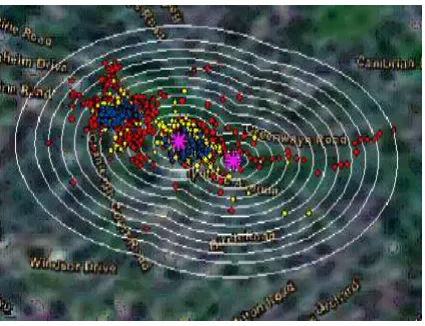
Conversely, the spatial data generated from the GPS tracking devices was analysed using ArcGIS Desktop version 9.3x. Multiple ring buffers were drawn around the school to indicate spatial relationships between the various learning style categories.
Figure 2: Multiple ring buffers around a school
RESULTS
Learning styles and gender
[image:4.595.74.287.504.667.2]respectively. Conversely, (50.0%) of the girls were classified as visual learners while (30.0%) and (20.0%) were respectively categorised as auditory and kinaesthetic learners.
Using the t-test the result indicated that there were no gender differences on learning styles among the children: X2 1.143 and p=0.565. Conversely, a further application of the Kruskal-Wallis test statistics revealed that there were statistically significant differences in the three learning styles categories: visual; (p=0.001), auditory; (p=0.003) and kinaesthetic; (p=0.001)
Learning styles and visual methods
An application of the Kruskal-Wallis test statistics indicated that there were
[image:5.595.100.466.363.434.2]statistically significant differences in the distribution of the number of photographs taken between the various learning styles categories (x2 = 26.254, p= 0.001). A post-hoc application using the Kruskal-Wallis test shown on Table 2 indicate that there was a statistically significant upward shift in the number of photographs taken for the visual group compared with auditory (p =0.001), and compared with kinaesthetic (p =0.001), however no significant difference existed between the auditory category and the kinaesthetic category on the number of photographs taken within the group (p = 0.103).
Table 2: Learning styles categories and Number of photographs
Variable Learning style N Mean Rank Kruskal-Wallis test
X2 p
Photographs Visual 3 10.32
Auditor 3 8.13 26.25 0.001
Kinaesthetic 3 7.23
Total 9
Learning styles and auditory method
Results from the application of the Kruskal-Wallis test statistic shown in table 3 revealed that there were statistically significant differences in speech duration during discussion sessions between all the three learning styles categories (x2=24.86, p=0.001). Similarly, a post-hoc finding from the application of the test statistics revealed that the distribution of speech duration was shifted relatively higher in the auditory learning style category than visual and kinaesthetic learning styles categories; (p=0.001) and there were evidence that the speech duration in the visual category was higher than in kinaesthetic category (p=0.03). The findings from the application of Kruskal-Wallis test statistics also revealed that there were statistically significant differences in the frequencies of contribution made by participants between the various learning styles categories (x2= 25.680, p= 0.001).
Table 3: Learning styles categories and speech duration
Variable Learning style N Mean Rank Kruskal-Wallis test
X2 p
Speech duration Visual 3 31.67
Auditor 3 47.48 24.86 0.001
Kinaesthetic 3 25.10
Total 9
Learning styles and kinaesthetic method
[image:5.595.101.464.636.708.2]learners in space between the various learning styles categories as (x2 = 20.391, p = 0.001). The median of motion in space in the kinaesthetic learners category were statistically higher than in the visual learners category (p= 0.001) and higher than the auditory learners categories (p=0.001), but there was no significant difference in distance moved between the auditory learners and the visual learners categories (p = 0.623). The distribution of motion in space is positively skewed in the visual learner’s category and in the auditory category; and relatively large outlying values are
detected. (However these observations are genuine observations and are not gross errors).
Table 4: Learning styles and motion in space
Variable Learning style N Mean Rank Kruskal-Wallis test
X2 p
Motion in space Visual 3 0.528
Auditor 3 0.537 20.391 0.001
Kinaesthetic 3 0.822
Total 9
DISCUSSION
The result of this study revealed that children have specific learning style preferences, but these preferences do not vary between males and females. This finding confirms that gender is not a confounding factor and does not influence individual children’s category of learning styles classification. Anzelmo-Skelton (2006) and Li et al.,
(2010) research concurred with these findings and confirmed that gender is not a confounding factor of learning styles categories.
The findings revealed that children’s choice and selection of appropriate methods of engagement were informed by their respective learning styles preferences among the three categories. For instance, the results shown that there were significant noticeable systemic increases in visual children’s engagement towards visual method used (Photo-safari) compared to auditory and kinaesthetic learners. Auditory learners were found not to be significantly engaged with the visual and kinaesthetic methods during the sessions involving photo-safari and motion in space within school outdoor
playgrounds. This result suggests that because the methods of engagement used during the sessions did not match auditory learners predominant or preferred learning styles strategies, they were not favourably disposed towards these methods of engagement (Silverman 2000; Smith 2002).
Similarly, the study found that kinaesthetic learners’ engagement with the visual methods was significantly low; a possible explanation could be attributed to the lack of compatibility and major variations in their learning style category and this method of engagement. Therefore learning styles did have effect on children’s choice and selection of appropriate methods of engagement in the visual category. These findings are supported by Gardner (1993) and Felder (2006) who argued that in order to design strategies that enable children to participate effectively, designers needs to go beyond the general patterns of design and focus on children’s divergent styles of learning. A plausible explanation to this could be because the visual methods and strategies used in the study were ‘fine-tuned’ to accommodate visual characteristics requirements such as pictures and visual displays, the learners were motivated to incline to and engaged with the methods.
kinaesthetic learners. Although there is evidence to suggest that speech duration in the visual category was relatively higher than in the kinaesthetic, the results from the analysis indicate that auditory learners in both cases registered significant differences when speech duration and frequency of contribution were analysed (p< 0.003). This finding supports (Kolb 1984; Hormer 2000; Schaller et al., 2002) who suggested that auditory learners tend to engage and understand new ideas when they hear and speak about the information. Based on the findings of this study, learning styles emerged as a powerful mechanism for engaging children for school design projects. These results are largely consistent with the findings of similar research that examined the
importance of the learning style paradigm for children’s preferred interaction with information.
Implications for policy and practice
The findings of this research provided sufficient evidence in support of the learning style hypothesis and its implications on effective engagement of children in school projects. This suggests that effective engagement methods in school design may significantly improve if built environment professionals select methods which are in tune with children’s preferred method of engagement. The results suggested that identifying and accounting for children’s learning styles, professionals could select engagement methods that are likely to be inclusive of the majority of school children.
These findings have important implications on built environment professionals in engaging children in school design projects. Professionals could use combined methods of engagement, involving visual, auditory and kinaesthetic techniques so that all categories of learners’ modality preferences are fully considered. Combined
methods of engagement could include questionnaires, walks in the woods, mapping, guided tours, and word pictures. The advantage of these methods is that they offer a wider coverage, methodical and in-depth results, independence and all encompassing which use two or three of the senses, and encourage active participation. Their limitations is that the design takes time, needs special expertise, can be expensive, and the presence of an adult may affect the output.
CONCLUSION
Children have diverse learning styles preferences which significantly impact how they receive and engage with methods of engagement presented to them. Learning styles have effects on children’s inclination for preferred methods of interaction with
information. Designers, practitioners and educators should be fully aware of children’s learning styles preferences and adjust their engagement strategies according to
children’s learning styles. Built environment professionals could use a combination of engagement methods to include all categories of learners’ modality preferences. They could also carefully fine tune their engagement methods, according to a specific learning style preference.
Study limitation
A limitation of this study is that, the VAK learning styles instrument has not been statistically validated. Similarly, the VAK learning styles assessment instrument does not account for confounding factors such as socioeconomic status, race, culture and individuals disabilities, which are claimed could have effects on children’s
preferences for engagement methods in school design projects.
REFERENCES
Anzelmo-Skelton, N. (2006) “Learning style, strategy use, personalization of mathematical word problem and response of student’s learning disability”, International Journal of Special Education”, 21(1).
Clarke, S. (2004), Enriching Feedback, Hodder and Stoughton, London, UK.
De Bello, T. (1990), “Comparison of eleven major learning styles models: Variables, appropriate populations, validity of instrumentation and the research behind them”, Journal of Reading, Writing and Learning Disabilities International, 6(3), 203-222.
Driskell, D. (2002), Creating better cities with children and youth, Earthscan, London, UK.
Dunn, R. and Dunn, K. (1975), Learning Style as a Criterion for Placement in Alternative.
Ennis, R.H. (2000), “Goals for critical thinking curriculum and its assessment”, in Costa, A.L. (Ed), Developing minds: A resource book for teaching thinking, Alexandria, USA.
Faulkner, D. (1998), Research with Children: Perspectives and Practices, Falmer, London, UK.
Felder, R.M. (2006), “How to Teach (Almost) Anybody Anything”, Chem. Engr. Education, 40(3), 173–174.
Gardner, H. (1993), Multiple intelligences: The theory in practice, Basic Books, New York, USA.
Hart, R. (1997), Children’s Participation: The theory and practice of involving young citizens in community development and environmental care, UNICEF/Earthscan, New York and London.
Honey, P. (2001), Honey and Mumford Learning Styles Questionnaire, Peter Honey Learning,
http://www.peterhoney.com/product/learningstyles [Date accessed 8 March 2010].
Jonson, K. (2003), “Use of photographs with a group of Australian school-aged children”, in Coad, J. and Lewis, A. (Eds), Engaging children and young people in research. Literature review, The National Evaluation of the Children’s Fund.
Kimberley, L. (2005), “Children’s Participation in Planning Processes”, Journal of Planning Literature, 20, 13-14.
Kolb, D.A. (1984), Experiential Learning: Experience as the Source of Learning and Development, Prentice-Hall, Englewood Cliffs, New Jersey, USA.
Li, Y.S., Chen, H.M., Yang, B.H. and Liu, C.F. (2010), An exploratory study of the relationship between age and learning styles among students in different nursing programs in Taiwan, Nurse Educ Today, Taiwan.
Pet, M. (1997), Nonparametric Statistics for Healthcare Research, Sage Publications. London, UK.
Schaller, D.T., Allison-Bunnell, S.W., Borun, M. and Chambers, M. (2002), “How do you like to learn? Comparing user preferences and visit length of educational Web sites”, in Bearman, D. and Trant, J. (Eds), Museums and the Web.
Silverman, L.K. (2000), “Identifying visual-spatial and auditory-sequential learners: A validation study”, in Colangelo, N. and Assouline, S. G. (Ed.), Talent development V: Proceedings from the 2000 Henry B. and Jocelyn Wallace National Research
Symposium on Talent Development, Scottsdale, AZ: Gifted Psychology Press.
Slater, J.A., Heidi L.L. and DiCarlo, S.E. (2007), “Does gender influence learning style preferences of first-year medical students?”, American Physiological Society, 31, 336-342.
Sletto. B., Walsh, E., Moore, J., Ford, S. and Niswonger, J. (2007), Spatial Distribution of Industrial Land Use and Children’s Perception of Safety and their Environment, GIS Technical Report, The University of Texas at Austin, USA.