Towards conceptualizing reverse service supply chains
1Qile He
Coventry Business School, Coventry University, UK
Abby Ghobadian
Henley Business School, University of Reading, UK
David Gallear
Brunel Business School, Brunel University
Loo-See Beh
Faculty of Economics & Administration, University of Malaya, Malaysia
Nicholas O’Regan
Faculty of Business and Law, University of the West of England, UK
Corresponding author: Abby Ghobadian ([email protected])
Structured Abstract:
Purpose – Recognizing the heterogeneity of services, this paper attempts to clarify the
characteristics of forward and the corresponding reverse supply chains of different
services.
Design/methodology/approach – The paper develops a two-dimensional typology
matrix, representing four main clusters of services according to the degree of input
standardization and the degree of output tangibility. Based on this matrix, we develop
a typology and parsimonious conceptual models illustrating the characteristics of
forward and the corresponding reverse supply chains of each cluster of services.
Findings – The four main clusters of service supply chains have different
characteristics. This provides the basis for the identification, presentation and
explanation of the different characteristics of their corresponding reverse service
supply chains.
1
Research limitations/implications – The findings of this research can help future
researchers to analyse, map and model forward and reverse service supply chains, and
to identify potential research gaps in the area.
Practical implications – The findings of the research can help managers of service
firms to gain better visibility of their forward and reverse supply chains, and refine
their business models to help extend their reverse/closed–loop activities. Furthermore,
the findings can help managers to better optimize their service operations to reduce
service gaps and potentially secure new value-adding opportunities.
Originality/value – This paper is the first, to our knowledge, to conceptualize the
basic structure of the forward and reverse service supply chains while dealing with the
high level of heterogeneity of services.
Keywords:
1. Introduction
Reverse supply chains are an important current focus of research (Mondragon et al.,
2011; Govindan et al., 2015). The concept is predicated on the maximization of value
creation, securing sustainable development opportunities throughout products’
lifecycles, and dynamic value creation from different types of returns over time
(Govindan et al., 2015). To date, the manufacturing sector has provided the context
for the majority of reverse supply chain (RSC) research (e.g. Jayaraman et al., 1999;
Blackburn et al., 2004; Jayaraman and Luo, 2007; Huang et al., 2013; Mafakheri and
Nasiri, 2013; Chuang et al., 2014). Although the supply chain concept is increasingly
being used in sectors outside of manufacturing services (e.g. Sampson, 2000; Ellram
et al., 2004; Giannakis, 2011; Lillrank et al., 2011; Vries and Huijsman, 2011; Shi
and Liao, 2013), the interest in the reverse service supply chain (RSSC) is more recent
and nascent in nature (Amini et al., 2005; Bienstock et al., 2011).
How significant is the RSSC and, conceptually, what are the key design issues? The
answers to these two questions matter because of the service sector’s share of gross
domestic product (GDP) and its heterogeneity. The service sector is the largest
contributor to the GDPs of the developed economies. For example, in the United
States the service sector accounts for 68% of GDP and four out of five jobs (OUSTR,
2014) and in the UK it accounts for around 78% of GDP (ONS, 2014). The
significance of the service sector is growing rapidly within the emerging and
developing economies. The service sector is both broad and inherently heterogeneous
– points discussed more fully in the next section. This heterogeneity affects both the
importance and the design of forward service supply chains (FSSCs) and reverse
service supply chains (RSSCs); hence no single FSSC or RSSC model is capable of
depicting the service sector as a whole.
Service supply chains possess different characteristics to manufacturing supply chains
(Sampson, 2000), hence RSSCs need to be conceptualized differently in order to
capture the unique characteristics of a diverse groups of services. The research
examining the RSSC is showing potential, but is sparse, thus limiting our
understanding (Sampson, 2000; Bienstock et al., 2011). The growing significance of
services calls for greater research effort, developing conceptual understanding,
The aim of this paper is to develop a conceptual model/typology of FSSCs and RSSCs.
We first develop a two-dimensional service firm typology based on output
tangibility/intangibility and input customized/standardized continuums as they impact
on the design of FSSCs and RSSCs. The proposed service supply chain (SSC)
typology potentially aids future theoretical/empirical research, as well as practising
managers, by highlighting the significance of operations and the design characteristics
enabling them to better address potential RSSC issues.
A review of the extant literature is presented in Section 2, and FSSCs and RSSCs are
defined. In Section 3 we discuss methodology; in Section 4 we introduce our
two-dimensional matrix, which serves as the foundation for our conceptual model and
typologies introduced in Section 5. In Section 6 we discuss the implications, and we
draw conclusions in Section 7.
2. Literature review
The current focus of RSC research is primarily on manufacturers’ reverse flow (e.g.
Jayaraman et al., 1999; Blackburn et al., 2004; Jayaraman and Luo, 2007; Huang et
al., 2013; Mafakheri and Nasiri, 2013; Chuang et al., 2014). The few existing studies
examining the RSSC rely on manufacturing concepts or service activities that are
treated as supporting functions of the manufacturing supply chain (Amini et al., 2005;
Bienstock et al., 2011).
2.1 Heterogeneity of service supply chains
The diversity and context dependency of SSCs contributes to the paucity of
conceptual RSSC studies (Sampson, 2000; Ellram et al., 2004; Giannakis, 2011).
Compared with manufacturing supply chains, SSCs are heterogeneous in nature for
five reasons.
First, services encompass almost all economic activities apart from agriculture,
mining and manufacturing (Goodman and Steadman, 2002; Ellram et al., 2004).
Heterogeneity not only occurs between sectors, but also exists within sectors affecting
Second, service value chains display significant variations between and across sectors.
According to Porter (1985), value is what buyers are willing to pay and the value
chain consists of a set of primary and support activities that an organization carries
out to create value for its customers. In some sectors, service elements dominate the
value chain as primary activities creating the majority of value for the customer, for
example, consultancy services, education and finance. However, in other sectors
service contribution to value creation is more balanced vis-à-vis other elements of the
value chain. For example, in retail, in-bound logistics and the effectiveness of
operations also make significant contributions to the creation of value.
Third, the value chain processes of service firms are much less standardized compared
to those of typical manufacturing firms. Service firms’ outputs display significant
variations and uncertainties due to the sizeable human involvement (Sengupta et al.,
2006). Furthermore, the requirements and expectations of customers can be very
different from case to case (Schmenner, 1986; Sampson, 2000).
Fourth, service provision largely tends to be decentralized (with some notable
exceptions), because decisions are generally taken locally to meet the varied customer
requirements (Sampson, 2000; Sengupta et al., 2006). Moreover, when services are
outsourced, the procurement of services is often not centrally managed but based on
local requirements (Ellram et al., 2004). Hence outputs are also likely to vary from
case to case.
Fifth, uncertainties in processes due to significant human involvement and the
variations in service outputs due to varied customer requirements tend to make service
evaluation and performance measurement highly complex and differentiated (Ellram
et al., 2004). In turn, this compounds the complexities of SSC standardization and
conceptualization.
2.2 Products as bundles of goods and services
Sampson (2000) argued that services are not solely intangible and their provision is
often dependent on facilitating goods. According to Davis and Heineke (2003) service
products can be viewed as bundles of goods and services across a continuum, with
groceries at one end, having close to 100% facilitating goods, and consultancy at the
Services, depending on their position on the continuum, will possess different
operational characteristics (Davis and Heineke, 2003; Ellram et al., 2004). Hence, a
one-model-fits-all approach will not suffice.
Previous research focused on services offering intangible product (output) bundles
capturing the position at one end of the continuum (e.g. Sampson, 2000; Ellram et al.,
2004; Giannakis, 2011). These do not necessarily reflect the realities of the forward
and reverse supply chains of services occupying other positions on the continuum. In
this paper we attempt to differentiate between the FSSC and the RSSC, utilising
critical distinguishing dimensions. We maintain that a clear typology will allow for a
more fine-grained representation of the FSSC and the RSSC.
2.3 Towards definitions of forward and reverse service supply chains
The traditional definition of supply chain management (SCM) does not readily apply
to services. Hence Ellram et al. (2004, p. 17) defined SCM for services as: “the
management of information, processes, capacity, service performance and funds from
the earliest supplier to the ultimate customer”. The focus here was on service
operations outsourcing – limiting its scope.
Johnson and Mena (2008, p. 28) provided a similar definition, but with a focus on
servitization strategy. They defined SCM of servitized products as “the management
of information, processes, capacity (people, equipment and facilities), products,
services and funds from the earliest supplier to the ultimate customer”.
As Albino et al. (2002, p.119) suggested, “a supply chain can be analyzed as a
network of production processes. Each process can be defined as a system that
produces output flows in consequence of input flows”. From this perspective, a
service firm is a value-adding unit transforming inputs into service outputs. As such,
SSCs entail the flow of non-physical inputs and outputs, or bundles of physical and
non-physical inputs and outputs. The flow of information, funds, and intangible and
tangible inputs and outputs is common to all services. The differences arise from the
tangibility and/or intangibility of inflows and outflows, which vary significantly from
one service firm to another, regardless of whether they fall within the same or a
In this paper, we rely on a single broad definition of service SCM based on previous
studies: “the management of the flow of information, funds and materials between the
service firm, its earliest suppliers and the ultimate customer in the process of
transforming tangible and/or intangible inputs into tangible and/or intangible service
outputs valued by the customer”. We do not specify the direction of flows as flows are
bi-directional – not least because of the “customer–supplier duality” highlighted by
Sampson (2000).
In manufacturing, the direction of flow determines whether the supply chain is
forward or reverse. For example, the American Reverse Logistics Executive Council
defined the RSC as “the process of planning, implementing, and controlling the
efficient, cost effective flow of raw materials, in-process inventory, finished goods
and related information from the point of consumption to the point of origin for the
purpose of recapturing value or proper disposal” (Govindan et al. 2013, p. 320).
However, as Blackburn et al. (2004) noted, not all reverse manufacturing supply
chains possess similar characteristics; the dissimilarities are accentuated in the case of
service organizations because of the heterogeneity discussed previously. For SSCs it
is more difficult to identify the RSSC simply by the direction of flow of information
or inputs, because it is very likely that an SSC will have bi-directional flows of
information/inputs and will have multiple input points (Sampson, 2000). Hence, a
different approach for defining the RSSC is needed.
Another approach for identifying the RSSC is to consider triggers, simply because the
reverse flow is logically instigated by an event, for example, when customers become
dissatisfied with the service or want to cancel the service contract, or when they want
to return the tangible part of a service output that may have become faulty or reached
the end of its useful life. Consequently, it is reasonable to identify the RSSC through
such triggers. Therefore in this study we define RSSC management as “the process of
planning, implementing and controlling the efficient and cost effective flow of
tangible and/or intangible input and output between the point(s) of consumption and
the point(s) of origin, induced by a service cessation event, for the purpose of
recapturing value or proper disposal”. This definition, again, does not restrict the
direction of flow of input/output to the RSSC; instead it recognizes all possible flows
3. Methodology
We take our lead from Meredith (1993), arguing that conceptual model building
creates a balance between inductive and deductive reasoning enabling academics to
lead and guide managerial practices. We broadly follow the methodology suggested
by Meredith (1993) and deployed by other SCM scholars (e.g. Carter and Rogers,
2008).
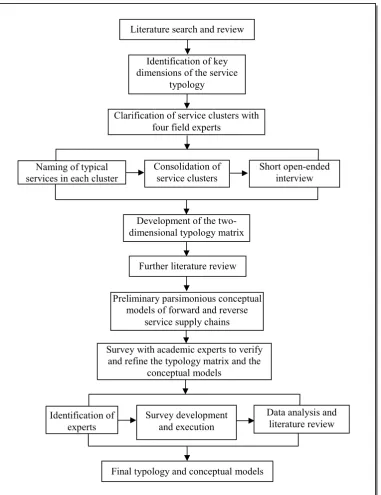
Figure 1 illustrates the process we followed. First, we reviewed the relevant literature
identified through a rigorous search of two major databases – ABI/Inform and
EBSCO – using keywords such as: service/supply chain, service/supply chain
management, service/reverse supply chain, service/closed/closed-loop supply chain,
and in each case we conducted the search with the word “service” included and with it
excluded. Each search was preceded by terms such as definition, theory, concept,
model, typology and inductive/deductive research. An extensive database of relevant
literature was developed through initial searches.
We then examined this literature in detail and, based on our initial reading, conducted
further searches adding additional literature to our database. This phase, in particular,
involved consulting books referred to by papers in our database. Our conceptual
development is the product of the integration of different works, summarizing
common elements through extensive discussions, contrasting the key concepts,
synthesizing the outcomes of our findings and applying “logical deduction” along the
lines suggested by Wacker (1998) and Handfield and Melnyk (1998).
[Insert Figure 1 about here]
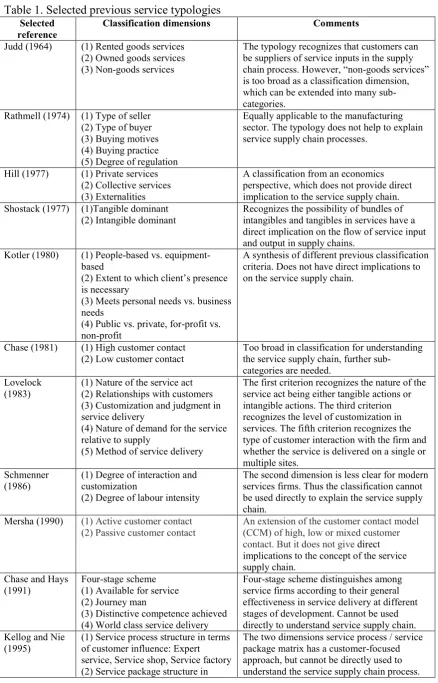
We used the previous literature (see Table 1) to identify key dimensions of service
typology and narrowed these down to dimensions helpful in the classification of
reverse supply chains. These dimensions (standardization of process and input, and
tangibility of expected service output) were used as the basis for the development of a
two-dimensional matrix (see Figure 2 in Section 4). We then used this typology, our
summary of the literature, extensive discussion and logical deduction to develop four
archetypal service clusters (see Figure 2).
We drew on the knowledge of four field experts in our effort to identify the four
archetypal service clusters. Our selection criteria for experts were: (1) alignment
between knowledge and research field; (2) publications in leading journals; and (3)
research leadership. Panels of experts offer opinion diversity, independence,
knowledge decentralization and opinion aggregation (Surowiecki, 2004). We used a
variant of the Delphi technique based on populated charts to obtain experts’ opinions
on the archetypal service clusters (VandeVen and Delbecq, 1974), but experts were
also asked to independently name some typical services or service firms and note
these on separate cards. They were then asked, independently, to place their cards
onto the two-dimensional matrix that had been developed. A researcher then
compared the four independently populated charts, noting the area of the chart on
which the cards were placed as well as the similarities and differences. Thirty
different services were identified by the experts, while 18 of those services were
shared between experts, within these 18 shared services 12 were put into the same
quadrant by all four experts yielding an inter-rater reliability of 66.7% (Gwet, 2014).
Where there were differences the experts were consulted to ascertain the logic of their
choices. The aim was to gain consensus, but where this was not forthcoming a simple
majority rule was applied. In the event there were only a few such cases and experts
reached consensus during the interview stage described below. The process enabled
the development of a single consolidated chart, with services having similar
characteristics being grouped together in an appropriate quadrant.
To enhance reliability, one of the researchers conducted a short open-ended interview
with each of the four experts independently, asking them to comment on why they
had placed the service in a particular quadrant and whether the overall typology was
robust. Services placed in a particular quadrant based on the majority rule (mentioned
above) were highlighted and consensus was reached at this stage. The literature was
revisited, using the service typology we had developed, in order to specify and
illustrate the basic structure and activities of the FSSC and the corresponding RSSC
of firms belonging to each archetypal service organization. The unit of analysis was
service firm. As a result of this process four FSSC and RSSC models were developed
for each archetypal service firm cluster. This culminated in a typology of FSSCs and
With the set of preliminary conceptual models developed, we followed a similar
approach to Lyles (1990) and Carrol (1994) by developing an open-ended
questionnaire and conducting a survey of academic experts world-wide to verify the
veracity and relevance of the proposed parsimonious conceptual models. We
identified a panel of 52 academic experts who had published in the previous five years
in leading journals, focusing on green or reverse logistics and supply chain, service
characteristics, service operation, service classification, service logistics, service
procurement including public organizations, and service supply chain.
We developed the open-ended questionnaire using Qualtrics – a popular
internet-based survey engine – allowing a combination of diagrams and text within the survey
instrument. The questionnaire was designed to ascertain the experts’ views on the
two-dimensional service typology and the four parsimonious models, as well as the
definitions of key terms, such as FSSC and RSSC, service input and output, and the
examples of archetypal services. Respondents were asked: (1) To what extent does the
service typology accurately capture the different types of services? (2) Are there any
service types not covered by this typology? and (3) To what extent does each of the
four conceptual models represent the essential characteristics of the FSSCs and
RSSCs of different type of services? The survey was included as a hyperlink in the
invitation email sent to our panel of academic experts. We received 39 responses, but
only 21 were fully completed resulting in an effective response rate of 40.38%. This
compares favourably with responses received by previous researchers targeting a
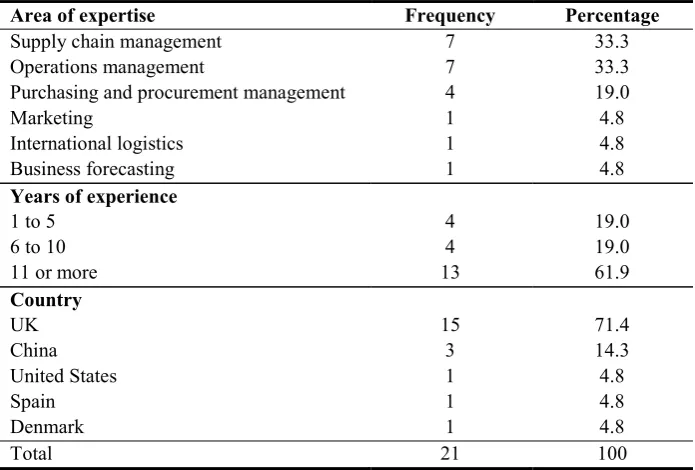
similar population (Lyles, 1990). Table 2 summarizes the basic profiles of the
respondents.
[Insert Table 2 about here]
Two of the authors independently reviewed the responses and noted the emerging
themes before comparing and synthesizing the responses; they had a consistent
interpretation to most of the open-ended responses and reached consistency on the
small number of responses with discrepancies after open discussion. While most of
the respondents generally agreed with the efficacy of the typology and the
parsimonious conceptual models, discrepancies in opinions were reviewed by
undertaking further review of the literature to improve and refine the preliminary
4. Towards a service typology
The heterogeneity of services makes it difficult to develop a grand conceptual
model/theory of service firms (Verma and Boyer, 2000). To advance our nascent
understanding of service firms’ forward and reverse supply chains we need to develop
clusters of service firms with common characteristics relevant to the conceptualization
of their forward and reverse supply chains. Therefore construction of a robust service
typology is a critical first step in the advancement of a conceptual RSSC. To this end,
we carefully examined the typologies proposed by leading scholars in the field
(including those of Judd, 1964; Rathmell, 1974; Shostack, 1977; Sasser et al., 1978;
Hill, 1977; Kotler, 1980; Chase, 1981; Lovelock, 1983; Schmenner, 1986, 1995;
Mersha, 1990; Chase and Hays, 1991; Kellog and Nie, 1995; see also Table 1) in light
of the definition of RSSC.
A product seems a logical dimension of a service typology designed to dovetail with
the development of conceptual models of the reverse supply chain. It was central to
the typologies developed by a number of scholars (Shostack 1977, 1982; Sasser et al.,
1978; Goodman and Steadman, 2002; Davis and Heineke, 2003). We used the idea of
the proportion of goods and services making up a product, suggested by Davis and
Heineke (2003), to delineate one dimension of our typology because it can be
objectively assessed. Moreover, it fits with the current definitions of a reverse supply
chain and is the foundation of a number of prominent existing typologies.
In assessing the proportion of tangible goods and services making up a product, it is
not sufficient to solely consider the product bundle. Rather, it is crucial to consider
how the product bundle is viewed by customers. For example, the core bundle offered
by mobile telecoms companies comprises mobile voice and data services. To reach
the market all the telecoms companies have retail businesses, and the design and
function of handsets is also highly valued by customers.
Another common element in definitions of the reverse supply chain is “value
generation”, which in turn is process driven (Silvestro et al., 1992; Hill et al., 2002).
To this end, a number of scholars have argued that manufacturing process labels
(namely “one-off” or “project”, “batch” or “continuous” process) can also be applied
classifications do not fully take into account the inherent variability created by
customer requirements (Silvestro et al., 1992). To address this criticism, some
researchers have developed process typologies using the extent of service
customization, so that at one extreme service processes are highly customized to meet
the needs of each customer, and at the other extreme standardized processes are
deployed to produce the desired product bundle (Maister and Lovelock, 1982; Kellog
and Nie, 1995). We extend this classification and suggest that services can be
produced through either customized/non-standardized processes and inputs, or
standardized processes and inputs.
By linking the two elements found commonly in the definitions of reverse supply
chain with the previous service sector typologies, we developed a two-dimensional
matrix reflecting the characteristics of key clusters of services pertinent to such supply
chains (see Figure 2). Later we use this matrix to develop the structure of forward and
reverse supply chains of service organizations falling within each of the four service
clusters identified.
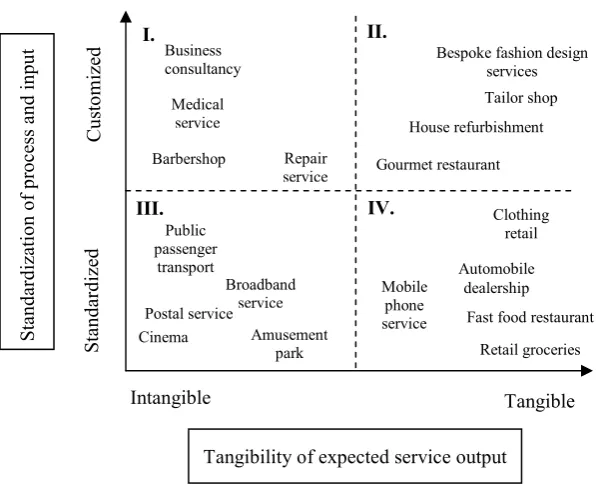
As shown in Figure 2, the horizontal axis represents the degree of tangibility of the
service output; the vertical axis represents the degree of standardization of the process
and input. Four clusters of services are therefore indicated by this matrix.
[Insert Figure 2 about here]
For the Type I cluster, service output (product bundle) is typically intangible as
valued by customers, but the process of producing the output relies on customized
input. Examples include medical service, business consultancy, barbershop and repair
service.
For the Type II cluster, service output (product bundle) is typically tangible, but the
process of producing the service is normally customized. A Savile Row tailor offers a
customized product and process, which is valued highly by the customer.
For the Type III cluster, service output (product bundle) is typically intangible as
valued by customers, and producing the service normally relies on standardized
processes and inputs. Typical examples include broadband service, public passenger
typically intangible in the form of experience, aesthetics or recreation (Goodman and
Steadman, 2002). The same standardized resources are dedicated to different
customers, although sometimes with limited levels of variation.
For the Type IV cluster, service output (product bundle) is typically tangible as valued
by customers, and the process of producing the service relies heavily on standardized
inputs. Typical examples include retailing, automobile dealerships and grocery stores.
Generally, these types of services tend to fit at the end of the manufacturing supply
chain – handling the distribution of product from manufacturer to customers.
Our verification process (feedback and interview with four field experts and survey of
opinions of leading academics) suggests that the proposed typology does not imply
absolute homogeneity within clusters, but rather signifies substantial similarity in
relation to the chosen dimensions.
5. Forward and reverse service supply chains illustrated
Based on the two-dimensional typology matrix (Figure 2) and the survey responses,
we now discuss the conceptual models illustrating the characteristics of the forward
and corresponding reverse supply chains for each of the four clusters of services. As
our aim is to develop pertinent insight into the main structure of the FSSC and the
RSSC, we do not include flow of funds and information in our conceptual models.
Instead we focus on the main input and output flows within the SSC. Moreover, we
do not extend our conceptual models beyond first-tier suppliers, to give a clear
conceptual view of the main value-adding activities of the focal service firm. To assist
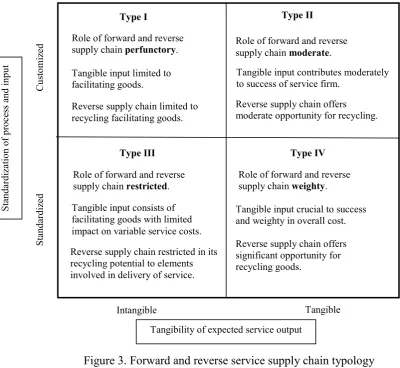
we have developed a simple schematic for each of our four archetypal FSSCs and
RSSCs, highlighting their key features (see Figure 3). A more detailed discussion is
provided in the following sections.
5.1 Type I forward and reverse service supply chain
In the Type I cluster, the intangible elements are valued highly by customers. The
purchasing process entails transfer of the intangible outputs, such as suppliers’
capacity, information or knowledge, to customers (Ellram et al., 2004). As the survey
respondents pointed out, in exceptional circumstances there may be some minor
transfer of tangibles. In the main, though, the physical goods involved play a
facilitating role. Moreover, the deployment of tangible inputs by the service firm is
relatively small compared to the value added serving a supporting role in the value
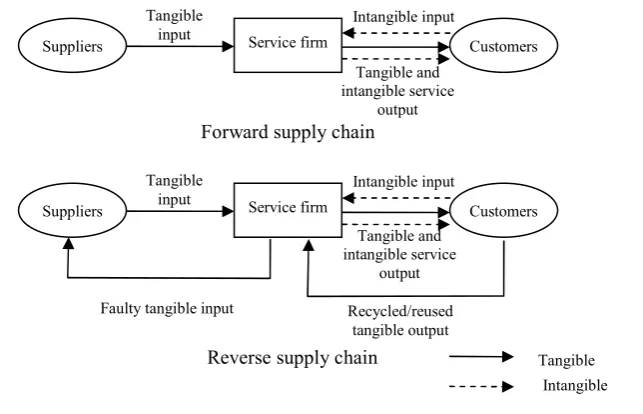
chain (Porter, 1985). Therefore the conceptual model (Figure 4) does not include
tangible outputs as a major flow from the service firm to customers. Instead,
intangible inputs, such as data, information, and knowledge, are converted into
intangible service outputs (Figure 4). The conversion of customer requirements into
service outputs is highly heterogeneous varying from case to case. The provision of
Type I services is crucially reliant on the knowledge and expertise of the service firm
personnel. The provision of Type I services requires intangible inputs, such as
knowledge, information, expertise and experience. In this sense, the forward supply
chain of a Type I cluster of services is more of an intangible supply chain.
Furthermore, as indicated by “customer–supplier duality”, customers themselves are
also suppliers of information or inputs – that is, they are both a recipient of the service
and a necessary input enabling the service to be performed (Sampson, 2000).
Therefore, in the forward supply chain of a Type I cluster of services, there is
simultaneous backward flow of intangible or tangible inputs from the customer to the
service firm. Hence the flow of intangible or tangible input in this type of service is
bi-directional, and the service firm is the hub of the input flows (see Figure 4).
[Insert Figure 4 about here]
For the Type I cluster, the RSSC processes start, for example, when the customer
returns with an uncomfortable condition after medical treatment, with a
malfunctioning device after a repair service, or with unsatisfactory solutions from a
consultancy firm. Since the service output is normally intangible and produced by
non-standardized inputs and resources dedicated to the specific customer, it is very
Therefore the start of the RSSC for Type I services invariably triggers a new FSSC
(Figure 4). The FSSC and the RSSC are likely to be the same for a Type I cluster of
services although the RSSC may be smaller in scale than the original FSSC, because
fewer resources or inputs may be required to undertake the rework.
5.2 Type II forward and reverse service supply chain
For the Type II cluster, customer requirements are bespoke and vary from case to case.
Customized resources and inputs are deployed according to specific customer
requirements. Unlike Type I services, the output bundle for Type II services includes
a larger tangible element. According to the survey respondents, although the
intangible element of output contributes significantly to the service value added,
tangible inputs and outputs are critical for this cluster of services. Type II SSCs more
closely mimic manufacturing supply chains, but the service is highly customized and
customer driven (Figure 5). Suppliers to Type II services will normally supply
tangible inputs to the service firm, such as parts, ingredients, components and
materials. The service firm will then deploy its in-house expertise to convert these
tangible inputs into tangible and intangible service outputs. For this type of service,
customer information, personal data and preferences are important intangible inputs.
Therefore the FSSCs of Type II services have a bi-directional element between the
focal service firm and its customers (Figure 5).
[Insert Figure 5 about here]
For a Type II service, the RSSC is again likely to be triggered by customer
dissatisfaction with the tangible service output. However, since the original service
outputs are customized or personalized, it is likely that only a small proportion, if any
at all, of the original tangible service output can be returned to the supply chain
directly for reuse. Interestingly, a survey respondent commented “an over-cooked dish
cannot be recooked or consumed by another customer once served”; “a refurbishment
is likely to be modified in situ” (although some removable fixtures can be returned);
“a tailored dress/suit is also likely to be modified and if this is not possible, the
suppliers of the textiles are unlikely to find any value in taking back the highly
unlikely because the service provider would not have the infrastructure and because of
potential damage to the brand.
As with Type I services, for Type II services the start of the RSSC process is likely to
trigger the start of a new FSSC, since rework is normally needed (Figure 5). However,
a low level of recycling or reuse of the original tangible output may be possible for
Type II services.
5.3 Type III forward and reverse service supply chain
The Type III cluster possesses the same expected service output characteristics as
Type I services, in that the outputs expected by customers are generally intangible.
There is essentially very limited or no flow of tangible outputs from the service
provider to the customer. These services generally involve the transfer of experience
or capability to the customer, or physical transformation (e.g. transport) (Ellram et al.,
2004). Even if there is a flow of tangible output between the service firm and the
customer, it will account for a very small proportion of the service value offered to the
customer. Here, unlike Type I services, the conversion of customer requirements into
service output is normally much more standardized and does not vary significantly
from customer to customer. To perform the service the firm will deploy standardized
tangible or intangible inputs. Therefore, alongside a relatively small degree of
intangible input flow generated by limited customer input choices, for Type III
services there is significant tangible input flow from suppliers to the service firm
(Figure 6).
Moreover, compared to Type I services, although customer information or personal
data are an input to the service process, as pointed out by a survey respondent, they
are not the key inputs to Type III service processes. The concept of “customer–
supplier duality” (Sampson, 2000) is much less prevalent. Therefore we do not
consider customer input as an important input flow in the FSSCs of Type III services
(Figure 6).
[Insert Figure 6 about here]
For Type III services, the main service outputs are intangible experiences. Such
output purchased or consumed by the customer in most cases cannot be reversed; it
can only be exited/stopped by the customer (and possibly a refund issued). Therefore
no reverse flow of output from customers can be identified (Figure 6). However, in
some Type III services, such as broadband services, facilitating goods such as internet
modems could be returned for reuse; similarly, in others, facilitating goods such as
vehicles have recyclable materials, which can be reclaimed.
The equipment, facilities and infrastructure used to provide many examples of Type
III services are usually dedicated for specific purposes, and consequently it is
normally unlikely for the service firm to be able to return bundles of its fixtures,
facilities and equipment back to suppliers. To restore the right level of service,
suppliers will normally rework or reinstall the facilities and infrastructures for the
service firm, although the scale of rework may be smaller than the original input.
Meanwhile, suppliers may renew necessary intangible inputs, such as training and
information supply. As such, although both tangible and intangible inputs are needed
for the FSSC of the Type III cluster of services, only the tangible part of the inputs
may be returned to the supplier in the RSSC for recycle or reuse (Figure 6).
5.4 Type IV forward and reverse service supply chain
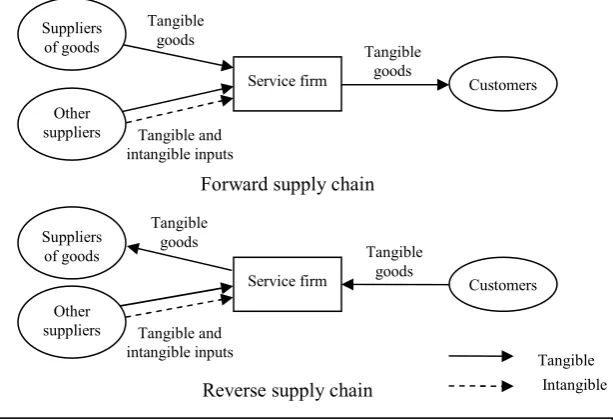
For a Type IV cluster, the output valued by the customer is normally highly tangible.
The provision of the service to the customer primarily entails distributing standard
tangible goods from the supplier to the customer. The service firm is typically located
at the end of a manufacturing supply chain with the upstream manufacturer or
wholesaler of tangible goods being their main supplier. The direction of flow of the
tangible goods is from the supplier to the service firm and then to the customer (i.e.
uni-directional). Moreover, the conversion of any customer requirements into output
is highly standardized with only small variations from customer to customer.
Alongside the tangible goods to be distributed, Type IV services will deploy
standardized tangible or intangible inputs and resources, such as point of sales (POS)
devices, shelves and employees trained to a standard specification (e.g. sales
personnel) to perform the service. Thus there will be tangible and intangible input
flows from other suppliers to the service firm, which are separated from the suppliers
[Insert Figure 7 about here]
The RSSC of a Type IV cluster of services starts with customers returning their
tangible service output (i.e. goods). With the exception of rapidly perishable goods
(e.g. retail groceries), since the outputs of Type IV services are more tangible and
standardized, it is likely that a high proportion of those outputs can be returned back
to the supply chain. While the flow of tangible goods is reversed in the RSSC,
standardized tangible or intangible inputs and resources are still required by the
service firm to carry out its service. Thus there will be continued forward flows of
tangible and intangible input from other suppliers to the service firm (Figure 7).
6. Discussion and implications
The heterogeneity of services makes it almost impossible to develop grand
theories/concepts. The FSSCs and RSSCs follow this general rule. A better
understanding of the characteristics of FSSCs and RSSCs is predicated on the
development of an appropriate service typology. We developed such a typology using
two dimensions critical in the design and understanding of the FSSC and RSSC –
degree of output tangibility and level of standardization of inputs and processes –
underpinned by the extant literature, field experts’ comments and interviews, and an
extensive survey of leading academics. We then developed FSSCs and RSSCs for
each cluster of services, testing their veracity by deploying our three-stage process.
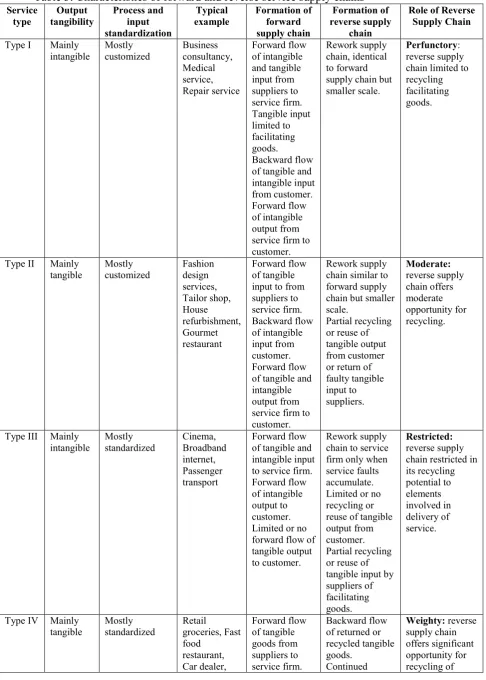
The characteristics of the four archetypal FSSCs and RSSCs are summarized in
Table 3, showing their unique characteristics and commonalities as well as the
configuration of the main input and output flows and their direction in the
value-adding process.
We identify how significant the reverse operation is and describe the differences
between FSSC and RSSC processes. These differences are governed by the service
bundle’s level of tangibility.
For Type I services, the role of the RSSC is “perfunctory”, since it is limited to
recycling facilitating goods or engaging in minor reworking. The RSSC is identical to
For Type II services, the RSSC plays a “moderate” role, typically concerned with
small-scale recycling of tangible output from the customer or return of faulty tangible
inputs to the original vendors.
For Type III services, the role of the RSSC is “restricted”, since its function is limited
to recycling facilitating goods that are substantial in nature.
For Type IV services, the role of the RSSC is “weighty” as there is significant
opportunity for recycling of tangible goods – a significant element of the service.
[Insert Table 3 about here]
The following points arise from the delineation of the different characteristics of the
FSSC and the RSSC. First, services deploying non-standardized inputs to produce
bespoke outputs are generally dependent on customer inputs – data, information,
service users – resulting in bi-directionality in the FSSC.
Second, for these services the start of the RSSC will normally trigger a new FSSC
chain because the service output generated will vary from customer to customer to
meet individual requirements. It is therefore unlikely that the original output would be
returned back to the supply chain directly. Hence, the RSSC operates as a forward
“rework” chain. There may also be limited opportunity for reusing or recycling some
of the facilitating goods.
Third, services deploying non-standardized inputs to produce bespoke outputs require
greater operational flexibility and human resource versatility. The operations system
and human capital may need adjustment from customer to customer, thus making
quality consistency and service-level maintenance more difficult in both the FSSC
and the RSSC. Especially when the reverse process is triggered by an unsatisfied
customer or service failure, it is more critical for the service firm to reconfigure its
resources and human capital to recover its services. According to the service recovery
literature (e.g. Hart et al., 1990; Spreng et al., 1995; Webster and Sundaram, 1998;
Miller et al., 2000) customer loyalty will be maintained if adequate efforts are made
to create rapid response to customers, to empower employees to generate local
Fourth, the more tangible the output component of the service bundle, the higher the
proportion of the service output that could be returned in the RSSC for recycling,
reuse or resale (or disposal). Intangible service outputs do not readily lend themselves
to be “reversed” or returned once consumed or once the service-delivery process has
commenced. Instead, they can only be stopped, or sometimes reworked. Thus it is not
feasible to reverse the intangible elements of a service along the supply chain, which
is very different from the RSC of manufacturing firms (e.g. Lau and Wang, 2009;
Govindan and Popiuc, 2014).
6.1 Practical implications
The FSSC and RSSC typologies presented in this paper offer practising managers a
classification system enabling them to better design their FSSCs and RSSCs. The
typologies clarify and group together services based on the service bundle and
customization of inputs and process, the nature of the relationship with customers and
the characteristics of the service delivery system. This in turn helps managers to
decide on an appropriate level of focus, time and investment in designing and
operating their FSSCs and RSSCs. The supply chain, relationship with suppliers and
channels of distribution are among the critical elements of firms’ business models.
They assume greater importance in service firms because customers and the
information they provide are among the important component inputs of, and integral
to, channels of distribution. The typologies presented in this paper help managers to
better align the internal elements of their business model – an important source of
competitive advantage. Furthermore, they help with external alignment and a deeper
appreciation of the supply chain contributes to business model innovation.
Another key practical point concerns the increased risk of service inconsistency
inherent in the high reliance on customized/non-standardized inputs (Ungan, 2006).
To mitigate this risk an effective documentation and talent-retention system is
required (Ungan, 2006). This in turn will reduce the need for rework and hence result
in cost reduction and shorter recycle lead-time increasing the efficiency of the RSSC.
Although input standardization can reduce supply chain risks and improve
consistency in the FSSCs and RSSCs, in reality process standardization and output
variation can be a trade-off. Managers need to balance the degree of input
while the cost and extra complexity caused by RSSC processes are minimized. For
Type I and II services issues with output are likely to lead to increased costs with no
cost recovery opportunity, hence the best way of reducing the costs of the RSSC is not
allowing it to happen (Miller et al., 2000).
6.2 Research implications
For academics, the conceptual models of FSSCs and RSSCs and the subsequent
typology offer the basis for identifying research gaps and a better ordered exploration
of RSSCs. Our proposed typology along with the review of the extant literature
suggests an imbalance in the research effort. Most of the previous research has
focused on Type IV RSSCs (e.g. Bienstock et al., 2011; Ruiz-Benitez and Muriel,
2014), while the consideration of Type I, II and III services is very sparse. More
importantly, the typology allows theoretical developments for each cluster of services
and their FSSCs and RSSCs and better focused empirical research.
It was not our intention to provide a fine-grained specification of the actual value
chain process through which service outputs are produced. For example, we do not
include the flow of information in our conceptual models, unless the flow of
information forms an important service input, as in the case of Type I and II services.
This is because the service sector is highly heterogeneous and our intention was to
provide, as clearly as possible, a differentiation between the four service clusters and
their resultant FSSCs and RSSCs focusing on primary value-adding activities. In
doing so, we highlight the distinct characteristics of the FSSC and RSSC of each
cluster of firms. Future researchers, however, could extend our conceptual models by
adding flows of funds, information and knowledge – developing a fine-grained
representation of supply chains of firms in each cluster.
It is also important to note that some services and their associated FSSC and RSSC
may fall on or close to the boundaries delineating the four clusters, a common issue
with all typologies. This point was alluded to by a number of experts participating in
our survey. For example, a cruise ship offers a bundle of both intangible and tangible
outputs, based on both standardized and customized service outputs (Veronneau and
Roy, 2009), thus having characteristics of different RSSCs. This raises an important
conceptual models. Many service firms provide a combination of different types of
services. For example, a cinema nowadays is likely to offer movie screening (Type
III), restaurant facilities (Type II) and retail merchandising (Type IV) at the same time.
A medical tourism service combines medical service (Type I) and tourism (Type III)
(Lee and Fernando, 2015). Therefore for future researchers the choice of unit of
analysis assumes greater importance, for example, the firm or its business units. It
may be more pertinent to focus on the FSSC and RSSC of the business unit to
develop a finer grained understanding. Our typology helps researchers to better
choose their unit of analysis.
7. Conclusions
Prior research has tended to apply manufacturing-oriented frameworks directly or
with limited modifications to examining SSC management (Swank, 2003; Ellram et
al., 2004; Giannakis, 2011), hence limiting the opportunity for developing
generalizable service-specific theories. Here we present the basic structure of FSSCs
and their corresponding RSSCs related to four general service clusters. The
conceptual models presented will help future researchers and practitioners to better
clarify the processes of the FSSC and RSSC of each cluster of service firms, and to
develop better solutions to reduce service gaps, optimize service value chains and
enhance the potential for value recapture or creation from RSSC activities. We
explore both the FSSC and RSSC for each of our clusters because we firmly establish
that the FSSC and RSSC are not mutually exclusive. This is particularly important
given the limited previous research addressing service firms’ supply chains.
This paper, while making a unique contribution, has a number of limitations leading
us to propose areas for future research. First, our conceptual models serve as a starting
point and may not neatly fit all the different types of service provision. In reality there
may be many services that fall at the intercept of our typology matrix, or there will be
some exceptions not fitting into our typology matrix. However, our typology is more
of what Kellog and Nie (1995) referred to as a “midrange” typology of services,
which restricts the scope to more manageable segments, rather than a “grand”
typology capable of embracing all organizations. Therefore most service firms will fit
into the matrix or find useful insights from using the service typology and the related
for some services, and there may be other ways of categorizing SSCs to augment our
conceptualization of the RSSC. Future researchers may wish to explore other
dimensions of service classification to develop finer grained classification schemes.
Second, as was pointed out by the experts responding to our survey, we do not claim
that the four parsimonious conceptual models are an absolute representation of all
services. Our models can be criticized as being oversimplified, particularly given the
breath covered by service firms. However, our conceptual models will allow for easier
evaluation and comparison of different service firms’ FSSCs and RSSCs. Our
conceptual models provide a starting point for examining the variation and
commonalities in FSSCs and RSSCs and they pave the way for a more focused
conceptualization of SSCs.
Third, the conceptualization of forward and reverse supply chains in this paper does
not extend to the network structure of many supply chains, or incorporate the
dimension of supply chain collaborations (Chakraborty et al., 2014; Lee and Fernando,
2015). In our conceptual models we did not extend the supply chain beyond first-tier
suppliers or customers. This is because we sought to bring a high level of initial
clarity to the conceptual models. Future research could elaborate more on the
extended network structure of the SSCs and on collaborative relationships between
SSC actors.
References
Albino, V., Izzo, C. and Kuhtz, S. (2002), "Input–output models for the analysis of a local/global supply chain", International Journal of Production Economics, Vol. 78, No. 2, pp. 119–31.
Amini, M. M., Retzlaff-Roberts, D. and Bienstock, C. C. (2005), "Designing a reverse logistics operation for short cycle time repair services", International Journal of Production Economics, Vol. 96, No. 3, pp. 367–80.
Bienstock, C. C., Amini, M. and Retzlaff-Roberts, D. (2011), "Reengineering a reverse supply chain for product returns services", International Journal of Business Performance and Supply Chain Modelling, Vol. 3, No. 4, pp. 335–52. Blackburn, J. D., Guide, V. D. R., Souza, G. C. and Van Wassenhove, L. N. (2004),
"Reverse supply chains for commercial returns", California Management Review, Vol. 46, No. 2, pp. 6–22.
Carrol, A. B. (1994), "Social issues in management research", Business and Society, Vol. 33, No. 1, pp. 5–29.
Chakraborty, S., Bhattacharya, S. and Dobrzykowski, D. D. (2014), "Impact of supply chain collaboration on value co-creation and firm performance: a healthcare service sector perspective", Procedia Economics and Finance, Vol. 11, pp. 676–94.
Chase, R. B. (1981), "The customer contact approach to services: theoretical bases and practical extensions", Operations Research, Vol. 29, No. 4, pp. 698–710. Chase, R. B. and Hays, R. H. (1991), "Beefing up operations in service firms", Sloan
Management Review, Vol. 33, No. 1, pp. 15–26.
Chuang, C.-H., Wang, C. X. and Zhao, Y. (2014), "Closed-loop supply chain models for a high-tech product under alternative reverse channel and collection cost structures", International Journal of Production Economics, Vol. 156, pp. 108–23.
Davis, M. M. and Heineke, J. (2003), Managing Services: Using Technology to Create Value, McGraw-Hill, Irwin.
Ellram, L. M., Tate, W. L. and Billington, C. (2004), "Understanding and managing the services supply chain", Journal of Supply Chain Management, Vol. 40, No. 4, pp. 17–32.
Giannakis, M. (2011), "Management of service supply chains with a service-oriented reference model: the case of management consulting", Supply Chain
Management: An International Journal, Vol. 16, No. 5, pp. 346–61.
Goodman, B. and Steadman, R. (2002), "Services: business demand rivals consumer demand in driving job growth", Monthly Labor Review, Vol. 125, No. 4, pp. 3–9.
Govindan, K. and Popiuc, M. N. (2014), "Reverse supply chain coordination by revenue sharing contract: a case for the personal computers industry", European Journal of Operational Research, Vol. 233, No. 2, pp. 326–36. Govindan, K., Popiuc, M. N. and Diabat, A. (2013), "Overview of coordination
contracts within forward and reverse supply chains", Journal of Cleaner Production, Vol. 47, pp. 319–34.
Govindan, K., Soleimani, H. and Kannan, D. (2015), "Reverse logistics and closed-loop supply chain: a comprehensive review to explore the future", European Journal of Operational Research, Vol. 240, No. 3, pp. 603–26.
Gwet, K. L. (2014), Handbook of Inter-Rater Reliability: The Definitive Guide to Measuring the Extent of Agreement Among Multiple Raters, Advanced Analytics, LLC, Gaithersburg, MD.
Handfield, R. B. and Melnyk, S. A. (1998), "The scientific theory-building process: a primer using the case of TQM", Journal of Operations Management, Vol. 16, No. 4, pp. 321–39.
Hart, C. W., Heskett, J. L. and Sasser, W. E. J. (1990), "The profitable art of service recovery", Harvard Business Review, Vol. 68, No. 4, pp. 148–56.
Hill, A. V., Collier, D. A., Froehle, C. M., Goodale, J. C., Metters, R. D. and Verma, R. (2002), "Research opportunities in service process design", Journal of Operations Management, Vol. 20, No. 2, pp. 189–202.
Hill, T. P. (1977), "On goods and services", Review of Income and Wealth, Vol. 23, No. 4, pp. 315–38.
Jayaraman, V. and Luo, Y. (2007), "Creating competitive advantages through new value creation: a reverse logistics perspective", Academy of Management Perspectives, Vol. 21, No. 2, pp. 56–73.
Jayaraman, V., Guide Jr, V. and Srivastava, R. (1999), "A closed-loop logistics model for remanufacturing", Journal of the Operational Research Society, Vol. 50, pp. 497–508.
Johnson, M. and Mena, C. (2008), "Supply chain management for servitised products: a multi-industry case study", International Journal of Production Economics, Vol. 114, No. 1, pp. 27–39.
Judd, R. C. (1964), "The case for redefining services", Journal of Marketing, Vol. 28, No. 1, pp. 58–9.
Kellog, D. L. and Nie, W. (1995), "A framework for strategic service management", Journal of Operations Management, Vol. 13, No. 4, pp. 323–37.
Kotler, P. (1980), Principles of Marketing, Prentice Hall, Englewood Cliffs, NJ. Lau, K. H. and Wang, Y. (2009), "Reverse logistics in the electronic industry of
China: a case study", Supply Chain Management: An International Journal, Vol. 14, No. 6, pp. 447–65.
Lee, H. K. and Fernando, Y. (2015), "The antecedents and outcomes of the medical tourism supply chain", Tourism Management, Vol. 46, pp. 148–57.
Lillrank, P., Groop, J. and Venesmaa, J. (2011), "Processes, episodes and events in health service supply chains", Supply Chain Management: An International Journal, Vol. 16, No. 3, pp. 194–201.
Lovelock, C. H. (1983), "Classifying services to gain strategic marketing insights", Journal of Marketing, Vol. 47, No. 3, pp. 9–20.
Lyles, M. A. (1990), "A research agenda for strategic management in the 1990s", Journal of Management Studies, Vol. 27, No. 4, pp. 363–75.
Mafakheri, F. and Nasiri, F. (2013), "Revenue sharing coordination in reverse logistics", Journal of Cleaner Production, Vol. 59, pp. 185–96.
Maister, D. and Lovelock, C. H. (1982), "Managing facilitator services", Sloan Management Review, Vol. 23, pp. 19–31.
Meredith, J. (1993), "Theory building through conceptual methods", International Journal of Operations & Production Management, Vol. 13, No. 5, pp. 3–11. Mersha, T. (1990), "Enhancing the customer contact model", Journal of Operations
Management, Vol. 9, No. 3, pp. 391–405.
Miller, J. L., Craighead, C. W. and Karwan, K. R. (2000), "Service recovery: a framework and empirical investigation", Journal of Operations Management, Vol. 18, No. 4, pp. 387–400.
Mondragon, A. E. C., Lalwani, C. and Mondragon, C. E. C. (2011), "Measures for auditing performance and integration in closed-loop supply chains", Supply Chain Management: An International Journal, Vol. 16, No. 1, pp. 43–56. ONS (2014), "Index of services, October 2014", Office for National Statistics,
Released 23 December 2014. Available at: www.ons.gov.uk/ons/rel/ios/index-of-services/october-2014/index.html (accessed 9 September 2015).
OUSTR (2014), "Services and investment: services", Office of the United States Trade Representative, www.ustr.gov/trade-topics/services-investment/services (accessed January 2014).
Porter, M. E. (1985), Competitive Advantage: Creating and Sustaining Superior Performance, Simon and Schuster, New York.
Ruiz-Benitez, R. and Muriel, A. (2014), "Consumer returns in a decentralized supply chain", International Journal of Production Economics, Vol. 147, Part C, pp. 573–92.
Sampson, S. E. (2000), "Customer-supplier duality and bidirectional supply chains in service organizations", International Journal of Service Industry Management, Vol. 11, No. 4, pp. 348–64.
Sasser, W. E., Jr., Olsen, R. P. and Wyckoff, D. D. (1978), Management of Service Operations: Text and Cases, Allyn and Bacon, Boston, MA.
Sasser, W. E., Olsen, R. R. and Wyckoff, D. D. (1982), Management of Service Operations, Allyn and Bacon, Boston, MA.
Schmenner, R. W. (1986), "How can service businesses survive and prosper", Sloan Management Review, Vol. 27, No. 3, pp. 21–32.
Schmenner, R. W. (1995), Service Operations Management, Prentice Hall, Englewood Cliffs, NJ.
Sengupta, K., Heiser, D. and Koll, L. (2006), "Manufacturing and service supply chain performance: a comparative analysis", Journal of Supply Chain Management, Vol. 42, No. 4, pp. 4–15.
Shi, X. and Liao, Z. (2013), "Managing supply chain relationships in the hospitality services: an empirical study of hotels and restaurants", International Journal of Hospitality Management, Vol. 35, pp. 112–21.
Shostack, G. L. (1977), "Breaking free from product marketing", Journal of Marketing, Vol. 41, No. 4, pp. 73–80.
Shostack, G. L. (1982), "How to design a service", European Journal of Marketing, Vol. 16, No. 10, pp. 49–63.
Silvestro, R., Fitzgerald, L., Johnston, R. and Voss, C. (1992), "Towards a
classification of service processes", International Journal of Service Industry Management, Vol. 3, No. 3, pp. 62–75.
Spreng, R. A., Harrell, G. D. and Mackoy, R. D. (1995), "Service recovery: impact on satisfaction and intentions", Journal of Services Marketing, Vol. 9, No. 1, pp. 15–23.
Surowiecki, J. (2004), The Wisdom of Crowds: Why the Many Are Smarter Than the
Few and How Collective Wisdom Shapes Business, Economies, Societies and Nations, Anchor, New York.
Swank, C. K. (2003), "The lean service machine", Harvard Business Review, Vol. 81, No. 10, pp. 123–9.
Ungan, M. C. (2006), "Standardization through process documentation", Business Process Management Journal, Vol. 12, No. 2, pp. 135–48.
VandeVen, A. H. and Delbecq, A. L. (1974), "The effectiveness of nominal, delphi, and interacting group decision making processes", Academy of Management Journal, Vol. 17, No. 4, pp. 605–21.
Verma, R. and Boyer, K. K. (2000), "Service classification and management challenges", Journal of Business Strategies, Vol. 17, No. 1, pp. 5–24.
Veronneau, S. and Roy, J. (2009), "Global service supply chains: an empirical study of current practices and challenges of a cruise line corporation", Tourism Management, Vol. 30, No. 1, pp. 128–39.
Wacker, J. G. (1998), "A definition of theory: research guidelines for different theory-building research methods in operations management", Journal of Operations Management, Vol. 16, No. 4, pp. 361–85.
Table 1. Selected previous service typologies Selected
reference
Classification dimensions Comments
Judd (1964) (1) Rented goods services (2) Owned goods services (3) Non-goods services
The typology recognizes that customers can be suppliers of service inputs in the supply chain process. However, “non-goods services” is too broad as a classification dimension, which can be extended into many sub-categories.
Rathmell (1974) (1) Type of seller (2) Type of buyer (3) Buying motives (4) Buying practice (5) Degree of regulation
Equally applicable to the manufacturing sector. The typology does not help to explain service supply chain processes.
Hill (1977) (1) Private services (2) Collective services (3) Externalities
A classification from an economics perspective, which does not provide direct implication to the service supply chain. Shostack (1977) (1)Tangible dominant
(2) Intangible dominant
Recognizes the possibility of bundles of intangibles and tangibles in services have a direct implication on the flow of service input and output in supply chains.
Kotler (1980) (1) People-based vs. equipment-based
(2) Extent to which client’s presence is necessary
(3) Meets personal needs vs. business needs
(4) Public vs. private, for-profit vs. non-profit
A synthesis of different previous classification criteria. Does not have direct implications to on the service supply chain.
Chase (1981) (1) High customer contact (2) Low customer contact
Too broad in classification for understanding the service supply chain, further
sub-categories are needed. Lovelock
(1983)
(1) Nature of the service act (2) Relationships with customers (3) Customization and judgment in service delivery
(4) Nature of demand for the service relative to supply
(5) Method of service delivery
The first criterion recognizes the nature of the service act being either tangible actions or intangible actions. The third criterion recognizes the level of customization in services. The fifth criterion recognizes the type of customer interaction with the firm and whether the service is delivered on a single or multiple sites.
Schmenner (1986)
(1) Degree of interaction and customization
(2) Degree of labour intensity
The second dimension is less clear for modern services firms. Thus the classification cannot be used directly to explain the service supply chain.
Mersha (1990) (1) Active customer contact (2) Passive customer contact
An extension of the customer contact model (CCM) of high, low or mixed customer contact. But it does not give direct implications to the concept of the service supply chain.
Chase and Hays (1991)
Four-stage scheme (1) Available for service (2) Journey man
(3) Distinctive competence achieved (4) World class service delivery
Four-stage scheme distinguishes among service firms according to their general effectiveness in service delivery at different stages of development. Cannot be used directly to understand service supply chain. Kellog and Nie
(1995)
(1) Service process structure in terms of customer influence: Expert service, Service shop, Service factory (2) Service package structure in
terms of degree of customization: Unique, Selective, Restricted Goodman and
Steadman (2002)
(1) Physical (2) Intellectual (3) Aesthetic
(4) Service of experiential value
A generic typology recognizes services being diversified in providing physical goods and intangible services. Helps to explain different types of service output generated by service firms along the supply chain.
Davis and Heineke (2003)
Proportion of goods and services making up a service product
Table 2. Profile of experts responding to the semi-structured survey
Area of expertise Frequency Percentage
Supply chain management 7 33.3
Operations management 7 33.3
Purchasing and procurement management 4 19.0
Marketing 1 4.8
International logistics 1 4.8
Business forecasting 1 4.8
Years of experience
1 to 5 4 19.0
6 to 10 4 19.0
11 or more 13 61.9
Country
UK 15 71.4
China 3 14.3
United States 1 4.8
Spain 1 4.8
Denmark 1 4.8
Table 3. Characteristics of forward and reverse service supply chains Service type Output tangibility Process and input standardization Typical example Formation of forward supply chain Formation of reverse supply chain
Role of Reverse Supply Chain
Type I Mainly intangible Mostly customized Business consultancy, Medical service, Repair service Forward flow of intangible and tangible input from suppliers to service firm. Tangible input limited to facilitating goods. Backward flow of tangible and intangible input from customer. Forward flow of intangible output from service firm to customer.
Rework supply chain, identical to forward supply chain but smaller scale.
Perfunctory:
reverse supply chain limited to recycling facilitating goods.
Type II Mainly tangible Mostly customized Fashion design services, Tailor shop, House refurbishment, Gourmet restaurant Forward flow of tangible input to from suppliers to service firm. Backward flow of intangible input from customer. Forward flow of tangible and intangible output from service firm to customer.
Rework supply chain similar to forward supply chain but smaller scale.
Partial recycling or reuse of tangible output from customer or return of faulty tangible input to suppliers. Moderate: reverse supply chain offers moderate opportunity for recycling.
Type III Mainly intangible Mostly standardized Cinema, Broadband internet, Passenger transport Forward flow of tangible and intangible input to service firm. Forward flow of intangible output to customer. Limited or no forward flow of tangible output to customer.
Rework supply chain to service firm only when service faults accumulate. Limited or no recycling or reuse of tangible output from customer. Partial recycling or reuse of tangible input by suppliers of facilitating goods.
Restricted:
reverse supply chain restricted in its recycling potential to elements involved in delivery of service.
Type IV Mainly tangible Mostly standardized Retail groceries, Fast food restaurant, Car dealer, Forward flow of tangible goods from suppliers to service firm. Backward flow of returned or recycled tangible goods.
Continued
Weighty: reverse
Clothing retail Forward flow of tangible and intangible input from suppliers of facilitating goods and services to service firm. Forward flow of tangible output from service firm to customer.
forward flow of tangible and intangible inputs from suppliers of facilitating goods and services to service firm.
Figure 1. Conceptual model development process
Literature search and review Identification of key dimensions of the service
typology
Clarification of service clusters with four field experts
Preliminary parsimonious conceptual models of forward and reverse
service supply chains Survey with academic experts to verify
and refine the typology matrix and the conceptual models
Development of the two-dimensional typology matrix Naming of typical
services in each cluster
Short open-ended interview
Final typology and conceptual models Further literature review
Consolidation of service clusters
Identification of experts
Survey development and execution
Figure 2. Process standardization: output tangibility matrix
Fast food restaurant
S ta n d ar d iz at io n o f p ro ce ss a n d i n p u t
Tangibility of expected service output
Intangible Tangible
S ta n d ar d iz ed C u st o m iz ed Automobile dealership Clothing retail House refurbishment Business consultancy Cinema Gourmet restaurant Medical service Barbershop Broadband service Amusement park
I. II.
III. IV.
Repair service Public passenger transport Tailor shop Retail groceries Bespoke fashion design
services