https://doi.org/10.1007/s00426-018-1107-3
ORIGINAL ARTICLE
You ≠ me: individual differences in the structure of social cognition
D. J. Shaw1,2 · K. Czekóová1,3 · C. R. Pennington4 · A. W. Qureshi5 · B. Špiláková1 · M. Salazar1 · M. Brázdil1 · T. Urbánek3
Received: 17 April 2018 / Accepted: 4 October 2018 © The Author(s) 2018
Abstract
This study investigated the structure of social cognition, and how it is influenced by personality; specifically, how various socio-cognitive capabilities, and the pattern of inter-relationships and co-dependencies among them differ between diver-gent personality styles. To measure social cognition, a large non-clinical sample (n = 290) undertook an extensive battery of self-report and performance-based measures of visual perspective taking, imitative tendencies, affective empathy, intero-ceptive accuracy, emotion regulation, and state affectivity. These same individuals then completed the Personality Styles and Disorders Inventory. Latent Profile Analysis revealed two dissociable personality profiles that exhibited contrasting cognitive and affective dispositions, and multivariate analyses indicated further that these profiles differed on measures of social cognition; individuals characterised by a flexible and adaptive personality profile expressed higher action orientation (emotion regulation) compared to those showing more inflexible tendencies, along with better visual perspective taking, superior interoceptive accuracy, less imitative tendencies, and lower personal distress and negativity. These characteristics point towards more efficient self-other distinction, and to higher cognitive control more generally. Moreover, low-level cognitive mechanisms served to mediate other higher level socio-emotional capabilities. Together, these findings elucidate the cognitive and affective underpinnings of individual differences in social behaviour, providing a data-driven model that should guide future research in this area.
Introduction
We take for granted the sophisticated repertoire of skills required to navigate our way through the myriad of social contexts encountered on a daily basis. Even in simple face-to-face interactions, for example, achieving a desired out-come requires us to infer the mental and emotional states of our interaction partner(s) whilst adapting our own behav-iour accordingly. This broad set of cognitive mechanisms is referred to collectively as social cognition, and an extensive literature has revealed its highly nuanced and multifaceted composition (see Frith & Frith, 2012; Happé, Cook, & Bird,
2017). Despite this developing understanding, however, an overarching model of social cognition has not yet been spec-ified; it remains unknown if and how its various sub-com-ponents are inter-related or co-dependent on one another, or how individual differences in this structure impact on social behaviour.
Research has delineated a variety of socio-cognitive and -emotional mechanisms that enable individuals to interact within social situations (see Frith & Frith, 2012). The conventional perspective on social cognition places each facet within a hierarchical network, in which lower
Electronic supplementary material The online version of this article (https ://doi.org/10.1007/s0042 6-018-1107-3) contains supplementary material, which is available to authorized users.
* D. J. Shaw
1 Behavioural and Social Neuroscience Research Group,
CEITEC - Central European Institute of Technology, Masaryk University, Kamenice 5, 62500 Brno, Czech Republic
2 Department of Psychology, School of Life and Health
Sciences, Aston University, Birmingham B4 7ET, UK
3 Institute of Psychology, Academy of Sciences of the Czech
Republic, Veveří 97, 60200 Brno, Czech Republic
4 Department of Health and Social Sciences, Faculty of Health
and Applied Sciences, University of the West of England, Coldharbour Lane, Bristol BS16 1QY, UK
5 Department of Psychology, Edge Hill University, St Helens
level mechanisms contribute partly towards, or serve as necessary prerequisites for higher level processes (Happé et al., 2017). One such elementary mechanism is self-other distinction (SOD), through which we are able to treat inde-pendently and distinguish flexibly between representations of the self and others (Lamm, Bukowski, & Silani, 2016; Steinbeis, 2016). Inefficient SOD results in ego-centric misattributions of our own cognitive and affective states onto others, leading us to respond inappropriately in social interactions. This is true, especially when inferring our interaction partners’ perspective or understanding of a sit-uation; since the perspective of others often conflicts with our own, appreciating another’s point of view requires us to detach ourselves from our own viewpoint (Epley, Key-sar, van Boven, & Gilovich, 2004). Experimental tasks designed to measure perspective-taking attempt to tap into this capacity to resolve self-other conflict, and demonstrate the cognitive cost involved in SOD (Keysar, Barr, Balin, & Brauner, 2000; Samson et al., 2010). Recently, however, conflict resolution has been shown to be just one of two dimensions along which perspective-taking ability var-ies; compared with individuals reporting an ego-centric attentional focus during social interactions, those reporting more altercentrism or a greater flexibility in attentional focus between self and other exhibit a better perspective-taking performance (Bukowski & Samson, 2016). In this light, variations in attentional focus might underlie the reports of individual differences in perspective taking (e.g., Peterson, Bellows, & Peterson, 2015).
Self-other distinction is also believed to serve a funda-mental role in imitation. Humans exhibit an involuntary tendency to mimic one another during social interaction, which serves important social functions—it enhances rap-port and affiliation among interactants (Chartrand & Lakin,
2013; Leighton, Bird, Orsini, & Hayes, 2010). Neurosci-entific investigations have revealed this involuntary behav-iour results from a common neural coding (“mirroring”) of self- and other-action (Catmur, Walsh, & Heyes, 2009; Iaco-boni et al., 2009). Since our own and others’ actions share a common representational space in the brain, controlling imitative tendencies requires SOD to differentiate between them (Brass, Ruby, & Spengler, 2009; Guzman et al., 2016; Steinbeis, 2016). Consistent with the notion of SOD pro-viding a low-level mechanism common to both perspective taking and imitation, several studies have demonstrated that the expression of involuntary imitation is related inversely to perspective-taking performance (Santiesteban et al., 2012a;
b; Shaw, Czekóová, & Porubanová, 2017; Spengler, Bird, & Brass, 2010). Interestingly, attentional focus also appears to exert an influence on imitative tendencies, since individuals scoring high on narcissism show lower involuntary imita-tion (Hogeveen & Obhi, 2013; Obhi, Hogeveen, Giacomin, & Jordan, 2014).
Neural mirroring mechanisms give rise to brain coupling between actor and observer, thereby affording inter-subjec-tivity. As such, similar mechanisms might contribute towards
empathy—that is, an affective state elicited by observing or imagining another person experiencing an emotion, which is both isomorphic to the other’s state yet accompanied by the knowledge that the other person is the source of one’s own affective response (de Vignemont & Singer, 2006). Through neural mirroring, observing another’s emotions might acti-vate our own affective brain systems, thereby allowing us to share in their affective state (Bastiaansen, Thioux, & Key-sers, 2009; Lamm, Decety, & Singer, 2011). Recent models distinguish between an affective and cognitive component of empathy (e.g., Shamay-Tsoory, 2011; Shamay-Tsoory, Aha-ron-Peretz, & Perry, 2009). Given conflicting taxonomies surrounding this dichotomy, we take the former to capture the process of affective sharing (or emotional contagion), and the latter analogous to emotion recognition—a propo-sitional knowledge of the other’s emotional state (see Coll et al., 2017). Since empathic expression is considered a pri-mary trait that drives individual differences in social behav-iour (Baron-Cohen, 2009), it is important to elucidate its interdependences on other socio-cognitive and/or -emotional mechanisms that might exert a mediating influence (Kan-ske, Boeckler, & Singer, 2015). For example, SOD should be necessary to disambiguate between self- and other-affect representations during affective empathy/sharing; inad-equate SOD might lead to self-other merging, resulting in personal distress when sharing in others’ negative affective states (Lamm et al., 2016).
Accurate processing and interpretation of affective states elicited during empathy also requires a mechanism of intero-ception, the sensory system through which afferent physi-ological signals of bodily states are communicated (Tsakiris & Critchley, 2016). Our sensitivity to internal physiological signals influences our subjective experience of emotions and the processing of affective states observed in others (Critch-ley & Garfinkel, 2017; Critchley, Wiens, Rotshtein, & Dolan,
Given its potential influence on other components of social cognition, elucidating individual differences in interoception and its relationship with other aspects of social cognition is central to our understanding of social behaviour (Garfinkel et al., 2015).
Emotional reactions comprise a set of physiological changes that influence our behavioural response to environ-mental demands; when scared, we might recoil automati-cally, but, when angered, we might engage aggressively with the provocateur. Although such automatic behavioural reactions can serve important adaptive functions (i.e., fight-or-flight responses), emotion-driven behaviours are often ill-suited to social contexts and must be down-regulated (Gross,
2002). Suppressing impulsive emotion-driven behavioural responses requires cognitive control in the context of emo-tionally evocative stimuli (Tottenham et al., 2011). Emotion regulation, then, is another core component of social behav-iour (Schipper & Peterman, 2013). Indeed, emotional dys-regulation is observed in clinical syndromes characterised largely by atypical social behaviour, such as autism (Kon-stantareas & Stewart, 2006), conduct disorder (Davidson, Putnam, & Lawson, 2000), and borderline personality disor-der (Fertuck, Lenzenweger, Clarkin, Hoermann, & Stanley,
2006). A number of potential mechanisms appear to underlie this; for example, research demonstrates that the ability to self-regulate emotional states is associated inversely with an individual’s general negative affectivity (Eisenberg et al.,
1994; Okun, Shepard, & Eisenberg, 2000).
Given the combined influence of attentional focus (alter- versus ego-centrism), interoceptive sensitivity and state affectivity, and the capacity for emotional self-regulation, it follows that any discussion of individual differences in social cognition demands a consideration of personality. Very few studies have explored the links between social cognition and personality in the healthy population, however, and those that have report inconsistent findings; while reduced imita-tive tendencies are reported in narcissism (Hogeveen & Obhi
2013; Obhi et al., 2014), and the self-reported cognitive and affective empathy have been associated with agreeableness and conscientiousness (Melchers et al., 2016), the other studies have found no such relationships (Butler, Ward, & Ramsay, 2015). This contrasts with the findings of investiga-tions into atypical social cognition in clinical samples; social cognitive dysfunction is observed in a number of personality disorders (Herpertz & Bertsch, 2014), and disorder severity is often related to empathic expression (Hengartner et al.,
2014). Individuals with narcissistic personality disorder, for instance, exhibit deficits in affective but not cognitive empathy (Herpertz & Bertsch, 2014). Furthermore, patients with borderline personality disorder display impaired emo-tion regulaemo-tion and high personal distress when empathising (New et al., 2012), together with poor perspective taking (Semerari et al., 2014; 2015). This may be a consequence
of their ego-centric attentional focus (Frick, Lang, & Kotchoubey, 2012). Antisocial personality disorder is also characterised by ego-centrism, coupled with emotional detachment (for a comprehensive review, see Thoma et al.,
2013). For this reason, Moroni et al. (2016) have proposed that personality style, rather than diagnostic category, gives rise to these atypical patterns of social cognition.
non-clinical individuals with similar profiles of personality style.
To advance our understanding of individual differences in the structure of social cognition, this investigation employed an analytical technique capable of capturing sample hetero-geneity by classifying individuals into dissociable subgroups of personality styles defined by PSI. Differences among personality profiles were then explored with a large battery of self-report and performance-based measures employed frequently to assess discrete components of social cogni-tion; namely, perspective taking, imitative tendencies, affec-tive empathy, interoception, and emotion regulation. This allowed us to gain insight into the tapestry of inter-relation-ships and co-dependencies among these core components of social cognition in the typical population, and the potentially differentiating influence of personality.
Methods
Participants
Three hundred and seven right-handed individuals (122 males) from Brno, Czech Republic, participated in this study, but data from four of these individuals were omitted, because they represented multivariate outliers. Data from the remaining 303 individuals (122 males; Mage = 23.1 years, SE = 0.18) were used for personality assessment, with all individuals reporting normal or correct-to-normal eyesight and no neurological or psychiatric diagnoses. After exclud-ing from this initial personality sample any individuals from whom we had incomplete data across all measures of social cognition (n = 13; see “Statistical Analyses”), further analy-ses were conducted on a sub-set of 290 individuals (117 males; Mage = 23.03 years, SE = 0.19). Sensitivity power analyses indicated that this sample size was sufficient to detect the smallest effect size of interest (r > .10) with 80% power, consistent with guidelines on individual differences (Gignac & Szodari, 2016). Comprehensive participant demographics are provided in Supplementary Table S1 (see
Supplementary Material). The study was approved by the Ethics Board of the Institute of Psychology, Academy of Sciences in the Czech Republic. All individuals provided informed consent prior to their participation in the study, and were recompensed with 200 Kč (approx. €7.5).
Measures and procedure
Participants completed a personality assessment prior to their arrival in the laboratory. Individual facets of social cog-nition were then measured using a variety of computerised measures administered in Cogent (v1.31; http://www.visla
b.ucl.ac.uk/cogen t), a toolbox for MATLAB (vR2015b; The MathWorks Inc., Natick, MA).
Personality
Personality was assessed with the Personality Styles and Disorders Inventory (PSDI; Kuhl & Kazén, 2002), a self-report instrument borne out of PSI theory. The PSDI com-prises 140 items, each rated on a four-point Likert scale (0 = “Certainly no”, 3 = “Certainly yes”). Together, these items measure 14 personality dimensions, which are presented in Supplementary Table S2 along with reliability measures (all
a > 0.64). Importantly, personality styles identified with this instrument differentiate on a variety of cognitive tasks (e.g., Urbánek, & Marček, 2016).
Imitative tendencies
Imitation was assessed with a stimulus–response compat-ibility task (Brass, Bekkering, & Prinz, 2001), whereby participants are required to execute finger-lifting actions in response to a coloured dot (imperative stimulus) while observing task-irrelevant finger actions performed by a model’s hand (stimulus hand). The degree to which par-ticipants are faster and more accurate at executing finger movements signalled by the imperative stimulus when they observe simultaneous compatible (matching) compared with incompatible (opposing) movements is referred to as auto-matic imitation, and is considered an experimental measure of spontaneous mimicry. Genschow et al. (2017) reported a high split-half reliability of 0.86 for this compatibility effect.
To avoid the confounding influences of anatomical, spatial- and orthogonal-compatibility effects (Shaw et al.,
and stimulus hand resulted in four trial types: compatible (the same finger action was both signalled and observed), incompatible (opposite finger actions were signalled and observed), baseline (a movement was signalled, but the stimulus hand did not move a finger), and catch (no move-ment was signalled, but the stimulus hand moved a finger). The procedure comprised two blocks of 90 trials—30 com-patible, 30 incomcom-patible, 20 baseline, and 10 catch—with accuracy and response time (RT) measured on each trial. Each block presented either the + 90° or − 90° rotation of the stimulus hand, with the order of blocks counterbalanced across participants. Five practice trials were completed before the task began. To be consistent with the vast major-ity of stimulus–response paradigms employed to investigate automatic imitation and its relationship with other socio-cognitive variables (Cracco et al., 2018), we subtracted mean RT on the incompatible from the compatible condition. We refer to this herein as automatic imitation, with higher scores representing greater imitative tendencies.
Visual perspective taking
The director task (e.g., Keysar et al., 2000) was employed to measure low-level (level-one) visual perspective-taking (VPT). This task requires participants to move objects around a grid of shelves according to verbal instructions given by a ‘Director’. Sometimes, the grid display affords two competing perspectives; the participants’ viewpoint from the front of the display differs from the Director’s vantage point from the rear. Under these conditions, the participants must ignore their own self-perspective and act according to their inference of the Director’s perspective.
An example trial from each of the three conditions is illustrated in Supplementary Figure S1. On each trial, the stimulus consisted of an 8 × 8 grid of shelves forming 16 boxes, five of which had opaque backs. Various objects were placed within eight of these boxes, and the participant was presented with a recorded verbal instruction from the Director to move one of the objects to a different box. The Director was located behind the shelf display in all the con-ditions, which meant that she was unable to see the contents of the five opaque boxes—their contents were visible only from the participant’s (front) perspective. On experimental trials, the Director’s instruction referred to an object in one of the opaque boxes; in the illustrated example, the Director would instruct the participant to “move the smallest apple”. This created a discrepancy between the Director and partici-pants’ perspectives, and to follow the instructions correctly on these trials, the participant had to discount any “distrac-tor” objects not visible to the Director (e.g., they were to move the medium-sized apple rather than the smallest). In the first- and second-control conditions, there was no dis-tractor object to discount; it was replaced in the first, and in
the second, the Director’s instruction referred to an object in a box that they could see. Each condition comprised 20 trials presented pseudo-randomly. The recordings of verbal instructions were equivalent across all 60 trials [mean dura-tion = 3.26 (SD = 0.22) s]. Participants responded by indi-cating with the mouse into which box the object should be moved, and accuracy and RT were measured on each trial.
In line with our previous research (Shaw et al., 2017), in which we revealed a relationship between VPT and auto-matic imitation using the exact same experimental proce-dures, we used a residualised measure of difference between the conditions: First, at the participant level, to account for any speed-accuracy trade-off, we calculated inverted effi-ciency scores in each condition by dividing the mean RT by the proportion of correct responses. This was justified, since RT and accuracy were correlated in all conditions (r > 0.12,
p < 0.043; see Bruyer & Brysbaert, 2011). We then averaged inverted efficiency scores over the two control conditions. Finally, across the entire sample, we regressed these aver-aged scores across the control conditions from those in the experimental condition. This produced standardised residu-als for each participant, with higher values representing poorer performance on trials, whereby their own perspec-tive differed from the director’s relaperspec-tive to those in which no such discrepancy existed. To our knowledge, there has been no formal assessment of reliability for the director task, so we assessed the split-half reliability of our data from this performance measure. Both RTs and accuracy demonstrated excellent split-half reliability in each condition (> 0.96).
Interoception
We assessed interoception implicitly by measuring heart-beat estimation with the mental tracking method (Schan-dry, 1981)—a well-validated technique with the reports of test–retest reliability up to 0.81 (Knoll & Hodapp, 1992; Werner et al., 2013). This task measures the accuracy with which individuals count their own heartbeat, a measure that correlates highly with awareness of other bodily cues (e.g., gastric events; Herbert et al., 2012).
can you count silently each heartbeat you feel in your body from the first to the second tone. Any kind of physical manipulation, such as holding your breath or evaluating your pulse, is not allowed’. After each block, the participant was asked to state verbally the number of heartbeats that they had counted in that interval.
Actual heartbeat was measured during each interval via the electrocardiogram (ECG), recorded with a PsychLab EEG8 amplifier unit (http://www.psych lab.com/EEG_8_ ampli fier.html) sampling at 1000 Hz and Ag-AgCl surface electrodes positioned on the participant’s left and right wrist. The ECG data acquired during the task were analysed offline using a processing pipeline in MATLAB (http://www.libro w.com/cases /case-2), which involves a Fourier transforma-tion to remove low-frequency drifts from the recording and the subsequent identification of local maxima considered to be R-peaks. Our measure of interoceptive accuracy was calculated according to the formula given by Garfinkel et al. (2015):
Emotion regulation
Implicit measure
Emotion regulation was measured implicitly with an emo-tional Go/No-Go task, which assesses individuals’ ability to maintain cognitive control over impulsive responses to emotionally evocative stimuli (e.g., Tottenham et al., 2011). The previous research using the Go/No-Go task reports good test–retest reliability (0.65; Weafer, Baggott, & de Wit,
2013).
This task comprised six blocks of 40 trials. In each block, a sequence of face stimuli was presented in rapid succession, each face showing one of two expressions. At the beginning of each block, participants were instructed to press the space bar as quickly as possible whenever a particular expression was presented. These “Go” trials occurred frequently (70%; 28) in a given block to instil a pre-potent tendency for the participant to respond. The remaining “No-Go” trials (30%; 12) presented participants with a different emotional expres-sion. Participants were instructed to withhold the response for any facial expression other than the “Go” expression. The task comprised three emotional (angry, fearful, and happy expressions) and three non-emotional blocks (neu-tral expressions). In any given block, an emotional expres-sion was always paired with a neutral expresexpres-sion; the emo-tional expression served as either the “Go” stimulus (with the neutral expression as the “No-Go” stimulus) or the “No-Go” stimulus (with the neutral expression serving as the “Go” stimulus). The blocks comprising these pairings were performed in counterbalanced order: Angry–neutral and neutral–angry; fearful–neutral and neutral–fearful; 1 − (|nbeatsreal− nbeatsreported|
)
∕((nbeatsreal+nbeatsreported )
∕2).
happy–neutral and neutral–happy. Each trial started with a fixation cross presented for 1000–2000 ms (M = 1500), fol-lowed by the face stimulus presented for 500 ms (see Sup-plementary Figure S1). The order of Go and No-Go trials was pseudo-randomised to ensure that no two No-Go trials occurred in succession. Prior to the task, participants per-formed a short practice block with a different stimulus set to that used in the experimental blocks. The face stimuli were selected from the Radboud Faces Database (14 males; Langner et al., 2010); each one grey scaled and cropped to remove any hair.
As a measure of emotion regulation, we extracted the proportion of trials in which the participant incorrectly responded to an emotional No-Go stimulus; that is, the false-alarm rate on emotional blocks (Tottenham et al., 2011). Fol-lowing the approach taken by Tottenham et al. (2011), these values were z-scored by normalising to the sample standard deviation. Importantly, higher values on this measure repre-sent poorer emotion regulation ability.
Explicit measure
To assess emotion regulation via self-report, participants completed the Action Control Scale (Kuhl, 1994), an instru-ment that measures an individual’s ability to regulate affec-tive states quickly and flexibly in response to environmental demands (action orientation) rather than fixating on them in a change-preventing volitional mode that allows them to impact upon behaviour (state orientation).
This 36-item questionnaire consists of three sub-scales, each measured by 12 items: action orientation after failure versus preoccupation (AOF); demand-related action ori-entation versus hesitation (AOD); and action oriori-entation during activity performance versus volatility (AOP). Each item presents an everyday situation (e.g., “When I am told that my work has been completely unsatisfactory”), and par-ticipants select one of two possibilities—one indicative of action orientation (“I don’t let it bother me for too long”) and the other of state orientation (“I feel paralyzed”). Since AOP is considered less relevant than AOF and AOD to the personality theory (see below; Kuhl, 1994), we focus only on the latter two dimensions herein. These two sub-scales achieved acceptable reliability (a > 0.74; see Supplementary Table S2).
Empathy
Implicit measure
components of empathy at the behavioural and neurophysi-ological level, and in healthy and clinical samples (Mazza et al., 2014; Moore et al., 2015).
In our adaptation (see Czekóová et al., 2016), participants were presented with 30 colour photographs of individuals experiencing different emotions in various contexts. The task involves two blocks, with each photograph presented randomly in each block. In the first block, participants were required to select one of four options that best describes how they believe the person in the image is feeling (cognitive empathy). In the second block, they rated their own arousal in response to observing the emotion expressed by the per-son in the image (affective empathy) on a 7-point Likert scale (1 = “None”, 7 = “Very strong”; affective empathy). Both accuracy and arousal ratings were recorded. In both blocks, each image was presented for a maximum of 10 s. Internal consistency was excellent for measures of affective empathy (Cronbach’s α = 0.84). Unlike our initial piloting, however, in which we achieved good levels of reliability for the measure of cognitive empathy (n = 112, α = 0.67), this measure achieved unacceptable reliability in the pre-sent sample (α = 0.47). For this reason, we focus only on the former measurement herein, referred to henceforth as affective empathy.
Explicit measure
We also obtained an explicit, self-report measure of empa-thy with the Interpersonal Reactivity Index (Davis, 1983), a multidimensional measure of individual differences in trait empathy shown to be valid and highly reliable across a range of populations pertinent to the present sample (mid- to late-adolescence [Hawk et al., 2013], various European countries [De Corte et al., 2007; Gilet et al., 2013], and experimental hypotheses [autistic individuals; Rogers et al., 2007]).
This 28-item instrument consists of four seven-item sub-scales that measure discrete empathic tendencies: Per-spective taking (adopting spontaneously the psychological perspective of others), Fantasy (transposing oneself imagi-natively into the feelings and actions of fictitious charac-ters), Empathic concern (adopting “other-oriented” feelings of sympathy and concern), and Personal distress (having “self-oriented” feelings of personal anxiety and unease in tense interpersonal settings). The Perspective taking and Fantasy sub-scales’ index cognitive empathy, whilst Empathic concern and Personal distress reflect affective empathy. Participants indicated their answer for each item on a five-point Likert scale (1 = “Does not describe me well”, 5 = “Describes me very well”). Given that we were inter-ested primarily in empathy as it unfolds during real-world social interactions, we focused only on perspective taking, empathic concern, and personal distress (for related discus-sions see De Corte et al., 2007; Su, Lee, Ding, & Comer,
2005) [see Supplementary Table S2 for the internal consist-ency of all three sub-scales (α > 0.73)].
State affectivity
To measure participants’ state affectivity at the time of test-ing, we employed the Implicit Positive and Negative Affect Test (Quirin, Kazén, & Kuhl, 2009)—a task designed to measure implicitly an individual’s positive and negative affective state. This measure has been shown to have good test–retest reliability (> 0.72) and construct validity (Quirin et al., 2009; van der Ploeg et al., 2016), and to predict physi-ological indices of affectivity (e.g., cortisol levels) much better than direct self-report instruments (Quirin & Bode,
2014).
The test consisted of six artificial words (e.g., “SAFME” and “TALEP”) that participants were asked to rate in terms of the extent to which they conveyed six different mood states (happy, cheerful, energetic, helpless, tense, or inhib-ited), using a four-point Likert scale (1 = “Does not fit at all”, 4 = “Fits very well”). In a pseudo-random order, each non-word was presented six times alongside one of the six mood-state adjectives, resulting in 36 trials. Ratings across both positive and negative adjectives showed accept-able internal consistency (Cronbach’s α = 0.71 and 0.66, respectively), and positive and negative affectivity scores were uncorrelated (r(288) = 0.08). Given its known relation-ship with the other measures of social cognition (Eisenberg et al., 1994; Okun et al., 2000), we focused our analyses only on scores of negative affectivity (referred to herein as negativity).
Statistical analyses
Latent Profile Analysis
Latent Profile Analysis (Lazarsfeld & Henry, 1968) was conducted on PSDI data to classify participants into homo-geneous sub-groups on the basis of preferred personality styles across all personality dimensions. LPA is a data-driven, model-based analytical technique that uncovers hidden groups within a sample of individuals, while taking into account uncertainty of group membership for each par-ticipant. Models with one to five latent profiles were calcu-lated to identify the best-fitting model. The optimal model solution was determined on the basis of several fit indi-ces, including Akaike Information Criteria (AIC; Akaike,
1974), Bayesian Information Criteria (BIC; Schwarz, 1978), sample-size adjusted BIC, the Lo-Mendell-Rubin Adjusted Likelihood Ratio Test (LMRT; Lo, Mendell, & Rubin,
2001), the Parametric Bootstrapped Likelihood Ratio Test (BLRT; McLachlan & Peel, 2000), and entropy, as well as with respect to the previous research. The LMRT and BLRT reflect a significant improvement in model fit after compar-ing a given profile solution with a model that contains one less profile. Entropy summarises the degree of accuracy in classifying participants into discrete profiles on the basis of posterior probabilities, with higher values signifying a better profile separation (Ramaswamy, DeSarbo, Reibstein, & Rob-inson, 1993). While there is no general consensus on which fit indices should be preferred in case of their disagreement, the past research suggests that some indicators tend to per-form better than others—BIC and sample-size adjusted BIC, for instance, have been shown to be more accurate in identi-fication of correct solution compared to AIC, which tends to overestimate the number of profiles. Furthermore, the BLRT has been found to outperform LMRT as well as the rest of above-listed indices across various models and sample sizes (Nylund, Asparouhov & Muthén, 2007; Morgan, 2015). For this reason, we used maximal convergence among all fit indi-ces to determine the optimal number of profiles.
The analyses were conducted in Mplus 7.3 (Muthén & Muthén, 2012), with 100 bootstrap samples drawn from all the models for BLRT.
Performance measure checks
The stimulus–response compatibility task successfully elic-ited automatic imitation; participants were faster to respond correctly to the imperative stimulus on compatible com-pared with incompatible trials [480.12 (± 3.71) vs. 487.96 (3.82) ms; Z(290) = 3.27, p = 0.001]. Accuracy was equivalent between the conditions; however, [94.79 (± 0.33) vs. 94.81 (± 0.34) ms; Z(290) = 0.48, p = 0.630].
When measuring VPT, participants were expectedly slower and less accurate on the experimental condition [4.98 (± 0.07) s, 81.28 (± 1.04) %] compared with control
conditions one [4.94 (± 0.06) s, Z = 2.29, p = 0.022; 87.93 (± 0.95) %, Z = 9.57, p < 0.001] and two of the Director Task [4.88 (± 0.05) s, Z = 4.52, p < 0.001; 86.53 (± 0.92) %, Z = 7.76, p < 0.001].
Structural equation modelling
We conducted SEM to investigate directional relationships between our various measures of socio-cognitive and -emo-tional abilities, and the influence of personality. First, all pairwise plots were examined for nonlinearity and hetero-scedasticity, and the distributions of the dependent vari-ables were checked for multivariate outliers (c.f. Tabach-nik & Fidell, 2013) before the variance of each variable was examined and modified as per Kline (2015). We then defined a default model—a reference against which any subsequent modifications suggested by the SEM analysis could be evaluated (e.g., addition or removal of directional paths and covariances). We employed a two-step process to arrive at a default structure objectively: first, we performed an MANOVA to identify variables that did and did not differ
directly between the two personality classes. Having identi-fied variables that did not differ, we then entered each into a mediation analysis to examine whether or not they differed between personality profiles indirectly via the influence of other measures. This approach follows contemporary rec-ommendations that argue against the first condition of the causal steps approach (Baron & Kenny, 1986); specifically, the causal and outcome variable do not need to be corre-lated for the identification of important mediating influences (Hayes, 2013; Kenny & Judd, 2014; Zhao, Lynch, & Chen,
2010). Only variables that differed significantly between the personality profiles and correlated with those that did not differ were considered as mediators, however, thereby satisfying the second and third conditions of the causal steps approach. Mediation analyses were conducted using ordinary least-squares path analysis (Hayes, 2013). Indirect effects were assessed with 1000 bias-corrected bootstrap confidence intervals to ensure that, for significant paths, these did not overlap zero.
Having defined a default model by combining all fully or partially mediated models, in a step-by-step manner, we implemented structural changes suggested by modification indices that decreased disparity in fit between the observed and modelled data; specifically, changes that resulted in sig-nificant decreases of χ2, AIC, and the BIC.
Results
negative scores, indicating that a style is used infrequently and positive scores suggestive of a tendency (persistence) for that style. Latent profile 1 (P#1) comprised 187 partici-pants (61.7%; 78 males), and is characterised by low scores on the Self-critical-Avoidant, Spontaneous-Borderline, and Passive-Depressive styles. Instead, individuals in this profile demonstrate a slight tendency for the Optimistic–Rhapsodic and Charming–Histrionic styles. Importantly, however, these style preferences are less strong than those shown by profile 2 (P#2), indicating less rigidity (greater flexibility). The 116 participants (38.3%; 44 males) comprising P#2 scored low on Optimistic–Rhapsodic and Charming–Histrionic person-ality styles but especially high on the Self-critical–Avoidant, Spontaneous–Borderline, and Passive–Depressive styles. Such strong scores on these personality styles indicate rela-tive inflexibility. No significant differences between the pro-files were found with respect to demographics such as sex, age, marital status, or completed education (see Supplemen-tary Table S1). To check the reliability of the participant classification and profile characterisation, we performed two split-half validations; the sample was divided randomly into halves and a two-profile LPA was performed on each of the four sub-samples. Aside from a single instance of misclas-sification in one sub-sample, profile clasmisclas-sifications were equivalent across all four iterations, as was the characteri-sation of the two profiles (see Supplementary Figure S2).
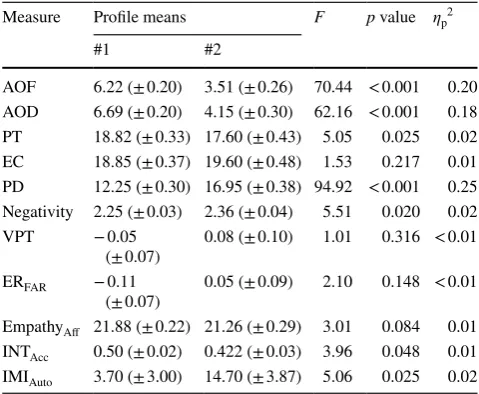
As shown in Table 1, an MANOVA revealed that mean scores on seven of our 11 measures of social cognition dif-fered significantly between the two personality profiles. In line with the results of the LPA, individuals showing greater flexibility between styles (P#1) scored higher on both dimensions of action orientation (AOF and AOD), and
lower on Personal distress and negativity relative to P#2. These individuals also reported higher Perspective taking, which showed superior interoceptive accuracy and exhibited considerably lower automatic imitation compared with P#2.
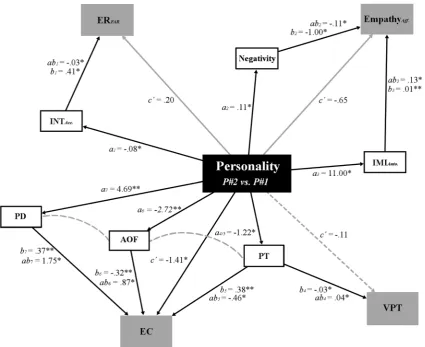
Mediation analyses were then conducted on the four measures that did not differ significantly between the per-sonality profiles: Empathic concern, visual perspective taking (VPT), emotion regulation, and affective empathy. Supplementary Table S4 presents the correlations between these four measures and all other dependent variables used to define potential mediators. Four models emerged that revealed variables serving as significant mediators in the influence of personality on measures of social cogni-tion: (1) interoceptive accuracy fully mediated the effect on emotion regulation; (2) negativity and automatic imita-tion fully mediated the influence on affective empathy; (3) self-reported Perspective taking fully mediated the effect on VPT; (4) self-reported Personal distress, Perspective taking, and AOF partially mediated the influence on self-reported Empathic concern. The direction of these mediating influ-ences is presented below, along with a description of the SEM results. It is important to stress that the term “full mediation” is a statistical concept—it does not imply that only the modelled variables underpin an observed relation-ship (see Hayes, 2018).
When these separate mediation models were combined in an SEM analysis, modification indices suggested only three changes: the removal of a direct pathway from personal-ity profile to VPT and two covariances—between AOF and
Fig. 1 Profiles emerging from Latent Profile Analysis. Negative scores suggest a style is used infrequently, whilst positive scores indi-cate a strong preference (inflexibility) for that style
Table 1 Direct group comparisons
Values present means (± SE)
AOF Failure-related action orientation, AOD Demand-related action orientation, PT Perspective-taking, EC Empathic concern; PD Per-sonal distress, VPT visual perspective taking, ERFAR emotion
regula-tion, EmpathyAff. affective empathy, INTAcc. interoceptive accuracy,
IMIAuto. automatic imitation
Measure Profile means F p value ηp2
#1 #2
AOF 6.22 (± 0.20) 3.51 (± 0.26) 70.44 < 0.001 0.20 AOD 6.69 (± 0.20) 4.15 (± 0.30) 62.16 < 0.001 0.18 PT 18.82 (± 0.33) 17.60 (± 0.43) 5.05 0.025 0.02 EC 18.85 (± 0.37) 19.60 (± 0.48) 1.53 0.217 0.01 PD 12.25 (± 0.30) 16.95 (± 0.38) 94.92 < 0.001 0.25 Negativity 2.25 (± 0.03) 2.36 (± 0.04) 5.51 0.020 0.02 VPT − 0.05
(± 0.07) 0.08 (± 0.10) 1.01 0.316 < 0.01 ERFAR − 0.11
(± 0.07) 0.05 (± 0.09) 2.10 0.148 < 0.01 EmpathyAff 21.88 (± 0.22) 21.26 (± 0.29) 3.01 0.084 0.01
INTAcc 0.50 (± 0.02) 0.422 (± 0.03) 3.96 0.048 0.01
[image:9.595.53.287.55.254.2] [image:9.595.305.545.70.267.2]self-reported Perspective taking, and AOF and Personal dis-tress. The final model is presented in Fig. 2, which achieved excellent levels of fit with the observed data across discrep-ancy functions (χ2
[37] = 37.32, p = 0.45; root-mean-square error of approximation = 0.008) and comparative indices (normalised fit index = 0.896; comparative fit index = 0.999; Tucker Lewis index = 0.998). Moving clockwise through this structure from top left, the first branch presents an indirect pathway through which interoceptive accuracy fully medi-ates the influence of personality on emotion regulation. The
ab path (indirect effect) reveals how the two personality profiles are estimated to differ on emotion regulation (the outcome) as a result of the effect of personality on interocep-tive accuracy (the mediator), which, in turn, affects emotion regulation (the b path; cf. Hayes, 2013, pp. 92). In other words, while emotion regulation did not significantly differ
directly between the two profiles, P#2 did have significantly poorer interoceptive accuracy and, through the positive relationship between interoception and emotion regulation, this was associated with a better emotion regulation (lower false-alarm rate).
The second branch encompasses a multimediator model, whereby there is no direct effect of personality on affec-tive empathy but two indirect effects involving negativity and automatic imitation. First, individuals in P#2 exhibit stronger negativity than those in P#1, and this is associ-ated inversely with affective empathy. As such, those in P#2 express a more negative affective state and, consequently, are less aroused by the emotions of others. P#2 also exhibit stronger automatic imitation relative to P#1, and automatic imitation is related positively with affective empathy. Due to the positive influence of automatic imitation on affective
Fig. 2 Unstandardised parameter estimates emerging from structural equation modelling (Hayes, 2013), expressing the values of profile 2 (P#2) relative to profile 1 (P#1). Grey nodes represent measures that did not differ significantly between personality profiles, while white nodes represent indirect pathways identified by mediation analy-ses. Dashed lines show changes to the mediation models suggested by modification indices: the curved lines represent covariances, and
the straight line signifies a direct connection that was removed from the default model. ERFAR emotion regulation, EmpathyAff. affective
empathy, INTAcc. interoceptive accuracy, IMIAuto automatic imitation,
[image:10.595.86.512.282.629.2]empathy, when taking into account the difference between profiles, people in P#2 show higher affective empathy than those in P#1. This inconsistent mediation reveals the oppos-ing influences of negative affectivity and imitative tenden-cies on affective empathy, which has the potential to mask any difference between personality profiles.
The bottom right-hand branch comprises a single indirect pathway; those in P#2 report lower self-reported Perspective taking, and this is associated inversely with VPT. Keeping in mind that higher scores on VPT reflect poorer perfor-mance (inverted efficiency), the indirect path reveals that P#2 perform worse on the Director Task as a result of their self-reported lower Perspective taking.
The final branch presents another multimediator model, but this time comprising sub-scales from the self-report instruments. Relative to P#1, P#2 express lower Perspec-tive taking, and through the posiPerspec-tive relationship between Perspective taking and Empathic concern, in turn, demon-strate lower Empathic concern. Conversely, P#2 also exhibit higher Personal distress and, in turn, this is positively related to Empathic concern compared with P#1. Finally, people categorised as P#2 report lower AOF, with this associated negatively with scores of Empathic concern. Due to the neg-ative influence of AOF on Empathic concern, P#2 express increased Empathic concern relative to P#1.
Discussion
This study sought to elucidate the structure of inter-relation-ships and co-dependencies among discrete components of social cognition, and the personality mechanisms driving individual differences in this structure. From a large non-clinical sample, we acquired both performance-based and self-report measures of various socio-cognitive and -emo-tional capacities, and personality data with an instrument capable of delineating between personality style configura-tions. After profiling participants according to their person-ality style tendencies, we compared them on discrete facets of social cognition. Our results revealed three primary find-ings: (1) two dissociable personality profiles emerged that exhibited contrasting cognitive and affective dispositions; one showing flexibility among personality styles and adap-tive action orientation, the other expressing persistence for certain styles and state orientation; (2) these profiles dif-fered on a number of performance and self-report measures, revealing that mechanisms driving individual differences in personality also shape social cognition; (3) other facets of social cognition appear to mediate differences between these profiles in selected components, uncovering a hierarchical structure.
The two emerging profiles differed primarily in their preference for styles of Self-critical–Avoidant,
Passive–Depressive, Spontaneous–Borderline, Optimis-tic–Rhapsodic, and Charming–Histrionic. According to the PSI theory, the lack of a strong preference across personality styles in Profile 1 (P#1) is indicative of greater flexibility and adaptation; individuals employing a larger repertoire of styles should be able to adjust to different situational demands more efficiently (Block, 2002; Kuhl, 2000a). In contrast, the strong tendency for Self-critical–Avoidant and Passive–Depressive styles shown by individuals in Profile 2 (P#2) suggests more inflexibility or rigidity. The styles pre-ferred by P#2 indicate that they have a heightened sensitivity for negative affect together with a tendency to down-regu-late positive affect. Interestingly, this replicates two previ-ous findings: our group has identified a similar profile in an independent sample (n = 431; Czekóová, Shaw, & Urbánek,
2016), and a large-scale review of personality styles reports an “Overcontrolled prototype” that exhibits many of the same characteristics (Donnellan & Robbins, 2010). In line with these contrasting personality characteristics, individu-als in P#2 expressed significantly stronger negativity than those in P#1. The PSI framework predicts that (a) chronic down-regulation of positive affect may induce state orienta-tion, and (b) state-oriented individuals discriminate poorly between their own and others’ thoughts, wishes, and expec-tations (Koole et al., 2006; Kuhl, 1992). Consistent with the former premise, P#2 scored significantly lower on both Failure- and Demand-related action orientation (AOF and AOD, respectively), indicating a poorer ability to regulate their emotions when faced with negative events. This profile also scored lower on self-reported Perspective taking during social interactions, reported higher Personal distress when empathising with others, and exhibited much stronger imita-tive tendencies—all indices of inefficient self-other distinc-tion (SOD).
control over imitative tendencies shown by P#1. In contrast, poorer cognitive control will lead to a cognitive system that is too inflexible to switch between alternative cognitive rep-resentations. Further research is needed to ascertain whether cognitive control does, indeed, underlie the two divergent personality profiles which we have observed. Furthermore, since considerable progress has been made in elucidating the various factors contributing to cognitive control (e.g., genetic and neurophysiological mechanisms; see Hommel,
2015), future research should investigate whether these same factors drive these two differential personality profiles.
Participants in P#2 reported significantly lower Perspec-tive taking, and this was negaPerspec-tively associated with their VPT performance—with a lower tendency to take the per-spective of others during social interaction, individuals are worse when resolving conflicts between their own and another’s perspective. This is, perhaps, unsurprising given the inefficient SOD of P#2, as indexed by their increased automatic imitation (Brass et al., 2009) and Personal dis-tress (Lamm et al., 2016), and their apparent inefficiency in meta-control; avoiding ego-centric errors in perspective taking demands an ability to distinguish flexibly between competing self and other representations (Keysar et al.,
2000; for a critical discussion, see Heyes, 2014; Santieste-ban et al., 2012a). The state orientation of these individuals also suggests a bias in attentional focus towards the self, an additional factor shown to impact negatively on the ability to adopt another person’s viewpoint (Bukowski & Samson,
2016). Interestingly, individuals in P#2 showed a strong preference for Self-critical-Avoidant personality style, and patients diagnosed with Avoidant personality disorder pre-sent difficulties with metacognitive abilities of monitoring and decentration—the mislabelling of self-states and poor inference of others’ states, respectively (Moroni et al., 2016). This will result in both low ability and motivation to take the perspective of others, thereby reinforcing social with-drawal and hindering practice in perspective taking (for a related discussion, see Bird & Viding, 2014). In line with this, an association was reported recently between higher social anxiety and lower VPT (Pile et al., 2017). Studies have also shown that training individuals to withhold invol-untary imitation enhances perspective-taking performance (Santiesteban et al., 2012b). It would be interesting, then, to see how individuals comprising P#2 respond to such SOD training; if effective, this simple intervention might prove beneficial for samples characterised by ego-centrism (Pile et al., 2017).
Given the significant difference in self-reported action orientation between profiles, it is surprising that personality did not influence emotion regulation directly; differences in false-alarm rate for affective stimuli on the emotional Go/ No-Go task emerged only after interoceptive accuracy was included in the model. Moreover, the positive association
between interoceptive accuracy and emotion regulation seems counter-intuitive; why should the greater interocep-tive accuracy shown by individuals in P#1 lead to poorer emotion regulation? We suggest that this indicates a complex interaction between affective dispositions and the processing of physiological signals. While action-orientated individuals are more decisive and show less rumination under stress, when combined with enhanced processing of emotional stimuli facilitated by heightened interoception (see Critch-ley & Garfinkel, 2017), this might manifest as impulsivity on the emotional Go/No-Go task—that is, it may interfere with the withholding of responses to emotional expressions in others. At this point, it is important to stress that action orientation per se should not be considered superior to state orientation; individuals will benefit from a state-orientated approach in certain social situations, such as dangerous and unpredictable contexts (see Kuhl, 1992). Rather, effective emotion regulation requires the ability to switch flexibly between regulatory strategies in different situations. Like-wise, it has been proposed that a balance between flexibil-ity and persistence is needed for optimal cognitive control (Hommel, 2015).
Converging with the findings of Ainley et al. (2015), no association was observed between interoceptive accuracy and affective empathy, whether the latter is measured via the ratings of arousal in response to the emotions of oth-ers or by self-report instrument. Instead, our data reveal two mechanisms that together mediate the influence of personality mechanisms on empathic expression in oppos-ing directions: First, negativity is related inversely with affective empathy, and through this pathway, individuals in P#2 exhibiting stronger negativity than P#1 also show
less affective empathy. Negative affectivity has been shown to be associated positively with Personal distress (Eisen-berg et al., 1994), and our data show that P#2 exhibited both stronger negativity and greater Personal distress than P#1. As such, this mediating effect of negativity might drive individuals in P#2 to withdraw, either implicitly or explicitly, from empathic engagement. Second, the strength of involuntary imitative tendencies is associated positively with affective empathy, and so greater imitative tendencies shown by P#2 may lead them to experience more arousal when empathising. Involuntary imitation is attributed to neural perception–action matching mechanisms (see Heyes,
that the ability to empathize affectively with others depends upon an interaction between our own current affective state and our tendency to simulate the emotional state of others. The difference which we observed in imitative tendencies between personality profiles stands in contrast to the find-ings of Butler et al. (2015) who observed no such influence of stable personality traits. This discrepancy could be due to methodological factors: first, imitation elicited by the action stimuli employed by Butler et al. (2015) is influenced heavily by spatial confounds (see Bertenthal et al., 2006; Shaw et al.,
2017), but the present study used stimuli that avoided these effects and might have unmasked this relationship. Second, our person-centred approach to personality assessment might be more sensitive than the variable-centred approach adopted by Butler et al. (2015) in uncovering associations between this aspect of behaviour and personality.
The majority of sub-scales measured by the self-report instruments were clustered together in a single multimedia-tor model. Lower Perspective taking, higher Personal dis-tress, and reduced AOF reported by P#2 served as mediators in the influence of personality on Empathic concern. First, P#2 report higher Personal distress relative to P#1 and, in turn, this is associated positively with Empathic concern. Since the Empathic concern sub-scale is considered an explicit measure of affective empathy, this is entirely con-sistent with this group’s increased affective empathy. This may be indicative of greater self-other merging. Indeed, these same individuals exhibit greater automatic imitation, which suggests lower SOD. As discussed above, imitative tendencies are believed to reflect neural mirroring mecha-nisms through which the actions and emotions of others are understood through a process of implicit simulation. Inef-ficient distinction between self- and other-affect representa-tions will lead to a misattribution of increased arousal levels experienced during this simulation process, leading to Per-sonal distress when empathising (Lamm et al., 2016).
Conversely, P#2 report lower Perspective taking and AOF compared with P#1, and these two sub-scales are related to Empathic concern in an opposing manner; while reduced Perspective taking is associated with lower Empathic con-cern, decreased AOF is related to greater Empathic concern. Focusing on the first of these indirect pathways, the ego-cen-tric attentional focus of this group seems to reduce the con-cern that they feel for others when empathising. The second pathway might be explained by the other inter-relationships and co-dependencies revealed in our structural model; P#2 report more state orientation during negative experiences and a greater tendency to imitate others, the latter of which leads to greater arousal during empathy. In the same way that imitation of others’ emotional states will lead to per-sonal distress without compensatory SOD mechanisms, the state-orientated style of emotion regulation characterising
this profile seems to result in greater empathic concern for the agent whose affect that they are simulating.
It is noteworthy that, aside from Perspective taking, none of the other sub-scales from self-report instruments served to mediate differences between personality profiles on the corresponding performance measures. This lack of associa-tion between explicit and implicit measures (see also Ain-ley et al., 2015; Böckler, Tusche, & Singer, 2016; Melchers et al., 2016) may suggest that they capture different facets of social cognition, or that our subjective experiences dif-fer from our actual abilities. Our results indicate that many of the explicit measures are inter-related, and covariance between self-report measures suggest that individuals’ sub-jective view of themselves is consistent. As such, further research is needed to investigate whether self-report meas-ures of social cognition differ from actual ability, and how personality might influence this.
Conclusion
To our knowledge, this is the first investigation into social cognition that has collected data from a large sample on such an extensive battery of self-report and performance-based measures, and considered the influence of personal-ity on patterns of inter-relationships and mediating effects among them. Our results reveal a hierarchical pattern of rela-tionships among various components of social cognition, informing us about manner in which lower level cognitive mechanisms (e.g., visual perspective taking and self-other distinction) may influence higher level socio-emotional pro-cesses (e.g., affective empathy and emotion regulation). By moving beyond the modular approach that has dominated social cognition research to date, such findings provide a more detailed characterisation of individual differences in social behaviour. Using a person-centred approach to per-sonality assessment, we have also shown that different con-figurations of personality systems exert an influence over discrete aspects of social cognition. At the most general level, these two profiles appear to reflect opposing capacities for cognitive control–flexibility versus rigidity/persistence— thereby providing a model for future research.
Compliance with ethical standards
Conflict of interest The author(s) declare no potential conflicts of
in-terest with respect to the research, authorship, and/or publication of this article.
Ethical approval “All procedures performed in studies involving human participants were in accordance with the ethical standards of the insti-tutional and/or national research committee and with the 1964 Helsinki declaration and its later amendments or comparable ethical standards.”
Open Access This article is distributed under the terms of the
Crea-tive Commons Attribution 4.0 International License (http://creat iveco mmons .org/licen ses/by/4.0/), which permits unrestricted use, distribu-tion, and reproduction in any medium, provided you give appropriate credit to the original author(s) and the source, provide a link to the Creative Commons license, and indicate if changes were made.
References
Ainley, V., Maister, L., & Tsakiris, M. (2015). Heartfelt empathy? No association between interoceptive awareness, question-naire measures of empathy, reading the mind in the eyes task or the director task. Frontiers in Psychology, 1, 554. https ://doi. org/10.3389/fpsyc g.2015.00554 .
Akaike, H. (1974). A new look at the statistical model identification. IEEE Transactions on Automatic Control, 19, 716–723. https :// doi.org/10.1109/TAC.1974.11007 05.
Baron, R. M., & Kenny, D. A. (1986). The moderator–mediator vari-able distinction in social psychological research: Conceptual, strategic, and statistical considerations. Journal of Personality and Social Psychology, 51(6), 1173–1182.
Baron-Cohen, S. (2009). Autism: The empathizing-systemizing (E-S) theory. Annals of the New York Academy of Sciences, 1156, 68–80. https ://doi.org/10.1111/j.1749-6632.2009.04467 .x. Bastiaansen, J. A., Thioux, M., & Keysers, C. (2009). Evidence for
mir-ror systems in emotions. Philosophical Transactions of the Royal Society of London B: Biological Sciences, 364, 2391–2404. https ://doi.org/10.1098/rstb.2009.0058.
Baumann, N., Kuhl, J., & Kazén, M. (2005). Left-hemispheric activa-tion and self-infiltraactiva-tion: Testing a neuropsychological model of internalization. Motivation and Emotion, 29(3), 135–163. https ://doi.org/10.1007/s1103 1-005-9439-x.
Bentley, S. V., Greenaway, K. H., & Haslam, A. (2017). Cognition in context: Social inclusion attenuates the psychological boundary between self and other. Journal of Experimental Social Psychol-ogy, 73, 42–49. https ://doi.org/10.1016/j.jesp.2017.06.008. Bertenthal, B. I., Longo, M. R., & Kosobud, A. (2006).
Imita-tive response tendencies following observation of intran-sitive actions. Journal of Experimental Psychology: Human Perception and Performance, 32, 210. https ://doi. org/10.1037/0096-1523.32.2.210.
Bird, G., & Viding, E. (2014). The self to other model of empathy: providing a new framework for understanding empathy impair-ments in psychopathy, autism, and alexithymia. Neuroscience & Biobehavioral Reviews, 47, 520–532. https ://doi.org/10.1016/j. neubi orev.2014.09.021.
Block, J. (2002). Personality as an affect-processing system: Toward an integrative theory. New York: Psychology Press.
Böckler, A., Tusche, A., & Singer, T. (2016). The structure of human prosociality: Differentiating altruistically motivated, norm
motivated, strategically motivated, and self-reported prosocial behavior. Social Psychological and Personality Science, 7(6), 530–541. https ://doi.org/10.1177/19485 50616 63965 0.
Brass, M., Bekkering, H., & Prinz, W. (2001). Movement observa-tion affects movement execuobserva-tion in a simple response task. Acta Psychologica, 106, 3–22. https ://doi.org/10.1016/S0001 -6918(00)00024 -X.
Brass, M., Ruby, P., & Spengler, S. (2009). Inhibition of imitative behaviour and social cognition. Philosophical Transactions of the Royal Society of London B: Biological Sciences, 364, 2359– 2367. https ://doi.org/10.1098/rstb.2009.0066.
Bruyer, R., & Brysbaert, M. (2011). Combining speed and accuracy in cognitive psychology: is the inverse efficiency score (IES) a better dependent variable than the mean reaction time (RT) and the percentage of errors (PE)? Psychologica Belgica, 51, 5–13.
https ://doi.org/10.5334/pb-51-1-5.
Bukowski, H., & Samson, D. (2016). Can emotions influence level-1 visual perspective taking? Cognitive Neuroscience, 7, 182–191.
https ://doi.org/10.1080/17588 928.2015.10438 79.
Butler, E. E., Ward, R., & Ramsey, R. (2015). Investigating the rela-tionship between stable personality characteristics and automatic imitation. PLoS One, 10, e0129651. https ://doi.org/10.1371/ journ al.pone.01296 51.
Catmur, C., Walsh, V., & Heyes, C. (2009). Associative sequence learn-ing: the role of experience in the development of imitation and the mirror system. Philosophical Transactions of the Royal Soci-ety of London B: Biological Sciences, 364, 2369–2380. https :// doi.org/10.1098/rstb.2009.0048.
Chartrand, T. L., & Lakin, J. L. (2013). The antecedents and conse-quences of human behavioral mimicry. Annual Review of Psy-chology, 64, 285–308. https ://doi.org/10.1146/annur ev-psych -11301 1-14375 4.
Cikara, M., Bruneau, E., Van Bavel, J. J., & Saxe, R. (2014). Their pain gives us pleasure: How intergroup dynamics shape empathic failures and counter-empathic responses. Journal of Experimen-tal Social Psychology, 55, 110–125. https ://doi.org/10.1016/j. jesp.2014.06.007.
Coll, M. P., Viding, E., Rütgen, M., Silani, G., Lamm, C., Catmur, C., & Bird, G. (2017). Are we really measuring empathy? Proposal for a new measurement framework. Neuroscience and Biobe-havioral Reviews, 83, 132–139. https ://doi.org/10.1016/j.neubi orev.2017.10.009.
Cracco, E., Bardi, L., Desmet, C., Genschow, O., Rigoni, D., De Cos-ter, L., Brass, M. (2018). Automatic imitation: A meta-analysis. Psychological Bulletin, 144, 453–500. https ://doi.org/10.1037/ bul00 00143 .
Critchley, H. D., & Garfinkel, S. N. (2017). Interoception and emo-tion. Current Opinion in Psychology, 17, 7–14. https ://doi. org/10.1016/j.copsy c.2017.04.020.
Critchley, H. D., & Harrison, N. A. (2013). Visceral influences on brain and behavior. Neuron, 77, 624–638. https ://doi.org/10.1016/j. neuro n.2013.02.008.
Critchley, H. D., Wiens, S., Rotshtein, P., & Dolan, R. J. (2004). Neural systems supporting interoceptive awareness. Nature Neurosci-ence, 7, 189. https ://doi.org/10.1038/nn117 6.
Cronbach, L. J., & Furby, L. (1970). How we should measure” change”: Or should we? Psychological bulletin, 74(1), 68. https ://doi. org/10.1037/h0029 382.
Czekóová, K., Pokorná, Z., & Špiláková, B. (2016). Vývoj metody pro posouzení sociální kognice. Sociální procesy a osobnost 2015—Otázky a výzvy, 67–72. Sborník příspěvků. Masarykova Univerzita Brno.