warwick.ac.uk/lib-publications
Original citation:
Kochkina, Elena, Liakata, Maria and Augenstein, Isabelle (2017) Turing at SemEval-2017 task 8 : sequential approach to rumour stance classification with branch-LSTM. In: International Workshop on Semantic Evaluation 2017 (SemEval-2017), Vancouver, Canada, 3-4 August 2017. Published in: Proceedings of the 11th International Workshop on Semantic Evaluations (SemEval-2017) pp. 466-471.
Permanent WRAP URL:
http://wrap.warwick.ac.uk/89264
Copyright and reuse:
The Warwick Research Archive Portal (WRAP) makes this work by researchers of the University of Warwick available open access under the following conditions. Copyright © and all moral rights to the version of the paper presented here belong to the individual author(s) and/or other copyright owners. To the extent reasonable and practicable the material made available in WRAP has been checked for eligibility before being made available.
Copies of full items can be used for personal research or study, educational, or not-for-profit purposes without prior permission or charge. Provided that the authors, title and full
bibliographic details are credited, a hyperlink and/or URL is given for the original metadata page and the content is not changed in any way.
A note on versions:
The version presented here may differ from the published version or, version of record, if you wish to cite this item you are advised to consult the publisher’s version. Please see the ‘permanent WRAP URL’ above for details on accessing the published version and note that access may require a subscription.
Turing at SemEval-2017 Task 8: Sequential Approach to Rumour Stance
Classification with Branch-LSTM
Elena Kochkina12, Maria Liakata12, Isabelle Augenstein3 1 University of Warwick, Coventry, United Kingdom
2Alan Turing Institute, London, United Kingdom 3University College London, London, United Kingdom
{E.Kochkina, M.Liakata}@warwick.ac.uk, [email protected]
Abstract
This paper describes team Turing’s sub-mission to SemEval 2017 RumourEval: Determining rumour veracity and support for rumours (SemEval 2017 Task 8, Sub-task A). SubSub-task A addresses the challenge of rumour stance classification, which in-volves identifying the attitude of Twitter users towards the truthfulness of the ru-mour they are discussing. Stance classi-fication is considered to be an important step towards rumour verification, therefore performing well in this task is expected to be useful in debunking false rumours. In this work we classify a set of Twit-ter posts discussing rumours into either supporting, denying, questioning or com-menting on the underlying rumours. We propose a LSTM-based sequential model that, through modelling the conversational structure of tweets, which achieves an ac-curacy of 0.784 on the RumourEval test set outperforming all other systems in Sub-task A.
1 Introduction
In stance classification one is concerned with de-termining the attitude of the author of a text to-wards a target (Mohammad et al.,2016). Targets can range from abstract ideas, to concrete entities and events. Stance classification is an active re-search area that has been studied in different do-mains (Ranade et al., 2013; Chuang and Hsieh,
2015). Here we focus on stance classification of tweets towards the truthfulness of rumours circu-lating in Twitter conversations in the context of breaking news. Each conversation is defined by a tweet that initiates the conversation and a set of nested replies to it that form a conversation thread. The goal is to classify each of the tweets in the
conversation thread as eithersupporting,denying,
querying or commenting (SDQC) on the rumour initiated by the source tweet. Being able to detect stance automatically is very useful in the context of events provoking public resonance and associ-ated rumours, as a first step towards verification of early reports (Zhao et al., 2015). For instance, it has been shown that rumours that are later proven to be false tend to spark significantly larger num-bers of denying tweets than rumours that are later confirmed to be true (Mendoza et al.,2010; Proc-ter et al.,2013;Derczynski et al., 2014;Zubiaga et al.,2016b).
Here we focus on exploiting the conversational structure of social media threads for stance clas-sification and introduce a novel LSTM-based ap-proach to harness conversations.
2 Related Work
Single Tweet Stance Classification Stance classification for rumours was pioneered by Qazvinian et al. (2011) as a binary classification task (support/denial). Zeng et al. (2016) perform stance classification for rumours emerging during crises. Both works use tweets related to the same rumour during training and testing.
A model based on bidirectional LSTM encod-ing of tweets conditioned on targets has been shown to achieve state-of-the-art on the SemEval-2016 task 6 dataset (Augenstein et al., 2016). However the RumourEval task is different as it ad-dresses conversation threads.
@user0 LOL. 5 million Muslims in France, what a disgrace. the french worm president and politicians killed them. tine for croissants now
user 3 comment
user 4
@user3 They who? Stupid and partial opinions like this one only add noise to any debate.
deny
user 3
@user4 Socialists, Antisemites, anti zionists - usual suspects
comment
user 0
France: 10 people dead after shooting at HQ of satirical weekly newspaper #CharlieHebdo, according to witnesses http://t.co/ FkYxGmuS58
user 1
MT @user0 France: 10 dead after shooting at HQ of satirical weekly #CharlieHebdo. If Zionists/Jews did this they'd be nuking Israel source support comment branch 1 response 1 user 2
@user0 @user5 A French crime of passion or another heathen moslem atrocity?
query branch 2
[image:3.595.329.507.61.116.2]response 3 response 2
Figure 1: Example of a conversation thread from the dataset with three branches, two of which are highlighted. The conversation has a tree structure, which can be split into individual branches by tak-ing each leaf node with all its direct parents.
al. (2016a) model the conversational structure of source tweets and subsequent replies: as a linear chain and as a tree. They use linear- and tree- ver-sions of a CRF classifier, outperforming the ap-proach by Lukasik et al. (2016).
3 Dataset
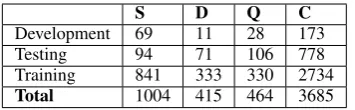
The dataset provided for this task contains Twit-ter conversation threads associated with rumours around ten different events in breaking news, in-cluding the Paris shootings in Charlie Hebdo, the Ferguson unrest, the crash of a Germanwings plane. These events include 325 conversation threads consisting of 5568 underlying tweets an-notated for stance at the tweet level (breakdown between training, testing and development sets is shown in Table1) (Derczynski et al.,2017).
# threads # branches # tweets
Development 25 215 281
Testing 28 772 1049
Training 272 3030 4238
[image:3.595.75.286.62.325.2]Total 325 4017 5568
Table 1: Number of threads, branches and tweets in the training, development and testing sets.
S D Q C
Development 69 11 28 173
Testing 94 71 106 778
Training 841 333 330 2734
[image:3.595.78.284.661.717.2]Total 1004 415 464 3685
Table 2: Per-class distribution of tweets in the training, development and testing sets.
Each thread includes a source tweet that initi-ates a conversation and nested tweets responding to either the source tweet or earlier replies. The thread can be split into linear branches of tweets, where a branch is defined as a chain of tweets that starts with a leaf tweet including its direct parent tweets, all the way up to the source tweet. Fig-ure 1 shows an example of a conversation along with its annotations represented as a tree struc-ture with highlighted branches. The depth of a tweet is the number of its parents starting from the root node. Branches 1 and 2 in Figure1have depth one whereas branch 3 has depth three. There is a clear class imbalance in favour of comment-ing tweets (66%) and supporting tweets (18%), whereas the denying (8%) and querying classes (8%) are under-represented (see Table2). While this imbalance poses a challenge, it is also indica-tive of the realistic scenario where only a few users question the veracity of a statement.
4 System Description
4.1 Features
Prior to generating features for the tweets, we per-form a pre-processing step where we remove non-alphabetic characters, convert all words to lower case and tokenise texts.1Once tweet texts are pre-processed, we extract the following features:
• Word vectors:we use a word2vec (Mikolov et al.,2013) model pre-trained on the Google News dataset (300d)2using the gensim pack-age (Reh˚uˇrek and Sojkaˇ ,2010).
• Tweet lexicon:(1) count of negation words3
and (2) count of swear words.4
1
For implementation of all pre-processing routines we use Python 2.7 with the NLTK package.
2
We have also tried using Glove word embeddings trained on Twitter dataset, but it lead to a decrease in performance on both development and testing sets comparing to the Google News word vectors
3A presence of any of the following words would be
con-sidered as a presence of negation: not, no, nobody, nothing, none, never, neither, nor, nowhere, hardly, scarcely, barely, don’t, isn’t, wasn’t, shouldn’t, wouldn’t, couldn’t, doesn’t
4A list of 458 bad words was taken from
[As querying] @username Weren’t you the one who abused her?
[As supporting]”Go online & amp; put down ’Hillary Clinton illness,’” Rudy says. Yes – but look up the truth – not health smears https://t.co/EprqiZhAxM
[As supporting] @username I demand you retract the lie that people in #Ferguson were shouting ”kill the police”, local reporting has refuted your ugly racism
[As commenting]@FoxNews six years ago... real good evidence. Not!
Figure 2: Examples of misclassified denying tweets.
• Punctuation: (1) presence of a period, (2) presence of an exclamation mark, (3) pres-ence of a question mark, (4) ratio of capital letters.
• Attachments:(1) presence of a URL and (2) presence of images.
• Relation to other tweets (1) Word2Vec cosine similarity wrt source tweet, (2) Word2Vec cosine similarity wrt preceding tweet, and (3) Word2Vec cosine similarity wrt thread
• Content length:(1) word count and (2) char-acter count.
• Tweet role: whether the tweet is a source tweet of a conversation.
Tweet representations are obtained by averaging word vectors in a tweet and then concatenating with the additional features into a single vector, at the preprocessing step. This set of features have shown to be the best comparing to using word2vec features on their own or any of the reduced com-binations of these features.
4.2 Branch - LSTM Model
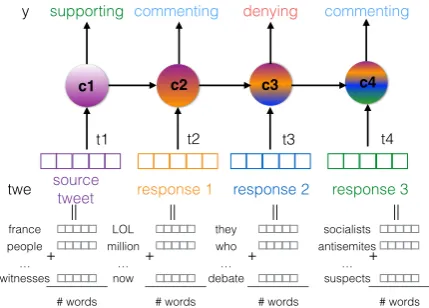
To tackle the task of rumour stance classificaiton, we proposebranch-LSTM, a neural network archi-tecture that uses layers of LSTM units ( Hochre-iter and Schmidhuber,1997) to process the whole branch of tweets, thus incorporating structural in-formation of the conversation (see the illustration of thebranch-LSTM on the Figure3). The input at each time stepiof the LSTM layer is the rep-resentation of the tweet as a vector. We record the
supporting commenting denying commenting
t1 t2 t3 t4
source
tweet response 1 response 2 response 3 twe
y
c1 c2 c3 c4
[image:4.595.309.524.69.223.2]france people witnesses … + # words ———— || LOL million now … + # words ———— || they who debate … + # words ———— || socialists antisemites suspects … + # words ———— ||
Figure 3: Illustration of the input/output structure of the branch-nestedLSTM model.
output of each time step so as to attach a label to each tweet in a branch5. This output is fed through several dense ReLU layers, a 50% dropout layer, and then through a softmax layer to obtain class probabilities. We use zero-padding and masks to account for the varying lengths of tweet branches. The model is trained using the categorical cross entropy loss function. Since there is overlap be-tween branches originating from the same source tweet, we exclude the repeating tweets from the loss function using a mask at the training stage. The model uses tweet representation as the mean average of word vectors concatenated with ex-tra features described above. Due to the short length of tweets, using more complex models for learning tweet representations, such as an LSTM that takes each word as input at each time step and returns the representation at the final time step, does not lead to a noticeable difference in the performance based on cross-validation experi-ments on the training and development sets, while taking significantly longer to train. We experi-mented with replacing the unidirectional LSTMs with bidirectional LSTMs but could observe no improvements in accuracy (using cross-validation results on the training and development set).
5 Experimental Setup
The dataset is split into training, development and test sets by the task organisers. We determined the optimal set of hyperparameters via testing the performance of our model on the development set for different parameter combinations. We used the
5For implementation of all models we used Python
Accuracy Macro F S D Q C
[image:5.595.135.466.62.106.2]Development 0.782 0.561 0.621 0.000 0.762 0.860 Testing 0.784 0.434 0.403 0.000 0.462 0.873
Table 3: Results on the development and testing sets. Accuracy and F1 scores: macro-averaged and per class (S:supporting, D:denying, Q:querying, C:commenting).
Depth # tweets # S # D # Q # C Accuracy MacroF S D Q C
0 28 26 2 0 0 0.929 0.481 0.963 0.000 0.000 0.000
1 704 61 60 81 502 0.739 0.348 0.000 0.000 0.550 0.842
2 128 3 6 7 112 0.875 0.233 0.000 0.000 0.000 0.933
3 60 2 1 5 52 0.867 0.232 0.000 0.000 0.000 0.929
4 41 0 0 3 38 0.927 0.481 0.000 0.000 0.000 0.962
5 27 1 0 1 25 0.926 0.321 0.000 0.000 0.000 0.961
[image:5.595.80.527.151.247.2]6+ 61 1 2 9 49 0.803 0.223 0.000 0.000 0.000 0.891
Table 4: Number of tweets per depth and performance at each of the depths.
Tree of Parzen Estimators (TPE) algorithm 6 to search the parameter space, which is defined as follows: the number of dense ReLU layers varies from one to four; the number of LSTM layers is one or two; the mini-batch size is either 32 or 64; the number of units in the ReLU layer is one of
{100, 200, 300, 400, 500}, and in the LSTM layer one of{100, 200, 300}; the strength of the L2 reg-ularisation is one of {0.0, 1e-4, 3e-4, 1e-3} and the number of epochs is selected from{30, 50, 70, 100}. We performed 100 trials of different param-eter combinations optimising for accuracy on the development set in order to choose the best com-bination. We fixed hyperparameters to train the model on combined training and development sets and evaluated on the held out test set.
6 Results
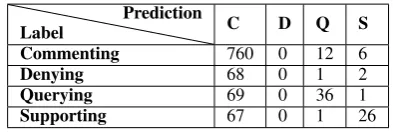
The performance of our model on the testing and development set is shown in Table 3. Together with the accuracy we show macro-averaged F-score and per-class macro-averaged F-F-scores as these metrics account for the class imbalance. The difference in accuracy between testing and devel-opment set is minimal, however we see significant difference in Macro-F score due to different class balance in these sets. Macro-F score could be im-proved if we used it as a metric for optimising hyper-parameters. The branch-LSTM model pre-dicts commenting, the majority class well, how-ever it is unable to pick out anydenying, the most-challenging under-represented class. Most
deny-6We used the implementation of the TPE algorithm in the
hyperopt package (Bergstra et al.,2013)
Label
Prediction
C D Q S
Commenting 760 0 12 6
Denying 68 0 1 2
Querying 69 0 36 1
Supporting 67 0 1 26
Table 5: Confusion matrix for testing set predic-tions
inginstances get misclassified ascommenting(see Table 5), with only one tweet misclassified as
querying and two assupporting (Figure 2). An increased amount of labelled data would be help-ful to improve performance of this model. As we were considering conversation branches, it is in-teresting to analyse the performance distribution across different tweet depths (see Table4). Maxi-mum depth/branch length in the testing set is 13 with most tweets concentrated at depths from 0 to 3. Source tweets (depth zero) are usually sup-portingand the model predicts these very well, but performance ofsupportingtweets at other depths decreases. The model does not show a notice-able difference in performance on tweets of vary-ing lengths.
7 Conclusions
[image:5.595.316.513.290.356.2]Acknowledgments
This work was supported by The Alan Turing Institute under the EPSRC grant EP/N510129/1. Cloud computing resource were kindly provided through a Microsoft Azure for Research Award. Work by Elena Kochkina was partially supported by the Leverhulme Trust through the Bridges Pro-gramme.
References
Isabelle Augenstein, Tim Rockt¨aschel, Andreas Vla-chos, and Kalina Bontcheva. 2016. Stance Detection with Bidirectional Conditional Encoding. In
Pro-ceedings of EMNLP.
Fr´ed´eric Bastien, Pascal Lamblin, Razvan Pascanu, James Bergstra, Ian Goodfellow, Arnaud Bergeron, Nicolas Bouchard, David Warde-Farley, and Yoshua Bengio. 2012. Theano: new features and speed im-provements. arXiv preprint arXiv:1211.5590.
James Bergstra, Daniel Yamins, and David D Cox. 2013. Making a science of model search: Hyper-parameter optimization in hundreds of dimensions for vision architectures.ICML (1)28:115–123.
Ju-han Chuang and Shukai Hsieh. 2015. Stance classi-fication on ptt comments. InProceedings of the 29th Pacific Asia Conference on Language, Information
and Computation.
Leon Derczynski, Kalina Bontcheva, Maria Li-akata, Rob Procter, Geraldine Wong Sak Hoi, and Arkaitz Zubiaga. 2017. Semeval-2017 task
8: Rumoureval: Determining rumour veracity
and support for rumours. In Proceedings of the
11th International Workshop on Semantic
Evalu-ation (SemEval-2017). Association for
Computa-tional Linguistics, Vancouver, Canada, pages 69–76.
http://www.aclweb.org/anthology/S17-2006.
Leon Derczynski, Kalina Bontcheva, Michal Lukasik, Thierry Declerck, Arno Scharl, Georgi Georgiev, Petya Osenova, Toms Pariente Lobo, Anna Kolli-akou, Robert Stewart, et al. 2014. Pheme: comput-ing veracity: the fourth challenge of big social data.
InProceedings of ESWC EU Project Networking.
Sander Dieleman, Jan Schl¨uter, Colin Raffel, Eben Ol-son, Sren Kaae Sønderby, Daniel Nouri, Daniel Mat-urana, Martin Thoma, Eric Battenberg, Jack Kelly, Jeffrey De Fauw, Michael Heilman, Diogo Moit-inho de Almeida, Brian McFee, Hendrik Weideman, Gbor Tak´acs, Peter de Rivaz, Jon Crall, Gregory Sanders, Kashif Rasul, Cong Liu, Geoffrey French, and Jonas Degrave. 2015. Lasagne: First release.
https://doi.org/10.5281/zenodo.27878.
Sepp Hochreiter and J¨urgen Schmidhuber. 1997. Long short-term memory. Neural computation 9(8):1735–1780.
Michal Lukasik, P. K. Srijith, Duy Vu, Kalina Bontcheva, Arkaitz Zubiaga, and Trevor Cohn. 2016. Hawkes processes for continuous time se-quence classification: an application to rumour stance classification in twitter. InProceedings of the 54th Meeting of the Association for Computational Linguistics. Association for Computer Linguistics, pages 393–398.
Marcelo Mendoza, Barbara Poblete, and Carlos Castillo. 2010. Twitter under crisis: Can we trust what we RT? In1st Workshop on Social Media
An-alytics. SOMA’10, pages 71–79.
Tomas Mikolov, Kai Chen, Greg Corrado, and Jef-frey Dean. 2013. Efficient estimation of word representations in vector space. arXiv preprint
arXiv:1301.3781.
Saif M Mohammad, Svetlana Kiritchenko, Parinaz Sobhani, Xiaodan Zhu, and Colin Cherry. 2016. Semeval-2016 task 6: Detecting stance in tweets. In Proceedings of the International Workshop on
Se-mantic Evaluation, SemEval. volume 16.
Rob Procter, Farida Vis, and Alex Voss. 2013. Read-ing the riots on twitter: methodological innovation for the analysis of big data. International journal of
social research methodology16(3):197–214.
Vahed Qazvinian, Emily Rosengren, Dragomir R Radev, and Qiaozhu Mei. 2011. Rumor has it: Iden-tifying misinformation in microblogs. In Proceed-ings of the Conference on Empirical Methods in
Nat-ural Language Processing. Association for
Compu-tational Linguistics, pages 1589–1599.
Sarvesh Ranade, Rajeev Sangal, and Radhika Mamidi. 2013. Stance classification in online debates by rec-ognizing users’ intentions. In Proceedings of the
SIGDIAL 2013 Conference. pages 61–69.
Radim ˇReh˚uˇrek and Petr Sojka. 2010. Software Frame-work for Topic Modelling with Large Corpora. In Proceedings of the LREC 2010 Workshop on New
Challenges for NLP Frameworks. ELRA, Valletta,
Malta, pages 45–50. http://is.muni.cz/ publication/884893/en.
Li Zeng, Kate Starbird, and Emma S Spiro. 2016. #unconfirmed: Classifying rumor stance in crisis-related social media messages. In Tenth
Interna-tional AAAI Conference on Web and Social Media.
Zhe Zhao, Paul Resnick, and Qiaozhu Mei. 2015. En-quiring minds: Early detection of rumors in social media from enquiry posts. In Proceedings of the
24th International Conference on World Wide Web.
ACM, pages 1395–1405.
Arkaitz Zubiaga, Maria Liakata, Rob Procter, Geral-dine Wong Sak Hoi, and Peter Tolmie. 2016b. Analysing how people orient to and spread rumours in social media by looking at conversational threads.