http://wrap.warwick.ac.uk
Original citation:
Henfridsson, Ola, Mathiassen, Lars and Svahn, Fredrik. (2014) Managing technological change in the digital age : the role of architectural frames. Journal of Information
Technology, 29 (1). pp. 27-43.
Permanent WRAP url:
http://wrap.warwick.ac.uk/76098
Copyright and reuse:
The Warwick Research Archive Portal (WRAP) makes this work by researchers of the University of Warwick available open access under the following conditions. Copyright © and all moral rights to the version of the paper presented here belong to the individual author(s) and/or other copyright owners. To the extent reasonable and practicable the material made available in WRAP has been checked for eligibility before being made available.
Copies of full items can be used for personal research or study, educational, or not-for profit purposes without prior permission or charge. Provided that the authors, title and full bibliographic details are credited, a hyperlink and/or URL is given for the original metadata page and the content is not changed in any way.
Publisher’s statement:
“This is a post-peer-review, pre-copyedit version of an article published in Journal of Information Technology. The definitive publisher-authenticated version Henfridsson, Ola, Mathiassen, Lars and Svahn, Fredrik. (2014) Managing technological change in the digital age : the role of architectural frames. Journal of Information Technology, 29 (1). pp. 27-43. doi:10.1057/jit.2013.30 is available online at:
http://www.palgrave-journals.com/jit/journal/v29/n1/full/jit201330a.html ”
A note on versions:
1
[Research Article]
MANAGING TECHNOLOGICAL CHANGE IN THE DIGITAL AGE:
THE ROLE OF ARCHITECTURAL FRAMES
post-‐print version of :
Henfridsson, O., Mathiassen, L., and Svahn, F. 2014. "Managing Technological Change in the Digital Age: The Role of Architectural Frames," Journal of Information Technology (29:1), pp 27-‐43.
Ola Henfridsson*
University of Warwick, Coventry, CV4 7AL United Kingdom E-‐mail: [email protected]
Phone: +46703779729
Lars Mathiassen
Georgia State University, PO Box 4015, Atlanta, GA 30302-‐4015 E-‐mail: [email protected]
Fredrik Svahn
Chalmers University of Technology, 412 96 Göteborg, Sweden &
Viktoria Institute
E-‐mail: [email protected]
* Corresponding author
42 pages including figures, tables, references, appendix, and this title page Running title: Managing Technological Change in the Digital Age
Abstract. Inspired by Herbert Simon’s notion of nearly decomposable systems, researchers have examined modularity as a powerful approach to manage technological change in product innovation. We articulate this approach as the hierarchy-of-parts architecture and explain how it emphasizes decomposition of a design into loosely coupled parts and subsequent aggregation of these into an industrial product. To realize the scale benefits of modularity, firms successively freeze design specifications before production and therefore only allow limited windows of functionality design and redesign. This makes it difficult to take advantage of the increased speed by which digitized products can be developed and modified.
To address this problem, we draw on Christopher Alexander’s notion of design patterns to introduce a complementary approach to manage technological change that is resilient to digital technology. We articulate this approach as the network-of-patterns architecture and explain how it emphasizes generalization of ideas into patterns and subsequent specialization of patterns for different design purposes. In response to the increased digitization of industrial products, we demonstrate the value of complementing hierarchy-of-parts thinking with network-of-patterns thinking through a case study of infotainment architecture at an automaker.
2
3
AUTHOR BIOGRAHIES
Ola Henfridsson is a Professor of Information Systems and Management at Warwick Business
School, University of Warwick, UK. His research interests include digital innovation, digital
infrastructure, platforms, and technology management. The outcome of this research has been
published in
MIS Quarterly, Information Systems Research
,
Organization Science
, and other top
journals. He is a Senior Editor of
Journal of Information Technology
and a former Senior Editor
of the
MIS Quarterly.
Ola also serves on the editorial boards of
Information Technology and
People
and
Journal of the Association for Information Systems
. He is a Visiting Professor at
Department of Applied Information Technology, Chalmers University of Technology, Sweden.
Lars Mathiassen is Georgia Research Alliance Eminent Scholar, Professor at the Computer
Information Systems Department, and co-Founder of The Center for Process Innovation at
Georgia State University. His research focuses on development of software and information
services, on IT-enabled innovation of business processes, and on management and facilitation of
organizational change processes. He has published extensively in major information systems and
software engineering journals and has co-authored several books on the subject including
Professional Systems Development, Computers in Context: The Philosophy and Practice of
Systems Design, Object Oriented Analysis & Design, and Improving Software Organizations:
From Principles to Practice. He can be reached at [email protected].
4
1. INTRODUCTION
There is hardly any watchmaker receiving more attention in the scholarly literature than Hora.
Serving as key actor in Herbert Simon’s (1962) renowned parable, Hora, unlike his colleague Tempus,
had designed subassemblies of the many parts of his watches. In turn, he aggregated these subassemblies
into larger subassemblies, forming a hierarchical system. Organizing “his work such that there was a
one-to-one mapping between functions and sub-assemblies” (Garud et al. 2003, p.2), Hora radically decreased
the design complexity, meaning that he, when interrupted by new customers, only lost a fraction of the
assembly work compared to Tempus. This story and the idea of a product decomposed into a hierarchy of
stable subassemblies have served as inspiration for a substantive literature in technology and innovation
management (Baldwin and Clark 2000, Clark 1985, Garud and Kumaraswamy 1995, Garud et al. 2003,
Henderson and Clark 1990). This literature argues that modularity offers a powerful architecture for
achieving economies of scale by drawing on the wealth of external production capabilities available on a
global market (Langlois 2007, Langlois and Robertson 1992, Sturgeon 2002).
The parable of Hora is primarily about creating a smart design for production. As Hora created
subassemblies consisting of ten elements each, he anticipated customers would want different watches
based on similar components. Following Hora’s modular design practice, firms may split a product “into
a set of components with low variety and high reusability, and another set with high variety and low
reusability” (Baldwin and Woodard 2009, p. 25). In order to reap the scale benefits of modularity, the
consequential architecture is then frozen for suitable periods of time (Baldwin and Clark 2000, Iansiti
1995). In this way, modularity has served as a powerful way to address technological change in aircrafts,
automobiles, consumer electronics, household appliances, personal computers, software, test instruments,
and power tools (Clark 1985, Garud and Kumaraswamy 1995, Sanchez and Mahoney 1996).
However, the increasing digitization of productsi affords extended windows of redesign that
challenge the idea of stable sub-assemblies in managing technological change. First, products become
5
integrated at any time, even after production (Kallinikos et al. 2013,Yoo et al. 2010, Zittrain 2006).
Second, economics of scale in production is less relevant as anything that is encoded into a digital format
can be reproduced instantly without virtually any marginal cost (Benkler 2006, Shapiro and Varian 1999).
As products become increasingly digitized, firms therefore need to consider new software-based
approaches to introduce, or improve, functionality in their products that parallel the traditional practice of
replacing manufactured parts (Tiwana et al. 2010).
As we will argue in this paper, Hora’s decomposition into hierarchies of physical components,
which we refer to as the hierarchy-of-parts frame, represents only one form of architectural thinking. A
complementary option devotes attention to designers’ problem-solving practices to exploit the speed of
change made possible by digital technology. The dominant hierarchy-of-parts frame is inspired by
Simon’s principle of near decomposability and invites designers to structure products into loosely coupled
parts (Baldwin and Clark 2000, Murmann and Frenken 2006, Wilson 1969). The complementary frame,
which we refer to as network-of-patterns, is inspired by the adoption of Christopher Alexander’s pattern
theory in software engineering (Alexander 1979, Alexander 1999, Alexander et al. 1977) and invites
firms to structure products into loosely coupledpatterns. A pattern “describes a problem that occurs over
and over again in our environment, and then describes the core of the solution to that problem, in such a
way that you can use this solution a million times over, without doing it the same way twice” (Alexander
et al. 1977, p. x). Because patterns are generic solutions to recurring problems that stay at an arm’s length
distance to specific product implementations, their use in architectural thinking support reuse of ideas and
functionality re-design. Hence, patterns resonate well with properties of digital technology, they make
design relevant over the entire product lifecycle, and, they facilitate scale innovation rather than scale
economics.
Our paper makes a number of contributions. First, we highlight the properties that increase the
speed by which digitized products can be redesigned. Second, we contribute two architectural frames for
product-6
developing firms can leverage the complementarity between the frames to help effectively manage
technological change in the digital age. We demonstrate the value of the two frames through an empirical
analysis of an automaker’s attempts to introduce a new architecture for infotainment system design in
response to technological change. Lastly, we outline a future research agenda that reconsiders the work of
Simon and Alexander as well as their followers to address key challenges in innovating digitized
products.
2. MODULARITY AND TECHNOLOGICAL CHANGE
Management cognition is challenged when product-developing firms face technological change
(Kaplan and Tripsas 2008, Tripsas and Gavetti 2000). Based on experience, managers develop mental
representations of markets, products, and technologies that are often imperfect (Kaplan and Tripsas 2008,
March and Olson 1976, Weick 1979). Over time, these representations become taken-for-granted and
expressed in a dominant design (Anderson and Tushman 1990), often embedded in technical
architectures, standards, and day-to-day routines, that influence a product-developing firm’s ability to
recognize the threats and opportunities created by new technology.
As the digitization of products presents new opportunities for innovation in long-established
industries such as automotive, telecom, media, consumer electronics, and publishing (Hanseth and
Lyytinen 2010, Henfridsson and Bygstad 2013, Lee and Berente 2012, Lucas and Goh 2009, Selander et
al. 2013, Tilson et al. 2010), it challenges us to rethink architectures (Yoo et al. 2010) and the extent to
which established approaches represent barriers to unleash digital opportunities (cf. Tripsas and Gavetti
2000). Product architecture cannot be separated from industrial dynamics and economic organization
(Langlois 2007, Yoo et al. 2010), which suggests that examining its cognitive basis and assumptions can
be valuable for understanding the challenges that product-developing firms face in the digital era.
Modularity has almost a canonical status as a template for managing technological change in the
7
about and representing a product’s architecture in product-developing firmsii. Modularity serves as a
technological frame-of-reference (Davidson 2002, Kaplan and Tripsas 2008, Orlikowski and Gash 1994)
that fosters a “built-up repertoire of tacit knowledge” (Gioia 1986, p. 56) for managing technological
change when the key source of value creation is economics of scale. We refer to this dominating
architectural frame as the hierarchy-of-parts frameiii and in the following we detail its benefits in
responding to technological change as well as its limits in leveraging the opportunities afforded by digital
technology.
2.1 The Hierarchy-of-Parts Frame
We define the hierarchy-of-parts frame as a schema that views design processes as acts of
decomposition and aggregation to achieve architectures that preserve and enhance a hierarchy of loosely
coupled parts. Table 1 summarizes the characteristics that distinguish this frame.
<Table 1 about here>
Simon (1962) observed that a complex system is “one made up of a large number of parts that
interact in a non-simple way” (p. 468) and suggested that decomposing systems into parts reduces
complexity and increases design flexibility (cf. Garud et al. 2003, Henderson and Clark 1990, Murmann
and Frenken 2006, Schilling 2000; Simon 2002). Decomposition increases design flexibility and
scalability by dividing a product into a hierarchy of parts which can serve as a blueprint for materializing
its components. The parts can later be assembled into a ready-made product through aggregation. The
goal of decomposition is to increase independence among parts. Such independence relies on interfaces
intended to resolve potential conflicts among a complex product’s interacting parts (Sanchez 1995, Ulrich
1995).
Following Baldwin and Clark (2000), interfaces are predefined procedures for exchanging
necessary information about the functional interactions between components. Interfaces encapsulate,
8
Schilling 2000). As a result, interfaces can be designed to reduce the implications of changes in individual
components for the overall design and at the same time enable concurrent design of individual
components (Baldwin and Clark 2000, Murmann and Frenken 2006).
The hierarchy-of-parts frame assumes a part-whole view of a product, where each part is associated
with the whole through many-to-one relationships in design hierarchies (Clark 1985). A component on
one level is part of precisely one component on the level above and consists of several components on the
level below. As an example, a navigation system might be decomposed into user interface, GPS receiver,
data storage, and a computing platform. In turn, user interface might be further decomposed into display,
speakers, and controls. Each component normally performs one primary function and a design therefore
reflects a hierarchy of physical parts as well as a hierarchy of functions.
2.2 Hierarchy-of-parts as Response to Technological Change
As a template for managing technological change in product innovation (Garud et al. 2003), the
benefits of the hierarchy-of-parts frame can be located to two distinct episodesiv in the product life cycle:
design and production. In the design episode where “a complete description of the structural elements of a
particular artifact” (Baldwin and Clark 2000, p.42) is created, modularity provides design flexibility. We
refer to design flexibility as the degree to which a firm is unconstrained by previous design decisions in
making new ones. Compared to an integral architecture that “includes a complex (no one-to-one)
mapping from functional elements to physical components and/or coupled interfaces between
components” (Ulrich 1995, p. 422), a modular architecture facilitates redesign of the product by
implementing one-to-one mapping between functions and physical components (Brusoni et al. 2001,
Ulrich 1995). Although just nearly decomposable in practice (Simon 2002), the product-developing firm
can then substitute parts of the design to improve performance and increase fit with customer needs
(Garud and Kumaraswamy 1995). Splitting the modular system into a set of components that remain a
9
Woodard 2009). Firms in capital-intensive industries such as commercial vehicles and white goods often
develop clusters of components, so-called product platforms, from which derivate products are generated
to achieve customer differentiation (Muffatto and Roveda 2000, Robertson and Ulrich 1998).
In the production episode, modularity enables scale economics, i.e., it enables firms to decrease the
unit costs as the volume of materials increases (Chandler 1990). Product decomposition presents
significant opportunity to accomplish scale advantages on the component level by drawing on external
manufacturing capabilities (Langlois 2007). Specialized suppliers are in a much better position than the
product-developing firm to offer low unit prices as their fixed costs can be distributed across a higher
volume (Sturgeon 2002). Even though market segmentation matters for integration decisions (Argyres
and Bigelow 2010), decomposition of products provides the basis for vertical disintegration (Christensen
2006) and allows firms to benefit “from the external capabilitiesof the entire economy” (Langlois 2003,
p. 375). As a result, the 1990s witnessed the emergence of modular clusters (Baldwin and Clark 2000)
and modular production networks (Sturgeon 2002) that Garud and Kumaraswamy (1995) succinctly refer
to as an economics of substitution. Economics of substitution increases the speed by which the product
can be changed, although design decisions will be constrained by the availability of new components
among suppliers.
As noted above, successful combination of design flexibility and scale economics requires that the
design and production episodes be kept apart. Since mass production needs to be nearly algorithmic with
well-synchronized stages for assembling the product and enabling high-speed throughput (Chandler
1977), this puts high demands on the specificity of the design. It leaves little room for ambiguity about
the structure of the product and underlines why the design needs to be successively frozen each time it is
released for production (Baldwin and Clark 2000, Iansiti 1995). While this separation of the design and
production episodes is essential for reaping the benefits from external economics of scale, it squarely
brackets the time period during which the design is open to redesign in response to emergent customer
10
2009), as in the case of Apple’s iOS (Ghazawneh and Henfridsson 2013), the window can be kept open
over an extended amount of time for particular parts of the product.
3. New Opportunities in the Digital Age
Some research recognize the unique opportunities afforded by digital technology by distinguishing
between a hierarchy of control and a hierarchy of inclusion as two structures of complex products
(Murmann and Frenken 2006, Wilson 1969). Since unforeseen interactions between components may not
be accommodated through “simple” modularity, scholars of system integration (Brusoni et al. 2001,
Hobday 1998, Prencipe 2000) consider complex forms of modularity with hierarchies of control to enable
coordination of operations across multiple distributed components. The system integration perspective
recognizes digital technology’s integration capabilities and provides a useful lens for understanding its
capacity to process complex real-time information for control purposes. Working in this tradition, Lee and
Berente (2012) recognize how the integration of digital controls in products such as automotive emission
control systems involve a generative aspect, where their re-programmability tends to spawn new
applications that were unforeseen. In what follows, we pick up on this observation by considering more
closely how digital technology introduces new and powerful forms of design flexibility and scalability.
Design Flexibility. Digital technology supports design flexibility across the product lifecycle.
While the hierarchy-of-parts frame positions functionality attribution as an activity that precedes
production of the physical product (Baldwin and Clark 2000, Ulrich 1995), digital technology radically
relaxes the requirement of successive freezing of the product design. Tangible components get
functionality instantiated at the time of production, but digital components may modify subsidiary
functionality, add supplemental functionality, or introduce entirely new functionality over the product
lifecycle. This form of unbounded design flexibility can be traced to the programmability of digitized
11
As Yoo et al. (2010) point out, computers use a processing unit for executing digitally encoded
instructions, and a storage unit for holding these instructions and the data manipulated by them. Traced to
Von Neumann and Turing, the stored-program concept has worked as the basis for the modern computer
since the late 40s (Langlois 2002). The power of the stored-program concept is that it separates functional
logic from the physical hardware that executes it. This means that the same physical artifact can perform
new functions if equipped with new instructions or programs. As tangible artifacts embed digital
technology, they therefore become increasingly programmable, enabling artifacts to perform new
functions after their production (Kallinikos et al. 2013, Yoo et al. 2010, Zittrain 2006).
The degree of functionality change through reprogramming may vary, largely determined by the
governance framework used by its proprietor. At one end of the continuum, in a control system with
specific functions to monitor or regulate the behavior of another system (cf. Lee and Berente, 2012),
reprogramming may amount to changing subsidiary functions. For instance, programmable power-train
control units (PTCU) in a car allow modification of design parameters such as fuel mixture, ignition
timing, and idle speed of a combustion engine. New parameter configurations give the engine new
behaviors by attributing new subsidiary functions to the engine while its primary function remains
untouched. At the other end of the continuum, an open-ended system such as a smart phone may allow
entirely new software to be installed, making it a multi-functional artifact supporting calls, picture-taking,
gaming, reading, movie-watching, and so on. Its users essentially determine what should be regarded as
the artifact’s primary functions (Yoo 2010).
Design Scalability: Digital technology also supports the scaling of new designs. While the
hierarchy-of-parts frame seeks to achieve external scale economics (Sturgeon 2002), digital technology is
characterized by swift reproducibility, making it inexpensive to scale a new design. We refer to design
scalability as the degree to which a firm can efficiently translate new design ideas into volume products.
As underlined by economists of information, an information good such as software or contents is
12
anything that is digitized, i.e., encoded into a digital format, can be reproduced without virtually any
marginal cost (Benkler 2006). In contrast, tangible artifacts are typically dependent on significant
investment in production resources to avoid diminishing returns (Arthur 1996). Mass production plants
secure that the cost per unit drops when increasing the volume of processed materials (Chandler 1990).
Comparing software and tangible products from the perspective of the product lifecycle, the
distinction between design and production is largely meaningless in the former case, while it is
fundamental in the latter. In fact, the reproducibility feature of software implies the design becomes the
product, that is, once a detailed design is in place, there is virtually no time lag before the product can be
marketed, sold, and distributed to users. Instead of large investments in production technology, all that is
required for realizing the software design are software tools such as compilers and operating systems
(Yoo et al. 2010). This makes it comparably inexpensive to scale ideas and it enables democratization in
innovation (von Hippel 2005, Baldwin and von Hippel 2011).
In an idealized case, reproducibility is endless. In practice, however, the degree of reproducibility
varies. At one end of the continuum, we find simple updates of software and contents, which can be
distributed to all clients in a network of usage. For instance, the modern car increasingly relies on
software updates, or exchanges, to deal with software errors and avoid expensive return calls. Today, this
is typically done at authorized workshops, but the future promises such updates online (de Boer et al.
2005). At the other end of the continuum, entirely new functionality can be added to digitized products by
distributing new applications. For instance, many leading automakers, most notably GM and Ford, have
announced making so-called “appstores” available, from which car owners can download new automaker
and third-party developed functionality to their vehicle.
In summary then, the hierarchy-of-parts frame supports design flexibility and scale economics as
powerful responses to technological change. However, exploitation of these benefits requires the design
of a product to be frozen before production and therefore only allows limited windows of functionality
13
advantage of two important properties of digital technology that increase the speed by which digitized
products can be redesigned: digital technology affords (a) unbounded design flexibility across the product
lifecycle, and (b) design scalability at virtually no marginal cost. As a result, the increased digitization
challenges the dominant position of modularity and the hierarchy-of-parts frame in design and
management of industrial products.
4. PATTERNS AND TECHNOLOGICAL CHANGE
Next, we draw on the adoption of Alexander’s pattern theory in software engineering research to
suggest a complementary architectural frame for managing technological change. While a significant
body of technology and innovation management research points to the similarities in Simonian and
Alexandrian thinking (Baldwin 2008, Langlois 2006, Murmann and Frenken 2006, Schilling 2000, Ulrich
and Eppinger 2003, von Hippel 1990), the increasing digitization of products (Kallinikos et al. 2013; Lee
and Berente 2012, Lindgren et al. 2008, Yoo 2010) calls for consideration of their differences. To
substantiate this claim, it is necessary to turn the attention to Alexander’s thinking on design patterns
(Alexander 1979, 1999, Alexander et al. 1977), something that is rarely done within technology and
innovation management research. Such focused attention can take heart from the fact that Alexander’s
design pattern theory already has had profound impact on the software engineering communityv without
devaluing Simon’s legacy (Alexander 1999, Gabriel 1996, Gamma et al. 1995).
4.1 Alexander’s Patterns Theory
At the heart of Alexander’s theory is the idea that “the actual substance of which the environment is
made consists of patterns rather than things” (Grabow 1983, p. 11). A pattern describes the properties of a
generic solution to a recurring problem (Alexander 1979, Gabriel 1996, Mehaffy 2007). It allows reuse of
ideas without concern for implementation details. In this regard, a well-formulated pattern serves as a
resource for a product-developing firm confronted with a problem. It affords a general solution yet offers
14
For instance, to position (i.e., determine the geographical location of) an object is a recurring
problem in many settings. Different techniques exist (such as celestial navigation, dead reckoning, and
satellite-positioning), each serving as a pattern that provides a high-level description of how to locate an
object. Consider satellite positioning as an example. It can be viewed as a pattern offering a solution for
how to determine the position of an object on earth by measuring its distance to at least four different
satellites in orbit. This pattern can be reused in many different settings, where it is engaged together with
other patterns to help design well-adapted location-based products and services.
Pattern theory’s focus on recombination (cf. Arthur 2009, Schumpeter 1934) is shared with
modularity and the hierarchy-of-parts frame. However, rather than recombining parts based on
substitution (Garud and Kumaraswamy 1995), pattern theory assumes recombination of problem-solving
procedures based on abstractions (Gamma et al. 1995). As Alexander (1979, p.84) observe, “it is very
puzzling to realize that the ‘elements’, which seem like elementary building blocks, keep varying, and are
different every time that they occur.” Patterns abstract from this variation and focuses on the general
properties of a solution shared across many settings. Hence, the utility of patterns depends on the
product-developing firm’s ability to establish generic solution properties based on prior experience from different
settings within a particular design domain. Generic solution properties can be traced to “the implicit,
language-like system of rules that determines their structure” (Grabow 1983, p. 45) and a pattern
languagevi explicates such rules within a particular design domain that a designer, or a group of designers,
can follow (Alexander 1979). In designing new solutions to particular settings, product-developing firms
may combine and adapt existing patterns into new sub-patterns that reflect the particulars of the
considered problem. Pattern theory facilitates thinking about abstract and generic solutions to recurring
15
4.2 The Network-of-Patterns Frame
The network-of-patterns frame views design processes as acts of generalization and specialization
to achieve an architecture that preserves and enhances a network of loosely coupled solution patterns. The
strengths of the network structure are that it increases reusability of patterns and affords multiple relations
between patterns. Table 2 summarizes the characteristics that distinguish this frame.
<Table 2 about here>
The frame directs attention to generalizationand subsequentspecialization as a means for
managing technological change (Mathiassen et al. 2000). We refer to generalization as a cognitive
process that increases design flexibility and scalability by deriving generic concepts, or patterns, that
abstract from irrelevant information related to its implementation. To accomplish functional fit with
specific settings (Alexander 1964), patterns are contextualized through specialization, i.e., the process of
creating a pattern by combining and adapting existing patterns to create a new solution for a recurring
problem. When using patterns to support a new solution (i.e., specializing), the solution (i.e., specialized
pattern) inherits important properties from generic patterns in addition to its own unique properties.
Hence, inheritance is the process by which a specialized pattern receives some or all of the properties
from another pattern (Shalloway and Trott 2005). For instance, a smartphone-enabled application for
locating tourist attractions in a city inherits properties from the positioning pattern among other patterns,
but adds specific properties valuable for navigating the city as a place. This approach allows the designer
of the tourist attraction application to focus entirely on the particular features important for city tourists
without having to worry about positioning.
Rather than focusing on hierarchies of parts, the network-of-patterns frame focuses on networks of
patterns. As epitomized in Alexander’s (1966) article “A City is not a Tree”, seemingly unrecognized in
the technology and innovation literature, patterns on lower and higher levels in the Alexandrian frame are
related in many-to-many relationships in network architectures (Alexander et al. 1977, Mehaffy 2007).
16
combustion engine, the Alexandrian frame draws attention to how a general solution for hybridization of
powertrains can be applied and reused to solve specific problems in different contexts. Sticking to this
example, the network-of-patterns frame captures the shared functional roots of a sport utility vehicle
(such as Lexus RS) and a luxury sedan (such as Lexus GS), applying the same concept for hybridization.
In other words, the structural representation in the Alexandrian frame is a network in which patterns can
inherit properties from multiple patterns on the level above, and patterns on higher levels support
description of several patterns on the level below.
Patterns and pattern languages work as generic resources that product-developing firms can enact
to manage technological change. However, to benefit from these resources, they must translate patterns
into actual products. Accordingly, designers can create (many) specific instances of any particular pattern
as part of the digital and physical components that constitute a given product. Although instantiation, i.e.,
the process that generates specific digital and physical components from a pattern, of digital components
(say software for positioning) requires the pattern to be expressed in executable code, such patterns may
be instantiated again and again without virtually any marginal cost (Benkler 2006). In contrast,
instantiation of physical components (say sensors for measuring car speed) requires investments in
production resources and involves economics of scale consideration (Chandler 1990).
4.3 Network-of-Patterns as Response to Technological Change
Although modifications and supplements (such as adopting the notion of platform) to the
hierarchy-of-parts frame can increase its resilience to digitized products, we argue that complementing it with the
network-of-patterns frame makes it considerably easier for managers to take advantage of the new forms
of design flexibility and scalability induced by digital technology. Innovations in general-purpose
programming languages have over the past decades allowed software designers to increasingly focus on
details of the problem at hand rather than on the idiosyncrasies of the supporting computer technology
17
increasingly productive, patterns represent complementary opportunities by offering domain specific,
high-level language constructs that represent solutions within a particular problem setting.
By having access to a positioning pattern, a designer of car navigation technology achieves two
advantages. First, the pattern enables reuse of software code in the design of new specific applications,
thereby curbing the cost of repetitive design. Second, since the positioning code is used across many
different mobile services, investments can be made in ensuring that the code performs according to
specification, thereby increasing the reliability of the application. Hence, taking a network-of-patterns
frame perspective, product-developing firms can achieve flexibility by developing languages of patterns
specified by many designers (inside and outside the firm) within a particular area, thereby propelling the
space of possible digital solutions readily available at any point in time. The resulting pattern languages
introduce new opportunities for each individual designer. Subsequent instantiations of specialized patterns
serve as a critical way to quickly respond to emerging and varying customer needs in volatile
environments. In this way, pattern languages leverage the unbounded flexibility of digital technology by
offering a schema for maintaining functional fit between a product and its use environment and by
encouraging product-developing firms to develop architectures that support “living structures” (Alexander
1999, Zittrain 2006).
Moreover, since the marginal cost of reproducing software is close to zero, there are fewer
incentives for product-developing firms to treat digital components as standardized parts. Hence, taking a
network-of-patterns frame perspective, product-developing firms can leverage design scalability by
sharing pattern languages with many designers, even outside their organizational boundaries. Such a
move affords the opportunity to specializing and instantiating new applications or services for particular
groups of users (cf. von Hippel 2005). This, in turn, accommodates variations in needs amongst the
product-developing firm’s customers. For instance, Apple’s flourishing developer program for the iPhone
and iPad has stimulated many third-party application developers, leading in their customer segment, to
18
While Apple maintains control over which instantiated patterns (applications) end up on its digitized
product, the company wishes their customers to have access to a wide variety of functionality.
Accordingly, they offer open access to their platform’s development environment (pattern language)
(Ghazawneh and Henfridsson 2013). This approach leverages digital technology’s scalability of ideas by
increasing the value proposition of Apple’s products for consumers as well as leading developers within
the industry. As such, it provides a powerful approach to the management of technological change.
5. METHODS
5.1 Case Context and Selection
To assess the proposition that the network-of-patterns frame adds value as a complement to the
hierarchy-of-parts frame, we draw on a longitudinal study of an automaker’s management of
technological change in the area of infotainmentvii systems (Svahn 2012). The single case study design
can be motivated by the need of rich and detailed data about the architectural thinking of a firm that
develops and manufactures digitized products, something that can difficult to obtain if focusing on
multiple cases.
The automaker is CarCorp, a small, international automaker with a devoted customer base in
Europe and the US. In 2007, when this study started, CarCorp sold around 125,000 cars across five
product lines and employed approximately 4,300 people. For the purpose of this paper, we zoomed in on
a service-oriented architecture for infotainment system design called Media-Oriented Systems Transport
(MOST). A key element of MOST is the function block framework, essentially serving as a language for
conceptualizing and describing functionality independently from hardware. This language affords
automakers the opportunity to develop harmonized infotainment solutions that share basic resources and
functions.
Infotainment is a suitable empirical context for this research as it represents a product area in the
19
(b) challenged by non-automotive competitors operating at a higher clockspeed of change (Fine 1998),
and (c) facing architectural challenges to integrate data from various, heterogeneous source systems (Yoo
et al. 2010). The specific case of the MOST architecture is particularly interesting because it carries rich
evidence of the transition to complement hierarchy-of-patterns as the traditional architectural frame
within the automotive industry with pattern-oriented architectural thinking.
5
.2 Data Collection
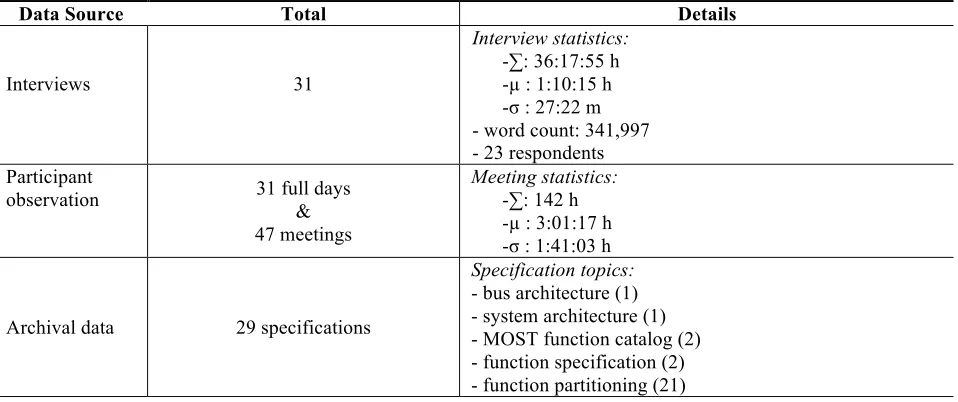
The presented data was collected between 2007 and 2009. As summarized in Table 3, it comprised
multiple data sources, including interviews, participant observation, and archival data. We organized and
recorded this data in a single research database using the Atlas.ti software for qualitative analysis. First,
we conducted 31 semi-structured interviews (µ=70 minutes, σ= 27 minutes) with a total of 23
respondents. All interviews were tape-recorded and transcribed, producing 36 hours of recorded material
amounting to approximately 342,000 words. Our respondents came primarily from CarCorp (15/23), but
also from consultancy organizations engaged in architecture-related projects at CarCorp (8/20). Using a
snowball approach (Knoke and Yang 2008), we interviewed CarCorp employees of various rank,
including engineers, departmental managers, and directors, and from a variety of functions, including
advanced engineering, software and control, and infotainment.
Participant observationwas another valuable data source. Over the most intensive period
(September 2007 to March 2008) we spent more than 30 days at CarCorp, acting as embedded researchers
in CarCorp’s different infotainment projects. Over the entire data collection period, we also took part in
various meetings, including project meetings, workshops, steering committee meetings, and supplier
meetings. All in all, we participated in 47 meetings, summing up to 142 hours (µ = 181 minutes, σ=101
minutes). It was generally problematic to record these meetings, so we took extensive field notes for
inclusion in our research database. In addition, we conducted recurring debriefings after interviews and
20
Finally, we had largely unlimited access to CarCorp’s internal project documentation. In particular,
we made use of different specifications of the automaker’s first MOST-based infotainment system. Apart
from being boundary objects for informal discussion with CarCorp practitioners in situ, these
specifications provided a solid foundation for reconstructing the details of how architectural framing
evolved. We selected 29 specifications related to bus architecture, system architecture, MOST function
catalog, function specifications, and function partitioning to be included in the case database.
<Table 3 about here>
5.3 Data Analysis
Our data analysis was driven by the theoretical proposition that the network-of-patterns frame adds
value as a complement to the prevailing hierarchy-of-parts frame in explaining technological change. We
therefore approached the case findings with the ambition to sensitize the concepts deriving from our
conceptual basis. As to avoid imposing our lens without sensitivity to the story that the data tell, however,
we initiated our analysis by using open coding to discover concepts and their properties and dimensions
in the data material (Charmaz 2006, Strauss and Corbin 1998). The first and third authors conducted the
coding process together, which yielded an initial set of approximately two hundred descriptive concepts.
To reduce overlap, we reviewed and compared all concepts by eliminating duplicates and merging closely
related ones. In the comparison process, we formulatedpreliminary definitions to capture concept
properties and dimensions. This eventually resulted in a list of 128 mutually exclusive concepts.
We then applied key concepts of our conceptual basis for making sense of the coded material. This
process was conducted in an iterative fashion where we frequently revisited Alexander’s work and the
literature on product architecture and modularity. The MOST-specifications provided strong basis for
identifying the use of patterns at CarCorp, but this step in the data analysis also involved constructing the
dense texture of relationships between these patterns and the automaker’s challenges to respond to
21
6. ARCHITECTURAL FRAMES AT CARCORP
At the turn of the century, CarCorp engineers could look back on a period of exceptional growth of
infotainment functionality. Moving beyond a simple radio, rapid digitalization had opened up for in-car
phones, navigation, telematics, TV, CD, and rear-seat entertainment. As a result, the complexity had
increased dramatically. In particular, the couplings between components skyrocketed as speakers,
displays, controls, and various sensors were shared over a range of infotainment functions to (a) support a
coherent end-user experience (e.g., coordinated speaker output from navigation and the telephone) and (b)
leverage economy of scale (e.g., single speaker system for several functions). Among CarCorp’s
infotainment engineers, there was an increasing recognition that the encapsulation of software in
hardware components was at the heart of their problems. While the use of software afforded suppliers the
opportunity to quickly change functionality at the component level, this advantage did not play out at the
system level as the specificity of interfaces effectively prevented flexible redeployment of functionality.
In 2000, CarCorp decided to adopt MOST as a response to the experienced problems. CarCorp
engineers needed an architecture in which software-enabled functionality was less coupled to particular
components. Such decoupling between hardware and software was expected to facilitate change at the
system-level and, at the same time, increase the degrees of freedom when decomposing the system. An
architect reflected upon the early impressions of the MOST architecture:
I think we all realized – at least the people involved in [architecting] infotainment – that this was the future. We needed to focus on the system, solving problems at the system level. We could not remain in the hands of suppliers, making stand-alone components. Instead, we had to make these suppliers part of a larger whole. […] I think, at the heart of MOST, there is a kind of system level thinking that is not component-oriented. Instead, it centers on the structure of logical elements or functionality. (Senior system architect)
There was consensus among engineers that this new architectural thinking was a necessary
complement to the existing hierarchy-of-parts thinking to cope with the increasing complexity and
fast-changing functional requirements of infotainment systems. Although the electronics division had
22
were concerned about the way the firm’s manufacturing heritage negatively affected the clockspeed by
which they could introduce new functionality. The temporal differences in product design between the
automotive industry on one hand, and the consumer electronics, information technology, and telecom
industries on the other hand, came to dominate architectural thinking at CarCorp’s advanced engineering
unit:
The providers are pushing new functionality, updates, and so on, into the market space in a rapid pace. The car industry is a bit schizophrenic. We want all these new features in our cars, but our development cycle is so slow. Once we design and implement a new function, it is not attractive on the market anymore. (Infotainment product manager)
The new competitive landscape made CarCorp engineers and managers reflect upon current
innovation practices, especially in terms of what made automakers slow in introducing new functionality.
They traced this difficulty to the timing of requirements determination:
The problem is that the automotive industry designs and constructs their cars over three or four years. We nail down requirements early on, and then it is immensely difficult to make change requests along the way. On the consumer device side, time-to-market is totally different. If they miss a deadline with six months, then that model is commercially dead. (Senior consultant)
We are struggling with a reality where we cannot update functionality because of our processes. Therefore, there is no other way than telling the customer that this is what we have, nothing more. We can schedule an update for the next generation of systems, but it is a very long process integrating a new component into a car. (Infotainment product manager)
Early freezing of functionality was a natural ingredient of CarCorp’s hierarchy-of-parts thinking,
allowing for division of labor and effective sourcing. However, the flip side was significant inflexibility.
Once the functional purpose of a component was defined through its interface, it was virtually impossible
to modify it. CarCorp engineers generally traced this inflexibility to the product architecture:
If we could get away from a hardware solution, we might address the problem of long lead times for introducing new functionality in the car…. The hardware should remain the same over time, while the software modules should enable the adaptation needed. … We need architectures that can enable new functionality in a flexible way. (Infotainment R&D manager)
23
MOST paved the way for a wave of new architectural thinking. In particular, it offered a new
approach to conceptualizing functional patterns independently from hardware components. Traditionally,
CarCorp engineers specified functions in relation to a component where an interface specification defined
the relationship between components and a functional requirement. In contrast, the MOST architecture
centered on description of available functional patterns without any a priori assumptions on how
functions eventually would be deployed in a particular car infotainment system. Documented in the
so-called “MOST Function Catalog”, this description essentially served as a pattern language. First, the
catalog described how patterns were to be instantiated in software, including all the details on how to
instantiate a particular function. Second, function-partitioning specifications described how different
patterns related to each other and how general functions could be combined to form more specific
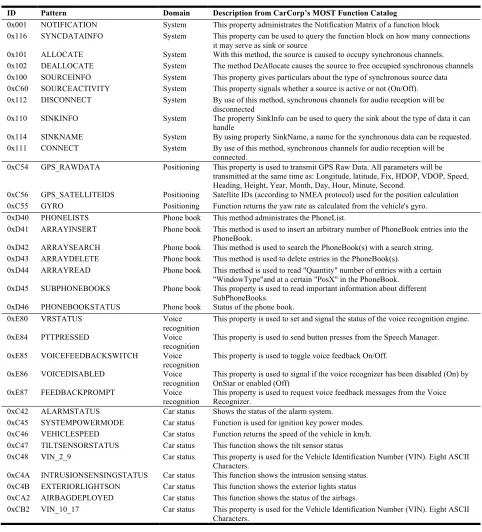
functionality. In 2004, after ten revisions over a two-year period, CarCorp’s function catalog consisted of
280 general patterns (see Table 4 for an excerpt), frequently reused in more specific patterns.
The most general patterns in the catalog served as templates for orchestration of shared system
resources (e.g., see Table 4 pattern IDs 0x001-0x111). They made the ground rules for how to make use
of speakers, displays, button, and many other critical assets, referred to as “sinks” and “sources”. Other
patterns – resolving positioning (0xC54), phone book search (0xD42), voice recognition feedback
(0xE87), or vehicle speed (0xC46) – had more specific functionality. They could, in turn, be inherited by
other patterns to make up complete solutions for end-user functions within navigation, phone, or
telematics. Since the MOST architecture did not enforce any particular deployment strategy, this network
of patterns could be reconfigured without affecting the hardware setup. Accordingly, as new functional
requirements emerged for a subsystem, MOST offered a common pattern language for developing
functionality to specific physical infotainment components.
<Table 4 about here>
The MOST architecture offered generalized patterns that largely remained relevant across
24
teams worked on different subsystems with similar problems. Reflecting a network-of-patterns frame, the
MOST architecture afforded a seemingly unambiguous way to create, structure, and maintain the
functional patterns that defined the infotainment system and its various components over time. In this
way, system architects turned into platform designers and platform users.
6.2 Tensions between Architectural Frames
Despite initial optimism, CarCorp’s adoption of MOST turned out to be rather painful, as the new
network-of-patterns frame was introduced into an organization that for decades had practiced architectural
thinking shaped by the hierarchy-of-parts frame. Just like the product structures were hierarchical with
horizontal independency between components, the organization design was hierarchical with clear
division of labor. To control such design hierarchies, CarCorp followed a strictly linear innovation
process, reflecting a waterfall model of product development. Accordingly, requirements were gradually
broken down alongside the design hierarchy. Business objectives, general system topics, and overall
functional properties were managed by CarCorp, while the design of components and detailed
functionality was assigned to highly autonomous suppliers, operating on lower levels of the hierarchy. As
witnessed by a consultant deeply involved as system engineer in developing CarCorp’s MOST
architecture, this traditional hierarchy-of-parts thinking did not change easily:
They thought the traditional model would work, where each [supplier] had responsibility for his own function, embedded in his own component. […] Down the road, they saw the flip side. It didn’t work since the whole system – end-to-end – was so incredibly distributed. (Senior consultant)
CarCorp had invested considerable efforts in generalizing patterns, trying to build a powerful
infotainment platform where functional patterns were consistently reused by more specific patterns. At
the time of deployment, when patterns were allocated to physical components, tensions between the two
architectural frames became clear: functions and components did not match anymore. General patterns,
inherited by many specific patterns, were instantiated where it made best sense from an economic or
25
different components. This had significant implications for suppliers, contracted to design and produce
components, not software. Relying on the existing legal practices at CarCorp, these suppliers were
formally made liable to functionality that was distributed across a range of other components, outside
their immediate control.
Neither suppliers nor manufacturers were comfortable with this situation. Without dedicated
software suppliers, taking full responsibility for component-spanning functions, innovation would most
likely slow down. CarCorp saw no other option than bridging the gap between suppliers and themselves
by specifying not only interfaces between components but also the general patterns to be widely reused
across the system. This transition of responsibility increased the automakers’ stakes in functional design
dramatically:
You are taking a [new] responsibility as a manufacturer, when specifying this stuff. It becomes… I mean, they [suppliers] cannot even do anything! When I think about it, it’s not them rejecting responsibility; it’s us taking it from them. Yes, that’s what it is. We are telling them that “the only thing you’re about to do is to support this [our solution]… Earlier, when things were more component-oriented, they had an opinion of their own on things, they had tested it – possibly with other manufacturers – and knew what was good and what was bad. With this approach [MOST] we more or less lost such feedback. (Project manager)
Clearly, these problems were grounded in an emerging and fundamental mismatch between the
existing organizational structures and the MOST’s approach to conceptualize software-enabled
functionality. Taking the network-of-patterns frame seriously, CarCorp’s engineers and managers had to
increasingly background the physical hardware. At the same time, they remained organized to match the
hardware structure of the system.
6.3 Leveraging Network-of-Patterns Thinking
Knowing that this mismatch could not be easily resolved, the automaker initiated two different
measures to smooth the implementation of a MOST-based infotainment solution. First, they found that
26
that hardware components were no longer at the core of architectural thinking, managers started to
structure the infotainment group to enable system level control and general pattern development:
Originally, it was a component-oriented group. They were expected to work with functional specifications as well. Later on, this didn’t work out, so they invited some people working with functions only. They needed more and more such people and, eventually they were a group of their own. Probably 10-12 [persons], maybe even more. Most of them were consultants since it was running so fast, and we wanted it implemented. We underestimated the efforts significantly. (Project manager)
Rather than obliterating the hierarchical structure, the manufacturer rebalanced the workforce, with
old roles essentially remaining the same, but the center of design moved upwards in the waterfall model,
from the component level to the system level.
Second, as designers reinforced the network-of-patterns frame, they had to break with the strictly
linear model of innovation associated with component-based modularity. The new architectural practices
pushed new forms of collaboration and new relationships – some temporary and some more permanent –
that were not supported by the traditional hierarchy. Moreover, as CarCorp’s design focus shifted, from
specific solutions (guiding decomposition) to general solutions (guiding specialization), it was necessary
to adopt an iterative approach to innovation. The traditional development processes stated few iterations,
each resulting in the production of a pre-series car, but the new way of designing infotainment systems
called for endless series of iterations. Although management formally approved the new emphasis on
patterns thinking, solutions to these challenges emerged bottom-up from designers’ daily need to make
progress. When proposed patterns were ambiguous to suppliers, CarCorp designers initiated workshops
with relevant stakeholders. When suppliers failed to reuse patterns due to various misconceptions,
designers built extensive system-level test environments to identify and solve problems in collaboration
with suppliers. When progress was too slow, designers increased iterations dramatically to boost learning
from constant interplay between generalizations and specializations. Sometimes, the clockspeed of
iterations exceeded one software release per week, a stark contrast to the traditional development process
27
Struggling to combine the hierarchy-of-parts and the network-of-patterns frames, engineers and
managers gradually found a reasonably stable way forward. On one hand, the hierarchy-of-parts frame
remained. Specific functional patterns were defined and used to guide decomposition of infotainment
systems, eventually sourced to various suppliers following existing principles. On the other hand,
designers engaged in generalization and specialization of infotainment systems with suppliers. These
iterations were performed in a fluid structure of more or less temporary, cross-organizational design
teams. Relations and arenas for collaboration were established and destroyed according to project needs.
Together these informal teams and processes made up a network-based structure of innovation,
augmented to the formal hierarchy.
To help balance the two ways of organizing, CarCorp tried to locate specific patterns characterized
by particularly high pace of change to just a few components. As demonstrated by CarCorp’s user
interface guidelines, this strategy was expected to give a malleable infotainment system that could be
effectively changed, without involving tensions between different suppliers:
The infotainment system is a user interactive and user intensive (application) with
continuous changes in the user interface, but with core functionality that in some degree is defined as stable. Therefore it is a good idea to split the core functionality from the user interface. (MOST system architecture specification)
However, splitting the more durable core functionality from specific user interface patterns
reinforced the need for a shared approach to generalization. A scenario where navigation, telematics, and
media player had different user interface logics, would eventually confuse end-users. Therefore, as
described in CarCorp’s architectural specification, all designers had to adopt the same strategy when
applying generalization to their respective functionality:
In many cases there exist design issues that do not map onto a single component, neither physical nor logical. These issues are more general in nature and must be addressed and expressed in form of strategies that must be followed by all designers involved in the design of the infotainment system family. (MOST system architecture specification)
In retrospect, the MOST architecture helped develop powerful and flexible infotainment systems,
28
However, despite a massive range of teething problems, the MOST architecture survived and became a
first-hand choice for many automakers. Over the coming years, standard practices emerged for how to
deploy functionality to physical components. These standard practices allowed automakers and suppliers
to identify and advance their respective roles in innovation. It also restored the basis for exercising scale
production. While this can be viewed as a return to modularity, it can just as well be portrayed as a
breakthrough for network-of-patterns thinking in the automotive industry. Today navigation, telematics,
and media playback are described, modeled, and manifested as networks of interacting functional patterns
rather than hierarchies of nearly decomposable parts. Since the first car was introduced based on the
MOST architecture in 2001, the technology has been increasingly accepted as a reliable and profitable
solution for in-car infotainment. In 2012, MOST was integrated in over 115 vehicle models, provided by
16 automakers worldwide. This makes MOST a significant basis for the use of pattern languages in the
ongoing digitalization of one the most profound industries in the world.
7. DISCUSSION
New technologies arise from the combination of existing technologies (Arthur 2009, Schumpeter
1934). While such combination is powered by forward-looking visions and a desire to accomplish new
goals, it is also characterized by its legacy – the genesis of a particular technology largely defines how it
can be reused for new purposes. The legacy simply makes some directions of progression “much more
compelling of attention than others” and often “advance seems to follow advance in a way that appears
almost inevitable” (Nelson and Winter 1982). The legacy largely shapes our thinking about technology
and its management (Kaplan and Tripsas 2008, Tripsas and Gavetti 2000). Hence, as product-developing
organizations engage in architectural thinking, rigid templates may emerge for how to manage the
complexity of innovation in the midst of technological change. In this regard, architectures constitute a
link between historical achievements and future potentialities. An architecture is a strategic tool that,
29
and structure-enhancing transformations” (Alexander 1999, p.79). In other words, architecture is an
instrument for path creation, but, at the same time, a shackle of path dependency. Whether
product-developing firms will be able to transform innovation practices and leverage the opportunities of digital
technology depend, to a significant extent, on their capability to fertilize new architectural perspectives
that resonate with the opportunities afforded by digital technology.
CarCorp adopted network-of-patterns thinking in the appropriation of MOST. The new architecture
was founded on the idea of developing a language of functional patterns for how to solve different
problems in the context of infotainment. These patterns opened up for functions to be designed
independently from the physical realization of the system. Drawing on this capability, designers engaged
in generalization of the system, resulting in a whole range of shared general patterns that could be
inherited by specific applications. This investment paid off through specialization, when functions such as
navigation, telematics, and media playback could be designed by reusing the same general solutions for
volume control or positioning.
At the same time, the organization as a whole viewed MOST from a hierarchy-of-parts perspective.
Fiber optics offered an exceptionally simple interface. In fact, the same, standardized interface could be
applied to all the different parts constituting the system. With such a clean and simple template for how to
build the physical structure of an infotainment system, CarCorp saw a great opportunity to reinforce
modularity. Therefore, the physical infotainment system continued to be decomposed into a wide range of
components, each expected to enable a well-defined piece of functionality. This would not just preserve
the existing hierarchy of engineers, managers and suppliers, but would also allow them to aggregate the
system aggressively to differentiate the product portfolio and launch a range of new, attractive offers.
Trying to exercise both perspectives, CarCorp uncovered a strong tension between the two
architectural frames at the point when patterns were instantiated and deployed to physical parts. While
hierarchy-of-parts thinking prescribed functional decomposition to provide nearly independent parts,
30
coupling dramatically. The clash between architectural frames became obvious, when suppliers realized
their components were not functionally independent, but deeply intertwined with other components,
outside their control. In some sense, they lost their creative leeway as CarCorp strived for general
functionality. As a result, this tension pushed them to adopt a defensive strategy, largely leaving for
CarCorp to define how to improve navigation, telematics, and other infotainment functions over time.
Validating its new infotainment solution, CarCorp could establish that it resulted in much needed and
appreciated harmonization, but little new specific end-user functionality. Network-of-patterns thinking
had offered the automaker new opportunities, but to the price of a crashed innovation model. Unless
resolving this issue through appropriate mixtures of different approaches to work design and
collaboration, CarCorp would not be able to release the potential in a continuous interplay between
31
Drawing on these insights, this research contributes to the literature on management of
technological innovations. As a first contribution, we have highlighted how the properties of digital
technology increase the clockspeed by which digitized products can be redesigned. Within the technology
and innovation management literature, these properties have typically been masked by the separation
between design and production implicated in the product lifecycle of tangible artifacts (cf. Baldwin and
Clark 2000). While programmability allows for design flexibility through functionality change of the
digitized product (Yoo et al. 2010, Zittrain 2006) and reproducibility enables design scalability through
instant reproduction of software and content (Benkler 2006, Shapiro and Varian 1999), seminal works
maintain that functionality is both attributed and fixed to physical components, and manifested in the
design specification serving as the basis for production (Baldwin and Clark 2000, Brusoni et al. 2001,
Ulrich 1995). There is little doubt that the emergence of digitized products motivates a modification of
this view.
Our
research extends the technology and innovation management literature (Baldwin and Clark 2000, Garud et al. 2003, Schilling 2000, Ulrich 1995) by focusing on the particular challenges andopportunities related to digitized products.
As a second contribution, our research introduces the notion of architectural frames, and proposes
two complementary frames for managing technological change in product innovation. Our view on
architectural frames draws on traditional notions of modularity from the technology of innovation
management literature inspired by Simon’s notion of nearly decomposable systems and on
complementary approaches to complexity inspired by the adoption of Alexander’s patterns theory in the
software engineering literature. The hierarchy-of-parts frame emphasizes decomposition of products into
parts and the network-of-patterns frame focuses on generalization of solution patterns across contexts and
implementations (Table 3). Moreover, we posit that both frames are needed since they represent
complementary ways to think about and manage digitized product architectures: the hierarchy-of-parts