RESEARCH ARTICLE
Rafting on floating fruit is effective for oceanic dispersal of
flightless weevils
Hui-Ying Yeh1,*, Hui-Yun Tseng2,*, Chung-Ping Lin3, Chen-Pan Liao2, Jung-Ya Hsu2and Wen-San Huang1,2,‡
ABSTRACT
Terrestrial species, especially non-vagile ones (those unable to fly or swim), cannot cross oceans without exploiting other animals or floating objects. However, the colonisation history of flightless Pachyrhynchus weevils, inferred from genetic data, reveals their ability to travel long distances to colonise remote islands. Here, we used captive-bred Pachyrhynchus jitanasaius to analyse (i) the physiological tolerance of weevils (egg, larva and adult stages) to different levels of salinity; (ii) the survival rate of larvae in a simulated ocean environment in the laboratory; and (iii) the survival rate of larvae in a field experiment in the ocean using fruit of the fish poison tree floating on the Kuroshio current in the Pacific Ocean. We found that the survival rate of larvae in seawater was lower than in fresh water, although if the larvae survived 7 days of immersion in seawater, some emerged as adults in the subsequent rearing process. No adults survived for more than 2 days, regardless of salinity level. After floating separately for 6 days in salt water in the laboratory and in the Kuroshio current, two of 18 larvae survived in the fruit. This study provides the first empirical evidence that P. jitanasaiuslarvae can survive‘rafting’on ocean currents and that the eggs and larvae of these weevils have the highest probability of crossing the oceanic barrier. This ability may facilitate over-the-sea dispersal of these flightless insects and further shape their distribution and speciation pattern in the Western Pacific islands.
KEY WORDS:Barringtonia asiatica, Kuroshio current, Oceanic islands,Pachyrhynchus jitanasaius, Salinity tolerance, Fish poison tree, Taiwan
INTRODUCTION
Oceans often act as a strong geographical barrier for species with restricted dispersal ability (Whittaker and Fernández-Palacios, 2007). The evolutionary pattern and process of colonisation of species on ocean islands are important topics in biogeographical studies (Cowie and Holland, 2006). With the advent of molecular genetics, molecular evidence has been used to understand the colonisation history of different species on such islands (Raxworthy et al., 2002; Vences et al., 2003; Gillespie, 2004; Cowie and Holland, 2008; Harbaugh et al., 2009; Claridge et al., 2017; Machado et al., 2017). However, for most island species with limited mobility, little information is available about the mechanism
of and the natural transportation routes for long-distance dispersal across the oceanic barrier.
There are two critical factors that affect successful colonisation of islands in the ocean: the remoteness of the island and the dispersal ability of colonisers (Simberloff and Wilson, 1969; de Queiroz, 2005; Gillespie et al., 2012). Few colonisers have the ability to reach remote islands and successfully establish populations there (Schrago and Russo, 2003). For vagile species (e.g. birds and butterflies), long-distance dispersal over distances >1000 km is possible (Brower, 1996; Hake et al., 2001). However, it is difficult for terrestrial non-vagile organisms to disperse to islands (Blaustein et al., 1994; Vences et al., 2003). The possible mechanisms for over-the-sea dispersal of non-vagile species include rafting on floating debris (e.g. tree trunks) and transport by wind and animals (Gillespie et al., 2012; Incagnone et al., 2014). Many organisms, including terrestrial insects, have been discovered on debris floating on the ocean surface (Heatwole and Levins, 1972; Peck, 1994; Thiel and Gutow, 2005). Following major tsunamis, it has been reported that rafting distances across the Pacific Ocean for insects can be thousands of kilometres over 6 years (Carlton et al., 2017).
Ocean currents – large-scale seawater movements with
continuous, stable velocity and flow for great distances – can
greatly influence the dispersal and colonisation of insular organisms (de Queiroz, 2005; Gillespie et al., 2012). The Kuroshio current is one of the major ocean currents in the Western Pacific Ocean. It originates from north of the equator and flows mainly in a northward direction from Luzon in the Philippines, via the Babuyan Islands, the Batan Islands and the Ryukyu Islands to the main islands of Japan. The Kuroshio current plays an important role in shaping the distribution of various organisms (e.g. sea grasses; Kuo et al., 2006)
and the genetic structures of their populations [e.g.Plestiodonskinks
(Kurita and Hikida, 2014) andJapaluratree lizards (Yang et al.,
2018)]. ForPachyrhynchusweevils on the Taiwan–Luzon volcanic
belt, the Kuroshio current may carry floating plant parts between different islands, thus facilitating their dispersal (Tseng et al., 2018).
During colonisation across the ocean, several potential‘filters’,
such as salinity tolerance (Coulson et al., 2002) and environmental changes (climate change, temperature), could hamper species dispersal and establishment. Salinity tolerance is critical for the survival of species when they are floating on the ocean (Hart et al., 1991). Salinity tolerance has been examined in some invertebrates, such as the terrestrial cryptostigmatic mites, the Collembola (Coulson et al., 2002) and insects (Kobayashi et al., 2014). A
previous study onPachyrhynchusweevils suggested that they are
capable of long-distance dispersal along the Taiwan–Luzon
volcanic belt (Tseng et al., 2018); however, the extent to which
Pachyrhynchusweevils can survive in seawater is still unclear.
Pachyrhynchusweevils (order Coleoptera, family Curculionidae) are a group of colourful beetles found mainly on islands in Southeast Asia, including the southern Ryukyu Islands (Iriomote and Ishigaki Islands), and the Green and Orchid Islands of Taiwan
Received 10 August 2018; Accepted 19 October 2018
1Department of Life Science, National Chung Hsing University, Taichung 404, Taiwan.2Department of Biology, National Museum of Natural Science, Taichung 404, Taiwan.3Department of Life Science, National Taiwan Normal University, Taipei 116, Taiwan.
*These authors contributed equally to this work
‡Author for correspondence ([email protected])
H.-Y.T., 0000-0002-1166-4756; W.-S.H., 0000-0003-0073-3557
Journal
of
Experimental
and the Philippines (Schultze, 1923; Starr and Wang, 1992).
Pachyrhynchusweevils are flightless insects with fused elytra and atrophic hindwings. A previous test suggested that these weevils have a cavity beneath the fused elytra, which can store air to help them float on water at least for 6 h (Schultze, 1923). Moreover, they are wood-boring insects, and their larvae and pupae live inside the stems or fruits of their host plants (Kayashima, 1940; Oshiro, 1991; Hsu et al., 2017). Their morphological adaptation and wood-boring
life history suggest thatPachyrhynchusweevils may have dispersed
across the ocean as adults rafting on floating debris, or as eggs, larvae and pupae inside the stems and fruits of their host plants (Tseng et al., 2018).
In this study, we tested the hypothesis that Pachyrhynchus
weevils can disperse across the islands in the ocean, rafting on their host plants on the Kuroshio current. Specifically, we hypothesized
that (i) adultPachyrhynchusweevils can survive better in seawater
than their eggs and larvae because the air cavity under the fused elytra of the adults keeps them afloat on the ocean surface and their hard exoskeletons are water resistant, and (ii) the eggs and larvae of
Pachyrhynchusweevils inhabiting the stems and fruits of their host
plants, such asBarringtonia asiatica, can survive during oceanic
drifting on the Kuroshio current because the large box-shaped fruits of B. asiatica, which have thick, spongy fibrous layers that are extremely water resistant and buoyant, help isolate the weevils from seawater. To test these two hypotheses, we used laboratory-reared
Pachyrhynchus jitanasaiusto examine: (i) the hatching rate and egg
period ofP. jitanasaiuseggs, and the survival rate ofP. jitanasaius
larvae and adults under low (freshwater), medium (brackish water) and high (seawater) salinity conditions in the laboratory; (ii) the
survival rate of P. jitanasaius larvae placed in the stems of
B. asiaticain a simulated ocean environment in the laboratory; and
(iii) the survival rate ofP. jitanasaiuslarvae placed in the fruits of
B. asiatica drifting on the Kuroshio current between Orchid and Yaeyama Islands offshore of Taiwan in the Western Pacific Ocean.
MATERIALS AND METHODS Ethical statement
The research permit for collecting and breedingP. jitanasaiuswas
issued by the Forestry Bureau, Council of Agriculture, Taiwan (no. 1061701832). After the experiments, we released all surviving weevils back into their collection sites. The dead weevils were deposited in an insect collection at the National Museum of Natural Science, Taichung, Taiwan, for educational use.
Weevil rearing
Pachyrhynchus jitanasaius(Fig. 1A) is a newly discovered species (Chen et al., 2017). It was previously considered to be a population ofPachyrhynchus sonaniKôno, originally described from Orchid
Island (Chen et al., 2017).Pachyrhynchus jitanasaiusis distributed
only on Green Island (121°29′15″E, 22°39′33″N), which is located
∼30 km off the coast of southeastern Taiwan. The host plants of
P. jitanasaius include the Ceylon ardisia (Ardisia elliptica,
family Myrsinaceae), the elephant’s ear (Macaranga tanarius,
family Euphorbiaceae), Melastoma (Melastomaprob.affine, family
Melastomataceae), B. asiatica (family Lecythidaceae) and
ironwood (Casuarina equisetifolia, family Casuarinaceae) (Chen
et al., 2017; Hsu et al., 2017; Tseng et al., 2018). We collected three
pairs ofP. jitanasaiusweevils by hand from Green Island in March
2016 and then bred them in a chamber at 60–70% humidity, a
temperature of 26–27°C and a photoperiod of 12 h light:12 h dark in
the laboratory. Each pair was reared in a plastic container
(15.5×12.0×7.8 cm) and supplied with fresh B. asiatica leaves
every 3 days. After a few days, the weevils started to lay eggs. Each of the oviposited eggs was transferred to another plastic container (7.5 cm diameter×4.6 cm height) for rearing. Small holes were
made with tweezers in the midribs ofB. asiaticaleaves and stems,
and the larvae, depending on their size, were placed inside these holes. For example, first to third instar larvae were placed inside the
leaf midrib holes (∼0.5 cm diameter×5.0 cm length), and fourth to
10 mm 10 mm 10 mm
100 km
A
B
C
D
E
21°N
22°N
23°N
China
Taiwan
Ishigaki N
122°03′02.24′′E
24°27′09.44′′N
Iriomote
121°06′09.88′′E
22°22′09.48′′N
Green Island
Orchid Island
[image:2.612.104.512.443.693.2]120°E 121°E 122°E
Fig. 1.Pachyrhynchus jitanasaiushabitat and rafting experiment location.(A)Pachyrhynchus jitanasaiusinhabiting the trunk of the ironwood tree (Casuarina equisetifolia) on Green Island. (B)Pachyrhynchus jitanasaiuslarvae (circled) inhabiting the fruit of the fish poison tree (Barringtonia asiatica).
(C) A fifth to sixth instar larva ofP. jitanasaius. (D) Map of Taiwan and nearby islands showing the rafting route from Dawu, Taitung, to Guishan Island, Yilan.
(E)Barringtonia asiaticafruits (yellow arrow) containing larvae were fixed with fishing nets and tied to a plastic platform made of 36 floating buoys and bamboo.
Journal
of
Experimental
last instar larvae were placed inside stem holes (∼1.5 cm diameter×5.0 cm length). The stems were replaced with fresh ones every 5 days. The body size (i.e. head width) of each larva was measured to determine the developmental stage. Because of the high mortality rate of the first to third instar larvae in the laboratory
(∼30–40%), we used only fifth instar larvae reared for about
2 months for the larval experiments described below. The experiments involving eggs were conducted on the second day after they were laid. The adults used in the salinity tests were reared from eggs to adults under optimum conditions to avoid any stress prior to the experiments, which were started about 1 month after adult emergence.
Salinity tolerance ofP. jitanasaius
To evaluate the salinity tolerance of the three developmental stages
(egg, larva and adult) ofP. jitanasaiusand to compare the weevils’
survival rate, we used one control treatment (non-immersed) and three salinity immersion treatments. The three salinity treatments
were freshwater (0.2‰salinity), brackish water (16.5‰salinity)
and seawater (35‰ salinity). The salinity levels were confirmed
using a portable hand-held refractometer (M10704645, Jiou-Ying Computer Technology Co., Ltd, Taichung, Taiwan). We prepared saline solutions by dissolving crude salt (Taiyen Biotech Co., Ltd, Taichung, Taiwan) in distilled water. For the control treatment, the eggs were placed individually without immersing them. During all experiments, the eggs, larvae and adults were placed in a chamber
at 60–70% humidity, a temperature of 26–27°C and a photoperiod
of 12 h light:12 h dark in the laboratory. For salinity treatments, the eggs were placed in compartments (4.5×2.8×4.5 cm) of plastic containers (27.5×17.5×4.5 cm) filled with 66 ml of the different saline solutions. After days 3, 7 and 14 of immersion, the eggs were removed from the saline solutions and placed in plastic containers (7.5 cm diameter×4.6 cm height) for hatching until day 21. A total of 644 eggs were used in the experiments (control treatment,
n=143; freshwater treatment, n=167; brackish water treatment,
n=167; seawater treatment, n=167). The egg stage duration was
≤14 days (ranging from 7 to 10 days); therefore, the eggs were
considered dead if they did not hatch by the end of the experiment (21 days).
A total of 78 fifth instar larvae were randomly assigned to one of
the four treatments (control treatment,n=19; freshwater treatment,
n=19; brackish water treatment,n=20; seawater treatment,n=20).
Each larva was placed on a sheet of A4 paper and photographed using a digital camera (Canon Powershot G7X, Taichung, Taiwan). The body size (i.e. head width) of each larva was measured using ImageJ (http://rsb.info.nih.gov/ij/). All larvae were then placed individually in a compartment (4.5×2.8×4.5 cm) of a plastic container (27.5×17.5×4.5 cm), and submerged beneath 66 ml of test solution, except for the control treatment. The larvae were checked every 6 h until day 7. If any larva stopped moving, we stimulated it using a fine brush and observed it for 10 min to determine its condition. After day 7 of immersion, the surviving larvae were individually reared in a plastic container and supplied
with a freshB. asiaticastem once a week. These larvae were reared
until they emerged as adults (it takes about 2 months to emerge as adults from the 5th instar larva stage). A total of 57 adults were
used for the experiment (control treatment, n=15; freshwater
treatment, n=14; brackish water treatment, n=14; seawater
treatment,n=14). The experimental setup was identical to that for
the larvae, except that each compartment of the plastic container was covered with a slice of ethafoam (thickness: 0.5 cm), on the surface of the solution, to prevent the insects from escaping. Each
adult was fixed on a piece of soft rubber (25×45×10 mm; LIFE-NO.3012, Taichung, Taiwan) and photographed using a digital camera. The thorax length of each adult was measured using ImageJ. We recorded the condition of these adults 3 and 6 h after the beginning of the experiment and then continuously every 6 h until day 7 of immersion.
Oceanic rafting on floating fruits ofB. asiatica
Fifth instar larvae (n=66) were placed inside the fruits ofB. asiatica
(Fig. 1B,C) and assigned to the control treatment or one of two salinity treatments. The fruits assigned to the control treatment
(n=22) were kept in a growth chamber at 60–70% humidity, a
temperature of 26–27°C and a photoperiod of 12 h light:12 h dark in
the laboratory. The fruits assigned to the first salinity treatment
(n=22) were floated in a tank (2.0×3.0×0.45 m) filled with seawater
(33‰salinity). We used macro wave makers (E-M-F5, 8000L/H;
WP-25, 10800L/H; Taichung, Taiwan) to simulate the oceanic
environment under 33‰salinity and a temperature of∼29.3°C. The
fruits assigned to the second treatment (n=22) were floated on the
ocean as part of the‘Kuroshio 101 Rafting Plan’, a 6 day trip (22–27
August 2016) organised by the Kuroshio Ocean Education Foundation, Taiwan (http://www.kuroshio.org.tw/newsite/). The
rafting experiment started from Dawu, Taitung (121°06′09.88″E,
22°22′09.48″N) and ended near Guishan Island, Yilan (122°03′
02.24″E, 24°27′09.44″N) (Fig. 1D). The Kuroshio current velocity
is∼1.0–1.5 m s−1(Barkley, 1970; Qiu, 2001). The longest known
dispersal distance for P. jitanasaius and the closely related
Pachyrhynchus orbiferalong the Taiwan–Luzon volcanic belt is about 600 km (direct distance), between Dalupiri in the Babuyan Islands, and the Yaeyama Islands (Tseng et al., 2018), a journey potentially requiring less than 7 days of rafting on the Kuroshio current. Meanwhile, short-distance ocean crossings (less than 50 km) between northern Luzon and Fuga and between Calayan and Camiguin Islands might require less than 14 h. Therefore, 6 days were considered as adequate to test the survival rate of
weevils under‘natural’rafting conditions.
At the beginning of the rafting experiment, fruits containing larvae were individually fixed with fishing nets and tied to a plastic platform (3.0×3.0×0.4 m) made of 36 floating buoys
(0.5×0.5×0.4 m) and bamboo (length: 35–40 m) (Fig. 1E).
The plastic platform was loosely connected to a fishing boat (HUA-KUO 189, 75 m in length) by a rope for security and then released into the ocean. The boat and experiments were carried by the Kuroshio current. The fruits floated on the ocean surface (salinity
∼34.3±0.14‰, temperature∼29.69±0.55°C measured at noon and
in the evening each day;n=10). At the end of the rafting experiment,
we dissected the fruits to locate the larvae and then reared the surviving larvae in the laboratory until they emerged as adults.
Statistical analysis
We performed two-way ANOVA with salinity treatment and
immersion period as factors to compare the egg periods of P.
jitanasaius. The egg hatching rates in the salinity tolerance
experiments were fitted using Firth’s bias-reduced logistic
regression with salinity treatment and immersion period as
independent variables. We also used Firth’s bias-reduced logistic
regression to analyse whether the survival rate of P. jitanasaius
larvae in the B. asiatica fruits was different between treatments.
These logistic regressions allowed us to estimate how different salinities, immersion periods or experimental treatments affected the binary outcome (alive or dead) of subjects using relatively small
sample sizes.
Journal
of
Experimental
For the salinity tolerance experiment, we used the Cox
proportional hazard regression with Firth’s penalised likelihood
in order to determine whether (i) the survival rate ofP. jitanasaius
larvae during 7 days of immersion and the time until adulthood were affected by salinity or body size (i.e. head width) and (ii) the
survival rate ofP. jitanasaius adults was affected by salinity or
body size (thorax length). The Cox regressions allowed us to estimate how the independent variables affected the survival time of subjects using a small sample size. In each Cox model, we allowed right-censored data including (i) larva survived for 7 days of immersion, (ii) larva survived not only for 7 days of immersion but also to adulthood and (iii) adults survived for 180 days after salinity treatments.
In each regression model, a series of multiple comparisons between treatments by switching reference levels and adjusting
P-values using the Holm–Bonferroni method to control for
family-wise error rates was conducted when a factor was marginally
significant. All analyses were conducted using the packages‘logistf’
(https://CRAN.R-project.org/package=logistf) and ‘coxphf’ (http://
cemsiis.meduniwien.ac.at/kb/wf/software/statistische-software/ fccoxphf/) in R 3.4.1 software (http://www.R-project.org/).
RESULTS
Salinity tolerance of eggs, larvae and adults
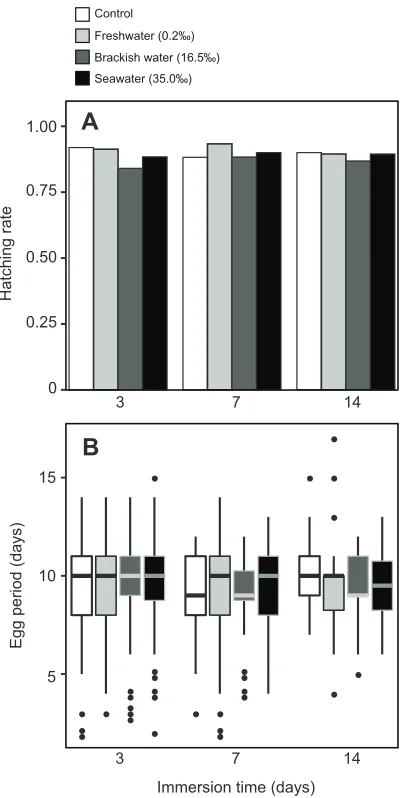
The logistic regression showed no difference in the hatching
rates ofP. jitanasaiuseggs between the three salinity treatments
for the same immersion period (marginal likelihood ratio test,
P=0.461). In addition, the hatching rates in two immersion
periods (7 and 14 days) showed no difference under the
same salinity conditions (marginal likelihood ratio test,
P=0.895) (see Table 1 and Fig. 2A). Some eggs hatched
while immersed under all three salinity conditions. We found no
difference in the average duration of the egg stages (9–10 days)
between salinity treatments (type III F-test, F3,565=0.0362,
P=0.991) and immersion periods (type III F-test, F2,25=0.242,
P=0.090) (Fig. 2B). We also confirmed homogeneity of egg
period variance among treatments (Brown–Forsythe test,
F11,541=0.0362,P=0.825). These results indicated that hatching
rates and egg stage duration were similar regardless of the length of immersion or the salinity level.
The survival rate of larvae was measured over three periods: during the immersion experiment (from day 1 to day 7) (Fig. 3A), after immersion (from day 7 to adult) (Fig. 3B), and from initial immersion to adult (day 1 to adult) (Fig. 3C). The survival rates of
P. jitanasaius larvae were 100%, 68%, 75% and 25% for the control, freshwater, brackish water and seawater treatments, respectively, after 7 days of immersion (Fig. 3A). The body size (i.e. head width) of the larvae showed no correlation with survival rate (Table 2). The survival rates of the larvae were significantly
different among the four salinity treatments (marginal likelihood
ratio test: χ2=22.666; d.f.=3; P<0.0001; see Table 2). Also,
subsequent multiple comparisons showed that the hazard ratios of the control versus other treatments (freshwater, brackish water and seawater) were significantly different, indicating that water immersion affected the survival rate of larvae. Likewise, the hazard ratios of seawater versus freshwater or brackish water treatment were significantly different. However, the hazard ratios of freshwater and brackish water treatments were not significantly different (Table 2). Comparison of the different salinity treatments revealed that salinity affected the survival rate of larvae. In contrast, in the second period under consideration ( post-immersion, from day 7 to adult), the survival rates were not significantly different among
the four salinity treatments (marginal likelihood ratio test:χ2=2.016;
d.f.=3; P=0.569; see Fig. 3B). Thus, although the larvae are
sensitive to seawater, the small proportion that survive immersion can grow to adulthood [the number of surviving individuals in control, freshwater, brackish water and seawater was 19 (100%), 13 (68%), 15 (75%) and 5 (25%), respectively] (Fig. 3C).
[image:4.612.339.541.55.454.2]TheP. jitanasaiusadults survived for less than 40 h (1.66 days) under all three salinity conditions, with 70% and 95% of
Table 1. Firth’s bias-reduced logistic regression fitting the hatching rate of eggs ofPachyrhynchus jitanasaiusafter immersion
Estimate s.e. χ2 P
Intercept 2.136 0.310 68.763 <0.001
Salinity treatment Type III likelihood ratio test:χ2
3=2.580 0.461
Freshwater vs control 0.169 0.389 0.188 0.664
Brackish water vs control −0.373 0.355 1.125 0.289
Seawater vs control −0.100 0.370 0.073 0.786
Immersion times Type III likelihood ratio test:χ2
2=0.222 0.895
Day 7 vs day 3 0.123 0.289 0.181 0.671
Day 14 vs day 3 −00.005 0.324 <0.001 0.987
Control Freshwater (0.2‰) Brackish water (16.5‰) Seawater (35.0‰)
1.00
A
B
0.75
0.50
Hatching rate
Egg period (days)
0.25
0
15
10
5
3 7
Immersion time (days) 14
[image:4.612.47.300.642.736.2]3 7 14
Fig. 2. Salinity tolerance ofP. jitanasaius.Hatching rate (A) and duration of
egg stages (B) ofP. jitanasaiuseggs under different salinity conditions and
immersion times. Control refers to the normal, non-immersed, condition.
Journal
of
Experimental
individuals dying before 12 and 24 h (0.5–1 day), respectively (Fig. 3D). The survival rates of the adults were significantly different among the three salinity and control treatments (marginal
likelihood ratio test:χ2=44.128; d.f.=3;P<0.0001; see Table 3).
In addition, subsequent multiple comparisons showed that the hazard ratios of control versus the three salinity treatments were significantly different, and water immersion reduced the survival rate of adults (Table 3). The hazard ratios of freshwater versus
0 0.25 0.50 0.75 1.00
Control
0 2 4 6
A
0 0.25 0.50 0.75 1.00
0 20 40 60 80
B
0 0.25 0.50 0.75 1.00
0 25 50 75
Survival probability
C
0 0.25 0.50 0.75 1.00
0
D
Time (days)
1 2 3 4 5 6 7
Freshwater (0.2‰)
Brackish water (16.5‰)
[image:5.612.82.531.53.504.2]Seawater (35.0‰)
Fig. 3. Survival probability ofP. jitanasaiusunder three salinity conditions over time.(A–D) Survival probability (A) of larvae from immersion day 1 to day 7; (B) of larvae after day 7 of immersion to adult emergence; (C) of larvae from day 1 of immersion to adult emergence; and (D) of adults from day 1 of immersion to day 7. A plus sign indicates a right-censored event, and the grey area in C indicates the initial 7 day immersion.
Table 2. Results of the Cox proportional hazard model fitted to the survival rates ofPachyrhynchus jitanasaiuslarvae from immersion day 1 to day 7
Cox proportional hazard model Estimate s.e. Hazard ratio (95% CI) χ2 d.f. P
Head width (mm) 0.649 1.113 1.915 (0.225, 17.878) 0.347 1 0.555
Salinity treatmenta – – – 22.666 3 <0.0001
Multiple comparisons of salinity treatment
Freshwater vs control 2.603 1.521 13.509 (1.593, 1762.881) 6.313 1 0.023b
Brackish water vs control 2.406 1.531 11.097 (1.256, 1457.392) 4.908 1 0.032b
Seawater vs control 3.702 1.491 40.536 (5.417, 5184.290) 21.547 1 <0.0001b
Brackish water vs freshwater −0.196 0.606 0.821 (0.248, 2.617) 0.113 1 0.736b
Seawater vs freshwater 1.098 0.494 3.000 (1.224, 8.239) 5.850 1 0.023b
Seawater vs brackish water 1.295 0.518 3.652 (1.449, 10.715) 7.770 1 0.015b
aMarginal likelihood ratio test of the joint hypothesis.bP-values adjusted by the Holm–Bonferroni method to control for false discovery rates. CI, confidence interval.
Journal
of
Experimental
[image:5.612.48.565.621.726.2]brackish water and seawater treatments were significantly different, showing salinity affected the survival rate of adult weevils (Table 3). However, the hazard ratios of brackish water versus seawater treatment were not significantly different
(Table 3). These results indicate thatP. jitanasaiusadults cannot
survive in water regardless of salinity level, and that the higher the salinity level, the more survival is reduced in adults.
Survival rate in rafting experiments
In this study, four out of the 22 fruits used in the rafting experiment in the ocean were lost as a result of wave action. There was a significant difference between the two experiments and the control treatment
(χ2=35.902; d.f.=2;P<0.0001). Multiple comparisons showed that the
survival probabilities in the control versus rafting experiment and in the control versus simulated ocean treatment were both significantly different, but no differences were found between the rafting and simulation experiments (Table 4). The survival rates of larvae in the rafting and simulated groups were lower than in the control group.
Most importantly, two out of 18 and two out of 22P. jitanasaiuslarvae
survived in the rafting and simulation experiments, respectively. These four larvae emerged as adults and subsequently survived for more than a month in the laboratory, indicating that, although the survival rate
was only∼10%, a small portion of theP. jitanasaiuslarvae rafting in
the fruits ofB. asiaticacan survive the ocean journey on the Kuroshio
current for at least∼300 km over 6 days.
DISCUSSION
Egg and larval stages are probable dispersal stages
Our study provides evidence thatP. jitanasaiuseggs and larvae have
a much better chance of survival in seawater than P. jitanasaius
adults. Our analyses showed that the hatching rate of eggs was
similar (84–93%) regardless of the immersion time and salinity
level. The larvae survived for 7 days in our salinity experiments. In
addition, a few larvae placed in B. asiaticafruits survived in the
simulated oceanic environment in the laboratory and in the ocean. A
previous study reported that twoPachyrhynchusadults could float
on water for at least 6 h; by 12 h, one weevil had died, but the other remained alive (Schultze, 1923). Our study showed similar results, that 70% of adult weevils can survive for less than 12 h, and that the survival rate decreases in seawater.
Physiological mechanisms of seawater tolerance at different life cycle stages
Osmoregulation is a physiological adaptation employed in various environments. However, osmoregulatory strategies in insects, especially Coleoptera, are not well known (Nicolson, 1980; Riddle, 1986; Naidu, 2001; Pallarés et al., 2015). Most osmoregulation studies have focused on the dehydration of terrestrial beetles (Nicolson, 1980; Naidu, 2001, 2006), and very few studies have explored the salinity tolerance in aquatic (Pallarés et al., 2015) or terrestrial coleopteran insects. Beetles that show osmoregulatory capacity can maintain haemolymph osmotic concentration in different saline environments (Pallarés et al., 2015). Our study provides the first example of salinity tolerance in flightless weevils that may colonize different islands by crossing the ocean at egg and larval stages.
Eggs of some invertebrate species have evolved special features which allow them to adapt to a high-salinity environment. For
example, eggs of the stick insectMegacrania alpheuscan tolerate
seawater for 150 days because of their protective crystalline shell structure (Kobayashi et al., 2014). The results of our study suggested
that the structural characteristics ofP. jitanasaiusegg shells may
protect them from seawater, similar to stick insects (Shu et al., 2015). In the larval stage, some aquatic invertebrates display osmotic adaptation under freshwater and hypersaline immersion. In a study of osmotic regulation in the larvae of euryhaline mosquitos, it was found that their distinct rectal segments could regulate the ionic concentration and osmotic pressure of the haemolymph (Clark
et al., 2004). Marine caddisfly larvae (Philanisus plebeius) can
survive in salinity levels from 90 mmol l−1 (∼15% seawater) to
900 mmol l−1(∼150% seawater) sodium chloride because of highly
efficient osmoregulation (Leader, 1972). Further physiology
experiments are needed to determine whether P. jitanasaius
larvae display special osmoregulation strategies to overcome the challenge of seawater salinity.
Adult beetles are assumed to have an impermeable cuticle that may serve as a barrier to osmotic stress from the environment. However, despite the presumably thicker and more impermeable
cuticle of adults, P. jitanasaius larvae and eggs display better
salinity tolerance. MostP. jitanasaiusadult weevils did not survive
more than 24 h in water, although they survived longer in freshwater than in saltwater. Different salinity tolerances at different life cycle
stages was also observed in Hygrotus salinarius, in which
[image:6.612.48.566.69.175.2]adults and larvae possess different types of osmotic regulation in highly saline environments (Tones, 1978). The salinity tolerance of
Table 3. Results of the Cox proportional hazard model fitted to the survival rates ofPachyrhynchus jitanasaiusadults after salinity treatment
Cox proportional hazard model Estimate s.e. Hazard ratio (95% CI) χ2 d.f. P
Thorax length (cm) −1.480 2.198 0.227 (0.003, 18.481) 0.448 1 0.503
Salinity treatmenta – – – 44.128 3 <0.0001
Multiple comparisons of salinity treatment
Freshwater vs control 2.390 0.747 10.922 (3.052, 59.991) 15.974 1 <0.0001b
Brackish water vs control 3.377 0.794 29.303 (7.421, 174.680) 29.478 1 <0.0001b
Seawater vs control 3.927 0.820 50.762 (12.171, 315.736) 38.004 1 <0.0001b
Brackish water vs freshwater 0.986 0.425 2.682 (1.181, 6.205) 5.546 1 0.022b
Seawater vs freshwater 1.536 0.470 4.647 (1.906, 11.941) 11.509 1 0.001b
Seawater vs brackish water 0.549 0.392 1.732 (0.813, 3.712) 2.044 1 0.152b
aMarginal likelihood ratio test of the joint hypothesis.bP-values adjusted by the Holm–Bonferroni method to control for false discovery rates.
Table 4. Multiple comparisons among treatments based on Firth’s bias-reduced logistic regression fitted to the survival rates of Pachyrhynchus jitanasaiuslarvae in simulated and rafting experiments
Comparison Estimate s.e. Odds ratio (95% CI) χ2 P
Rafting vs normal condition
−3.605 0.916 0.027 (0.004, 0.134) 23.716 <0.001
Simulated vs normal condition
−3.822 0.906 0.022 (0.003, 0.106) 28.245 <0.001
Rafting vs simulated
−0.217 0.977 0.805 (0.113, 5.744) 2.044 0.820
P-values were adjusted by the Holm–Bonferroni method to control for false
discovery rates.
Journal
of
Experimental
[image:6.612.46.303.642.715.2]P. jitanasaiusweevils shown here provides a potential system for further study of osmoregulatory mechanisms in flightless insects.
Characteristics ofB. asiaticaas a dispersal vector
Our study also provides the first empirical evidence to show that
P. jitanasaiuslarvae can survive oceanic rafting inside the fruits of
B. asiatica (the fish poison tree). Natural disturbances, such as typhoons, tsunamis or floods, strongly affect the coastal habitat of tropical islands (Hirsh and Marier, 2002) and alter the distribution of plants (Walker, 1991; Gannon et al., 2008) and animals, such as stick insects (Kobayashi et al., 2014) and iguanas (Censky et al., 1998).
Barringtonia asiatica, found on Orchid Island, is a host plant for
P. sonani(Hsu et al., 2017).Barringtonia asiaticais a salt-tolerant plant which extensively inhabits tropical coastal regions, in the Indian Ocean and the Western Pacific Ocean from eastern Zanzibar to Taiwan (Mojica and Micor, 2007). The outermost layer of the
B. asiaticafruit is thick and waterproof (Quigley et al., 2014). The middle layer is spongy and contains air sacs to help the fruit float. The innermost layer is hard and thick to protect the seed. The hard and spongy layers are similar to coconuts, which can survive afloat on the ocean surface for more than 2 years (Tsou and Mori, 2002;
Thiel and Gutow, 2005; Quigley et al., 2014). Pachyrhynchus
weevils are wood-boring insects (Schultze, 1923; Kayashima, 1940; Oshiro, 1991; Hsu et al., 2017). Therefore, the fruits, stems and
roots of B. asiatica (the host plant) can serve to isolate
Pachyrhynchuseggs and larvae from seawater and simultaneously supply a constant food source (Thiel and Gutow, 2005).
Dispersal and distribution ofPachyrhynchusweevils is shaped by physiological tolerance, host plant
characteristics and ocean currents
Oceanic rafting is a major mechanism for species dispersal, and ocean currents play an important role in shaping the biogeography of island biodiversity (Fraser et al., 2011). Animals of diverse taxa, including terrestrial invertebrates and vertebrates, that use oceanic rafting to disperse have been found on debris floating on the sea between islands in the Puerto Rican Bank (Heatwole and Levins, 1972) and the Galapagos archipelago (Peck, 1994); the floating debris may come from the coastlines of nearby islands. Moving
northwards along the Taiwan–Luzon volcanic belt, the fast-moving
Kuroshio current carrying viable eggs and larvae embedded in rafting
B. asiatica fruits provides a probable mechanism for over-the-sea
dispersal ofPachyrhynchusweevils between remote islands in that
region. This study provides the first empirical evidence to support the
theory that because of the insect’s physiological tolerance to
seawater, the characteristics of the host plant (B. asiatica) and the
fast-moving ocean current (Kuroshio current), Pachyrhynchus
weevils can cross the ocean barrier, exploiting this combination of factors to enhance their dispersal and colonisation of other islands.
Acknowledgements
We thank Y.-W. Kuo and several volunteers for help with fieldwork. Green Island Marine Research Station of Academia Sinica provided a laboratory for the experiments.
Competing interests
The authors declare no competing or financial interests.
Author contributions
Conceptualization: W.-S.H.; Methodology: H.-Y.T., C.-P. Liao, W.-S.H.; Software: C.-P. Liao; Validation: W.-S.H.; Data curation: H.-Y.Y., J.H.; Writing - original draft: H.-Y.Y., H.-Y.T., W.-S.H.; Writing - review & editing: C.-P. Lin, W.-S.H.; Supervision: W.-S.H.; Funding acquisition: W.-S.H.
Funding
The Ministry of Science and Technology (MOST) of Taiwan provided financial support (MOST 106-2621-B-178-001-MY3).
References
Barkley, R.(1970). The Kuroshio current.Sci. J.6, 54-60.
Blaustein, A. R., Wake, D. B. and Sousa, W. P.(1994). Amphibian declines: judging stability, persistence, and susceptibility of populations to local and global extinctions.Conserv. Biol.8, 60-71.
Brower, L.(1996). Monarch butterfly orientation: missing pieces of a magnificent puzzle.J. Exp. Biol.199, 93-103.
Carlton, J. T., Chapman, J. W., Geller, J. B., Miller, J. A., Carlton, D. A., McCuller, M. I., Treneman, N. C., Steves, B. P. and Ruiz, G. M.(2017). Tsunami-driven rafting: transoceanic species dispersal and implications for marine biogeography. Science357, 1402-1406.
Censky, E. J., Hodge, K. and Dudley, J.(1998). Over-water dispersal of lizards due to hurricanes.Nature395, 556-556.
Chen, Y.-T., Tseng, H.-Y., Jeng, M.-L., Su, Y. C., Huang, W.-S. and Lin, C.-P.
(2017). Integrated species delimitation and conservation implications of an endangered weevilPachyrhynchus sonani(Coleoptera: Curculionidae) in Green and Orchid Islands of Taiwan.Syst. Entomol.42, 796-813.
Claridge, E. M., Gillespie, R. G., Brewer, M. S. and Roderick, G. K.(2017). Stepping-stones across space and time: repeated radiation of Pacific flightless broad-nosed weevils (Coleoptera: Curculionidae: Entiminae: Rhyncogonus). J. Biogeogr.44, 784-796.
Clark, T. M., Flis, B. J. and Remold, S. K.(2004). Differences in the effects of salinity on larval growth and developmental programs of a freshwater and a euryhaline mosquito species (Insecta: Diptera, Culicidae).J. Exp. Biol.207, 2289-2295.
Coulson, S. J., Hodkinson, I. D., Webb, N. R. and Harrison, J. A.(2002). Survival of terrestrial soil-dwelling arthropods on and in seawater: implications for trans-oceanic dispersal.Funct. Ecol.16, 353-356.
Cowie, R. H. and Holland, B. S. (2006). Dispersal is fundamental to biogeography and the evolution of biodiversity on oceanic islands. J. Biogeogr.33, 193-198.
Cowie, R. H. and Holland, B. S.(2008). Molecular biogeography and diversification of the endemic terrestrial fauna of the Hawaiian Islands.Philos. Trans. R. Soc. B Biol. Sci.363, 3363-3376.
de Queiroz, A. (2005). The resurrection of oceanic dispersal in historical biogeography.Trends Ecol. Evol.20, 68-73.
Fraser, C. I., Nikula, R. and Waters, J. M.(2011). Oceanic rafting by a coastal community.Proc.R. Soc. Lond. B Biol. Sci.278, 649-655.
Gannon, M. R., Willig, M. R., Fleming, T. and Racey, P.(2008). Island in the storm: disturbance ecology of plant-visiting bats on the hurricane-prone island of Puerto Rico. InIsland bats: Evolution, Ecology, and Conservation(ed. T. H. Fleming and P. A. Racey), pp. 281-301. University of Chicago Press.
Gillespie, R.(2004). Community assembly through adaptive radiation in Hawaiian spiders.Science303, 356-359.
Gillespie, R. G., Baldwin, B. G., Waters, J. M., Fraser, C. I., Nikula, R. and Roderick, G. K.(2012). Long-distance dispersal: a framework for hypothesis testing.Trends Ecol. Evol.27, 47-56.
Hake, M., Kjellén, N. and Alerstam, T.(2001). Satellite tracking of Swedish OspreysPandion haliaetus: autumn migration routes and orientation.J. Avian Biol.32, 47-56.
Harbaugh, D. T., Wagner, W. L., Allan, G. J. and Zimmer, E. A.(2009). The Hawaiian Archipelago is a stepping stone for dispersal in the Pacific: an example from the plant genus Melicope (Rutaceae).J. Biogeogr.36, 230-241.
Hart, B. T., Bailey, P., Edwards, R., Hortle, K., James, K., McMahon, A., Meredith, C. and Swadling, K.(1991). A review of the salt sensitivity of the Australian freshwater biota.Hydrobiologia210, 105-144.
Heatwole, H. and Levins, R.(1972). Biogeography of the Puerto Rican Bank: flotsam transport of terrestrial animals.Ecology53, 112-117.
Hirsh, H. and Marier, T.(2002). Damage and recovery ofCycas micronesicaafter Typhoon Paka.Biotropica34, 598-602.
Hsu, C.-F., Tseng, H.-Y., Hsiao, Y. and Ko, C.-C.(2017). First record of the host plant and larvae ofPachyrhynchus sonani(Coleoptera: Curculionidae) on Lanyu Island, Taiwan.Entomol. Sci.20, 288-291.
Incagnone, G., Marrone, F., Barone, R., Robba, L. and Naselli-Flores, L.(2014). How do freshwater organisms cross the“dry ocean”? A review on passive dispersal and colonization processes with a special focus on temporary ponds. Hydrobiologia750, 103-123.
Kayashima, I.(1940). Notes on a Weevil (Pachyrrhynchus moniliferus Germ.) injurious to Cacao Fruit in the Philippine Islands.Trans. Nat. Hist. Soc. Formosa 30, 200-201 (In Japanese).
Kobayashi, S., Usui, R., Nomoto, K., Ushirokita, M., Denda, T. and Izawa, M.
(2014). Does egg dispersal occur via the ocean in the stick insect Megacrania tsudai (Phasmida: Phasmatidae)?Ecol. Res.29, 1025-1032.
Journal
of
Experimental
Kuo, J., Kanamoto, Z., Iizumi, H., Aioi, K. and Mukai, H.(2006). Seagrasses from the Nansei Islands, Southern Japanese Archipelago: species composition, distribution and biogeography.Mar. Ecol.27, 290-298.
Kurita, K. and Hikida, T.(2014). Divergence and long-distance overseas dispersals of island populations of the Ryukyu five-lined skink, Plestiodon marginatus (Scincidae: Squamata), in the Ryukyu Archipelago, Japan, as revealed by mitochondrial DNA phylogeography.Zool. Sci.31, 187-194.
Leader, J. P.(1972). Osmoregulation in the larva of the marine caddis fly, Philanisus plebeius (Walk.)(Trichoptera).J. Exp. Biol.57, 821-838.
Machado, A., Rodrı́guez-Expósito, E., López, M. and Hernández, M.(2017). Phylogenetic analysis of the genus Laparocerus, with comments on colonisation and diversification in Macaronesia (Coleoptera, Curculionidae, Entiminae). ZooKeys651, 1-77.
Mojica, E.-R. E. and Micor, J. R. L.(2007). Bioactivity study of Barringtonia asiatica (Linnaeus) kurz. seed aqueous extract in Artemia salina.Int. J. Bot.3, 325-328.
Naidu, S. G.(2001). Water balance and osmoregulation inStenocara gracilipes, a wax-blooming tenebrionid beetle from the Namib Desert.J. Insect Physiol.47, 1429-1440.
Naidu, S. G.(2006). Haemolymph amino acid, sugar and glycerol levels in the Namib Desert tenebrionid Physadesmia globosa(Coleoptera: Tenebrionidae) during dehydration and rehydration.Eur. J. Entomol.103, 305-310.
Nicolson, S. W.(1980). Water balance and osmoregulation inOnymacris plana, a tenebrionid beetle from the Namib Desert.J. Insect Physiol.26, 315-320.
Oshiro, Y.(1991). Studies on thePachyrhynchus infernaliseffectingMangifera indicain Ishigaki Island.Okinawa Agr.26, 19-23 (In Japanese).
Pallarés, S., Arribas, P., Bilton, D. T., Millán, A. and Velasco, J.(2015). The comparative osmoregulatory ability of two water beetle genera whose species span the fresh-hypersaline gradient in inland waters (Coleoptera: Dytiscidae, Hydrophilidae).PLoS ONE10, e0124299.
Peck, S. B.(1994). Aerial dispersal of insects between and to islands in the Galápagos Archipelago, Ecuador.Ann. Entomol. Soc. Am.87, 218-224.
Qiu, B.(2001). Kuroshio and Oyashio currents. InOcean Currents: A Derivative of the Encyclopedia of Ocean Sciences(ed. E. J. H. Steele and K. K. Turekian), pp. 61-72. Academic Press.
Quigley, D. T. G., Gainey, P. A. and Dinsdale, A. (2014). First records of Barringtonia asiatica (Lecythidaceae) from UK waters and a review of north-western European records.New J. Bot.4, 107-109.
Raxworthy, C. J., Forstner, M. R. J. and Nussbaum, R. A.(2002). Chameleon radiation by oceanic dispersal.Nature415, 784-787.
Riddle, W. A.(1986). Hemolymph osmoregulation in three species of beetles. Comp. Biochem. Physiol. A Physiol.83, 619-626.
Schrago, C. G. and Russo, C. A. M.(2003). Timing the origin of New World monkeys.Mol. Biol. Evol.20, 1620-1625.
Schultze, W. (1923). A monograph of the pachyrrhynchid group of the Brachyderinae, Curculionidae: part 1.Philipp. J. Sci.23, 609-673.
Shu, L., Suter, M. J. F. and Räsänen, K.(2015). Evolution of egg coats: linking molecular biology and ecology.Mol. Ecol.24, 4052-4073.
Simberloff, D. S. and Wilson, E. O.(1969). Experimental zoogeography of islands: the colonization of empty islands.Ecology50, 278-296.
Starr, C. and Wang, H. (1992). Pachyrhynchine weevils (Coleoptera: Curculionidae) of the islands fringing Taiwan.J. Taiwan Mus.45, 5-14.
Thiel, M. and Gutow, L. (2005). The ecology of rafting in the marine environment. I. The floating substrata.Oceanogr. Mar. Biol. Annu. Rev. 42, 181-264.
Tones, P. I.(1978). Osmoregulation in adults and larvae ofHygrotus salinarius Wallis(Coleoptera, Dytiscidae).Comp. Biochem. Physiol. A Physiol.60, 247-250.
Tseng, H.-Y., Huang, W.-S., Jeng, M.-L., Villanueva, R. J. T., Nuñeza, O. M. and Lin, C.-P. (2018). Complex inter-island colonization and peripatric founder speciation promote diversification of flightlessPachyrhynchus weevils in the Taiwan-Luzon volcanic belt.J. Biogeogr.45, 89-100.
Tsou, C.-H. and Mori, S. A.(2002). Seed coat anatomy and its relationship to seed dispersal in subfamily Lecythidoideae of the Lecythidaceae (the Brazil nut family). Bot. Bull. Acad. Sin.43, 37-56.
Vences, M., Vieites, D. R., Glaw, F., Brinkmann, H., Kosuch, J., Veith, M. and Meyer, A.(2003). Multiple overseas dispersal in amphibians.Proc. R. Soc. B Biol. Sci.270, 2435-2442.
Walker, L. R.(1991). Tree damage and recovery from Hurricane Hugo in Luquillo experimental forest, Puerto Rico.Biotropica23, 379-385.
Whittaker, R. J. and Fernández-Palacios, J. M.(2007).Island Biogeography: Ecology, Evolution, and Conservation. New York: Oxford University Press.
Yang, S.-F., Komaki, S., Brown, R. M. and Lin, S.-M.(2018). Riding the Kuroshio Current: stepping stone dispersal of the Okinawa tree lizard across the East Asian Island Arc.J. Biogeogr.45, 37-50.