Original citation:
Bernini, Michele, Du, Jun and Love, James H.. (2016) Explaining intermittent exporting : exit and conditional re-entry in export markets. Journal of International Business Studies, 47 (9). pp. 1058-1076.
Permanent WRAP URL:
http://wrap.warwick.ac.uk/79631
Copyright and reuse:
The Warwick Research Archive Portal (WRAP) makes this work by researchers of the University of Warwick available open access under the following conditions. Copyright © and all moral rights to the version of the paper presented here belong to the individual author(s) and/or other copyright owners. To the extent reasonable and practicable the material made available in WRAP has been checked for eligibility before being made available.
Copies of full items can be used for personal research or study, educational, or not-for profit purposes without prior permission or charge. Provided that the authors, title and full bibliographic details are credited, a hyperlink and/or URL is given for the original metadata page and the content is not changed in any way.
Publisher’s statement:
“The final publication is available at Springer via http://doi.org/10.1057/s41267-016-0015-2
A note on versions:
The version presented here may differ from the published version or, version of record, if you wish to cite this item you are advised to consult the publisher’s version. Please see the ‘permanent WRAP url’ above for details on accessing the published version and note that access may require a subscription.
Explaining Intermittent Exporting: exit and
conditional re-entry in export markets
Michele Bernini
National Institute of Economic and Social Research London SW1P 3HE, UK
Jun Du
Enterprise Research Centre and Aston Business School Aston University
Birmingham B4 7ET, UK
James H Love
Enterprise Research Centre and Warwick Business School University of Warwick
Coventry CV4 7AL, UK
Abstract
Intermittent exporting is something of a puzzle. In theory, exporting represents a major commitment, and is often the starting point for further internationalisation. However, intermittent exporters exit and subsequently re-enter exporting, sometimes frequently. We develop a conceptual model to explain how firm characteristics and market conditions interact to affect the decision to exit and re-enter exporting, and model this process using an extensive dataset of French manufacturing firms from 1997 to 2007. As anticipated, smaller and less productive firms are more likely to exit exporting, and react more strongly to changes in both domestic and foreign markets than larger firms. Exit and re-entry are closely linked. Firms with a low exit probability also have a high likelihood of re-entry, and vice versa. However, the way in which firms react to market conditions at the time of exit matters greatly in determining the likelihood of re-entry:thus re-entry depends crucially on the strategic rationale for exit. Our analysis helps explain the opportunistic and intermittent exporting of (mainly) small firms, the demand conditions under which intermittent exporting is most likely to occur, and the firm attributes most likely to give rise to
such behavior.
Key words:
Intermittent exporting; export exit; export re-entry; re-internationalisation
Acknowledgment:
INTRODUCTION
The literature on internationalisation is dominated by two theoretical approaches: the
process approach and the international entrepreneurship (or ‘born global’) approach
(Johanson and Vahlne, 1977, 2009; Knight and Cavusgil 2004; Jones and Coviello
2005). Despite their differences, both approaches implicitly see becoming
international as an important step in a firm’s development, and one which is
effectively irreversible. The process literature typically revolves around
understanding what determines and mediates the process in which firms learn and
increase resource commitments, but rarely addresses the reverse situation where
resources are decreased or withdrawn. This tendency is perhaps even more evident in
the ‘born global’ literature, in which it is assumed that relatively young enterprises
quickly (and by implication permanently) achieve relatively high levels of
international activity.
However, for many firms the evidence suggests that becoming international is by no
means irreversible, especially as regards one crucial part of internationalisation:
exporting. There is evidence that for many firms – especially SMEs – exporting is
often a rather opportunistic and sporadic activity, rather than a continuous process.
Recent analysis suggests that firms often engage in relatively intermittent exporting
for extended periods, and that sporadic exporting is commonplace among UK SMEs
without either entry to or exit from export markets being a coherent strategy (Crick
2003; Requena-Silvente 2005; Love and Ganotakis 2013). Similar results have been
found for Italian SMEs, with repeated, serial entry and exit to and from export
markets being relatively commonplace, and firms taking time to build up the
experience and internal assets necessary to make export market entry a clear strategic
decision (Bonaccorsi 1992). Research on other countries suggests this is not a
specifically European phenomenon, with similar patterns of intermittent exporting
reported for Colombia (Eaton et al. 2008) and Chile (Blum et al. 2013). However,
while the phenomenon has been observed, there is little systematic analysis of the
causes of intermittent exporting, or of the precise conditions that make it more likely
One of the problems with both conceptual and empirical research in this area is
simply definitional: there is a problem of categorizing intermittent exporters even
where longitudinal data series are available. Ex-ante categorizations of intermittent
exporters on the basis of their revealed behavior are bound to be arbitrary: each
continuous exporter within a particular time window may have been an intermittent
exporter before or after the period of observation (Blum et al 2013). By contrast, the
analysis we perform does not rely on ex-ante categorization and arbitrary definition.
Intermittent exporting must, by its nature, involve international market entry,
followed by exit and subsequent re-entry: to understand fully the phenomenon of
intermittent or sporadic exporters, each of these actions has to be understood. We now
know a great deal about the first of these, with many studies of the exporting decision
and its determinants1: however, we know much less about the process of exit from export markets, and even less about re-internationalisation via exporting (Welch and
Welch 2009). The conceptual and empirical analysis below concentrates on this
process of exit and (conditional) re-entry, the characteristics that define intermittent
exporters. By concentrating on the exit and re-entry process we therefore avoid
arbitrary ex-ante classifications of ‘continuous’ or ‘intermittent’ exporters.
In doing so, our study provides three contributions towards understanding the puzzle
of intermittent exporting. First, we extend theory by developing a new conceptual
model of exit and re-entry, building on both the resource-based view of the firm and
the process model of internationalisation (Johanson and Vahlne, 1977; Johanson and
Vahlne, 2006), augmented with insights from the performance feedback literature
(Lages et al 2008; Lin, 2014). The model highlights the important roles of firms’
internal resources and the nature of external demand (both domestic and foreign) in
determining exit and re-entry, and provides testable hypotheses of the conditions
under which export exit and re-entry – and hence intermittent exporting – will take
place.
We then test the model on a very extensive dataset of firm-level export entries and
exits over the period 1997-2007. This leads to the second contribution, which is a
better understanding of the conditional nature of re-entry. We show that how firms
react to market conditions at the time of exit is important in determining the
likelihood of re-entry: we thus demonstrate that re-entry depends crucially on the
strategic rationale for exit. Specifically, we are able to identify theoretically, and
confirm empirically, the (exit) demand conditions under which re-entry, and thus
intermittent exporting, is most likely to occur, and the firm attributes most likely to
lead to intermittent exporting.
We make a third contribution to both researchers and policy makers by shedding light
on a phenomenon that has previously been observed but never satisfactorily
explained. We show how and why smaller and less productive firms react most
strongly to changes in (domestic and foreign) demand conditions in terms of export
exit and re-entry, and so we are able to account for the opportunistic and intermittent
nature of exporting among such firms.
CONCEPTUAL FRAMEWORK AND HYPOTHESES
No single theoretical model fully explains the phenomenon of intermittent exporters.
We therefore develop our conceptual framework based on two major theoretical
perspectives to explain how firm characteristics and market conditions affect firms’
decision to exit and re-enter exporting. Augmenting these theories with insights from
the performance feedback literature, we develop a model of firm export exit and
(possible) re-entry conditional on exit – the defining characteristics of intermittent
exporters.
The first theoretical pillar is the resource-based view (RBV). Recent international
trade theory has highlighted the importance of producer heterogeneity in explaining
the dynamics in international trade (e.g. Melitz 2003). Scholars in these fields have
investigated intensively why firms export and how they benefit from exporting. While
the economics literature has tended to regard firm-level productivity to be the
‘catch-all’ determinant of heterogeneous export behavior, the IB literature in parallel has
adopted a more complex and nuanced view, and explored these questions in the
framework of the resource-based view and firm-specific advantages (Dunning, 1980).
An underlying assumption about these frameworks is that firms vary in their resource
conclusions – we now understand that to start exporting, firms need to be sufficiently
productive or competitive to cover the sunk cost associated with export entry,
including the costs of collecting market information, modifying products to global
preferences, logistics and distribution. This is supported by a large body of empirical
work (as reviewed by Wagner, 2007; ISGEP, 2008; Martins and Yang, 2015).
The second strand of theories we draw on is the gradual process of
internationalisation. This includes the original Uppsala internationalisation process
models and the further developments that highlight the interplay between learning,
commitment building and business network development (Johanson and
Wiedersheim-Paul 1975; Johanson and Vahlne, 1977; Johanson and Vahlne, 2006;
Johanson and Vahlne, 2009). Here, the gradual learning process of
internationalisation is featured in which firms first gain experience from the domestic
market before moving to foreign markets, starting their foreign operations from ‘less foreign’ countries (in terms of psychic distance) before moving to more foreign
countries, and starting foreign operations by using traditional exports before gradually
moving to more intensive and demanding operation modes such as sales subsidiaries
and direct investment. This is a process in which firms develop market knowledge,
decide foreign market commitments, and identify and develop opportunities2.
Despite their usefulness in explaining exporting and internationalisation, neither the
RBV nor the process model satisfactorily explains the phenomenon of intermittent
exporting. The RBV concentrates on the internal resources of the firm, while the
process model stresses learning from previous international experience coupled with
decisions on likely future prospects in foreign markets in deciding on future
commitment levels. In their more recent re-conceptualisation of the process model,
Johanson and Vahlne (2009) stress that commitment may decline, or even cease, if
performance and prospects are not sufficiently promising. However, this is
considered in the context of commitment to a given market, and does not specifically
explain why some firms repeatedly enter, withdraw from, and re-enter exporting
activity as a whole. More specifically, neither theoretical approach fully explains the
interplay between demand conditions in both the domestic and potential export
markets and internal firm characteristics in the decision to exit or re-enter exporting,
nor the conditions under which firms react more or less strongly to changes in
demand patterns in deciding whether to exit or re-enter exporting. We develop a
conceptual model which does this, drawing on elements of the resource-based
perspective and the process model, but augmenting both with an understanding of
firms’ reaction to domestic and foreign demand changes through the process of
performance feedback.
Performance feedback describes a situation in which the firm evaluates performance
against an aspirational level which is set either in terms of previous performance
achievement, or through comparisons with competitors. Previous research suggests
that performance feedback does play a role in internationalisation, and especially in
irregular and intermittent forms of internationalisation. For example, in a study of
Swedish SMEs, Wennberger and Holmquist (2008) find that performance below
defined aspiration levels tended to increase the firm’s search for opportunities to
internationalise; and in a study of over 500 export managers, Lages et al (2008)
demonstrate that exporting performance is inversely correlated with the extent of
change in exporting marketing strategy in the next period, consistent with
performance feedback. More specifically, Lin (2014) shows that where performance
is below the aspiration level, firms tend to respond not only by adopting more rapid
internationalisation, but also a more irregular pace of international expansion in order
to improve performance.
The interplay between firms’ internal resources and perceived opportunities in
domestic and international markets drives the process of export entry, exit and
potential re-entry. A firm engaged in domestic operations has the opportunity to
employ its internal productive resources and its knowledge of the external
environment to commit resources in the decision to start exporting. The firm’s
experience as an exporter then helps to shape its view of the profitable opportunities
available in both domestic and overseas markets, and it decides whether to remain as
an exporter or to exit exporting. This is done by comparing actual performance arising
from exporting to the level considered acceptable. We argue below that this decision
is influenced by the interaction between a firm’s internal resources and demand
internal capacity and on the reasons for exit, the firm then faces the decision to remain
as a domestic producer or re-enter exporting. Crucially, the re-entry decision is
shaped by experiences and performance prior to and during the exit phase, including
the rationale for exit. The re-entry decision is therefore a conditional one. Firms
which go through all three stages culminating in re-entry are intermittent exporters,
the focus of this paper.
The detailed hypotheses underlying this process are developed below. As
demonstrated in the empirical analysis, this model exhibits several useful features. It
explains why intermittent exporting is more likely to be carried out by smaller, less
resource-intensive firms, shedding light on the opportunistic and intermittent nature of
exporting among small firms observed but largely unexplained in earlier research (e.g.
Crick 2004; Love and Ganotakis 2013). The model also demonstrates that demand
conditions at the time of exit, and the firm’s reaction to these, are central to the
probability of export re-entry, an issue not previously considered in empirical
research. More generally, our analysis highlights the role of the firm’s strategic
choice in exit and re-entry, especially regarding reaction to changes in home and
overseas demand.
The initial export entry decision is well researched in the IB and economics
literatures. In the sections below we concentrate on developing the conceptual
arguments and hypotheses for the exit and conditional re-entry stages that define
intermittent exporters.
Export Exit: Firm Resources and External Market Conditions
We hypothesis that export exit is shaped both by perceived market demand conditions
and on the interaction between the firm’s internal resources and demand at home and
overseas.
External market conditions
Firms make exit decisions strategically, based at least partly on expected earnings in
growing evidence that the globalization of markets and industries has fundamentally
changed the competitive conditions facing firms (Colantone et al 2008). Not only has
the global market place become more competitive, but there are also more market
opportunities from which firms can take advantage. Therefore, demand conditions in
domestic and foreign markets are likely to play a role in the exit decision alongside
the firm’s internal resources.
Export and domestic sales are closely linked. There is ample macro-level evidence
that exports can be motivated both by improved global trade condition and by
domestic crisis or depression (Greenaway and Kneller, 2007). Indeed, Salomon and
Shaver (2005) argue that export sales and domestic sales should be determined
simultaneously: their relationship is interdependent rather than independent. In a
similar vein, Belke et al (2015) argue that under certain conditions, firms consider
export activity as a substitute for serving domestic demand. One potential limitation
of the previous literature is that the ‘complementarity’ versus ‘substitutability’
property of domestic demand and export activity has typically been analysed in a
linear framework. The relationship between domestic demand and export
performance may, however, vary with economic conditions and thus be of a
non-linear nature.
Some empirical evidence supports this view. Based on firm-level data from five Euro
area countries, Belke et al (2015) find that domestic demand developments are
relevant for the short-run dynamics of exports especially during the more extreme
stages of the business cycle. A strong substitute relationship between domestic and
foreign sales can most clearly be found in Spain, Portugal and Italy, providing
evidence of the importance of sunk costs and suggesting that history matters in
international trade. In their analysis of Chilean firms, Blum et al. (2013) find that
intermittent exporters have lower capital (either given exogenously or related to their
lower productivity): as a consequence the marginal costs of exporting is higher when
domestic demand is high since it is more profitable to sell domestically. When
domestic demand is low it becomes more profitable to sell to foreign markets, and as
Given these theories and evidence, we argue that firms’ export exit may reflect the
adjustment to external market conditions, including both domestic and overseas
market condition. It is a process of firms’ learning through engaging in international
export markets and at the same time identifying and creating opportunities. Profitable
opportunities encourage entry, into either the domestic market or global markets.
When the domestic market grows, exporters may find higher profit margins from
domestic sales increase and hence are willing to shift sales from exports back to the
home market. Similarly, when global markets grow, selling in international markets
becomes more profitable, hence staying in export markets and expanding the market
share is logical.
Hypothesis 1a: The higher the growth rate in the domestic market, the more
likely are firms to exit export markets.
Hypothesis 1b: The higher the growth rate in foreign markets, the less likely
are firms to exit export markets.
The Role of Internal Resources
The outcome of the knowledge gained from exporting can be to withdraw
commitment from international markets, just as much as it is possible to increase
resource commitment. Firms may realise only after starting to export, or only through
exporting, that they are not competitive enough to stay in international markets:
negative performance feedback therefore leads such firms to cease exporting. An
example of this arises in ‘opportunistic’ or ‘accidental’ exporters, firms which may
respond to an enquiry or order placed by a customer overseas without such behavior
being a clear strategic decision (Crick 2003; Requena-Silvente 2005). Such firms may
not have sufficient time to learn about foreign markets and that may induce their rapid
exit from exporting. By contrast, more resourceful and capable firms are more likely
to be in the position to survive the negative productivity shocks than less resourceful
and capable ones.
This suggests that the nature of a firm’s response to changes in domestic and foreign
hypothesise that firms’ internal characteristics and resources interact with market
conditions in systematic ways to determine the likelihood of exit.
Although expanding foreign markets provide opportunities for all firms (as H1b
above suggests), for small firms this is something of a mixed blessing. Smaller firms
and those further from the productivity frontier are less likely to be able to compete
effectively with the increased competition that is likely to accompany increased
foreign demand. Such marginal firms may find themselves squeezed out of export
markets as their (relative) productivity levels fall relative to the average, as new, more
capital-intensive and more productive entrants move into the market. Similarly,
smaller and less productive firms are more likely than larger, more capital-intensive
and more productive enterprises to exit export markets when domestic demand rises.
Such firms are more likely to be ‘opportunistic’ exporters: for them exporting is often
a marginal exercise, and one which is easily reversed when domestic demand
conditions improve relative to export markets. Precisely such a scenario is outlined
by Crick (2003), and demonstrated for British new technology-based firms by Love
and Ganotakis (2013). And in their analysis of Chilean firms, Blum et al. (2013) find
that intermittent exporters tend to have lower capital intensity, possibly related to their
lower productivity. By contrast, larger and more productive firms are less likely to be
adversely affected by increased demand in expanding export markets, and are also
more able to cope with increased production in times of rising domestic demand
without the need to switch out of export markets, an option which may be more
difficult for smaller firms and those further from the productivity frontier. In
addition, larger and more capital-intensive firms may suffer from a degree of inertia
or sclerotic thinking as well as having longer-term planning horizons than their
smaller, more nimble counterparts, making them less reactive to short-term changes in
demand conditions. This leads to our next hypothesis:
Hypothesis 2a: The larger the firm, the less strongly it reacts to changes in
domestic and foreign demand in terms of the likelihood of export exit.
Hypothesis 2b: The more productive the firm, the less strongly it reacts to
changes in domestic and foreign demand in terms of the likelihood of export
Hypothesis 2c: The more capital-intensive the firm, the less strongly it reacts
to changes in domestic and foreign demand in terms of the likelihood of
export exit.
Export Re-Entry: Firm Resources and External Market Conditions
The key distinguishing feature of intermittent exporters is that they re-enter exporting
having previously ceased doing so. As with the exit decision, we postulate that
re-entry will depend on firms’ internal productive resources and on their strategic
reactions to domestic and foreign demand conditions.
There is evidence that experience of exporting helps firms to learn about and
overcome the difficulties of operating in foreign markets (Salomon and Shaver 2005;
Love and Ganotakis 2013; Sui and Baum, 2014). In particular, the past experience of
exporting reduces the uncertainty associated with re-entering export markets and
helps firms lower the sunk cost associated with re-entry. This is consistent with the
view that previous international experience leaves international ‘heritage’ which can
be useful for subsequent re-entry (Welch and Welch, 2009).
However, firms will vary in their capacity to access, interpret and absorb the
information gained through a previous period of exporting. Firms with a low
probability of exiting exporting, typically larger, more productive enterprises, will
typically find the same attributes useful in re-entering should the need arise: we know
from the export entry literature how important scale and productivity are in entering
foreign markets. In addition we argue that the firms best equipped to absorb useful
knowledge from their previous exporting experience are those which already have the
scale, productive capacity and absorptive capacity to learn – precisely the set of firms
which had a relatively low likelihood of exit. While some larger firms may suffer
from inertia or sclerotic thinking, recent evidence indicates this is largely a function
of firm age rather than size, while scale and previous experience are major advantages
resources not only directly affect exit, but have a conditional effect on the probability
of re-entry: exit and re-entry are inversely correlated.
External market conditions
Related to Hypothesis 1a and 1b on exit, we argue that the external market conditions
in which exporters exited exporting not only help explain the exit decision, but also
matter with respect to the likelihood of re-entry. This is because the reasons for exit
say much about the quality of firm’s internal resources and the nature of the export
re-entry. On the one hand, when the domestic market experiences a boom, firms face
increasing marginal costs of exporting as it is more profitable to sell domestically and
output is fixed in the short term (as in Blum et al 2013). Firms that have suitably high
productive capacity may not need to choose the domestic market over foreign
markets, and are able to expand in domestic market while remaining as exporters.
However, firms that have short-term quantity constraints in the amount of output that
they can produce may decide to retreat (temporarily) from the foreign market to
satisfy increased domestic demand. Subsequently such firms are more likely to
increase production in the following periods not only to meet the increased demand
domestically, but also to re-start selling abroad.
On the other hand, if firms exit exporting when the domestic market experiences a
negative shock (such as an economic crisis), then it is reasonable to assume that they
might be experiencing challenges in maintaining sufficient profit margins to stay in
export markets. A likely scenario is that the firm is heading towards closure:
Ilmakunnas and Nurmi (2010) show that many exporting firms share similar
characteristics to those of firms completely exiting from the market. Such firms are
hence less likely to re-enter export markets.
Similarly, when foreign markets experience a boom, irrespective of domestic market
conditions, firms face lower marginal costs of exporting, as it is more profitable to
expand international market and sell less domestically. Under these conditions it is
counter-intuitive to retreat from exporting unless firms experience serious challenges
in maintaining sufficient profit margins to stay in foreign markets. One possible
in the existing markets. Increased competition decreases profit margins for
incumbents, and some of the existing exporters may no longer be able to continue
exporting. If exit from exporting is driven by the exporter’s insufficient productive
efficiency, it may take time to catch up with the productivity frontier: thus firms
which exited when foreign demand was growing are in a relatively weak position to
subsequently re-enter exporting. Hence:
Hypothesis 3a: The higher the domestic market growth rate at the time of exit,
the more likely firms are to re-enter exporting.
Hypothesis 3b: The higher the foreign market growth rate at the time of exit,
the less likely firms are to re-enter exporting.
Together, Hypotheses 1a/1b and 3a/3b indicate that reactions to demand conditions at
the time of exit systematically affect the probabilities of both exit and re-entry.
Coupled with the other hypotheses, this in turn suggests a clear pattern of the nature
and likelihood of intermittent exporting under different demand conditions at the time
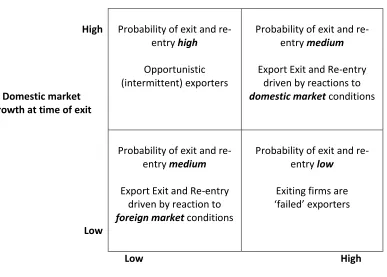
of exit. These are illustrated in Figure 1, which compares the situations when
domestic and foreign demand are high/low at the time of exit.
In the top left quadrant, where demand growth is (relatively) high in the domestic
market but (relatively) low in overseas markets, domestic and foreign conditions pull
in the same direction with regard to exit/re-entry: firms clearly have an incentive to
exit exporting on both counts. As indicated in H3a/3b, firms exiting under these
conditions also have a high likelihood of subsequent re-entry: firms that have
short-term quantity constraints in the amount of output that they can produce may decide to
retreat (temporarily) from the foreign market to satisfy increased domestic demand.
Such firms are able to increase production in the following periods to re-start selling
abroad when demand conditions improve. Under these conditions, exit and re-entry is
therefore likely to be relatively frequent: firms reacting this way may be
characterised as the opportunistic intermittent exporters, frequently relatively
On the leading diagonal are conditions where demand in both domestic and foreign
markets is high/low at the time of exit. Here, conditions in either the domestic or
export markets drives exit and re-entry patterns. In the high/high case (top right
quadrant) any incentive to exit comes exclusively from reaction to the growth in the
domestic market, as some firms switch production there in the short term (H1a).
These firms are also likely to re-enter exporting (H3a) as they are subsequently able
to expand production to accommodate growth in both domestic and overseas markets.
Thus intermittent exporting takes place, but is driven wholly by reactions to events in
the domestic market. In the opposite low/low growth case (bottom left quadrant) the
reverse applies: exit and re-entry occurs as a result of firm’s responses to low demand
growth in export markets. Firms thus have an incentive to exit exporting, but they are
also in a good position to re-enter exporting subsequently. This is because they left
exporting purely because of low demand, and were not driven out by the competition
in export markets.
The final case is where domestic market growth at the time of exit is low, and that of
export markets at the time of exit is high. Firms have little incentive to exit exporting
here, but those that do are ill-equipped for re-entry into exporting: these firms exit
exporting because they are unable to keep up with the competition in growing export
markets, not because of limited export opportunities. The likelihood of intermittent
exporting is therefore low, and firms exiting under these conditions might best be
regarded as ‘failed’ exporters.
< Figure 1 near here>
DATA AND METHODS
France has a large exposure to international trade, a large domestic market and a
well-developed manufacturing sector; hence it represents the ideal setting to test our
hypotheses. In addition, France shares its borders with the largest economies of the
Euro area and it has close linguistic and cultural ties with some of its neighboring
countries such as Belgium, Switzerland and parts of Germany. These factors favor the
diffusion of export intermittency across French companies, because bordering
(Eaton et al., 2004), and common language, similar culture and currency further
reduce the barriers to trade with these countries (Egger and Lassmann 2015).
We can test our hypotheses using a longitudinal firm-level dataset covering almost the
entire population of French firms observed over the period 1997-2007.Our dataset is
based on data sourced from the Fichier complet de Systeme Unifie de Statistique
d’Entreprises (FICUS) database that is provided by the French National Statistical
Office (INSEE). Data from FICUS are mostly based on firms' fiscal declarations, and
they provide accurate information on a number of balance sheet items. The wide
coverage of FICUS, and the wealth of information on individual firms that it provides,
permits the tracking of French firms' demography, exporting activities, and
performance indicators with an unusual level of detail. 3 The relatively long period of
time covered by our dataset also allows us to overcome one of the most common
limitations of micro-level datasets that prevent tracking the export behavior of firms
over time.
We restrict our analysis to the manufacturing sectors.4 Although manufacturing firms
constitute only about 10% of the population of French companies, we calculate that
they nevertheless account for over 60% of total French exports as reported by the
firms in the dataset. The focus on manufacturing firms is a common feature of the
empirical trade literature and it is in line with the objective of studying the strategy of
companies that are both involved in the production and in the sales of their output.
In each period, exporters are identified as companies reporting a positive value of
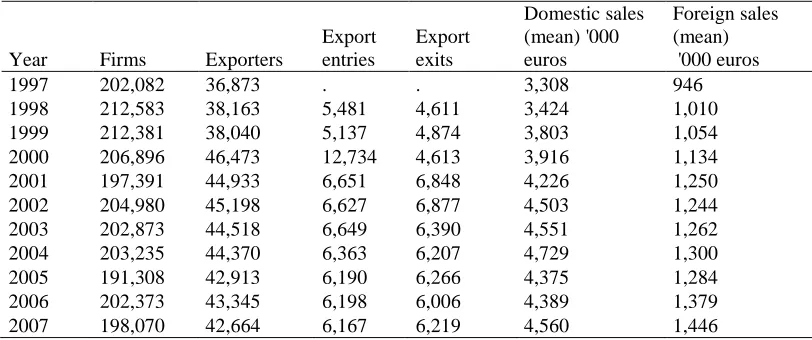
foreign sales. Table 1 describes the composition of the dataset by export status over
the period 1997-2007. Approximately 200,000 manufacturing firms are observed
every year, and the number of exporters ranges from a minimum of 36,873 in 1997 to
a maximum of 46,473 in 2000. In 2000, the number of firms that enter into the export
market (12,734) is much larger than in other years (about 6,000). In addition, since
3 FICUS excludes only firms with fewer than 10 employees and revenue below 81,500 euros for manufacturing or below 32,600 for services. All values reported in this dataset are in thousands of euros and they are deflated using 2-digit industry specific indices provided by INSEE for consumer, value added and capital prices.
2001 the number of firms that exit the export markets is larger than in previous
periods. Both the massive entrance of new exporters in 2000 and the higher number of
exits in following periods are consistent with the idea that the introduction of the Euro
increased the export entry of smaller companies that are also more likely to quit
exporting. More importantly for our study, the significant numbers of firms that enter
and exit the export market suggest that we may exploit firm-level variations in export
status to test our hypotheses.
<Table 1 near here>
Methodology
A possible approach to identify intermittent exporters is to split the sample of firms
into categories such as ‘intermittent’ and ‘continuous’ exporters on the basis of
pre-defined patterns of export participation observed during the period of the analysis. By
definition, such an approach involves some arbitrary decisions. For example, to
identify intermittent exporters it is necessary to choose the minimum length of each
exporting and non-exporting spell that distinguishes intermittent exporting from other
forms of exporting behavior. Regardless of the argument made to justify any chosen
definition of intermittency, this approach restricts the validity of the analysis to the
period in which firms are observed in the dataset. For example, a company exiting
and re-entering the export market during the period of the analysis may behave as a
continuous exporter if observed in previous or later periods.
Our investigation does not rely on a discretionary typology of export intermittency:
instead, we study how firm-level characteristics and demand variations concur in
determining an exporter's retreat to the domestic market and its subsequent re-entry
into the export market. In practical terms we first model a firm's probability of leaving
the export market and then estimate a second model aimed at identifying which
factors facilitate the re-entry of those firms that previously exited the export market.
By modeling explicitly export exit and re-entry our results are less sensitive to the
definition of export intermittency, although clearly the sample of firms that we
observe re-entering the export market is inevitably dependent on the time window of
sufficiently long time span to capture a representative sample of intermittent
exporters.
To operationalize this strategy, the analysis proceeds in two steps. We first estimate a
Probit model of export entry where the dependent variable is the bivariate variable
Exitit that assumes value one in the year t in which an exporter i exits the export
market. The period of exit is defined as the first period with no foreign sales5. This
model is estimated on a sample including exporting firms observed from the first year
they enter the dataset (or the first year they are observed exporting) until the
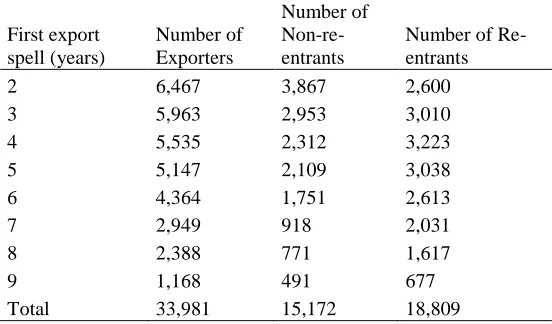
occurrence of their first observed export exit. Table 2 reports the number of unique
exporters by the length of the first export spell observed (number of years): ‘exiters’
are those we observe exiting the export market at some point in time between 1997
and 2007, while ‘non-exiters’ are those that keep exporting throughout the period they
appear in the dataset. The distinction between non-exiters and exiters is important
because only the latter group of firms enters in the estimation sample that we use in
the second step.
<Table 2 about here>
The second step of our analysis investigates the role of firm-level attributes and
demand conditions in determining re-entry into exporting. We therefore estimate a
second Probit model for those firms that previously exited the export market. Some of
the firms included in this second sample are observed re-entering the export market
before 2008 (i.e., `re-entrants') while others continue as non-exporters until the end of
the observation period (i.e., `non-re-entrants’ – see Table 3). The dependent variable,
is a dummy variable assuming value one for the period in which the firm
re-enters exporting and value zero otherwise.
<Table 3 about here>
Independent Variables
To test our hypotheses both estimations contain independent variables reflecting firm
resources and demand conditions in both domestic and foreign markets. The relevant
variables are now explained in turn.
The variables for firm’s internal resources include measures of size, technology, and
performance. Firm productivity is measured by total factor productivity TFPi,t. This is
obtained as the residual from the estimation of a production function by the
Levinsohn-Petrin method (Levinsohn and Petrin, 2003).6 We control for a firm's
technology by the inclusion of capital intensity Ki,t , that is computed as the natural
log of a firm's book value of tangible assets per employee. Lastly, we proxy for a
firm's size by the log number of employees Employi,t .
The variables ∆Doms,t and ∆Fors,t respectively proxy the demand conditions faced by
a firm in the domestic and in the foreign market. ∆Doms,t measures year-to-year
variations in domestic demand as the log difference between sectoral absorption in
France (i.e. domestic production plus exports minus imports) between two
consecutive years for the aggregate output of the 2-digit ISIC industry of the firm.7
Positive and negative year-to-year variations respectively indicate expansions and
contractions of the domestic market. Similarly ∆Fors,t is the log difference in the
aggregate sectoral absorption across the countries sharing a border with France. We
proxy foreign demand with the demand of bordering countries only because previous
research shows that firms first expand into geographically close export markets and
then target more distant export destinations (Eaton et al., 2004). Hence, we expect
neighboring countries' demand to affect more directly the export decisions of
potentially intermittent exporters.
The re-entry probit model contains additional variables that describe the demand
conditions in the domestic and in the foreign market in the year when firm i left the
export market (∆Doms,0 and ∆Fors,0 respectively). The inclusion of these variables is
intended to capture the different probability of re-entering into exporting across firms
that left the export market under different demand conditions. For example, it is
possible that a firm that leaves the export market when domestic demand is booming
6 Production functions are estimated separately for different 2-digit ISIC sectors.
is following a different export strategy from a firm leaving the export market when
domestic demand is stagnant, a key component of H3a and H3b.
The re-entry model also contains the term IMR0 , the Inverse Mill's Ratio computed
on the basis of the estimated coefficients obtained from the model on export exit. This
term corrects for any bias arising in the re-entry model due to the correlation between
firm-specific, time-invariant factors that determine both the termination of the first
export spell and the probability of export re-entry.
In both models we include two conditioning variables. As a standard indicator of a
firm's vintage we use the variable Agei,t, the log number of years since the
establishment of the firm.8 Finally, siis the (log) of the length of time a firm exports
(in the exit model) or does not export following exit (in the re-entry model).
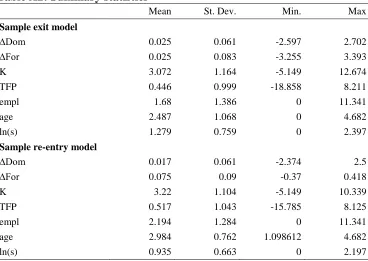
Summary statistics and correlation coefficients for the key variables are shown in the
appendix. A more technical discussion of the estimation process is contained in the
Web Appendix.
RESULTS
This section reports the empirical results of our analysis and discusses the findings.
We first focus on the results of export exit, which test Hypotheses 1 and 2. They are
also instrumental to the following analysis focusing on export re-entry, which directly
tests Hypothesis 3.
Export Exit
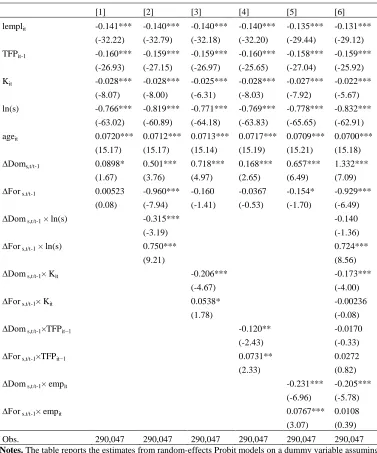
Table 4 reports the estimated marginal effects of the determinants of export exit. The
baseline regression model, as listed in Column (1), delivers largely consistent
estimates with our expectations built upon the conceptual framework. The negative
signs of firm size, TFP and capital intensity suggest that bigger, more productive,
more capital intensive firms are less likely to exit exporting, ceteris paribus. This also
confirms the predictions in the literature on symmetry in the determinants of export
entry and exit (Wagner 2008; Ilmakunnas and Nurmi 2010).
<Table 4 about here>
Turning to examining the role of external market conditions in driving export exit
decisions, we experiment on introducing their influence gradually, by first only
including in the model the linear terms of domestic market conditions and
international market conditions. The results in Column (1) suggest that on average,
domestic market expansion increases the likelihood of export exit, consistent with
H1a. However, this specification does not find that demand conditions in the foreign
market have any effect on the probability of export exit.
Column (2)~(6) extend the analysis to allow for market conditions being moderated
by firms’ internal resources (H2). We interact one set of individual firm characteristic
with domestic and international market changes at a time, and finally allow them to
enter the estimation together. Interestingly, the marginal effects of the interaction
terms are generally statistically and economically significant, while the marginal
effects of the market condition variables (∆Dom and ∆For) change noticeably
depending on which interaction terms we include in the model. This is particularly
true of the response to changes in foreign demand, suggesting that while firms’ exit
decisions are affected by domestic market conditions across all firms, firm-specific
characteristics determine the impact of foreign market conditions. Put differently,
exporting firms commonly respond to changes in domestic demand, but only specific
types of firms tend to respond to changes in foreign demand.
Turning to Column (6), our main model specification, four clear results emerge. First,
domestic market growth increases the probability of firms’ exiting export market.
This is consistent across all model specifications. Second, firms are generally less
likely to exit exporting when foreign markets experience growth. Hence our
hypotheses 1a and 1b are supported. These findings show that exporters adjust their
export decision to external market conditions. Exporters with restricted production
profit margins. On the contrary, firms are unlikely to stop exporting when
international markets are flourishing.
Third, firm variations in firms’ internal resources play an important moderating role
in these effects. Smaller, less productive and less capital-intensive firms appear to
respond to market changes more strongly, from both domestic and international
markets, supporting H2. This is not difficult to understand, in that these firms are
more likely to be opportunistic and may actively seek market opportunities and hence
react to circumstances more flexibly (Love and Ganotakis 2013). Another explanation
is that compared to these firms, the larger, more capital-intensive counterparts take
longer to alter their strategies and hence are unable to react to market changes right
away.
Finally, we also find that the longer a firm stays in export market, the less likely it is
to exit exporting (the coefficient on ln(s) is negative and significant). This is the case
even after other resource effects are allowed for: firms are more likely to overcome
the liability of foreignness if they have stayed in export markets longer. In addition,
the probability of exit increases with age, complementing recent findings that age has
a negative effect on exporting performance (D’Angelo et al 2013).
Export Re-Entry
Building on the findings on export exit, we move to export re-entry models. Table 5
reports the six sets of regression estimates of marginal effects. As before, we start by
only including only linear market condition terms without interaction terms (Column
(1)), and then gradually include one set of interactions at a time (Column (3)-(5)), and
finally arrive at the final model specification as reported in Column (6).
<Table 5 about here>
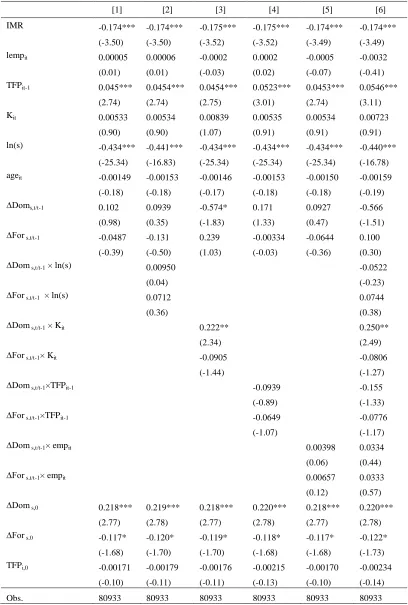
The first thing to note is that the IMR is consistently statistically significant across all
model specifications. The fact that the coefficient sign is consistently negative offers
support for the intuition that firms with a low probability of exit have a higher
between the unobserved firm heterogeneity in the export exit estimation and the
unobserved firm heterogeneity in the export re-entry estimation. Hence factors that
prevent firms from dropping out of export markets – and which have not been
accounted for in our exit model – also encourage firms to re-enter export market.
Although our data and model cannot (by definition) identify these unobserved
firm-specific characteristics, the existing literature provides room for imagination about
possible factors, such as management experience and capability (Ganotakis and Love,
2012), production networking effects (Bertrand, 2011), and differential international
strategies (Baum, 2014).
Paralleling the exit results, we also find that the longer the period since a firm’s
export exit, the less likely it is to re-enter exporting, indicating that the knowledge
obtained from export experience has a limited shelf-life and is liable to atrophy if not
used9. The other obvious pattern in Table 5 is that we observe far less impact of firm characteristics on firm re-entry compared to their prominent roles in determining the
export exit decision. Given the abundant literature on firm export entry (Wagner,
2008), this finding makes an interesting contrast with the crucial role of firm
resources in determining export entry. Our results imply that while variations in
internal resources also matter in determining exit (Table 4), they have less predictive
power to explain export re-entry once the conditional nature of previous export exit is
controlled for through the IMR variable.10
Shifting our attention to market condition variables, we find the recent changes in
market conditions do not have statistically significant impacts on re-entry. This is in
marked contrast to the results for exit, where market conditions played a key role.
What does appear rather important for re-entry, however, are the market conditions
the firm experienced at the time of export exit (∆Dom0 and ∆For0). To be more exact,
domestic market growth at the time of the previous export exit has a strong and
consistent positive effect on the probability of firms’ export re-entry. Growth in
international markets at the time of exit is associated with a reduced probability of
9 Note that this is quite independent of the IMR finding. One result (IMR) tells us that certain unobserved factors both discourage export exit and encourage re-entry: the other (length of time) tells us that, even after allowing for the link between export and re-entry determinants, the longer a firm is out of exporting the less likely it is to re-enter.
export re-entry. This result shows that the reasons for export exit help explain the
likelihood of export re-entry, supporting H3a and H3b. This also accords with the
findings of Lin (2014) that greater irregularity in the pattern of internationalisation
(i.e. more intermittent exporting) is linked to relative performance in domestic and
export markets .
ROBUSTNESS CHECKS
To check the robustness of our results we carried out three extensions to the analysis.
First, we re-ran our analysis using a broader definition of foreign market demand
which employed a weighted average of all French export markets rather than demand
in countries sharing a border with France. Second, we checked for the effects of
potential endogeneity arising from the possibility that the set of variables capturing
firm resources (employment size, capital intensity and productivity) could be
correlated with firms’ unobserved factors subsumed in the Probit equations error
terms. Finally, we checked our results for the possibility that firms switching out of
exporting to other forms of internationalization (e.g. FDI) could partly explain our
results. In all cases the additional econometric analysis produced results qualitatively
indistinguishable from those presented in Tables 4 and 5. These results, and a more
extensive discussion of the robustness testing procedure, can be found in the
accompanying Web Appendix.
DISCUSSION AND LIMITATIONS
Intermittent exporting is something of a puzzle. In the theoretical literature in both
economics and international business, exporting represents a major commitment
available only to the most productive and best-resourced firms, and is often the
starting point for further internationalisation. In practice, however, there is evidence
from numerous countries of firms engaging in intermittent exporting, moving into and
out of exporting, sometimes on more than one occasion. Since intermittent exporting
involves export exit and re-entry, and since the re-internationalisation process is
relatively poorly understood (Welch and Welch 2009), there is merit in focusing
attention on the empirics of the exit and (conditional) re-entry process. We do this for
Our empirical analysis produces a number of key findings. Unsurprisingly, smaller
and less productive firms are more likely to exit exporting than their larger, more
productive counterparts. However, domestic and overseas market conditions matter
greatly here. While growth in demand affects all firms in systematic ways, smaller
and less productive firms react much more strongly to changes in both domestic and
foreign market growth than larger firms. Coupled with the finding that the longer a
firm remains in exporting the less likely it is to cease doing so, this suggests that
smaller firms, especially those with limited experience of exporting, are more likely
to be opportunistic in moving out of export markets as demand conditions vary (Crick
2002; Love and Ganotakis 2013). While larger, better resourced firms have less need
to exit exporting as market conditions vary, inertia and sclerosis may also play a part
here. Larger and (especially) older firms are more likely to suffer from inertia in the
form of both a slower recognition of a need for change and a slower response to such
a need (Love et al 2016), which may in part explain their less nimble behavior.
There are three key finding on export re-entry. First, those firms with a low exit
probability also have a high likelihood of re-entry, and vice versa. However, once
this conditional link between entry exit and re-entry is accounted for, characteristics
such as size and capital intensity lose their importance: put simply, once a firm leaves
exporting, merely being large or capital intensive won’t help it get back into export
markets (although being highly productive will help). The second key finding is that
conditions in domestic and foreign markets around the time of re-entry have little
effect on the probability of re-entry. This is in sharp contrast to the situation on
export exit, described above. However, the third finding is that market conditions at
the time of exit – and how the firm reacted to these – matter greatly in determining the
likelihood of re-entry. Specifically, firms that stop exporting when the domestic
market is growing are more likely to re-enter later, while firms that stop exporting
when export markets grow are less likely to start exporting again. Crucially, our
results strongly support the predictions of the effects of different domestic/export
market growth rates summarized in Figure 1.
Taken together, these findings highlight the role of the firm’s strategic choice in exit
and abroad. Our other empirical results further support and clarify the predictions of
Figure 1, and in particular shed light on the opportunistic and intermittent nature of
exporting among small firms, a feature observed but largely unexplained in earlier
research (e.g. Crick 2004; Love and Ganotakis 2013). Small firms react more
strongly than larger firms to changes in demand patterns in terms of exiting export
markets because they are able more quickly to shift production to areas of growth.
This may mean moving out of exporting completely when the domestic market grows
rapidly, and performance in exporting is (relatively) less profitable. However, they
are also able to re-enter exporting at short notice, as long as they are above the
threshold level of productivity and have the management capacity to be competitive at
the fringes of exporting. Indeed, for at least some small firms moving into and out of
export markets may not be a coherent strategy at all. They may become exporters
almost by default as a result of unsolicited export orders, and simply act
entrepreneurially to market opportunities as they present themselves, without
consciously distinguishing between domestic and export markets (Love and
Ganotakis 2013). Our results show clearly that this form of behavior is most likely to
occur among relatively small firms and when domestic demand is growing relative to
overseas market growth, giving rise to the opportunistic intermittent exporters shown
in the top left quadrant of Figure 1. To the best of our knowledge the nature this
interplay between firm characteristics and market demand patterns has not been
clearly documented previously.
Theoretical Implications
Our findings have a number of implications for theory. First, internationalisation is
not irreversible, at least as far as exporting is concerned. A simple examination of the
raw data demonstrates that a significant proportion of manufacturing firms enter and
exit exporting each year. The data are particularly striking on exit: for the FICUS
data, on average around 14% of firms that had previously exported ceased doing so in
any given year (Table 1). In addition, over the eleven years of our dataset, around
half of exporters exited exporting at least once (Table 2), and over half of those
subsequently re-entered exporting (Table 3). This suggests that for a substantial
proportion of French manufacturers exporting is at best a temporary activity. While
(Johanson and Vahlne 2009) – intermittent exporting could be a stage into a more
persistent exporting pattern – it does suggest that the simple dichotomy of firms into
‘exporters’ and ‘non-exporters’ is unhelpful or at least insufficient in both conceptual
and empirical terms. Many firms – especially small firms – inhabit an area between
these two categories, in which opportunistic, intermittent and even accidental
exporting is commonplace. As indicated in the conceptual section above, theoretical
conceptions of (small) business internationalisation typically do not explicitly allow
for or explain this grey area of internationalisation, suggesting an area for further
theoretical consideration.
Second, there is a clear need to pay attention to both external (demand) conditions as
well as internal firm resources in considering export exit and re-entry. Crucially, this
relates not simply to conditions in (potential) export markets, but also conditions in
the domestic market. Unlike the RBV which focuses on the internal resources of the
firm, the process model of internationalisation does consider the nature and scale of
foreign markets, and the need to develop experiential knowledge of potential new
markets (Johanson and Vahlne, 1977, 2009). However, the focus in the process
model is very much on the potential foreign market. Our analysis indicates that
domestic market conditions are an equally important in the decision to exit and/or
re-enter export markets, especially with regard to small and less capital-intensive firms.
Importantly, the interaction between market conditions and firm’s internal resources
matters here, especially with regard to the export exit decision.
Third, and most importantly, our analysis demonstrates how closely interlinked are
exit and re-entry, but in ways not previously acknowledged. Both the firm
characteristics and the external demand conditions which are present at the time of
exit are crucial determinants of the probability of re-entry: why and how firms came
to the decision to exit are crucial determinants of the re-entry decision. Most
importantly, we have identified theoretically, and confirmed empirically, the demand
conditions under which intermittent exporting is most likely to occur, and the firm
attributes most likely to give rise to such behavior. Welch and Welch (2009) suggest
that previous episodes of internationalisation leaves a heritage of experience which
support this view within the confines of exporting behavior, and indeed indicate that
any analysis of export re-entry must consider the rationale for the earlier exit decision.
Finally, our analysis indicates that firm age is a poor proxy for international
experience. Some studies still use firm age as a proxy for the duration of firms’
internationalisation (e.g. Majocchi et al 2005; D’Angelo et al 2013), implicitly
assuming that age automatically reflects international experience. However, we find
strong evidence that while firm age is positively associated with the likelihood of exit,
the length of time a firm has been exporting has a highly negative effect on the
probability of export exit: in addition, age has no effect on the likelihood of re-entry,
while the length of time out of exporting is strongly inversely correlated with re-entry.
In terms of export entry and exit, age and firm experience are different attributes, and
one is a poor proxy for the other (Love et al, 2016).
Limitations
As with all empirical analysis, our research is subject to a number of limitations, some
of which provide opportunities for further research. Although very extensive, our
data relate to firms from one country (France), and to manufacturing only. It seems
likely that conclusions drawn from French data are reproducible for other large, open
economies, but we cannot preclude the possibility that there are peculiarities of
French exporting behavior that are unique to that country. We restrict our analysis to
manufacturing, and do not consider trade in services. However, we regard this as a
strength rather than a limitation, as exporting in services has its own peculiarities and
differences from trade in manufactured goods which often requires separate
consideration (Love and Mansury 2009).
Necessarily, the FICUS data are restricted to variables available from financial
statements, and exclude information on aspects such as the internal capability of
management and firm strategy. These important considerations are relegated to
unobserved heterogeneity in our analysis: while we believe this is more than
compensated for by the extensive nature of the FICUS data, in terms of both firm
numbers and timescale, it is a limitation of using official secondary data that must be
acknowledged. For example, we are able to say nothing about the decision processes
on the extent to which it represents a conscious strategy as opposed to an
opportunistic reaction to circumstances. Further detailed research on this would
undoubtedly be revealing, especially on the ways in which the strategic rationale for
exit has a role to play in the export re-entry decision. We are also limited in the lack
of information on alternative internationalisation modes. Although the robustness
checks indicate that our findings are unlikely to be driven by firms switching to
alternative modes of market entry, the precise role of alternative forms of
internationalisation remains unclear: the link between intermittent exporting and the
decision to engage in, for example, FDI would appear to be an area of potentially
fruitful research. Finally, the timing of our data just precedes the financial crash of
2008. Given that financial health and exporting are closely linked among French
firms (Görg and Spaliara 2014), this episode may well have resulted in changes in the
Figure 1: Market growth conditions and probability of export exit and re-entry
High
Domestic market growth at time of exit
Low
Probability of exit and re-entry high
Opportunistic (intermittent) exporters
Probability of exit and re-entry medium
Export Exit and Re-entry driven by reactions to
domestic market conditions
Probability of exit and re-entry medium
Export Exit and Re-entry driven by reaction to foreign market conditions
Probability of exit and re-entry low
Exiting firms are ‘failed’ exporters
Low High