Design and implementation approach of an eHealth
intervention to decrease stress in university students
Master thesis Kira Oberschmidt University of Twente
First supervisor: Dr. Saskia Kelders
Abstract
Introduction. In order to decrease the high levels of student stress that are being reported a technological intervention is being developed. This study focuses on the design of this technology, including options for personalization, as well as the implementation approach. Method. Firstly, approximately 2000 students filled in a questionnaire on stress level, possible predictors of stress and counselling preferences. Furthermore, a prototype was developed and evaluated in a usability test and a focus group. This focus group also discussed parts of a business model that was developed to implement the technology.
Results. Student stress levels were found to be high. Amongst others, intolerance of uncertainty, fear of missing out and mindset were found to be predictors of stress. Students are open to online counselling. The prototype was overall well received and only small remarks were made. A concern that was raised was the protection of privacy. Lastly, the business model was extended to include key partners and channels that were mentioned by the stakeholders.
Introduction
In the past years, there has been an increase in student stress and burnout both in the Netherlands and internationally (dos Santos Boni et al., 2018; Grützmacher, 2018; NOS, 2018; Van Dinther, 2018). While stress does not have to be negative, and so called ‘eustress’, or positive stress, can actually be beneficial (Ogden, 2012), negative stress or ‘distress’ can lead to burnout (Vandereycken, Hoogduin, & Emmelkamp, 2012). Next to general causes of stress like life events, this stress in students can be caused by specific aspects of university life (Vandereycken et al., 2012). Examples are high subjective workload, less involvement with the university and competing demands like extracurricular activities or part-time work (Jacobs & Dodd, 2003; Neumann, Finaly-Neumann, & Reichel, 1990; Schaufeli, Leiter, & Maslach, 2009; Vaccaro & Mena, 2011). For students, stress can have a negative effect on their academic achievements (Lin & Huang, 2014; Yang, 2004). Reviews have found behavioral, cognitive and mindfulness interventions to be successful treatment options for student stress (Bamber & Morpeth, 2018; Regehr, Glancy, & Pitts, 2013). In the past years, interest in technological interventions to increase student stress has grown, as students are generally in favor of using health technology (Lungu & Sun, 2016; Stellefson et al., 2011).
This also became apparent in our previous research, where students as well as counsellors reacted positively to the idea of an online intervention to decrease stress.
(Chew‐Graham, Rogers, & Yassin, 2003; Eisenberg, Golberstein, & Gollust, 2007), which would make a technological intervention even more valuable if it is able to decrease this stigma. Therefore, there are many benefits of a well-developed technological intervention to decrease student stress. It is important that such a technology is developed well in order to increase adherence and the positive effects for the students’ mental health (Andrikopoulou, Scott, Herrera, & Good, 2019; Ludden, Van Rompay, Kelders, & van Gemert-Pijnen, 2015).
Personalization
In a review, Andrikopoulou et al. (2019) found personalization to be an effective way of increasing adherence. Furthermore, it became apparent in our previous study that
personalization is an important aspect of developing a technology to decrease stress in
students (Oberschmidt, 2019). Other research has shown that personalization, for example by letting students choose which mini-modules of an intervention they wanted to follow, was well received (Harrer et al., 2018). Similar to what was found in our previous research, the modules were based on topics that are relevant to students and their wellbeing. However, there are many other ideas on how a technology can be personalized, for example through personalized conversations with a stress management coach (Martin, Lescanff, Rosset, Walker, & Whittaker, 2018) or through the use of a virtual agent (Jin, 2010). In order to be able to develop a technology that fits with the target group of the intervention, attentions needs to be paid to personalization, both in the design of the technology itself and when creating the content.
Design of technological interventions
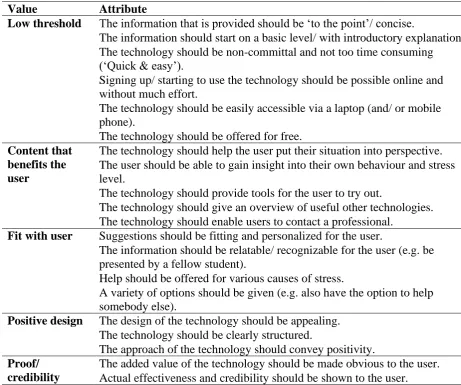
have been completed (Oberschmidt, 2019). Table 1 shows the values and attributes that have been determined in this previous study. What is next is the design of the technology, and the evaluation of this first prototype. By including end-users in this evaluation, their perspective can be taken into account in the next iteration. This approach prevents the full development of a product that users are not content with. It is therefore very important to continuously update the design of the technology based on input from different stakeholders. The process of involving users in the development process is often called user centered or human centered design (J. E. W. C. Van Gemert-Pijnen, Peters, & Ossebaard, 2013), and can for example be achieved in a usability test.
Not only the design of the technology is important in this case, but the content should fit the needs of users, too. Therefore, in order to provide personalized, fitting support for students that are feeling stressed, it is important to have a clear view of what factors are influencing their stress level. This idea fits with the concept of intervention mapping which focuses on the understanding of determinants that cause behavior in order to address these determinants and ultimately change behaviour (Bartholomew, Parcel, & Kok, 1998). Intervention mapping has been effectively used in student populations (Voogt, Poelen, Kleinjan, Lemmers, & Engels, 2013), previous studies on stress (van Oostrom et al., 2007) and in prevention programs (Kok, Schaalma, Ruiter, Van Empelen, & Brug, 2004).
Table 1.
Overview of the determined values and corresponding attributes. From Oberschmidt (2019).
Value Attribute
Low threshold The information that is provided should be ‘to the point’/ concise.
The information should start on a basic level/ with introductory explanations. The technology should be non-committal and not too time consuming
(‘Quick & easy’).
Signing up/ starting to use the technology should be possible online and without much effort.
The technology should be easily accessible via a laptop (and/ or mobile phone).
The technology should be offered for free. Content that
benefits the user
The technology should help the user put their situation into perspective. The user should be able to gain insight into their own behaviour and stress level.
The technology should provide tools for the user to try out.
The technology should give an overview of useful other technologies. The technology should enable users to contact a professional.
Fit with user Suggestions should be fitting and personalized for the user.
The information should be relatable/ recognizable for the user (e.g. be presented by a fellow student).
Help should be offered for various causes of stress.
A variety of options should be given (e.g. also have the option to help somebody else).
Positive design The design of the technology should be appealing. The technology should be clearly structured.
The approach of the technology should convey positivity. Proof/
credibility
The added value of the technology should be made obvious to the user. Actual effectiveness and credibility should be shown to the user. Determinants influencing stress in students
competing demands that students face, which come from university on the one hand, but also from for example family or activism on the other hand (Vaccaro & Mena, 2011), which might cause them to feel like they are missing out on something. Especially in international students, being unfamiliar with culture and lifestyle of the country they are studying in can increase stress as well (Chen, 1999; Mori, 2000). Furthermore, it is important that students feel involved with and committed to their university, otherwise their risk of burnout increases (Neumann et al., 1990). Lastly, uncertainty about the time after studying, also called ‘future development stress’ is also a common stressor in students (Lin & Huang, 2014). This shows that there is a broader variety of factors that might be related to student stress than those that were found in our previous study. Firstly, it is important to see whether all of these factors are indeed relevant. Then, the relevant factors should be examined to see how technology can be personalized based on these factors.
Implementation
However, if a fitting technology is developed it might still not be used if no attention is paid to the implementation. In order to ensure successful implementation, aspects like the context of an intervention and different stakeholders need to be taken into account.
Aim
While previous research described the context into which the to be developed technology needs to fit and established values for the development of said technology, the current study will take the next steps in the design and implementation process, by answering the following research questions.
Research questions
Q1. What are factors related to student stress that should be taken into account in a technological intervention?
Q2. Does the developed prototype fit the needs and wishes of stakeholders and what are their suggestions for possible improvements?
Q3. Which key partners, channels and costumer segments do stakeholders perceive to be important for the business model?
Methods
Overview of methods
First, in a large survey of students at the UT, general data about their well-being, stress levels and other aspects of mental health will be gathered, answering Q1. Secondly, in order to test the developed prototype and evaluate the determined values (Q2), a usability test will be performed. Lastly, in order to answer Q3, part of the business model that was developed based on both previous and current research, will be discussed in a focus group with different stakeholders .
Questionnaire
included if they gave their informed consent and completed the whole questionnaire. The minimum age for participation was set to 18, so participants younger than 18 were excluded.
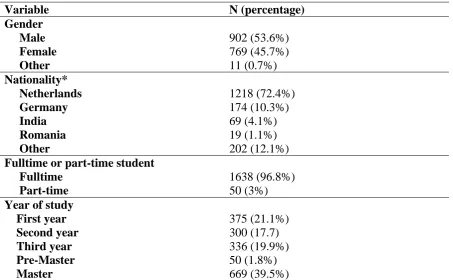
[image:9.595.73.527.315.595.2]Approximately 20% of the UT students started filling in the survey (n=2055). Of these 2055 students, 1682 completed all questions. On average, the participants were 22 years old (minimum 18, maximum 48, SD 3.08). Table 2 shows the demographic variables of participants.
Table 2.
Demographic variables of the participants.
Variable N (percentage)
Gender
Male 902 (53.6%)
Female 769 (45.7%)
Other 11 (0.7%)
Nationality*
Netherlands 1218 (72.4%)
Germany 174 (10.3%)
India 69 (4.1%)
Romania 19 (1.1%)
Other 202 (12.1%)
Fulltime or part-time student
Fulltime 1638 (96.8%)
Part-time 50 (3%)
Year of study
First year 375 (21.1%)
Second year 300 (17.7)
Third year 336 (19.9%)
Pre-Master 50 (1.8%)
Master 669 (39.5%)
*most frequently mentioned nationalities (>1%). A total of 73 nationalities were represented.
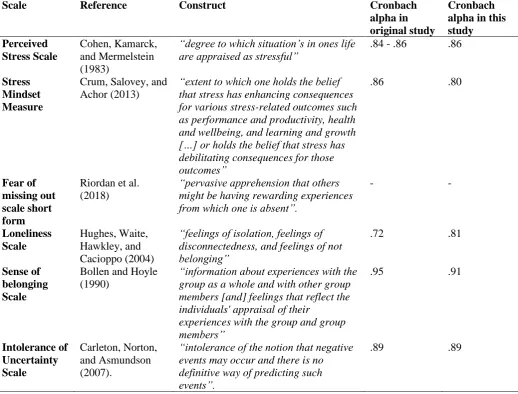
whether - and if so, where - they received mental health counselling in the past. Afterwards, participants were asked to fill in a series of questionnaires, which can be found in Table 3. These factors chosen based on the results from our previous research as well as some previously discussed findings from literature. At the end of the survey, participants had the opportunity to sign up for participation in a student panel on well-being, to receive a summary of the study results and/ or to take place in a raffle to win a gift voucher. The median time it took participants to fill in the survey was 25.03 minutes (SD 1176.47). Many participants filled in the survey over several days, explaining the large standard deviation.
Table 3.
Reference, construct description and Cronbach alpha for all used scales.
Scale Reference Construct Cronbach
alpha in original study
Cronbach alpha in this study Perceived Stress Scale Cohen, Kamarck, and Mermelstein (1983)
“degree to which situation’s in ones life are appraised as stressful”
.84 - .86 .86
Stress Mindset Measure
Crum, Salovey, and Achor (2013)
“extent to which one holds the belief that stress has enhancing consequences for various stress-related outcomes such as performance and productivity, health and wellbeing, and learning and growth […] or holds the belief that stress has debilitating consequences for those outcomes”
.86 .80
Fear of missing out scale short form
Riordan et al. (2018)
“pervasive apprehension that others might be having rewarding experiences from which one is absent”.
- - Loneliness Scale Hughes, Waite, Hawkley, and Cacioppo (2004)
“feelings of isolation, feelings of disconnectedness, and feelings of not belonging”
.72 .81
Sense of belonging Scale
Bollen and Hoyle (1990)
“information about experiences with the group as a whole and with other group members [and] feelings that reflect the individuals' appraisal of their
experiences with the group and group members”
.95 .91
Intolerance of Uncertainty Scale Carleton, Norton, and Asmundson (2007).
“intolerance of the notion that negative events may occur and there is no definitive way of predicting such events”.
Counselling channels. Additionally, a multiple choice question about different counselling channels at the university was added. Here participants were asked to rate how likely they were to seek help for each of the channels, of which some exist at the UT, while others were hypothetical. Answers were rated on a Likert scale ranging from “Extremely likely” (1) to “Extremely unlikely” (5). The included face-to-face channels were mentors, study advisors, student counsellors, student psychologists, teachers, friends, mental health buddies. A website or an app, both with either information or tools and exercises, were added as online channels. Participants also had the opportunity to give answers that had not been included in an open question.
Analysis. All analyses were performed in IBM SPSS Statistics 25. Firstly, test cases by the researchers were excluded from the data set. Participants that had not filled in all questions were taken into account as far as data was available for a whole sub-scale. Scores for the different questionnaires were calculated and recoded where necessary. Open answers to the question on counselling channels were inductively coded by the researcher.
Exploration of the data showed that the stress variable and the other concepts were normally distributed. Descriptive statistics were calculated for the demographic variables,
questionnaire scores and answers to open questions. Furthermore, due to the normal
distribution of the data, Pearson correlations between perceived stress and the other concepts were determined. Lastly, linear regression models with perceived stress as the dependent variable were calculated, firstly including all expected predictors as well as the demographic variables (gender, nationality and study progress).
Usability test
test. Recruitment was done via convenience sampling in the network of the researcher. Participants were included if they were proficient in English. There were no specific inclusion criteria with regards to age, gender, study program or progress. Mean age was 22 (minimum 18, maximum 24). Two participants were male, three were female. All participants were studying a different program, namely Biomedical Engineering and Management,
Electrical Engineering, Industrial Engineering and Management, Psychology and Technical Medicine. Three of the five faculties were represented, BMS (n=2), TNW (n=2) and EEMCS (n=1). Two participants were bachelor students, the other three were in their master. One participant was German, the others were all Dutch.
Furthermore, two study advisors took part in the usability test as well. One worked for the faculty of Behavioural, Management and Social Sciences (BMS) and the other for the Science and Technology faculty (TNW). The study advisors were contacted via the platform of Student Affairs Coaching and Counselling (SACC) at the UT. All interviews took place June and July, 2019.
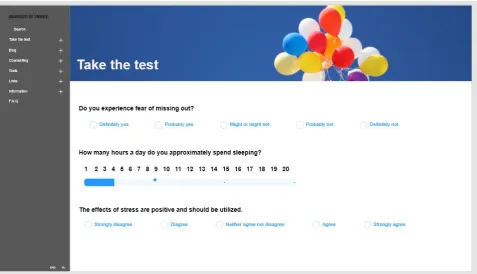
Procedure and materials. To see whether the first prototype of a possible new technological intervention fit the needs of different stakeholders, a usability test with a high fidelity prototype was performed. A high fidelity prototype was seen to be more beneficial because it gives the potential users a good look and feel of the final product. Furthermore, the prototype was presented on a computer, which was found to lead to more comments than a paper prototype (Walker, Takayama, & Landay, 2002). As comments from the stakeholders are valued for the iterative design process, more comments are seen as an advantage for this study. The high fidelity prototype was developed in Adobe XD. Included in this prototype were examples of the main functions of the technology, namely the mental health test,
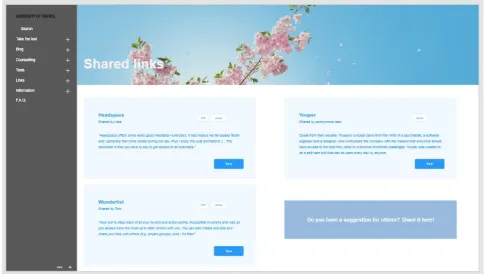
Furthermore, the previously determined values, low threshold, content that benefits the user, fit with the user, positive design and proof or credibility, were incorporated in the prototype. The style of the university website was taken as a basis for the prototype. The prototype was (partially) clickable. Figures 1-3 show examples of the different screens of the prototype. The other screens can be found in Appendix A.
Before the usability test was started, a short introduction about the study was given and participants signed the informed consent form. Then, participants were asked their age, study program and study progress. During the first part of the usability test, participants were presented with a scenario which guided them through the prototype. This scenario described how a first year student at the UT first looks at the website and the different elements of the website, like the test and the blogs. Participants were asked to voice their thoughts while they clicked through and looked at the prototype (‘concurrent thinking aloud’). After the
participants walked through the whole scenario, they were asked questions about the determined values, and whether they were incorporated into the prototype in a way that satisfied the users. These values were translate into statements and users were asked to rate how much they agreed with each statement and why. One example of such a statement is ‘I felt like I would need to commit too much to the use of this technology’. The other statements that were used can be found in Appendix B. Based on the time and what had already been discussed before, not all statements were discussed with all participants. Lastly, they were asked if they would use the website themselves and whether they would recommend it to others.
prototype, practical matters regarding the implementation were discussed as well. The prepared statements were discussed with neither of the study advisors.
The prototype was also shortly presented at the start of a focus group that was conducted after the usability tests had taken place. The prototype was included to give the participants an idea of what the study was about. The researcher clicked through the prototype on the screen and explained the structure and elements of the technology. There was room for the participants to ask questions and give remarks on each of the screens. These were analysed in the same was the results from the usability test, and the results of both discussions will be given simultaneously.
[image:14.595.76.554.446.720.2]Analysis. The remarks during the thinking aloud part of the interview and the discussion during the focus group were deductively coded based on the set of values. For each statement it was determined whether this meant that the value was incorporated well or not. Any additional remarks were coded inductively. Coding was done in ATLAS.ti.
Figure 2. Advice screen from the prototype.
[image:15.595.70.556.394.668.2]Focus group
Participants. A business model was developed and tested in a focus group with two main stakeholders, namely students as end-users and counselling staff of the UT as a possible key partner. Therefore, a study advisor, a student psychologist and a representative of the Student Affairs Coaching and Counselling (SACC) were present during the focus group. Furthermore, one female and two male students were present, of which one was a bachelor student, while two were in their master. They studied computer science, psychology and technical medicine. All participants, both students and staff, were Dutch. The staff representatives were approached via the platform of the SACC, while the students were approached via convenience sampling in the network of the researcher.
As it was mentioned in the description of the usability test, the focus group started with another discussion of the prototype. In the second part, participants were asked to discuss the three elements of the business model canvas. Firstly, an open question was asked for each of these elements and participants had time to voice their opinion. Then, the ideas that the researcher had for each building block were presented and the participants were asked whether or not they agreed with these suggestions where they differed from what was discussed before. The focus group ended with room for general questions and remarks. Overall, the focus group took approximately an hour.
Analysis. A transcript of the focus group was made and analysed using ATLAs.ti. For the business model, mentioned ideas were categorized as either key partner, channel or customer segment. Comments on the ideas that were brought up by the researcher were also taken into account here and categorized in the same way.
Results
Questionnaire
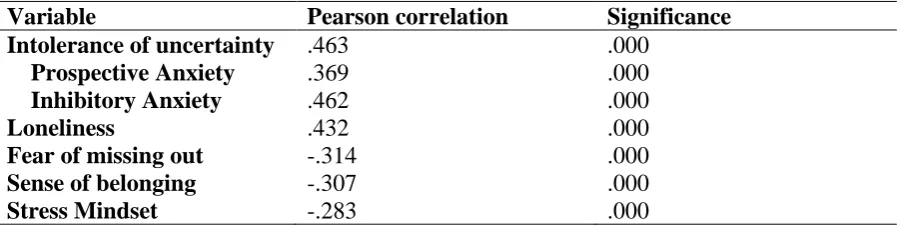
[image:18.595.74.529.461.574.2]Perceived Stress. The mean score for perceived stress was 27.28 (SD= 8.44). Correlations between perceived stress and the factors that potentially influence stress are depicted in Table 4. All correlations are significant. The strongest correlation was found between uncertainty and perceived stress.
Table 4.
Correlation between perceived stress and other variables, sorted descending by correlation.
Variable Pearson correlation Significance
Intolerance of uncertainty .463 .000
Prospective Anxiety .369 .000
Inhibitory Anxiety .462 .000
Loneliness .432 .000
Fear of missing out -.314 .000
Sense of belonging -.307 .000
Stress Mindset -.283 .000
Table 5.
Difference in mean PSS score between international and Dutch students.
N Mean Standard deviation
International 385 29.81 8.38
Dutch 980 26.28 8.35
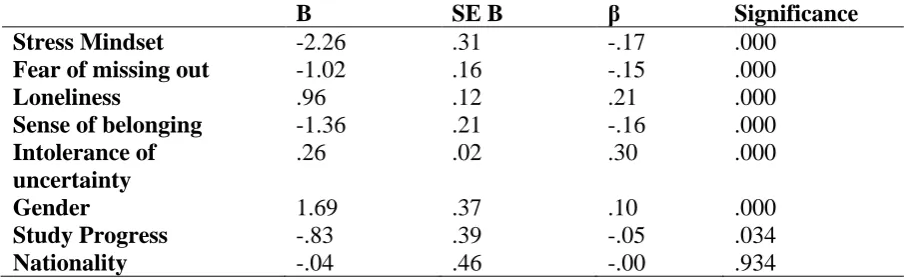
[image:19.595.71.529.392.532.2]Factors influencing perceived stress. A regression model including gender, nationality, study progress and the predicting variables was calculated (R²=.388, F=87.17, p<.001). However, other than gender, these factors did not significantly predict stress.
Table 6.
Regression model predicting perceived stress including gender, nationality and study
progress.
B SE B β Significance
Stress Mindset -2.26 .31 -.17 .000
Fear of missing out -1.02 .16 -.15 .000
Loneliness .96 .12 .21 .000
Sense of belonging -1.36 .21 -.16 .000
Intolerance of uncertainty
.26 .02 .30 .000
Gender 1.69 .37 .10 .000
Study Progress -.83 .39 -.05 .034
Nationality -.04 .46 -.00 .934
Table 7.
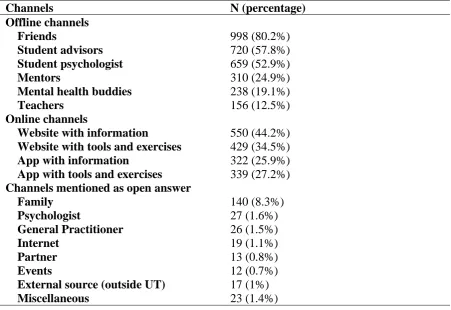
Overview of mentioned online and offline channels where participants would seek help.
Channels N (percentage)
Offline channels
Friends 998 (80.2%)
Student advisors 720 (57.8%)
Student psychologist 659 (52.9%)
Mentors 310 (24.9%)
Mental health buddies 238 (19.1%)
Teachers 156 (12.5%)
Online channels
Website with information 550 (44.2%) Website with tools and exercises 429 (34.5%)
App with information 322 (25.9%)
App with tools and exercises 339 (27.2%) Channels mentioned as open answer
Family 140 (8.3%)
Psychologist 27 (1.6%)
General Practitioner 26 (1.5%)
Internet 19 (1.1%)
Partner 13 (0.8%)
Events 12 (0.7%)
External source (outside UT) 17 (1%)
Miscellaneous 23 (1.4%)
Synthesis
The mean stress score found in this survey is comparable that found in focus groups at the UT that were part of our earlier research, which was 27.85 (Oberschmidt, 2019). Cohen et al. (1983) report mean scores of 23.18 and 23.67 in their initial student sample and Morrison and O'Connor (2005) found a mean score of 22.34 in their study of college students. While
perceived stress is even higher in international students than in Dutch students, nationality does not predict stress levels.
previously determined attribute that ‘Help should be offered for various causes of stress’ is underlined. Furthermore, while the technologies offering tools and exercises were not the preferred way of seeking help for the students, a large part nonetheless said that they would seek help via such a website or app if it existed. Therefore, the attribute ‘The technology should provide tools for the user to try out’ seems to fit the wishes of the students as well.
A technological solution seems to be a good approach, as students only prefer talking to friends and the two official counselling options (study advisors and student psychologist) over using a technology. Students would rather use a technological solution instead of talking to for example teachers or mentors. It became apparent that students prefer a website over an app and that they do not only want to be provided with exercises but also with more mental health information in general. However, as face-to-face contact with a study advisor or student psychologist is still the preferred way of seeking help, that attribute that ‘The technology should enable users to contact a professional’ is underlined.
Usability test
General outcomes. Participants were able to navigate the website easily and almost always found the expected pages on the first try. There was some confusion about the difference between the ‘links’ and the ‘tools’ for some participants, and it was suggested to make the section names more explicit.
All students stated that they would use the technology themselves and that they would recommend the finished product to others as well, with one participant adding “Well I would first maybe look if it really helps me” and another remarking that first the design would need
Low threshold. The value ‘low threshold’ refers to attributes that make the technology more accessible to students, for example by not being too time consuming and giving easy to understand information. Most participants expected that it would not take a lot of time to use the technology (n=4). One participant stated that it would maybe take longer “if I really have some issues”.
All participants agreed that the way that the information was provided was to the point. Furthermore, one of the student participants said that because the layout fit that of the universities own website it “would [not] be that hard for people either to use it or to
implement it”.
Two participants specifically mentioned that the test was part of what made the website accessible and easy to use. However, it was also stated that the aim of the test could be made more explicit on the front page, for example by calling it ‘take the test for personal advice’, as one participant suggested.
One study advisor explicitly mentioned that this technology could especially be beneficial for international students as they “perceive a higher threshold […] and a digital
first step is very pleasant and accessible for them”.
There were different opinions about the necessity of logging in. On the one hand, participants appreciated being able to revisit the outcomes of previous tests, and where therefore expecting to see a profile or personal page (n=2). However, two participants remarked that they would not want to log in because “if I am logged in I think my data is collected to my account” and it was unclear to them who would see this data One study
advisor advised to add information about the data protection as “a notification, telling you that data will be used anonymously for improvements, quality of counselling and research”.
advisor mentioned that “there are programs that say ‘we do not want our colleagues in other cities to know everything about us’”. Her suggestion was to look into the possibility of using the UT’s intranet (private network within the organisation) to keep the information open and accessible to students without publishing it openly on the internet for everybody to see.
The fact that the website was in English was explicitly mentioned as a positive point, because, as the study advisor explained, “there are quite some Dutch universities that have or had these things in order very well but where the step to English has not been made because
of the pressure in the previous years”.
Content that benefits the user. ‘Content that benefits the users’ refers to the fact that the technology should be providing users with tools that relevant for them and provide
information in a way that they can relate to. As the prototype only contained a limited amount of content that was not fully worked out, it was difficult for the participants to really evaluate whether the content of the website would in fact benefit them. However, one participant in the usability test generally stated that information on mental health, what to do and how to get help would be very useful to students “because nobody really has any knowledge about it”.
Furthermore, there were some remarks about how the blogs might help students put their situation into perspective. One participant said “I think the blog is a really good one. Because it’s nice to feel other people go through the same thing” and another remarked “I think if I am stressed out and I hear from other students ‘oh sure, you have to go to this page,
there are a lot of tools and tips and tricks on it’, then I think I would go to this one”.
dealt with”. However, they did agree that for less severe cases the website could be useful.
Another participant also stated that the technology was useful because “a lot of people don’t know about the options the university offers”.
While the personalization in this case was not based on the participants answers in the test, this aspect was still appreciated. One participant said that the advise page with suggested blogs and exercises gives “a feeling that someone gave me an advice” and that she would
therefore read the suggestions. Another participant remarked that it could be good to give a column or list of suggestions for each of the determined stressors. The participants in the focus group also positively remarked on the personalization of the technology. The study advisors said that she expects the personalized suggestions to work very well because “you can drown in tips and it helps to say ‘these are your tips, start here’”. As for the blogs, one of the student participants said that he found it “useful to have the blogs from the perspective of a student”.
Almost all student participants in the usability test liked the option of taking the test and then getting an advice on which counselling service best to contact (n=4). However, the study advisors remarked that making a clear distinction between referring someone to the student psychologist versus the study advisors might not always be useful, as study advisors also need to be involved in cases of mental health because of the impact that it can have on the student’s studies. One of the study advisors said that students “should not have the idea that they can only discuss mental health issues with the student psychologist”. So, while
students were enthusiastic about the test referring them to one of the counselling services, the study advisors were more critical.
(n=5). The only remarks were that there was no way of finding previous test results yet and that some buttons and texts were too small.
When asked about the positive design, mostly the included pictures and the colours used in the prototype were mentioned. The colour scheme was seen as “nice” (n=1),
well-used (n=1) and giving “a calm feeling” (n=1). No negative remarks about the chosen colour
were made.
Opinions about the pictures on top of the page were more divided. While one participant said he thought the banners were “well-chosen” another participant perceived
some of the pictures as too positive and said that this “is weird if you have to take a test about your mental health”. However, he did agree that pictures are a good addition in general,
“because it shouldn’t be too boring”. The advise was to keep the pictures a bit more neutral. As for the content of the website, participants appreciated that solutions were offered “because it helps me, instead of just saying how wrong I am”. One of the study advisors was
critical about the language that was used. While she liked the use of the term ‘student wellbeing’, she was more sceptical about the use of ‘mental health’ saying that while this is still positively worded it “feels more like it is about psychological problems”. Her advise was
to look at the phrasing that is used to describe the different concepts, and to keep this is positive as possible. This was emphasized even more in the focus group. The study advisors suggested to “make the link between wellbeing and talent development and professional skills” more apparent. To this, the student counsellor added that it would maybe be good to talk less “in terms of disorders and problems but more in terms of ‘do you find this difficult?’ That makes it seem more friendly immediately”. One of the students said that it would help to
Credibility. Lastly, ‘Credibility’ was seen as an important value because students need to trust the information they receive through the technology, and also believe that the technology will actually have a beneficial effect on their mental health. Three participants mentioned that embedding the technology within the university increased credibility and that “you can expect a certain quality of information there”. However, it was also mentioned that
“the UT website is not always well-sorted [and] if you put in somewhere far in the back nobody will figure it out“.
Synthesis
From what was discussed with the student participants especially, it seems that the values are notable in the prototype. Participants perceived the threshold of using the technology to be low, liked the content and its presentation so far and were appreciative of the personal character of the website. While there were some comments on the implementation of the positive design, the general idea of a more positive approach was welcomed. The minor points of improvement that were mentioned mostly related to the design and sizing of the pages and buttons. An important remark that should be studied further concerns the necessity of logging in and saving results to a profile. In the focus group, the suggestion was made to make use of the private network at the UT to keep the information available only for UT students, but without forcing them to log in. Overall, participants said that they would use the technology themselves and also recommend it to others.
Focus group - Business model development
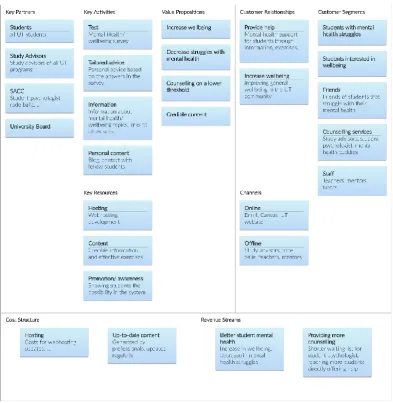
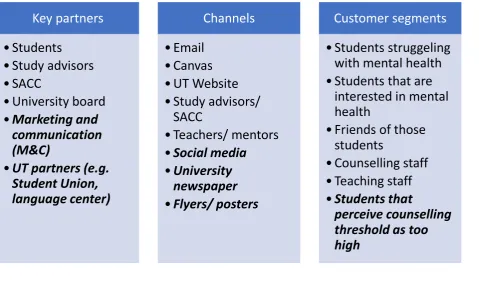
Figure 5. Updated version of the three blocks of the business model canvas including the findings from the focus group.
Key partners. In the initial version of the business model canvas, students, study advisors, the SACC and the university board were seen as the key partners for an
intervention. The participants in the focus group generally agreed with these ideas, and had some additional remarks.
Involving students in the development and implementation process was seen as “one of the most important things […] in these kinds of processes and projects”. One of the student participants also mentioned that the blogs would be most appealing to students if they were written by fellow students, and not, as it was suggested by the student psychologist, by somebody from the their office. The students counsellor agreed that “especially in such a situation, students should say what they do and do not want”. Therefore, the idea was broad
up of making “a redaction where students and employees are represented”.
Key partners
•
Students
•
Study advisors
•
SACC
•
University board
•
Marketing and
communication
(M&C)
•
UT partners (e.g.
Student Union,
language center)
Channels
•
•
Canvas
•
UT Website
•
Study advisors/
SACC
•
Teachers/ mentors
•
Social media
•
University
newspaper
•
Flyers/ posters
Customer segments
•
Students struggeling
with mental health
•
Students that are
interested in mental
health
•
Friends of those
students
•
Counselling staff
•
Teaching staff
•
Students that
It was mentioned that both the student psychologists and study advisors could play a role in finding suitable students that might want to write a blog (n=2). Furthermore, the student psychologist explained that they have some material available already and would be willing to help with the creation of content for the information, tools or link pages. The student counsellor also mentioned that it would be good to involve the SACC employees that keep the website up to date.
A new key partner that was not included in the first plan of the business model, but that was mentioned several times during the focus group is the Marketing and
Communication department of the UT (M&C). They “decide how a website should look like and [the different departments and services] fill them with content”. Therefore, to make sure
that the website can easily be accessed and is embedded within the UT website, M&C is an important key partner for the implementation.
Lastly, the study advisors mentioned that there are other possible partners within the UT that offer interesting tools or links. As examples, the Student Union and the UT Language Centre. Therefore, the group concluded that a more thorough investigation is necessary in order to potentially find more parties at the UT that offer relevant courses or tools.
Channels. It was expected that both online channels (like email, the use of Canvas and the website of the UT) and offline channels (e.g. talks by counselling or teaching staff) should be used to inform students about the technology.
In the first version of the business model, one of the potential online channels that could be used to promote the website was sending an email to the students. However, the student participants mentioned that they already receive a lot of emails from or related to the university and would therefore probably not read it.
said that currently, the counselling option are not always easily found because there are many different pages offering some information. An integration of those different sources of
information was welcomed by all students. One student did say that it would not help to make one central information page without getting rid of some other pages because otherwise there would be even more different websites.
Another way of informing students about the existence of the website that was brought up by one of the student participants was the website where appointments with the study advisors can be made. The study advisor added that it could also be useful to add a link in the email signature of the study advisors.
The student counsellor asked about the importance of using social media in the promotion of the website. While one student said that “an announcement could be done via Facebook and Instagram”, another said that he would find it “more fitting for LinkedIn than for Instagram”.
A channels that could be used both online and offline is the university newspaper, U-Today. While an article in the (online) newspaper would also be more of a one time
promotion, a students offered the idea of placing an advertisement in the paper version of the magazine. The students stated that they do read the newspaper, either online via Facebook or in print in the UT buildings. Therefore, it was seen as a good way of reaching students in general.
There were other ideas for offline promotion of the website. The participants agreed that students should be made aware of the website as soon as possible after the start of their studies. Therefore, ideas like handing out folders, posting an advertisement in the magazine of the introduction week or in the information booklet that first year students receive.
made and spread around the university. One student added the possibility of putting the posters outside of exam rooms, with slogans like “Are you stressed? Visit this site.”. The big
screens in the UT buildings and at the entrance were also seen as a good way of reaching students.
As for the idea of involving teachers and mentors in the promotion of the website, the student counsellor was sceptical and said that “it would be nice if teachers would do this” but
that she did so expect this to happen. However, she admitted that awareness of these topics was growing. The study advisor added that teachers usually correctly refer students to the study advisors.
Customer segments. Different costumer segments were identified in the first version of the business model canvas. These were students that struggle with their mental health, those that have a general interest in mental health, friends of students that are struggling that want to help them, counselling staff and lastly educational staff.
The first target group of the intervention that was mentioned were students “who perceive the threshold for seeking help as too high”. As it was mentioned before, the
technology was seen as posing a much lower threshold, and therefore as being more accessible to more students.
The student counsellor added that the technology would be useful for “all students that value wellbeing. And that should be everybody”. It was expected that then technology
could be useful for prevention in those students that “maybe do not experience it yet […] that maybe never will experience it”.
Some student groups that were mentioned in the previous research were mentioned again here, namely international students, students working on their graduation project and first year students.
was seen as important, because, as the student psychologist explained “many employees do not know what is available at the UT”. She said that the student psychologists’ office often
gets calls from employees that are worried about a student but do not know how to help them. Lastly, the study advisor explicitly stated that the students’ parent should not be seen as a target group, but their role should be taken into account as “parents meddle with their children’s study more, and therefore also with [the counselling services]”. She said that this website should rather be made for and by the students.
Synthesis
There were some additions to what was proposed in the first version of the business model. New key partners that were mentioned were the Marketing and Communication department at the UT (M&C) and other UT parties offering wellbeing related courses, like the Student Union or the Language Centre. Furthermore, the importance of involving students and the counselling staff was underlined. The UT newspaper was seen as a good way to promote the technology. Participants also thought it important that the website can be easily found on Google. Offline means like information booklets or posters were also seen as effective. The target groups that were mentioned fit with what was included in the first version of the business model.
Discussion
missing out. Some of these factors were then incorporated as examples in the prototype. Furthermore, the incorporation of the determined values in the prototype was evaluated and some slight additions were made to some blocks of the business model canvas.
The questionnaire results and answers from the usability test emphasize that participants especially value the possibility of receiving mental health information online. Psychoeducation is therefore another main element of the website. A review by Van Daele, Hermans, Van Audenhove, and Van den Bergh (2012) found that psychoeducation is effective in reducing stress levels in a variety of contexts and populations. Psychoeducation can also increase the promotion of help seeking in the future and decrease stigma (Fernandez, Tan, Knaak, Chew, & Ghazali, 2016; Taylor-Rodgers & Batterham, 2014). Topics for
psychoeducation should include the stressors or stress-related factors that were determined in the questionnaire, like intolerance of uncertainty, fear of missing out and stress mindset, as well as those that were mentioned in our previous research with counselling staff, for example perfectionism, being in a new environment and facing different expectations. For example, educating students on different stress mindsets can help them perceive stress not only as negative, but also as enhancing in some cases, which can improve their mental health (Pfeiffer, 2001). However, while some of the topics were measured in a student population, there has not yet been specific research into what students themselves perceive to be relevant topics. The input came from literature and discussions with the counselling staff, but there might be other topics that students would like the receive information about, but that were not found yet. Still, the points that were gathered until now could be used as a starting point, for example in interviews or focus groups with students, stimulating them to come up with more ideas.
therefore needs to be paid both to the attribute that ‘Help should be offered for various causes of stress’, while also making sure that the technology is not too time consuming, and that users receive personalized content. Therefore, the test that is used for personalization plays an essential role in our technology. The idea is that students fill in a short questionnaire to
determine relevant stressors for them and get personalized counselling suggestions based on the results. A similar approach is used in the student health test that was developed by Van der Heijde, Vonk, and Meijman (2018). However, they do not only focus on mental health, but include other factors like lifestyle and study satisfaction. Furthermore, no personalized counselling suggestions are given. In order to be able to link the questionnaire outcomes to counselling suggestions, more research is needed to determine questions that are useful. A list of one or two item measures of relevant concepts like perfectionism, stress mindset or fear of missing out should be compiled and tested to see whether fitting personalized counselling suggestions can be given based on the questionnaire results. For example, students
experiencing fear of missing out might be referred to a tool that helps them deal with the fear of missing out, while those that suffer from high expectations from their surroundings could receive coaching on how to deal with those expectations.
One of the values that were determined in our previous study is the ‘Fit with the user’, which entails that content that is developed needs to resonates with the users. A good
same psychoeducational content can be used for Dutch and international students, for the blogs, using the stories of international students can be more helpful to help internationals acculturate (Wu, Garza, & Guzman, 2015). Furthermore, improving acculturation and
thereby decrease stress can be achieved when students perceive that they are being supported by their university, in which the offering of counselling is an important point (Bai, 2016).
It became clear both from the questionnaire and from the usability test that students, while being open to using eHealth technology, do not fully want to stop using face-to-face counselling. In the usability test it was argued that the website would work more preventive or for milder cases of mental health problems, while those with more severe problems should still visit a counsellor. Other studies similarly stress the importance of offering both face-to-face counselling and online counselling (Dunbar, Sontag-Padilla, Kase, Seelam, & Stein, 2018; Li, 2018). However, having online and offline counselling coexist is not enough. Rather, a blended care approach was seen as the most useful. Blended care, which is the combination of face-to-face and online counselling, was found to be most effective in
Previous studies have identified issues that students see in using a mental health technology (Lattie, Lipson, & Eisenberg, 2019; Levin, Stocke, Pierce, & Levin, 2018). In a review on college students’ eHealth literacy by Stellefson et al. (2011) three main concerns were mentioned, namely that the technology might not fit their needs, that they were doubtful whether the information they found was credible and that they were concerned about the privacy of their data. The first two points were already dealt with in this study, as the test ensures that each student receives relevant information for their own situation and the
collaboration with the SACC guarantees that the provided information is reliable and correct. The privacy concerns on the other hand were mentioned both in the usability test and in the focus group and so far, no real solution was proposed. Therefore, it is important to investigate further how information can be provided to students without invading their privacy, while also keeping the threshold of the technology low.
Strengths and limitations
Stakeholder involvement is one of the big strengths of this research. In the usability test as well as in the focus group, the two main stakeholders, students and counselling staff, had the opportunity to give their opinion and voice any criticism or concern they might have. Without the involvement of the students as end-users, their preferences with regards to the prototype as well as the implementation and promotion would not have been taken into account. An example is the necessity of logging in to see the website, which was at first not seen as a problems, but that students overall did not agree with. However, only involving students and excluding the counselling staff would have led to a less practical intervention. The
counselling staff shared some valuable experience on what and who to include, and how to implement the technology, for example by mentioning various other parties that could add to the website to make it more useful to students.
While the questionnaire provided more factual information on the stress level and main stressors that students face, the usability test and the focus group gave insight into the preferences of students and supporting staff regarding an intervention. One example are the imagines that were picked for the top of each page the make it look appealing. A student participant commented that he perceived the images to be too happy and that it made him feel less like he was taken seriously. Additionally, the survey gave a more objective measure of perceived stress, rather than asking counselling staff to estimate how many stressed students they see and how stressed those students are. Therefore, combining outcomes from
qualitative as well as quantitative methods, the prototype includes content that benefits the users, presented to them in a way that they like.
Both the student participants in the usability test and those in the focus group were approached through convenience sampling in the network of the researcher. As most of the research was performed during the summer holidays, sampling via other channels (e.g. test subject pool, Facebook group of international students) did not yield any participants. Therefore, participants that could have given valuable information and opinions might have been missed in the sampling. For the most part however, there was a good variation in gender, study program and study progress. International students were however
underrepresented in the qualitative studies. For future studies it would therefore be wise to test an improved version of the prototype with more international students, to ensure that their preferences are taken into account as well.
For the survey, all UT students were invited to participate via an email by the
university board. However, it is likely that those students that perceived some problems with their mental health or the counselling at the UT were more likely to fill in the survey,
that study, which was to find factors that influence stress levels and should be tackled in an intervention. Thus, while the reported stress levels should be regarded with some caution, the other results of the survey are very valuable.
Due to time restrictions, only part of the developed business model was discussed with the stakeholder. While the focus group showed that they generally agreed with what had been proposed beforehand, there were some additions and changes to the business model based on the input of the stakeholders. Therefore, it would be could to include a broader discussion of the whole business model, together with the stakeholders, in a future study.
Conclusion
It became apparent that there are different factors predicting stress that should be
incorporated in the to be developed technology. Examples are intolerance of uncertainty, stress mindset and fear of missing out. Furthermore, a first prototype of the technology was developed and evaluated. Overall, the prototype fits with the needs and wishes of the two main stakeholders, students and counselling staff. It can be concluded that the determined values are already incorporated well in the technology and that only small changes need to be made based on some remarks. However, there were some topics that need to receive more attention but that fell outside the scope of this research. Firstly, privacy concerns and the protection of data, both from the perspective of students, and from the universities
References
Andrikopoulou, E., Scott, P., Herrera, H., & Good, A. (2019). What are the important design features of personal health records to improve medication adherence for patients with long-term conditions? A systematic literature review. BMJ open, 9(9), e028628. Bai, J. (2016). Perceived support as a predictor of acculturative stress among international
students in the United States. Journal of International Students, 6(1), 93-106. Baker, Z. G., Krieger, H., & LeRoy, A. S. (2016). Fear of missing out: Relationships with
depression, mindfulness, and physical symptoms. Translational Issues in Psychological Science, 2(3), 275.
Bamber, M. D., & Morpeth, E. J. M. (2018). Effects of mindfulness meditation on college student anxiety: A meta-analysis. 1-12.
Bartholomew, L. K., Parcel, G. S., & Kok, G. (1998). Intervention mapping: a process for developing theory and evidence-based health education programs. Health Education & Behavior, 25(5), 545-563.
Bollen, K. A., & Hoyle, R. H. (1990). Perceived cohesion: A conceptual and empirical examination. Social forces, 69(2), 479-504.
Borjalilu, S., Mazaheri, M. A., & Talebpour, A. (2019). Effectiveness of Mindfulness-Based Stress Management in The Mental Health of Iranian University Students: A
Comparison of Blended Therapy, Face-to-Face Sessions, and mHealth App (Aramgar). Iranian Journal of Psychiatry and Behavioral Sciences(In Press).
Carleton, R. N., Norton, M. P. J., & Asmundson, G. J. (2007). Fearing the unknown: A short version of the Intolerance of Uncertainty Scale. Journal of anxiety disorders, 21(1), 105-117.
Chen, C. P. (1999). Professional issues: Common stressors among international college students: Research and counseling implications. Journal of College Counseling, 2(1), 49-65.
Chew‐Graham, C. A., Rogers, A., & Yassin, N. (2003). ‘I wouldn't want it on my CV or their records': medical students' experiences of help‐seeking for mental health problems.
Medical education, 37(10), 873-880.
Cohen, S., Kamarck, T., & Mermelstein, R. (1983). A global measure of perceived stress.
Journal of health and social behavior, 385-396.
Cooper, M., & Norcross, J. C. (2016). A brief, multidimensional measure of clients’ therapy preferences: The Cooper-Norcross Inventory of Preferences (C-NIP). International Journal of Clinical and Health Psychology, 16(1), 87-98.
Crum, A. J., Salovey, P., & Achor, S. (2013). Rethinking stress: The role of mindsets in determining the stress response. Journal of personality and social psychology, 104(4), 716.
dos Santos Boni, R. A., Paiva, C. E., De Oliveira, M. A., Lucchetti, G., Fregnani, J. H. T. G., & Paiva, B. S. R. (2018). Burnout among medical students during the first years of undergraduate school: Prevalence and associated factors. PloS one, 13(3), e0191746. Dunbar, M. S., Sontag-Padilla, L., Kase, C. A., Seelam, R., & Stein, B. D. (2018). Unmet
mental health treatment need and attitudes toward online mental health services among community college students. Psychiatric Services, 69(5), 597-600.
Eisenberg, D., Golberstein, E., & Gollust, S. E. (2007). Help-seeking and access to mental health care in a university student population. Medical care, 45(7), 594-601.
Grützmacher, J. G., B.; Lesener, T.; Sudheimer, S.; Willige, J. (2018). Gesundheit Studierender in Deutschland 2017. Retrieved from
https://www.tk.de/resource/blob/2046078/8bd39eab37ee133a2ec47e55e544abe7/studi e--gesundheit-studierender-2017-pdf-data.pdf
Harrer, M., Adam, S. H., Fleischmann, R. J., Baumeister, H., Auerbach, R., Bruffaerts, R., . . . Lehr, D. (2018). Effectiveness of an internet-and app-based intervention for college students with elevated stress: randomized controlled trial. Journal of Medical Internet Research, 20(4), e136.
Hughes, M. E., Waite, L. J., Hawkley, L. C., & Cacioppo, J. T. (2004). A short scale for measuring loneliness in large surveys: Results from two population-based studies.
Research on aging, 26(6), 655-672.
Jacobs, S. R., & Dodd, D. (2003). Student burnout as a function of personality, social support, and workload. Journal of college student development, 44(3), 291-303. Jamieson, J. P., Crum, A. J., Goyer, J. P., Marotta, M. E., & Akinola, M. (2018). Optimizing
stress responses with reappraisal and mindset interventions: An integrated model.
Anxiety, Stress, & Coping, 31(3), 245-261.
Jamieson, J. P., Peters, B. J., Greenwood, E. J., & Altose, A. J. (2016). Reappraising stress arousal improves performance and reduces evaluation anxiety in classroom exam situations. Social Psychological and Personality Science, 7(6), 579-587.
Jin, S.-A. A. (2010). The effects of incorporating a virtual agent in a computer-aided test designed for stress management education: The mediating role of enjoyment.
Computers in Human Behavior, 26(3), 443-451.
Johansson, R., Nyblom, A., Carlbring, P., Cuijpers, P., & Andersson, G. (2013). Choosing between Internet-based psychodynamic versus cognitive behavioral therapy for depression: a pilot preference study. BMC psychiatry, 13(1), 268.
Kok, G., Schaalma, H., Ruiter, R. A., Van Empelen, P., & Brug, J. (2004). Intervention mapping: protocol for applying health psychology theory to prevention programmes.
Journal of health psychology, 9(1), 85-98.
Lattie, E. G., Lipson, S. K., & Eisenberg, D. (2019). Technology and College Student Mental Health: Challenges and Opportunities. Frontiers in psychiatry, 10, 246.
Levin, M. E., Stocke, K., Pierce, B., & Levin, C. (2018). Do college students use online self-help? A survey of intentions and use of mental health resources. Journal of College Student Psychotherapy, 32(3), 181-198.
Li, H. (2018). On the Path of College Students’ Mental Health under the Internet Plus. Paper presented at the 2018 4th International Conference on Social Science and Higher Education (ICSSHE 2018).
Lin, S.-H., & Huang, Y.-C. (2014). Life stress and academic burnout. Active Learning in Higher Education, 15(1), 77-90.
Ludden, G. D., Van Rompay, T. J., Kelders, S. M., & van Gemert-Pijnen, J. E. (2015). How to increase reach and adherence of web-based interventions: a design research viewpoint. Journal of Medical Internet Research, 17(7), e172.
Lungu, A., & Sun, M. (2016). Time for a Change: College students' preference for
technology-mediated versus face-to-face help for emotional distress. Telemedicine and e-Health, 22(12), 991-1000.
Martin, J.-C., Lescanff, C., Rosset, S., Walker, M., & Whittaker, S. (2018). How to
Personalize Conversational Coaches for Stress Management? Paper presented at the Proceedings of the 2018 ACM International Joint Conference and 2018 International Symposium on Pervasive and Ubiquitous Computing and Wearable Computers. Mori, S. C. (2000). Addressing the mental health concerns of international students. Journal
Morrison, R., & O'Connor, R. C. (2005). Predicting psychological distress in college students: The role of rumination and stress. Journal of clinical psychology, 61(4), 447-460.
Neumann, Y., Finaly-Neumann, E., & Reichel, A. (1990). Determinants and consequences of students' burnout in universities. The Journal of Higher Education, 61(1), 20-31. NOS. (2018). 'Studenten vallen bij bosjes uit met psychische problemen'. Retrieved from https://nos.nl/op3/artikel/2246058-studenten-vallen-bij-bosjes-uit-met-psychische-problemen.html
Oberschmidt, K. (2019). Possibilities Of Technology To Decrease Stress In Students At The University Of Twente. (Master). University of Twente,
Ogden, J. (2012). Health Psychology: A Textbook: A textbook: McGraw-Hill Education (UK).
Osterwalder, A., & Pigneur, Y. (2010). Business model generation: a handbook for visionaries, game changers, and challengers: John Wiley & Sons.
Pfeiffer, D. (2001). Academic and environmental stress among undergraduate and graduate college students: A literature review.
Regehr, C., Glancy, D., & Pitts, A. J. J. o. a. d. (2013). Interventions to reduce stress in university students: A review and meta-analysis. 148(1), 1-11.
Riordan, B. C., Cody, L., Flett, J. A., Conner, T. S., Hunter, J., & Scarf, D. (2018). The development of a single item FoMO (fear of missing out) scale. Current Psychology, 1-6.
Rogers, V. L., Griffin, M. Q., Wykle, M. L., & Fitzpatrick, J. J. (2009). Internet versus face-to-face therapy: emotional self-disclosure issues for young adults. Issues in mental health nursing, 30(10), 596-602.
Santucci, L. C., McHugh, R. K., Elkins, R. M., Schechter, B., Ross, M. S., Landa, C. E., . . . Barlow, D. H. (2014). Pilot implementation of computerized cognitive behavioral therapy in a university health setting. Administration and Policy in Mental Health and Mental Health Services Research, 41(4), 514-521.
Schaufeli, W. B., Leiter, M. P., & Maslach, C. (2009). Burnout: 35 years of research and practice. Career development international, 14(3), 204-220.
Shumaker, D., Killian, K., Cole, C., Hruby, A., & Grimm, J. (2017). Existential anxiety, personality type, and therapy preference in young adults. Journal of Humanistic Psychology, 0022167817702783.
Stellefson, M., Hanik, B., Chaney, B., Chaney, D., Tennant, B., & Chavarria, E. A. (2011). eHealth literacy among college students: a systematic review with implications for eHealth education. Journal of Medical Internet Research, 13(4).
Taylor-Rodgers, E., & Batterham, P. J. (2014). Evaluation of an online psychoeducation intervention to promote mental health help seeking attitudes and intentions among young adults: randomised controlled trial. Journal of affective disorders, 168, 65-71. Vaccaro, A., & Mena, J. A. (2011). It's not burnout, it's more: Queer college activists of color
and mental health. Journal of Gay & Lesbian Mental Health, 15(4), 339-367. Van Daele, T., Hermans, D., Van Audenhove, C., & Van den Bergh, O. (2012). Stress
reduction through psychoeducation: a meta-analytic review. Health Education & Behavior, 39(4), 474-485.
Van der Heijde, C. M., Vonk, P., & Meijman, F. J. (2018). Studentengezondheidstest. Retrieved from http://studentengezondheidstest.nl/en
Van Dinther, M. (2018). Studenten bezwijken psychisch onder prestatiedruk: ‘De psychologen zijn niet aan te slepen’. De Volkskrant. Retrieved from
van Gemert-Pijnen, J. E., Nijland, N., van Limburg, M., Ossebaard, H. C., Kelders, S. M., Eysenbach, G., & Seydel, E. R. J. J. o. m. I. r. (2011). A holistic framework to improve the uptake and impact of eHealth technologies. 13(4).
Van Gemert-Pijnen, J. E. W. C., Peters, O., & Ossebaard, H. C. (2013). Improving eHealth. Den Haag: Eleven International Publishing.
van Oostrom, S. H., Anema, J. R., Terluin, B., Venema, A., de Vet, H. C., & van Mechelen, W. (2007). Development of a workplace intervention for sick-listed employees with stress-related mental disorders: Intervention Mapping as a useful tool. BMC health services research, 7(1), 127.
Vandereycken, W., Hoogduin, C. A. L., & Emmelkamp, P. M. G. (2012). Handboek
Psychopathologie: deel 1 basisbegrippen /W. Vandereycken, C.A.L. Hoogduin: Bohn Stafleu van Loghum.
Voogt, C. V., Poelen, E. A., Kleinjan, M., Lemmers, L. A., & Engels, R. C. (2013). The development of a web-based brief alcohol intervention in reducing heavy drinking among college students: an Intervention Mapping approach. Health promotion international, 29(4), 669-679.
Walker, M., Takayama, L., & Landay, J. A. (2002). High-fidelity or low-fidelity, paper or computer? Choosing attributes when testing web prototypes. Paper presented at the Proceedings of the human factors and ergonomics society annual meeting.
Wentzel, J., van der Vaart, R., Bohlmeijer, E. T., & van Gemert-Pijnen, J. E. (2016). Mixing online and face-to-face therapy: how to benefit from blended care in mental health care. JMIR mental health, 3(1), e9.
Wu, H.-p., Garza, E., & Guzman, N. (2015). International student’s challenge and adjustment to college. Education Research International, 2015.