Proceedings of the 45th Annual Meeting of the Association of Computational Linguistics, pages 536–543,
Semantic Class Induction and Coreference Resolution
Vincent Ng
Human Language Technology Research Institute University of Texas at Dallas
Richardson, TX 75083-0688
Abstract
This paper examines whether a learning-based coreference resolver can be improved using semantic class knowledge that is au-tomatically acquired from a version of the Penn Treebank in which the noun phrases are labeled with their semantic classes. Ex-periments on the ACE test data show that a resolver that employs such induced semantic class knowledge yields a statistically signif-icant improvement of 2% in F-measure over one that exploits heuristically computed se-mantic class knowledge. In addition, the in-duced knowledge improves the accuracy of common noun resolution by 2-6%.
1 Introduction
In the past decade,knowledge-leanapproaches have significantly influenced research in noun phrase (NP) coreference resolution — the problem of deter-mining which NPs refer to the same real-world en-tity in a document. In knowledge-lean approaches, coreference resolvers employ only morpho-syntactic cues as knowledge sources in the resolution process (e.g., Mitkov (1998), Tetreault (2001)). While these approaches have been reasonably successful (see Mitkov (2002)), Kehler et al. (2004) speculate that deeper linguistic knowledge needs to be made avail-able to resolvers in order to reach the next level of performance. In fact, semantics plays a crucially im-portant role in the resolution of common NPs, allow-ing us to identify the coreference relation between two lexically dissimilar common nouns (e.g., talks
and negotiations) and to eliminateGeorge W. Bush from the list of candidate antecedents ofthe city, for instance. As a result, researchers have re-adopted the once-popular knowledge-rich approach, investi-gating a variety of semantic knowledge sources for common noun resolution, such as thesemantic rela-tions between two NPs (e.g., Ji et al. (2005)), their semantic similarity as computed using WordNet (e.g., Poesio et al. (2004)) or Wikipedia (Ponzetto and Strube, 2006), and thecontextual roleplayed by an NP (see Bean and Riloff (2004)).
Another type of semantic knowledge that has been employed by coreference resolvers is the se-mantic class(SC) of an NP, which can be used to dis-allow coreference between semantically incompat-ible NPs. However, learning-based resolvers have not been able to benefit from having an SC agree-ment feature, presumably because the method used to compute the SC of an NP is too simplistic: while the SC of a proper name is computed fairly accu-rately using a named entity (NE) recognizer, many resolvers simply assign to a common noun the first (i.e., most frequent) WordNet sense as its SC (e.g., Soon et al. (2001), Markert and Nissim (2005)). It is not easy to measure the accuracy of this heuristic, but the fact that the SC agreement feature is not used by Soon et al.’s decision tree coreference classifier seems to suggest that the SC values of the NPs are not computed accurately by this first-sense heuristic. Motivated in part by this observation, we exam-ine whether automatically induced semantic class knowledge can improve the performance of a learning-based coreference resolver, reporting eval-uation results on the commonly-used ACE
ence corpus. Our investigation proceeds as follows.
Train a classifier for labeling the SC of an NP.
In ACE, we are primarily concerned with classify-ing an NP as belongclassify-ing to one of the ACE seman-tic classes. For instance, part of the ACE Phase 2 evaluation involves classifying an NP as PERSON, ORGANIZATION, GPE (a geographical-political
re-gion),FACILITY,LOCATION, orOTHERS. We adopt
a corpus-based approach to SC determination, re-casting the problem as a six-class classification task.
Derive two knowledge sources for coreference resolution from the induced SCs. The first
knowledge source (KS) issemantic class agreement (SCA). Following Soon et al. (2001), we represent SCA as a binary value that indicates whether the in-duced SCs of the two NPs involved are the same or not. The second KS ismention, which is represented as a binary value that indicates whether an NP be-longs to one of the five ACE SCs mentioned above. Hence, the mention value of an NP can be readily derived from its induced SC: the value is NOif its
SC is OTHERS, and YES otherwise. This KS could
be useful for ACE coreference, since ACE is con-cerned with resolving only NPs that are mentions.
Incorporate the two knowledge sources in a coreference resolver. Next, we investigate whether
these two KSs can improve a learning-based base-line resolver that employs a fairly standard feature set. Since (1) the two KSs can each be repre-sented in the resolver as a constraint (for filtering non-mentions or disallowing coreference between semantically incompatible NPs) or as afeature, and (2) they can be applied to the resolver inisolationor incombination, we have eight ways of incorporating these KSs into the baseline resolver.
In our experiments on the ACE Phase 2 coref-erence corpus, we found that (1) our SC induc-tion method yields a significant improvement of 2% in accuracy over Soon et al.’s first-sense heuristic method as described above; (2) the coreference re-solver that incorporates our induced SC knowledge by means of the two KSs mentioned above yields a significant improvement of 2% in F-measure over the resolver that exploits the SC knowledge com-puted by Soon et al.’s method; (3) themention KS, when used in the baseline resolver as aconstraint, improves the resolver by approximately 5-7% in F-measure; and (4)SCA, when employed as afeature
by the baseline resolver, improves the accuracy of common noun resolution by about 5-8%.
2 Related Work
Mention detection. Many ACE participants have
also adopted a corpus-based approach to SC deter-mination that is investigated as part of the mention detection (MD) task (e.g., Florian et al. (2006)). Briefly, the goal of MD is to identify the boundary of a mention, its mention type (e.g., pronoun, name), and its semantic type (e.g., person, location). Un-like them, (1) we do not perform the full MD task, as our goal is to investigate the role of SC knowl-edge in coreference resolution; and (2) we do not use the ACE training data for acquiring our SC clas-sifier; instead, we use theBBN Entity Type Corpus (Weischedel and Brunstein, 2005), which consists of all the Penn Treebank Wall Street Journal articles with the ACE mentions manually identified and an-notated with their SCs. This provides us with a train-ing set that is approximately five times bigger than that of ACE. More importantly, the ACE participants do not evaluate the role of induced SC knowledge in coreference resolution: many of them evaluate coreference performance on perfect mentions (e.g., Luo et al. (2004)); and for those that do report per-formance on automatically extracted mentions, they do not explain whether or how the induced SC infor-mation is used in their coreference algorithms.
Joint probabilistic models of coreference.
Re-cently, there has been a surge of interest in im-proving coreference resolution by jointly modeling coreference with a related task such as MD (e.g., Daum´e and Marcu (2005)). However, joint models typically need to be trained on data that is simulta-neously annotated with information required by all of the underlying models. For instance, Daum´e and Marcu’s model assumes as input a corpus annotated with both MD and coreference information. On the other hand, we tackle coreference and SC induction separately (rather than jointly), since we train our SC determination model on the BBN Entity Type Cor-pus, where coreference information is absent.
3 Semantic Class Induction
3.1 Training the Classifier
Training corpus. As mentioned before, we use
the BBN Entity Type Corpus for training the SC classifier. This corpus was originally developed to support the ACE and AQUAINT programs and con-sists of annotations of 12 named entity types and nine nominal entity types. Nevertheless, we will only make use of the annotations of the five ACE semantic types that are present in our ACE Phase 2 coreference corpus, namely, PERSON, ORGANIZA -TION,GPE,FACILITY, andLOCATION.
Training instance creation. We create one
train-ing instance for each proper or common NP (ex-tracted using an NP chunker and an NE recognizer) in each training text. Each instance is represented by a set of lexical, syntactic, and semantic features, as described below. If the NP under consideration is annotated as one of the five ACE SCs in the corpus, then the classification of the associated training in-stance is simply the ACE SC value of the NP. Other-wise, the instance is labeled asOTHERS. This results
in 310063 instances in the training set.
Features. We represent the training instance for a
noun phrase,NPi, using seven types of features:
(1) WORD: For each word w in NPi, we create a
WORD feature whose value is equal tow. No fea-tures are created from stopwords, however.
(2) SUBJ VERB: If NPi is involved in a
subject-verb relation, we create aSUBJ VERBfeature whose
value is the verb participating in the relation. We use Lin’s (1998b) MINIPAR dependency parser to extract grammatical relations. Our motivation here is to coarsely model subcategorization.
(3) VERB OBJ: A VERB OBJ feature is created in
a similar fashion as SUBJ VERB if NPi participates
in a verb-object relation. Again, this represents our attempt to coarsely model subcategorization. (4) NE: We use BBN’s IdentiFinder (Bikel et al.,
1999), a MUC-style NE recognizer to determine the NE type ofNPi. IfNPiis determined to be aPERSON
or ORGANIZATION, we create anNE feature whose
value is simply its MUC NE type. However, ifNPi
is determined to be aLOCATION, we create a feature
with value GPE (because most of the MUC LOCA -TION NEs are ACE GPE NEs). Otherwise, no NE
feature will be created (because we are not interested in the other MUC NE types).
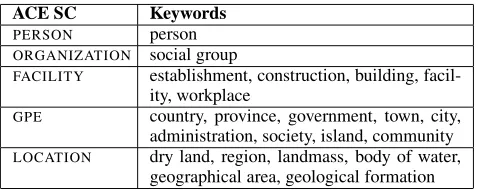
ACE SC Keywords
PERSON person ORGANIZATION social group
FACILITY establishment, construction, building, facil-ity, workplace
GPE country, province, government, town, city, administration, society, island, community LOCATION dry land, region, landmass, body of water,
[image:3.612.313.552.71.166.2]geographical area, geological formation
Table 1: List of keywords used in WordNet search for generatingWN CLASSfeatures.
(5) WN CLASS: For each keyword w shown in the right column of Table 1, we determine whether the head noun of NPi is a hyponym of w in WordNet,
using only the first WordNet sense of NPi.1 If so,
we create a WN CLASSfeature with was its value. These keywords are potentially useful features be-cause some of them are subclasses of the ACE SCs shown in the left column of Table 1, while others appear to be correlated with these ACE SCs.2
(6) INDUCED CLASS: Since the first-sense
heuris-tic used in the previous feature may not be accurate in capturing the SC of an NP, we employ a corpus-based method for inducing SCs that is motivated by research in lexical semantics (e.g., Hearst (1992)). Given a large, unannotated corpus3, we use
Identi-Finder to label each NE with its NE type and MINI-PAR to extract all the appositive relations. An ex-ample extraction would be <Eastern Airlines, the carrier>, where the first entry is a proper noun la-beled with either one of the seven MUC-style NE types4 or OTHERS5 and the second entry is a
com-mon noun. We then infer the SC of a comcom-mon noun as follows: (1) we compute the probability that the common noun co-occurs with each of the eight NE types6 based on the extracted appositive
relations, and (2) if the most likely NE type has a co-occurrence probability above a certain threshold (we set it to 0.7), we create aINDUCED CLASS
fea-1This is motivated by Lin’s (1998c) observation that a
coref-erence resolver that employs only the first WordNet sense per-forms slightly better than one that employs more than one sense.
2The keywords are obtained via our experimentation with
WordNet and the ACE SCs of the NPs in the ACE training data.
3We used (1) the BLLIP corpus (30M words), which
con-sists of WSJ articles from 1987 to 1989, and (2) the Reuters Corpus (3.7GB data), which has 806,791 Reuters articles.
ture forNPiwhose value is the most likely NE type.
(7) NEIGHBOR: Research in lexical semantics
sug-gests that the SC of an NP can be inferred from its distributionally similar NPs (see Lin (1998a)). Mo-tivated by this observation, we create for each of
NPi’s ten most semantically similar NPs a NEIGH
-BOR feature whose value is the surface string of
the NP. To determine the ten nearest neighbors, we use the semantic similarity values provided by Lin’s dependency-based thesaurus, which is constructed using a distributional approach combined with an information-theoretic definition of similarity.
Learning algorithms. We experiment with four
learners commonly employed in language learning:
Decision List (DL): We use the DL learner as
de-scribed in Collins and Singer (1999), motivated by its success in the related tasks of word sense dis-ambiguation (Yarowsky, 1995) and NE classifica-tion (Collins and Singer, 1999). We apply add-one smoothing to smooth the class posteriors.
1-Nearest Neighbor (1-NN): We use the 1-NN
clas-sifier as implemented in TiMBL (Daelemans et al., 2004), employingdot productas the similarity func-tion (which defines similarity as the number of com-mon feature-value pairs between two instances). All other parameters are set to their default values.
Maximum Entropy (ME): We employ Lin’s ME
implementation7, using a Gaussian prior for
smooth-ing and runnsmooth-ing the algorithm until convergence.
Naive Bayes (NB): We use an in-house
implementa-tion of NB, using add-one smoothing to smooth the class priors and the class-conditional probabilities.
In addition, we train an SVM classifier for SC determination by combining the output of five clas-sification methods: DL, 1-NN, ME, NB, and Soon et al.’s method as described in the introduction,8
with the goal of examining whether SC classifica-tion accuracy can be improved by combining the output of individual classifiers in a supervised man-ner. Specifically, we (1) use 80% of the instances generated from the BBN Entity Type Corpus to train the four classifiers; (2) apply the four classifiers and Soon et al.’s method to independently make
predic-7See http://www.cs.ualberta.ca/
∼lindek/downloads.htm
8In our implementation of Soon’s method, we label an
in-stance asOTHERSif noNEorWN CLASSfeature is generated; otherwise its label is the value of theNEfeature or the ACE SC that has theWN CLASSfeatures as its keywords (see Table 1).
[image:4.612.314.539.71.104.2]PER ORG GPE FAC LOC OTH Training 19.8 9.6 11.4 1.6 1.2 56.3 Test 19.5 9.0 9.6 1.8 1.1 59.0
Table 2: Distribution of SCs in the ACE corpus.
tions for the remaining 20% of the instances; and (3) train an SVM classifier (using the LIBSVM pack-age (Chang and Lin, 2001)) on these 20% of the in-stances, where each instance,i, is represented by a set of 31 binary features. More specifically, letLi =
{li1, li2, li3, li4, li5}be the set of predictions that we
obtained foriin step (2). To representi, we generate one feature from each non-empty subset ofLi.
3.2 Evaluating the Classifiers
For evaluation, we use the ACE Phase 2 coreference corpus, which comprises 422 training texts and 97 test texts. Each text has its mentions annotated with their ACE SCs. We create our test instances from the ACE texts in the same way as the training in-stances described in Section 3.1. Table 2 shows the percentages of instances corresponding to each SC.
Table 3 shows the accuracy of each classifier (see row 1) for the ACE training set (54641 NPs, with 16414 proper NPs and 38227 common NPs) and the ACE test set (13444 NPs, with 3713 proper NPs and 9731 common NPs), as well as their performance on the proper NPs (row 2) and the common NPs (row 3). We employ as our baseline system the Soon et al. method (see Footnote 8), whose accuracy is shown under the Soon column. As we can see, DL, 1-NN, and SVM show a statistically significant improve-ment over the baseline for both data sets, whereas ME and NB perform significantly worse.9
Addi-tional experiments are needed to determine the rea-son for ME and NB’s poor performance.
In an attempt to gain additional insight into the performance contribution of each type of features, we conduct feature ablation experiments using the DL classifier (DL is chosen simply because it is the best performer on the ACE training set). Results are shown in Table 4, where each row shows the accu-racy of the DL trained on all types of features except for the one shown in that row (All), as well as accu-racies on the proper NPs (PN) and the common NPs (CN). For easy reference, the accuracy of the DL
9We use Noreen’s (1989) Approximate Randomization test
Training Set Test Set
Soon DL 1-NN ME NB SVM Soon DL 1-NN ME NB SVM 1 Overall 83.1 85.0 84.0 54.5 71.3 84.2 81.1 82.9 83.1 53.0 70.3 83.3
2 Proper NPs 83.1 84.1 81.0 54.2 65.5 82.2 79.6 82.0 79.8 55.8 64.4 80.4
[image:5.612.87.529.71.125.2]3 Common NPs 83.1 85.4 85.2 54.6 73.8 85.1 81.6 83.3 84.3 51.9 72.6 84.4
Table 3: SC classification accuracies of different methods for the ACE training set and test set.
[image:5.612.75.297.157.259.2]Training Set Test Set Feature Type PN CN All PN CN All All features 84.1 85.4 85.0 82.0 83.3 82.9 -WORD 84.2 85.4 85.0 82.0 83.1 82.8 -SUBJ VERB 84.1 85.4 85.0 82.0 83.3 82.9 -VERB OBJ 84.1 85.4 85.0 82.0 83.3 82.9 -NE 72.9 85.3 81.6 74.1 83.2 80.7 -WN CLASS 84.1 85.9 85.3 81.9 84.1 83.5 -INDUCED C 84.0 85.6 85.1 82.0 83.6 83.2 -NEIGHBOR 82.8 84.9 84.3 80.2 82.9 82.1 Table 4: Results for feature ablation experiments.
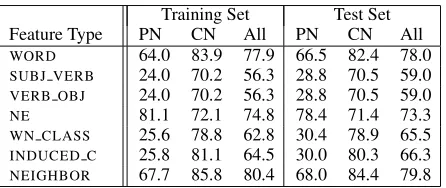
Training Set Test Set Feature Type PN CN All PN CN All WORD 64.0 83.9 77.9 66.5 82.4 78.0 SUBJ VERB 24.0 70.2 56.3 28.8 70.5 59.0 VERB OBJ 24.0 70.2 56.3 28.8 70.5 59.0 NE 81.1 72.1 74.8 78.4 71.4 73.3 WN CLASS 25.6 78.8 62.8 30.4 78.9 65.5 INDUCED C 25.8 81.1 64.5 30.0 80.3 66.3 NEIGHBOR 67.7 85.8 80.4 68.0 84.4 79.8
Table 5: Accuracies of single-feature classifiers.
classifier trained on all types of features is shown in row 1 of the table. As we can see, accuracy drops significantly with the removal ofNEandNEIGHBOR.
As expected, removingNE precipitates a large drop
in proper NP accuracy; somewhat surprisingly, re-movingNEIGHBORalso causes proper NP accuracy
to drop significantly. To our knowledge, there are no prior results on using distributionally similar neigh-bors as features for supervised SC induction.
Note, however, that these results do not imply that the remaining feature types are not useful for SC classification; they simply suggest, for instance, thatWORDis not important in the presence of other
feature types. To get a better idea of the utility of each feature type, we conduct another experiment in which we train seven classifiers, each of which em-ploys exactly one type of features. The accuracies of these classifiers are shown in Table 5. As we can see, NEIGHBOR has the largest contribution. This
again demonstrates the effectiveness of a distribu-tional approach to semantic similarity. Its superior performance toWORD, the second largest
contribu-tor, could be attributed to its ability to combat data
sparseness. The NE feature, as expected, is crucial
to the classification of proper NPs.
4 Application to Coreference Resolution
We can now derive from the induced SC informa-tion two KSs —semantic class agreementand men-tion— and incorporate them into our learning-based coreference resolver in eight different ways, as de-scribed in the introduction. This section examines whether our coreference resolver can benefit from any of the eight ways of incorporating these KSs.
4.1 Experimental Setup
As in SC induction, we use the ACE Phase 2 coref-erence corpus for evaluation purposes, acquiring the coreference classifiers on the 422 training texts and evaluating their output on the 97 test texts. We re-port performance in terms of two metrics: (1) the F-measure score as computed by the commonly-used MUC scorer (Vilain et al., 1995), and (2) the accu-racyon the anaphoric references, computed as the fraction of anaphoric references correctly resolved. Following Ponzetto and Strube (2006), we consider an anaphoric reference,NPi, correctly resolved ifNPi
and its closest antecedent are in the same corefer-ence chain in the resulting partition. In all of our experiments, we use NPs automatically extracted by an in-house NP chunker and IdentiFinder.
4.2 The Baseline Coreference System
Our baseline coreference system uses the C4.5 deci-sion tree learner (Quinlan, 1993) to acquire a classi-fier on the training texts for determining whether two NPs are coreferent. Following previous work (e.g., Soon et al. (2001) and Ponzetto and Strube (2006)), we generate training instances as follows: a positive instance is created for each anaphoric NP,NPj, and
its closest antecedent,NPi; and a negative instance is
created for NPj paired with each of the intervening
NPs,NPi+1,NPi+2,. . .,NPj−1. Each instance is
[image:5.612.76.299.282.376.2]positional features that have been employed by high-performing resolvers such as Ng and Cardie (2002) and Yang et al. (2003), as described below.
Lexical features. Nine features allow different
types of string matching operations to be performed on the given pair of NPs, NPx and NPy10, including
(1) exact string match for pronouns, proper nouns, and non-pronominal NPs (both before and after de-terminers are removed); (2) substring match for proper nouns and non-pronominal NPs; and (3) head noun match. In addition, one feature tests whether all the words that appear in one NP also appear in the other NP. Finally, a nationality matching feature is used to match, for instance,BritishwithBritain.
Grammatical features. 22 features test the
gram-matical properties of one or both of the NPs. These include ten features that test whether each of the two NPs is a pronoun, a definite NP, an indefinite NP, a nested NP, and a clausal subject. A similar set of five features is used to test whether both NPs are pronouns, definite NPs, nested NPs, proper nouns, and clausal subjects. In addition, five features deter-mine whether the two NPs are compatible with re-spect to gender, number, animacy, and grammatical role. Furthermore, two features test whether the two NPs are in apposition or participate in a predicate nominal construction (i.e., the IS-A relation).
Semantic features. Motivated by Soon et al.
(2001), we have a semantic feature that tests whether one NP is a name alias or acronym of the other.
Positional feature. We have a feature that
com-putes the distance between the two NPs in sentences. After training, the decision tree classifier is used to select an antecedent for each NP in a test text. Following Soon et al. (2001), we select as the an-tecedent of each NP, NPj, the closestpreceding NP
that is classified as coreferent with NPj. If no such
NP exists, no antecedent is selected forNPj.
Row 1 of Table 6 and Table 7 shows the results of the baseline system in terms of F-measure (F) and accuracy in resolving 4599 anaphoric references (All), respectively. For further analysis, we also re-port the corresponding recall (R) and precision (P) in Table 6, as well as the accuracies of the system in resolving 1769 pronouns (PRO), 1675 proper NPs (PN), and 1155 common NPs (CN) in Table 7. As
10We assume thatNP
xprecedesNPyin the associated text.
we can see, the baseline achieves an F-measure of 57.0 and a resolution accuracy of 48.4.
To get a better sense of how strong our baseline is, we re-implement the Soon et al. (2001) corefer-ence resolver. This simply amounts to replacing the 33 features in the baseline resolver with the 12 fea-tures employed by Soon et al.’s system. Results of our Duplicated Soon et al. system are shown in row 2 of Tables 6 and 7. In comparison to our baseline, the Duplicated Soon et al. system performs worse according to both metrics, and although the drop in F-measure seems moderate, the performance differ-ence is in fact highly significant (p=0.002).11
4.3 Coreference with Induced SC Knowledge
Recall from the introduction that our investigation of the role of induced SC knowledge in learning-based coreference resolution proceeds in three steps:
Label the SC of each NP in each ACE document.
If a noun phrase, NPi, is a proper or common NP,
then its SC value is determined using an SC classi-fier that we acquired in Section 3. On the other hand, ifNPiis a pronoun, then we will be conservative and
posit its SC value asUNCONSTRAINED(i.e., it is
se-mantically compatible with all other NPs).12 Derive two KSs from the induced SCs.Recall that
our first KS,Mention, is defined on an NP; its value isYES if the induced SC of the NP is notOTHERS,
and NO otherwise. On the other hand, our second
KS, SCA, is defined on a pair of NPs; its value is
YES if the two NPs have the same induced SC that
is notOTHERS, andNOotherwise.
Incorporate the two KSs into the baseline re-solver. Recall that there are eight ways of
incor-porating these two KSs into our resolver: they can each be represented as aconstraint or as a feature, and they can be applied to the resolver inisolation and in combination. Constraints are applied dur-ing the antecedent selection step. Specifically, when employed as a constraint, theMentionKS disallows coreference between two NPs if at least one of them has aMentionvalue ofNO, whereas theSCAKS dis-allows coreference if theSCAvalue of the two NPs involved isNO. When encoded as a feature for the
resolver, theMentionfeature for an NP pair has the
11Again, we use Approximate Randomization with
p=.05.
12The only exception is pronouns whose SC value can be
System Variation R P F R P F R P F R P F 1 Baseline system 60.9 53.6 57.0 – – – – – – – – – 2 Duplicated Soon et al. 56.1 54.4 55.3 – – – – – – – – –
Add to the Baseline Soon’s SC Method Decision List SVM Perfect Information 3 Mention(C) only 56.9 69.7 62.6 59.5 70.6 64.6 59.5 70.7 64.6 61.2 83.1 70.5
4 Mention(F) only 60.9 54.0 57.2 61.2 52.9 56.7 60.9 53.6 57.0 62.3 33.7 43.8 5 SCA(C) only 56.4 70.0 62.5 57.7 71.2 63.7 58.9 70.7 64.3 61.3 86.1 71.6 6 SCA(F) only 62.0 52.8 57.0 62.5 53.5 57.6 63.0 53.3 57.7 71.1 33.0 45.1 7 Mention(C) + SCA(C) 56.4 70.0 62.5 57.7 71.2 63.7 58.9 70.8 64.3 61.3 86.1 71.6 8 Mention(C) + SCA(F) 58.2 66.4 62.0 60.9 66.8 63.7 61.4 66.5 63.8 71.1 76.7 73.8
[image:7.612.88.536.70.190.2]9 Mention(F) + SCA(C) 56.4 69.8 62.4 57.7 71.3 63.8 58.9 70.6 64.3 62.7 85.3 72.3 10 Mention(F) + SCA(F) 62.0 52.7 57.0 62.6 52.8 57.3 63.2 52.6 57.4 71.8 30.3 42.6
Table 6: Coreference results obtained via the MUC scoring program for the ACE test set.
System Variation PRO PN CN All PRO PN CN All PRO PN CN All 1 Baseline system 59.2 54.8 22.5 48.4 – – – – – – – – 2 Duplicated Soon et al. 53.4 45.7 16.9 41.4 – – – – – – – –
Add to the Baseline Soon’s SC Method Decision List SVM
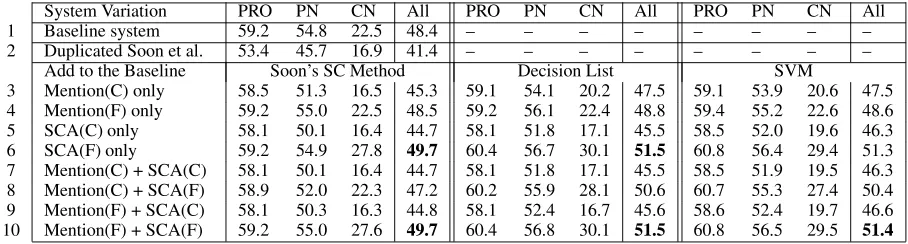
3 Mention(C) only 58.5 51.3 16.5 45.3 59.1 54.1 20.2 47.5 59.1 53.9 20.6 47.5 4 Mention(F) only 59.2 55.0 22.5 48.5 59.2 56.1 22.4 48.8 59.4 55.2 22.6 48.6 5 SCA(C) only 58.1 50.1 16.4 44.7 58.1 51.8 17.1 45.5 58.5 52.0 19.6 46.3 6 SCA(F) only 59.2 54.9 27.8 49.7 60.4 56.7 30.1 51.5 60.8 56.4 29.4 51.3
7 Mention(C) + SCA(C) 58.1 50.1 16.4 44.7 58.1 51.8 17.1 45.5 58.5 51.9 19.5 46.3 8 Mention(C) + SCA(F) 58.9 52.0 22.3 47.2 60.2 55.9 28.1 50.6 60.7 55.3 27.4 50.4 9 Mention(F) + SCA(C) 58.1 50.3 16.3 44.8 58.1 52.4 16.7 45.6 58.6 52.4 19.7 46.6 10 Mention(F) + SCA(F) 59.2 55.0 27.6 49.7 60.4 56.8 30.1 51.5 60.8 56.5 29.5 51.4
Table 7: Resolution accuracies for the ACE test set.
valueYES if and only if theMentionvalue for both NPs isYES, whereas theSCAfeature for an NP pair has its value taken from theSCAKS.
Now, we can evaluate the impact of the two KSs on the performance of our baseline resolver. Specifi-cally, rows 3-6 of Tables 6 and 7 show the F-measure and the resolution accuracy, respectively, when ex-actly one of the two KSs is employed by the baseline as either a constraint (C) or a feature (F), and rows 7-10 of the two tables show the results when both KSs are applied to the baseline. Furthermore, each row of Table 6 contains four sets of results, each of which corresponds to a different method for deter-mining the SC value of an NP. For instance, the first set is obtained by using Soon et al.’s method as de-scribed in Footnote 8 to compute SC values, serving as sort of a baseline for our results using induced SC values. The second and third sets are obtained based on the SC values computed by the DL and the SVM classifier, respectively.13 The last set corresponds to
an oracle experiment in which the resolver has ac-cess to perfect SC information. Rows 3-10 of Table
13Results using other learners are not shown due to space
lim-itations. DL and SVM are chosen simply because they achieve the highest SC classification accuracies on the ACE training set.
7 can be interpreted in a similar manner.
From Table 6, we can see that (1) in comparison to the baseline, F-measure increases significantly in the five cases where at least one of the KSs is employed as a constraint by the resolver, and such improve-ments stem mainly from significant gains in preci-sion; (2) in these five cases, the resolvers that use SCs induced by DL and SVM achieve significantly higher F-measure scores than their counterparts that rely on Soon’s method for SC determination; and (3) none of the resolvers appears to benefit fromSCA in-formation whenevermentionis used as a constraint. Moreover, note that even with perfectly computed SC information, the performance of the baseline sys-tem does not improve when neitherMDnorSCAis employed as a constraint. These results provide fur-ther evidence that the decision tree learner is not ex-ploiting these two semantic KSs in an optimal man-ner, whether they are computed automatically or per-fectly. Hence, in machine learning for coreference resolution, it is important to determine not onlywhat linguistic KSs to use, but alsohowto use them.
[image:7.612.82.536.228.350.2]sug-gest thatSCAis better encoded as a feature. Specifi-cally, (1) in comparison to the baseline, the accuracy of common NP resolution improves by about 5-8% whenSCAis encoded as a feature; and (2) whenever SCAis employed as a feature, the overall resolution accuracy is significantly higher for resolvers that use SCs induced by DL and SVM than those that rely on Soon’s method for SC determination, with improve-ments in resolution observed on all three NP types.
Overall, these results provide suggestive evidence that both KSs are useful for learning-based corefer-ence resolution. In particular,mentionshould be em-ployed as a constraint, whereasSCAshould be used as a feature. Interestingly, this is consistent with the results that we obtained when the resolver has access to perfect SC information (see Table 6), where the highest F-measure is achieved by employing men-tionas a constraint andSCAas a feature.
5 Conclusions
We have shown that (1) both mentionand SCAcan be usefully employed to improve the performance of a learning-based coreference system, and (2) em-ploying SC knowledge induced in a supervised man-ner enables a resolver to achieve better performance than employing SC knowledge computed by Soon et al.’s simple method. In addition, we found that the MUC scoring program is unable to reveal the usefulness of the SCA KS, which, when encoded as a feature, substantially improves the accuracy of common NP resolution. This underscores the im-portance of reporting both resolution accuracy and clustering-level accuracy when analyzing the perfor-mance of a coreference resolver.
References
D. Bean and E. Riloff. 2004. Unsupervised learning of contex-tual role knowledge for coreference resolution. InProc. of HLT/NAACL, pages 297–304.
D. M. Bikel, R. Schwartz, and R. M. Weischedel. 1999. An algorithm that learns what’s in a name. Machine Learning
34(1–3):211–231.
C.-C. Chang and C.-J. Lin, 2001. LIBSVM: a library for support vector machines. Software available at http://www.csie.ntu.edu.tw/∼cjlin/libsvm.
M. Collins and Y. Singer. 1999. Unsupervised models for named entity classification. InProc. of EMNLP/VLC.
W. Daelemans, J. Zavrel, K. van der Sloot, and A. van den Bosch. 2004. TiMBL: Tilburg Memory Based Learner, ver-sion 5.1, Reference Guide. ILK Technical Report.
H. Daum´e III and D. Marcu. 2005. A large-scale exploration of effective global features for a joint entity detection and tracking model. InProc. of HLT/EMNLP, pages 97–104.
R. Florian, H. Jing, N. Kambhatla, and I. Zitouni. 2006. Fac-torizing complex models: A case study in mention detection. InProc. of COLING/ACL, pages 473–480.
M. Hearst. 1992. Automatic acquisition of hyponyms from large text corpora. InProc. of COLING.
H. Ji, D. Westbrook, and R. Grishman. 2005. Using seman-tic relations to refine coreference decisions. In Proc. of HLT/EMNLP, pages 17–24.
A. Kehler, D. Appelt, L. Taylor, and A. Simma. 2004. The (non)utility of predicate-argument frequencies for pronoun interpretation. InProc. of NAACL, pages 289–296.
D. Lin. 1998a. Automatic retrieval and clustering of similar words. InProc. of COLING/ACL, pages 768–774.
D. Lin. 1998b. Dependency-based evaluation of MINIPAR. In
Proc. of the LREC Workshop on the Evaluation of Parsing Systems, pages 48–56.
D. Lin. 1998c. Using collocation statistics in information ex-traction. InProc. of MUC-7.
X. Luo, A. Ittycheriah, H. Jing, N. Kambhatla, and S. Roukos. 2004. A mention-synchronous coreference resolution algo-rithm based on the Bell tree. InProc. of the ACL.
K. Markert and M. Nissim. 2005. Comparing knowledge sources for nominal anaphora resolution. Computational Linguistics, 31(3):367–402.
R. Mitkov. 2002.Anaphora Resolution. Longman.
R. Mitkov. 1998. Robust pronoun resolution with limited knowledge. InProc. of COLING/ACL, pages 869–875.
V. Ng and C. Cardie. 2002. Improving machine learning ap-proaches to coreference resolution. InProc. of the ACL.
E. W. Noreen. 1989. Computer Intensive Methods for Testing Hypothesis: An Introduction. John Wiley & Sons.
M. Poesio, R. Mehta, A. Maroudas, and J. Hitzeman. 2004. Learning to resolve bridging references. InProc. of the ACL.
S. P. Ponzetto and M. Strube. 2006. Exploiting semantic role labeling, WordNet and Wikipedia for coreference resolution. InProc. of HLT/NAACL, pages 192–199.
J. R. Quinlan. 1993. C4.5: Programs for Machine Learning.
Morgan Kaufmann, San Mateo, CA.
W. M. Soon, H. T. Ng, and D. Lim. 2001. A machine learning approach to coreference resolution of noun phrases. Compu-tational Linguistics, 27(4):521–544.
J. Tetreault. 2001. A corpus-based evaluation of centering and pronoun resolution.Computational Linguistics, 27(4).
M. Vilain, J. Burger, J. Aberdeen, D. Connolly, and L. Hirschman. 1995. A model-theoretic coreference scor-ing scheme. InProc. of MUC-6, pages 45–52.
R. Weischedel and A. Brunstein. 2005. BBN pronoun corefer-ence and entity type corpus. Linguistica Data Consortium. X. Yang, G. Zhou, J. Su, and C. L. Tan. 2003. Coreference resolution using competitive learning approach. InProc. of the ACL, pages 176–183.