Application of High Pressure Gas Jet Mill Process to Fabricate
High Performance Harmonic Structure Designed Pure Titanium
Mie Ota
1, Sanjay Kumar Vajpai
1, Ryota Imao
2,+1, Kazuaki Kurokawa
2,+2and Kei Ameyama
2,+3 1Research Organization of Science and Technology, Ritsumeikan University, Kusatsu 525-8577, Japan2Department of Mechanical Engineering, Faculty of Science and Engineering, Ritsumeikan University, Kusatsu 525-8577, Japan
Through many years, conventional material developments have emphasized on microstructural refinement and homogeneity. However, “Nano- and Homogeneous”microstructures do not, usually, satisfy the need to be both strong and ductile, due to the plastic instability in the early stage of the deformation. As opposed to such a“nano- and homo-”microstructure design, we have proposed“Harmonic Structure”design. The harmonic structure has a heterogeneous microstructure consisting of bimodal grain size together with a controlled and specific topological distribution offine and coarse grains. In other words, the harmonic structure is heterogeneous on micro- but homogeneous on macro-scales. In the present work, the harmonic structure design has been applied to pure-Ti via a novel powder metallurgy route consisting of controlled severe plastic deformation of thefine-sized powder particles via jet milling and subsequent consolidation by SPS. At a macro-scale, the harmonic structure materials exhibited significantly better combination of strength and ductility, under quasi-static tensile loadings, as compared to their homogeneous microstructure counterparts. [doi:10.2320/matertrans.M2014280]
(Received August 4, 2014; Accepted October 14, 2014; Published November 21, 2014)
Keywords: harmonic structure, pure titanium, severe plastic deformation, powder metallurgy, jet mill, mechanical properties, strength, ductility, absorbed energy, heterogeneous
1. Introduction
Grain refinement is a well-known method of strengthening metallic materials.13) However, the metals and alloys with homogeneous fine-grained microstructures exhibit an im-provement in strength at the expense of ductility.4,5) As a result, ultra-fine/nano grained materials exhibit very high strength but extremely poor ductility, i.e. poor toughness. Interestingly, however, a bimodal grain size distribution proved to be extremely effective in achieving an attractive combination of high strength together with reasonable ductility.610) In particular, a novel microstructural design, called“harmonic structure”, has been proposed by Ameyama and co-workers.1115) The harmonic structure design corre-sponds to a heterogeneous and bimodal microstructure. In a harmonic structure, the coarse-grained areas (“core”) are surrounded by a three-dimensional continuously connected network (“shell”) offine-grained matrix. Bulk pure Titanium, pure Copper, SUS329J1 steel, Co-Cr-Mo alloy and SUS304L steel with a harmonic structure design were successfully prepared via a controlled mechanical milling of metal/alloy powder particles followed by their consolidation. The harmonic structured materials demonstrated a significantly better combination of strength and ductility as compared to their homogeneous fine or coarse-grained counterparts. In our previous work, the harmonic structure was created by controlled mechanical milling of coarse powders via a planetary ball mill. However, it would be worth pointing towards the limitations of the proposed powder metallurgy route. Firstly, the controlled mechanical milling via a ball mill was effective primarily with coarse particles and it is very difficult to achieve controlled deformation in fine size
particles by ball milling. Secondly, the ball milling is also prone to induce some amount of contamination in the milled powders. Therefore, it would be worth making efforts to develop a new powder metallurgy processing method so as the above mentioned issues could be handled effectively. Such developments would immensely enhance the commer-cial viability of preparing near-net shape components with a harmonic structure and improved mechanical properties.
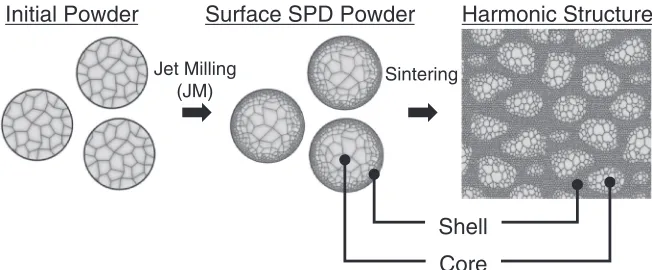
In the present work, “jet milling”is proposed to achieve controlled severe plastic deformation in fine-sized metallic powder particles. In jet milling, highly compressed air or gases are used, usually in a vortex motion, to facilitate the collision of fine particles against each other at a very high velocity.16)The jet milling is a relatively clean process. Since no milling media is used in this process, the possibility of contamination is extremely minimal. Furthermore, high purity inert gas can be used, instead of air, to further minimize the risk of oxidation during the milling process. Therefore, the present work deals with the preparation of harmonic structured Ti through a powder metallurgy process involving controlled severe plastic deformation of fine-size pure Ti powders via jet milling followed by spark plasma sintering. A schematic of the proposed fabrication process of the harmonic structure using the jet milling process is shown in Fig. 1. In the present work, the microstructural evolution at every stage of processing has been presented. Furthermore, the effect of milling conditions on the microstructure and mechanical properties of the bulk Ti compacts, thus prepared, has also been presented and discussed.
2. Experimental Procedure
In this work, gas atomized low oxygen content commercial pure Ti powder, supplied by Osaka Titanium Technologies Co. Ltd., was used as starting materials. Chemical compo-sition of the powder was (O: 0.128, C: 0.004, N: 0.007, H: 0.006, Fe: 0.029, Ti: Bal. mass%). The particle size +1Graduate Student, Ritsumeikan University. Present address: Mitsubishi
Electric Corporation, Inazawa 492-8161, Japan
+2Graduate Student, Ritsumeikan University
+3Corresponding author, E-mail: ameyama@se.ritsumei.ac.jp
distribution is shown in Fig. 2. The particle size distribution appears to be very close to follow the normal distribution, with a median particle size of the powder approximately 38.8 µm. Also, it would be worth mentioning that the size of the initial powder varied from as small as 5 µm to as large as 100 µm. The powders were milled using a high pressure gas milling apparatus, Nano Jetmizer, manufactured by Aishin Nano Technologies Co. Ltd. The mechanism of milling using a jet mill is demonstrated in Fig. 3. The milling was carried out using argon gas, at a pressure of 0.9 MPa, as a milling media to minimize any significant contamination and oxidation. The vial of the apparatus (volume=10 mL) was made of ZrO2 ceramics. Since no solid milling media, such as milling balls, is used during milling, the possibility of any significant contamination is greatly minimized. In the beginning, a total amount of 50 grams of powder was supplied in the vial with Argon gas at a feeding rate of 0.03 g/s. The milled powder is collected through afilter. In the present case, approximately 10 grams of powder were removed after every pass and rest of the powder is supplied for the next milling pass. This process was repeated up to 5 passes in the present work. Subsequently, the powders were consolidated by spark plasma sintering (SPS) at 1073 K, where temperature was measured at the surface of die, holding for 1.8 ks under a vacuum and 50 MPa applied pressure, using a graphite die with 15 mm internal diameter. Chemical analysis of oxygen content after sintering revealed that the initial powder compact and all of the jet milled powder compacts had the same oxygen content of 0.14
mass%, hence there were no oxygen contamination by the jet milling process.
The microstructural characteristics of the initial powder, milled powder, and the sintered compacts were observed by a scanning electron microscope (SEM) and the electron backscattered diffraction (EBSD) technique. The mechanical properties of the bulk material were evaluated by tensile tests. The tensile tests were carried out on specimens having gauge dimensions 3 mm (length)©1 mm (width)©1 mm (thick-ness), using a Shimadzu AGS-10kND tensile testing machine at a strain rate of 5.6©10¹4s¹1.
3. Results and Discussions
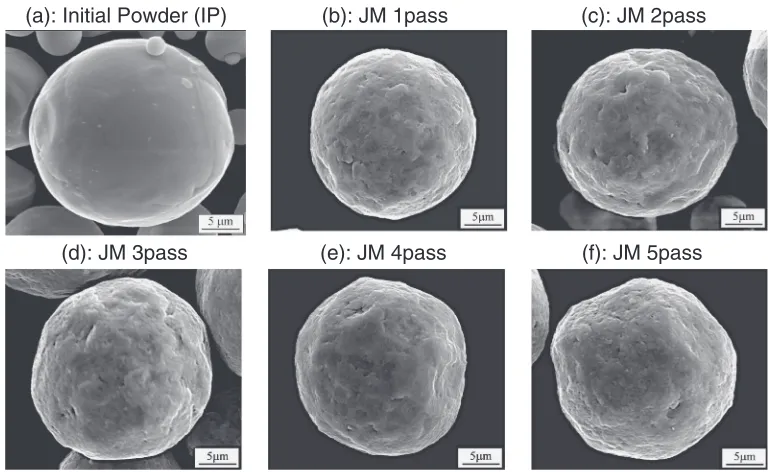
3.1 Microstructural evolution during jet milling process Figure 4 shows the morphology of the initial and milled powder particles. It can be seen that the initial powder was spherical in shape with almost smooth surfaces (Fig. 4 (a)), while the shape of the milled powders became slightly distorted with rough surface (Fig. 4 (b)4 (d)). Interestingly, the distortion of the shape of the spherical powder particles increased with increasing number of jet milling passes; however, the shape still remained nearly spherical and the increasing number of jet milling passes did not lead to any significant change in the overall morphology of the powder particles. Figure 5 shows the cross-section of the initial and Jet Milling
(JM) Sintering
Initial Powder
Surface SPD Powder
Harmonic Structure
Core
Shell
Fig. 1 A schematic of the proposed fabrication process of a harmonic structure design.
0 2 4 6 8 10 12 14
4.1 5.1 7.3 9.3
1
1.8 15.0 19.0 24.1 30.6 38.8 49.3 62.5 79.3
100.6
Frequency
, (%)
Particle size, D/ µm
Fig. 2 Particle size distribution of initial powder.
HP Ar
(High pressure Ar gas: 0.9MPa)
HP Ar
HP Ar HP Ar
HP Ar
powder & HP Ar
Powder Outlet
Powder-powder impact
[image:2.595.135.461.70.205.2] [image:2.595.65.275.242.401.2] [image:2.595.306.545.251.438.2]milled powders. An equiaxed microstructure having a grain size in the range of 5 to 10 µm was observed in the initial powder (Fig. 5 (a)). On the other hand, the microstructure of the cross-section of the milled powders shows that the jet milling led to the formation of a featureless region, having a “shell-like”appearance, in the vicinity of the surface of the powder particles whereas the remaining inner part of the milled powder particles, i.e. “core” of the powder, still consisted of a coarse equiaxed microstructure. It can also be noticed that the area/volume fraction of the shell-like region
increased with the increasing number of milling passes, amounting to more than 70%area fraction after 5 jet milling passes.
The appearance of such a featureless “shell” region is primarily related with the formation of a nanocrystalline structure due to severe plastic deformation.7,11,15)Hence, the controlled mechanical milling via the jet mill proved extremely effective in achieving controlled severe plastic deformation, limited to the sub-surface regions of the fine size powder particles, in the form of a featureless “shell” region. As a result, jet milling successfully created a bimodal microstructure in the milled powder particles, i.e. (i) a nanocrystalline “shell” region in the vicinity of the surface of the particle, and (ii) a coarse-grained “core” inner region. Furthermore, the jet milling also provides an opportunity to control the volume/area fraction of the fine/coarse grained areas via controlling the number of jet milling passes.
[image:3.595.105.490.69.305.2]3.2 Microstructure of the sintered Ti compact
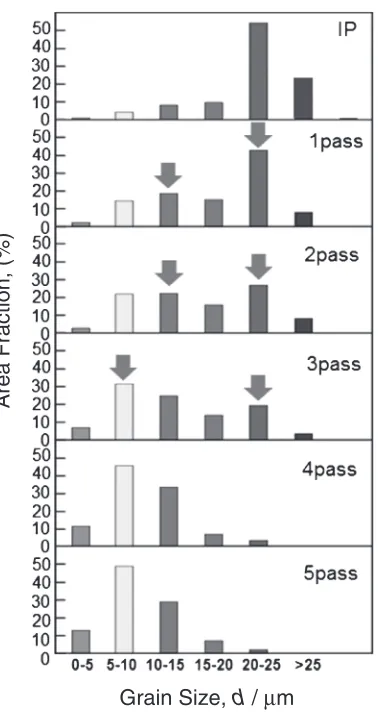
Figure 6 shows the microstructure, EBSD band contrast images with grain boundary, of the pure Ti compacts prepared from initial and jet milled powders up to 5 passes. The grain size distribution of the initial and milled powder compacts is also shown in Fig. 7. It can be noted that the compacts prepared from the initial unmilled powder consisted of primarily coarse grained microstructure wherein majority of the grains, more than 50 area%, had size in the range of 2025 µm. In fact, grains having size in the range of 2550 µm occupy almost 25 area% in the microstructure. Finally, approximately 25 area%were occupied by the grains with size smaller than 20 µm. From the above results, it is immediately clear that a grain growth occurred during spark plasma sintering, leading to considerably larger average size of grains in the sintered compacts as compared to that in the starting powder particles. However, the general nature of
(a): Initial Powder (IP) (b): JM 1pass (c): JM 2pass
(d): JM 3pass (e): JM 4pass (f): JM 5pass
Fig. 4 Morphology of pure Ti powders: (a): initial powder, (b): 1 pass, (c): 2 pass, (d): 3 pass, (e): 4 pass and (f ): 5 pass jet milling, respectively.
(a): Initial Powder (IP) (b): JM 1pass
(c): JM 3pass (d): JM 5pass
[image:3.595.48.290.358.611.2]grain size distribution appears to be guided by the particle size distribution of the initial powder. Also, the fine and coarse grains were randomly distributed in the compacts. However, it must be emphasized that, although bothfine and coarse grains are present in the sintered compacts, the microstructure is not truly bimodal.
From Figs. 6 and 7, it can also be observed that the average grain size decreased with increasing number of milling passes. It can be seen that the area fraction of finer grains, size less than 15 µm, increased significantly at the expense of coarser grains with size more than 20 µm. In particular, it is interesting to note that the 13pass milled bimodal powders resulted in an equiaxed grain structure with a wide grain size distribution, which could be considered a multimodal distribution within the limit of 130 µm. Never-theless, these microstructures exhibit a peculiar topological distribution of relatively finer and coarser grains, i.e. the regions with coarse grains are embedded in the matrix offi ne-equiaxed grains (Figs. 6 (b), 6 (c) and 6 (d)). Such a peculiar microstructure, i.e. regions withfine-equiaxed grains form a continuously connected three dimensional network around the regions with a coarse grained microstructure, is referred as“harmonic”structure design wherein the regions withfi ne-equiaxed and coarse-ne-equiaxed microstructures correspond to the severely deformed“shell”and moderately-deformed/ un-deformed“core”regions of the milled powders, respectively. It is also interesting to note that the grain size of the core region in the harmonic structure is somewhat smaller than that of the compacts prepared from the initial as-received Ti powders. Furthermore, microstructures become finer with increasing number of passes,finally leading to uniformfi ne-grained microstructure (Fig. 6 (f )).
(d): JM 3pass
(a): Initial Powder (IP)
(b): JM 1pass
(c): JM 2pass
(e): JM 4pass
(f): JM 5pass
Fig. 6 Microstructure of the initial and jet milled pure Ti compacts: (a): an initial powder compact: homogeneous coarse-grained microstructure, (b): 1 pass, (c): 2 pass, (d): 3 pass: harmonic microstructure, (e): 4 pass and (f ): 5 pass: Homogeneousfine-grained microstructure, respectively.
Area Fraction, (%)
Grain Size,
d
/
µ
m
[image:4.595.87.508.70.342.2] [image:4.595.78.267.405.761.2]Such a microstructural evolution suggests that the effect of jet milling on the plastic deformation of the powder particles is not limited only to the near surface region but also extended to the inner part of the powder particles due to the very small particle sizes. It appears that the relatively finer structure is evolved in the core region due to recrystallization and grain growth during subsequent elevated temperature consolidation. As a result, the grain size of the core and the shell region is not as apparently different as observed in the case of the harmonic structure created using coarse powder particles. Nevertheless, as marked in Fig. 6 (b), 6 (c) and 6 (d), the microstructure of the sintered compacts exhibits peculiar characteristics of the harmonic structure design.
Table 1 summarizes average grain size and average Vickers hardness of the compacts. It can be clearly observed that the average grain size decreased and average hardness increased with increasing number of the jet milling passes. However, it must be emphasized that the average grain size did not decreased significantly with increasing number of milling passes. Therefore, these variations in microstructure and hardness with increasing milling time appear to be related with the increasing volume fraction of relativelyfi ne-grained region rather than with any significant reduction in the grain size. Therefore, the above results indicate that the grain size and the volume fraction of the core and the shell areas can be controlled by varying the milling and consolidation conditions.
3.3 Mechanical properties
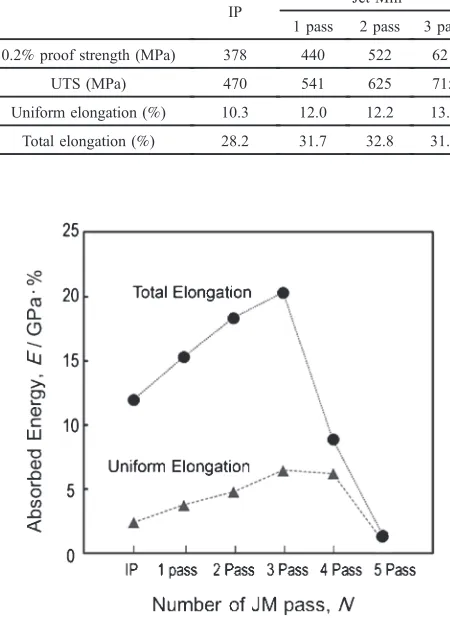
Figure 8 shows the representative nominal stress-nominal strain curves of pure Ti compacts with homogeneous coarse-grains, prepared from the initial powder (IP), as well as the compacts prepared from milled powders (1 pass5 pass). Table 2 summarizes the mechanical properties of the compacts. It can be clearly observed that the sintered compacts with the harmonic structure exhibited a consid-erably higher yield strength, tensile strength, total strain-to-fracture, and uniform elongation as compared to its counter-part with a coarse-grained homogeneous microstructure prepared from the initial powder. Moreover, these results also indicated that the harmonic structured Ti exhibit a superior set of mechanical properties as compared to the homogeneous coarse-grained or ultra-fine grained counter-part, i.e., the 5 pass compact.
Figure 9 shows the relationship between the number of JM pass and the absorbed energy, i.e., integrated area under the tensile stress-strain (uniform or fracture strain) curve. Absorbed energy estimated by integrating the stress-strain curve until fracture can be regarded as toughness17) of the material under investigation. It can be observed that the
absorbed energy of the compacts under quasi-static tensile loading increased with increasing number of jet milling passes up to 3 passes. As indicated in Figs. 6 and 7 and Table 2, it is noteworthy that the evolution of the harmonic structure, especially in the 3 pass jet milled powder compact, led to increase in strength and uniform elongation at the same time, and thus the absorbed energy drastically improved.
[image:5.595.319.534.69.234.2]Therefore, the present results further confirm that the harmonic structure design is extremely effective in achieving higher strength without compromising ductility in the pure Table 1 Average grain size and hardness of the compacts.
Compact IP 1pass 2pass 3pass 4pass 5pass
Ave. Grain Size
(µm) 17.8 10.3 9.1 8.6 6.5 6.1
Ave. Hardness
(Hv) 186.5 209.0 230.7 257.9 289.4 314.8
[image:5.595.47.293.84.149.2]Fig. 8 Stress-Strain curves of homogeneous structure (IP) and harmonic structure compacts.
Table 2 Mechanical Properties of IP and 13 pass jet milled compacts.
IP Jet Mill
1 pass 2 pass 3 pass
0.2%proof strength (MPa) 378 440 522 621
UTS (MPa) 470 541 625 715
Uniform elongation (%) 10.3 12.0 12.2 13.5
Total elongation (%) 28.2 31.7 32.8 31.3
[image:5.595.312.537.305.614.2]Ti, i.e., improved absorbed energy as compared to the conventional coarse/fine grained homogeneous microstruc-tures. It has been observed that the harmonic structure has the ability to promote a uniform distribution of strain during plastic deformation, leading to improved mechanical proper-ties by avoiding or delaying localized plastic instability.18)
4. Conclusion
The harmonic structure was successfully created by controlled milling of fine-sized pure Ti powder via jet milling followed by spark plasma sintering. The jet milling led to the milled powder particles with a bimodal grain size distribution consisting of a severely deformed nano/ultra-fine grained “shell”in the sub-surface region of the particle and coarse-grained“core”inner region. Spark plasma sintering of milled powder resulted in the formation of a “harmonic” structure wherein the severely deformed shell regions of the milled powders transformed to a three dimensional network of equiaxed fine-sized grains, enclosing the coarse-grained “core”areas. The pure Ti compacts with a harmonic structure exhibited a significant enhancement in the strength without compromising the ductility, i.e. improved absorbed energy as compared to the conventional homogeneous coarse/fi ne-grained microstructures. The improved mechanical properties of the harmonic structure compacts were attributed to the specific topological distribution of high strengthfine-grained “shell”and ductile coarse-grained“core”regions; as such a microstructure promotes uniform distribution of strain during plastic deformation and avoids the localized plastic deforma-tion in the early stages of deformadeforma-tion.
Acknowledgments
This research was supported by the Japan Science and Technology Agency (JST) under a Collaborative Research
Based on Industrial Demand “Heterogeneous Structure Control: Towards Innovative Development of Metallic Structural Materials”, and by the Grant-in-Aid for Scientific Research on Innovative Area, Bulk Nanostructured Metals through MEXT, Japan (contract No. 22102004). These supports are gratefully acknowledged.
REFERENCES
1) Y. Estrin and A. Vinogradov:Acta Mater.61(2013) 782817.
2) N. Hansen:Scr. Mater.51(2004) 801806.
3) M. A. Meyers, A. Mishra and D. J. Benson:Prog. Mater. Sci.51(2006) 427556.
4) E. Ma:Scr. Mater.49(2003) 663668.
5) N. Tsuji, N. Kamikawa, R. Ueji, N. Takata, H. Koyama and D. Terada:
ISIJ Int.48(2008) 11141121.
6) G. Dirras, J. Gubicza, S. Ramtani, Q. H. Bui and T. Szilagyi:Mater. Sci. Eng. A527(2010) 12061214.
7) H. Fujiwara, R. Akada, A. Noro, Y. Yoshita and K. Ameyama:Mater. Trans.49(2008) 9096.
8) Y. Wang, M. Chen, F. Zhou and E. Ma:Nature419(2002) 912915.
9) Y. M. Wang and E. Ma:Acta Mater.52(2004) 16991709.
10) D. Witkin, Z. Lee, R. Rodriguez, S. Nutt and E. Lavernia:Scr. Mater. 49(2003) 297302.
11) T. Sekiguchi, K. Ono, H. Fujiwara and K. Ameyama:Mater. Trans.51 (2010) 3945.
12) D. Orlov, H. Fujiwara and K. Ameyama:Mater. Trans.54(2013) 1549 1553.
13) O. P. Ciuca, M. Ota, S. Deng and K. Ameyama: Mater. Trans.54 (2013) 16291633.
14) C. Sawangrat, O. Yamaguchi, S. K. Vajpai and K. Ameyama:Mater. Trans.55(2014) 99105.
15) Z. Zhang, S. K. Vajpai, D. Orlov and K. Ameyama:Mater. Sci. Eng. A 598(2014) 106113.
16) N. Midoux, P. Hosek, L. Pailleres and J. R. Authelin:Powder Technol. 104(1999) 113120.
17) T. Daitoh and T. Takaai:Japan Inst. Light Metal39(1989) 873877.
18) S. K. Vajpai, K. Ameyama, M. Ota, T. Watanabe, R. Maeda, T. Sekiguchi, G. Dirras and D. Tingaud: Mater. Sci. Eng. 63 (2014)