Application of Al-Si Semi-Solid Reaction for Fabricating Harmonic Structured Al
Based Alloy
Nur Zalikha Khalil
1,2,*, Sanjay Kumar Vajpai
3, Mie Ota
4and Kei Ameyama
4 1Department of Mechanical Engineering, Ritsumeikan University, Kusatsu 525–8577, Japan 2Faculty of Mechanical Engineering, Universiti Malaysia Pahang, 26600 Pekan, Pahang, Malaysia 3Research Organization of Science and Technology, Ritsumeikan University, Kusatsu 525–8577, Japan4Faculty of Science and Engineering, Department of Mechanical Engineering, Ritsumeikan University, Kusatsu 525–8577, Japan The present work deals with a novel approach of fabricating harmonic structure in Al alloy through the application of semi-solid reaction between Al and Si. The harmonic structured Al was prepared by powder metallurgy route, where the Al and Si powder were subjected to con-trolled mechanical milling followed by subsequent spark plasma sintering to make a compact. The sintered compact resulted in a network structure of hard interconnected silicon dispersed region combined with Al-Si solid solution phase, known as shell , enclosing the soft phase of pure aluminum matrix known as core . The harmonic structured Al compact demonstrated retention of both uniform and total elongation as compared to its heterogeneous bimodal structure counterpart, which is the typical feature of the harmonic structured material. The application of semi-solid reaction between Al and Si in fabricating harmonic structure proved to be effective in improving mechanical properties of Al alloy. Present work also discusses the deformation behavior of the sintered compacts, with respect to its strain hardening behavior.
[doi:10.2320/matertrans.MH201516]
(Received April 25, 2016; Accepted June 20, 2016; Published July 25, 2016)
Keywords: aluminum alloy, harmonic structure, semi-solid reaction, mechanical properties, high strength, high ductility
1. Introduction
In recent years, extensive investigations have been con-ducted in order to meet the demand of structural materials with superior mechanical properties, as compared to those of the conventional materials, with an emphasis on improving the existent material s properties. The improved mechanical properties will not only reduce the cost by providing small sized components with high strength but also enable the gen-eration of novel lightweight materials for a wide range of emerging industrial applications.
Recently, Ameyama and co-workers have proposed a mi-crostructural design to improve mechanical properties by ob-taining both high strength and high ductility in metallic mate-rials, through the formation of so-called harmonic structured material 1–13). Essentially, it is an exquisite heterogeneous microstructural design, consisting of bimodal grain size dis-tribution, in which ductile coarse grained regions (termed as
core ) are enclosed in a continuously connected three-di-mensional networks regions with high strength ultra-fine grained structure, known as shell . It has been reported that a variety of metals and alloys with such structure demonstrate excellent combination of strength and ductility, when com-pared to its homogeneous counterpart.
It is well known that there are several strengthening mech-anisms in metallic materials, such as grain refinement strengthening, solid solution strengthening, dispersion strengthening and dislocation strengthening. With regard to harmonic structured material, it was revealed that the effec-tive strengthening mechanism is the grain refinement strengthening. In conventional harmonic structured material, ultra-fine grained structure at the shell region is achieved through the severe plastic deformation (SPD) process of
me-tallic powder, via controlled mechanical milling process. The severely deformed powder exhibited heterogeneous micro-structure, which has fine grained structure at the shell re-gion and coarse grained structure at the core rere-gion.
Considering the improved ductility in harmonic structured material, in earlier works,9,14) it has been experimentally demonstrated that an improvement in the ductility is attribut-ed to the large uniform deformation under tensile loading. In other words, strain hardening is kept to larger strain region, and thus resulting in the improvement of ductility. Through multi scale finite element analysis (FEA), Yu et.al.15) have validated that the existence of the network in the harmonic structured materials results in the avoidance of plastic defor-mation localization leading to homogeneous defordefor-mation be-havior.
In the present work, an attempt has been made to explore the possibility to fabricate harmonic structured material through a novel approach, namely by semi-solid reaction. By utilizing the harmonic structure concept, an attempt has been made to fabricate a network structure of soft phase, which is enclosed by three dimensional interconnected network re-gions of hard phase. In the proposed approach, attempt has been made to design the shell region with a different strengthening mechanism than that of the conventional har-monic structured material, while maintaining the core re-gion as the softer phase.
As described earlier, strengthening mechanism of the typi-cal harmonic structured material relies on the grain refine-ment via SPD during controlled mechanical milling. Howev-er, with regard to aluminum alloy, the formation of fine grains via mechanical milling and/or retention of the same during subsequent sintering is rather difficult to achieve due to the low melting point of aluminum. Therefore, it is expected that by applying semi-solid reaction between Al and Si, it will provide another strengthening alternative to the shell region in harmonic structure of this alloy. In particular, it is antici-*
Graduate Student, Ritsumeikan University. Corresponding author, E-mail: [email protected]
pated that the formation of Al-Si solid solution phase com-bined with dispersion of Si particles will provide two strength-ening mechanisms, namely, solid solution strengthstrength-ening and dispersion strengthening. Hence, by applying the semi solid reaction, it is expected that alternative and multiple strength-ening mechanisms on the shell region of the harmonic com-pact Al alloy can be achieved.
In particular, by applying the semi-solid reaction of Al and Si, an attempt has been made to form a shell region with the above mentioned strengthening mechanism, while maintain-ing the core region as the ductile pure aluminum phase (Fig. 1). Apart from its hard nature, Si has been chosen as the secondary element candidate, because aluminum and silicon form a simple binary eutectic system and the formation of possible phases is relatively easier to characterize.
Therefore, present work has two main objectives; (1) to in-vestigate the possibilities of formation such design in Al alloy and (2) to evaluate whether or not the harmonic structure fab-ricated by semi-solid reaction of Al and Si, is effective in im-proving mechanical properties of Al alloy in the similar man-ner as in the conventional harmonic structure material. In this work, the harmonic structure is fabricated through powder metallurgy route, which comprises of controlled mechanical milling of aluminum and silicon powder, followed by consol-idation by spark plasma sintering (SPS) at eutectic tempera-ture. Mechanical milling was employed to achieve uniform distribution of Si around Al particles. Finally, the deformation behavior of sintered compacts is also presented and discussed.
2. Experimental Procedures
In the present work, commercially pure Al powder pre-pared by plasma rotating electrode process (PREP) and pure Si powder were used as starting material. The chemical com-position of the as received Al powder is shown in Table 1. Figure 2 shows the morphology of as received Al and Si pow-ders. It can be noted that as received Al powder has smooth surface with spherical morphology, as shown in Fig. 2(a). It is also noted that the Al particles have more or less uniform par-ticle size, which is the typical characteristic of PREP powder. The average particle size of the Al powder particles is 283 μm. As received Si powders demonstrate an irregular morphology with a wide range of particle size as shown in Fig. 2(b). The mean particle size of Si particles is 11 μm.
The mixture of aluminum and silicon powder was subject-ed to controllsubject-ed mechanical milling using Fritch P-5
plane-tary ball mill, under Ar atmosphere at room temperature. A constant rotation of 150 rpm and a total time of 36 ks were used to mill the powders and the ratio of the grinding ball to powder mixture was 10: 1 by mass. WC-Co vial and high carbon chromium steel balls (SUJ2) of 3 mm in diameter were used as grinding media. Stearic acid (C17H35CO2H) in 1.0 mass% of the total powder mass was used as process con-trol agent to minimize the agglomeration/sticking amongst Al powders and to the milling media. The silicon content was varied from 0 5 mass% of the total powder mass during me-chanical milling. Subsequently, the milled powder was sub-jected to spark plasma sintering under 50 MPa for 1.8 ks (0.5 h) at 850 K. Phase and microstructural characterization of sintered compacts was carried out by the means of SEM equipped with EBSD and EDS detectors. The mechanical properties of the sintered compacts were evaluated by Vickers indentation and tensile tests. The tensile specimens were pre-pared with a gauge length of 3 mm, width of 1 mm and thick-ness of 1 mm. The initial strain rate for tensile tests was 2.7 × 10⁻³ s−1 at room temperature.
3. Results and Discussions
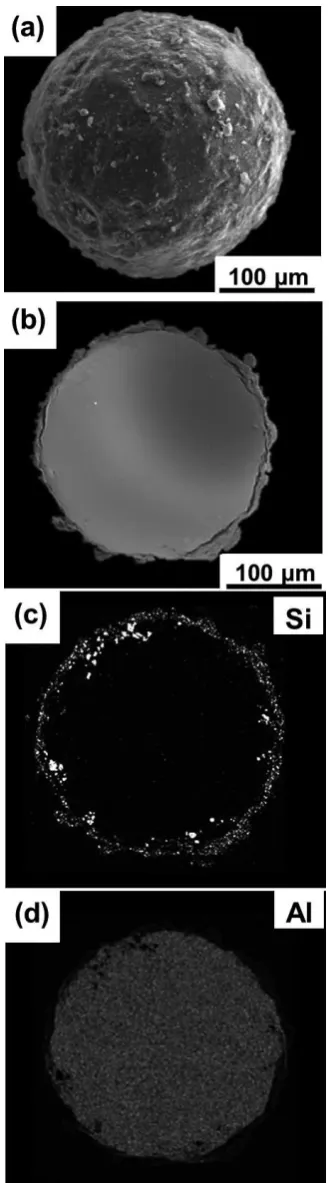
3.1 Characterization of mechanically milled powders Figure 3 demonstrates the morphology of the mechanically milled (MM) Al-5 mass% Si powder. After mechanical mill-ing is conducted, the MM powder retains more or less its
ini-Table 1 Chemical composition of as received Al powder.
Element Si Fe Cu Ti Al
Mass (%) 0.07 0.14 0.01 0.01 Bal.
Fig. 1 Schematic of harmonic- structured design.
[image:2.595.82.254.72.197.2] [image:2.595.325.525.142.419.2]tial shape without any appreciable deformation, as shown in Fig. 3(a). It is worth emphasizing that, this is due to the opti-mization made to mechanical milling parameters and condi-tion, so that it will not lead to any agglomeration and/or stick-ing and fractures of the Al particles. Moreover, it can also be
observed that the Al powders surface demonstrates the for-mation of a deformed rough surface. This suggests that plas-tic deformation was induced while mechanical milling was conducted. It appears that the plastic deformation is only lim-ited to the surface of the powder particles. Similar morpho-logical observations have been reported also in litera-ture9,12,13). Moreover, it is also noticed that the Si particles have fragmented to significantly smaller particle size after mechanical milling. As shown in Figs. 3(b)–(d), in the MM powder, Si particles are uniformly distributed around Al par-ticles, indicating that the anticipated uniform distribution of Si particles around Al particles has been achieved at this stage.
Table 2 shows the average hardness values of initial and MM Al-5 mass% Si powders. The indentation was made at 98.07 mN for 5 seconds of holding time. The measurements were taken in two separate regions namely, surface and center region. For surface region, the measurements were conducted approximately 25 μm from the surface of Al particles. Mean-while, for center region, the measurements were taken at the center of the respective particles. The measurement was made at different powder particles for each region to avoid any pos-sible work hardening effect due to indentation. Apparently, the average hardness of both center and surface region of MM powder particles was significantly higher than that of the ini-tial powder particles. The increment of hardness in the MM powder particles can be attributed to the work hardening ef-fect, which is caused by the plastic deformation due to me-chanical milling. Considering the increment in the average hardness value in the center region of the MM powder as compared to the initial powder, it is apparent that the work hardening effect is not only limited to the surface area of the MM powder, but also extends to some extent to the center region as well. Furthermore, in the MM powder, it can also be observed that the hardness of surface region is higher than that of the center region. It is worth emphasizing that the higher average hardness value of the surface region, as com-pared to that of the center region in the MM powder, reflects that the work hardening is relatively higher at the powder sur-face as compared to the center region. Similar observations have been reported in the other works also11). Moreover, the existence of Si particles on the surface region also contributes to hardness increment in surface region by acting as obstacles to dislocation movement.
3.2 Microstructural characteristics of the sintered har-monic Al compact
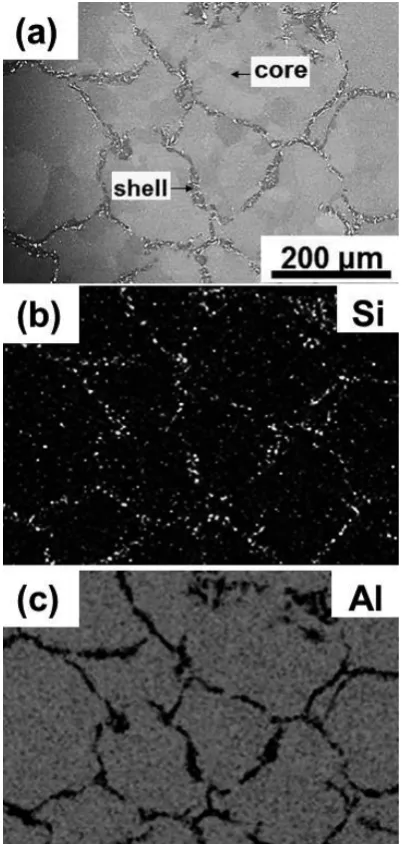
Figure 4 shows the BSE image of the sintered Al-5 mass% Si harmonic compact and EDS mapping images at the same magnification. Apparently, the BSE image reveals that the sintered compact demonstrates a formation of continuous network structure of two phases; dark phase in the shell
re-Table 2 Vickers hardness of initial and MM Al-5 mass% Si powder.
Powder Hardness (HV)
Surface Centre
Initial Powder 27.3 ± 3
MM 36 ks 39.9 ± 5 34.6 ± 3
[image:3.595.86.251.68.661.2] [image:3.595.304.549.85.138.2]gion and grey phase in the core region, as shown in Fig. 4(a). The EDS analysis result demonstrates that the shell region corresponds to Si-rich region (Fig. 4(b)) while the core re-gion corresponds to Al rich rere-gion (Fig. 4(c)). At this stage, it is worth emphasizing that the formation of desired harmonic structure consisting three- dimensional network of intercon-nected silicon dispersed region surrounding isolated alumi-num matrix region has been achieved. Figure 5 depicts an enlargement of the shell region in the harmonic compact. From BSE image, it is observed that mainly three phases exist in the shell region. They are present as dark phase (area I ), grey phase (area II ) and white phase (area III ). These ar-eas are marked as I , II and III respectively in Fig. 5(a). From Figs. 5(b)–5(c), it is revealed that area I corresponds to the Al-Si solid solution phase (α), area II corresponds to pure Al while area III corresponds to pure silicon particles. Moreover, it is worth emphasizing that in area III , Si cles exhibit two distinct morphologies, namely blocky parti-cles and acicular partiparti-cles, which is not presence in the initial
Si powder. It has been reported elsewhere16) that the co-exis-tence of blocky faceted primary Si and acicular eutectic Si is a product of a hypereutectic composition during solidifica-tion. Hence, it appears that in present work the consolidation process by SPS occurs in the presence of liquid phase of hy-pereutectic composition in some parts of the shell regions. As a result, during solidification process, the liquid phase solidifies to form pure Si precipitates of different morpholo-gy, as illustrated in Fig. 5(a). From these observations, it can be concluded that, the formation of the desired harmonic structure consisting of three- dimensional network of inter-connected silicon dispersed region combined with α phase (i.e: shell), surrounding isolated aluminum matrix region (i.e: core) has been achieved. In this work, the estimated shell fraction in harmonic structured Al compact is 15.3%.
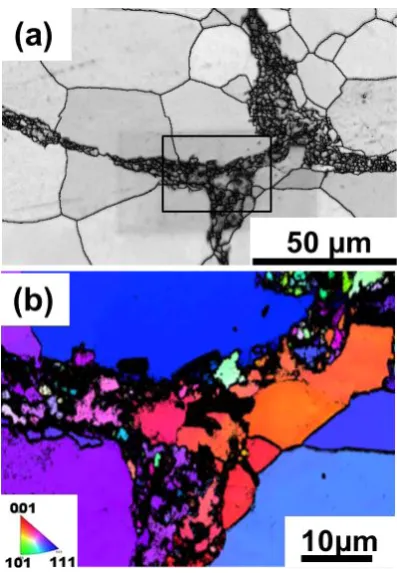
Figure 6 shows the EBSD image quality map overlaid with grain boundaries and inverse pole figure (IPF) of the enlarge-Fig. 4 Phase distribution in the sintered Al-5 mass% Si harmonic
struc-tured compact (a) BSE image (b) and (c) are EDS analysis results
[image:4.595.327.526.67.503.2] [image:4.595.68.270.70.493.2]ment of the shell region of the harmonic structure Al com-pact. It can be observed that, the shell region is composed of relatively fine sized grains. These fine grains are the combina-tion of α phase grains and silicon particles.
In the harmonic structured Al compact, hardness indenta-tions were conducted separately in the shell and the core re-gions, and the average hardness of the respective region was Hv: 111.9 ± 39.8 and Hv: 40.7 ± 3.1. The higher average hardness in the shell region compared to core region can be attributed to the formation of fine grain structure, α phase and the existence of Si particles.
3.3 Tensile properties of sintered compacts and its de-formation behavior
In the present work, the variation of Si content during me-chanical milling implies the completeness of network struc-ture formation in the final sintered compact, in such that the increasing Si content results in a complete network structure. In this work, the variation of silicon content results in three hard phase fraction hf, namely, 0%, 2.5% and 15.3%. In this work, the term hard phase is used to define the combination of Si dispersed region and α phase, while the term shell is used to describe the continuous network structure of the hard phase in the harmonic structured Al compact as discussed in 3.2.
Figure 7(a) shows the microstructure of the compacts with zero percent hard phase fractions, hf. This compact refers to initial Al powder compact with no hard phase (Henceforth referred as homogeneous compact.) Figs. 7(b)–(c) illustrate the compact with hf = 2.5% at low and high magnifications. It is observed that this compact exhibit the heterogeneous
bi-modal structure without the unique network structure specific to harmonic structure (Henceforth, referred as heterogeneous bimodal compact). The average grain size of the aluminum phase for homogeneous and heterogeneous bimodal structure was estimated as 132.5 μm and 107.2 μm, respectively.
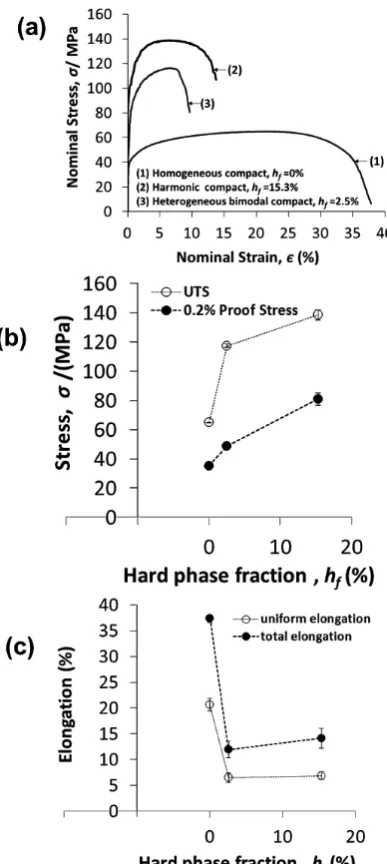
Figure 8(a) illustrates the representative nominal stress- nominal strain curves of the sintered Al compacts having dif-ferent hard phase fraction, hf. Figures 8(b)–(c) summarize the relation between stress and elongation a function of hf. It is observed that, as compared to homogeneous compact, hetero-geneous bimodal and harmonic compacts demonstrated sig-nificant increment in both 0.2% proof stress and UTS. An increment in the proof stress and UTS of these compacts ap-pears to be related to the larger strengthening with increasing
hf, combined with the existence of fine grained structure. The general trend of variation of the tensile properties of homoge-neous materials includes a decrease in ductility with increas-ing strength, which is related to the early plastic instability. With respect to present work, the harmonic compact is ex-Fig. 6 Microstructure on the shell region for harmonic structured
com-pact (a) EBSD band contrast map overlaid with grain boundary map (b) Inverse pole figure of the enlargement in the shell region.
Fig. 7 Microstructure of sintered compacts at different hf fraction. (a)
Ho-mogeneous compact, hf = 0%, (b) Microstructure of heterogeneous
bi-modal compact, hf = 2.5%, (c) Enlargement of the black rectangle shown
[image:5.595.69.268.67.354.2] [image:5.595.324.525.68.493.2]pected to have lower ductility as compared to that of the het-erogeneous bimodal compact, due to the higher strength in the harmonic compact. Nevertheless, harmonic compact demonstrates retention in both total and uniform elongation, when compared to the heterogeneous bimodal compact. It is to mention that the retention/improvement in ductility is the typical behavior, in general, for harmonic structured material, and this is associated with the existence of unique network structure which suppresses the deformation localization spe-cific to harmonic compact, as already mentioned in the intro-duction of the present paper.
To understand the deformation behavior of the harmonic structured Al compact, the true stress and true strain along with its corresponding strain hardening rate curve (SHR = dσ/dε),was presented in Fig. 9. Essentially, in the early stage of deformation, dσ/dε comprise of relatively rapid decrease with increasing true strain, followed by relatively small
de-creasing rate, until the dσ/dε crosses the true stress-true strain curve at the point of plastic instability (i.e dσ/dε = σ),in which the necking of the specimen starts thereafter. With regards to homogenous compact, dσ/dε demonstrates a relatively sluggish strain hardening rate at the early stages of deformation when compared to that of the harmonic and het-erogeneous bimodal counterparts. It is worth noting that this is the typical trend in coarse grained structure. On the other hand, it is observed that the harmonic structured compact un-dergoes higher strain hardening at the early stage of deforma-tion, when compared to that of its homogeneous and hetero-geneous bimodal structure counterpart. It is to mention that the higher strain hardening at the early stage of deformation is a general trend for fine grained structure. When compared to the heterogeneous bimodal compact, harmonic compact demonstrated a shift of dσ/dε = σ towards a higher strain val-ues, which indicates, in harmonic structured compact, that the point of plastic instability is delayed towards higher strain values. This implies that the plastic deformation localization is delayed, leading to the delayed necking of the specimen which results in the higher uniform elongation in the harmon-ic compact. Therefore, from these observations, there are two main conclusions that can be drawn for the present harmonic structured Al compact: (1) in the early stage of deformation, harmonic Al compact exhibits somewhat similar strain hard-ening behavior to the fine grained structure, and (2) when compared to the heterogeneous bimodal structure, the point of plastic instability dσ/dε = σ in harmonic compact is de-layed to a higher strain rate, leading to improved uniform elongation in harmonic Al compact. To summarize, as com-pared to the homogeneous pure Al, harmonic structured Al exhibits significant improvement in the strength while retain-ing sufficient ductility.
4. Conclusions
In present work, harmonic structured of Al was successful-ly fabricated by powder metallurgy route in which pure alu-minum and silicon powder were subjected to controlled me-chanical milling followed by subsequent spark plasma sinter-ing. The mechanical performance was evaluated by tensile properties and the following conclusions can be drawn: (1) Uniform distribution of silicon particles around Al
parti-cles can be achieved by controlled mechanical milling. Fig. 8 Tensile properties of Al alloy samples with different hard phase
frac-tion, hf (a) Representative nominal stress-strain curve, (b) and (c)
illus-trate the correlation between hard phase fraction, hf with stress and
elon-gation respectively.
[image:6.595.71.265.67.500.2] [image:6.595.326.526.69.208.2](2) Harmonic structured Al comprised of soft core areas with pure aluminum matrix, enclosed into three-dimensional network of hard Si dispersed region combined with Al-Si solid solution phase structure was successfully fabricat-ed. The shell region of harmonic structured Al demon-strates the existence of fine grains structure. Harmonic structured Al compact demonstrates improvement in strength while retaining sufficient ductility when com-pared to its homogenous structure counterpart.
(3) When compared to its heterogeneous bimodal counter-part, harmonic structured Al compact demonstrates de-layed plastic instability, which results in the improvement of uniform and total elongations.
(4) Network structure of three dimensional interconnected network regions of hard phase, enclosing soft phase is effective in improving mechanical properties of Al based alloy.
Acknowledgments
This research was supported by the Japan Science and Technology Agency (JST) under a Collaborative Research Based on Industrial Demand Heterogeneous Structure Con-trol.
REFERENCES
1) H. Fujiwara, S. Takarae and K. Ameyama: The 2nd International
Sym-posium on Steel Science, (ISSS, 2009) pp.262–272.
2) T. Sekiguchi, K. Ono, H. Fujiwara and K. Ameyama: Mater. Trans. 51 (2010) 39–45.
3) H. Fujiwara, H. Tanaka, M. Nakatani and K. Ameyama: Mater. Sci. Forum 638–642 (2010) 1790–1795.
4) H. Fujiwara, M. Nakatani, T. Yoshida, Z. Zhang and K. Ameyama: Ma-ter. Sci. Forum 584–586 (2008) 55–60.
5) H. Fujiwara, R. Akada, Y. Yoshita and K. Ameyama: Mater. Sci. Forum
503–504 (2006) 227–232.
6) H. Fujiwara, R. Akada, A. Noro, Y. Yoshita and K. Ameyama: Mater. Trans. 49 (2008) 90–96.
7) D. Orlov, H. Fujiwara and K. Ameyama: Mater. Trans. 54 (2013) 1549– 1553.
8) O.P. Ciuca, M. Ota, S. Deng and K. Ameyama: Mater. Trans. 54 (2013) 1629–1633.
9) Z. Zhang, S.K. Vajpai, D. Orlov and K. Ameyama: Mater. Sci. Eng. A
598 (2014) 106–113.
10) Z. Zhang, D. Orlov, S.K. Vajpai, B. Tong and K. Ameyama: Adv. Eng. Mater. 17 (2015) 791–795.
11) S.K. Vajpai, M. Ota, T. Watanabe, R. Maeda, T. Sekiguchi, T. Kusaka and K. Ameyama: Metall. Mater. Trans., A Phys. Metall. Mater. Sci. 46 (2015) 903–914.
12) C. Sawangrat, O. Yamaguchi, S.K. Vajpai and K. Ameyama: Mater. Trans. 55 (2014) 99–105.
13) C. Sawangrat, S. Kato, D. Orlov and K. Ameyama: J. Mater. Sci. 49 (2014) 6579–6585.
14) S.K. Vajpai, C. Sawangrat, O. Yamaguchi, O.P. Ciuca and K. Ameya-ma: Mater. Sci. Eng. C 58 (2016) 1008–1015.
15) H. Yu, I. Watanabe and K. Ameyama: Adv. Mater. Res 1088 (2015) 853–857.
16) R. Asthana, A. Kumar and N. B. Dahotre: Materials Processing and