A Dynamic Bayesian Framework to Model Context and Memory in Edit
Distance Learning: An Application to Pronunciation Classification
Karim Filali and Jeff Bilmes∗
Departments of Computer Science & Engineering and Electrical Engineering University of Washington
Seattle, WA 98195, USA
{karim@cs,bilmes@ee}.washington.edu
Abstract
Sitting at the intersection between statis-tics and machine learning, Dynamic Bayesian Networks have been applied with much success in many domains, such as speech recognition, vision, and compu-tational biology. While Natural Language Processing increasingly relies on statisti-cal methods, we think they have yet to use Graphical Models to their full poten-tial. In this paper, we report on experi-ments in learning edit distance costs using Dynamic Bayesian Networks and present results on a pronunciation classification task. By exploiting the ability within the DBN framework to rapidly explore a large model space, we obtain a 40% reduc-tion in error rate compared to a previous transducer-based method of learning edit distance.
1 Introduction
Edit distance (ED) is a common measure of the sim-ilarity between two strings. It has a wide range of applications in classification, natural language processing, computational biology, and many other fields. It has been extended in various ways; for example, to handle simple (Lowrance and Wagner, 1975) or (constrained) block transpositions (Leusch et al., 2003), and other types of block opera-tions (Shapira and Storer, 2003); and to measure similarity between graphs (Myers et al., 2000; Klein, 1998) or automata (Mohri, 2002).
∗
This material was supported by NSF under Grant No. ISS-0326276.
Another important development has been the use of data-driven methods for the automatic learning of edit costs, such as in (Ristad and Yianilos, 1998) in the case of string edit distance and in (Neuhaus and Bunke, 2004) for graph edit distance.
In this paper we revisit the problem of learn-ing strlearn-ing edit distance costs within the Graphi-cal Models framework. We apply our method to a pronunciation classification task and show sig-nificant improvements over the standard Leven-shtein distance (LevenLeven-shtein, 1966) and a previous transducer-based learning algorithm.
In section 2, we review a stochastic extension of the classic string edit distance. We present our DBN-based edit distance models in section 3 and show re-sults on a pronunciation classification task in sec-tion 4. In secsec-tion 5, we discuss the computasec-tional aspects of using our models. We end with our con-clusions and future work in section 6.
2 Stochastic Models of Edit Distance Letsm1 =s1s2...smbe a source string over a source alphabetA, andmthe length of the string.sji is the substringsi...sj andsji is equal to the empty string,
, when i > j. Likewise, tn1 denotes a target string over a target alphabetB, andnthe length oftn1.
A source string can be transformed into a target string through a sequence of edit operations. We writehs, ti((s, t)6= (, )) to denote an edit
opera-tion in which the symbolsis replaced byt. Ifs=
andt6=,hs, tiis an insertion. Ifs6=andt=,hs, ti
is a deletion. Whens6=,t6=ands6=t,hs, tiis a
substitution. In all other cases,hs, tiis an identity. The string edit distance, d(sm1 , tn1) between sm1
andtn1 is defined as the minimum weighted sum of
the number of deletions, insertions, and substitutions required to transform sm1 into tn1 (Wagner and Fis-cher, 1974). A O(m·n) Dynamic Programming (DP) algorithm exists to compute the ED between two strings. The algorithm is based on the following recursion:
d(si1, tj1) =min
d(si1−1, tj1) +γ(hsi, i),
d(si1, t1j−1) +γ(h, tji),
d(si1−1, t1j−1) +γ(hsi, tji)
withd(, )=0andγ:{hs, ti|(s, t)6= (, )} → <+
a cost function. Whenγ maps non-identity edit op-erations to unity and identities to zero, string ED is often referred to as the Levenshtein distance.
To learn the edit distance costs from data, Ristad and Yianilos (1998) use a generative model (hence-forth referred to as the RY model) based on a mem-oryless transducer of string pairs. Below we sum-marize their main idea and introduce our notation, which will be useful later on.
We are interested in modeling the joint probability
P(S1m=sm1 , T1n=tn1|θ) of observing the source/target string pair (sm1 , tn1) given model parameters θ. Si (resp. Ti),1≤i≤m, is a random variable (RV) as-sociated with the event of observing a source (resp. target) symbol at positioni.1
To model the edit operations, we introduce a hid-den RV,Z, that takes values in(A ∪ × B ∪)\ {(, )}. Z can be thought of as a random vector with two components,Z(s)andZ(t).
We can then write the joint probability
P(sm1 , tn1|θ)as
P(sm1 , tn1|θ) =XX
{z`
1:v(z`1)=<sm1 ,tn1>, max(m,n)≤`≤m+n}
P(Z1`=z1`, sm1 , tn1|θ) (1)
where v(z`1) is the yield of the sequence z1`: the string pair output by the transducer.
Equation 1 says that the probability of a par-ticular pair of strings is equal to the sum of the probabilities of all possible ways to generate the pair by concatenating the edit operationsz1...z`. If we make the assumption that there is no depen-dence between edit operations, we call our model
memoryless. P(Z1`, sm1 , tn1|θ)can then be factored as ΠiP(Zi, sm1 , tn1|θ). In addition, we call the
model context-independent if we can writeQ(zi) =
1We follow the convention of using capital letters for
ran-dom variables and lowercase letters for instantiations of ranran-dom variables.
P(Zi=zi, sm1 , tn1|θ),1<i<`, wherezi=hzi(s), z(it)i, in the form
Q(zi)∝
fins(tbi) forz
(s)
i =;z
(t)
i =tbi
fdel(sai) forzi(s)=sai;zi(t)=
fsub(sai, tbi) for(zi(s), z
(t)
i ) = (sai, tbi)
0 otherwise
(2) whereP
zQ(z) = 1;ai=
Pi−1
j=11{zj(s)6=} (resp.bi)
is the index of the source (resp. target) string gen-erated up to theith edit operation; andfins,fdel,and
fsub are functions mapping to [0,1].2 Context in-dependence is not to be taken here to mean Zi does not depend onsai ortbi. It depends on them through the global context which forcesZ1` to gen-erate (sm
1 , tn1). The RY model is memoryless and
context-independent (MCI).
Equation 2, also implicitly enforces the
consis-tency constraint that the pair of symbols output,
(z(is), zi(t)), agrees with the actual pair of symbols, (sai, tbi), that needs to be generated at stepiin or-der for the total yield,v(z1`), to equal the string pair. The RY stochastic model is similar to the one in-troduced earlier by Bahl and Jelinek (1975). The difference is that the Bahl model is memoryless and context-dependent (MCD); thef functions are now indexed by sai (or tai, or both) such that
P
zQsai(z) = 1 ∀sai. In general, context depen-dence can be extended to include up to the whole source (and/or target) string,sai1 −1, sai, smai+1.
Sev-eral other types of dependence can be exploited as will be discussed in section 3.
Both the Ristad and the Bahl transducer mod-els give exponentially smaller probability to longer strings and edit sequences. Ristad presents an al-ternate explicit model of the joint probability of the length of the source and target strings. In this parametrization the probability of the length of an edit sequence does not necessarily decrease geomet-rically. A similar effect can be achieved by modeling the length of the hidden edit sequence explicitly (see section 3).
3 DBNs for Learning Edit Distance
Dynamic Bayesian Networks (DBNs), of which Hidden Markov Models (HMMs) are the most
fa-2By convention,s
ai =forai > m. Likewise,tbi =if
bi> n. fins() =fdel() =fsub(, ) = 0. This takes care
mous representative, are well suited for modeling stochastic temporal processes such as speech and neural signals. DBNs belong to the larger family of Graphical Models (GMs). In this paper, we restrict ourselves to the class of DBNs and use the terms DBN and GM interchangeably. For an example in which Markov Random Fields are used to compute a context-sensitive edit distance see (Wei, 2004).3
There is a large body of literature on DBNs and algorithms associated with them. To briefly de-fine a graphical model, it is a way of representing a (factored) probability distribution using a graph. Nodes of the graph correspond to random variables; and edges to dependence relations between the vari-ables.4 To do inference or parameter learning us-ing DBNs, various generic exact or approximate algorithms exist (Lauritzen, 1996; Murphy, 2002; Bilmes and Bartels, 2003). In this section we start by introducing a graphical model for the MCI trans-ducer then present four additional classes of DBN models: context-dependent, memory (where an edit operation can depend on past operations), direct (HMM-like), and length models (in which we ex-plicitly model the length of the sequence of edits to avoid the exponential decrease in likelihood of longer sequences). A few other models are dis-cussed in section 4.2.
3.1 Memoryless Context-independent Model
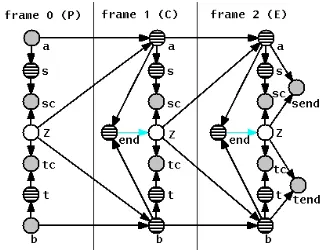
Fig. 1 shows a DBN representation of the memo-ryless context-independent transducer model (sec-tion 2). The graph represents a template which con-sists, in general, of three parts: a prologue, a chunk, and an epilogue. The chunk is repeated as many times as necessary to model sequences of arbitrary length. The product of unrolling the template is a Bayesian Network organized into a given number of
frames. The prologue and the epilogue often differ
from the chunk because they model boundary con-ditions, such as ensuring that the end of both strings is reached at or before the last frame.
Associated with each node is a probability func-tion that maps the node’s parent values to the values the node can take. We will refer to that function as a
3While the Markov Edit Distance introduced in the paper
takes local statistical dependencies into account, the edit costs are still fixed and not corpus-driven.
4The concept of d-separation is useful to read independence
[image:3.612.346.509.54.179.2]relations encoded by the graph (Lauritzen, 1996).
Figure 1: DBN for the memory-less transducer model. Unshaded nodes are hidden nodes with prob-abilistic dependencies with respect to their parents. Nodes with stripes are deterministic hidden nodes, i.e., they take a unique value for each configuration of their parents. Filled nodes are observed (they can be either stochastic or deterministic). The graph template is divided into three frames. The center frame is repeatedm+n−2 times to yield a graph with a total ofm+nframes, the maximum number of edit operations needed to transform sm1 into tn1. Outgoing light edges mean the parent is a switch-ing variable with respect to the child: dependswitch-ing on the value of the switching RV, the child uses different CPTs and/or a different parent set.
conditional probability table (CPT).
Common to all the frames in fig. 1, are position RVs,aandb, which encode the current positions in the source and target strings resp.; source and target symbols,sandt; the hidden edit operation,Z; and consistency nodesscandtc, which enforce the con-sistency constraint discussed in section 2. Because of symmetry we will explain the upper half of the graph involving the source string unless the target half is different. We drop subscripts when the frame number is clear from the context.
In the first frame, a and b are observed to have value 1, the first position in both strings. aand b
determine the value of the symbolssandt. Z takes a random valuehz(s), z(t)i.schas the fixed observed value 1. The only configurations of its parents, Z
ands, that satisfy P(sc= 1|s, z)>0are such that (Z(s)=s) or (Z(s)=andZ6=h, i). This is the consistency constraint in equation 2.
In the following frame, the position RV a2
de-pends on a1 and Z1. If Z1 is an insertion (i.e.
not output), then a2 retains the same value as a1;
otherwisea2is incremented by1to point to the next
symbol in the source string.
The endRV is an indicator of when we are past the end of both source and target strings (a > mand
b > n). endis also a switching parent ofZ; when
end = 0, the CPT of Z is the same as described above: a distribution over edit operations. When
end= 1, Z takes, with probability 1, a fixed value outside the range of edit operations but consistent withsandt. This ensures 1) no “null” state (h, i) is required to fill in the value of Z until the end of the graph is reached; our likelihoods and model parameters therefore do not become dependent on the amount of “null” padding; and 2) no probability mass is taken from the other states ofZas is the case with the special termination symbol # in the original RY model. We found empirically that the use of ei-ther a null or an end state hurts performance to a small but significant degree.
In the last frame, two new nodes make their ap-pearance. sendandtend ensure we are at or past the end of the two strings (the RVendonly checks that we are past the end). That is whysenddepends on bothaandZ. Ifa > m,send(observed to be 1) is 1with probability1. Ifa < m, thenP(send=1) = 0 and the whole sequenceZ1` has zero probability. If
a=m, thensendonly gets probability greater than zero ifZ is not an insertion. This ensures the last source symbol is indeed consumed.
Note that we can obtain the equivalent of the to-tal edit distance cost by using Viterbi inference and adding acostivariable as a deterministic child of the random variableZi: in each frame the cost is equal tocosti−1 plus 0when Zi is an identity, or plus 1 otherwise.
3.2 Context-dependent Model
Adding context dependence in the DBN framework is quite natural. In fig. 2, we add edges from si,
sprevi, andsnexti toZi. Thescnode is no longer required because we can enforce the consistency constraint via the CPT ofZgiven its parents.snexti is an RV whose value is set to the symbol at theai+1 position of the string, i.e.,snexti=sai+1. Likewise,
sprevi=sai−1. The Bahl model (1975) uses a
de-pendency onsionly. Note thatsi−1is not
[image:4.612.344.512.53.173.2]necessar-ily equal tosai−1. Conditioning onsi−1induces an
Figure 2: Context-dependent model.
indirect dependence on whether there was an inser-tion in the previous step becausesi−1=simight be correlated with the eventZi(−s)1=.
3.3 Memory Model
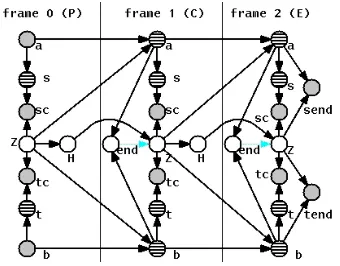
Memory models are another easy extension of the basic model as fig. 3 shows. Depending on whether the variable Hi−1 linking Zi−1 to Zi is stochastic or deterministic, there are several models that can be implemented; for example, a latent factor mem-ory model whenHis stochastic. The cardinality of
H determines how much the information from one frame to the other is “summarized.” With a deter-ministic implementation, we can, for example, spec-ify the usualP(Zi|Zi−1)memory model whenHis
a simple copy ofZ or haveZidepend on the type of edit operation in the previous frame.
Figure 3: Memory model. Depending on the type of
dependency betweenZi and Hi, the model can be
latent variable based or it can implement a deter-ministic dependency on a function ofZi
3.4 Direct Model
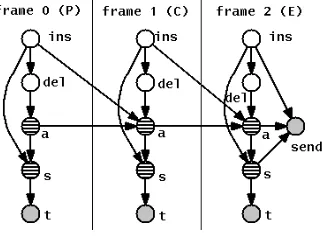
[image:4.612.344.514.430.563.2]to consume a target symbol per frame. To achieve that, we introduce two RVs, ins, with cardinality 2, anddel, with cardinality at mostm. The depen-dency ofdeloninsis to ensure the two events never happen concomitantly. At each frame, a is incre-mented either by the value of del in the case of a (possibly block) deletion or by zero or one depend-ing on whether there was an insertion in the previous frame. An insertion also forcessto take value.
Figure 4: Direct model.
In essence the direct model is not very differ-ent from the context-dependdiffer-ent model in that here too we learn the conditional probabilities P(ti|si) (which are implicit in the CD model).
3.5 Length Model
While this model (fig. 5) is more complex than the previous ones, much of the network structure is “control logic” necessary to simulate variable length-unrolling of the graph template. The key idea is that we have a new stochastic hidden RV,inclen, whose value added to that of the RV inilen deter-mines the number of edit operations we are allowed. A counter variable, counter is used to keep track of the frame number and when the required num-ber is reached, the RVatReqLenis triggered. If at that point we have just reached the end of one of the strings while the end of the other one is reached in this frame or a previous one, then the variableend
is explained (it has positive probability). Otherwise, the entire sequence of edit operations up to that point has zero probability.
4 Pronunciation Classification
In pronunciation classification we are given a
lexi-con, which consists of words and their
correspond-ing canonical pronunciations. We are also provided with surface pronunciations and asked to find the most likely corresponding words. Formally, for each
Figure 5: Length unrolling model.
surface form, tn1, we need to find the set of words ˆ
W s.t. Wˆ =argmaxwP(w|tn1). There are several
ways we could model the probabilityP(w|tn1). One way is to assume a generative model whereby a word
wand a surface pronunciationtn1 are related via an underlying canonical pronunciationsm1 of wand a stochastic process that explains the transformation fromsm1 totn1. This is summarized in equation 3.
C(w)denotes the set of canonical pronunciations of
w. ˆ
W =argmax w
X
sm
1∈C(w)
P(w|sm1 )P(sm1 , tn1) (3)
If we assume uniform probabilities P(w|sm1 ) (sm1 ∈C(w)) and use the max approximation in place of the sum in eq. 3 our classification rule becomes
ˆ
W={w|Sˆ∩C(w)6=∅,Sˆ=argmax sm
1
P(sm1 , tn1)} (4)
It is straightforward to create a DBN to model the joint probabilityP(w, sm1 , tn1)by adding a word RV and a canonical pronunciation RV on top of any of the previous models.
There are other pronunciation classification ap-proaches with various emphases. For example, Rentzepopoulos and Kokkinakis (1996) use HMMs to convert phoneme sequences to their most likely orthographic forms in the absence of a lexicon.
4.1 Data
[image:5.612.107.268.179.304.2]phone. Because of the informal non-scripted nature of the speech and the variety of speakers, the cor-pus presents much variety in word pronunciations, which can significantly deviate from the prototypical pronunciations found in a lexicon. Another source of pronunciation variability is the noise introduced during the annotation of speech segments. Even when the phone labels are mostly accurate, the start and end time information is not as precise and it af-fects how boundary phones get aligned to the word sequence. As a reference pronunciation dictionary we use a lexicon of the 2002 Switchboard speech recognition evaluation. The lexicon contains 40000 entries, but we report results on a reduced dictio-nary5with 5000 entries corresponding to only those words that appear in our train and test sets. Ristad and Yianilos use a few additional lexicons, some of which are corpus-derived. We did reproduce their results on the different types of lexicons.
For testing we randomly divided STP data into 9495 training words (corresponding to 9545 pronun-ciations) and 912 test words (901 pronunpronun-ciations). For the Levenshtein and MCI results only, we per-formed ten-fold cross validation to verify we did not pick a non-representative test set. Our models are implemented using GMTK, a general-purpose DBN tool originally created to explore different speech recognition models (Bilmes and Zweig, 2002). As a sanity check, we also implemented the MCI model in C following RY’s algorithm.
The error rate is computed by calculating, for each pronunciation form, the fraction of words that are correctly hypothesized and averaging over the test set. For example if the classifier returns five words for a given pronunciation, and two of the words are correct, the error rate is 3/5*100%.
Three EM iterations are used for training. Addi-tional iterations overtrained our models.
4.2 Results
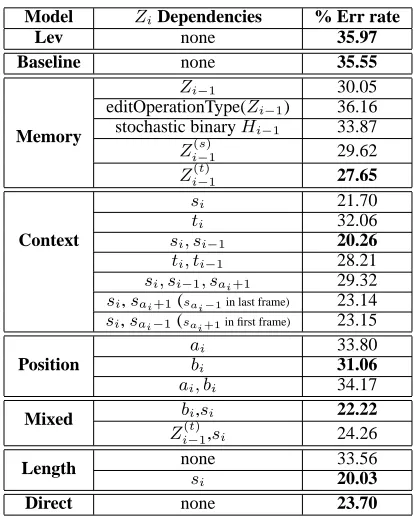
Table 1 summarizes our results using DBN based models. The basic MCI model does marginally bet-ter than the Levenshtein edit distance. This is con-sistent with the finding in RY: their gains come from the joint learning of the probabilitiesP(w|sm
1 ) and
P(sm1 , tn1). Specifically, the word model accounts for much of their gains over the Levenshtein
dis-5Equivalent to the E2 lexicon in RY.
tance. We use uniform priors and the simple classi-fication rule in eq. 4. We feel it is more compelling that we are able to significantly improve upon stan-dard edit distance and the MCI model without using any lexicon or word model.
Memory Models Performance improves with the
addition of a direct dependence ofZi onZi−1. The
biggest improvement (27.65% ER) however comes from conditioning on Zi(−t)1, the target symbol that is hypothesized in the previous step. There was no gain when conditioning on the type of edit operation in the previous frame.
Context Models Interestingly, the exact opposite
from the memory models is happening here when we condition on the source context (versus condi-tioning on the target context). Condicondi-tioning on si gets us to 21.70%. Withsi, si−1 we can further
re-duce the error rate to 20.26%. However, when we add a third dependency, the error rate worsens to 29.32%, which indicates a number of parameters too high for the given amount of training data. Backoff, interpolation, or state clustering might all be appro-priate strategies here.
Position Models Because in the previous
mod-els, when conditioning on the past, boundary condi-tions dictate that we use a different CPT in the first frame, it is fair to wonder whether part of the gain we witness is due to the implicit dependence on the source-target string position. The (small) improve-ment due to conditioning onbiindicates there is such dependence. Also, the fact that the target position is more informative than the source one is likely due to the misalignments we observed in the phonetically transcribed corpus, whereby the first or last phones would incorrectly be aligned with the previous or next word resp. I.e., the model might be learning to not put much faith in the start and end positions of the target string, and thus it boosts deletion and insertion probabilities at those positions. We have also conditioned on coarser-grained positions (be-ginning, middle, and end of string) but obtained the same results as with the fine-grained dependency.
Length Models Modeling length helps to a small
extent when it is added to the MCI and MCD mod-els. Belying the assumption motivating this model, we found that the distribution over the RV inclen
beyond the length of the source string) is skewed to-wards small values ofinclen. This indicates on that insertions are rare when the source string is longer than the target one and vice-versa for deletions.
Direct Model The low error rate obtained by this
model reflects its similarity to the context-dependent model. From the two sets of results, it is clear that source string context plays a crucial role in predict-ing canonical pronunciations from corpus ones. We would expect additional gains from modeling con-text dependencies across time here as well.
Model ZiDependencies % Err rate
Lev none 35.97
Baseline none 35.55
Memory
Zi−1 30.05
editOperationType(Zi−1) 36.16
stochastic binaryHi−1 33.87
Zi(−1s) 29.62
Zi(−1t) 27.65
Context
si 21.70
ti 32.06
si, si−1 20.26
ti, ti−1 28.21
si, si−1, sai+1 29.32
si,sai+1(sai−1in last frame) 23.14 si,sai−1(sai+1in first frame) 23.15
Position
ai 33.80
bi 31.06
ai, bi 34.17
Mixed bi,si 22.22
Z(i−1t),si 24.26
Length none 33.56
si 20.03
[image:7.612.70.277.216.476.2]Direct none 23.70
Table 1: DBN based model results summary.
When we combine the best position-dependent or memory models with the context-dependent one, the error rate decreases (from 31.31% to 25.25% when conditioning on bi andsi; and from 28.28% to 25.75% when conditioning onzi(−t)1andsi) but not to the extent conditioning onsialone decreases error rate. Not shown in table 1, we also tried several other models, which although they are able to produce reasonable alignments (in the sense that the Leven-shtein distance would result in similar alignments) between two given strings, they have extremely poor discriminative ability and result in error rates higher than 90%. One such example is a model in which
Zidepends on bothsiandti. It is easy to see where the problem lies with this model once one considers
that two very different strings might still get a higher likelihood than more similar pair because, givens
andts.t. s6=t, the probability of identity is obvi-ously zero and that of insertion or deletion can be quite high; and when s =t, the probability of in-sertion (or deletion) is still positive. We observe the same non-discriminative behavior when we replace, in the MCI model,Zi with a hidden RVXi, where
Xi takes as values one of the four edit operations.
5 Computational Considerations
The computational complexity of inference in a graphical model is related to the state space of the largest clique (maximal complete subgraph) in the graph. In general, finding the smallest such clique is NP-complete (Arnborg et al., 1987).
In the case of the MCI model, however, it is not difficult to show that the smallest such clique con-tains all the RVs within a frame and the complex-ity of doing inference is orderO(mn·max(m, n)). The reason there is a complexity gap is that the source and target position variables are indexed by the frame number and we do not exploit the fact that even though we arrive at a given source-target position pair along different edit sequence paths at different frames, the position pair is really the same regardless of its frame index. We are investigating generic ways of exploiting this constraint.
In practice, however, state space pruning can sig-nificantly reduce the running time of DBN infer-ence. Ukkonen (1985) reduces the complexity of the classic edit distance toO(d·max(m, n)), wheredis the edit distance. The intuition there is that, assum-ing a small edit distance, the most likely alignments are such that the source position does not diverge too much from the target position. The same intuition holds in our case: if the source and the target posi-tion do not get too far out of sync, then at each step, only a small fraction of them·n possible source-target position configurations need be considered.
The direct model, for example, is quite fast in practice because we can restrict the cardinality of the
6 Conclusion
We have shown how the problem of learning edit distance costs from data can be modeled quite naturally using Dynamic Bayesian Networks even though the problem lacks the temporal or order con-straints that other problems such as speech recog-nition exhibit. This gives us confidence that other important problems such as machine translation can benefit from a Graphical Models perspective. Ma-chine translation presents a fresh set of challenges because of the large combinatorial space of possible alignments between the source string and the target. There are several extensions to this work that we intend to implement or have already obtained pre-liminary results on. One is simple and block trans-position. Another natural extension is modeling edit distance of multiple strings.
It is also evident from the large number of depen-dency structures that were explored that our ing algorithm would benefit from a structure learn-ing procedure. Maximum likelihood optimization might, however, not be appropriate in this case, as exemplified by the failure of some models to dis-criminate between different pronunciations. Dis-criminative methods have been used with significant success in training HMMs. Edit distance learning could benefit from similar methods.
References
S. Arnborg, D. G. Corneil, and A. Proskurowski. 1987. Complexity of finding embeddings in a k-tree. SIAM
J. Algebraic Discrete Methods, 8(2):277–284.
L. R. Bahl and F. Jelinek. 1975. Decoding for channels with insertions, deletions, and substitutions with appli-cations to speech recognition. Trans. on Information
Theory, 21:404–411.
J. Bilmes and C. Bartels. 2003. On triangulating dy-namic graphical models. In Uncertainty in
Artifi-cial Intelligence: Proceedings of the 19th Conference,
pages 47–56. Morgan Kaufmann.
J. Bilmes and G. Zweig. 2002. The Graphical Models Toolkit: An open source software system for speech and time-series processing. Proc. IEEE Intl. Conf. on
Acoustics, Speech, and Signal Processing.
J. J. Godfrey, E. C. Holliman, and J. McDaniel. 1992. SWITCHBOARD: Telephone speech corpus for re-search and development. In ICASSP, volume 1, pages 517–520.
S. Greenberg, J. Hollenback, and D. Ellis. 1996. Insights into spoken language gleaned from phonetic transcrip-tion of the switchboard corpus. In ICSLP, pages S24– 27.
P. N. Klein. 1998. Computing the edit-distance between unrooted ordered trees. In Proceedings of 6th Annual
European Symposium, number 1461, pages 91–102.
S.L. Lauritzen. 1996. Graphical Models. Oxford Sci-ence Publications.
G. Leusch, N. Ueffing, and H. Ney. 2003. A novel string-to-string distance measure with applications to machine translation evaluation. In Machine
Transla-tion Summit IX, pages 240–247.
V. Levenshtein. 1966. Binary codes capable of cor-recting deletions, insertions and reversals. Sov. Phys.
Dokl., 10:707–710.
R. Lowrance and R. A. Wagner. 1975. An extension to the string-to-string correction problem. J. ACM,
22(2):177–183.
M. Mohri. 2002. Edit-distance of weighted automata. In CIAA, volume 2608 of Lecture Notes in Computer
Science, pages 1–23. Springer.
K. Murphy. 2002. Dynamic Bayesian Networks:
Repre-sentation, Inference and Learning. Ph.D. thesis, U.C.
Berkeley, Dept. of EECS, CS Division.
R. Myers, R.C. Wison, and E.R. Hancock. 2000. Bayesian graph edit distance. IEEE Trans. on Pattern
Analysis and Machine Intelligence, 22:628–635.
M. Neuhaus and H. Bunke. 2004. A probabilistic ap-proach to learning costs for graph edit distance. In
ICPR, volume 3, pages 389–393.
P. A. Rentzepopoulos and G. K. Kokkinakis. 1996. Ef-ficient multilingual phoneme-to-grapheme conversion based on hmm. Comput. Linguist., 22(3):351–376.
E. S. Ristad and P. N. Yianilos. 1998. Learning string edit distance. Trans. on Pattern Recognition and
Ma-chine Intelligence, 20(5):522–532.
D. Shapira and J. A. Storer. 2003. Large edit distance with multiple block operations. In SPIRE, volume 2857 of Lecture Notes in Computer Science, pages 369–377. Springer.
E. Ukkonen. 1985. Algorithms for approximate string matching. Inf. Control, 64(1-3):100–118.
R. A. Wagner and M. J. Fischer. 1974. The string-to-string correction problem. J. ACM, 21(1):168–173.
J. Wei. 2004. Markov edit distance. Trans. on Pattern