A Multi-Domain Translation Model Framework
for Statistical Machine Translation
Rico Sennrich
Institute of Computational Linguistics University of Zurich
Binzm¨uhlestr. 14 CH-8050 Z¨urich [email protected]
Holger Schwenk and Walid Aransa
LIUM, University of Le Mans 72085 Le Mans cedex 9, France [email protected]
Abstract
While domain adaptation techniques for SMT have proven to be effective at im-proving translation quality, their practical-ity for a multi-domain environment is of-ten limited because of the computational and human costs of developing and main-taining multiple systems adapted to differ-ent domains. We presdiffer-ent an architecture that delays the computation of translation model features until decoding, allowing for the application of mixture-modeling techniques at decoding time. We also de-scribe a method for unsupervised adapta-tion with development and test data from multiple domains. Experimental results on two language pairs demonstrate the effec-tiveness of both our translation model ar-chitecture and automatic clustering, with gains of up to 1 BLEUover unadapted
sys-tems and single-domain adaptation.
1 Introduction
The effectiveness of domain adaptation ap-proaches such as mixture-modeling (Foster and Kuhn, 2007) has been established, and has led to research on a wide array of adaptation techniques in SMT, for instance (Matsoukas et al., 2009; Shah et al., 2012). In all these approaches, adaptation is performed during model training, with respect to a representative development corpus, and the mod-els are kept unchanged when then system is de-ployed. Therefore, when working with multiple and/or unlabelled domains, domain adaptation is often impractical for a number of reasons. Firstly, maintaining multiple systems for each language pair, each adapted to a different domain, is costly
in terms of computational and human resources: the full system development pipeline needs to be performed for all identified domains, all the mod-els are separately stored and need to be switched at runtime. This is impractical in many real applica-tions, in particular a web translation service which is faced with texts coming from many different do-mains. Secondly, domain adaptation bears a risk of performance loss. If there is a mismatch be-tween the domain of the development set and the test set, domain adaptation can potentially harm performance compared to an unadapted baseline.
We introduce a translation model architecture that delays the computation of features to the de-coding phase. The calculation is based on a vec-tor of component models, with each component providing the sufficient statistics necessary for the computation of the features. With this framework, adaptation to a new domain simply consists of up-dating a weight vector, and multiple domains can be supported by the same system.
We also present a clustering approach for un-supervised adaptation in a multi-domain environ-ment. In the development phase, a set of develop-ment data is clustered, and the models are adapted to each cluster. For each sentence that is being decoded, we choose the weight vector that is op-timized on the closest cluster, allowing for adap-tation even with unlabelled and heterogeneous test data.
2 Related Work
(Ortiz-Mart´ınez et al., 2010) delay the compu-tation of translation model features for the pur-pose of interactive machine translation with online training. The main difference to our approach is that we store sufficient statistics not for a single model, but a vector of models, which allows us to
weight the contribution of each component model to the feature calculation. The similarity suggests that our framework could also be used for inter-active learning, with the ability to learn a model incrementally from user feedback, and weight it differently than the static models, opening new re-search opportunities.
(Sennrich, 2012b) perform instance weighting of translation models, based on the sufficient statistics. Our framework implements this idea, with the main difference that the actual combina-tion is delayed until decoding, to support adapta-tion to multiple domains in a single system.
(Razmara et al., 2012) describe an ensemble de-coding framework which combines several trans-lation models in the decoding step. Our work is similar to theirs in that the combination is done at runtime, but we also delay the computation of translation model probabilities, and thus have ac-cess to richer sufficient statistics. In principle, our architecture can support all mixture operations that (Razmara et al., 2012) describe, plus addi-tional ones such as forms of instance weighting, which are not possible after the translation proba-bilities have been computed.
(Banerjee et al., 2010) focus on the problem of domain identification in a multi-domain setting. They use separate translation systems for each do-main, and a supervised setting, whereas we aim for a system that integrates support for multiple domains, with or without supervision.
(Yamamoto and Sumita, 2007) propose unsu-pervised clustering at both training and decoding time. The training text is divided into a number of clusters, a model is trained on each, and during decoding, each sentence is assigned to the clos-est cluster-specific model. Our approach bears re-semblance to this clustering, but is different in that Yamamoto and Sumita assign each sentence to the closest model, and use this model for decoding, whereas in our approach, each cluster is associ-ated with a mixture of models that is optimized to the cluster, and the number of clusters need not be equal to the number of component models.
3 Translation Model Architecture
This section covers the architecture of the multi-domain translation model framework. Our transla-tion model is embedded in a log-linear model as is common for SMT, and treated as a single transla-tion model in this log-linear combinatransla-tion. We
im-plemented this architecture for phrase-based mod-els, and will use this terminology to describe it, but in principle, it can be extended to hierarchical or syntactic models.
The architecture has two goals: move the calcu-lation of transcalcu-lation model features to the decoding phase, and allow for multiple knowledge sources (e.g. bitexts or user-provided data) to contribute to their calculation. Our immediate purpose for this paper is domain adaptation in a multi-domain en-vironment, but the delay of the feature computa-tion has other potential applicacomputa-tions, e.g. in inter-active MT.
We are concerned with calculating four features during decoding, henceforth just referred to as the translation model features:p(s|t),lex(s|t),p(t|s) andlex(t|s). sandtdenote the source and target phrase. We follow the definitions in (Koehn et al., 2003).
Traditionally, the phrase translation probabili-ties p(s|t) and p(t|s) are estimated through un-smoothed maximum likelihood estimation (MLE).
p(x|y) = c(x, y) c(y) =
c(x, y)
P
x0c(x0, y) (1)
wherecdenotes the count of an observation, and pthe model probability.
The lexical weights lex(s|t) and lex(t|s) are calculated as follows, using a set of word align-mentsabetweensandt:1
lex(s|t, a) = n
Y
i=1
1
|{j|(i, j)∈a}|
X
∀(i,j)∈a
w(si|tj)
(2) A special NULL token is added totand aligned to each unaligned word in s. w(si|tj)is calculated through MLE, as in equation 1, but based on the word (pair) frequencies.
To combine statistics from a vector of n com-ponent corpora, we can use a weighted version of equation 1, which adds a weight vectorλof length n(Sennrich, 2012b):
p(x|y;λ) =
Pn
i=1λici(x, y)
Pn i=1
P
x0λici(x0, y) (3) The word translation probabilitiesw(ti|sj)are de-fined analogously, and used in equation 2 for a weighted version.
In order to compute the translation model fea-tures online, a number of sufficient statistics need to be accessible at decoding time. For p(s|t) andp(t|s), we require the statisticsc(s),c(t)and c(s, t). For accessing them during decoding, we simply store them in the decoder’s data struc-ture, rather than storing pre-computed translation model features. This means that we can use exist-ing, compact data formats for storing and access-ing them.2
The statistics are accessed when the decoder collects all translation options for a phrasesin the source sentence. We then access all translation op-tions for each component table, obtaining a vector of statisticsc(s)for the source phrase, andc(t)and c(s, t)for each potential target phrase. For phrase pairs which are not found,c(s, t)andc(t)are ini-tially set to 0.
Note that c(t) is potentially incorrect at this point, since a phrase pair not being found does not entail thatc(t)is 0. After all tables have been accessed, and we thus know the full set of possi-ble translation options(s, t), we perform a second round of lookups for allc(t) in the vector which are still set to 0. We introduce a second table for accessingc(t)efficiently, again storing it in the de-coder’s data structure. We can easily create such a table by inverting the source and target phrases, deduplicating it for compactness (we only need one entry per target phrase), and storing c(t) as only feature.
For lex(s|t), we require an alignment a, plus c(tj)andc(si, tj)for all pairs(i, j)ina.lex(t|s) can be based on the same alignmenta(with the ex-ception of NULL alignments, which can be added online), but uses statisticsc(sj)andc(ti, sj). For estimating the lexical probabilities, we load the frequencies into a vector of four hash tables.3
Both space and time complexity of the lookup is linear to the number of component tables. We deem it is still practical because the collection of translation options is typically only a small frac-tion of total decoding time, with search making up the largest part. For storing and accessing the sufficient statistics (except for the word (pair) fre-quencies), we use an on-disk data structure
pro-2We have released an implementation of the architecture as part of the Moses decoder.
3c(s, t) and c(t, s) are not identical since the lexical probabilities are based on the unsymmetrized word align-ment frequencies (in the Moses implealign-mentation which we re-implement).
phrase (pair) c1(x) c2(x)
row 300 80
(row, Zeile) 240 20
(row, Reihe) 60 60
λ p(Zeile|row) p(Reihe|row)
(1, 1) 0.68 0.32
(1, 10) 0.40 0.60
[image:3.595.312.521.62.174.2](10, 1) 0.79 0.21
Table 1: Illustration of instance weighting with weight vectors for two corpora.
vided by Moses, which reduces the memory re-quirements. Still, the number of components may need to be reduced, for instance through clustering of training data (Sennrich, 2012a).
With a small modification, our framework could be changed to use a single table that stores a vec-tor of nstatistics instead of a vector of ntables. While this would be more compact in terms of memory, and keep the number of table lookups in-dependent of the number of components, we chose a vector ofntables for its flexibility. With a vec-tor of tables, tables can be quickly added to or re-moved from the system (conceivable even at run-time), and can be polymorph. One applications where this could be desirable is interactive ma-chine translation, where one could work with a mix of compact, static tables, and tables designed to be incrementally trainable.
In the unweighted variant, the resulting fea-tures are equivalent to training on the concatena-tion of all training data, excepting differences in word alignment, pruning4 and rounding. The
ar-chitecture can thus be used as a drop-in replace-ment for a baseline system that is trained on con-catenated training data, with non-uniform weights only being used for texts for which better weights have been established. This can be done either us-ing domain labels or unsupervised methods as de-scribed in the next section.
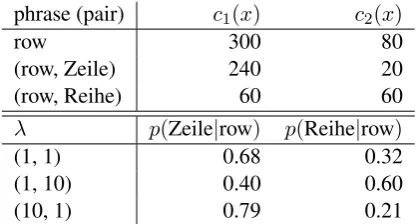
As a weighted combination method, we imple-mented instance weighting as described in equa-tion 3. Table 1 shows the effect of weighting two corpora on the probability estimates for the trans-lation ofrow. GermanZeile(row in a table) is pre-dominant in a bitext from the domain IT, whereas
0 1 2 3 4 5 6 0
1 2 3 4 5 6
entropy with KDE LM (IT)
entrop
y
with
Acquis
LM
(LEGAL)
gold clusters
0 1 2 3 4 5 6
0 1 2 3 4 5 6
entropy with KDE LM (IT)
entrop
y
with
Acquis
LM
(LEGAL)
clustering with Euclidean distance
0 1 2 3 4 5 6
0 1 2 3 4 5 6
entropy with KDE LM (IT)
entrop
y
with
Acquis
LM
(LEGAL)
[image:4.595.81.519.64.191.2]clustering with cosine similarity
Figure 1: Clustering of data set which contains sentences from two domains: LEGAL and IT. Compari-son between gold segmentation, and clustering with two alternative distance/similarity measures. Black: IT; grey: LEGAL.
Reihe(line of objects) occurs more often in a legal corpus. Note that the larger corpus (or more pre-cisely, the one in which row occurs more often) has a stronger impact on the probability distribu-tion with uniform weights (or in a concatenadistribu-tion of data sets). Instance weighting allows us to modify the contribution of each corpus. In our implemen-tation, the weight vector is set globally, but can be overridden on a per-sentence basis. In principle, using different weight vectors for different phrase pairs in a sentence is conceivable. The framework can also be extended to support other combination methods, such as a linear interpolation of models.
4 Unsupervised Clustering for Online Translation Model Adaptation
The framework supports decoding each sentence with a separate weight vector of size4n, 4 being the number of translation model features whose computation can be weighted, andn the number of model components. We now address the ques-tion of how to automatically select good weights in a multi-domain task. As a way of optimizing in-stance weights, (Sennrich, 2012b) minimize trans-lation model perplexity on a set of phrase pairs, automatically extracted from a parallel develop-ment set. We follow this technique, but want to have multiple weight vectors, adapted to different texts, between which the system switches at de-coding time. The goal is to perform domain adap-tation without requiring domain labels or user in-put, neither for development nor decoding.
The basic idea consists of three steps:
1. Cluster a development set intokclusters.
2. Optimize translation model weights for each
cluster.
3. For each sentence in the test set, assign it to the nearest cluster and use the translation model weights associated with the cluster. For step 2, we use the algorithm by (Sennrich, 2012b), implemented in the decoder to allow for a quick optimization of a running system. We will here discuss steps 1 and 3 in more detail.
4.1 Clustering the Development Set
We usek-means clustering to cluster the sentences of the development set. We train a language model on the source language side of each of the n component bitexts, and compute ann-dimensional vector for each sentence by computing its entropy with each language model. Our aim is not to dis-criminate between sentences that are more likely and unlikely in general, but to cluster on the ba-sis of relative differences between the language model entropies. For this purpose, we choose the cosine as our similarity measure. Figure 1 illustrates clustering in a two-dimensional vector space, and demonstrates that Euclidean distance is unsuitable because it may perform a clustering that is irrelevant to our purposes.
As a result of development set clustering, we obtain a bitext for each cluster, which we use to optimize the model weights, and a centroid per cluster. At decoding time, we need only perform an assignment step. Each test set sentence is as-signed to the centroid that is closest to it in the vector space.
4.2 Scalability Considerations
a different domain than the development data, or if the development data is a heterogeneous mix of domains. A multi-domain setup can mitigate this risk, but only if the relevant domain is repre-sented in the development data, and if the devel-opment data is adequately segmented for the op-timization. We thus suggest that the development data should contain enough data from all domains that one wants to adapt to, and a high number of clusters.
While the resource requirements increase with the number of component models, increasing the number of clusters is computationally cheap at runtime. Only the clustering of the develop-ment set and optimization of the translation model weights for each clusters is affected by k. This means that the approach can in principle be scaled to a high number of clusters, and support a high number of domains.5
The biggest risk of increasing the number of clusters is that if the clusters become too small, perplexity minimization may overfit these small clusters. We will experiment with different num-bers of clusters, but since we expect the optimal number of clusters to depend on the amount of development data, and the number of domains, we cannot make generalized statements about the ideal number ofk.
While it is not the focus of this paper, we also evaluate language model adaptation. We perform a linear interpolation of models for each clter, with interpolation coefficients optimized us-ing perplexity minimization on the development set. The cost of moving language model interpo-lation into the decoding phase is far greater than for translation models, since the number of hy-potheses that need to be evaluated by the language model is several orders of magnitudes higher than the number of phrase pairs used during the trans-lation. For the experiments with language model adaptation, we have chosen to perform linear in-terpolation offline, and perform language model switching during decoding. While model switch-ing is a fast operation, it also makes the space com-plexity of storing the language models linear to the number of clusters. For scaling the approach to a high number of clusters, we envision that
multi-5If the development set is labelled, one can also use a gold segmentation of development sets instead ofk-means cluster-ing. At decoding time, cluster assignment can be performed by automatically assigning each sentence to the closest cen-troid, or again through gold labels, if available.
data set sentences words (de)
kde 216 000 1 990 000
kdedoc 2880 41 000
kdegb 51 300 450 000
oo 41 000 434 000
oo3 56 800 432 000
php 38 500 301 000
tm 146 000 2 740 000
acquis 2 660 000 58 900 000
dgt 372 000 8 770 000
ecb 110 000 2 850 000
ep7 1 920 000 50 500 000
nc7 159 000 3 950 000
total (train) 5 780 000 131 000 000
dev (IT) 3500 47 000
dev (LEGAL) 2000 46 800
test (IT) 5520 51 800
[image:5.595.321.510.60.307.2]test (LEGAL) 9780 250 000
Table 2: Parallel data sets English–German.
data set sentences words (en) eu 1 270 000 25 600 000 fiction 830 000 13 700 000 navajo 30 000 490 000 news 110 000 2 550 000 paraweb 370 000 3 930 000 subtitles 2 840 000 21 200 000 techdoc 970 000 7 270 000 total (train) 6 420 000 74 700 000
dev 3500 50 700
test 3500 49 600
Table 3: Parallel data sets Czech–English.
pass decoding, with an unadapted language model in the first phase, and rescoring with a language model adapted online, could perform adequately, and keep the complexity independent of the num-ber of clusters.
5 Evaluation
5.1 Data and Methods
[image:5.595.327.504.342.492.2]system TM adaptation LM adaptation TM+LM adaptation
IT LEGAL IT LEGAL IT LEGAL
baseline 21.1 49.9 21.1 49.9 21.1 49.9
[image:6.595.118.480.63.184.2]1 cluster (no split) 21.3* 49.9 21.8* 49.7 21.8* 49.8 2 clusters 21.6* 49.9 22.2* 50.4* 22.8* 50.2* 4 clusters 21.7* 49.9 23.1* 50.2* 22.6* 50.2* 8 clusters 22.1* 49.9 23.1* 50.1* 22.7* 50.3* 16 clusters 21.1 49.9 22.6* 50.3* 21.9* 50.1* gold clusters 21.8* 50.1* 22.4* 50.1* 23.2* 49.9
Table 4: Translation experiments EN–DE. BLEUscores reported.
al., 2002). We account for optimizer instability by running 3 independent MERT runs per system, and performing significance testing with MultEval (Clark et al., 2011). Systems significantly better than the baseline withp < 0.01are marked with (*).
We conduct experiments on two data sets. The first is an English–German translation task with two domains, texts related to information technol-ogy (IT) and legal documents (LEGAL). We use data sets from both domains, plus out-of-domain corpora, as shown in table 2. 7 data sets come from the domain IT: 6 from OPUS (Tiedemann, 2009) and a translation memory (tm) provided by our in-dustry partner. 3 data sets are from the legal do-main: the ECB corpus from OPUS, plus the JRC-Acquis (Steinberger et al., 2006) and DGT-TM (Steinberger et al., 2012). 2 data sets are out-of-domain, made available by the 2012 Workshop on Statistical Machine Translation (Callison-Burch et al., 2012). The development sets are random sam-ples from the respective in-domain bitexts (held-out from training). The test sets have been pro-vided by Translated, our industry partner in the MATECATproject.
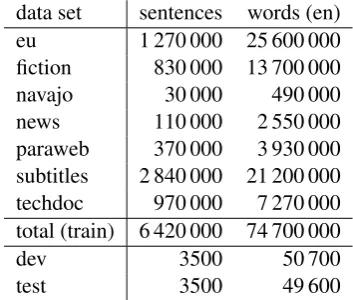
Our second data set is CzEng 0.9, a Czech– English parallel corpus (Bojar and Zabokrtsk´y, 2009). It contains text from 7 different sources, on which we train separate component models. The size of the corpora is shown in table 3. As de-velopment and test sets, we use 500 sentences of held-out data per source.
For both data sets, language models are trained on the target side of the bitexts. In all experiments, we keep the number of component models con-stant: 12 for EN–DE, 7 for CZ–EN. We vary the number of clusterskfrom 1, which corresponds to adapting the models to the full development set, to 16. The baseline is the concatenation of all
train-Data set λIT λLEGAL λcluster 1 λcluster 2
kde 1.0 1.0 1.0 1.0
kdedoc 0.64 12.0 86.0 6.4
kdegb 1.6 2.3 1.7 2.7
oo 0.76 1.6 0.73 1.7
oo3 1.8 4.7 2.4 2.7
php 0.79 6.3 0.69 3.5
tm 1.3 1.3 1.5 1.1
acquis 0.024 3.5 0.018 1.9
dgt 0.053 4.5 0.033 2.4
ecb 0.071 2.3 0.039 1.2
ep7 0.037 0.53 0.024 0.29
[image:6.595.310.529.226.401.2]nc7 0.1 1.1 0.063 0.62
Table 5: Weight vectors for feature p(t|s) opti-mized on four development sets (from gold split and clustering withk= 2).
ing data, with no adaptation performed. We also evaluate the labelled setting, where instead of un-supervised clustering, we use gold labels to split the development and test sets, and adapt the mod-els to each labelled domain.
5.2 Results
system TM adaptation LM adaptation TM+LM adaptation
baseline 34.4 34.4 34.4
1 cluster (no split) 34.5 33.7 34.1
2 clusters 34.6 34.0 34.4
4 clusters 34.7* 34.3 34.6
8 clusters 34.7* 34.5 34.9*
16 clusters 34.7* 34.7* 35.0*
[image:7.595.128.473.63.173.2]gold clusters 35.0* 35.0* 35.4*
Table 6: Translation experiments CZ–EN. BLEUscores reported.
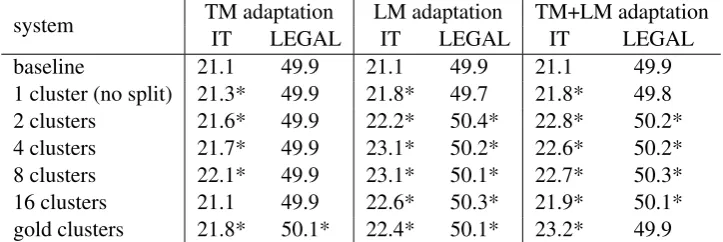
We find that an adaptation of the TM and LM to the full development set (system “1 cluster”) yields the smallest improvements over the un-adapted baseline. The reason for this is that the mixed-domain development set is not representa-tive for the respecrepresenta-tive test sets. Using multiple adapted systems yields better performance. For the IT test set, the system with gold labels and TM adaptation yields an improvement of 0.7 BLEU
(21.1 → 21.8), LM adaptation yields 1.3 BLEU
(21.1→ 22.4), and adapting both models outper-forms the baseline by 2.1 BLEU (21.1 → 23.2).
The systems that use unsupervised clusters reach a similar level of performance than those with gold clusters, with best results being achieved by the systems with 2–8 clusters. Some sys-tems outperform both the baseline and the gold clusters, e.g. TM adaptation with 8 clusters (21.1 → 21.8→ 22.1), or LM adaptation with 4 or 8 clusters (21.1→22.4→23.1).
Results with 16 clusters are slightly worse than those with 2–8 clusters due to two effects. Firstly, for the system with adapted TM, one of the three MERT runs is an outlier, and the reported BLEU
score of 21.1 is averaged from the three MERT runs achieving 22.1, 21.6, and 19.6 BLEU,
respec-tively. Secondly, about one third of the IT test set is assigned to a cluster that is not IT-specific, which weakens the effect of domain adaptation for the systems with 16 clusters.
For the LEGAL subset, gains are smaller. This can be explained by the fact that the majority of training data is already from the legal domain, which makes it unnecessary to boost its impact on the probability distribution even further.
Table 5 shows the automatically obtained trans-lation model weight vectors for two systems, “gold clusters” and “2 clusters”, for the feature p(t|s). It illustrates that all the corpora that we consider out-of-domain for IT are penalized by
a factor of 10–50 (relative to the in-domain kde
corpus) for the computation of this feature. For the LEGAL domain, the weights are more uni-form, which is congruent with our observation that BLEUchanges little.
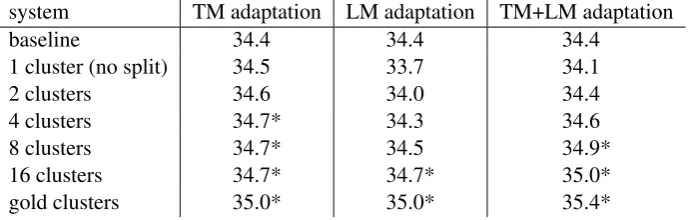
Table 6 shows results for the CZ–EN data set. For each system, MERT is performed on the full development set. As in the first task, adaptation to the full development set is least effective. The sys-tems with unsupervised clusters significantly out-perform the baseline. For the system with 16 clus-ters, we observe an improvement of 0.3 BLEUfor
TM adaptation, and 0.6 BLEU for adapting both
models (34.4→ 34.7→ 35.0). The labelled
sys-tem, i.e. the system with 7 clusters corresponding to the 7 data sources, both for the development and test set, performs best. We observe gains of 0.6 BLEU (34.4 → 35.0) for TM or LM adaptation, and 1 BLEU(34.4→35.4) when both models are adapted.
We conclude that the translation model archi-tecture is effective in a multi-domain setting, both with unsupervised clusters and labelled domains. The fact that language model adaptation yields an additional improvement in our experiments sug-gests that it it would be worthwhile to also inves-tigate a language model data structure that effi-ciently supports multiple domains.
6 Conclusion
imple-ment a multi-domain translation system. If avail-able, one can also use the architecture in a labelled setting.
Future work could involve merging our trans-lation model framework with the online adapta-tion of other models, or the log-linear weights. Our approach is orthogonal to that of (Clark et al., 2012), who perform feature augmentation to obtain multiple sets of adapted log-linear weights. While (Clark et al., 2012) use labelled data, their approach could in principle also be applied after unsupervised clustering.
The translation model framework could also serve as the basis of real-time adaptation of trans-lation systems, e.g. by using incremental means to update the weight vector, or having an incremen-tally trainable component model that learns from the post-edits by the user, and is assigned a suit-able weight.
Acknowledgments
This research was partially funded by the Swiss National Science Foundation under grant 105215 126999, the European Commission (MATECAT, ICT-2011.4.2 287688) and the
DARPA BOLT project.
References
Pratyush Banerjee, Jinhua Du, Baoli Li, Sudip Kumar Naskar, Andy Way, and Josef Van Genabith. 2010. Combining multi-domain statistical machine trans-lation models using automatic classifiers. In 9th Conference of the Association for Machine
Trans-lation in the Americas (AMTA 2010), Denver,
Col-orado, USA.
Ondrej Bojar and Zdenek Zabokrtsk´y. 2009. Czeng 0.9: Large parallel treebank with rich annotation.
Prague Bull. Math. Linguistics, 92:63–84.
Chris Callison-Burch, Philipp Koehn, Christof Monz, Matt Post, Radu Soricut, and Lucia Specia. 2012. Findings of the 2012 workshop on statistical ma-chine translation. In Proceedings of the Seventh
Workshop on Statistical Machine Translation, pages
10–51, Montr´eal, Canada, June. Association for Computational Linguistics.
Jonathan H. Clark, Chris Dyer, Alon Lavie, and Noah A. Smith. 2011. Better hypothesis testing for statistical machine translation: Controlling for op-timizer instability. InProceedings of the 49th An-nual Meeting of the Association for Computational
Linguistics: Human Language Technologies, pages
176–181, Portland, Oregon, USA, June. Association for Computational Linguistics.
Jonathan H. Clark, Alon Lavie, and Chris Dyer. 2012. One system, many domains: Open-domain statisti-cal machine translation via feature augmentation. In
Conference of the Association for Machine
Transla-tion in the Americas 2012 (AMTA 2012), San Diego,
California, USA.
George Foster and Roland Kuhn. 2007. Mixture-model adaptation for SMT. In Proceedings of the Second Workshop on Statistical Machine Transla-tion, StatMT ’07, pages 128–135, Prague, Czech Republic. Association for Computational Linguis-tics.
Philipp Koehn, Franz Josef Och, and Daniel Marcu. 2003. Statistical phrase-based translation. In
NAACL ’03: Proceedings of the 2003 Conference of the North American Chapter of the Association for Computational Linguistics on Human Language
Technology, pages 48–54, Edmonton, Canada.
As-sociation for Computational Linguistics.
Philipp Koehn, Hieu Hoang, Alexandra Birch, Chris Callison-Burch, Marcello Federico, Nicola Bertoldi, Brooke Cowan, Wade Shen, Christine Moran, Richard Zens, Chris Dyer, Ondˇrej Bojar, Alexandra Constantin, and Evan Herbst. 2007. Moses: Open Source Toolkit for Statistical Machine Translation.
InACL 2007, Proceedings of the 45th Annual
Meet-ing of the Association for Computational LMeet-inguis- Linguis-tics Companion Volume Proceedings of the Demo
and Poster Sessions, pages 177–180, Prague, Czech
Republic, June. Association for Computational Lin-guistics.
Spyros Matsoukas, Antti-Veikko I. Rosti, and Bing Zhang. 2009. Discriminative corpus weight estima-tion for machine translaestima-tion. InProceedings of the 2009 Conference on Empirical Methods in Natural
Language Processing: Volume 2 - Volume 2, pages
708–717, Singapore. Association for Computational Linguistics.
Franz Josef Och and Hermann Ney. 2003. A sys-tematic comparison of various statistical alignment models. Computational Linguistics, 29(1):19–51.
Daniel Ortiz-Mart´ınez, Ismael Garc´ıa-Varea, and Fran-cisco Casacuberta. 2010. Online learning for in-teractive statistical machine translation. In
HLT-NAACL, pages 546–554. The Association for
Com-putational Linguistics.
Kishore Papineni, Salim Roukos, Todd Ward, and Wei-Jing Zhu. 2002. Bleu: A method for automatic evaluation of machine translation. InACL ’02: Pro-ceedings of the 40th Annual Meeting on
Associa-tion for ComputaAssocia-tional Linguistics, pages 311–318,
Philadelphia, Pennsylvania, USA. Association for Computational Linguistics.
Proceedings of the 50th Annual Meeting of the
As-sociation for Computational Linguistics, Jeju,
Re-public of Korea. Association for Computational Lin-guistics.
Rico Sennrich. 2012a. Mixture-modeling with unsu-pervised clusters for domain adaptation in statistical machine translation. In16th Annual Conference of the European Association for Machine Translation
(EAMT 2012), pages 185–192, Trento, Italy.
Rico Sennrich. 2012b. Perplexity minimization for translation model domain adaptation in statistical machine translation. In Proceedings of the 13th Conference of the European Chapter of the
Asso-ciation for Computational Linguistics, pages 539–
549, Avignon, France. Association for Computa-tional Linguistics.
Kashif Shah, Loc Barrault, and Holger Schwenk. 2012. A general framework to weight heteroge-neous parallel data for model adaptation in statistical machine translation. InConference of the Associa-tion for Machine TranslaAssocia-tion in the Americas 2012
(AMTA 2012), San Diego, California, USA.
Ralf Steinberger, Bruno Pouliquen, Anna Widiger, Camelia Ignat, Tomaz Erjavec, Dan Tufis, and Daniel Varga. 2006. The JRC-Acquis: A multilin-gual aligned parallel corpus with 20+ languages. In
Proceedings of the 5th International Conference on
Language Resources and Evaluation (LREC’2006),
Genoa, Italy.
Ralf Steinberger, Andreas Eisele, Szymon Klocek, Spyridon Pilos, and Patrick Schl¨uter. 2012. DGT-TM: A freely available translation memory in 22 lan-guages. InProceedings of the Eight International Conference on Language Resources and Evaluation
(LREC’12), Istanbul, Turkey. European Language
Resources Association (ELRA).
Andreas Stolcke. 2002. SRILM – An Extensible Lan-guage Modeling Toolkit. In Seventh International
Conference on Spoken Language Processing, pages
901–904, Denver, CO, USA.
J¨org Tiedemann. 2009. News from OPUS - a col-lection of multilingual parallel corpora with tools and interfaces. In N. Nicolov, K. Bontcheva, G. Angelova, and R. Mitkov, editors, Recent
Advances in Natural Language Processing,
vol-ume V, pages 237–248. John Benjamins, Amster-dam/Philadelphia, Borovets, Bulgaria.
Hirofumi Yamamoto and Eiichiro Sumita. 2007. Bilin-gual cluster based models for statistical machine translation. In Proceedings of the 2007 Joint Con-ference on Empirical Methods in Natural Language Processing and Computational Natural Language