Learning to Prune: Context-Sensitive Pruning for Syntactic MT
Wenduan Xu Computer Laboratory University of Cambridge [email protected]
Yue Zhang Singapore University of Technology and Design yue [email protected]
Philip Williams and Philipp Koehn School of Informatics
University of Edinburgh
[email protected] [email protected]
Abstract
We present a context-sensitive chart prun-ing method for CKY-style MT decoding.
Source phrases that are unlikely to have aligned target constituents are identified using sequence labellers learned from the parallel corpus, and speed-up is obtained by pruning corresponding chart cells. The proposed method is easy to implement, or-thogonal to cube pruning and additive to its pruning power. On a full-scale English-to-German experiment with a string-to-tree model, we obtain a speed-up of more than 60% over a strong baseline, with no loss in BLEU.
1 Introduction
Syntactic MT models suffer from decoding effi-ciency bottlenecks introduced by online n-gram
language model integration and high grammar complexity. Various efforts have been devoted to improving decoding efficiency, including hyper-graph rescoring (Heafield et al., 2013; Huang and Chiang, 2007), coarse-to-fine processing (Petrov et al., 2008; Zhang and Gildea, 2008) and gram-mar transformations (Zhang et al., 2006). For more expressive, linguistically-motivated syntac-tic MT models (Galley et al., 2004; Galley et al., 2006), the grammar complexity has grown considerably over hierarchical phrase-based mod-els (Chiang, 2007), and decoding still suffers from efficiency issues (DeNero et al., 2009).
In this paper, we study a chart pruning method for CKY-style MT decoding that is orthogonal to
cube pruning (Chiang, 2007) and additive to its pruning power. The main intuition of our method is to find those source phrases (i.e. any sequence of consecutive words) that are unlikely to have any consistently aligned target counterparts according to the source context and grammar constraints. We show that by using highly-efficient sequence la-belling models learned from the bitext used for translation model training, such phrases can be ef-fectively identified prior to MT decoding, and cor-responding chart cells can be excluded for decod-ing without affectdecod-ing translation quality.
We call our method context-sensitive pruning (CSP); it can be viewed as a bilingual adap-tation of similar methods in monolingual pars-ing (Roark and Hollpars-ingshead, 2008; Zhang et al., 2010) which improve parsing efficiency by “clos-ing” chart cells using binary classifiers. Our con-tribution is that we demonstrate such methods can be applied to synchronous-grammar parsing by la-belling the source-side alone. This is achieved through a novel training scheme where the la-belling models are trained over the word-aligned bitext and gold-standard pruning labels are ob-tained by projecting target-side constituents to the source words. To our knowledge, this is the first work to apply this technique to MT decoding.
The proposed method is easy to implement and effective in practice. Results on a full-scale English-to-German experiment show that it gives more than 60% speed-up over a strong cube prun-ing baseline, with no loss in BLEU. While we use a string-to-tree model in this paper, the approach can be adapted to other syntax-based models.
but we need that reform process . TOP
S-TOP
KON
denn
NP-OA
PDAT
diesen NN
Reformprozeß VVFIN
brauchen NP-SB
PPER
wir PUNC.
.
r1 KON → hbut, denni
r2 NP-SB → hwe, wiri
r3 NP-OA → hthat reform process,
diesen Reformprozeßi r4 TOP → hX1. ,S-TOP1.i
r5 S-TOP → hbutX1needX2,
[image:2.595.338.495.62.150.2]dennNP-OA2brauchenNP-SB1i
Figure 1: A selection of grammar rules extractable from an example word-aligned sentence pair.
2 The Baseline String-to-Tree Model Our baseline translation model uses the rule ex-traction algorithm of Chiang (2007) adapted to a string-to-tree grammar. After extracting phrasal pairs using the standard approach of Koehn et al. (2003), all pairs whose target phrases are not ex-haustively dominated by a constituent of the parse tree are removed and each remaining pair,hf , ei, together with its constituent label,C, forms a
lex-ical grammar rule: C → hf , ei. The rulesr1,r2,
andr3 in Figure 1 are lexical rules. Non-lexical
rules are generated by eliminating one or more pairs of terminal substrings from an existing rule and substituting non-terminals. This process pro-duces the example rulesr4andr5.
Our decoding algorithm is a variant of CKY
and is similar to other algorithms tailored for spe-cific syntactic translation grammars (DeNero et al., 2009; Hopkins and Langmead, 2010). By tak-ing the source-side of each rule, projecttak-ing onto it the non-terminal labels from the target-side, and weighting the grammar according to the model’s local scoring features, decoding is a straightfor-ward extension of monolingual weighted chart parsing. Non-local features, such asn-gram lan-guage model scores, are incorporated through cube pruning (Chiang, 2007).
3 Chart Pruning 3.1 Motivations
The abstract rules and large non-terminal sets of many syntactic MT grammars cause translation
products the of value
NP-TOP NP-AG
NN Produkte ART
der NN Wert
(a) en-de
products the of value
NP NN 価値
NP DEG
の
NN
製品
[image:2.595.69.289.64.254.2](b) en-jp
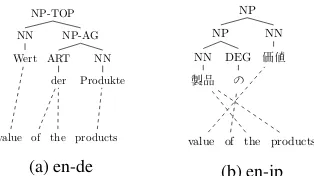
Figure 2: Two example alignments. In (a) “the products” does not have a consistent alignment on the target side, while it does in (b).
overgeneration at the span level and render decod-ing inefficient. Prior work on monoldecod-ingual syn-tactic parsing has demonstrated that by exclud-ing chart cells that are likely to violate constituent constraints, decoding efficiency can be improved with no loss in accuracy (Roark and Hollingshead, 2008). We consider a similar mechanism for syn-tactic MT decoding by prohibiting subtranslation generation for chart cells violating synchronous-grammar constraints.
A motivating example is shown in Figure 2a, where a segment of an English-German sentence pair from the training data, along with its word alignment and target-side parse tree is depicted. The English phrases “value of” and “the products” do not have corresponding German translations in this example. Although the grammar may have rules to translate these two phrases, they can be safely pruned for this particular sentence pair.
In contrast to chart pruning for monolingual parsing, our pruning decisions are based on the source context, its target translation and the map-ping between the two. This distinction is impor-tant since the syntactic correspondence between different language pairs is different. Suppose that we were to translate the same English sentence into Japanese (Figure 2a); unlike the English to German example, the English phrase “the prod-ucts” will be a valid phrase that has a Japanese translation under a target constituent, since it is syntactically aligned to “製品” (Figure 2b).
The key question to consider is how to inject target syntax and word alignment information into our labelling models, so that pruning decisions can be based on the source alone, we address this in the following two sections.
3.2 Pruning by Labelling
1 0 1 1 1 (a)b-tags
1 1 1 0 1
[image:3.595.115.249.60.133.2](b)e-tags
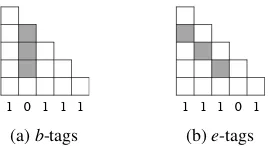
Figure 3: The pruning effects of two types of bi-nary tags. The shaded cells are pruned and two types of tags are assigned independently.
a consistently aligned target constituent. We call these two types the b-tag and the e-tag, respec-tively, and use the set of values{0,1}for both.
Under this scheme, a b-tag value of 1 indi-cates that a source word can be the start of a source phrase that has a consistently aligned target phrase; similarly ane-tag of 0 indicates that a word cannot end a source phrase. If either theb-tag or thee-tag of an input phrase is 0, the correspond-ing chart cells will be pruned. The pruncorrespond-ing effects of the two types of tags are illustrated in Figure 3. In general, 0-valuedb-tags prune a whole column of chart cells and 0-valued e-tags prune a whole diagonal of cells; and the chart cells on the first row and the top-most cell are always kept so that complete translations can always be found.
We build a separate labeller for each tag type us-ing gold-standardb- ande-tags, respectively. We train the labellers with maximum-entropy models (Curran and Clark, 2003; Ratnaparkhi, 1996), us-ing features similar to those used for suppertag-ging for CCG parsing (Clark and Curran, 2004).
In each case, features for a pruning tag consist of word and POSuni-grams extracted from the
5-word window with the current 5-word in the middle,
POStrigrams ending with the current word, as well
as two previous tags as a bigram and two separate uni-grams. Our pruning labellers are highly effi-cient, run in linear time and add little overhead to decoding. During testing, in order to prevent over-pruning, a probability cutoff valueθis used. A tag
value of 0 is assigned to a word only if its marginal probability is greater thanθ.
3.3 Gold-standard Pruning Tags
Gold-standard tags are extracted from the word-aligned bitext used for translation model train-ing, respecting rule extraction constraints, which is crucial for the success of our method.
For each training sentence pair, gold-standard b-tags and e-tags are assigned separately to the
Algorithm 1Gold-standard Labelling Algorithm Input forward alignment Ae∼f, backward
align-mentAˆf∼eand 1-best parse treeτ forf
Output Tag sequencesbandefor e
1: procedureTAG(e,f,τ, A,Aˆ) 2: l← |e|
3: fori←0tol−1do 4: b[i]←0,e[i]←0 5: forf[i0, j0]inτ do
6: s← {Aˆ[k]|k∈[i0, j0]} 7: if|s| ≤1then continue 8: i←min(s),j←max(s) 9: ifCONSISTENT(i, j, i0, j0)then 10: b[i0]←1,e[j0]←1
11: procedureCONSISTENT(i, j, i0, j0) 12: t← {A[k]|k∈[i, j]}
13: returnmin(t)≥i0andmax(t)≤j0
source words. First, we initialize both tags of each source word to 0s. Then, we iterate through all tar-get constituent spans, and for each span, we find its corresponding source phrase, as determined by the word alignment. If a constituent exists for the phrase pair, theb-tag of thefirstword and thee-tag of thelastword in the source phrase are set to 1s, respectively. Pseudocode is shown in Algorithm 1. Note that our definition of the gold-standard al-lows source-side labels to integrate bilingual in-formation. On line 6, the target-side syntax is projected to the source; on line 9, consistency is checked against word alignment.
Consider again the alignment in Figure 2a. Tak-ing the target constituent span coverTak-ing “der Pro-dukte” as an example, the source phrase under a consistent word alignment is “of the products”. Thus, the b-tag of “of” and the e-tag of “prod-ucts” are set to 1s. After considering all target constituent spans, the complete b- and e-tag se-quences for the source-side phrase in Figure 2a are [1,1,0,0] and [0,0,1,1], respectively. Note
that, since we never prune single-word spans, we ignore source phrases under consistent one-to-one or one-to-many alignments.
From the gold standard data, we found73.69%
of the 54M words do not begin a multi-word aligned phrase and 77.71% do not end a
0.146 0.1465 0.147 0.1475 0.148 0.1485 0.149
0 2 4 6 8 10 12 14 16 18 20
BLEU
CPU seconds/sentence csp cube pruning
(a) time vs. BLEU
0.146 0.1465 0.147 0.1475 0.148 0.1485 0.149
0 0.5 1 1.5 2 2.5
BLEU
Hypothesis Count (x106) csp cube pruning
[image:4.595.84.511.64.223.2](b) hypo count vs. BLEU
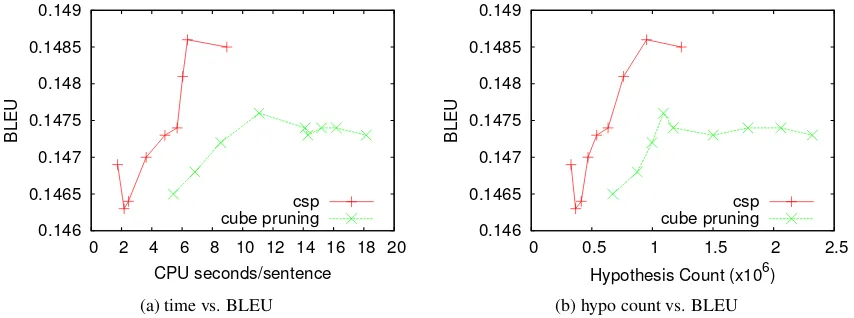
Figure 4: Translation quality comparison with the cube pruning baseline.
4 Experiments 4.1 Setup
A Moses (Koehn et al., 2007) string-to-tree sys-tem is used as our baseline. The training cor-pus consists of the English-German sections of the Europarl (Koehn, 2005) and the News Com-mentary corpus. Discarding pairs without target-side parses, the final training data has 2M sen-tence pairs, with 54M and 52M words on the English and German sides, respectively. Word-alignments are obtained by running GIZA++ (Och and Ney, 2000) in both directions and refined with “grow-diag-final-and” (Koehn et al., 2003). For all experiments, a 5-gram language model with Kneser-Ney smoothing (Chen and Goodman, 1996) built with the SRILM Toolkit (Stolcke and others, 2002) is used.
The development and test sets are the 2008 WMT newstest (2,051 sentences) and 2009 WMT newstest (2,525 sentences) respectively. Feature weights are tuned with MERT (Och, 2003) on the development set and output is evaluated us-ing case-sensitive BLEU (Papineni et al., 2002). For both rule extraction and decoding, up to seven terminal/non-terminal symbols on the source-side are allowed. For decoding, the maximum span-length is restricted to 15, and the grammar is pre-filtered to match the entire test set for both the baseline system and the chart pruning decoder.
We use two labellers to performb- ande-tag la-belling independently prior to decoding. Training of the labelling models is able to complete in un-der 2.5 hours and the whole test set is labelled in under 2 seconds. A standard perceptronPOS
tag-ger (Collins, 2002) trained on Wall Street Journal sections 2-21 of the Penn Treebank is used to
as-signPOStags for both our training and test data.
4.2 Results
Figures 4a and 4b compare CSP with the cube pruning baseline in terms of BLEU. Decoding speed is measured by the average decoding time and average number of hypotheses generated per sentence. We first run the baseline decoder un-der various beam settings (b = 100 - 2500)
un-til no further increase in BLEU is observed. We then run the CSP decoder with a range ofθ val-ues (θ = 0.91−0.99), at the default beam size
of 1000 of the baseline decoder. The CSP
de-coder, which considers far fewer chart cells and generates significantly fewer subtranslations, con-sistently outperforms the slower baseline. It ulti-mately achieves a BLEU score of 14.86 at a proba-bility cutoff value of0.98, slightly higher than the
highest score of the baseline.
At all levels of comparable translation quality, our decoder is faster than the baseline. On aver-age, the speed-up gained is 63.58%as measured
by average decoding time, and comparing on a point-by-point basis, our decoder always runs over
60% faster. At the θ value of 0.98, it yields a
speed-up of57.30%, compared with a beam size of400for the baseline, where both achieved the
highest BLEU.
Figures 5a and 5b demonstrate the pruning power of CSP (θ= 0.95) in comparison with the
baseline (beam size = 300); across all the cutoff
values and beam sizes, the CSP decoder considers 54.92% fewer translation hypotheses on average and the minimal reduction achieved is 46.56%.
0 1 2 3 4 5 6 7
0 20 40 60 80 100 120 140
Hypothesis Count (x10
6 )
Sentence Length csp
cube pruning
(a) sentence length vs. hypo count
0 1000 2000 3000 4000 5000 6000 7000 8000 9000
0 20 40 60 80 100 120 140
Chart Cell Count
Sentence Length csp
cube pruning
[image:5.595.94.510.64.213.2](b) sentence length vs. cell count
Figure 5: Search space comparison with the cube pruning baseline.
0 10 20 30 40 50 60
0 20 40 60 80 100 120
Percentage Pruned (%)
Span Length
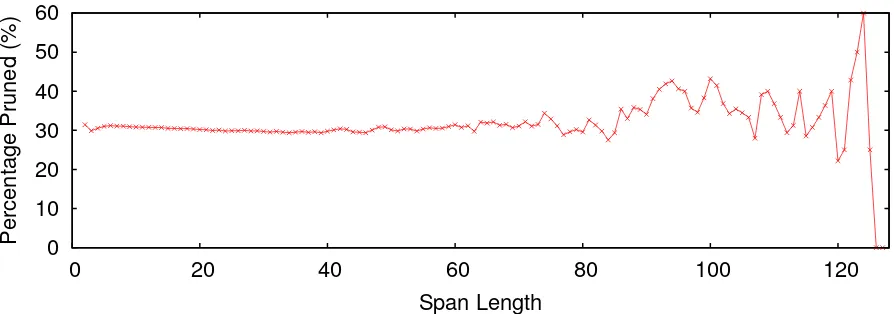
Figure 6: Percentage of spans of different lengths pruned atθ=0.98.
pected, longer spans are pruned more often, as they are more likely to be at the intersections of cells pruned by the two types of pruning labels, thus can be pruned by either type.
We also find CSP does not improve search qual-ity and it leads to slightly lower model scores, which shows that some higher scored translation hypotheses are pruned. This, however, is perfectly desirable. Since our pruning decisions are based on independent labellers using contextual infor-mation, with the objective of eliminating unlikely subtranslations and rule applications. It may even offset defects of the translation model (i.e. high-scored bad translations). The fact that the output BLEU did not decrease supports this reasoning.
Finally, it is worth noting that our string-to-tree model does not force complete target parses to be built during decoding, which is not required in our pruning method either. We do not use any other heuristics (other than keeping singleton and the top-most cells) to make complete translation al-ways possible. The hypothesis here is that good
labelling models should not affect the derivation of complete target translations.
5 Conclusion
We presented a novel sequence labelling based, context-sensitive pruning method for a string-to-tree MT model. Our method achieves more than
60% speed-up over a state-of-the-art baseline on
a full-scale translation task. In future work, we plan to adapt our method to models with differ-ent rule extraction algorithms, such as Hiero and forest-based translation (Mi and Huang, 2008).
Acknowledgements
[image:5.595.76.523.264.421.2]References
S.F. Chen and J. Goodman. 1996. An empirical study of smoothing techniques for language modeling. In Proc. ACL, pages 310–318.
David Chiang. 2007. Hierarchical phrase-based trans-lation. Comput. Linguist., 33(2):201–228.
S. Clark and J.R. Curran. 2004. The importance of su-pertagging for wide-coverage ccg parsing. InProc. COLING, page 282.
Michael Collins. 2002. Discriminative training meth-ods for hidden Markov models: Theory and experi-ments with perceptron algorithms. InProc. EMNLP, pages 1–8.
J.R. Curran and S. Clark. 2003. Investigating gis and smoothing for maximum entropy taggers. InProc. EACL, pages 91–98.
John DeNero, Mohit Bansal, Adam Pauls, and Dan Klein. 2009. Efficient parsing for transducer gram-mars. InProc. NAACL-HLT, pages 227–235.
M. Galley, M. Hopkins, K. Knight, and D. Marcu. 2004. What’s in a translation rule. InProc. HLT-NAACL, pages 273–280.
Michel Galley, Jonathan Graehl, Kevin Knight, Daniel Marcu, Steve DeNeefe, Wei Wang, and Ignacio Thayer. 2006. Scalable inference and training of context-rich syntactic translation models. InProc. COLING and ACL, pages 961–968.
Kenneth Heafield, Philipp Koehn, and Alon Lavie. 2013. Grouping language model boundary words to speed k–best extraction from hypergraphs. InProc. NAACL.
Mark Hopkins and Greg Langmead. 2010. SCFG decoding without binarization. In Proc. EMNLP, pages 646–655, October.
L. Huang and D. Chiang. 2007. Forest rescoring: Faster decoding with integrated language models. In Proc. ACL, volume 45, page 144.
Philipp Koehn, Franz Josef Och, and Daniel Marcu. 2003. Statistical phrase-based translation. InProc. NAACL-HLT, pages 48–54.
Philipp Koehn, Hieu Hoang, Alexandra Birch, Chris Callison-Burch, Marcello Federico, Nicola Bertoldi, Brooke Cowan, Wade Shen, Christine Moran, Richard Zens, et al. 2007. Moses: Open source toolkit for statistical machine translation. InProc. ACL Demo Sessions, pages 177–180.
P. Koehn. 2005. Europarl: A parallel corpus for statis-tical machine translation. InMT Summit, volume 5.
H. Mi and L. Huang. 2008. Forest-based translation rule extraction. InProc. EMNLP, pages 206–214.
F. J. Och and H. Ney. 2000. Improved statistical alignment models. In Proc. ACL, pages 440–447, Hongkong, China, October.
F.J. Och. 2003. Minimum error rate training in statis-tical machine translation. InProc. ACL, pages 160– 167.
K. Papineni, S. Roukos, T. Ward, and W.J. Zhu. 2002. Bleu: a method for automatic evaluation of machine translation. InProc. ACL, pages 311–318.
S. Petrov, A. Haghighi, and D. Klein. 2008. Coarse-to-fine syntactic machine translation using language projections. InProc. ACL, pages 108–116.
A. Ratnaparkhi. 1996. A maximum entropy model for part-of-speech tagging. InProc. EMNLP, volume 1, pages 133–142.
Brian Roark and Kristy Hollingshead. 2008. Classify-ing chart cells for quadratic complexity context-free inference. InProc. COLING, pages 745–751. Brian Roark and Kristy Hollingshead. 2009. Linear
complexity context-free parsing pipelines via chart constraints. InProc. NAACL, pages 647–655.
A. Stolcke et al. 2002. Srilm-an extensible language modeling toolkit. InProc. ICSLP, volume 2, pages 901–904.
Hao Zhang and Daniel Gildea. 2008. Efficient multi-pass decoding for synchronous context free gram-mars. InProc. ACL.
Hao Zhang, Liang Huang, Daniel Gildea, and Kevin Knight. 2006. Synchronous binarization for ma-chine translation. InProc. NAACL, pages 256–263. Y. Zhang, B.G. Ahn, S. Clark, C. Van Wyk, J.R.