
Munich Personal RePEc Archive
Does Oil Predict Gold? A
Nonparametric Causality-in-Quantiles
Approach
Shahbaz, Muhammad and Balcilar, Mehmet and Ozdemir,
Zeynel Abidin
Montpellier Business School, Montpellier, France, Eastern
Mediterranean University, Northern Cyprus, Turkey, Gazi
University, Ankara, Turkey
1 March 2017
Online at
https://mpra.ub.uni-muenchen.de/77324/
Does Oil Predict Gold? A Nonparametric
Causality-in-Quantiles Approach
*
Muhammad Shahbaz a, Mehmet Balcilar a, b, Zeynel Abidin Ozdemir c
a
Montpellier Business School, Montpellier, France
b
Eastern Mediterranean University, Northern Cyprus, via Mersin 10, Turkey
c Gazi University, Ankara, Turkey
Abstract
This paper examines the predictive power of oil price for gold price using the novel nonparametric causality-in-quantiles testing approach. The study uses weekly data over the April 1983-August 2016 period for both the spot and 1-month to 12-month futures markets. The new approach, the causality-in-quantile, allows one to test for causality-in-mean and causality-in-variance when there may be no causality in the first moment but higher order interdependencies may exist. The tests are preferred over the linear Granger causality test that might be subject to misleading results due to misspecification. Contrary to no predictability results obtained under misspecified linear structure, the nonparametric causality-in-quantiles test shows that oil price has a weak predictive power for the gold price. Moreover, the causality-in-variance tests obtain strong support for the predictive capacity of oil for gold market volatility. The results underline the importance of accounting for nonlinearity in the analysis of causality from oil to gold.
Keywords: Gold, Oil, Spot and futures markets; Quantile Causality. JEL Codes: C22, G15
*
1. Introduction
On account of oil’s frequent tradability, voluminous trades, high liquidity and synchronization
of its movement, gold has held its righteous positions in not only national but in international
economies as well. Oil is the commodity with the highest volume of trade and with higher
price volatility and gold, on the other hand, is the most traded precious metal with the lowest
price volatility. A comprehensive analysis of oil and gold prices suggests that prices of both
are strongly related. Oil and gold hold a positive price correlation of 80% in the last 50 years.1 There are a large number of studies suggesting that oil price changes give rise to price
variations in gold. To illustrate, According to Sari et al. (2010) gold price changes are related
to the oil price changes and oil price changes explain the 1.7% of the price change in gold.
Hence, an empirical study is of enormous importance in examining this relationship and this
study aims to examine the causality-in-quantiles running from oil to gold.
There are several channels accounting for the relation between oil and gold prices.
Many oil-exporting countries, for instance, perform oil transaction in return for gold. Due to
its nature of safe investment, oil revenues are invested in gold. Besides, the costs in gold
mining are very much related to energy and oil issues. This being the case, a rise in energy
and oil prices inevitably has an impact on the costs in gold mining. Another channel effective
in explaining the relation between oil and gold prices is inflation. As a support to explain this
connection, Narayan et al. (2010) argues that the relation between oil and gold prices can be
best explained through inflation. Other things being equal, a rise in oil prices at the
international scale will affect the prices in global terms and will have a negative effect on the
oil importing countries, yielding a negative relation between oil and inflation. Nowadays,
gold is regarded as an instrument investors buy to balance their portfolio during times with
high inflation (Ghosh, 2011). Since gold is a safe means of investment (safe heaven) the price
of gold goes up in high inflation periods, hence, as oil prices rise so does inflation and price of
gold.
1
The literature on oil and gold price relationship and their interaction with a specific
emphasis on macroeconomic and financial issues is scant. Each economic crisis led to some
studies into the issue, especially gold seen as a safe haven. One of the leading studies is that
of Melvin and Sultan (1990) and Kim and Dilts (2011), in which they found out a high
correlation between oil and gold in terms of export channel. Nevertheless, the literature hosts
other studies with no evidence of the relationship between the rises in prices of oil and gold
(e.g., Soytas et al. 2009; Liao and Chen, 2008; Sari et al. 2007; Hammoudeh and Yuan, 2008;
Narayan et al. 2010; Simakova, 2011; Le and Chang, 2011a and Lee et al. 2012). Sari et al.
(2007) examined the dynamic links among commodities such as the oil, gold, silver and
copper and financial variables, exchange rate and the interest rate. Their result showed that
gold and exchange rate have predictive power for the oil, but oil does not have significant
explanatory power these commodities. Soytas et al. (2009) studied the dynamic relationships
among the oil, commodities (gold and silver), and financial variables (dollar exchange rate
and bond rate) in Turkey. They examined both the short- and long-run dynamic interactions
and concluded that oil prices do not have significant explanatory power for the gold.
Thus, the empirical evidence on the relationship between the oil and gold markets can
be best described as mixed, if not confusing. The studies on oil-gold relationship center more
on whether oil has predictive power for gold and given the mixed evidence further studies are
needed. The mixed evidence on the relationship between the oil and gold gets even more
complicated due the use of different sample periods, methods and countries under
consideration. What is more important is that no comprehensive and insightful study exists to
date to examine the relationship between oil and gold prices. A study that takes into account
of nonlinearities, structural breaks, outliers and effects of extreme markets conditions in the
analysis of the oil and gold market relationship will resolve some of the ambiguities relating
to the empirical studies.
Against this backdrop, the objective of the current study is to use the recently
proposed nonparametric causality-in-quantiles test by of Balcilar et al. (2016a, b) to analyze
the predictability of mean and variance of gold price by oil price. The weekly data for the spot
and 1- to 12-month futures prices of oil and gold market have been employed. The sample
period ends at 8/10/16 and the beginning of the sample varies from 4/6/83 to 1/8/86 due to the
Our first contribution to the literature on oil and gold price is that, rather than focusing
on specific episodes of market periods, we use a nonparametric quantile testing approach
which is rich enough to consider all market conditions jointly (low volatility, high volatility,
crises, crashes, or bubbles). Thus, we can examine the predictive content of the oil market for
the gold market under different market conditions. This will allow us to see under what
conditions oil does predict the gold or does not. Our second contribution to the literature is the
consideration of the both spot and futures markets. To our knowledge Narayan et al. (2010) is
the only study considering futures markets. However, our study considers dynamic
nonparametric quantile Granger causality and, therefore, significantly differs from Narayan et
al. (2010) which only considers contemporaneous relationship via a static regression. Our
third contribution to the literature is the examination of causality not only in mean but also
causality in variance (volatility). Previous literature only studied the predictive power of the
oil for gold in mean. Oil market may have predictive power for the second moment (variance)
even if it does not have predictive power for the first moment (mean). The predictive power
of oil market for gold market volatility can even be more important for investors and portfolio
manager in developing hedging strategies. Our last contribution to the literature on oil and
gold price causal nexus is that we use a novel nonparametric causality-in-quantiles test
recently proposed by Balcilar et al. (2016a, b) to study whether oil price causes gold price
returns and volatility. Their test integrates the test for nonlinear causality of k-th order
developed by Nishiyama et al. (2011) with the quantile-causality test advanced by Jeong et al.
(2012) and, hence, can be considered to be a generalization of the former. The
causality-in-quantiles approach mainly has three novel aspects: first, this approach identifies the
dependence structure of the time series under consideration using a nonparametric estimation
and therefore misspecification errors are at minimum level or none. Next, it is viable to test
both causality-in-mean and causality-in-variance; this being the case, it allows for
higher-order dependency investigation, considered an essential point since there might be no
causality in the conditional-mean for some periods, but higher-order dependency might be
exists in the same periods. Finally, to date, this paper is the first one to examine the
predictability and volatility of gold returns with the nonparametric causality-in-quantiles
method, to the best knowledge of the authors. Our results show that oil prices have a weak
predictive power for gold markets, as suggested by the results of the nonparametric causality
tests. Still, we obtain strong evidence for causality-in-variance tests as we strongly reject the
null hypothesis that oil prices does not Granger cause gold price volatility for spot and the
The paper is organized as the following: Section-2 accommodates the literature
review, Section-3 introduces the method and Section-4 presents the data and the results and
lastly Section-5 presents the conclusion.
2. Literature Review
There are some studies (e.g., Zhang and Wei, 2010) holding that oil and gold prices have high
correlation, which is attributed to the phenomenon that high oil prices could have negative
effect for economies and which in turn has an adverse effect that lowers the share prices
(Kilian, 2009). Also, according to Melvin and Sultan (1990), export revenue channel may be
used to explain the relationship between oil and gold prices. In an attempt to distribute the
risks involved and to sustain the value of commodities and in order to possess more gold in
their portfolio, major oil exporting countries invest the revenues obtained from oil in gold,
paving the way for a rise in price of gold by increasing the demand. Finally, as stated by
Narayan et al. (2010), Hooker (2002), Hunt (2006) and Beckmann and Czudaj (2013),
inflation channel fits well in explaining the relation between oil and gold markets. On the
other hand, there are studies, e.g., Le and Chang (2012), Bampinas and Panagiotidis (2015),
claiming that oil and gold prices go hand in hand due to the correlation stemming from the
volatility in US dollars and in international politics.
From the empirical perspectives, there are studies using time series data for a given
country (Abhyankar et al. 2013; Mollick and Assefa, 2013; Reboredo, 2013; Wang and
Chueh, 2013; Tiwari and Sahadudheen, 2015; and Ghosh and Kanjilal, 2016) and studies with
cross-national data (Cunado and Perez de Gracia, 2003; Cunado and Perez de Gracia, 2005;
Cologni and Manera, 2008; Asteriou and Bashmakova, 2013; Wang et al. 2013; Degiannakis
et al. 2014; and Cunado and de Gracia, 2014). Considering the energy sectors, studies with
the theme of oil and stock markets are on the increase (e.g. Basher and Sadorsky, 2006; Park
and Ratti, 2008; Kilian and Park, 2009; and Broadstock and Filis, 2014). As suggested by
Kilian and Park (2009), the reaction of real stock returns depends on the demand-driven
increases or supply shock in the crude oil market.
A position of a country in the global crude oil market is very much related to the
impacts of oil price uncertainty, as shown by Wang et al. (2013). They reveal that, compared
negative, much stronger and more persistent in oil exporting countries. Furthermore, there are
studies incorporating short-term interest rates in their models to determine the effect of oil
price shock on stock markets (e.g., Cong et al. 2008 and Park and Ratti, 2008).
Exchange rate is another variable used in examining the stock market revenues
(Mishra, 2004). However, the results obtained from studies using exchange rates could yield
misleading results because they do not integrate oil prices as an important variable, a
significant one in the relation between exchange rate and stock market (Abdelaziz et al.
2008).
What is more, the number of studies on the relations between gold prices and
macroeconomic variables is fewer when compared with oil prices (Patel, 2013; Reboredo and
Rivera-Castro 2014; Arouri et al. 2015; Beckmann et al. 2015; and Pierdzioch et al. 2015).
The theoretical framework puts forward that the volatility in the exchange rate of dollar have
an impact on gold prices, for gold price is quoted in US dollars. The price of gold is likely to
go up in the event of dollar depreciation and the value of gold is sustained in this manner. For
this reason, gold is seen as a safe asset against currency fluctuations, especially for investors
with assets in dollars. Capie et al. (2005), Sjaastad (2008), Reboredo and Rivera-Castro
(2014) and Beckmann et al. (2015) are among those who examined the relation between gold
price and exchange rate empirically. Zhang and Wei (2010) examined the long-run
relationship between oil and gold markets and concluded that these markets are cointegrated.
They also found a one-way linear Granger causality from the oil market to the gold market
and obtain evidence that causality in not nonlinear using Hiemstra and Jones (1994) nonlinear
Granger causality test. Compared to Zhang and Wei (2010), our study finds nonlinear
Granger causality evidence in the mid-quantile ranges (generally from 0.20th 0.70th
quantiles). We also consider causality in variance (2nd moment) not only in the mean (1st
moment). Tiwari and Sahadudheen (2015) used univariate GARCH in mean models to
examine the impact of the oil prices on the gold. Their findings showed a positive significant
effect of oil on the gold. Our study is quite different than Tiwari and Sahadudheen (2015) as
they use a parametric GARCH in mean model with linear conditional mean specification. Our
study performs a nonparametric causality-in-quantiles tests for 2nd order causality while
Tiwari and Sahadudheen (2015) only considers a GARCH error specification and they do not
test for causality in variance. In addition, the literature on the relation between such strategic
limited, on the whole (see, Christiano et al. 1996; Awokuse and Yang, 2003; Sari et al. 2010;
Bhunia, 2013; Chang et al. 2013; and Hussin et al. 2013).
3. Methodology
By building on the framework of Nishiyama et al. (2011) and Jeong et al. (2012) we use a
novel methodology as advanced by Balcilar et al. (2016a, b), a method that is useful in
detecting nonlinear causality through a hybrid approach. The returns on gold is designated as
while the oil return is designated as . Based on Jeong et al. (2012), we define the
quantile-based causality as follow2: does not cause in the -quantile with regards to the
lag-vector of if
(1)
is presumably cause of in the -th quantile with regards to
if
(2)
Here, is the -th quantile of . The conditional quantiles of , ,
depends on t and the quantiles are restricted between zero and one, i.e., .
For a compact presentation of the causality-in-quantiles tests, we define the following
vectors , , and . Let also define the
conditional distribution functions and , which signify the
distribution functions of conditioned on vectors and , respectively. Moreover, the
conditional distribution is presumed to be completely continuous in for
nearly all . By defining and , we can see
that , which holds with a probability equal to one. As a result, the
hypotheses to be evaluated for the causality-in-quantiles based on equations (1) and (2) can be
represented as:
(3)
(4)
In order to define a measurable metric for the practical implementation of the
causality-in-quantiles tests, Jeong et al. (2012) make use of the distance measure
, where denotes the regression error and denotes the
marginal density function of . Consequently, the causality-in-quantiles test is based on
the regression error . The regression error arises based on the null hypothesis specified in
equation (3), which would be true, if and only if . In order to
make the regression error explicit, we rewrite this last statement as
, where is an indicator function. Now, following Jeong et al.
(2012), based on the regression error, the distance metric can be defined as:
(5)
In relation to equations (3) and (4), it is crucial to understand that . The statement will
hold with an equality, i.e., , if and only if the null in equation (3) is true, while
holds under the alternative in equation (4). The feasible counterpart of the distance
measure in equation (5) gives us a kernel-based causality-in-quantiles test statistics for the
fixed quantile and defined as:
(6)
where denotes a known kernel function, is the bandwidth for the kernel estimation,
denotes the sample size, and represents the lag-order used for defining vector . Jeong et
al. (2012) establish that the re-scaled statistics is asymptotically distributed as
standard normal, where . The
most crucial element of the test statistics is the regression error . In our particular case,
the estimator of the unknown regression error is defined as:
(7)
In equation (7), the quantile estimator yields an estimate of the -th
conditional quantile of given . We estimate by employing the nonparametric
kernel approach as:
(8)
(9)
with denote a known kernel function and is the bandwidth used in the kernel
estimation.
The causality in variance implies volatility transmission, which may exist even there is
no causality in the mean (1st moment). Testing for Granger causality in the second or higher
moments has some complications and the procedure for such tests should be carefully defined
since rejection of causality in the moment does not imply non-causality in the moment
for . We begin by employing Nishiyama et al. (2011) nonparametric Granger quantile
causality method. In order to demonstrate the causality in higher order moments, first we
examine the process below for :
(10)
where denote an independently and identically distributed (iid) process; the unknown
functions and satisfy some properties that are sufficient for the stationarity of .
Although, this representation does not permit linear or non-linear causalities from to , it
does allow to have predictive content for when is an established nonlinear
function. The representation in equation (10) illustrates that squares for does not
necessarily enter into the nonlinear function . Thus, we re-specify equations (3) and (4)
into a null and alternative hypothesis for causality in variance as follows:
(11)
(12)
In order to get a feasible test statistic for testing the null hypothesis in equation (11), we
substitute in equations (6) to (9) with . A problem may arise with the causality test based
on the definition given in equation (10), since there may be causality in the second moment
(variance) along with the causality in the conditional first moment (mean). We can illustrate
this with the following model:
(13)
Therefore, the higher order causality-in-quantiles can be stated as:
for (14)
Incorporating the whole concept, we specify that xt Granger causes in quantile
up to -th moment using equation (14) to formulate the test statistic of equation (6) for each
. Nishiyama et al. (2011) construct nonparametric Granger causality tests using the
density-weighted approach as in Jeong et al. (2011) and show that density-density-weighted nonparametric
tests in higher moments have the same asymptotic normal distribution as the test for causality
in first moment, although some stronger moment conditions might be necessary.
Nevertheless, it is not an easy task to test for all jointly, since the statistics are
jointly correlated (Nishiyama et al. 2011). In order to systematically overcome this issue, we
follow the sequential testing approach in Nishiyama et al. (2011) to test for causality in both
models defined in equations (10) and (13). In this approach, we first test for nonparametric
Granger causality in the first moment ( , but still continue for testing causality in
variance even if the non-causality is not rejected. That is, if the null for is not rejected,
then there might still be causality in the second moment and, thus, we construct the tests for
. This approach allows us to test the existence of causality only in variance as well as
the causality in the mean and variance successively. Conclusively, we can investigate the
existence of causality-in-mean and causality-in-variance sequentially. The empirical
application of causality testing through quantiles require identifying three crucial choices: the
lag order , the bandwidth , and the kernel type for and in equations (6) and (9),
respectively. In this study, we make use of lag order of 7 based on the Schwarz Information
Criterion (SIC) under a VAR involving oil returns and gold returns. Moreover, when it comes
to choosing lags, the SIC is considered being parsimonious compared to other lag-length
selection criteria. The SIC helps overcome the issue of over-parametrization usually arising
with nonparametric frameworks.3 The bandwidth value is chosen by employing the least squares cross-validation techniques.4 Finally, for and Gaussian-type kernels was employed.
4. Data and E mpirical F indings
4.1 Data
We employ weekly US dollar closing prices of crude oil spot and futures contracts traded on
the New York Mercantile Exchange as well as weekly US dollar prices of gold spot and
3
Hurvich and Tsai (1989) examine the Akaike Information Criterion (AIC) and show that it is biased towards selecting an over-parameterized model, while the SIC is asymptotically consistent.
4
futures contract on London Bullion Market (LBMA). All data is sourced from Datastream.
The data used for futures prices of oil and gold is for 1-month to 12-month maturities. The
data span used in this paper differs for both markets, for gold and oil markets started due to
their operations starting on different dates. The oil and gold series in the sample is presented
in the first column of Table 1. The data span is until 08/10/2016 and beginning of the sample
is given in the last column of Table 1. Figure 1 displays the time series plots all series.
Degrees of sensitivity of gold markets to oil prices tend to change in different markets,
as shown by the empirical evidence. To illustrate, while oil price rises are to the benefit of oil
exporting countries, it is not the same for oil importing countries. Market price (such as Gold)
would usually have an averaging affect across market and might not uncover the causal links
in oil and gold prices. Since it is our objective to describe a dependence structure, we found it
to be more appropriate to use weekly data in this paper. The use of daily data could mask the
dependence structure we wished to examine due to the probable effects of drifts, noise,
non-stationary variances, long memory or sudden jumps which could disrupt the modelling of
marginal distributions. In addition, due to the highly volatile structure of oil and gold markets,
it would be nearly impossible to grasp the relation between oil and gold prices, which is why
we use weekly data. As indicated by standard unit root tests, oil and gold series are
non-stationary in log-levels5. The nonparametric causality-in-quantile test requires stationary data and for this reason, we use the first-differences of the natural logarithmic values of the oil and
gold price in percentage.
# Insert Figure 1 in Here #
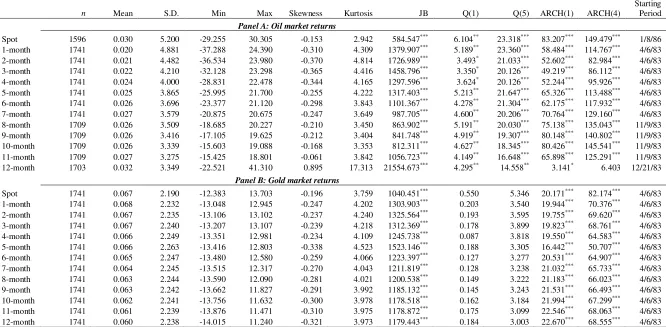
Key points of the data series under consideration are presented in Table 1, which
reports the mean, standard deviation, Kurtosis, Skewness, the Jarque-Bera normality test (JB),
the Ljung-Box first [Q(1)] and the fifth [Q(5)] autocorrelation tests, and the first [ARCH(1)]
and the fifth [ARCH(5)] order Lagrange multiplier (LM) tests for the autoregressive
conditional heteroskedasticity (ARCH) for oil and gold spot and futures contracts. The mean
of oil market returns is at its lowest for futures price but as for the spot prices there is a
gradual increase with the longest maturity of 12-month contracts with highest average price of
0.32. On the other hand, as for the mean of gold market returns, it is at its lowest with
5
maturity of 12-month contract for futures price but there is a gradual increase for spot prices,
with the lowest maturity of 1-months contract with the highest average price of 0.68. In terms
of volatility, oil market returns exhibit a more volatile structure than gold market returns.
Based on the negative values of the skewness, there is a higher possibility of large decreases
in returns, with one exception. The exception is that, considering oil market returns, the
12-month contract returns has a positive skewness estimate around 0.89. Based on the kurtosis
statistic, we observe fat-tailed distribution for all return series. As a more important finding,
the variables under consideration are skewed to left, with positive excess kurtosis, leading to
non-normal distributions, as shown by the strong rejection of Jarque-Bera statistic at 1%
significance level. The use of the causality-in-quantiles test is first justified by the fat-tailed
distributions of both returns. We observe significant serial correlation for oil market returns,
while significant serial correlation is not found for gold market returns, as suggested by
Ljung-Box statistic. There are ARCH (autoregressive conditional heteroscedasticity) effects
in all the return series, as shown by the autoregressive conditional
heteroskedasticity-Lagrange multiplier (ARCH-LM) statistic.
# Insert Table 1 in Here #
As well as examining the causality-in-quantiles from oil to gold, for completeness and
comparability, we also conducted the standard linear Granger causality test based on a linear
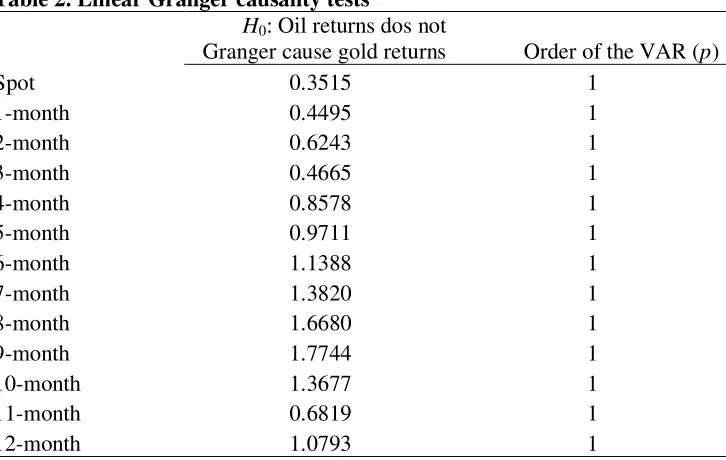
vector autoregression (VAR) model. Table 2 reports the results of linear Granger causality
tests. All of the F-statistics reported in Table 2 for the null hypothesis that oil returns does not
Granger cause gold returns are less than 1.8. Hence, we can conclude that even at significance
levels greater than 10%, there is no support of predictability running from oil to gold in a
linear VAR framework.
# Insert Table 2 in Here #
Subsequently, using the nonparametric quantile-in-causality approach, a
nonparametric (i.e., data-driven) approach, we examine the possibility of nonlinear
dependence between the oil returns and gold returns. In order to serve this purpose, Brock et
al. (1996, BDS) test is implemented on the residuals of an VAR(1) model for both returns.
We apply the BDS test to the residuals of oil returns and gold returns equation in the VAR(1)
dimensions (m), since there is strong evidence at the highest level of significance against
linearity. Based on this result, we conclude that there is strong evidence of nonlinearity in oil
returns and gold returns. This means that Granger causality tests in a linear framework might
lead to unreliable results due to misspecification errors. Because of the strong evidence of
nonlinearity, we implement the causality-in-quantiles test, which is deemed robust against,
jumps, outliers, structural breaks, and nonlinear dependence.
# Insert Table 3 in Here #
Given the strong evidence of nonlinearity obtained from the BDS tests, we further
investigate whether nonlinear Granger causality running from oil markets to gold markets
exists. In order to test for full sample nonlinear Granger causality, we use the nonlinear
Granger causality test of Diks and Panchenko (2006).6 Diks and Panchenko (2006) nonlinear Granger causality test results are presented in Table 4. We perform the tests for embedding
dimension m = 2, 3, 4 in order be robust against the lag order used in the test. The tests results
reported in Table 4 show that null hypothesis of no full sample nonlinear Granger causality
running from the oil to gold is rejected for none of the spot and futures markets. This results
holds unanimously for all embedding dimensions considered. Given the nonexistence of any
evidence on the full sample nonlinear Granger causality, we next turn to nonparametric
causality-in-quantiles tests, which considers all quantiles of the distribution not only the
center of the distribution.
# Insert Table 4 in Here #
The results of the quantile causality in mean and variance from the oil market series to
the gold market series are presented in Figure 2. The horizontal axis shows the quantiles and
the vertical axis shows the nonparametric causality test statistics corresponding to the quantile
in the horizontal axis. While 5% critical value is 1.96, 10 percent critical value is 1.64.
Horizontal thin solid lines show the critical value of 5% and thin two-dashed lines represent
10% critical values. There is clear difference between the quantile causality in mean and
quantile causality in variance analysis, as shown by the results in Figure 2. According to the
quantile causality test in mean the null hypothesis that oil does not Granger cause gold is not
6
rejected (p > 0.05) with a critical value of 1.96 over the quantile range of 0.25 to 0.60. The
only exception occurs at the quantile of 0.55. Except for one or two quantiles, the
causality-in-quantile test does reject the null hypothesis (p > 0.05) within the quantile range of 0.10 to
0.90 for future markets with differing maturities (1-month, 2-month, 3-month, 4-month,
6-month, 9-month). On the other hand, the null hypothesis that oil does not Granger cause gold
is rejected (p < 0.05) over the quantile range of 0.45 to 0.70 for futures market at 5-month
maturity as well as the quantile range of 0.25 to 0.65 for futures markets at 10-month and
11-month maturities, and the quantile range of 0.25 to 0.75 for futures market at 12-11-month
maturity. The quantile causality test in mean for the spot and futures markets at 5-month,
10-month, 11-10-month, and 12-month maturities exhibits that oil returns has predictive power on
gold returns. Yet, as for maturities of 1-month, 2-month, 3-month, 4-month, 6-month,
9-month, there is week evidence that oil returns have predictive power for gold returns for the
futures markets. For these maturities, oil has predictive power for gold only around the
quantiles from 0.40 to 0.60 and the null is rejected only at 10% level for the 3-month
maturity. In sum, oil returns have no predictive power for gold returns in bearish (lower
quantiles) and bullish (upper quantiles) market conditions.
According to the quantile causality in variance test results shown in Figure 2, the null
hypothesis that oil does not Granger cause gold in variance (2nd moment) is rejected (p < 0.05) over the quantile range of about from 0.15 to 0.75 for all spot and all futures markets.
This result shows that oil spot and all oil futures have strong predictive content for spot and
all future price volatility (variance) of gold market. Hence, there is no evidence supporting the
predictive power of oil for gold returns in the linear model. However, because of the
nonlinearity, the result of linear Granger causality is misleading. This in mind, nonparametric
causality-in-quantiles test results indicate that spot and future prices of oil have predictive
content for spot and future gold price volatility. This, in part, suggests that contrary to
equities, oil market moves in connection with gold market volatility during the periods of
stress.
The reason for this could be can be explained by the fact that crude oil is an essential
raw material in industrial manufacturing. Thus, global economic growth is much more linked
with crude oil than gold. For this reason, investors consider price changes in crude oil an
important phenomenon. With respect to global industrialization and globalization of markets,
world. The rapid development in alternative energy resources made it possible for the USA to
incorporate corn and white sugar in bioethanol in order to produce biodiesel fuel and this is an
example of the close link between crude oil prices and grease products, soybean and corns. In
summary, due to the extensive use of crude oil in the world global markets, the commodity
prices in world markets on the whole rest with the fluctuations of crude oil prices.
# Insert Figure 2 in Here #
The results in Figure 2 shows that the strength of the evidence of causality from oil
market to gold market, both in mean and variance, exhibits a hump-shaped pattern across
quantiles. Similar observations can be made across all the spot and 1- to 12-month maturities.
The hump-shaped pattern of causality is a new finding in this study and illustrates an
advantage of using our nonparametric causality-in-quantiles tests: A researcher who only
studies the median of the conditional distribution of gold returns and/or gold volatility would
likely to find strong evidence of predictive power from the oil to the gold, but, at the same
time, would completely miss that this evidence substantially weakens when the quantiles that
are farther away from the median are considered. We further point out that hump-shaped
curves in Figure 2 are asymmetric, where noncausality part is longer on the right tail and the
curves decline smoother on the right half of the figures. This implies that evidence of
noncausality is weaker on the right tail (extreme gold price increases) compared to the left tail
(extreme gold price decreases).
5. Conclusion
The extant literature so far has examined the oil market with respect to its predictive power
for gold markets. This paper adds to this literature by means of examining the predictability of
gold markets for the mean and volatility by the oil market. To serve this purpose, using
weekly data, standard linear Granger causality test is implemented but no evidence has been
found about causality running from oil market to gold market. Following the nonlinearity
tests, we find oil returns relationship with gold returns have nonlinear characteristics, which
suggests that the linear causality tests suffer from misspecification, thus yielding unreliable
results. In order to overcome this problem, we employ a nonparametric causality-in-quantiles
test, incorporating the test for nonlinear causality of k-th order developed by Nishiyama et al.
the causality-in-quantiles, enables us to examine causality-in-mean as well as the causality in
variance. In this way, even when there might be no causality in mean, we can still examine
the causality-in-variance (volatility). The nonparametric causality tests in mean indicate that
oil prices have a weak predictive content for gold market. Yet, the null hypothesis that oil
prices does not Granger cause gold price volatility for spot and the futures markets at all
maturities is strongly rejected for both spot and futures markets. The results on the nexus
between oil market and gold market, on the whole, underline the significance of detecting and
modeling nonlinearity when examining predictability via causal relationships.
The hump-shaped pattern in causality-in-quantiles tests we have found for causality
running from oil markets to gold markets, both for causality in mean and variance, highlights
the strong causal effects at the center of the conditional distribution of gold-price fluctuations.
In other words, the strongest effects of oil returns on gold returns and gold volatility may
occur on average, especially at higher data-frequencies (weekly data), in times of normal
rather than in times of exceptional movements of the gold price. However, this finding does
not rule out that singular events like the outbreak of a financial crisis or geopolitical
turbulences that trigger significant movements of the gold price, but it rather highlights that
investors and policymakers should study the entire conditional distribution of gold-price
movements when looking for causal effects of oil that operate, for example, in normal times
and in times of gold market turmoil. Similarly, an asymmetric hump-shaped pattern of
causality highlights that the strength of causality effects differs across the upper and lower
parts of the conditional distribution of gold-price movements.
As we pointed out, events such as important financial crisis or geopolitical events that
trigger significant gold price fluctuations are not ruled out by the strong causality evidence on
the center of the gold returns distribution, but it rather highlights that investors and
policymakers when looking for causal effects from oil to gold markets should consider the
entire conditional distribution of gold-price movements, not only the center of the distribution
which corresponds to low return periods. The asymmetric hump-shaped pattern of causality
running from oil to gold markets found in our study highlights that the strength of causality
effects differs across the upper and lower parts of the conditional distribution of gold price
movements. These results imply that investors should be aware that predictive power of oil
prices for the gold prices observed in normal times weakens during extreme market
managers, our results show that gold is a safe haven against extreme oil price movements, but
it not an effective hedge instrument against oil price during the normal market periods.
Investors should also know that oil precise would only indicate direction of gold price
movements during normal market periods, oil prices do fail to predict the extreme gold price
References
Abhyankar, A., Xu, B., Wang, J., 2013. Oil price shocks and the stock market: Evidence from Japan. Energy Journal 34, 199–222.
Abdelaziz, M., Chortareas, G., Cipollini, A., 2008. Stock prices, exchange rates, and oil: evidence from middle east oil-exporting countries. Soc. Sci. Res. Netw. 44, 1–27.
Arouri, M.E.H., Lahiani, A., Nguyen, D.K., 2015. World gold prices and stock returns in China: insights for hedging and diversification strategies. Econ. Model. 44, 273–282.
Asteriou, D., Bashmakova, Y., 2013. Assessing the impact of oil returns on emerging stock markets: a panel data approach for ten Central and Eastern European Countries. Energy Econ. 38, 204–211.
Awokuse, T.O., Yang, J., 2003. The information role of commodity prices in formulating monetary policy: a re-examination. Econ. Lett. 79, 219–224.
Balcilar, M., Gupta, R., Pierdzioch, C., 2016a. Does uncertainty move the gold price? New evidence from a nonparametric causality-in-quantiles test. Resources Policy 49, 74-80.
Balcilar, M., Bekiros, S., Gupta, R., 2016b. The role of news-based uncertainty indices in predicting oil markets: a hybrid nonparametric quantile causality method. Empirical Economics, forthcoming. DOI: 10.1007/s00181-016-1150-0.
Bampinas, G., Panagiotidis, T., 2015. On the relationship between oil and gold before and after financial crisis: linear, nonlinear and time-varying causality testing. Studies in Nonlinear Dynamics & Econometrics 19, 657-668.
Barisheff, N. (2005). The gold, oil and us dollar relationship.
http://www.kitco.com/ind/barisheff/apr222005.html, accessed on 2016-2-1.
Basher, S.A., Sadorsky, P., 2006. Oil price risk and emerging stock markets. Glob. Financ. J. 17, 224–251.
Beckmann, J., Czudaj, R., 2013. Oil and gold price dynamics in a multivariate coin- tegration framework. Int. Econ. Econ. Policy 10, 453–468.
Beckmann, J., Czudaj, R., Pilbeam, K., 2015. Causality and volatility patterns between gold prices and exchange rates. N. Am. J. Econ. Financ. 34, 292–300.
Bhunia, A., 2013. Cointegration and causal relationship among crude price, do- mestic gold price and financial variables: an evidence of BSE and NSE. J. Con- temp. Issues Bus. Res. 2 (1), 01–10.
Capie, F., Mills, T.C., Wood, G., 2005. Gold as a hedge against the dollar. J. Int. Financ. Mark. Inst. Money 15, 343–352.
Chang, H.F., Huang, L.C., Chin, M.C., 2013. Interactive relationships between crude oil prices, gold prices, and the NT–US dollar exchange rate—a Taiwan study. Energy Policy 63, 441–448.
Christiano, L.J., Eichenbaum, M., Evans, C., 1996. The effects of monetary policy shocks: evidence from the flow of funds. Rev. Econ. Stat. 78, 16–34.
Cologni, A., Manera, M., 2008. Oil prices, inflation and interest rates in a structural cointegrated VAR model for the G-7 countries. Energy Econ. 30, 856–888.
Cong, R.G., Wei, Y.M., Jiao, J.L., Fan, Y., 2008. Relationships between oil price shocks and stock market: an empirical analysis from China. Energy Policy 36, 3544–3553.
Cunado, J., Perez de Gracia, F., 2003. Do oil price shocks matter? Evidence for some european countries. Energy Econ. 25, 137–154.
Cunado, J., Perez de Gracia, F., 2005. Oil prices, economic activity and inflation: evidence for some asian countries. Q. Rev. Econ. Financ. 45, 65–83.
Cunado, J., de Gracia, F.P., 2014. Oil price shocks and stock market returns: evidence for some European countries. Energy Econ. 42, 365–377.
Degiannakis, S., Filis, G., Kizys, R., 2014. The effects of oil price shocks on stock market volatility: evidence from European data. Energy J. 35 (1), 35–56.
Diks C., Panchenko, V., 2006. A new statistic and practical guidelines for nonparametric Granger causality testing. Journal of Economic Dynamics & Control 30, 1647–1669.
Hammoudeh, S., Yuan, Y., 2008. Metal volatility in presence of oil and interest rate stocks. Energy Econ. 30, 606–620.
Hussin, M.Y.M., Muhammad, F., Razak, A.A., Tha, G.P., Marwan, N., 2013. The link between gold price, oil price and islamic stock market: experience from Ma- laysia. J. Stud. Soc. Sci. 4, 2.
Ghosh, S., 2011. Examining crude oil price-exchange rate nexus for India during the period of extreme oil price volatility. Appl. Energy 88, 1886–1889.
Ghosh, S., Kanjilal, K., 2016. Co-movement of international crude oil price and Indian stock market: Evidences from nonlinear cointegration tests. Energy Economics 53, 111–117.
Hooker, M.A., 2002. Are oil shocks inflationary? Asymmetric and nonlinear specifications versus changes in regime. Journal of Money Credit and Banking 34, 540–561.
Hiemstra, C., Jones, J., 1994. Testing for linear and nonlinear Granger causality in the stock price-volume relation. J. Finance 49, 1639–1664.
Hurvich, C. M., Tsai, C.-L., 1989. Regression and Time Series Model Selection in Small Samples. Biometrika 76, 297–307.
Jeong, K., Härdle, W.K., Song, S., 2012. A consistent nonparametric test for causality in quantile. Econom Theory 28, 861–887.
Kim, M.H., Dilts, D.A., 2011. The relationship of the value of the dollar, and the prices of gold and oil: a tale of asset risk. Econ. Bull. 31, 1151–1162.
Kilian, L., 2009. Not all oil price shocks are alike: Disentangling demand and supply shocks in the crude oil market. American Economic Review 99, 1053.
Kilian, L., Park, C., 2009. The impact of Oil Price shocks on the US stock market. Int. Econ. Rev. 50, 1267–1287.
Le, T., Chang, Y., 2011. Oil and Gold: Correlation or Causation? DEPOCEN Working Paper Series No. 22.2.
Lee, Y., Huang, Y., Yang, H., 2012. The asymmetric long-run relationship between crude oil and gold futures. Glob. J. Bus. Res. 6, 9–15.
Li, Q. and J.S. Racine (2004), “Cross-validated local linear nonparametric regression,” Statistica Sinica 14, 485-512.
Liao, S.J, Chen, J.T., 2008. The relationship among oil prices, gold prices and individual industrial sub indices in Thaiwan. Working Paper Presented at International Conference on Business and Information. Seoul, South Korea.
Melvin, M., Sultan, J., 1990. South African political unrest, oil prices, and the time varying risk premium in the fold futures market. Journal of Futures Markets 10, 103–111.
Mishra, A., 2004. Stock market and foreign exchange market in India: are they related? South Asia Econ. J. 5 (2), 209–232.
Mollick, A.V., Assefa, T.A., 2013. US stock returns and oil prices: the tale from daily data and the 2008–2009 financial crisis. Energy Econ. 36, 1–18.
Narayan, P.K., Narayan, S., Zheng, X., 2010. Gold and oil futures markets, are markets efficient? Applied Energy 87, 3299–3303.
Nishiyama, Y., Hitomi, K., Kawasaki, Y., and Jeong, K., (2011). A consistent nonparametric Test for nonlinear causality - specification in time series regression. Journal of Econometrics 165, 112-127.
Patel, S.A., 2013. Causal relationship between stock market indices and gold price: evidence from India. IUP J. Appl. Financ. 19, 99.
Pierdzioch, C., Risse, M., Rohloff, S., 2015. Fluctuations of the real exchange rate, real interest rates, and the dynamics of the price of gold in a small open economy. Empir. Econ., 1–19.
Racine, J.S., Li, Q., 2004. Nonparametric estimation of regression functions with both categorical and continuous data. Journal of Econometrics 119, 99-130.
Reboredo, J. C., 2013. Is gold a safe haven or a hedge for the US dollar? Implications for risk management. Journal of Banking & Finance 37, 2665-2676.
Reboredo, J.C., Rivera-Castro, M.A., 2014. Gold and exchange rates: downside risk and hedging at different investment horizons. Int. Rev. Econ. Financ. 34, 267–279.
Sari, R., Hammoudeh, S., Ewing, B.T., 2007. Dynamic relationships between oil and metal commodity futures prices. Geopolit. Energy 29, 2–13.
Sari, R., Hammoudeh, S., Soytas, U., 2010. Dynamics of oil price, precious metal prices, and exchange rate. Energy Economics 32, 351–362.
Simakova, J., 2011. Analysis of the relationships between oil and gold price. J. Financ. 51 (1), 651–662.
Sjaastad, L.A., 2008. The price of gold and the exchange rates: once again. Resour. Policy 33, 118–124.
Soytas, U., Sari, R., Hammoudeh, S., Hacihasanoglu, E., 2009. World oil prices, precious metal prices and macroeconomy in Turkey. Energy Policy 37, 5557–5566.
Tiwari, A.K., Sahadudheen, I., 2015. Understanding the nexus between oil and gold. Resour. Policy 46, 85-91.
Zhang, Yue-Jun, Wei, Yi-Ming, 2010. The crude oil market and the gold market: evidence for cointegration, causality and price discovery. Resour. Policy 35, 168–177.
22
Table 1. Descriptive statistics for returns (%)
n Mean S.D. Min Max Skewness Kurtosis JB Q(1) Q(5) ARCH(1) ARCH(4)
Starting Period
Panel A: Oil market returns
Spot 1596 0.030 5.200 -29.255 30.305 -0.153 2.942 584.547*** 6.104** 23.318*** 83.207*** 149.479*** 1/8/86 1-month 1741 0.020 4.881 -37.288 24.390 -0.310 4.309 1379.907*** 5.189** 23.360*** 58.484*** 114.767*** 4/6/83 2-month 1741 0.021 4.482 -36.534 23.980 -0.370 4.814 1726.989*** 3.493* 21.033*** 52.602*** 82.984*** 4/6/83 3-month 1741 0.022 4.210 -32.128 23.298 -0.365 4.416 1458.796*** 3.350* 20.126*** 49.219*** 86.112*** 4/6/83 4-month 1741 0.024 4.000 -28.831 22.478 -0.344 4.165 1297.596*** 3.624* 20.126*** 52.244*** 95.926*** 4/6/83 5-month 1741 0.025 3.865 -25.995 21.700 -0.255 4.222 1317.403*** 5.213** 21.647*** 65.326*** 113.488*** 4/6/83 6-month 1741 0.026 3.696 -23.377 21.120 -0.298 3.843 1101.367*** 4.278** 21.304*** 62.175*** 117.932*** 4/6/83 7-month 1741 0.027 3.579 -20.875 20.675 -0.247 3.649 987.705*** 4.600** 20.206*** 70.764*** 129.160*** 4/6/83 8-month 1709 0.026 3.509 -18.685 20.227 -0.210 3.450 863.902*** 5.191** 20.030*** 75.138*** 135.043*** 11/9/83 9-month 1709 0.026 3.416 -17.105 19.625 -0.212 3.404 841.748*** 4.919** 19.307*** 80.148*** 140.802*** 11/9/83 10-month 1709 0.026 3.339 -15.603 19.088 -0.168 3.353 812.311*** 4.627** 18.345*** 80.426*** 145.541*** 11/9/83 11-month 1709 0.027 3.275 -15.425 18.801 -0.061 3.842 1056.723*** 4.149** 16.648*** 65.898*** 125.291*** 11/9/83 12-month 1703 0.032 3.349 -22.521 41.310 0.895 17.313 21554.673*** 4.295** 14.558** 3.141* 6.403 12/21/83
Panel B: Gold market returns
Spot 1741 0.067 2.190 -12.383 13.703 -0.196 3.759 1040.451*** 0.550 5.346 20.171*** 82.174*** 4/6/83
1-month 1741 0.068 2.232 -13.048 12.945 -0.247 4.202 1303.903*** 0.203 3.540 19.944*** 70.376*** 4/6/83 2-month 1741 0.067 2.235 -13.106 13.102 -0.237 4.240 1325.564*** 0.193 3.595 19.755*** 69.620*** 4/6/83 3-month 1741 0.067 2.240 -13.207 13.107 -0.239 4.218 1312.369*** 0.178 3.899 19.823*** 68.761*** 4/6/83 4-month 1741 0.066 2.249 -13.351 12.981 -0.234 4.109 1245.738*** 0.087 3.818 19.550*** 64.583*** 4/6/83 5-month 1741 0.066 2.263 -13.416 12.803 -0.338 4.523 1523.146*** 0.188 3.305 16.442*** 50.707*** 4/6/83 6-month 1741 0.065 2.247 -13.480 12.580 -0.259 4.066 1223.397*** 0.127 3.277 20.531*** 64.907*** 4/6/83 7-month 1741 0.064 2.245 -13.515 12.317 -0.270 4.043 1211.819*** 0.128 3.238 21.032*** 65.733*** 4/6/83 8-month 1741 0.063 2.244 -13.590 12.090 -0.281 4.021 1200.538*** 0.149 3.222 21.183*** 66.023*** 4/6/83 9-month 1741 0.063 2.242 -13.662 11.827 -0.291 3.992 1185.132*** 0.145 3.243 21.531*** 66.493*** 4/6/83 10-month 1741 0.062 2.241 -13.756 11.632 -0.300 3.978 1178.518*** 0.162 3.184 21.994*** 67.299*** 4/6/83 11-month 1741 0.061 2.239 -13.876 11.471 -0.310 3.975 1178.872*** 0.175 3.099 22.546*** 68.063*** 4/6/83 12-month 1741 0.060 2.238 -14.015 11.240 -0.321 3.973 1179.443*** 0.184 3.003 22.670*** 68.555*** 4/6/83
Note: Table reports the descriptive statistics for the spot and futures (1- to 12-monh) returns (in percent) for the oil (Panel A) and gold (Panel B) markets. Sample period starts at the period given
Table 2. Linear Granger causality tests
H0: Oil returns dos not
Granger cause gold returns Order of the VAR (p)
Spot 0.3515 1
1-month 0.4495 1
2-month 0.6243 1
3-month 0.4665 1
4-month 0.8578 1
5-month 0.9711 1
6-month 1.1388 1
7-month 1.3820 1
8-month 1.6680 1
9-month 1.7744 1
10-month 1.3677 1
11-month 0.6819 1
12-month 1.0793 1
Note: The table reports the F-statistic for the no Granger causality restrictions imposed on a linear vector autoregressive (VAR) model under the null hypotheses H0. The order (p) of the VAR is
Table 3. [Brock et al. (1996)] BDS Test
m=2 m=3 m=4 m=5 m=6
Oil equation residuals
Spot 4.3366*** 6.3979*** 8.7684*** 12.0488*** 16.0429*** 1-month 2.8986*** 4.6127*** 6.4604*** 8.9956*** 12.0025*** 2-month 2.7707*** 4.5157*** 6.5014*** 9.0343*** 12.3810*** 3-month 2.8410*** 4.5077*** 6.5455*** 9.0949*** 12.4291*** 4-month 2.7309*** 4.4384*** 6.2019*** 8.4082*** 11.2339*** 5-month 3.0060*** 4.7500*** 6.5533*** 8.9485*** 12.0510*** 6-month 2.6507*** 4.4563*** 6.4262*** 9.0234*** 12.1425*** 7-month 2.6189*** 4.5234*** 6.6230*** 9.2676*** 12.3733*** 8-month 3.0602*** 5.1484*** 7.3224*** 10.2580*** 13.7494*** 9-month 3.1748*** 5.3310*** 7.5371*** 10.4716*** 14.1007*** 10-month 3.2983*** 5.4987*** 7.9570*** 11.0193*** 14.8379*** 11-month 3.3594*** 5.5370*** 7.9182*** 10.8389*** 14.5746*** 12-month 3.6148*** 5.5830*** 7.8992*** 10.8845*** 14.5896***
Gold returns equation residuals
Spot 4.3366*** 6.3979*** 8.7684*** 12.0488*** 16.0429*** 1-month 2.8986*** 4.6127*** 6.4604*** 8.9956*** 12.0025*** 2-month 2.7707*** 4.5157*** 6.5014*** 9.0343*** 12.3810*** 3-month 2.8410*** 4.5077*** 6.5455*** 9.0949*** 12.4291*** 4-month 2.7309*** 4.4384*** 6.2019*** 8.4082*** 11.2339*** 5-month 3.0060*** 4.7500*** 6.5533*** 8.9485*** 12.0510*** 6-month 2.6507*** 4.4563*** 6.4262*** 9.0234*** 12.1425*** 7-month 2.6189*** 4.5234*** 6.6230*** 9.2676*** 12.3733*** 8-month 3.0602*** 5.1484*** 7.3224*** 10.2580*** 13.7494*** 9-month 3.1748*** 5.3310*** 7.5371*** 10.4716*** 14.1007*** 10-month 3.2983*** 5.4987*** 7.9570*** 11.0193*** 14.8379*** 11-month 3.3594*** 5.5370*** 7.9182*** 10.8389*** 14.5746*** 12-month 3.6148*** 5.5830*** 7.8992*** 10.8845*** 14.5896***
[image:25.612.97.500.116.578.2]Table 4. [Diks and Panchenko (2006)] Nonlinear Granger Causality Test
m=2 m=3 m=4
Test statistic p-value Test statistic p-value Test statistic p-value 1.255 0.105 0.640 0.261 0.041 0.484 0.762 0.223 -0.032 0.513 -1.231 0.891 0.579 0.281 0.249 0.402 -0.424 0.664 0.592 0.277 0.262 0.397 -0.583 0.720 0.537 0.296 -0.208 0.582 -0.156 0.562 -0.089 0.535 -0.246 0.597 0.008 0.497 0.436 0.331 0.060 0.476 0.273 0.393 0.552 0.291 0.028 0.489 0.564 0.286 0.730 0.233 -0.269 0.606 0.830 0.203 0.716 0.237 0.105 0.458 1.248 0.106 0.445 0.328 0.071 0.472 1.161 0.123 -0.132 0.553 -0.446 0.672 0.905 0.183 -0.828 0.796 -1.335 0.909 0.440 0.330
[image:26.612.92.447.93.321.2]Figure 1. Time series plots of the spot and futures prices for the oil and gold markets
Figure 2. Causality in mean and variance from the oil market series to the gold market series
![Table 3. [Brock et al. (1996)] BDS Test](https://thumb-us.123doks.com/thumbv2/123dok_us/209752.520095/25.612.97.500.116.578/table-brock-et-al-bds-test.webp)
![Table 4. [Diks and Panchenko (2006)] Nonlinear Granger Causality Test](https://thumb-us.123doks.com/thumbv2/123dok_us/209752.520095/26.612.92.447.93.321/table-diks-panchenko-nonlinear-granger-causality-test.webp)


