Munich Personal RePEc Archive
Conceptualizing Local Knowledge and
Disaster Management
Abdul Razzaq, Khan and Khan, Abuturab and Razzaq,
Sadia
COMSATS IIT Abbottabad
20 March 2015
Online at
https://mpra.ub.uni-muenchen.de/63378/
Conceptualizing Local Knowledge and Disaster
Management
Abdul Razzaq Khan1, Abu Turab Khan2, Sadia Razzaq3
Abstract:
This article deals with review of conceptualization of local knowledge and highlights terms
related disaster management. The purpose is to relate local knowledge in disaster management as
an important factor, because rural communities mostly trust on their own wisdom, i.e. Local
knowledge. This article gives conceptual clearance of local knowledge, disaster, disaster
management, with theoretical discussion on vulnerability of the local communities in developing
countries.
Key Words: Local Knowledge, Disaster Management, Vulnerability, Rural Communities,
Hazards, Disaster Management Cycle.
1
Abdul Razzaq Khan: Assistant Professor, Department of Development Studies, COMSATS IIT Abbottabad
2
Abuturab Khan: Assistant Professor, Department of Development Studies, COMSATS IIT Abbottabad
3
1.1 Knowledge Defined
“Knowledge implies cognition the fact or condition of having information or of being-learned through experience or association”(Hoyos, 2007, p. 44)
It refers to the whole system, including concepts, beliefs, and perception, and the process whereby it is acquired, augmented, stored, and transmitted (Chambers R., 1983).
In 1998, Prusak and Davenport defined local knowledge as
“A fluid mixed of framed experience, contextual information, values and expert insight that provides a framework for evaluating and incorporating new experience and information” (Prusak and Davenport, 1998, p.5).
Above definitions reveal that knowledge defined in two ways, one is a mixed bag of experiences and the other one based upon contextual information comprising values and expert opinion. Knowledge based upon data, information that can synchronize, personally evaluated to widen the knowledge. It used to make wised decisions regarding philosophical thoughts and predicting solutions of various ranges of issues.
1.2 Types of Knowledge
Mwaura, 2008 categorize knowledge into further two types, explicit and tacit. The explicit knowledge includes grammatical statements, mathematical expressions, specification, that can transmit for else process through computer mode and this knowledge reveals a situation analysis for a particular event public issue that requires policy response. According to Posner & McLeod, 1982 explicit knowledge based upon procedural activities and used to find out the operational solution by directing or coordinating with different stakeholders (See Bransford, Sherwood, Vie, &Rieser, 1986; Polya, 1957 for further detail). Tacit knowledge comprises the individual experience and it revolves around intangible factors such as values and beliefs driven through customs, traditions. It is difficult to estimate into formal methods as this knowledge based upon a combination of quantifiable variables and attributes. The tacit knowledge is processed through technical knowledge solution to the cognitive dimension in other words technical knowledge is derived through explicit modes as discussed above where as cognition is a process which may or may not be quantifiable in umbers or numerical values. Since it derives from beliefs, perceptions, and value judgments predictions about the future, especially disasters and floods are predicting heavily on value judgments made by the communities. It is very important that in order to predict future losses especially in the context of rural communities both cognitive and tacit knowledge be used.
1.3 Use of Explicit and Tactic Knowledge in Predicting Events
In rural communities, explicit and tacit knowledge combine to gather as local knowledge. This sort of knowledge has different names in the literature depending on its immensity. Besides this,
“local knowledge is also known as “traditional knowledge” and “indigenous knowledge.”
Indigenous knowledge is a narrower term, for this, it is necessary for communities having all the innate members. Whereas nowadays, due to modernization various communities reformulated by new migrated members and hence very few communities existed with innate members, therefore
However, it is not necessary that local knowledge is always good, at various places local knowledge give much losses to reserve communities. In various communities, these local knowledge become hurdles in the way of developmental activities. Moreover, such local knowledge has certain limits in implementation, whenever any situation crosses that limit then such people become very feeble. Besides this, researchers evaluate local knowledge because of facts that local people manage their environment deal with devastating events and other problems with their local knowledge. Local knowledge developed by a dynamic system in which various factors like spirituality, relationship, local politics and others influence each other and form imbedded cultural practices. Besides various negative aspects and limitations, local knowledge has various positive aspects, and incorporating local knowledge into projects and management process, can contribute to local empowerment and can provide valuable input for alternative development strategies.
Local knowledge became the identity of particular communities, although many of these are now extinct. However, many of them stored in people’s memories and activities and expressed in
stories, songs, folklore, proverbs, dances, myths, cultural values, beliefs, rituals, local language and taxonomy, agricultural practices and in preventive measures from natural hazards (Grenier, 1998).
1.4 Characteristics of Local Knowledge
Howell 2003 discussed various characteristics of local knowledge, according to him knowledge always been passed on to younger generations, and is increasingly disregarded as “unscientific”
knowledge within communities varies from area to area. Whereas, many people still use them
and many see them as “old fashioned” knowledge, which has superseded by the newer scientific warning system. Despite this, now-a-days local knowledge vastly used by NGOs and various Governments for the fair implementations of the development projects.“Locally developed indigenous knowledge is a good basis for building up a participatory system, and one which has been used in Sub-Saharan Africa”.Visibility and availability of such knowledge or information on local communities does not need any especial technology. In rural and local communities, it has well developed by their parents and surroundings where these communities are living from years. Consequently, to developing such communities it is important to involve in their knowledge and identify all sorts of knowledge to erode libelous knowledge and to preserve practicable and sustainable knowledge highlighted various types of local knowledge in their studies as follows (see for more Johnson, (1992); Dewalt, (1994); Emery, (1996); Grenier, (1998); IIRR, (1996); and Yin, (2003).
1. Human Health includes knowledge on the topics like nutrition, human disease classification, preparation of traditional medicines using herbs in the handling of aliments, it also deals with collection, processing and cultivation of herbs used in traditional treatment of different diseases. This process includes searching, collecting, processing, storing, and utilizing prepared medicines for treatments.
2. Local Knowledge of Animals Health includes animal breeding and production, traditional fodder and forage species and their specific uses; animal disease classification; and their traditional ethnic veterinary medicine.
4. Soil Management Traditional people have best and sustainable soil conservation practices, which include the use of special species for soil conservation, effective soil-fertility enhancement practices which most of new researchers adopt for sustainable use of soil. 5. Agricultural Practices include various environments favorable practices, which do not
destroy the environment as by new scientific agricultural techniques. They have indigenous indicators to determine favorable times to prepare plant and harvest gardens. They have effective land-preparation practices, ways to propagate plants, seed storage, and processing, indigenous methods of sowing, seedling preparation and care, farming and cropping systems, crop harvesting, and storage, food processing and marketing and pest management systems and plant protection methods.
6. Fishing Methods Most of the world coastal communities engaged in the fishing profession from last many centuries. As they have a most profitable profession in fishing, therefore to make it more effective and sustainable their minds develop effective local knowledge practices. Their experiences make them expert in selection of area from the sea to fetch more and more fish, selecting a particular category for fishing in a particular season, selecting the type of net and deciding different methods to fetch different types of fish. Moreover, they have expert knowledge in fish storing, marketing, and farming.
7. Food Conservation Techniques as an aloof community there is no use of machineries due to poverty or due to lack of electricity facility, like in various developing countries. Therefore, local people use their own knowledge that developed from their experiences from last many centuries. They have effective measures to store food like milk, dough of flour, cooked meal etc. They mostly get the benefit of cool airs from sea to store food. They mostly keep their foods in a place and direction that they get continuously cool breeze and remained cool.
8. Environmental Preservation and Conservation deals with aloof communities have effective local practices to preserve their environment from extreme climate. They know that how to dig the soil for agricultural use, so that it could be used by coming generations also. Similarly, they manage their water recourses in a sustainable way. They have effective and conservative measures for range management, forestry, agro forestry, woodwork etc.
9. Meteorological Local Knowledge people of the local communities predicted easily about the weather of their own area or surroundings with the help of wind direction and speed,
moon shape and movement, cloud movement, sunlight’s intensity and by many other ways.
(Turbine, 1975).
10.Disaster Management In rural Communities due to poverty and scarce resources, people is mostly away from modern communication methods and unaware of modern early warning systems. These communities rely on their own local knowledge, which is highly beneficial for them to predict any occur on the future’s disaster event. Moreover, they have effective local knowledge about all different stages of disaster management, i.e., pre post and during disaster activities. The focused of the current study is also on local knowledge in disaster management.
1.5 Distinguishing Local Knowledge and Scientific Knowledge
knowledge derived through experience and based upon value judgment in predicting or else creating warning signals for the future. Table 1.1 elaborate differences between local and scientific knowledge.
Table 1.1: Differences between Local Knowledge and Scientific Knowledge
Comparison Local knowledge Scientific knowledge Relationship Subordinate Dominant
Dominant mode of thinking
Intuitive/holistic
Mind and matter considered together
Analytical/reductions Mind reduced to matter Communication Oral, storytelling, singing, dance
Subjective
Literature Objective Instruction Learned through observation of
hands-on experience
God taught and learned in a situation usually separated from the applied context
Effectiveness Slow Inconclusive
Fast Conclusive Data creation Based on personal observation, trial and
error, and synthesis of facts
Based on experimental and systematic, deliberate accumulation of facts Data type Qualitative
Historical ( long time-series one locality)
Quantitative
Statistics (short time-series over a large area)
Explanation Spiritual Moral
Hypothesis, laws, mechanistic value free
Classification Ecological Genetic and hierarchical
Source: Wolfe al. (1992) and Berkes (1993)
In the above table, 1.1 local knowledge and scientific knowledge differentiated in various areas through some indices. Due to the unique nature of local knowledge vary from area to area and person to person so it has very limited relationship with the environment unlike scientific knowledge which can be applied anywhere in the world without knowing the ground reality of the area. As discussed earlier local knowledge based on experience of individuals, values, beliefs and observation it depends on both thinking of the mind and occurrence of any events and transferred into new peers through verbally, stories, singing. Due to inadequate and slow in nature local knowledge cannot be applied in all areas have limited boundaries and based on qualitative data rather than quantitative like scientific knowledge. In order to summarize, the local knowledge is a descriptive base that estimated qualitatively and can be apply in preventing future losses caused by floods, earthquake, and other natural calamities. Moreover, estimating on scientific methods for local knowledge are at under especial consideration and more and more research carried out towards understanding importance and sorting out effective tools of analysis of parameters relating to estimation for local knowledge.
1.6 Local Knowledge in Development
The researchers had learned various advantages of integrating local knowledge in development. Their reasoning and determinations shows that, to enhance local empowerment and development it is important to develop self-sufficiency and strengthening self-determination by incorporating their local knowledge into research and development projects (Thrupp, 1989). Using local knowledge in developing projects and management plans gives it authenticity and believability in the eyes of local people. It raises cultural pride and thus motivates them to solve local problems with local superiority and resources (Grenier, 1998).
Since the researchers observed that for sustainable development the most important is capacity building of local communities, therefore, they are designing appropriate local knowledge and institutions. The recent worldwide ecological crisis fuelled international interest in local knowledge systems. Therefore, local knowledge can provide powerful fundaments, which could help in developing substituted ways of managing resources. Besides sustaining, local knowledge, technologies are also cost-effective. Moreover, local people are familiar with them and do not need any specialized training (IIRR, 1996).
1.7 Terminologies used in Disaster Management
To understand disaster in depth some concepts and terminologies are under fallows. 1.7.1 Disasters
“A disaster is a catastrophic occurrence, a sudden, or a major misfortune that disrupts the basic fabric and normal functioning of a whole society or a community within it.It is an event or series of events which gives rise to casualties, damage to or loss of property, infrastructure, essential services or means of livelihood on a scale which is beyond the normal capacity of the affected communities to cope with unaided”(Kumar, 2008).
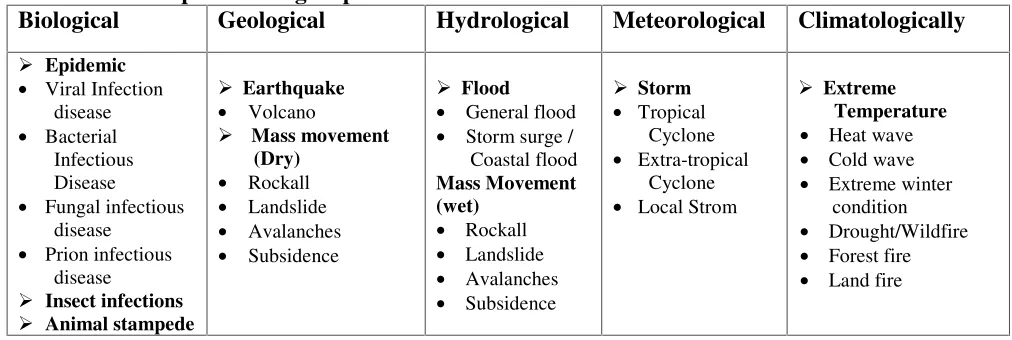
[image:7.612.63.569.456.626.2]Disasters has direct relation to vulnerability, increase in vulnerability means an increase in the frequency of occurrence of disasters rather it belongs to physical, social, economic, or environmental. EM-DAT 1988 divided disasters into two main groups i.e. natural Disaster and Man-made Disasters. Natural disasters further divided into 5 subgroups, which cover 12 main disaster types and more than 30 sub-types, main groups and subgroups are in the table 1.2. Table 1.2: Groups and Subgroups of Disaster
Biological Geological Hydrological Meteorological Climatologically
Epidemic
• Viral Infection disease • Bacterial
Infectious Disease
• Fungal infectious disease
• Prion infectious disease
Insect infections
Animal stampede
Earthquake
• Volcano
Mass movement (Dry) • Rockall • Landslide • Avalanches • Subsidence Flood
• General flood • Storm surge / Coastal flood Mass Movement (wet) • Rockall • Landslide • Avalanches • Subsidence Storm • Tropical Cyclone • Extra-tropical Cyclone • Local Strom
Extreme Temperature
• Heat wave • Cold wave • Extreme winter
condition • Drought/Wildfire • Forest fire • Land fire
Source: EM-DAT: The OFDA/CRED International Disaster Database”UCL,http://www.emdat.be
1.7.2 Calamity Management
“Disaster management can be defined as a “collective term encompassing all aspects of planning for and responding to disasters, including both pre- and post-disaster activities” (CERO, 2004).It
may refer to the management of both the risks and consequences of disaster (Amarasinghe, 2006). “It is the body of policy and administrative decisions and operational activities which
management can divided into four parts Emergency response and relief; Recovery and reconstruction; Mitigation and Preparedness; which are mainly, categorized under two main headings - Crisis Management, and Risk Management. The disaster management cycle is an open-ended process or an ongoing attempt to limit the effects of the disasters (Amarasinghe et al, 2006).The Figure 1.2 shows the schematic diagram of disaster emergency management as indicated.
Figure 1.2: Disaster Management Cycle
Source: Disaster Management Cycle (Kawata, 2001) 1.7.3 Disaster Planning
Disaster management planning is about anticipating the types of disasters that may occur and effect on communities. It is about drawing on the wisdom of the community and experts to develop ways to prevent, prepare for, respond to and recover from those disasters (Barbara Pollard, 2005).
1.7.4 Emergency Management
“Process used to protect lives and livelihoods from hazards that can cause disasters or catastrophes”(Haddow, Bullock, & Coppola, 2008).
1.7.5 Hazards
Hazard is a potentially damaging physical event, phenomenon, or human activity that may cause the loss of life or injury, property damage, social and economic disruption, or environmental degradation(Commonwealth, 2010).
Table 1.3: Differentiating Hazard and Disaster
Hazard Disaster
May cause loss of lives and the environment
Definitely cause loss of lives and the environment
Events like Earthquakes, floods, cyclones etc. are hazardous
Events like earthquakes, floods, cyclones etc. Become a disaster when they result in injuries, loss of life and livelihoods, displacement and homelessness etc.
The hazard intensity could not be controlled, even many preventive measures may become vague in front of severe intended hazard happened the first time
A disaster could control through proper disaster management activities and its intensity could minimize or even controlled totally.
1.7.6 Classification of Hazards
According to Alexander 1993 hazards become disasters when they become a cause of huge loss to human societies and environment hence, classification of hazards is also the classification of disasters. Water and Climate related includes floods, cyclones, tornadoes and hurricanes, hailstorm, cloudburst, snow avalanches, heat and cold waves, thunder and lightning, sea erosion and droughts. Geologically related includes earthquakes, landslides and mudflows, the dam bursts and dam failures and mine fires (Alexander, 1993).
Chemical, Industrial and Nuclear related include disasters resulted from mismanagement or by poor handling of chemicals in industries or by unjust dealing with nuclear related weapons. Accidents related includes sudden accidents that give no predictions and occur suddenly. These include road, rail, and other transportation accidents including waterways, mine flooding, major building collapse, serial bomb blasts, festival related disasters, urban fires boat capsizing, forest fires, electrical disasters and fires. Biologically related includes disasters like epidemics, food poisoning, cattle epidemics, and pest attacks (Alexander, 1993).
1.7.7 Types of Hazards
Types of hazards designed depending on their frequency of onset. Kumar 2008 divided hazards into three main types
Catastrophic Hazards, catastrophic hazards have devastating consequences over a huge area and of huge population in the whole world or have worldwide effect, such as impacts with large space objects, huge volcanic eruptions, worldwide disease epidemics, and worldwide droughts. Such catastrophic hazards only have a small chance of occurring, but can have devastating results if they occur. Rapid Onset Hazards, Rapid onset hazards considered as volcanic hazards, floods in the plane Ares along with the fire in forests caused by nature where as Slow Onset hazardsare described as drought conditions caused by uneven rainfall, diseases break out and epidemic infections caused by some outbreak of manmade practices e.g. plagues and dengue (Kumar, 2008).
1.7.8 Risk
The probability of harmful consequences, or expected loss of lives, people injured, property, livelihoods, economic activity disrupted (or environmental damaged) resulting from hazards (Kumar, 2008).
1.8 Disaster Management Cycle
Various organizations, researchers, and practitioners elaborate disaster management cycle according to the needs of their practicum or subjectivity. However, the theme of the cycle is same in all i.e. pre-disaster activities, during-disaster and after. The various stages of disaster management cycle elaborated here following various references over it (Commonwealth, 2010). 1.8.1 Pre-Disaster
Pre-disaster activities refer to activities that perform before the occurrence of disaster i.e. by anticipating natural hazards preventive measures must adopted. It includes two main sets of activities i.e. Prevention and mitigation
i. Prevention: Prevention is to ensure that human action or natural phenomena do not result in disaster or emergency(Commonwealth, 2010).
ii. Mitigation: Mitigation means to reduce the severity of the human and material damage caused by the disaster(Commonwealth, 2010).
During Disaster
Pre-disaster activities refer to activities that performed at the occurrence of disaster which include early response, rescue, and relief.
i. Response: This phase includes actions need to perform immediately during disasters i.e. to save lives, prevent property damage and to preserve the environment. The period of these activities may depend on the severity of the disaster; it may be for six months or for a year (Commonwealth, 2010).
ii. Rescue: The urgent support to disaster victims within first three days of disaster occurrence; it includes the provision of basic needs only i.e. Food, water, grouped temporary shelter and saving lives.
iii. Relief: The short term support to disaster victims to return to normal life i.e. Building suspension bridges for damaged bridges, providing individual temporary shelters, launching medical camps, provision of hygiene facilities, provision of advanced basic facilities.
1.8.2 Post-Disaster
It includes activities to ensure complete return of normal life with no sign of disaster occurrence (David, 2004).It provides long-term recovery through two main steps i.e. Rehabilitation and Reconstruction (Kumar, 2008).
i. Rehabilitation: It includes operations and decisions taken after a disaster with a view to restoring normal life (Kumar, 2008).
ii. Reconstruction: It includes actions to re-establish a community after a period of rehabilitation. Actions would include constructions of permanent houses to provide shelter, full permanent restoration of services, constructions of permanent roads and damaged bridges, and complete resumption of pre-disaster state (Kumar, 2008).
1.9 Effective Disaster Management
Following above disaster management cycle, organizations should keep in mind the objectives of disaster management that illustrated by Kumar (Kumar, 2008).
i. Reduce damages and deaths ii. Reduce personal suffering
iii. Speeds recovery iv. Protect victims
These objectives give a boundary to disaster management activities within which they should work following the disaster management cycle. Besides this, two more specify the activities of disaster management some principles had suggested by (ASALGP) .By following these principles, organizations could have more effective disaster management (Barbara Pollard, 2005).Disaster management is the responsibility of all spheres of government and it must recognize the involvement and potential role of
NGOs’.
Figure1.2: The Disaster Management
1.10 Vulnerability
Vulnerability defined differently by many authors, Kumar (2008) defined vulnerability and Human vulnerability as two different concepts, whereas others mostly take human vulnerability as the vulnerability.
“Vulnerability is the degree of loss (for example, from 0 to 100 per cent) resulting from a potentially damaging phenomenon” (Kumar, 2008).
“A human vulnerability is a human condition or process resulting from physical, social, economic and environmental factors, which determine the likelihood and scale of damage from the impact of a given hazard”(Kumar, 2008).
“Vulnerability is the threat of (hazardous material) to which people are exposed (including chemical agents and the ecological situation of the communities and their level of emergency preparedness) vulnerability is the risk context “(Cutter, 1996).
“Vulnerability is the ‘capacity to suffer harm and react adversely’” (Kates 1985).
The IPCC Third Assessment Report (TAR) describes the vulnerability as
“The degree to which a system is susceptible to or unable to cope with adverse effects of climate change including climate vulnerability and extremes, vulnerability is the function of the character, magnitude, and rate of climate variation to which a system is exposed, its sensitivity, and its adaptive capacity”( IPCC, 2001, p 995).For further please see chapter number four. 1.11 Conclusion
This chapter discussed the complex and dynamic nature of local knowledge. Worldwide rural communities still utilize this knowledge for predicting future events. These communities rely on their own knowledge because this type of knowledge has transferred from their parents. These parentages were fully aware of the surroundings and environment of the area. This chapter elaborates aims and gives conceptual clearance of disaster, its management, its process, vulnerability. Furthermore, this chapter distinguishes between local knowledge and scientific knowledge and highlighted than on the bases of ground realities local communities accept local knowledge rather than scientific knowledge.
1. Aalst, V. M., & Burton, I. (2002). The Last Straw: Integrating Disaster Mitigation with Enviroment Management.Disaster Risk Management Working Paer No.5.Washigton. DC.: The World Bank.
2. Agrawal, A. (1995). Dismantling the Divide Between Indigenous and Scientific Knowledge.Development and Change, 6, 430-439.
3. Alexander, D. (1993).Natural disaster.Gower Street: university College London. 4. Berkes, F. (1999). Role and Significance of Traditions in Indigenious Knowledge.
Indigenious Knowledge and Development Monitor, 7 (1), 19.
5. Brooks, L. (2011).Incident Management: Incident Command System, Coordinated Incident Management System, Helitack, Mass-Casualty Incident.Amazon.com: General Books LLC.
6. Cannon, T; Twigg, J; Rowell, J. (2003).Social vulnerability, sustainable livelihoods and disasters.United Kingdom: Benfield Hazard Research Centre.
7. Cutter, S. L. (1996). Vulnerability to enviromental hazards.Progress in Human Geography, 529-539.
9. Ginige, K., Amaratunga,D., and Haih, R. 2009. Mainstreaming gender in disaster
reduction: why and How?: Disaster Prevention and Management. Vol. 18 no.1. pp. 23-34 10. Howell, P. (2003).Indigenous Early Warning Indicators of Cyclones: Potential
Application in coastal Bangladesh.London: Aon Benfield UCL Hazard Centre (ABUHC).
11. Kate, P. M., & Adger, W. N. (1985).Assessing Vulnerability to Climate Change.
Cambridge, UK: Cambridge University Press.
12. Kawata, Y. (2001).Disaster mitigation due to next Nankai earthquake tsunamis occurring in around 2035 .Retrieved March 12, 2010, from Kyoto University: 13. Kumar, A. (2008).Global Disaster Prepardness.Dehli, India: Sbs Publisher &
Distributors India.