Approximation Strategies for Multi-Structure Sentence Compression
Kapil Thadani
Department of Computer Science Columbia University New York, NY 10025, USA [email protected]
Abstract
Sentence compression has been shown to benefit from joint inference involving both n-gram and dependency-factored objec-tives but this typically requires expensive integer programming. We explore instead the use of Lagrangian relaxation to decou-ple the two subproblems and solve them separately. While dynamic programming is viable for bigram-based sentence com-pression, finding optimal compressed trees within graphs is NP-hard. We recover ap-proximate solutions to this problem us-ing LP relaxation and maximum spannus-ing tree algorithms, yielding techniques that can be combined with the efficient bigram-based inference approach using Lagrange multipliers. Experiments show that these approximation strategies produce results comparable to a state-of-the-art integer linear programming formulation for the same joint inference task along with a sig-nificant improvement in runtime.
1 Introduction
Sentence compression is a text-to-text genera-tion task in which an input sentence must be transformed into a shorter output sentence which accurately reflects the meaning in the input and also remains grammatically well-formed. The compression task has received increasing attention in recent years, in part due to the availability of datasets such as the Ziff-Davis cor-pus (Knight and Marcu, 2000) and the Edinburgh compression corpora (Clarke and Lapata, 2006), from which the following example is drawn.
Original: In 1967 Chapman, who had cultivated a con-ventional image with his ubiquitous tweed jacket and pipe, by his own later admission stunned a party attended by his friends and future Python colleagues by coming out as a homosexual.
Compressed: In 1967 Chapman, who had cultivated a conventional image, stunned a party by coming out as a homosexual.
Following an assumption often used in compres-sion systems, the compressed output in this corpus is constructed by dropping tokens from the input sentence without any paraphrasing or reordering.1
A number of diverse approaches have been proposed for deletion-based sentence compres-sion, including techniques that assemble the out-put text under an n-gram factorization over the input text (McDonald, 2006; Clarke and Lapata, 2008) or an arc factorization over input depen-dency parses (Filippova and Strube, 2008; Galanis and Androutsopoulos, 2010; Filippova and Altun, 2013). Joint methods have also been proposed that invoke integer linear programming (ILP) formu-lations to simultaneously consider multiple struc-tural inference problems—both over n-grams and input dependencies (Martins and Smith, 2009) or n-grams and all possible dependencies (Thadani and McKeown, 2013). However, it is well-established that the utility of ILP for optimal infer-ence in structured problems is often outweighed by the worst-case performance of ILP solvers on large problems without unique integral solu-tions. Furthermore, approximate solutions can often be adequate for real-world generation sys-tems, particularly in the presence of linguistically-motivated constraints such as those described by Clarke and Lapata (2008), or domain-specific 1This is referred to asextractive compressionby Cohn and
Lapata (2008) & Galanis and Androutsopoulos (2010) fol-lowing the terminology used in document summarization.
pruning strategies such as the use of sentence tem-plates to constrain the output.
In this work, we develop approximate inference strategies to the joint approach of Thadani and McKeown (2013) which trade the optimality guar-antees of exact ILP for faster inference by sep-arately solving the n-gram and dependency sub-problems and using Lagrange multipliers to en-force consistency between their solutions. How-ever, while the former problem can be solved efficiently using the dynamic programming ap-proach of McDonald (2006), there are no efficient algorithms to recover maximum weighted non-projective subtrees in a general directed graph. Maximum spanning tree algorithms, commonly used in non-projective dependency parsing (Mc-Donald et al., 2005), are not easily adaptable to this task since the maximum-weight subtree is not necessarily a part of the maximum spanning tree.
We therefore consider methods to recover ap-proximate solutions for the subproblem of finding the maximum weighted subtree in a graph, com-mon acom-mong which is the use of a linear program-ming relaxation. This linear program (LP) ap-pears empirically tight for compression problems and our experiments indicate that simply using the non-integral solutions of this LP in Lagrangian re-laxation can empirically lead to reasonable com-pressions. In addition, we can recover approxi-mate solutions to this problem by using the Chu-Liu Edmonds algorithm for recovering maximum spanning trees (Chu and Liu, 1965; Edmonds, 1967) over the relatively sparse subgraph defined by a solution to the relaxed LP. Our proposed ap-proximation strategies are evaluated using auto-mated metrics in order to address the question: un-der what conditions should a real-world sentence compression system implementation consider ex-act inference with an ILP or approximate infer-ence? The contributions of this work include:
• An empirically-useful technique for approx-imating the maximum-weight subtree in a weighted graph using LP-relaxed inference.
• Multiple approaches to generate good ap-proximate solutions for joint multi-structure compression, based on Lagrangian relaxation to enforce equality between the sequential and syntactic inference subproblems.
• An analysis of the tradeoffs incurred by joint approaches with regard to runtime as well as performance under automated measures.
2 Multi-Structure Sentence Compression
Even though compression is typically formulated as a token deletion task, it is evident that drop-ping tokens independently from an input sentence will likely not result in fluent and meaningful com-pressive text. Tokens in well-formed sentences participate in a number of syntactic and seman-tic relationships with other tokens, so one might expect that accounting for heterogenous structural relationships between tokens will improve the co-herence of the output sentence. Furthermore, much recent work has focused on the challenge of joint sentence extraction and compression, also known as compressive summarization (Martins and Smith, 2009; Berg-Kirkpatrick et al., 2011; Almeida and Martins, 2013; Li et al., 2013; Qian and Liu, 2013), in which questions of efficiency are paramount due to the larger problems in-volved; however, these approaches largely restrict compression to pruning parse trees, thereby im-posing a dependency on parser performance. We focus in this work on a sentence-level compression system to approximate the ILP-based inference of Thadani and McKeown (2013) which does not re-strict compressions to follow input parses but per-mits the generation of novel dependency relations in output compressions.
The rest of this section is organized as fol-lows: §2.1 provies an overview of the joint se-quential and syntactic objective for compression from Thadani and McKeown (2013) while §2.2 discusses the use of Lagrange multipliers to en-force consistency between the different structures considered. Following this, §2.3 discusses a dy-namic program to find maximum weight bigram subsequences from the input sentence, while§2.4 covers LP relaxation-based approaches for ap-proximating solutions to the problem of finding a maximum-weight subtree in a graph of potential output dependencies. Finally, §2.5 discusses the features and model training approach used in our experimental results which are presented in§3.
2.1 Joint objective
We begin with some notation. For an input sen-tence S comprised of n tokens including dupli-cates, we denote the set of tokens in S by T ,
{ti : 1 ≤ i ≤ n}. Let C represent a
compres-sion ofS and letxi ∈ {0,1}denote an indicator
C. In addition, we define bigram indicator vari-ablesyij ∈ {0,1}to represent whether a particular
order-preserving bigram2hti, tjifromSis present
as a contiguous bigram inCas well as dependency indicator variableszij ∈ {0,1} corresponding to
whether the dependency arcti → tj is present in
the dependency parse ofC. The score for a given compressionCcan now be defined to factor over its tokens, n-grams and dependencies as follows.
score(C) = X
ti∈T
xi·θtok(ti)
+ X
ti∈T∪{START},
tj∈T∪{END}
yij·θbgr(hti, tji)
+ X
ti∈T∪{ROOT}, tj∈T
zij·θdep(ti→tj) (1)
whereθtok,θbgrandθdep are feature-based scoring
functions for tokens, bigrams and dependencies respectively. Specifically, eachθv(·) ≡ w>vφv(·)
where φv(·) is a feature map for a given vari-able typev ∈ {tok, bgr, dep} andwv is the
cor-responding vector of learned parameters.
The inference task involves recovering the high-est scoring compressionC∗ under a particular set
of model parametersw.
C∗ = arg max
C score(C)
= arg max
x,y,z x
>θ
tok+y>θbgr+z>θdep (2)
where the incidence vector x , hxiiti∈T repre-sents an entire token configuration overT, withy andzdefined analogously to represent configura-tions of bigrams and dependencies. θv ,hθv(·)i
denotes a corresponding vector of scores for each variable type v under the current model parame-ters. In order to recover meaningful compressions by optimizing (2), the inference step must ensure: 1. The configurationsx,yandzareconsistent with each other, i.e., all configurations cover the same tokens.
2. The structural configurations y and z are non-degenerate, i.e, the bigram configuration yrepresents an acyclic path while the depen-dency configurationzforms a tree.
2Although Thadani and McKeown (2013) is not restricted
to bigrams or order-preserving n-grams, we limit our discus-sion to this scenario as it also fits the assumptions of McDon-ald (2006) and the datasets of Clarke and Lapata (2006).
These requirements naturally rule out simple ap-proximate inference formulations such as search-based approaches for the joint objective.3 An
ILP-based inference solution is demonstrated in Thadani and McKeown (2013) that makes use of linear constraints over the boolean variablesxi,yij
andzij to guarantee consistency, as well as
aux-iliary real-valued variables and constraints repre-senting the flow of commodities (Magnanti and Wolsey, 1994) in order to establish structure iny andz. In the following section, we propose an al-ternative formulation that exploits the modularity of this joint objective.
2.2 Lagrangian relaxation
Dual decomposition (Komodakis et al., 2007) and Lagrangian relaxation in general are often used for solving joint inference problems which are decomposable into individual subproblems linked by equality constraints (Koo et al., 2010; Rush et al., 2010; Rush and Collins, 2011; DeNero and Macherey, 2011; Martins et al., 2011; Das et al., 2012; Almeida and Martins, 2013). This approach permits sub-problems to be solved sepa-rately using problem-specific efficient algorithms, while consistency over the structures produced is enforced through Lagrange multipliers via itera-tive optimization. Exact solutions are guaranteed when the algorithm converges on a consistent pri-mal solution, although this convergence itself is not guaranteed and depends on the tightness of the underlying LP relaxation. The primary advan-tage of this technique is the ability to leverage the underlying structure of the problems in inference rather than relying on a generic ILP formulation while still often producing exact solutions.
The multi-structure inference problem de-scribed in the previous section seems in many ways to be a natural fit to such an approach since output scores factor over different types of struc-ture that comprise the output compression. Even if ILP-based approaches perform reasonably at the scale of single-sentence compression problems, the exponential worst-case complexity of general-purpose ILPs will inevitably pose challenges when scaling up to (a) handle larger inputs, (b) use higher-order structural fragments, or (c) incorpo-rate additional models.
3This work follows Thadani and McKeown (2013) in
Consider once more the optimization problem characterized by (2) The two structural problems that need to be solved in this formulation are the extraction of a maximum-weight acyclic sub-sequence of bigrams y from the lattice of all order-preserving bigrams from S and the recov-ery of a maximum-weight directed subtreez. Let α(y) ∈ {0,1}n denote the incidence vector of
tokens contained in the n-gram sequence y and β(z) ∈ {0,1}n denote the incidence vector of
words contained in the dependency treez. We can now rewrite the objective in (2) while enforcing the constraint that the words contained in the se-quence yare the same as the words contained in the tree z, i.e., α(y) = β(z), by introducing a vector of Lagrange multipliers λ ∈ Rn. In
addi-tion, the token configurationxcan be rewritten in the form of a weighted combination ofα(y) and β(z)to ensure its consistency withyandz. This results in the following Lagrangian:
L(λ,y,z) =y>θ
bgr+z>θdep
+θ>
tok(ψ·α(y) + (1−ψ)·β(z))
+λ>(α(y)−β(z)) (3)
Finding theyandzthat maximize this Lagrangian above yields a dual objective, and the dual prob-lem corresponding to the primal objective speci-fied in (2) is therefore the minimization of this ob-jective over the Lagrange multipliersλ.
min
λ maxy,z L(λ,y,z)
= min
λ maxy y >θ
bgr+ (λ+ψ·θtok)>α(y)
+ max
z z>θdep−(λ+ (ψ−1)·θtok)
>β(z)
= min
λ maxy f(y,λ, ψ,θ)
+ max
z g(z,λ, ψ,θ) (4)
This can now be solved with the iterative subgra-dient algorithm illustrated in Algorithm 1. In each iterationi, the algorithm solves fory(i) andz(i) under λ(i), then generates λ(i+1) to penalize in-consistencies betweenα(y(i))andβ(z(i)). When α(y(i)) =β(z(i)), the resulting primal solution is exact, i.e.,y(i)andz(i)represent the optimal struc-tures under (2). Otherwise, if the algorithm starts oscillating between a few primal solutions, the un-derlying LP must have a non-integral solution in which case approximation heuristics can be
em-Algorithm 1Subgradient-based joint inference
Input:scoresθ, ratioψ, repetition limitlmax,
iteration limitimax, learning rate scheduleη Output: token configurationx
1: λ(0)← h0in
2: M ←∅, Mrepeats←∅ 3: foriterationi < imaxdo
4: yˆ ←arg maxyf(y,λ, ψ,θ) 5: ˆz ←arg maxz g(z,λ, ψ,θ) 6: ifα(ˆy) =β(ˆz)then returnα(ˆy)
7: ifα(ˆy)∈Mthen
8: Mrepeats←Mrepeats∪ {α(ˆy)} 9: ifβ(ˆz)∈M then
10: Mrepeats←Mrepeats∪ {β(ˆz)} 11: if|Mrepeats| ≥lmaxthen break 12: M ←M ∪ {α(ˆy),β(ˆz)}
13: λ(i+1)←λ(i)−ηi(α(ˆy)−β(ˆz)) returnarg maxx∈Mrepeatsscore(x)
ployed.4 The application of this Lagrangian
relax-ation strategy is contingent upon the existence of algorithms to solve the maximization subproblems forf(y,λ, ψ,θ)andg(z,λ, ψ,θ). The following sections discuss our approach to these problems.
2.3 Bigram subsequences
McDonald (2006) provides a Viterbi-like dynamic programming algorithm to recover the highest-scoring sequence of order-preserving bigrams from a lattice, either in unconstrained form or with a specific length constraint. The latter requires a dynamic programming tableQ[i][r]which repre-sents the best score for a compression of lengthr
ending at tokeni. The table can be populated us-ing the followus-ing recurrence:
Q[i][1] =score(S,START, i) Q[i][r] = max
j<i Q[j][r−1] +score(S, i, j) Q[i][R+ 1] =Q[i][R] +score(S, i,END)
whereR is the required number of output tokens and the scoring function is defined as
score(S, i, j),θbgr(hti, tji) +λj+ψ·θtok(tj)
so as to solve f(y,λ, ψ,θ) from (4). This ap-proach requiresO(n2R)time in order to identify 4Heuristic approaches (Komodakis et al., 2007; Rush et
A
B
C D
-20
[image:5.595.311.523.64.122.2]3 10 1 2
Figure 1: An example of the difficulty of recover-ing the maximum-weight subtree (B→C, B→D) from the maximum spanning tree (A→C, C→B, B→D).
the highest scoring sequenceyand corresponding token configurationα(y).
2.4 Dependency subtrees
The maximum-weight non-projective subtree problem over general graphs is not as easily solved. Although the maximumspanningtree for a given token configuration can be recovered ef-ficiently, Figure 1 illustrates that the maximum-scoring subtree is not necessarily found within it. The problem of recovering a maximum-weight subtree in a graph has been shown to be NP-hard even with uniform edge weights (Lau et al., 2006). In order to produce a solution to this subprob-lem, we use an LP relaxation of the relevant portion of the ILP from Thadani and McKeown (2013) by omitting integer constraints over the to-ken and dependency variables in xandz respec-tively. For simplicity, however, we describe the ILP version rather than the relaxed LP in order to motivate the constraints with their intended pur-pose rather than their effect in the relaxed prob-lem. The objective for this LP is given by
max
x,z x
>θ0
tok+z>θdep (5)
where the vector of token scores is redefined as θ0
tok,(1−ψ)·θtok−λ (6)
in order to solveg(z,λ, ψ,θ)from (4).
Linear constraints are introduced to produce de-pendency structures that are close to the optimal dependency trees. First, tokens in the solution must only be active if they have a single active in-coming dependency edge. In addition, to avoid producing multiple disconnected subtrees, only one dependency is permitted to attach to theROOT
pseudo-token.
xj −
X
i
zij = 0, ∀tj ∈T (7)
X
j
zij = 1, ifti=ROOT (8)
ROOT
Production was closed down at Ford last night .
5
γ3,1= 1 2 1
γ3,9= 1
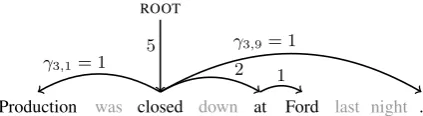
Figure 2: An illustration of commodity values for a valid solution of the non-relaxed ILP.
In order to avoid cycles in the dependency tree, we include additional variables to establish single-commodity flow(Magnanti and Wolsey, 1994) be-tween all pairs of tokens. Theseγij variables carry
non-negative real values which must be consumed by active tokens that they are incident to.
γij ≥0, ∀ti, tj ∈T (9)
X
i γij −
X
k
γjk =xj, ∀tj ∈T (10)
These constraints ensure that cyclic structures are not possible in the non-relaxed ILP. In addition, they serve to establish connectivity for the de-pendency structure z since commodity can only originate in one location—at the pseudo-token
ROOT which has no incoming commodity
vari-ables. However, in order to enforce these prop-erties on the output dependency structure, this acyclic, connected commodity structure must con-strain the activation of thezvariables.
γij −Cmaxzij ≤0, ∀ti, tj ∈T (11)
where Cmax is an arbitrary upper bound on the
value of γij variables. Figure 2 illustrates how
these commodity flow variables constrain the out-put of the ILP to be a tree. However, the effect of these constraints is diminished when solving an LP relaxation of the above problem.
In the LP relaxation,xiandzij are redefined as
real-valued variables in[0,1], potentially resulting in fractional values for dependency and token indi-cators. As a result, the commodity flow network is able to establish connectivity but cannot enforce a tree structure, for instance, directed acyclic struc-tures are possible and token indicatorsxi may be
partially be assigned to the solution structure. This poses a challenge in implementingβ(z) which is needed to recover a token configuration from the solution of this subproblem.
[image:5.595.132.230.66.130.2] [image:5.595.334.527.260.306.2]i.e., to setβ(˜z) = ˜xwhere˜xand˜zrepresent the real-valued counterparts of the incidence vectorsx andz. The viability of this approximation strategy is due to the following:
• The relaxed LP is empirically fairly tight, yielding integral solutions 89% of the time on the compression datasets described in§3.
• The bigram subproblem is guaranteed to re-turn a well-formed integral solution which obeys the imposed compression rate, so we are assured of a source of valid—if non-optimal—solutions in line 13 of Algorithm 1. We also consider another strategy that attempts to approximate a valid integral solution to the depen-dency subproblem. In order to do this, we first include an additional constraint in the relaxed LP which restrict the number of tokens in the output to a specific number of tokensR that is given by an input compression rate.
X
i
xi=R (12)
The addition of this constraint to the relaxed LP reduces the rate of integral solutions drastically— from 89% to approximately 33%—but it serves to ensure that the resulting token configuration˜xhas at least as many non-zero elements asR, i.e., there are at least as many tokens activated in the LP so-lution as are required in a valid soso-lution.
We then construct a subgraph G(˜z) consisting of all dependency edges that were assigned non-zero values in the solution, assigning to each edge a score equal to the score of that edge in the LP as well as the score of its dependent word, i.e., each
zij inG(˜z)is assigned a score ofθdep(hti, tji)− λj+ (1−ψ)·θtok(tj). Since the commodity flow
constraints in (9)–(11) ensure a connected˜z, it is therefore possible to recover a maximum-weight spanning tree from G(˜z) using the Chu-Liu Ed-monds algorithm (Chu and Liu, 1965; EdEd-monds, 1967).5 Although the runtime of this algorithm
is cubic in the size of the input graph, it is fairly speedy when applied on relatively sparse graphs such as the solutions to the LP described above. The resulting spanning tree is a useful integral approximation of˜zbut, as mentioned previously, may contain more nodes thanRdue to fractional values in˜x; we therefore repeatedly prune leaves 5A detailed description of the Chu-Liu Edmonds
algo-rithm for MSTs is available in McDonald et al. (2005).
with the lowest incoming edge weight in the cur-rent tree until exactlyRnodes remain. The result-ing tree is assumed to be a reasonable approxima-tion of the optimal integral soluapproxima-tion to this LP.
The Chu-Liu Edmonds algorithm is also em-ployed for another purpose: when the underly-ing LP for the joint inference problem is not tight—a frequent occurrence in our compression experiments—Algorithm 1 will not converge on a single primal solution and will instead oscillate between solutions that are close to the dual opti-mum. We identify this phenomenon by counting repeated solutions and, if they exceed some thresh-old lmax with at least one repeated solution from
either subproblem, we terminate the update proce-dure for Lagrange multipliers and instead attempt to identify a good solution from the repeating ones by scoring them under (2). It is straightforward to recover and score a bigram configurationyfrom a token configuration β(z). However, scoring so-lutions produced by the dynamic program from
§2.3 also requires the score over a corresponding parse tree; this can be recovered by constructing a dependency subgraph containing across only the tokens that are active inα(y) and retrieving the maximum spanning tree for that subgraph using the Chu-Liu Edmonds algorithm.
2.5 Learning and Features
The features used in this work are largely based on the features from Thadani and McKeown (2013).
• φtok contains features for part-of-speech (POS) tag sequences of length up to 3 around the token, features for the dependency label of the token conjoined with its POS, lexical features for verb stems and non-word sym-bols and morphological features that identify capitalized sequences, negations and words in parentheses.
• φbgr contains features for POS patterns in a bigram, the labels of dependency edges in-cident to it, its likelihood under a Gigaword language model (LM) and an indicator for whether it is present in the input sentence.
depen-dency (c) the label of the edge (d) the POS tags of the tokens incident to the edge and (e) the labels of their surrounding chunks and whether the edge remains within the chunk. For the experiments in the following section, we trained models using a variant of the structured perceptron (Collins, 2002) which incorporates minibatches (Zhao and Huang, 2013) for easy par-allelization and faster convergence.6 Overfitting
was avoided by averaging parameters and mon-itoring performance against a held-out develop-ment set during training. All models were trained using variants of the ILP-based inference approach of Thadani and McKeown (2013). We followed Martins et al. (2009) in using LP-relaxed inference during learning, assuming algorithmic separabil-ity (Kulesza and Pereira, 2007) for these problems.
3 Experiments
We ran compression experiments over the newswire (NW) and broadcast news transcription (BN) corpora compiled by Clarke and Lapata (2008) which contain gold compressions pro-duced by human annotators using only word deletion. The datasets were filtered to eliminate instances with less than 2 and more than 110 tokens for parser compatibility and divided into training/development/test sections following the splits from Clarke and Lapata (2008), yielding 953/63/603 instances for the NW corpus and 880/78/404 for the BN corpus. Gold dependency parses were approximated by running the Stanford dependency parser7over reference compressions.
Following evaluations in machine translation as well as previous work in sentence compres-sion (Unno et al., 2006; Clarke and Lapata, 2008; Martins and Smith, 2009; Napoles et al., 2011b; Thadani and McKeown, 2013), we evaluate sys-tem performance using F1 metrics over n-grams and dependency edges produced by parsing sys-tem output with RASP (Briscoe et al., 2006) and the Stanford parser. All ILPs and LPs were solved using Gurobi,8 a high-performance
commercial-grade solver. Following a recent analysis of com-pression evaluations (Napoles et al., 2011b) which revealed a strong correlation between system com-pression rate and human judgments of compres-sion quality, we constrained all systems to produce
6We used a minibatch size of 4 in all experiments. 7http://nlp.stanford.edu/software/ 8http://www.gurobi.com
compressed output at a specific rate—determined by the the gold compressions available for each instance—to ensure that the reported differences between the systems under study are meaningful.
3.1 Systems
We report results over the following systems grouped into three categories of models: tokens + n-grams, tokens + dependencies, and joint models.
• 3-LM: A reimplementation of the unsuper-vised ILP of Clarke and Lapata (2008) which infers order-preserving trigram variables pa-rameterized with log-likelihood under an LM and a significance score for token variables inspired by Hori and Furui (2004), as well as various linguistically-motivated constraints to encourage fluency in output compressions.
• DP:The bigram-based dynamic program of McDonald (2006) described in§2.3.9
• LP→MST: An approximate inference ap-proach based on an LP relaxation of ILP-Dep. As discussed in§2.4, a maximum span-ning tree is recovered from the output of the LP and greedily pruned in order to generate a valid integral solution while observing the imposed compression rate.
• ILP-Dep: A version of the joint ILP of Thadani and McKeown (2013) without n-gram variables and corresponding features.
• DP+LP→MST:An approximate joint infer-ence approach based on Lagrangian relax-ation that usesDPfor the maximum weight subsequence problem andLP→MSTfor the maximum weight subtree problem.
• DP+LP:Another Lagrangian relaxation ap-proach that pairs DP with the non-integral solutions from an LP relaxation of the maxi-mum weight subtree problem (cf.§2.4).
• ILP-Joint: The full ILP from Thadani and McKeown (2013), which provides an upper bound on the performance of the proposed approximation strategies.
The learning rate schedule for the Lagrangian re-laxation approaches was set asηi , τ/(τ +i),10
while the hyperparameter ψ was tuned using the
9For consistent comparisons with the other systems, our
reimplementation does not include thek-best inference strat-egy presented in McDonald (2006) for learning with MIRA.
Inference n-grams F1% Syntactic relations F1% Inference
objective technique n= 1 2 3 4 z Stanford RASP time (s)
n-grams 3-LM (CL08)DP (McD06) 74.96 60.60 46.83 38.7178.80 66.04 52.67 42.39 -- 60.5263.28 57.4957.89 0.720.01
deps LPILP-Dep→MST 79.6180.02 64.32 50.36 40.97 66.5765.99 52.42 43.07 72.43 66.8267.63 59.7060.78 0.070.16
DP + LP→MST 79.50 66.75 53.48 44.33 64.63 67.69 60.94 0.24
joint DP + LP 79.10 68.22 55.05 45.81 65.74 68.24 62.04 0.12
[image:8.595.83.515.62.188.2]ILP-Joint (TM13) 80.13 68.34 55.56 46.60 72.57 68.89 62.61 0.31
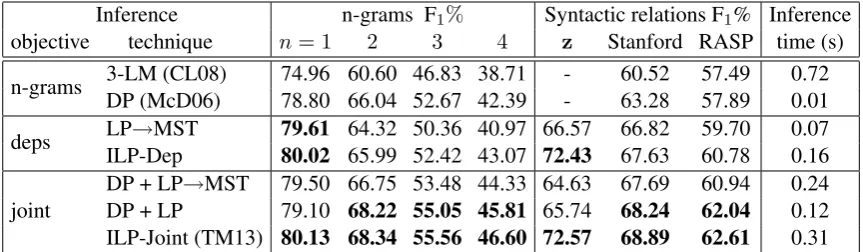
Table 1: Experimental results for the BN corpus, averaged over 3 gold compressions per instance. All systems were restricted to compress to the size of the median gold compression yielding an average compression rate of77.26%.
Inference n-grams F1% Syntactic relations F1% Inference
objective technique n= 1 2 3 4 z Stanford RASP time (s)
n-grams 3-LM (CL08)DP (McD06) 66.66 51.59 39.33 30.5573.18 58.31 45.07 34.77 -- 50.7656.23 49.5751.14 1.220.01
deps LPILP-Dep→MST 73.32 55.12 41.18 31.44 61.0173.76 57.09 43.47 33.44 65.45 58.3760.06 52.5754.31 0.120.28
DP + LP→MST 73.13 57.03 43.79 34.01 57.91 58.46 53.20 0.33
joint DP + LP 72.06 59.83 47.39 37.72 58.13 58.97 53.78 0.21
ILP-Joint (TM13) 74.00 59.90 47.22 37.01 65.65 61.29 56.24 0.60
Table 2: Experimental results for the NW corpus with all systems compressing to the size of the gold compression, yielding an average compression rate of70.24%. In both tables, bold entries show signifi-cant gains within a column under the paired t-test (p <0.05) and Wilcoxon’s signed rank test (p <0.01).
development split of each corpus.11
3.2 Results
Tables 1 and 2 summarize the results from our compression experiments on the BN and NW cor-pora respectively. Starting with the n-gram ap-proaches, the performance of 3-LM leads us to observe that the gains of supervised learning far outweigh the utility of higher-order n-gram factor-ization, which is also responsible for a significant increase in wall-clock time. In contrast,DPis an order of magnitude faster than all other approaches studied here although it is not competitive under parse-based measures such as RASP F1%which is known to correlate with human judgments of grammaticality (Clarke and Lapata, 2006).
We were surprised by the strong performance of the dependency-based inference techniques, which yielded results that approached the joint model in both n-gram and parse-based measures.
11We were surprised to observe that performance improved
significantly whenψwas set closer to 1, thereby emphasiz-ing token features in the dependency subproblem. The final values chosen wereψBN= 0.9andψNW= 0.8.
The exact ILP-Dep approach halves the run-time of ILP-Joint to produce compressions that have similar (although statistically distinguish-able) scores. Approximating dependency-based inference with LP→MST yields similar perfor-mance for a further halving of runtime; however, the performance of this approach is notably worse. Turning to the joint approaches, the strong performance of ILP-Joint is expected; less so is the relatively high but yet practically reason-able runtime that it requires. We note, how-ever, that these ILPs are solved using a highly-optimized commercial-grade solver that can uti-lize all CPU cores12 while our approximation
approaches are implemented as single-processed Python code without significant effort toward op-timization. Comparing the two approximation strategies shows a clear performance advantage for DP+LP over DP+LP→MST: the latter ap-proach entails slower inference due to the over-head of running the Chu-Liu Edmonds algorithm at every dual update, and furthermore, the error in-troduced by approximating an integral solution
sults in a significant decrease in dependency recall. In contrast, DP+LP directly optimizes the dual problem by using the relaxed dependency solution to update Lagrange multipliers and achieves the best performance on parse-based F1outside of the slower ILP approaches. Convergence rates also vary for these two techniques:DP+LPhas a lower rate of empirical convergence (15% on BN and 4%
on NW) when compared toDP+LP→MST(19%
on BN and 6% on NW).
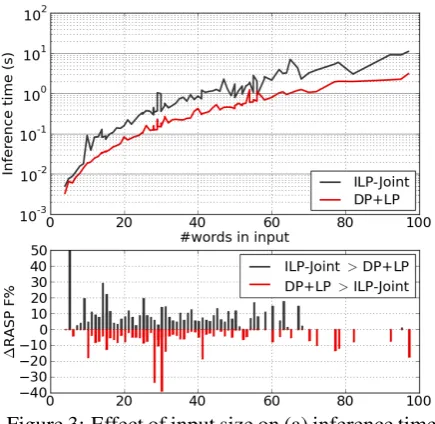
Figure 3 shows the effect of input sentence length on inference time and performance for ILP-JointandDP+LPover the NW test corpus.13 The
timing results reveal that the approximation strat-egy is consistently faster than the ILP solver. The variation in RASP F1% with input size indicates the viability of a hybrid approach which could bal-ance accuracy and speed by using ILP-Jointfor smaller problems andDP+LPfor larger ones.
4 Related Work
Sentence compression is one of the better-studied text-to-text generation problems and has been ob-served to play a significant role in human summa-rization (Jing, 2000; Jing and McKeown, 2000). Most approaches to sentence compression are su-pervised (Knight and Marcu, 2002; Riezler et al., 2003; Turner and Charniak, 2005; McDon-ald, 2006; Unno et al., 2006; Galley and McK-eown, 2007; Nomoto, 2007; Cohn and Lapata, 2009; Galanis and Androutsopoulos, 2010; Gan-itkevitch et al., 2011; Napoles et al., 2011a; Fil-ippova and Altun, 2013) following the release of datasets such as the Ziff-Davis corpus (Knight and Marcu, 2000) and the Edinburgh compression cor-pora (Clarke and Lapata, 2006; Clarke and Lap-ata, 2008), although unsupervised approaches— largely based on ILPs—have also received con-sideration (Clarke and Lapata, 2007; Clarke and Lapata, 2008; Filippova and Strube, 2008). Com-pression has also been used as a tool for document summarization (Daum´e and Marcu, 2002; Zajic et al., 2007; Clarke and Lapata, 2007; Martins and Smith, 2009; Berg-Kirkpatrick et al., 2011; Woodsend and Lapata, 2012; Almeida and Mar-tins, 2013; Molina et al., 2013; Li et al., 2013; Qian and Liu, 2013), with recent work formulating the summarization task as joint sentence extrac-tion and compression and often employing ILP or Lagrangian relaxation. Monolingual compression
[image:9.595.304.522.61.273.2]13Similar results were observed for the BN test corpus.
Figure 3: Effect of input size on (a) inference time, and (b) the corresponding difference in RASP F1% (ILP-Joint–DP+LP) on the NW corpus.
also faces many obstacles common to decoding in machine translation, and a number of approaches which have been proposed to combine phrasal and syntactic models (Huang and Chiang, 2007; Rush and Collins, 2011) inter alia offer directions for future research into compression problems.
5 Conclusion
We have presented approximate inference strate-gies to jointly compress sentences under bigram and dependency-factored objectives by exploiting the modularity of the task and considering the two subproblems in isolation. Experiments show that one of these approximation strategies produces re-sults comparable to a state-of-the-art integer linear program for the same joint inference task with a 60% reduction in average inference time.
Acknowledgments
The author is grateful to Alexander Rush for help-ful discussions and to the anonymous reviewers for their comments. This work was supported by the Intelligence Advanced Research Projects Activity (IARPA) via Department of Interior Na-tional Business Center (DoI/NBC) contract num-ber D11PC20153. The U.S. Government is autho-rized to reproduce and distribute reprints for Gov-ernmental purposes notwithstanding any copy-right annotation thereon.14
14The views and conclusions contained herein are those of
References
Miguel Almeida and Andr´e F. T. Martins. 2013. Fast and robust compressive summarization with dual
de-composition and multi-task learning. In
Proceed-ings of ACL, pages 196–206, August.
Taylor Berg-Kirkpatrick, Dan Gillick, and Dan Klein. 2011. Jointly learning to extract and compress. In Proceedings of ACL-HLT, pages 481–490.
Ted Briscoe, John Carroll, and Rebecca Watson. 2006.
The second release of the RASP system. In
Pro-ceedings of the ACL-COLING Interactive Presenta-tion Sessions.
Yoeng-jin Chu and Tseng-hong Liu. 1965. On the
shortest arborescence of a directed graph. Science
Sinica, 14:1396–1400.
James Clarke and Mirella Lapata. 2006. Models for sentence compression: a comparison across do-mains, training requirements and evaluation
mea-sures. InProceedings of ACL-COLING, pages 377–
384.
James Clarke and Mirella Lapata. 2007. Modelling compression with discourse constraints. In Proceed-ings of EMNLP-CoNLL, pages 1–11.
James Clarke and Mirella Lapata. 2008. Global in-ference for sentence compression: an integer linear programming approach. Journal for Artificial Intel-ligence Research, 31:399–429, March.
Trevor Cohn and Mirella Lapata. 2008. Sentence
com-pression beyond word deletion. InProceedings of
COLING, pages 137–144.
Trevor Cohn and Mirella Lapata. 2009. Sentence com-pression as tree transduction. Journal of Artificial Intelligence Research, 34(1):637–674, April.
Michael Collins. 2002. Discriminative training
meth-ods for hidden Markov models. In Proceedings of
EMNLP, pages 1–8.
Dipanjan Das, Andr´e F. T. Martins, and Noah A. Smith. 2012. An exact dual decomposition algo-rithm for shallow semantic parsing with constraints. InProceedings of the First Joint Conference on Lexi-cal and Computational Semantics (*SEM), SemEval ’12, pages 209–217.
Hal Daum´e, III and Daniel Marcu. 2002. A
noisy-channel model for document compression. In
Pro-ceedings of ACL, pages 449–456.
John DeNero and Klaus Macherey. 2011. Model-based aligner combination using dual
decomposi-tion. InProceedings of ACL-HLT, pages 420–429.
Jack R. Edmonds. 1967. Optimum branchings.
Jour-nal of Research of the NatioJour-nal Bureau of Standards, 71B:233–240.
Katja Filippova and Yasemin Altun. 2013. Overcom-ing the lack of parallel data in sentence compression. InProceedings of EMNLP, pages 1481–1491. Katja Filippova and Michael Strube. 2008.
Depen-dency tree based sentence compression. In
Proceed-ings of INLG, pages 25–32.
Dimitrios Galanis and Ion Androutsopoulos. 2010. An extractive supervised two-stage method for sentence
compression. InProceedings of HLT-NAACL, pages
885–893.
Michel Galley and Kathleen McKeown. 2007. Lex-icalized Markov grammars for sentence
compres-sion. In Proceedings of HLT-NAACL, pages 180–
187, April.
Juri Ganitkevitch, Chris Callison-Burch, Courtney Napoles, and Benjamin Van Durme. 2011. Learn-ing sentential paraphrases from bilLearn-ingual parallel corpora for text-to-text generation. InProceedings of EMNLP, pages 1168–1179.
Chiori Hori and Sadaoki Furui. 2004. Speech summa-rization: an approach through word extraction and a
method for evaluation. IEICE Transactions on
In-formation and Systems, E87-D(1):15–25.
Liang Huang and David Chiang. 2007. Forest rescor-ing: Faster decoding with integrated language mod-els. InProceedings of ACL, pages 144–151, June. Hongyan Jing and Kathleen R. McKeown. 2000. Cut
and paste based text summarization. InProceedings
of NAACL, pages 178–185.
Hongyan Jing. 2000. Sentence reduction for
auto-matic text summarization. In Proceedings of the
Conference on Applied Natural Language Process-ing, pages 310–315.
Kevin Knight and Daniel Marcu. 2000. Statistics-based summarization - step one: Sentence compres-sion. InProceedings of AAAI, pages 703–710. Kevin Knight and Daniel Marcu. 2002.
Summariza-tion beyond sentence extracSummariza-tion: a probabilistic ap-proach to sentence compression. Artificial Intelli-gence, 139(1):91–107, July.
Nikos Komodakis, Nikos Paragios, and Georgios Tzir-itas. 2007. MRF optimization via dual
decomposi-tion: Message-passing revisited. InProceedings of
ICCV, pages 1–8, Oct.
Terry Koo, Alexander M. Rush, Michael Collins, Tommi Jaakkola, and David Sontag. 2010. Dual decomposition for parsing with non-projective head
automata. InProceedings of EMNLP, pages 1288–
1298.
Hoong Chuin Lau, Trung Hieu Ngo, and Bao Nguyen
Nguyen. 2006. Finding a length-constrained
maximum-sum or maximum-density subtree and its application to logistics. Discrete Optimization, 3(4):385 – 391.
Chen Li, Fei Liu, Fuliang Weng, and Yang Liu. 2013. Document summarization via guided sentence
com-pression. In Proceedings of EMNLP, pages 490–
500, Seattle, Washington, USA, October.
Thomas L. Magnanti and Laurence A. Wolsey. 1994.
Optimal trees. In Technical Report 290-94,
Massechusetts Institute of Technology, Operations Research Center.
Andr´e F. T. Martins and Noah A. Smith. 2009. Sum-marization with a joint model for sentence extraction
and compression. InProceedings of the Workshop
on Integer Linear Programming for Natural Lan-gauge Processing, pages 1–9.
Andr´e F. T. Martins, Noah A. Smith, and Eric P. Xing. 2009. Concise integer linear programming
formu-lations for dependency parsing. InProceedings of
ACL-IJCNLP, pages 342–350.
Andr´e F. T. Martins, Noah A. Smith, Pedro M. Q. Aguiar, and M´ario A. T. Figueiredo. 2011. Dual decomposition with many overlapping components. InProceedings of EMNLP, pages 238–249.
Ryan McDonald, Fernando Pereira, Kiril Ribarov, and Jan Hajiˇc. 2005. Non-projective dependency
pars-ing uspars-ing spannpars-ing tree algorithms. InProceedings
of EMNLP-HLT, pages 523–530.
Ryan McDonald. 2006. Discriminative sentence
com-pression with soft syntactic evidence. In
Proceed-ings of EACL, pages 297–304.
Alejandro Molina, Juan-Manuel Torres-Moreno, Eric SanJuan, Iria da Cunha, and Gerardo Eugenio Sierra Mart´ınez. 2013. Discursive sentence com-pression. InComputational Linguistics and Intelli-gent Text Processing, volume 7817, pages 394–407. Springer.
Courtney Napoles, Chris Callison-Burch, Juri Ganitke-vitch, and Benjamin Van Durme. 2011a. Paraphras-tic sentence compression with a character-based metric: tightening without deletion. InProceedings of the Workshop on Monolingual Text-To-Text Gen-eration, pages 84–90.
Courtney Napoles, Benjamin Van Durme, and Chris Callison-Burch. 2011b. Evaluating sentence
com-pression: pitfalls and suggested remedies. In
Pro-ceedings of the Workshop on Monolingual Text-To-Text Generation, pages 91–97.
Tadashi Nomoto. 2007. Discriminative sentence
com-pression with conditional random fields.
Infor-mation Processing and Management, 43(6):1571– 1587, November.
Xian Qian and Yang Liu. 2013. Fast joint compression
and summarization via graph cuts. InProceedings
of EMNLP, pages 1492–1502, Seattle, Washington, USA, October.
Stefan Riezler, Tracy H. King, Richard Crouch, and Annie Zaenen. 2003. Statistical sentence condensa-tion using ambiguity packing and stochastic disam-biguation methods for lexical-functional grammar. InProceedings of HLT-NAACL, pages 118–125. Alexander M. Rush and Michael Collins. 2011.
Ex-act decoding of syntEx-actic translation models through
Lagrangian relaxation. InProceedings of ACL-HLT,
pages 72–82.
Alexander M. Rush, David Sontag, Michael Collins, and Tommi Jaakkola. 2010. On dual decomposition and linear programming relaxations for natural
lan-guage processing. InProceedings of EMNLP, pages
1–11.
Kapil Thadani and Kathleen McKeown. 2013. Sen-tence compression with joint structural inference. In Proceedings of CoNLL.
Jenine Turner and Eugene Charniak. 2005. Super-vised and unsuperSuper-vised learning for sentence
com-pression. InProceedings of ACL, pages 290–297.
Yuya Unno, Takashi Ninomiya, Yusuke Miyao, and Jun’ichi Tsujii. 2006. Trimming CFG parse trees for sentence compression using machine learning
approaches. InProceedings of ACL-COLING, pages
850–857.
Kristian Woodsend and Mirella Lapata. 2012. Mul-tiple aspect summarization using integer linear
pro-gramming. InProceedings of EMNLP, pages 233–
243.
David Zajic, Bonnie J. Dorr, Jimmy Lin, and Richard Schwartz. 2007. Multi-candidate reduction: Sen-tence compression as a tool for document
summa-rization tasks.Information Processing and
Manage-ment, 43(6):1549–1570, Nov.
Kai Zhao and Liang Huang. 2013. Minibatch and par-allelization for online large margin structured
learn-ing. In Proceedings of HLT-NAACL, pages 370–