Automation and Evaluation of the Keyword Method
for Second Language Learning
G¨ozde ¨Ozbal
Trento RISE Trento, Italy
Daniele Pighin
Google Z¨urich, Switzerland
Carlo Strapparava
FBK-irst Trento, Italy
Abstract
In this paper, we combine existing NLP techniques with minimal supervi-sion to build memory tips according to the keyword method, a well established mnemonic device for second language learning. We present what we believe to be the first extrinsic evaluation of a creative sentence generator on a vocabulary learn-ing task. The results demonstrate that NLP techniques can effectively support the de-velopment of resources for second lan-guage learning.
1 Introduction
The keyword method is a mnemonic device (Co-hen, 1987; Thompson, 1987) that is especially suitable for vocabulary acquisition in second lan-guage learning (Mizumoto and Kansai, 2009; Hummel, 2010; Shen, 2010; Tavakoli and Gerami, 2013). In this method, atarget word in a foreign language L2 can be learned by a native speaker of another language L1 in two main steps: 1) one or more L1 words, possibly referring to a concrete entity, are chosen based on orthographic or pho-netic similarity with the target word; 2) an L1 sen-tence is constructed in which an association be-tween the translation of the target word and the keyword(s) is established, so that the learner, when seeing or hearing the word, immediately recalls the keyword(s). To illustrate, for teaching the Ital-ian wordcuorewhich meansheartin English, the learner might be asked to imagine“a lonelyheart
with a hardcore”.
The keyword method has already been proven to be a valuable teaching device. However, the preparation of the memorization tips for each new word is an activity that requires considerable time, linguistic competence and creativity. To the best of our knowledge, there is only one study which attempts to automate the mechanism of the key-word method. In ( ¨Ozbal and Strapparava, 2011),
we proposed to automate the keyword method by retrieving sentences from the Web. However, we did not provide any evaluation to demonstrate the effectiveness of our approach in a real life sce-nario. In addition, we observed that retrieval poses severe limitations in terms of recall and sentence quality, and it might incur copyright violations.
In this paper, we overcome these limitations by introducing a semi-automatic system implement-ing the keyword method that builds upon the key-word selection mechanism of ¨Ozbal and Strappar-ava (2011) and combines it with a state-of-the-art creative sentence generation framework ( ¨Ozbal et al., 2013). We set up an experiment to simulate the situation in which a teacher needs to prepare material for a vocabulary teaching resource. Ac-cording to our scenario, the teacher relies on au-tomatic techniques to generate relatively few, high quality mnemonics in English to teach Italian vo-cabulary. She only applies a very light supervi-sion in the last step of the process, in which the most suitable among the generated sentences are selected before being presented to the learners. In this stage, the teacher may want to consider factors which are not yet in reach of automatic linguistic processors, such as the evocativeness or the mem-orability of a sentence. We show that the automat-ically generated sentences help learners to estab-lish memorable connections which augment their ability to assimilate new vocabulary. To the best of our knowledge, this work is the first documented extrinsic evaluation of a creative sentence genera-tor on a real-world application.
2 Related work
The effectiveness of the keyword method (KM) is a well-established fact (Sarıc¸oban and Bas¸ıbek, 2012). Sommer and Gruneberg (2002) found that using KM to teach French made learning easier and faster than conventional methods. Sagarra and Alba (2006) compared the effectiveness of
three learning methods including the semantic mapping, rote memorization (i.e., memorization by pure repetition, with no mnemonic aid) and keyword on beginner learners of a second lan-guage. Their results show that using KM leads to better learning of second language vocabulary for beginners. Similar results have been reported by Sarıc¸oban and Bas¸ıbek (2012) and Tavakoli and Gerami (2013). Besides all the experimental results demonstrating the effectiveness of KM, it is worthwhile to mention about the computational efforts to automate the mechanism. In ( ¨Ozbal and Strapparava, 2011) we proposed an automatic vo-cabulary teaching system which combines NLP and IR techniques to automatically generate mem-ory tips for vocabulary acquisition. The system exploits orthographic and phonetic similarity met-rics to find the best L2 keywords for each target L1 word. Sentences containing the keywords and the translation of the target word are retrieved from the Web, but we did not carry out an evaluation of the quality or the coverage of the retrieved sen-tences. In ¨Ozbal et al. (2013) we proposed an ex-tensible framework for the generation of creative sentences in which users are able to force sev-eral words to appear in the sentences. While we had discussed the potentiality of creative sentence generation as a useful teaching device, we had not validated our claim experimentally yet. As a previ-ous attempt at using NLP for education, Manurung et al. (2008) employ a riddle generator to create a language playground for children with complex communication needs.
3 Memory tip generation
Preparing memory tips based on KM includes two main ingredients: one or more keywords which are orthographically or phonetically similar to the L2 word to be learned; and a sentence in which the keywords and the translation of the target L2 word are combined in a meaningful way. In this section, we detail the process that we employed to generate such memory tips semi-automatically.
3.1 Target word selection and keyword generation
We started by compiling a collection of Ital-ian nouns consisting of three syllables from var-ious resources for vocabulary teaching includ-ing http://didattica.org/italiano. htm and http://ielanguages.com, and produced a list of 185 target L2 words. To
gen-erate the L1 keywords for each target word, we adopted a similar strategy to ¨Ozbal and Strappa-rava (2011). For each L2 target word t, the key-word selection module generates a list of possi-ble keyword pairs, K. A keyword pair k ∈ K can either consist of two non-empty strings, i.e., k= [w0, w1], or of one non-empty and one empty
string, i.e., w1 = . Each keyword pair has the
property that the concatenation of its elements is either orthographically or phonetically similar to the target wordt. Orthographic and phonetic sim-ilarity are evaluated by means of the Levenshtein distance (Levenshtein, 1966). For orthographic similarity, the distance is calculated over the char-acters in the words, while for phonetic similarity it is calculated over the phonetic representations oft andw0+w1. We use the CMU
pronuncia-tion dicpronuncia-tionary1to retrieve the phonetic
represen-tation of English words. For Italian words, instead, their phonetic representation is obtained from an unpublished phonetic lexicon developed at FBK-irst.
3.2 Keyword filtering and ranking
Unlike in ( ¨Ozbal and Strapparava, 2011), where we did not enforce any constraints for selecting the keywords, in this case we applied a more so-phisticated filtering and ranking strategy. We re-quire at least one keyword in each pair to be a content word; then, we require that at least one keyword has length≥3; finally, we discard pairs containing at least one proper noun. We allowed the keyword generation module to consider all the entries in the CMU dictionary, and rank the key-word pairs based on the following criteria in de-creasing order of precedence: 1) Keywords with a smaller orthographic/phonetic distance are pre-ferred; 2) Keywords consisting of a single word are preferred over two words (e.g., for the target word lavagna, which means blackboard, lasagna
takes precedence over love and onion); 3) Key-words that do not contain stop Key-words are preferred (e.g., for the target word pettine, which means
comb, the keyword pair pet and inn is ranked higher thanpetandin, sinceinis a stop word); 4) Keyword pairs obtained with orthographic similar-ity are preferred over those obtained with phonetic similarity, as learners might be unfamiliar with the phonetic rules of the target language. For example, for the target wordforbice, which meansscissors,
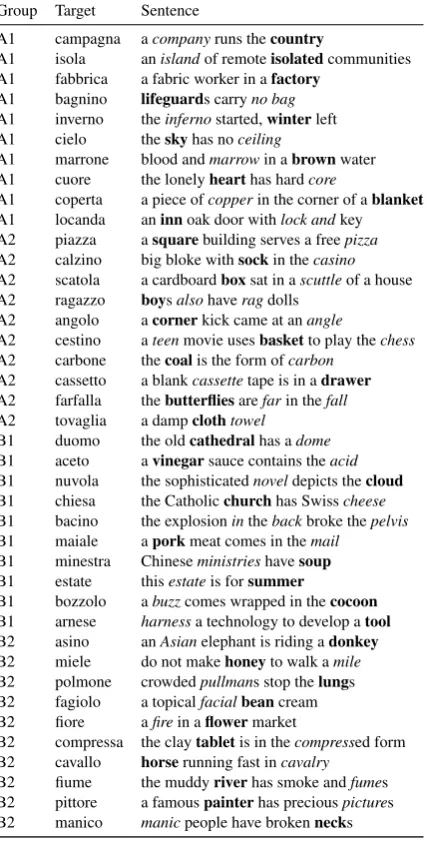
Group Target Sentence
A1 campagna acompanyruns thecountry
A1 isola anislandof remoteisolatedcommunities A1 fabbrica a fabric worker in afactory
A1 bagnino lifeguards carryno bag A1 inverno theinfernostarted,winterleft A1 cielo theskyhas noceiling
A1 marrone blood andmarrowin abrownwater A1 cuore the lonelyhearthas hardcore
A1 coperta a piece ofcopperin the corner of ablanket A1 locanda aninnoak door withlock andkey A2 piazza asquarebuilding serves a freepizza A2 calzino big bloke withsockin thecasino A2 scatola a cardboardboxsat in ascuttleof a house A2 ragazzo boysalsohaveragdolls
A2 angolo acornerkick came at anangle
A2 cestino ateenmovie usesbasketto play thechess A2 carbone thecoalis the form ofcarbon
A2 cassetto a blankcassettetape is in adrawer A2 farfalla thebutterfliesarefarin thefall A2 tovaglia a dampclothtowel
B1 duomo the oldcathedralhas adome B1 aceto avinegarsauce contains theacid B1 nuvola the sophisticatednoveldepicts thecloud B1 chiesa the Catholicchurchhas Swisscheese B1 bacino the explosioninthebackbroke thepelvis B1 maiale aporkmeat comes in themail
B1 minestra Chineseministrieshavesoup B1 estate thisestateis forsummer
B1 bozzolo abuzzcomes wrapped in thecocoon B1 arnese harnessa technology to develop atool B2 asino anAsianelephant is riding adonkey B2 miele do not makehoneyto walk amile B2 polmone crowdedpullmans stop thelungs B2 fagiolo a topicalfacialbeancream B2 fiore afirein aflowermarket
B2 compressa the claytabletis in thecompressed form B2 cavallo horserunning fast incavalry
[image:3.595.76.290.66.487.2]B2 fiume the muddyriverhas smoke andfumes B2 pittore a famouspainterhas preciouspictures B2 manico manicpeople have brokennecks
Table 1: Sentences used in the vocabulary acqui-sition experiment.
the keyword pairforandbidis preferred toforand
beach.
We selected up to three of the highest ranked keyword pairs for each target word, obtaining 407 keyword combinations for the initial 185 Italian words, which we used as the input for the sentence generator.
3.3 Sentence generation
In this step, our goal was to generate, for each Ital-ian word, sentences containing its L1 translation and the set of orthographically (or phonetically) similar keywords that we previously selected. For each keyword combination, starting from the top-ranked ones, we generated up to 10 sentences by allowing any known part-of-speech for the key-words. The sentences were produced by the state
of the art sentence generator of ¨Ozbal et al. (2013). The system relies on two corpora of automatic parses as a repository of sentence templates and lexical statistics. As for the former, we combined two resources: a corpus of 16,000 proverbs (Mi-halcea and Strapparava, 2006) and a collection of 5,000 image captions2 collected by Rashtchian et
al. (2010). We chose these two collections since they offer a combination of catchy or simple sen-tences that we expect to be especially suitable for second language learning. As for the sec-ond corpus, we used LDC’s English GigaWord 5th Edition3. Of the 12 feature functions described
in ( ¨Ozbal et al., 2013), we only implemented the following scorers: Variety (to prevent duplicate words from appearing in the sentences); Seman-tic Cohesion (to enforce the generation of sentence as lexically related to the target words as possi-ble); Alliteration, Rhyme and Plosive (to intro-duce hooks to echoic memory in the output); De-pendency Operator andN-gram (to enforce output grammaticality).
We observed that the sentence generation mod-ule was not able to generate a sentence for 24% of the input configurations. For comparison, when we attempted to retrieve sentences from the Web as suggested in ¨Ozbal and Strapparava (2011), we could collect an output for less than 10% of the in-put configurations. Besides, many of the retrieved sentences were exceedingly long and complex to be used in a second language learning experiment. 3.4 Sentence selection
For each L1 keyword pair obtained for each L2 target word, we allowed the system to output up to 10 sentences. We manually assessed the quality of the generated sentences in terms of meaningful-ness, evocativeness and grammaticality to select the most appropriate sentences to be used for the task. In addition, for keyword pairs not containing the empty string, we prioritized the sentences in which the keywords were closer to each other. For example, let us assume that we have the keywords
call and in for the target word collina. Among the sentences “The girl received a call in the bath-room” and “Call the blond girl in case you need”, the first one is preferred, since the keywords are closer to each other. Furthermore, we gave pri-ority to the sentences that included the keywords
2http://vision.cs.uiuc.edu/ pascal-sentences/
in the right order. To illustrate, for the same key-words and the target key-words, we would prefer the sentence “I called him in the morning yesterday” over “You talk a lot in a call”.
Accordingly, for each target word in random or-der, we sequentially scanned the outputs generated for each keyword pair. As soon as a sentence of adequate quality was found, we added it to our evaluation data and moved on to the next keyword. We continued this process until we selected a sen-tence for 40 distinct target words, which we set as the target size of the experiment. We had to inspect the outputs generated for 48 target words before we were able to select 40 good examples, meaning that for 17% of the target words the sen-tence generator could not produce a sensen-tence of acceptable quality.
4 Experiment setup
For our experiment, we drew inspiration from Sagarra and Alba (2006). We compared the re-tention error rate of learners who tried to memo-rize new words with or without the aid of the auto-matically generated sentences. Through academic channels, we recruited 20 native English speakers with no prior knowledge of Italian.4
After obtaining the sentences as explained in Section 3, we shuffled and then divided the whole set including 40 target words together with their translation, the generated keywords and sentences into 2 batches (A, B) and further divided each batch into 2 groups consisting of 10 elements (A1, A2, B1 and B2). The set of sentences assigned to each group is listed in Table 1: Column “ Tar-get” reports the Italian target word being taught; Column “Sentence” shows the automatically gen-erated sentence, where the translation of the tar-get word is shown in bold and the keyword(s) in italic. For the experiments, we randomly assigned each subject to one of the batches (A or B). Then, each subject was asked to memorize all the word pairs in a batch, but they would see the memory tips only for one of the two groups, which was again randomly assigned. This approach resulted in 4 different memorization exercises, namely 1) A1 with tips and A2 without, 2) A2 with tips and A1 without, 3) B1 with tips and B2 without, 4) B2 with tips and B1 without.
4We preferred to select the experiment subjects in person as opposed to crowdsourcing the evaluation to be able to ver-ify the proficiency of the subjects in the two languages and to ensure the reliability of the outcome of the evaluation.
Error rate (%) Reduction
Group Rote KW ∆e %e
A1 4.08 3.39 0.69 16.95
A2 12.07 10.42 1.65 13.69
B1 12.77 10.00 2.77 21.67
B2 22.50 12.50 10.00 44.44
Macro-average 12.85 9.08 3.78 29.39
[image:4.595.309.523.65.176.2]Micro-average 11.27 8.25 3.02 26.76
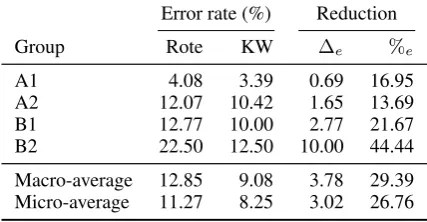
Table 2: Per-group and overall retention error rate when using rote or keyword-aided (KW) memo-rization.
When memorizing the translations without the aid of memory tips, the subjects were instructed to focus only on the Italian word and its English translation and to repeat them over and over in their mind. Conversely, when relying on the au-tomatic memory tips the subjects were shown the word, its translation and the generated sentence in-cluding the keywords. In this case, the subjects were instructed to read the sentence over and over trying to visualize it.
After going through each set of slides, we dis-tracted the subjects with a short video in order to reset their short term memory. After that, their re-tention was tested. For each Italian word in the ex-ercise, they were asked to select the English trans-lation among 5 alternatives, including the correct translation and 4 other words randomly selected from the same group. In this way, the subjects would always have to choose among the words that they encountered during the exercise.5 We
also added an extra option “I already knew this word” that the subjects were instructed to select in case they already knew the Italian word prior to taking part in the experiment.
5 Experiment results
Table 2 summarizes the outcome of the experi-ment. The contribution of the automatically gen-erated sentences to the learning task is assessed in terms of error rate-reduction, which we mea-sure both within each group (rows 1-4) and on the whole evaluation set (rows 5-6). Due to the pres-ence of the “I already knew this word” option in the learning-assessment questionnaire, the number of the actual answers provided by each subject can be slightly different, hence the difference between macro- and micro-average.
The error rate for each memorization technique t (where t = R for “Rote memorization” and t= Kfor “keyword-aided memorization”) is cal-culated as: et = cti+it t, where ct and it are the
number of correct and incorrect answers provided by the subjects, respectively. The absolute error rate reduction∆eis calculated as the absolute dif-ference in error rate between rote and keyword-aided memorization, i.e.:∆e=eR−eK. Finally,
the relative error rate reduction%eis calculated as
the the ratio between the absolute error rate reduc-tion∆eand the error rate of rote memorizationeR,
i.e.,:%e = ∆eRe = eRe−ReK.
The overall results (rows 5 and 6 in Table 2) show that vocabulary learning noticeably im-proves when supported by the generated sen-tences, with error rates dropping by almost 30% in terms of macro-average (almost 27% for micro-average). The breakdown of the error rate across the 4 groups shows a clear pattern. The results clearly indicate that one group (A1) by chance contained easier words to memorize as shown by the low error rate (between 3% and 4%) obtained with both methods. Similarly, groups A2 and B1 are of average difficulty, whereas group B2 ap-pears to be the most difficult, with an error rate higher than 22% when using only rote memoriza-tion. Interestingly, there is a strong correlation (Pearson’s r = 0.85) between the difficulty of the words in each group (measured as the error rate on rote memorization) and the positive contri-bution of the generated sentences to the learning process. In fact, we can see how the relative er-ror rate reduction%eincreases from∼17% (group
A1) to almost 45% (group B2). Based on the re-sults obtained by Sagarra and Alba (2006), who showed that the keyword method results in bet-ter long-bet-term word retention than rote memoriza-tion, we would expect the error rate reduction to be even higher in a delayed post-test. All in all, these findings clearly support the claim that a state-of-the-art sentence generator can be successfully em-ployed to support keyword-based second language learning. After completing their exercise, the sub-jects were asked to provide feedback about their experience as learners. We set up a 4-items Lik-ert scale (LikLik-ert, 1932) where each item consisted of a statement and a 5-point scale of values rang-ing from (1) [I strongly disagree] to (5) [I strongly agree]. The distribution of the answers to the ques-tions is shown in Table 3. 60% of the subjects ac-knowledged that the memory tips helped them in
Rating (%)
Question 1 2 3 4 5
Sentences helped 5 20 15 35 25
Sentences are grammatical - 25 30 35 10
Sentences are catchy - 25 10 50 15
Sentences are witty - 25 25 50
-Table 3: Evaluation of the generated sentences on a 5-point Likert scale.
the memorization process; 45% found that the sen-tences were overall correct; 65% confirmed that the sentences were catchy and easy to remember; and 50% found the sentences to be overall witty although the sentence generator does not include a mechanism to generate humor. Finally, it is worth mentioning that none of the subjects noticed that the sentences were machine generated, which we regard as a very positive assessment of the qual-ity of the sentence generation framework. From their comments, it emerges that the subjects ac-tually believed that they were just comparing two memorization techniques.
6 Conclusion and Future Work
In this paper, we have presented a semi-automatic system for the automation of the keyword method and used it to teach 40 Italian words to 20 En-glish native speakers. We let the system select appropriate keywords and generate sentences au-tomatically. For each Italian word, we selected the most suitable among the 10 highest ranked sug-gestions and used it for the evaluation. The sig-nificant reduction in retention error rate (between 17% and 45% on different word groups) for the words learned with the aid of the automatically generated sentences shows that they are a viable low-effort alternative to human-constructed exam-ples for vocabulary teaching.
As future work, it would be interesting to in-volve learners in an interactive evaluation to un-derstand the extent to which learners can bene-fit from ad-hoc personalization. Furthermore, it should be possible to use frameworks similar to the one that we presented to automate other teach-ing devices based on sentences conformteach-ing to spe-cific requirements (Dehn, 2011), such as verbal chainingandacrostic.
Acknowledgements
[image:5.595.309.524.63.151.2]References
Andrew D. Cohen. 1987. The use of verbal and imagery mnemonics in second-language vocabulary
learning. Studies in Second Language Acquisition,
9:43–61, 2.
M.J. Dehn. 2011. Working Memory and Academic
Learning: Assessment and Intervention. Wiley.
K. M. Hummel. 2010. Translation and short-term L2
vocabulary retention: Hindrance or help? Language
Teaching Research, 14(1):61–74.
V. Levenshtein. 1966. Binary codes capable of cor-recting deletions, insertions, and reversals. Soviet Physics Doklady, 10:707—710.
R. Likert. 1932. A technique for the measurement of attitudes. Archives of Psychology, 22(140):1–55.
Ruli Manurung, Graeme Ritchie, Helen Pain, Annalu Waller, Dave O’Mara, and Rolf Black. 2008. The Construction of a Pun Generator for Language Skill
Development. Appl. Artif. Intell., 22(9):841–869,
October.
R. Mihalcea and C. Strapparava. 2006. Learning to laugh (automatically): Computational models for
humor recognition. Journal of Computational
In-telligence, 22(2):126–142, May.
A. Mizumoto and O. T. Kansai. 2009. Examining the effectiveness of explicit instruction of vocabu-lary learning strategies with Japanese EFL university
students.Language Teaching Research 13, 4.
G¨ozde ¨Ozbal and Carlo Strapparava. 2011. MEANS:
Moving Effective Assonances for Novice Students. In Proceedings of the 16th International Confer-ence on Intelligent User Interfaces (IUI 2011), pages 449–450, New York, NY, USA. ACM.
G¨ozde ¨Ozbal, Daniele Pighin, and Carlo Strapparava. 2013. BRAINSUP: Brainstorming Support for
Cre-ative Sentence Generation. In Proceedings of the
51st Annual Meeting of the Association for Compu-tational Linguistics (ACL 2013), pages 1446–1455, Sofia, Bulgaria, August. Association for Computa-tional Linguistics.
Cyrus Rashtchian, Peter Young, Micah Hodosh, and Julia Hockenmaier. 2010. Collecting image
annota-tions using amazon’s mechanical turk. In
Proceed-ings of the NAACL HLT 2010 Workshop on Creating Speech and Language Data with Amazon’s Mechan-ical Turk, CSLDAMT ’10, pages 139–147, Strouds-burg, PA, USA. Association for Computational Lin-guistics.
N. Sagarra and M. Alba. 2006. The key is in the keyword: L2 vocabulary learning methods with
be-ginning learners of spanish. The Modern Language
Journal, 90(2):228–243.
A. Sarıc¸oban and N. Bas¸ıbek. 2012. Mnemonics tech-nique versus context method in teaching vocabulary
at upper-intermediate level. Journal of Education
and Science, 37(164):251–266.
Helen H. Shen. 2010. Imagery and verbal coding
ap-proaches in Chinese vocabulary instruction.
Lan-guage Teaching Research, 14(4):485–499.
Steffen Sommer and Michael Gruneberg. 2002. The use of linkword language computer courses in a classroom situation: a case study at rugby school.
’Language Learning Journal, 26(1):48–53.
M. Tavakoli and E. Gerami. 2013. The effect of key-word and pictorial methods on EFL learners’
vocab-ulary learning and retention.PORTA LINGUARUM,
19:299–316.
G. Thompson. 1987. Using bilingual