Learning Sentiment-Specific Word Embedding
for Twitter Sentiment Classification
∗Duyu Tang†, Furu Wei‡, Nan Yang\, Ming Zhou‡, Ting Liu†, Bing Qin† †Research Center for Social Computing and Information Retrieval
Harbin Institute of Technology, China
‡Microsoft Research, Beijing, China
\University of Science and Technology of China, Hefei, China {dytang, tliu, qinb}@ir.hit.edu.cn {fuwei, v-nayang, mingzhou}@microsoft.com
Abstract
We present a method that learns word em-bedding for Twitter sentiment classifica-tion in this paper. Most existing algorithm-s for learning continuoualgorithm-s word reprealgorithm-sen- represen-tations typically only model the syntactic context of words but ignore the sentimen-t of sentimen-texsentimen-t. This is problemasentimen-tic for sensentimen-ti- senti-ment analysis as they usually map word-s with word-similar word-syntactic context but oppo-site sentiment polarity, such asgood and
bad, to neighboring word vectors. We address this issue by learning sentiment-specific word embedding (SSWE), which encodes sentiment information in the con-tinuous representation of words. Specif-ically, we develop three neural networks to effectively incorporate the supervision from sentiment polarity of text (e.g. sen-tences or tweets) in their loss function-s. To obtain large scale training corpora, we learn the sentiment-specific word em-bedding from massive distant-supervised tweets collected by positive and negative emoticons. Experiments on applying SS-WE to a benchmark Twitter sentimen-t classificasentimen-tion dasentimen-tasesentimen-t in SemEval 2013 show that (1) the SSWE feature performs comparably with hand-crafted features in the top-performed system; (2) the perfor-mance is further improved by concatenat-ing SSWE with existconcatenat-ing feature set.
1 Introduction
Twitter sentiment classification has attracted in-creasing research interest in recent years (Jiang et al., 2011; Hu et al., 2013). The objective is to clas-sify the sentiment polarity of a tweet as positive,
∗This work was done when the first and third authors were visiting Microsoft Research Asia.
negative or neutral. The majority of existing ap-proaches follow Pang et al. (2002) and employ ma-chine learning algorithms to build classifiers from tweets with manually annotated sentiment polar-ity. Under this direction, most studies focus on designing effective features to obtain better clas-sification performance. For example, Mohammad et al. (2013) build the top-performed system in the Twitter sentiment classification track of SemEval 2013 (Nakov et al., 2013), using diverse sentiment lexicons and a variety of hand-crafted features.
Feature engineering is important but labor-intensive. It is therefore desirable to discover ex-planatory factors from the data and make the learn-ing algorithms less dependent on extensive fea-ture engineering (Bengio, 2013). For the task of sentiment classification, an effective feature learn-ing method is to compose the representation of a sentence (or document) from the representation-s of the wordrepresentation-s or phrarepresentation-serepresentation-s it containrepresentation-s (Socher et al., 2013b; Yessenalina and Cardie, 2011). Ac-cordingly, it is a crucial step to learn the word representation (or word embedding), which is a dense, low-dimensional and real-valued vector for a word. Although existing word embedding learn-ing algorithms (Collobert et al., 2011; Mikolov et al., 2013) are intuitive choices, they are not effec-tive enough if directly used for sentiment classi-fication. The most serious problem is that tradi-tional methods typically model the syntactic con-text of words but ignore the sentiment information of text. As a result, words with opposite polari-ty, such as goodand bad, are mapped into close vectors. It is meaningful for some tasks such as pos-tagging (Zheng et al., 2013) as the two words have similar usages and grammatical roles, but it becomes a disaster for sentiment analysis as they have the opposite sentiment polarity.
In this paper, we propose learning sentiment-specific word embedding (SSWE) for sentiment analysis. We encode the sentiment information
to the continuous representation of words, so that it is able to separategoodandbadto opposite ends of the spectrum. To this end, we extend the ex-isting word embedding learning algorithm (Col-lobert et al., 2011) and develop three neural net-works to effectively incorporate the supervision from sentiment polarity of text (e.g. sentences or tweets) in their loss functions. We learn the sentiment-specific word embedding from tweet-s, leveraging massive tweets with emoticons as distant-supervised corpora without any manual an-notations. These automatically collected tweet-s contain noitweet-setweet-s tweet-so they cannot be directly utweet-sed as gold training data to build sentiment classifier-s, but they are effective enough to provide weak-ly supervised signals for training the sentiment-specific word embedding.
We apply SSWE as features in a supervised learning framework for Twitter sentiment classi-fication, and evaluate it on the benchmark dataset in SemEval 2013. In the task of predicting posi-tive/negative polarity of tweets, our method yields 84.89% in macro-F1 by only using SSWE as fea-ture, which is comparable to the top-performed system based on hand-crafted features (84.70%). After concatenating the SSWE feature with ex-isting feature set, we push the state-of-the-art to 86.58% in macro-F1. The quality of SSWE is al-so directly evaluated by measuring the word sim-ilarity in the embedding space for sentiment lexi-cons. In the accuracy of polarity consistency be-tween each sentiment word and its top N closest words, SSWE outperforms existing word embed-ding learning algorithms.
The major contributions of the work presented in this paper are as follows.
• We develop three neural networks to learn sentiment-specific word embedding (SSWE) from massive distant-supervised tweets with-out any manual annotations;
• To our knowledge, this is the first work that exploits word embedding for Twitter senti-ment classification. We report the results that the SSWE feature performs comparably with hand-crafted features in the top-performed system in SemEval 2013;
• We release the sentiment-specific word em-bedding learned from 10 million tweets, which can be adopted off-the-shell in other sentiment analysis tasks.
2 Related Work
In this section, we present a brief review of the related work from two perspectives, Twitter senti-ment classification and learning continuous repre-sentations for sentiment classification.
2.1 Twitter Sentiment Classification
Twitter sentiment classification, which identifies the sentiment polarity of short, informal tweets, has attracted increasing research interest (Jiang et al., 2011; Hu et al., 2013) in recent years. Gen-erally, the methods employed in Twitter sentiment classification follow traditional sentiment classifi-cation approaches. The lexicon-based approaches (Turney, 2002; Ding et al., 2008; Taboada et al., 2011; Thelwall et al., 2012) mostly use a dictio-nary of sentiment words with their associated sen-timent polarity, and incorporate negation and in-tensification to compute the sentiment polarity for each sentence (or document).
The learning based methods for Twitter sen-timent classification follow Pang et al. (2002)’s work, which treat sentiment classification of texts as a special case of text categorization issue. Many studies on Twitter sentiment classification (Pak and Paroubek, 2010; Davidov et al., 2010; Bar-bosa and Feng, 2010; Kouloumpis et al., 2011; Zhao et al., 2012) leverage massive noisy-labeled tweets selected by positive and negative emoticon-s aemoticon-s training emoticon-set and build emoticon-sentiment claemoticon-semoticon-sifieremoticon-s di-rectly, which is calleddistant supervision(Go et al., 2009). Instead of directly using the distant-supervised data as training set, Liu et al. (2012) adopt the tweets with emoticons to smooth the lan-guage model and Hu et al. (2013) incorporate the emotional signals into an unsupervised learning framework for Twitter sentiment classification.
2.2 Learning Continuous Representations for Sentiment Classification
Pang et al. (2002) pioneer this field by using bag-of-word representation, representing each word as a one-hot vector. It has the same length as the size of the vocabulary, and only one dimension is 1, with all others being 0. Under this assumption, many feature learning algorithms are proposed to obtain better classification performance (Pang and Lee, 2008; Liu, 2012; Feldman, 2013). However, the one-hot word representation cannot sufficient-ly capture the complex linguistic characteristics of words.
With the revival of interest in deep learn-ing (Bengio et al., 2013), incorporatlearn-ing the con-tinuous representation of a word as features has been proving effective in a variety of NLP tasks, such as parsing (Socher et al., 2013a), language modeling (Bengio et al., 2003; Mnih and Hin-ton, 2009) and NER (Turian et al., 2010). In the field of sentiment analysis, Bespalov et al. (2011; 2012) initialize the word embedding by Laten-t SemanLaten-tic Analysis and furLaten-ther represenLaten-t each document as the linear weighted of ngram vec-tors for sentiment classification. Yessenalina and Cardie (2011) model each word as a matrix and combine words using iterated matrix multiplica-tion. Glorot et al. (2011) explore Stacked Denois-ing Autoencoders for domain adaptation in sen-timent classification. Socher et al. propose Re-cursive Neural Network (RNN) (2011b), matrix-vector RNN (2012) and Recursive Neural Tensor Network (RNTN) (2013b) to learn the composi-tionality of phrases of any length based on the representation of each pair of children recursively. Hermann et al. (2013) present Combinatory Cate-gorial Autoencoders to learn the compositionality of sentence, which marries the Combinatory Cat-egorial Grammar with Recursive Autoencoder.
The representation of words heavily relies on the applications or tasks in which it is used (Lab-utov and Lipson, 2013). This paper focuses on learning sentiment-specific word embedding, which is tailored for sentiment analysis. Un-like Maas et al. (2011) that follow the proba-bilistic document model (Blei et al., 2003) and give an sentiment predictor function to each word, we develop neural networks and map each n-gram to the sentiment polarity of sentence. Un-like Socher et al. (2011c) that utilize manually labeled texts to learn the meaning of phrase (or
sentence) through compositionality, we focus on learning the meaning of word, namely word em-bedding, from massive distant-supervised tweets. Unlike Labutov and Lipson (2013) that produce task-specific embedding from an existing word embedding, we learn sentiment-specific word em-bedding from scratch.
3 Sentiment-Specific Word Embedding for Twitter Sentiment Classification
In this section, we present the details of learn-ing sentiment-specific word embeddlearn-ing (SSWE) for Twitter sentiment classification. We pro-pose incorporating the sentiment information of sentences to learn continuous representations for words and phrases. We extend the existing word embedding learning algorithm (Collobert et al., 2011) and develop three neural networks to learn SSWE. In the following sections, we introduce the traditional method before presenting the details of SSWE learning algorithms. We then describe the use of SSWE in a supervised learning framework for Twitter sentiment classification.
3.1 C&W Model
Collobert et al. (2011) introduce C&W model to learn word embedding based on the syntactic con-texts of words. Given an ngram “cat chills on a mat”, C&W replaces the center word with a ran-dom wordwrand derives acorruptedngram“cat
chillswra mat”. The training objective is that the
original ngram is expected to obtain a higher lan-guage model score than the corrupted ngram by a margin of 1. The ranking objective function can be optimized by a hinge loss,
losscw(t, tr) =max(0,1−fcw(t) +fcw(tr))
(1) wheretis the original ngram, tr is the corrupted
ngram, fcw(·) is a one-dimensional scalar
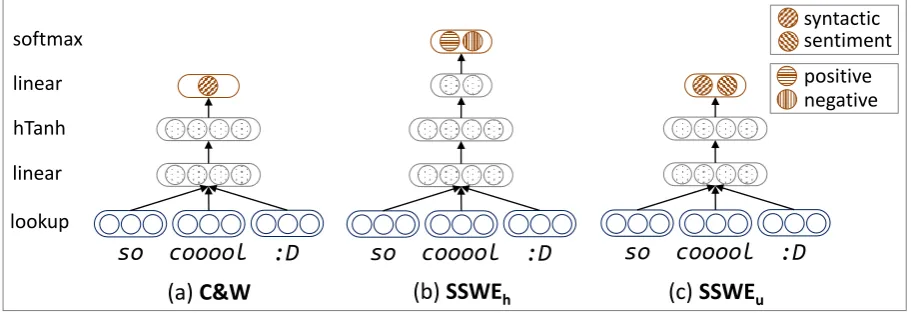
repre-senting the language model score of the input n-gram. Figure 1(a) illustrates the neural architec-ture of C&W, which consists of four layers, name-lylookup→ linear → hT anh → linear(from bottom to top). The original and corrupted ngram-s are treated angram-s inputngram-s of the feed-forward neural network, respectively. The outputfcw is the
lan-guage model score of the input, which is calculat-ed as given in Equation 2, whereLis the lookup table of word embedding,w1, w2, b1, b2are the
pa-rameters of linear layers.
so cooool :D
lookup linear hTanh linear softmax
(a) C&W
so cooool :D
(b) SSWE
hso cooool :D
(c) SSWE
u [image:4.595.71.527.65.222.2]syntactic sentiment positive negative
Figure 1: The traditional C&W model and our neural networks (SSWEh and SSWEu) for learning
sentiment-specific word embedding.
a=hT anh(w1Lt+b1) (3)
hT anh(x) =
−1 ifx <−1 x if −1≤x≤1 1 ifx >1
(4)
3.2 Sentiment-Specific Word Embedding
Following the traditional C&W model (Collobert et al., 2011), we incorporate the sentiment infor-mation into the neural network to learn sentiment-specific word embedding. We develop three neural networks with different strategies to integrate the sentiment information of tweets.
Basic Model 1 (SSWEh). As an unsupervised
approach, C&W model does not explicitly capture the sentiment information of texts. An intuitive solution to integrate the sentiment information is predicting the sentiment distribution of text based on input ngram. We do not utilize the entire tence as input because the length of different sen-tences might be variant. We therefore slide the window of ngram across a sentence, and then pre-dict the sentiment polarity based on each ngram with a shared neural network. In the neural net-work, the distributed representation of higher lay-er are intlay-erpreted as features describing the input. Thus, we utilize the continuous vector of top layer to predict the sentiment distribution of text.
Assuming there areKlabels, we modify the di-mension of top layer in C&W model as K and add a softmax layer upon the top layer. The neural network (SSWEh) is given in Figure 1(b).
Softmax layer is suitable for this scenario be-cause its outputs are interpreted as conditional probabilities. Unlike C&W, SSWEhdoes not
gen-erate any corrupted ngram. Let fg(t), where K
denotes the number of sentiment polarity label-s, be the goldK-dimensional multinomial distri-bution of input t and Pkfkg(t) = 1. For pos-itive/negative classification, the distribution is of the form [1,0] for positive and [0,1] for negative. The cross-entropy error of thesoftmaxlayer is :
lossh(t) =−
X
k={0,1}
fkg(t)·log(fh
k(t)) (5)
wherefg(t)is the gold sentiment distribution and
fh(t)is the predicted sentiment distribution.
Basic Model 2 (SSWEr). SSWEh is trained by
predicting the positive ngram as [1,0] and the neg-ative ngram as [0,1]. However, the constraint of SSWEh is too strict. The distribution of [0.7,0.3]
can also be interpreted as a positive label because the positive score is larger than the negative s-core. Similarly, the distribution of [0.2,0.8] indi-cates negative polarity. Based on the above obser-vation, the hard constraints in SSWEh should be
relaxed. If the sentiment polarity of a tweet is pos-itive, the predicted positive score is expected to be larger than the predicted negative score, and the exact reverse if the tweet has negative polarity.
We model the relaxed constraint with a rank-ing objective function and borrow the bottom four layers from SSWEh, namelylookup→linear→ hT anh → linear in Figure 1(b), to build the re-laxed neural network (SSWEr). Compared with
SSWEh, the softmaxlayer is removed because
SSWEr does not require probabilistic
de-scribed below.
lossr(t) =max(0,1−δs(t)f0r(t)
+δs(t)f1r(t) ) (6)
where fr
0 is the predicted positive score, f1r is
the predicted negative score, δs(t) is an indicator
function reflecting the sentiment polarity of a sen-tence,
δs(t) =
(
1 iffg(t) = [1,0]
−1 iffg(t) = [0,1] (7)
Similar with SSWEh, SSWEr also does not
gen-erate the corrupted ngram.
Unified Model (SSWEu). The C&W model
learns word embedding by modeling syntactic contexts of words but ignoring sentiment infor-mation. By contrast, SSWEh and SSWEr learn
sentiment-specific word embedding by integrating the sentiment polarity of sentences but leaving out the syntactic contexts of words. We develop a uni-fied model (SSWEu) in this part, which captures
the sentiment information of sentences as well as the syntactic contexts of words. SSWEu is
illus-trated in Figure 1(c).
Given an original (or corrupted) ngram and the sentiment polarity of a sentence as the in-put, SSWEupredicts a two-dimensional vector for
each input ngram. The two scalars (fu
0, f1u)
tand for language model score and sentiment s-core of the input ngram, respectively. The training objectives of SSWEu are that (1) the original
n-gram should obtain a higher language model score
fu
0(t)than the corrupted ngramf0u(tr), and (2) the
sentiment score of original ngramfu
1(t)should be
more consistent with the gold polarity annotation of sentence than corrupted ngramfu
1(tr). The loss
function of SSWEu is the linear combination of
t-wo hinge losses,
lossu(t, tr) =α·losscw(t, tr)+
(1−α)·lossus(t, tr) (8)
where losscw(t, tr) is the syntactic loss as given
in Equation 1, lossus(t, tr) is the sentiment loss
as described in Equation 9. The hyper-parameter
αweighs the two parts.
lossus(t, tr) =max(0,1−δs(t)f1u(t)
+δs(t)f1u(tr) ) (9)
Model Training. We train sentiment-specific word embedding from massive distant-supervised tweets collected with positive and negative emoti-cons1. We crawl tweets from April 1st, 2013 to
April 30th, 2013 with TwitterAPI. We tokenize each tweet with TwitterNLP (Gimpel et al., 2011), remove the@userandURLsof each tweet, and fil-ter the tweets that are too short (<7 words). Final-ly, we collect 10M tweets, selected by 5M tweets with positive emoticons and 5M tweets with nega-tive emoticons.
We train SSWEh, SSWEr and SSWEu by
taking the derivative of the loss through back-propagation with respect to the whole set of pa-rameters (Collobert et al., 2011), and use Ada-Grad (Duchi et al., 2011) to update the parame-ters. We empirically set the window size as 3, the embedding length as 50, the length of hidden lay-er as 20 and the learning rate of AdaGrad as 0.1 for all baseline and our models. We learn embed-ding for unigrams, bigrams and trigrams separate-ly with same neural network and same parameter setting. The contexts of unigram (bigram/trigram) are the surrounding unigrams (bigrams/trigrams), respectively.
3.3 Twitter Sentiment Classification
We apply sentiment-specific word embedding for Twitter sentiment classification under a supervised learning framework as in previous work (Pang et al., 2002). Instead of hand-crafting features, we incorporate the continuous representation of word-s and phraword-seword-s aword-s the feature of a tweet. The word- senti-ment classifier is built from tweets with manually annotated sentiment polarity.
We explore min, average and max convolu-tional layers (Collobert et al., 2011; Socher et al., 2011a), which have been used as simple and effective methods for compositionality learning in vector-based semantics (Mitchell and Lapata, 2010), to obtain the tweet representation. The re-sult is the concatenation of vectors derived from different convolutional layers.
z(tw) = [zmax(tw), zmin(tw), zaverage(tw)]
wherez(tw)is the representation of tweettwand
zx(tw)is the results of the convolutional layerx∈
{min, max, average}. Each convolutional layer 1We use the emoticons selected by Hu et al. (2013). The
zx employs the embedding of unigrams, bigrams
and trigrams separately and conducts the matrix-vector operation ofxon the sequence represented by columns in each lookup table. The output of
zx is the concatenation of results obtained from
different lookup tables.
zx(tw) = [wxhLuniitw, wxhLbiitw, wxhLtriitw]
where wx is the convolutional function of zx,
hLitw is the concatenated column vectors of the
words in the tweet. Luni, Lbi and Ltri are the
lookup tables of the unigram, bigram and trigram embedding, respectively.
4 Experiment
We conduct experiments to evaluate SSWE by in-corporating it into a supervised learning frame-work for Twitter sentiment classification. We also directly evaluate the effectiveness of the SSWE by measuring the word similarity in the embedding space for sentiment lexicons.
4.1 Twitter Sentiment Classification
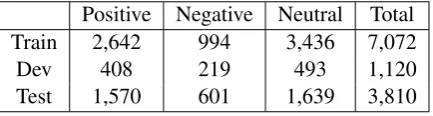
Experiment Setup and Datasets. We conduct experiments on the latest Twitter sentiment clas-sification benchmark dataset in SemEval 2013 (Nakov et al., 2013). The training and develop-ment sets were completely in full to task partici-pants. However, we were unable to download all the training and development sets because some tweets were deleted or not available due to mod-ified authorization status. The test set is directly provided to the participants. The distribution of our dataset is given in Table 1. We train sentiment classifier with LibLinear (Fan et al., 2008) on the training set, tune parameter−con the dev set and evaluate on the test set. Evaluation metric is the Macro-F1 of positive and negative categories2.
Positive Negative Neutral Total
Train 2,642 994 3,436 7,072
Dev 408 219 493 1,120
Test 1,570 601 1,639 3,810
Table 1: Statistics of the SemEval 2013 Twitter sentiment classification dataset.
2We investigate 2-class Twitter sentiment
classifica-tion (positive/negative) instead of 3-class Twitter sentiment classification (positive/negative/neutral) in SemEval2013.
Baseline Methods. We compare our method with the following sentiment classification algo-rithms:
(1)DistSuper: We use the 10 million tweets
se-lected by positive and negative emoticons as train-ing data, and build sentiment classifier with Lib-Linear and ngram features (Go et al., 2009).
(2)SVM: The ngram features and Support Vec-tor Machine are widely used baseline methods to build sentiment classifiers (Pang et al., 2002). Li-bLinear is used to train the SVM classifier.
(3) NBSVM: NBSVM (Wang and Manning,
2012) is a state-of-the-art performer on many sen-timent classification datasets, which trades-off be-tween Naive Bayes and NB-enhanced SVM.
(4)RAE: Recursive Autoencoder (Socher et al., 2011c) has been proven effective in many senti-ment analysis tasks by learning compositionality automatically. We run RAE with randomly initial-ized word embedding.
(5)NRC: NRC builds the top-performed system in SemEval 2013 Twitter sentiment classification track which incorporates diverse sentiment lexi-cons and many manually designed features. We re-implement this system because the codes are not publicly available3. NRC-ngramrefers to the
feature set ofNRCleaving out ngram features. Except forDistSuper, other baseline method-s are conducted in a method-supervimethod-sed manner. We do not compare with RNTN (Socher et al., 2013b) be-cause we cannot efficiently train the RNTN model. The reason lies in that the tweets in our dataset do not have accurately parsed results or fine grained sentiment labels for phrases. Another reason is that the RNTN model trained on movie reviews cannot be directly applied on tweets due to the d-ifferences between domains (Blitzer et al., 2007).
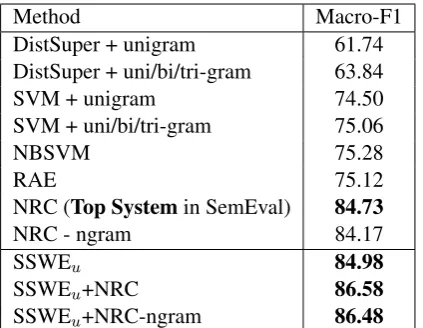
Results and Analysis. Table 2 shows the macro-F1 of the baseline systems as well as the SSWE-based methods on positive/negative sentimen-t classificasentimen-tion of sentimen-tweesentimen-ts. Dissentimen-tansentimen-t supervision is relatively weak because the noisy-labeled tweet-s are treated atweet-s the gold tweet-standard, which affecttweet-s the performance of classifier. The results of bag-of-ngram (uni/bi/tri-gram) features are not satis-fied because the one-hot word representation can-not capture the latent connections between words. NBSVM and RAE perform comparably and have 3For 3-class sentiment classification in SemEval 2013,
[image:6.595.74.291.620.678.2]Method Macro-F1
DistSuper + unigram 61.74
DistSuper + uni/bi/tri-gram 63.84
SVM + unigram 74.50
SVM + uni/bi/tri-gram 75.06
NBSVM 75.28
RAE 75.12
NRC (Top Systemin SemEval) 84.73
NRC - ngram 84.17
SSWEu 84.98
SSWEu+NRC 86.58
[image:7.595.77.289.61.225.2]SSWEu+NRC-ngram 86.48
Table 2: Macro-F1 on positive/negative classifica-tion of tweets.
a big gap in comparison with the NRC and SSWE-based methods. The reason is that RAE and NB-SVM learn the representation of tweets from the small-scale manually annotated training set, which cannot well capture the comprehensive linguistic phenomenons of words.
NRC implements a variety of features and reaches 84.73% in macro-F1, verifying the impor-tance of a better feature representation for Twit-ter sentiment classification. We achieve 84.98% by using only SSWEuas features without
borrow-ing any sentiment lexicons or hand-crafted rules. The results indicate that SSWEu automatically
learns discriminative features from massive tweets and performs comparable with the state-of-the-art manually designed features. After concatenating SSWEu with the feature set of NRC, the
perfor-mance is further improved to 86.58%. We also compare SSWEu with the ngram feature by
inte-grating SSWE intoNRC-ngram. The concatenated featuresSSWEu+NRC-ngram(86.48%)
outperfor-m the original feature set of NRC (84.73%). As a reference, we apply SSWEu on
subjec-tive classification of tweets, and obtain 72.17% in macro-F1 by using only SSWEu as feature.
Af-ter combining SSWEuwith the feature set of
NR-C, we improve NRC from 74.86% to 75.39% for subjective classification.
Comparision between Different Word Embed-ding. We compare sentiment-specific word em-bedding (SSWEh, SSWEr, SSWEu) with
base-line embedding learning algorithms by only us-ing word embeddus-ing as features for Twitter sen-timent classification. We use the embedding of u-nigrams, bigrams and trigrams in the
experimen-t. The embeddings of C&W (Collobert et al., 2011), word2vec4, WVSA (Maas et al., 2011) and
our models are trained with the same dataset and same parameter setting. We compare with C&W and word2vec as they have been proved effective in many NLP tasks. The trade-off parameter of ReEmb (Labutov and Lipson, 2013) is tuned on the development set of SemEval 2013.
Table 3 shows the performance on the pos-itive/negative classification of tweets5.
ReEm-b(C&W) and ReEmb(w2v) stand for the use of embeddings learned from 10 million distant-supervised tweets with C&W and word2vec, re-spectively. Each row of Table 3 represents a word embedding learning algorithm. Each column s-tands for a type of embedding used to compose features of tweets. The columnuni+bidenotes the use of unigram and bigram embedding, and the column uni+bi+tri indicates the use of unigram, bigram and trigram embedding.
Embedding unigram uni+bi uni+bi+tri
C&W 74.89 75.24 75.89
Word2vec 73.21 75.07 76.31
ReEmb(C&W) 75.87 – –
ReEmb(w2v) 75.21 – –
WVSA 77.04 – –
SSWEh 81.33 83.16 83.37
SSWEr 80.45 81.52 82.60
[image:7.595.308.527.347.470.2]SSWEu 83.70 84.70 84.98
Table 3: Macro-F1 on positive/negative classifica-tion of tweets with different word embeddings.
From the first column of Table 3, we can see that the performance of C&W and word2vec are obvi-ously lower than sentiment-specific word embed-dings by only using unigram embedding as fea-tures. The reason is that C&W and word2vec do not explicitly exploit the sentiment information of the text, resulting in that the words with oppo-site polarity such as good and bad are mapped to close word vectors. When such word embed-dings are fed as features to a Twitter sentimen-t classifier, sentimen-the discriminasentimen-tive abilisentimen-ty of sensentimen-timensentimen-t words are weakened thus the classification perfor-mance is affected. Sentiment-specific word em-4Available at https://code.google.com/p/word2vec/. We
utilize the Skip-gram model because it performs better than CBOW in our experiments.
5MVSA and ReEmb are not suitable for learning bigram
beddings (SSWEh, SSWEr, SSWEu) effectively
distinguish words with opposite sentiment polarity and perform best in three settings. SSWE outper-forms MVSA by exploiting more contextual infor-mation in the sentiment predictor function. SSWE outperforms ReEmb by leveraging more senti-ment information from massive distant-supervised tweets. Among three sentiment-specific word em-beddings, SSWEucaptures more context
informa-tion and yields best performance. SSWEh and
SSWErobtain comparative results.
From each row of Table 3, we can see that the bigram and trigram embeddings consistently im-prove the performance of Twitter sentiment classi-fication. The underlying reason is that a phrase, which cannot be accurately represented by uni-gram embedding, is directly encoded into the n-gram embedding as an idiomatic unit. A typical case in sentiment analysis is that the composed phrase and multiword expression may have a dif-ferent sentiment polarity than the individual word-s it containword-s, word-such aword-snot [bad] and [great] deal of (the word in the bracket has different sentiment polarity with the ngram). A very recent study by Mikolov et al. (2013) also verified the effective-ness of phrase embedding for analogically reason-ing phrases.
Effect of α in SSWEu We tune the
hyper-parameterαof SSWEuon the development set by
using unigram embedding as features. As given in Equation 8,αis the weighting score of syntac-tic loss of SSWEuand trades-off the syntactic and
sentiment losses. SSWEu is trained from 10
mil-lion distant-supervised tweets.
0 0.1 0.2 0.3 0.4 0.5 0.6 0.7 0.8 0.9 1 0.77
0.78 0.79 0.8 0.81 0.82 0.83 0.84
α
Macro−F1
[image:8.595.308.524.326.458.2]SSWEu
Figure 2: Macro-F1 of SSWEu on the
develop-ment set of SemEval 2013 with differentα.
Figure 2 shows the macro-F1 of SSWEuon
pos-itive/negative classification of tweets with differ-ent α on our development set. We can see that
SSWEu performs better when α is in the range
of [0.5, 0.6], which balances the syntactic context and sentiment information. The model withα=1 stands for C&W model, which only encodes the syntactic contexts of words. The sharp decline at
α=1 reflects the importance of sentiment informa-tion in learning word embedding for Twitter senti-ment classification.
Effect of Distant-supervised Data in SSWEu
We investigate how the size of the distant-supervised data affects the performance of SSWEu
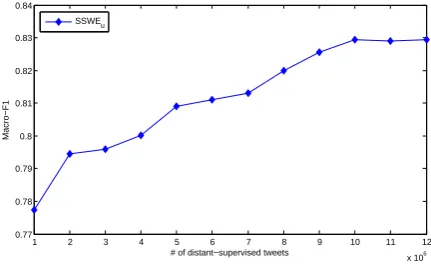
feature for Twitter sentiment classification. We vary the number of distant-supervised tweets from 1 million to 12 million, increased by 1 million. We set theα of SSWEu as 0.5, according to the
experiments shown in Figure 2. Results of posi-tive/negative classification of tweets on our devel-opment set are given in Figure 3.
1 2 3 4 5 6 7 8 9 10 11 12
x 106 0.77
0.78 0.79 0.8 0.81 0.82 0.83 0.84
# of distant−supervised tweets
Macro−F1
SSWEu
Figure 3: Macro-F1 of SSWEuwith different size
of distant-supervised data on our development set.
We can see that when more distant-supervised tweets are added, the accuracy of SSWEu
con-sistently improves. The underlying reason is that when more tweets are incorporated, the word em-bedding is better estimated as the vocabulary size is larger and the context and sentiment informa-tion are richer. When we have 10 million distant-supervised tweets, the SSWEu feature increases
the macro-F1 of positive/negative classification of tweets to 82.94% on our development set. When we have more than 10 million tweets, the per-formance remains stable as the contexts of words have been mostly covered.
4.2 Word Similarity of Sentiment Lexicons
[image:8.595.74.291.543.674.2]em-bedding space for sentiment lexicons. The evalua-tion metric is the accuracy of polarity consistency between each sentiment word and its topNclosest words in the sentiment lexicon,
Accuracy =
P#Lex
i=1 PNj=1β(wi, cij)
#Lex×N (10)
where#Lexis the number of words in the senti-ment lexicon,wiis thei-thword in the lexicon,cij
is thej-thclosest word towiin the lexicon with co-sine similarity, β(wi, cij) is an indicator function that is equal to 1 ifwiandcij have the same
sen-timent polarity and 0 for the opposite case. The higher accuracy refers to a better polarity consis-tency of words in the sentiment lexicon. We setN
as 100 in our experiment.
Experiment Setup and Datasets We utilize the widely-used sentiment lexicons, namely M-PQA (Wilson et al., 2005) andHL (Hu and Liu, 2004), to evaluate the quality of word embedding. For each lexicon, we remove the words that do not appear in the lookup table of word embedding. We only use unigram embedding in this section because these sentiment lexicons do not contain phrases. The distribution of the lexicons used in this paper is listed in Table 4.
Lexicon Positive Negative Total
HL 1,331 2,647 3,978
MPQA 1,932 2,817 4,749
[image:9.595.318.518.61.200.2]Joint 1,051 2,024 3,075
Table 4: Statistics of the sentiment lexicons. Join-tstands for the words that occur in both HL and
MPQAwith the same sentiment polarity.
Results. Table 5 shows our results com-pared to other word embedding learning al-gorithms. The accuracy of random result is 50% as positive and negative words are ran-domly occurred in the nearest neighbors of each word. Sentiment-specific word embed-dings (SSWEh, SSWEr, SSWEu) outperform
ex-isting neural models (C&W, word2vec) by large margins. SSWEu performs best in three
lexicon-s. SSWEh and SSWEr have comparable
perfor-mances. Experimental results further demonstrate that sentiment-specific word embeddings are able to capture the sentiment information of texts and distinguish words with opposite sentiment polari-ty, which are not well solved in traditional neural
Embedding HL MPQA Joint
Random 50.00 50.00 50.00
C&W 63.10 58.13 62.58
Word2vec 66.22 60.72 65.59
ReEmb(C&W) 64.81 59.76 64.09
ReEmb(w2v) 67.16 61.81 66.39
WVSA 68.14 64.07 67.12
SSWEh 74.17 68.36 74.03
SSWEr 73.65 68.02 73.14
SSWEu 77.30 71.74 77.33
Table 5: Accuracy of the polarity consistency of words in different sentiment lexicons.
models like C&W and word2vec. SSWE outper-forms MVSA and ReEmb by exploiting more con-text information of words and sentiment informa-tion of sentences, respectively.
5 Conclusion
In this paper, we propose learning continuous word representations as features for Twitter sen-timent classification under a supervised learning framework. We show that the word embedding learned by traditional neural networks are not ef-fective enough for Twitter sentiment classification. These methods typically only model the contex-t informacontex-tion of words so contex-thacontex-t contex-they cannocontex-t dis-tinguish words with similar context but opposite sentiment polarity (e.g.goodandbad). We learn sentiment-specific word embedding (SSWE) by integrating the sentiment information into the loss functions of three neural networks. We train SS-WE with massive distant-supervised tweets select-ed by positive and negative emoticons. The ef-fectiveness of SSWE has been implicitly evaluat-ed by using it as features in sentiment classifica-tion on the benchmark dataset in SemEval 2013, and explicitly verified by measuring word similar-ity in the embedding space for sentiment lexicon-s. Our unified model combining syntactic context of words and sentiment information of sentences yields the best performance in both experiments.
Acknowledgments
[image:9.595.89.275.441.495.2]References
Luciano Barbosa and Junlan Feng. 2010. Robust senti-ment detection on twitter from biased and noisy
da-ta. In Proceedings of International Conference on
Computational Linguistics, pages 36–44.
Yoshua Bengio, R´ejean Ducharme, Pascal Vincent, and Christian Janvin. 2003. A neural probabilistic
lan-guage model. Journal of Machine Learning
Re-search, 3:1137–1155.
Yoshua Bengio, Aaron Courville, and Pascal Vincent. 2013. Representation learning: A review and new
perspectives. IEEE Trans. Pattern Analysis and
Ma-chine Intelligence.
Yoshua Bengio. 2013. Deep learning of
represen-tations: Looking forward. arXiv preprint
arX-iv:1305.0445.
Dmitriy Bespalov, Bing Bai, Yanjun Qi, and Ali Shok-oufandeh. 2011. Sentiment classification based on
supervised latent n-gram analysis. InProceedings
of the Conference on Information and Knowledge Management, pages 375–382.
Dmitriy Bespalov, Yanjun Qi, Bing Bai, and Ali Shok-oufandeh. 2012. Sentiment classification with
su-pervised sequence embedding. In Machine
Learn-ing and Knowledge Discovery in Databases, pages 159–174. Springer.
David M Blei, Andrew Y Ng, and Michael I Jordan.
2003. Latent dirichlet allocation. the Journal of
ma-chine Learning research, 3:993–1022.
John Blitzer, Mark Dredze, and Fernando Pereira. 2007. Biographies, bollywood, boom-boxes and blenders: Domain adaptation for sentiment
classi-fication. InAnnual Meeting of the Association for
Computational Linguistics, volume 7.
Ronan Collobert, Jason Weston, L´eon Bottou, Michael Karlen, Koray Kavukcuoglu, and Pavel Kuksa. 2011. Natural language processing (almost) from
scratch. Journal of Machine Learning Research,
12:2493–2537.
Dmitry Davidov, Oren Tsur, and Ari Rappoport. 2010. Enhanced sentiment learning using twitter hashtags
and smileys. InProceedings of International
Con-ference on Computational Linguistics, pages 241– 249.
Xiaowen Ding, Bing Liu, and Philip S Yu. 2008. A holistic lexicon-based approach to opinion mining. In Proceedings of the International Conference on Web Search and Data Mining, pages 231–240.
John Duchi, Elad Hazan, and Yoram Singer. 2011. Adaptive subgradient methods for online learning
and stochastic optimization. The Journal of
Ma-chine Learning Research, pages 2121–2159.
Rong-En Fan, Kai-Wei Chang, Cho-Jui Hsieh, Xiang-Rui Wang, and Chih-Jen Lin. 2008. Liblinear: A
library for large linear classification. The Journal of
Machine Learning Research, 9:1871–1874.
Ronen Feldman. 2013. Techniques and
application-s for application-sentiment analyapplication-siapplication-s. Communications of the
ACM, 56(4):82–89.
Kevin Gimpel, Nathan Schneider, Brendan O’Connor, Dipanjan Das, Daniel Mills, Jacob Eisenstein, Michael Heilman, Dani Yogatama, Jeffrey Flanigan, and Noah A. Smith. 2011. Part-of-speech tagging for twitter: Annotation, features, and experiments. InProceedings of the Annual Meeting of the Associ-ation for ComputAssoci-ational Linguistics, pages 42–47. Xavier Glorot, Antoine Bordes, and Yoshua Bengio.
2011. Domain adaptation for large-scale sentiment
classification: A deep learning approach.
Proceed-ings of International Conference on Machine Learn-ing.
Alec Go, Richa Bhayani, and Lei Huang. 2009. Twit-ter sentiment classification using distant supervision.
CS224N Project Report, Stanford, pages 1–12. Karl Moritz Hermann and Phil Blunsom. 2013. The
role of syntax in vector space models of
compo-sitional semantics. In Proceedings of the Annual
Meeting of the Association for Computational Lin-guistics, pages 894–904.
Ming Hu and Bing Liu. 2004. Mining and
summa-rizing customer reviews. InProceedings of the tenth
ACM SIGKDD Conference on Knowledge Discovery and Data Mining, pages 168–177.
Xia Hu, Jiliang Tang, Huiji Gao, and Huan Liu. 2013. Unsupervised sentiment analysis with
emo-tional signals. In Proceedings of the International
World Wide Web Conference, pages 607–618. Long Jiang, Mo Yu, Ming Zhou, Xiaohua Liu, and
Tiejun Zhao. 2011. Target-dependent twitter
sen-timent classification. The Proceeding of Annual
Meeting of the Association for Computational Lin-guistics, 1:151–160.
Efthymios Kouloumpis, Theresa Wilson, and Johanna Moore. 2011. Twitter sentiment analysis: The good
the bad and the omg! In The International AAAI
Conference on Weblogs and Social Media.
Igor Labutov and Hod Lipson. 2013. Re-embedding
words. In Annual Meeting of the Association for
Computational Linguistics.
Kun-Lin Liu, Wu-Jun Li, and Minyi Guo. 2012. E-moticon smoothed language models for twitter
sen-timent analysis. InThe Association for the
Advance-ment of Artificial Intelligence.
Andrew L Maas, Raymond E Daly, Peter T Pham, Dan Huang, Andrew Y Ng, and Christopher Potts. 2011. Learning word vectors for sentiment analysis. In
Proceedings of the Annual Meeting of the Associ-ation for ComputAssoci-ational Linguistics.
Tomas Mikolov, Ilya Sutskever, Kai Chen, Greg Corra-do, and Jeffrey Dean. 2013. Distributed representa-tions of words and phrases and their compositionali-ty. The Conference on Neural Information Process-ing Systems.
Jeff Mitchell and Mirella Lapata. 2010. Composition
in distributional models of semantics. Cognitive
Sci-ence, 34(8):1388–1429.
Andriy Mnih and Geoffrey E Hinton. 2009. A s-calable hierarchical distributed language model. In
Advances in neural information processing systems, pages 1081–1088.
Saif M Mohammad, Svetlana Kiritchenko, and Xiao-dan Zhu. 2013. Nrc-canada: Building the
state-of-the-art in sentiment analysis of tweets. Proceedings
of the International Workshop on Semantic Evalua-tion.
Preslav Nakov, Sara Rosenthal, Zornitsa Kozareva, Veselin Stoyanov, Alan Ritter, and Theresa Wilson. 2013. Semeval-2013 task 2: Sentiment analysis in
twitter. In Proceedings of the International
Work-shop on Semantic Evaluation, volume 13.
Alexander Pak and Patrick Paroubek. 2010. Twitter as a corpus for sentiment analysis and opinion mining. InProceedings of Language Resources and Evalua-tion Conference, volume 2010.
Bo Pang and Lillian Lee. 2008. Opinion mining and
sentiment analysis. Foundations and trends in
infor-mation retrieval, 2(1-2):1–135.
Bo Pang, Lillian Lee, and Shivakumar Vaithyanathan. 2002. Thumbs up?: sentiment classification using
machine learning techniques. InProceedings of the
Conference on Empirical Methods in Natural Lan-guage Processing, pages 79–86.
Richard Socher, Eric H Huang, Jeffrey Pennington, Andrew Y Ng, and Christopher D Manning. 2011a. Dynamic pooling and unfolding recursive
autoen-coders for paraphrase detection. The Conference
on Neural Information Processing Systems, 24:801– 809.
Richard Socher, Cliff C Lin, Andrew Ng, and Chris Manning. 2011b. Parsing natural scenes and nat-ural language with recursive nenat-ural networks. In
Proceedings of the International Conference on Ma-chine Learning, pages 129–136.
Richard Socher, J. Pennington, E.H. Huang, A.Y. Ng, and C.D. Manning. 2011c. Semi-supervised recur-sive autoencoders for predicting sentiment
distribu-tions. InConference on Empirical Methods in
Nat-ural Language Processing, pages 151–161.
Richard Socher, Brody Huval, Christopher D. Man-ning, and Andrew Y. Ng. 2012. Semantic Com-positionality Through Recursive Matrix-Vector
S-paces. InProceedings of the Conference on
Empiri-cal Methods in Natural Language Processing. Richard Socher, John Bauer, Christopher D. Manning,
and Andrew Y. Ng. 2013a. Parsing with
composi-tional vector grammars. InAnnual Meeting of the
Association for Computational Linguistics.
Richard Socher, Alex Perelygin, Jean Wu, Jason Chuang, Christopher D. Manning, Andrew Ng, and Christopher Potts. 2013b. Recursive deep models for semantic compositionality over a sentiment
tree-bank. InConference on Empirical Methods in
Nat-ural Language Processing, pages 1631–1642. Maite Taboada, Julian Brooke, Milan Tofiloski,
Kim-berly Voll, and Manfred Stede. 2011.
Lexicon-based methods for sentiment analysis.
Computa-tional linguistics, 37(2):267–307.
Mike Thelwall, Kevan Buckley, and Georgios Pal-toglou. 2012. Sentiment strength detection for the
social web. Journal of the American Society for
In-formation Science and Technology, 63(1):163–173. Joseph Turian, Lev Ratinov, and Yoshua Bengio. 2010.
Word representations: a simple and general method
for semi-supervised learning. Annual Meeting of the
Association for Computational Linguistics.
Peter D Turney. 2002. Thumbs up or thumbs down?: semantic orientation applied to unsupervised
classi-fication of reviews. InProceedings of Annual
Meet-ing of the Association for Computational LMeet-inguistic-
Linguistic-s, pages 417–424.
Sida Wang and Christopher D Manning. 2012. Base-lines and bigrams: Simple, good sentiment and topic
classification. InProceedings of the Annual
Meet-ing of the Association for Computational LMeet-inguistic-
Linguistic-s, pages 90–94.
Theresa Wilson, Janyce Wiebe, and Paul Hoffmann. 2005. Recognizing contextual polarity in
phrase-level sentiment analysis. InProceedings of the
Con-ference on Empirical Methods in Natural Language Processing, pages 347–354.
Ainur Yessenalina and Claire Cardie. 2011. Compo-sitional matrix-space models for sentiment analysis. InProceedings of Conference on Empirical Methods in Natural Language Processing, pages 172–182. Jichang Zhao, Li Dong, Junjie Wu, and Ke Xu. 2012.
Moodlens: an emoticon-based sentiment analysis
system for chinese tweets. In Proceedings of the
18th ACM SIGKDD international conference on Knowledge discovery and data mining.
Xiaoqing Zheng, Hanyang Chen, and Tianyu Xu. 2013. Deep learning for chinese word
segmenta-tion and pos tagging. In Proceedings of the