Adaptive Recursive Neural Network
for Target-dependent Twitter Sentiment Classification
Li Dong†∗ Furu Wei‡ Chuanqi Tan†∗ Duyu Tang|∗ Ming Zhou‡ Ke Xu† †Beihang University, Beijing, China
‡Microsoft Research, Beijing, China
|Harbin Institute of Technology, Harbin, China
[email protected] [email protected] {ysjtcq,tangduyu}@gmail.com [email protected] [email protected]
Abstract
We propose Adaptive Recursive Neural Network (AdaRNN) for target-dependent Twitter sentiment classification. AdaRNN adaptively propagates the sentiments of words to target depending on the context and syntactic relationships between them. It consists of more than one composition functions, and we model the adaptive sen-timent propagations as distributions over these composition functions. The experi-mental studies illustrate that AdaRNN im-proves the baseline methods. Further-more, we introduce a manually annotated dataset for target-dependent Twitter senti-ment analysis.
1 Introduction
Twitter becomes one of the most popular social networking sites, which allows the users to read and post messages (i.e. tweets) up to 140 charac-ters. Among the great varieties of topics, people in Twitter tend to express their opinions for the brands, celebrities, products and public events. As a result, it attracts much attention to estimate the crowd’s sentiments in Twitter.
For the tweets, our task is to classify their senti-ments for a given target as positive, negative, and neutral. People may mention several entities (or targets) in one tweet, which affects the availabil-ities for most of existing methods. For example, the tweet “@ballmer: windows phone is better than ios!” has three targets (@ballmer, windows phone, andios). The user expresses neutral, pos-itive, and negative sentiments for them, respec-tively. If target information is ignored, it is diffi-cult to obtain the correct sentiment for a specified target. For target-dependent sentiment classifica-tion, the manual evaluation of Jiang et al. (2011)
∗Contribution during internship at Microsoft Research.
show that about 40% of errors are caused by not considering the targets in classification.
The features used in traditional learning-based methods (Pang et al., 2002; Nakagawa et al., 2010) are independent to the targets, hence the results are computed despite what the targets are. Hu and Liu (2004) regard the features of products as tar-gets, and sentiments for them are heuristically de-termined by the dominant opinion words. Jiang et al. (2011) combine the target-independent fea-tures (content and lexicon) and target-dependent features (rules based on the dependency parsing results) together in subjectivity classification and polarity classification for tweets.
In this paper, we mainly focus on integrating target information with Recursive Neural Network (RNN) to leverage the ability of deep learning models. The neural models use distributed repre-sentation (Hinton, 1986; Rumelhart et al., 1986; Bengio et al., 2003) to automatically learn fea-tures for target-dependent sentiment classification. RNN utilizes the recursive structure of text, and it has achieved state-of-the-art sentiment analysis re-sults for movie review dataset (Socher et al., 2012; Socher et al., 2013). The recursive neural mod-els employ the semantic composition functions, which enables them to handle the complex com-positionalities in sentiment analysis.
Specifically, we propose a framework which learns to propagate the sentiments of words to-wards the target depending on context and syn-tactic structure. We employ a novel adaptive multi-compositionality layer in recursive neural network, which is named as AdaRNN (Dong et al., 2014). It consists of more than one compo-sition functions, and we model the adaptive sen-timent propagations as learning distributions over these composition functions. We automatically learn the composition functions and how to select them from supervisions, instead of choosing them heuristically or by hand-crafted rules. AdaRNN
determines how to propagate the sentiments to-wards the target and handles the negation or in-tensification phenomena (Taboada et al., 2011) in sentiment analysis. In addition, we introduce a manually annotated dataset, and conduct extensive experiments on it. The experimental results sug-gest that our approach yields better performances than the baseline methods.
2 RNN: Recursive Neural Network
RNN (Socher et al., 2011) represents the phrases and words asD-dimensional vectors. It performs compositions based on the binary trees, and obtain the vector representations in a bottom-up way.
not very good
Negative
Softmax
[image:2.595.311.528.447.618.2]very good not very good
Figure 1: The composition process for “not very good” in Recursive Neural Network.
As illustrated in Figure 1, we obtain the repre-sentation of “very good” by the composition of “very” and “good”, and the representation of tri-gram “not very good” is recursively obtained by the vectors of “not” and “very good”. The di-mensions of parent node are calculated by linear combination of the child vectors’ dimensions. The vector representationvis obtained via:
v=f(g(vl,vr)) =f
W
vl
vr
+b
(1)
where vl,vr are the vectors of its left and right child,gis the composition function,f is the non-linearity function (such as tanh, sigmoid, softsign, etc.),W ∈RD×2Dis the composition matrix, and
b is the bias vector. The dimension of v is the same as its child vectors, and it is recursively used in the next step. Notably, the word vectors in the leaf nodes are regarded as the parameters, and will be updated according to the supervisions.
The vector representation of root node is then fed into a softmax classifier to predict the label. Thek-th element of softmax(x)is exp{xk}
P
jexp{xj}. For
a vector, the softmax obtains the distribution over
K classes. Specifically, the predicted distribution is y = softmax(Uv), where y is the predicted distribution,U ∈RK×D is the classification ma-trix, andvis the vector representation of node.
3 Our Approach
We use the dependency parsing results to find the words syntactically connected with the interested target. Adaptive Recursive Neural Network is pro-posed to propagate the sentiments of words to the target node. We model the adaptive sentiment propagations as semantic compositions. The com-putation process is conducted in a bottom-up man-ner, and the vector representations are computed recursively. After we obtain the representation of target node, a classifier is used to predict the sen-timent label according to the vector.
In Section 3.1, we show how to build recur-sive structure for target using the dependency pars-ing results. In Section 3.2, we propose Adaptive Recursive Neural Network and use it for target-dependent sentiment analysis.
3.1 Build Recursive Structure
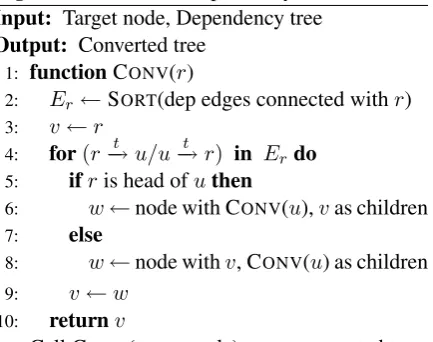
The dependency tree indicates the dependency re-lations between words. As described above, we propagate the sentiments of words to the target. Hence the target is placed at the root node to com-bine with its connected words recursively. The de-pendency relation types are remained to guide the sentiment propagations in our model.
Algorithm 1Convert Dependency Tree
Input: Target node, Dependency tree
Output: Converted tree 1: functionCONV(r)
2: Er←SORT(dep edges connected withr) 3: v←r
4: for(r −→t u/u→−t r) in Erdo 5: ifris head ofuthen
6: w←node with CONV(u),vas children
7: else
8: w←node withv, CONV(u) as children
9: v←w
10: returnv
11: Call CONV(target node) to get converted tree
child nodes in a certain order. We use two rules to determine the order of combinations: (1) the words whose head is the target in dependency tree are first combined, and then the rest of connected words are combined; (2) if the first rule cannot de-termine the order, the connected words are sorted by their positions in sentence from right to left. Notably, the conversion is performed recursively for the connected words and the dependency rela-tion types are remained. Figure 2 shows the con-verted results for different targets in one sentence.
3.2 AdaRNN: Adaptive Recursive Neural Network
RNN employs one global matrix to linearly com-bine the elements of vectors. Sometimes it is challenging to obtain a single powerful function to model the semantic composition, which moti-vates us to propose AdaRNN. The basic idea of AdaRNN is to use more than one composition functions and adaptively select them depending on the linguistic tags and the combined vectors. The model learns to propagate the sentiments of words by using the different composition functions.
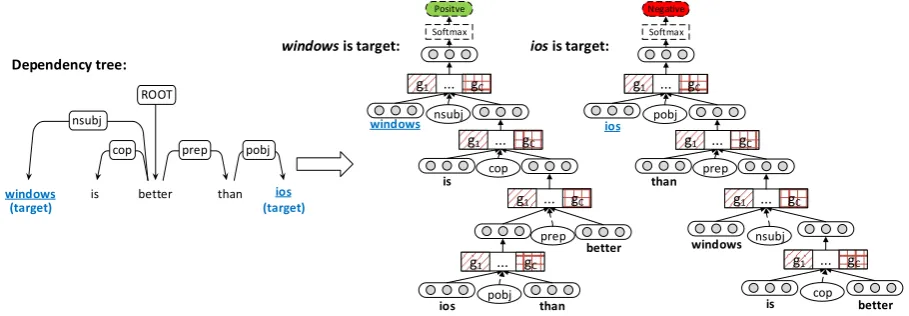
Figure 2 shows the computation process for the example sentence “windows is better than ios”, where the user expresses positive sentiment to-wardswindowsand negative sentiment toios. For the targets, the order of compositions and the de-pendency types are different. AdaRNN adap-tively selects the composition functions g1. . . gC depending on the child vectors and the linguistic types. Thus it is able to determine how to propa-gate the sentiments of words towards the target.
Based on RNN described in Section 2, we de-fine the composition resultvin AdaRNN as:
v=f XC
h=1
P(gh|vl,vr,e)gh(vl,vr) !
(2)
where g1, . . . , gC are the composition functions, P(gh|vl,vr,e)is the probability of employinggh given the child vectorsvl,vr and external feature vectore, andf is the nonlinearity function. For the composition functions, we use the same forms as in Equation (1), i.e., we have C composition matrices W1. . . WC. We define the distribution over these composition functions as:
P(g1|vl,vr,e) ...
P(gC|vl,vr,e)
=softmax
βS
vvrl
e
(3)
whereβis the hyper-parameter,S ∈RC×(2D+|e|) is the matrix used to determine which composition function we use,vl,vrare the left and right child vectors, andeare external feature vector. In this work,e is a one-hot binary feature vector which indicates what the dependency type is. If relation is thek-th type, we setekto 1 and the others to 0. Addingβ in softmax function is a widely used parametrization method in statistical mechanics, which is known as Boltzmann distribution and Gibbs measure (Georgii, 2011). Whenβ = 0, this function produces a uniform distribution; when
β = 1, it is the same as softmax function; when
β → ∞, it only activates the dimension with max-imum weight, and sets its probability to1.
3.3 Model Training
We use the representation of root node as the fea-tures, and feed them into the softmax classifier to predict the distribution over classes. We define the ground truth vectortas a binary vector. If thek-th class is the label, only tk is1 and the others are 0. Our goal is to minimize the cross-entropy error between the predicted distribution y and ground truth distributiont. For each training instance, we define the objective function as:
min
Θ −
X
j
tjlogyj+ X
θ∈Θ
λθkθk22 (4)
where Θ represents the parameters, and the L2 -regularization penalty is used.
Based on the converted tree, we employ back-propagation algorithm (Rumelhart et al., 1986) to propagate the errors from root node to the leaf nodes. We calculate the derivatives to update the parameters. The AdaGrad (Duchi et al., 2011) is employed to solve this optimization problem.
4 Experiments
windows
is
better
ios than
g1 ... gC g1 ... gC g1 ... gC g1 ... gC
nsubj
cop
prep
pobj Positve
Softmax
ios
than
windows
is better
g1 ... gC g1 ... gC g1 ... gC g1 ... gC
pobj
prep
nsubj
cop Negative
Softmax
windows is better than ios
ROOT
cop nsubj
prep pobj
(target) (target)
Dependency tree:
[image:4.595.72.527.64.222.2]windows is target: ios is target:
Figure 2: For the sentence “windows is better than ios”, we convert its dependency tree for the different targets (windowsandios). AdaRNN performs semantic compositions in bottom-up manner and forward propagates sentiment information to the target node. Theg1, . . . , gCare different composition functions, and the combined vectors and dependency types are used to select them adaptively. These composition functions decide how to propagate the sentiments to the target.
tweets. We randomly sample some tweets, and they are assigned with sentiment labels by two an-notators. About 82.5% of them have the same la-bels. The agreement percentage of polarity clas-sification is higher than subjectivity clasclas-sification. To the best of our knowledge, this is the largest target-dependent Twitter sentiment classification dataset which is annotated manually. We make the dataset publicly available1for research purposes.
We preprocess the tweets by replacing the tar-gets with $T$ and setting their POS tags to NN. Liblinear (Fan et al., 2008) is used for baselines. A tweet-specific tokenizer (Gimpel et al., 2011) is employed, and the dependency parsing results are computed by Stanford Parser (Klein and Man-ning, 2003). The hyper-parameters are chosen by cross-validation on the training split, and the test accuracy and macro-average F1-score score are re-ported. For recursive neural models, the dimen-sion of word vector is set to 25, and f = tanh is used as the nonlinearity function. We employ 10 composition matrices in AdaRNN. The param-eters are randomly initialized. Notably, the word vectors will also be updated.
SVM-indep: It uses the uni-gram, bi-gram, punctuations, emoticons, and #hashtags as the content features, and the numbers of positive or negative words in General Inquirer as lexicon fea-tures. These features are all target-independent.
SVM-dep: We re-implement the method pro-posed by Jiang et al. (2011). It combines both
1http://goo.gl/5Enpu7
the independent (SVM-indep) and target-dependent features and uses SVM as the classifier. There are seven rules to extract target-sensitive features. We do not implement the social graph optimization and target expansion tricks in it.
SVM-conn: The words, punctuations, emoti-cons, and #hashtags included in the converted de-pendency tree are used as the features for SVM.
RNN: It is performed on the converted depen-dency tree without adaptive composition selection.
AdaRNN-w/oE: Our approach without using the dependency types as features in adaptive se-lection for the composition functions.
AdaRNN-w/E: Our approach with employing the dependency types as features in adaptive se-lection for the composition functions.
AdaRNN-comb: We combine the root vectors obtained by AdaRNN-w/E with the uni/bi-gram features, and they are fed into a SVM classifier.
Method Accuracy Macro-F1
SVM-indep 62.7 60.2
SVM-dep 63.4 63.3
SVM-conn 60.0 59.6
RNN 63.0 62.8
AdaRNN-w/oE 64.9 64.4
AdaRNN-w/E 65.8 65.5
AdaRNN-comb 66.3 65.9
As shown in the Table 1, AdaRNN achieves bet-ter results than the baselines. Specifically, we find that the performances of SVM-dep increase than SVM-indep. It indicates that target-dependent fea-tures help improve the results. However, the accu-racy and F1-score do not gain significantly. This is caused by mismatch of the rules (Jiang et al., 2011) used to extract the target-dependent fea-tures. The POS tagging and dependency parsing results are not precise enough for the Twitter data, so these hand-crafted rules are rarely matched. Further, the results of SVM-conn illustrate that us-ing the words which have paths to target as bag-of-words features does not perform well.
RNN is also based on the converted depen-dency tree. It outperforms SVM-indep, and is comparable with SVM-dep. The performances of AdaRNN-w/oE are better than the above base-lines. It shows that multiple composition functions and adaptive selection help improve the results. AdaRNN provides more powerful composition ability, so that it achieves better semantic compo-sition for recursive neural models. AdaRNN-w/E obtains best performances among the above meth-ods. Its macro-average F1-score rises by 5.3% than the target-independent method SVM-indep. It employs dependency types as binary features to select the composition functions adaptively. The results illustrate that the syntactic tags are helpful to guide the model propagate sentiments of words towards target. Although the dependency results are also not precise enough, the composition se-lection is automatically learned from data. Hence AdaRNN is more robust for the imprecision of parsing results than the hand-crafted rules. The performances become better after adding the uni-gram and bi-uni-gram features (target-independent).
4.1 Effects ofβ
We compare different β for AdaRNN defined in Equation (3) in this section. Different parameterβ
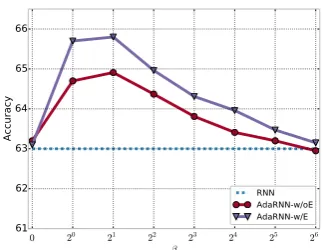
leads to different composition selection schemes. As illustrated in Figure 3, the AdaRNN-w/oE and AdaRNN-w/E achieve the best accuracies at
β = 2, and they have a similar trend. Specifi-cally, β = 0obtains a uniform distribution over the composition functions which does not help im-prove performances. β → ∞ results in a max-imum probability selection algorithm, i.e., only the composition function which has the maximum probability is used. This selection scheme makes
0 20 21 22 23 24 25 26
β 61
62 63 64 65 66
Accuracy
[image:5.595.335.497.60.185.2]RNN AdaRNN-w/oE AdaRNN-w/E
Figure 3: The curve shows the accuracy as the hyper-parameter β = 0,20,21, . . . ,26 increases. AdaRNN achieves the best results atβ = 21.
the optimization instable. The performances of
β = 1,2 are similar and they are better than other settings. It indicates that adaptive selection method is useful to model the compositions. The hyper-parameterβ makes trade-offs between uni-form selection and maximum selection. It adjusts the effects of these two perspectives.
5 Conclusion
We propose Adaptive Recursive Neural Network (AdaRNN) for the target-dependent Twitter senti-ment classification. AdaRNN employs more than one composition functions and adaptively chooses them depending on the context and linguistic tags. For a given tweet, we first convert its dependency tree for the interested target. Next, the AdaRNN learns how to adaptively propagate the sentiments of words to the target node. AdaRNN enables the sentiment propagations to be sensitive to both linguistic and semantic categories by using differ-ent compositions. The experimdiffer-ental results illus-trate that AdaRNN improves the baselines without hand-crafted rules.
Acknowledgments
This research was partly supported by the National 863 Program of China (No. 2012AA011005), the fund of SKLSDE (Grant No. SKLSDE-2013ZX-06), and Research Fund for the Doctoral Pro-gram of Higher Education of China (Grant No. 20111102110019).
References
Li Dong, Furu Wei, Ming Zhou, and Ke Xu. 2014. Adaptive multi-compositionality for recursive neu-ral models with applications to sentiment analysis. InTwenty-Eighth AAAI Conference on Artificial In-telligence (AAAI). AAAI.
John Duchi, Elad Hazan, and Yoram Singer. 2011. Adaptive subgradient methods for online learning and stochastic optimization. JMLR, 12:2121–2159, July.
Rong-En Fan, Kai-Wei Chang, Cho-Jui Hsieh, Xiang-Rui Wang, and Chih-Jen Lin. 2008. Liblinear: A li-brary for large linear classification. J. Mach. Learn. Res., 9:1871–1874, June.
H.O. Georgii. 2011. Gibbs Measures and Phase Transitions. De Gruyter studies in mathematics. De Gruyter.
Kevin Gimpel, Nathan Schneider, Brendan O’Connor, Dipanjan Das, Daniel Mills, Jacob Eisenstein, Michael Heilman, Dani Yogatama, Jeffrey Flanigan, and Noah A. Smith. 2011. Part-of-speech tagging for twitter: Annotation, features, and experiments. In Proceedings of the 49th Annual Meeting of the Association for Computational Linguistics: Human Language Technologies: Short Papers - Volume 2, HLT ’11, pages 42–47, Stroudsburg, PA, USA. As-sociation for Computational Linguistics.
Geoffrey E. Hinton. 1986. Learning distributed repre-sentations of concepts. InProceedings of the Eighth Annual Conference of the Cognitive Science Society, pages 1–12. Hillsdale, NJ: Erlbaum.
Minqing Hu and Bing Liu. 2004. Mining and summa-rizing customer reviews. InProceedings of the Tenth ACM SIGKDD International Conference on Knowl-edge Discovery and Data Mining, KDD ’04, pages 168–177, New York, NY, USA. ACM.
Long Jiang, Mo Yu, Ming Zhou, Xiaohua Liu, and Tiejun Zhao. 2011. Target-dependent twitter sen-timent classification. InProceedings of the 49th An-nual Meeting of the Association for Computational Linguistics: Human Language Technologies - Vol-ume 1, HLT ’11, pages 151–160, Stroudsburg, PA, USA. Association for Computational Linguistics.
Dan Klein and Christopher D. Manning. 2003. Ac-curate unlexicalized parsing. InProceedings of the 41st Annual Meeting on Association for Computa-tional Linguistics - Volume 1, ACL ’03, pages 423– 430, Stroudsburg, PA, USA. Association for Com-putational Linguistics.
Tetsuji Nakagawa, Kentaro Inui, and Sadao Kurohashi. 2010. Dependency tree-based sentiment classifica-tion using crfs with hidden variables. In Human Language Technologies: The 2010 Annual Confer-ence of the North American Chapter of the Associa-tion for ComputaAssocia-tional Linguistics, pages 786–794. Association for Computational Linguistics.
Bo Pang, Lillian Lee, and Shivakumar Vaithyanathan. 2002. Thumbs up?: sentiment classification using machine learning techniques. InProceedings of the ACL-02 conference on Empirical methods in natural language processing-Volume 10, pages 79–86. As-sociation for Computational Linguistics.
D.E. Rumelhart, G.E. Hinton, and R.J. Williams. 1986. Learning representations by back-propagating er-rors. Nature, 323(6088):533–536.
Richard Socher, Cliff C. Lin, Andrew Y. Ng, and Christopher D. Manning. 2011. Parsing Natural Scenes and Natural Language with Recursive Neural Networks. InICML.
Richard Socher, Brody Huval, Christopher D. Man-ning, and Andrew Y. Ng. 2012. Semantic composi-tionality through recursive matrix-vector spaces. In EMNLP-CoNLL, pages 1201–1211.
Richard Socher, Alex Perelygin, Jean Y Wu, Jason Chuang, Christopher D Manning, Andrew Y Ng, and Christopher Potts. 2013. Recursive Deep Mod-els for Semantic Compositionality Over a Sentiment Treebank. InEMNLP, pages 1631–1642.