Fine-grained Genre Classification using Structural Learning Algorithms
Zhili Wu
Centre for Translation Studies University of Leeds, UK
Katja Markert School of Computing University of Leeds, UK
Serge Sharoff
Centre for Translation Studies University of Leeds, UK
Abstract
Prior use of machine learning in genre classification used a list of labels as clas-sification categories. However, genre classes are often organised into hierar-chies, e.g., covering the subgenres of fic-tion. In this paper we present a method of using the hierarchy of labels to improve the classification accuracy. As a testbed for this approach we use the Brown Cor-pus as well as a range of other corpora, in-cluding the BNC, HGC and Syracuse. The results are not encouraging: apart from the Brown corpus, the improvements of our structural classifier over the flat one are not statistically significant. We discuss the relation between structural learning per-formance and the visual and distributional balance of the label hierarchy, suggesting that only balanced hierarchies might profit from structural learning.
1 Introduction
Automatic genre identification (AGI) can be traced to the mid-1990s (Karlgren and Cutting, 1994; Kessler et al., 1997), but this research came much more active in recent years, partly be-cause of the explosive growth of the Web, and partly because of the importance of making genre distinctions in NLP applications. In Information Retrieval, given the large number of web pages on any given topic, it is often difficult for the users to find relevant pages that are in the right genre (Vidulin et al., 2007). As for other applications, the accuracy of many tasks, such as machine trans-lation, POS tagging (Giesbrecht and Evert, 2009) or identification of discourse relations (Webber, 2009) relies of defining the language model suit-able for the genre of a given text. For example, the accuracy of POS tagging reaching 96.9% on
newspaper texts drops down to 85.7% on forums (Giesbrecht and Evert, 2009), i.e., every seventh word in forums is tagged incorrectly.
This interest in genres resulted in a prolifer-ation of studies on corpus development of web genres and comparison of methods for AGI. The two corpora commonly used for this task are KI-04 (Meyer zu Eissen and Stein, 20KI-04) and San-tinis (Santini, 2007). The best results reported for these corpora (with 10-fold cross-validation) reach 84.1% on KI-04 and 96.5% accuracy on Santinis (Kanaris and Stamatatos, 2009). In our research (Sharoff et al., 2010) we produced even better re-sults on these two benchmarks (85.8% and 97.1%, respectively). However, this impressive accuracy is not realistic in vivo, i.e., in classifying web pages retrieved as a result of actual queries. One reason comes from the limited number of genres present in these two collections (eight genres in KI-04 and seven in Santinis). As an example, only front pages of online newspapers are listed in San-tinis, but not actual newspaper articles, so once an article is retrieved, it cannot be assigned to any class at all. Another reason why the high accu-racy is not useful concerns the limited number of sources in each collection, e.g., all FAQs in Santi-nis come from either a website with FAQs on hur-ricanes or another one with tax advice. In the end, a classifier built for FAQs on this training data re-lies on a high topic-genre correlation in this par-ticular collection and fails to spot any other FAQs. There are other corpora, which are more diverse in the range of their genres, such as the fifteen genres of the Brown Corpus (Kuˇcera and Fran-cis, 1967) or the seventy genres of the BNC (Lee, 2001), but because of the number of genres in them and the diversity of documents within each genre, the accuracy of prior work on these collec-tions is much less impressive. For example, Karl-gren and Cutting (1994) using linear discriminant analysis achieve an accuracy of 52% without
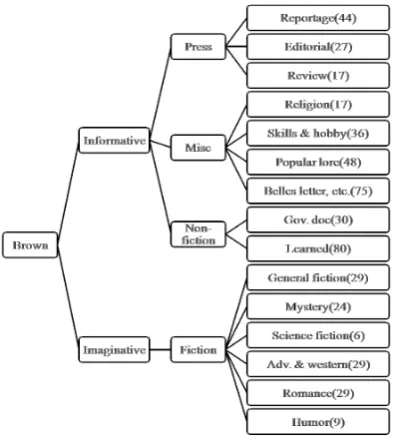
ing cross-validation (the entire Brown Corpus was used as both the test set and training set), with the accuracy improving to 65% when the 15 genres are collapsed into 10, and to 73% with only 4 gen-res (Figure 1). This gen-result suggests the importance of the hierarchy of genres. Firstly, making a deci-sion on higher levels might be easier than on lower levels (fiction or non-fiction rather than science fiction or mystery). Secondly, we might be able to improve the accuracy on lower levels, by taking into account the relevant position of each node in the hierarchy (distinguishing betweenreportage oreditorialbecomes easier when we know they are safely under the category ofpress).
Figure 1: Hierarchy of Brown corpus.
This paper explores a way of using information on the hierarchy of labels for improving fine-grained genre classification. To the best of our knowl-edge, this is the first work presenting structural genre classification and distance measures for gen-res. In Section 2 we present a structural reformula-tion of Support Vector Machines (SVMs) that can take similarities between different genres into ac-count. This formulation necessitates the develop-ment of distance measures between different gen-res in a hierarchy, of which we pgen-resent three dif-ferent types in Section 3, along with possible esti-mation procedures for these distances. We present experiments with these novel structural SVMs and distance measures on three different corpora in Section 4. Our experiments show that structural SVMs can outperform the non-structural standard. However, the improvement is only statistically sig-nificant on the Brown corpus. In Section 5 we
investigate potential reasons for this, including the (im)balance of different genre hierarchies and problems with our distance measures.
2 Structural SVMs
Discriminative methods are often used for clas-sification, with SVMs being a well-performing method in many tasks (Boser et al., 1992; Joachims, 1999). Linear SVMs on a flat list of labels achieve high efficiency and accuracy in text classification when compared to nonlinear SVMs or other state-of-the-art methods. As for structural output learning, a few SVM-based objective func-tions have been proposed, including margin for-mulation for hierarchical learning (Dekel et al., 2004) or general structural learning (Joachims et al., 2009; Tsochantaridis et al., 2005). But many implementations are not publicly available, and their scalability to real-life text classification tasks is unknown. Also they have not been applied to genre classification.
Our formulation can be taken as a special in-stance of the structural learning framework in (Tsochantaridis et al., 2005). However, they con-centrate on more complicated label structures as for sequence alignment or parsing. They proposed two formulations, slack-rescaling and margin-rescaling, claiming that margin-rescaling has two disadvantages. First, it potentially gives signifi-cant weight to output values that might not be eas-ily confused with the target values, because every increase in the loss increases the required margin. However, they did not provide empirical evidence for this claim. Second, margin rescaling is not necessarily invariant to the scaling of the distance matrix. We still used margin-rescaling because it allows us to use the sequential dual method for large-scale implementation (Keerthi et al., 2008), which is not applicable to the slack-rescaling for-mulation. For web page classification we will need fast processing. In addition, we performed model calibration to address the second disadvan-tage (distance matrix invariance).
Let xbe a document andwm a weight vector associated with the genre classmin a corpus with
kgenres at the most fine-grained level. The pre-dicted class is the class achieving the maximum inner product betweenxand the weight vector for the class, denoted as,
arg max
m w
T
Accurate prediction requires that when a docu-ment vector is multiplied with the weight vector associated with its own class, the resulting inner product should be larger than its inner products with a weight vector for any other genre classm. This helps us to define criteria for weight vectors. Let xi be the i−th training document, andyi its genre label. For its weight vector wyi, the inner productwTyixishould be larger than all other prod-uctswTmxi, that is,
wTyixi−wTmxi ≥0,∀m. (2)
To strengthen the constraints, the zero value on the right hand side of the inequality for the flat SVM can be replaced by a positive value, corresponding to a distance measureh(yi, m)between two genre classes, leading to the following constraint:
wTyixi−wTmxi ≥h(yi, m),∀m. (3)
To allow feasible models, in real scenarios such constraints can be violated, but the degree of vio-lation is expected to be small. For each document, the maximum violation in the k constraints is of interest, as given by the following loss term:
Lossi = max
m {h(yi, m)−w T
yixi+w T
mxi}. (4)
Adding up all loss terms over all training docu-ments, and further introducing a term to penalize large values in the weight vectors, we have the following objective function (Cis a user-specified nonnegative parameter).
min
m,i :
1 2
k
X
m=1
wTmwm+C p
X
i=1
Lossi. (5)
Efficient methods can be derived by borrowing the sequential dual methods in (Keerthi et al., 2008) or other optimization techniques (Crammer and Singer, 2002).
3 Genre Distance Measures
The structural SVM (Section 2) requires a dis-tance measure h between two genres. We can derive such distance measures from the genre hierarchy in a way similar to word similarity measures that were invented for lexical hierar-chies such as WordNet (see (Pedersen et al., 2007) for an overview). In the following, we will first shortly summarise path-based and
information-based measures for similarity. How-ever, information-based measures are based on the information content of a node in a hierarchy. Whereas the information content of a word or con-cept in a lexical hierarchy has been well-defined (Resnik, 1995), it is less clear how to estimate the information content of a genre label. We will therefore discuss several different ways of estimat-ing information content of nodes in a genre hierar-chy.
3.1 Distance Measures based on Path Length
If genre labels are organised into a tree (Figure 1), one of the simplest ways to measure distance be-tween two genre labels (= tree nodes) is path length(h(a, b)plen):
f(a, LCS(a, b)) +f(b, LCS(a, b)), (6)
where a and b are two nodes in the tree,
LCS(a, b)is their Least Common Subsumer, and
f(a, LCS(a, b)) is the number of levels passed through when traversing from a to the ancestral node LCS(a, b). In other words, the distance counts the number of edges traversed from nodesa
tobin the tree. For example, the distance between LearnedandMiscin Figure 1 would be 3.
As an alternative, the maximum path length h(a, b)pmax to their least common subsumer can be used to reduce the range of possible values:
max{f(a, LCS(a, b)), f(b, LCS(a, b))}. (7)
The Leacock & Chodorow similarity measure (Leacock and Chodorow, 1998) normalizes the path length measure (6) by the maximum number of nodesDwhen traversing down from the root.
s(a, b)plsk=−log((h(a, b)plen+ 1)/2D). (8)
To convert it into a distance measure, we can invert ith(a, b)plsk= 1/s(a, b)plsk.
Other path-length based measures include the
Wu & PalmerSimilarity (Wu and Palmer, 1994).
s(a, b)pwupal =
2f(R, LCS(a, b))
(f(R, a) +f(R, b)), (9)
3.2 Distance Measures based on Information Content
Path-based distance measures work relatively well on balanced hierarchies such as the one in Figure 1 but fail to treat hierarchies with different levels of granularity well. For lexical hierarchies, as a result, several distance measures based on infor-mation contenthave been suggested where the in-formation content of a conceptcin a hierarchy is measured by (Resnik, 1995)
IC(c) =−log( f req(c)
f req(root)). (10)
The frequencyf req of a conceptc is the sum of the frequency of the nodecitself and the frequen-cies of all its subnodes. Since the root may be a dummy concept, its frequency is simply the sum of the frequencies of all its subnodes. The simi-larity between two nodes can then be defined as the information content of their least common sub-sumer:
s(a, b)resk =IC(LCS(a, b)). (11)
If two nodes just share the root as their subsumer, their similarity will be zero. To convert 11 into a distance measure, it is possible to add a constant 1 to it before inverting it, as given by
h(a, b)resk = 1/(s(a, b)resk+ 1). (12)
Several other similarity measures have been pro-posed based on the Resnik similarity such as the one by (Lin, 1998):
s(a, b)lin=
2IC(LCS(a, b))
IC(a) +IC(b) . (13)
Again to avoid the effect of zero similarity when defining theLin’s distancewe use:
h(a, b)lin= 1/(s(a, b)lin+ 1). (14)
(Jiang and Conrath, 1997) directly defineJiang’s distance(h(a, b)jng):
IC(a) +IC(b)−2IC(LCS(a, b)). (15)
3.2.1 Information Content of Genre Labels The notion of information content of a genre is not straightforward. We use two ways of measuring the frequency f req of a genre, depending on its interpretation.
Genre Frequency based on Document Occur-rence. We can interpret the “frequency” of a genre node simply as the number of all documents belonging to that genre (including any of its sub-genres). Unfortunately, there are no estimates for genre frequencies on, for example, a representa-tive sample of web documents. Therefore, we ap-proximate genre frequencies from the document frequencies (dfs) in the training sets used in clas-sification. Note that (i) for balanced class distribu-tions this information will not be helpful and (ii) that this is a relatively poor substitute for an esti-mation on an independent, representative corpus.
Genre Frequency based on Genre Labels. We can also use the labels/names of the genre nodes as the unit of frequency estimation. Then, the frequency of a genre node is the occurrence fre-quency of its label in a corpus plus the occurrence frequencies of the labels of all its subnodes. Note that there is no direct correspondence between this measure and the document frequency of a genre: measuring the number of times the potential genre label poem occurs in a corpus is not in any way equivalent to the number of poems in that corpus. However, the measure is still structurally aware as frequencies of labels of subnodes are included, i.e. a higher level genre label will have higher frequency (and lower information content) than a lower level genre label.1
For label frequency estimation, we manually expand any label abbreviations (such as "newsp" for BNC genre labels), delete stop words and func-tion words and then use two search methods. For the search methodwordwe simply search the fre-quency of the genre label in a corpus, using three different corpora (the BNC, Brown and Google web search). As for the BNC and Brown cor-pus some labels are very rarely mentioned, we for these two corpora use also a search methodgram
where all character 5-grams within the genre label are searched for and their frequencies aggregated.
3.3 Terminology
Algorithms are prefixed by the kind of distance measure they employ — IC for Information con-tent andpfor path-based). If the measure is
infor-1
mation content based the specific measure is men-tioned next, such aslin. The way for measuring genre frequency is indicated last withdf for mea-suring via document frequency and word/gram
when measured via frequency of genre labels. If frequencies of genre labels are used, the corpus for counting the occurrence of genre labels is also indicated viabrown,bncor the Web as estimated by Google hit countsgg. Standard non-structural SVMs are indicated byf lat.
4 Experiments
4.1 Datasets
We use four genre-annotated corpora for genre classification: the Brown Corpus (Kuˇcera and Francis, 1967), BNC (Lee, 2001), HGC (Stubbe and Ringlstetter, 2007) and Syracuse (Crowston et al., 2009). They have a wide variety of genre labels (from 15 in the Brown corpus to 32 genres in HGC to 70 in the BNC to 292 in Syracuse), and different types of hierarchies.
4.2 Evaluation Measures
We use standard classification accuracy (Acc) on the most fine-grained level of target categories in the genre hierarchy.
In addition, given a structural distanceH, mis-classifications can be weighted based on the dis-tance measure. This allows us to penalize incor-rect predictions which are further away in the hi-erarchy (such as between government documents and westerns) more than "close" mismatches (such as between science fiction and westerns). For-mally, given the classification confusion matrixM
then each Mab for a 6= b contains the number of class a documents that are misclassified into class b. To achieve proper normalization in giv-ing weights to misclassified entries, we can redis-tribute a total weightk−1to each row ofH pro-portionally to its values, where k is the number of genres. That is, given g the row summation of H, we define a weight matrix Q by normal-izing the rows of H in a way given by Qab =
(k−1)hab/ga, a 6= b. We further assign a unit value to the diagonal ofQ. Then it is possible to construct a structurally-aware measure (S-Acc):
S-Acc=X
a
Maa/
X
a,b
MabQab. (16)
4.3 Experimental Setup
We compare structural SVMs using all path-based and information-content based measures (see also Section 3.3). As a baseline we use the accuracy achieved by a standard "flat" SVM.
We use 10-fold (randomised) cross validation throughout. In each fold, for each genre class10%
of documents are used for testing. For the re-maining90%, a portion of 10% are sampled for parameter tuning, leaving 80% for training. In each round the validation set is used to help de-termine the best C associated with Equation (5) based on the validation accuracy from the candi-date list 0.0001, 0.0005, 0.001, 0.005, 0.01, 0.05, 0.1, 0.5, 1. Note via this experiment setup, all methods are tuned to their best performance.
For any algorithm comparison, we use a McNe-mar test with the significance level of 5% as rec-ommended by (Dietterich, 1998).
4.4 Features
The features used for genre classification are char-acter 4-grams for all algorithms, i.e. each docu-ment is represented by a binary vector indicating the existence of each character 4-gram. We used character n-grams because they are very easy to extract, language-independent (no need to rely on parsing or even stemming), and they are known to have the best performance in genre classifica-tion tasks (Kanaris and Stamatatos, 2009; Sharoff et al., 2010).
4.5 Brown Corpus Results
The Brown Corpus has 500 documents and is or-ganized in a hierarchy with a depth of 3. It contains 15 end-level genres. In one experiment in (Karlgren and Cutting, 1994) the subgenres un-derfictionare grouped together, leading to 10 gen-res to classify.
Table 1: Brown 10-genre Classification Results.
Method Accuracy
Karlgren and Cutting, 1994 65 (Training)
Flat SVM 64.40
SSVM(IC-lin-word-bnc) 68.80 SSVM(IC-lin-word-br) 68.60 SSVM(IC-lin-gram-br) 67.80
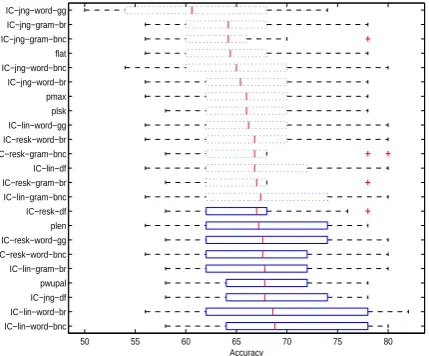
Figure 2 provides the box plots of accuracy scores. The dashed boxes indicate that the distance mea-sures perform significantly worse than the best performing IC-lin-word-bnc at the bottom. The solid boxes indicate the corresponding measures are statistically comparable to theIC-lin-word-bnc in terms of the mean accuracy they can achieve.
50 55 60 65 70 75 80
IC−lin−word−bnc IC−lin−word−br IC−jng−df pwupal IC−lin−gram−br IC−resk−word−bnc IC−resk−word−gg plen IC−resk−df IC−lin−gram−bnc IC−resk−gram−br IC−lin−df IC−resk−gram−bnc IC−resk−word−br IC−lin−word−gg plsk pmax IC−jng−word−br IC−jng−word−bnc flat IC−jng−gram−bnc IC−jng−gram−br IC−jng−word−gg
Accuracy
Figure 2: Accuracy on Brown Corpus (10 genres).
Results on 15-genre Brown Corpus. We per-form experiments on all 15 genres on the end level of the Brown corpus. The increase of genre classes leads to reduced classification performance. In our experiment, the flat SVM achieves an accuracy of 52.40%, and the structural SVM using path length measure achieves 55.40%, a difference significant at the 5% level. The structural SVMs using infor-mation content measureslin-gram-bnc and IC-resk-word-br also perform equally well. In addi-tion, we improve on the training accuracy of 52% reported in (Karlgren and Cutting, 1994).
We are also interested in structural accuracy (S-Acc) to see whether the structural SVMs make fewer "big" mistakes. Table 2 shows a cross com-parison of structural accuracy. Each row shows how accurate the corresponding method is un-der the structural accuracy criteria given in the
column. The ’no-struct’ column corresponds to vanilla accuracy. It is natural to expect each di-agonal entry of the numeric table to be the high-est, since the respective method is optimised for its own structural distance. However, in our case, Lin’s information content measure and the plen measure perform well under any structural ac-curacy evaluation measure and outperform flat SVMs.
4.6 Other Corpora
In spite of the promising results on the Brown Corpus, structural SVMs on other corpora (BNC, HGC, Syracuse) did not show considerable im-provement.
HGC contains 1330 documents divided into 32 approximately equally frequent classes. Its hierar-chy has just two levels. Standard accuracy for the best performing structural methods on HGC is just the same as for flat SVM (69.1%), with marginally better structural accuracy (for example, 71.39 vs. 71.04%, using a path-length based structural ac-curacy). The BNC corpus contains 70 genres and 4053 documents. The number of documents per class ranges from 2 to 501. The accuracy of SSVM is also just comparable to flat SVM (73.6%). The Syracuse corpus is a recently developed large col-lection of 3027 annotated webpages divided into 292 genres (Crowston et al., 2009). Focusing only on genres containing 15 or more examples, we ar-rived at a corpus of 2293 samples and 52 genres. Accuracy for flat (53.3%) and structural SVMs (53.7%) are again comparable.
5 Discussion
Given that structural learning can help in topical classification tasks (Tsochantaridis et al., 2005; Dekel et al., 2004), the lack of success on genres is surprising. We now discuss potential reasons for this lack of success.
5.1 Tree Depth and Balance
Table 2: Structural Accuracy on Brown 15-genre Classification.
Method no-struct (=typical accuracy) IC-lin-gram-bnc plen IC-resk-word-br IC-jng-word-gg
flat 52.40 55.34 60.60 58.91 52.19
IC-lin-gram-bnc 55.00 58.15 63.59 61.83 53.85
plen 55.40 58.74 64.51 62.61 54.27
IC-resk-word-br 55.00 58.24 63.96 62.08 54.08
IC-jng-word-gg 46.00 49.00 54.89 53.01 52.58
each leaf node is roughly comparable (distribu-tional balance).
The other hierarchies violate these properties to a large extent. Thus, the genres in HGC are al-most represented by a flat list with just one extra level over 32 categories. Similarly, the vast ma-jority of genres in the Syracuse corpus are also organised in two levels only. Such flat hierar-chies do not offer much scope to improve over a completely flat list. There are considerably more levels in the BNC for some branches, e.g., writ-ten/national/broadsheet/arts, but many other gen-res are still only specified to the second level of its hierarchy, e.g.,written/adverts. In addition, the BNC is also distributionally imbalanced, i.e. the number of documents per class varies from 2 to 501 documents.
To test our hypothesis, we tried to skew the Brown genre tree in two ways. First, we kept the tree relatively balanced visually and distribution-ally but flattened it by removing the second layer Press, Misc, Non-Fiction, Fictionfrom the hierar-chy, leaving a tree with only two layers. Second, we skewed the visual and distributional balance of the tree by collapsing its three leaf-level genres un-derPress, and the two undernon-fiction, leading to 12 genres to classify (cf. Figure 1).
30 35 40 45 50 55 60 65 70
IC−resk−word−bnc IC−resk−gram−bnc IC−resk−word−br IC−lin−gram−bnc plen pwupal IC−lin−word−br IC−resk−word−gg IC−lin−df IC−lin−word−bnc IC−lin−gram−br IC−jng−df flat IC−resk−df plsk IC−resk−gram−br pmax IC−lin−word−gg IC−jng−gram−bnc IC−jng−gram−br IC−jng−word−br IC−jng−word−bnc IC−jng−word−gg
[image:7.595.74.289.540.720.2]Accuracy
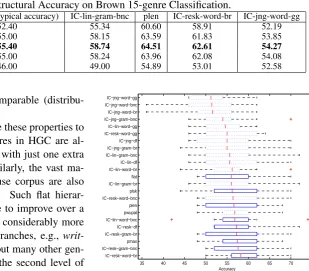
Figure 3: Accuracy on flattened Brown Corpus (15 genres).
35 40 45 50 55 60 65 70 75
IC−resk−word−br IC−resk−gram−bnc pmax IC−resk−gram−br IC−resk−df IC−lin−word−bnc pwupal plen IC−resk−word−bnc plsk IC−lin−gram−br flat IC−lin−word−br IC−lin−df IC−lin−gram−bnc IC−jng−gram−br IC−jng−df IC−resk−word−gg IC−lin−word−gg IC−jng−gram−bnc IC−jng−word−br IC−jng−word−bnc IC−jng−word−gg
Accuracy
Figure 4: Accuracy on skewed Brown Corpus (12 genres).
As expected, the structural methods on either skewed or flattened hierarchies are not signifi-cantly better than the flat SVM. For the flattened hierarchy of 15 leaf genres the maximal accuracy is 54.2% vs. 52.4% for the flat SVM (Figure 3), a non-significant improvement. Similarly, the max-imal accuracy on the skewed 12-genre hierarchy is 58.2% vs. 56% (see also Figure 4), again a not significant improvement.
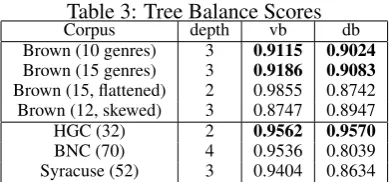
corre-sponding level. Finally, the entropy scores for all levels are averaged. It can be shown that any per-fect N-ary tree will have the largest visual balance score of 1. If in addition its nodes at each level contain the same number of documents, the distri-bution balance score will reach the maximum, too. Table 3 shows the balance scores for all the pora we use. The first two rows for the Brown cor-pus have both large visual balance and distribution balance scores. As shown earlier, for those two se-tups the structural SVMs perform better than the flat approach. In contrast, for the tree hierarchies of Brown that we deformed or flattened, and also BNC and Syracuse, either or both of the two bal-ance scores tend to be lower, and no improvement has been obtained over the flat approach. This may indicate that a further exploration of the rela-tion between tree balance and the performance of structural SVMs is warranted. However, high vi-sual balance and distribution scores do not neces-sarily imply high performance of structural SVMs, as very flat trees are also visually very balanced. As an example, HGC has a high visual balance score due to a shallow hierarchy and a high distri-butional balance score due to a roughly equal num-ber of documents contained in each genre. How-ever, HGC did not benefit from structural learning as it is also a very shallow hierarchy; therefore we think that a third variable depth also needs to be taken into account.
A similar observation on the importance of well-balanced hierarchies comes from a recent Pascal challenge on large scale hierarchical text classification,2 which shows that some flat ap-proaches perform competitively in topic classifi-cation with imbalanced hierarchies. However, the participants do not explore explicitly the relation between tree balance and performance.
Other methods for measuring tree balance (some of which are related to ours) are used in the field of phylogenetic research (Shao and Sokal, 1990) but they are only applicable to visual bal-ance. In addition, the methods they used often provide conflicting results on which trees are con-sidered as balanced (Shao and Sokal, 1990).
5.2 Distance Measures
We also scrutinise our distance measures as these are crucial for the structural approach. We no-tice that simple path length based measures
per-2
[image:8.595.319.514.71.162.2]http://lshtc.iit.demokritos.gr/
Table 3: Tree Balance Scores
Corpus depth vb db
Brown (10 genres) 3 0.9115 0.9024
Brown (15 genres) 3 0.9186 0.9083
Brown (15, flattened) 2 0.9855 0.8742 Brown (12, skewed) 3 0.8747 0.8947 HGC (32) 2 0.9562 0.9570
BNC (70) 4 0.9536 0.8039 Syracuse (52) 3 0.9404 0.8634
form well overall; again for the Brown corpus this is probably due to its balanced hierarchy which makes path length appropriate. There are other probable reasons why information content based measures do not perform better than path-length based ones. When measured via docu-ment frequency in a corpus we do not have suffi-ciently large, representative genre-annotated cor-pora to hand. When measured via genre label frequency, we run into at least two problems. Firstly, as mentioned in Section 3.2.1 genre la-bel frequency does not have to correspond to class frequency of documents. Secondly, the labels used are often abbreviations (e.g. W_institut_doc, W_newsp_brdsht_nat_social in BNC Corpus), underspecified (other, misc, unclassified) or a col-lection of phrases (e.g. belles letters, etc. in Brown). This made search for frequency very ap-proximate and also loosens the link between label and content.
We investigated in more depth how well the dif-ferent distance measures are aligned. We adapt the alignment measure between kernels (Cristian-ini et al., 2002), to investigate how close the dis-tance matrices are. For two disdis-tance matricesH1 andH2, their alignmentA(H1, H2)is defined as:
< H1, H2 >F
√
< H1, H1>F, < H2, H2>F
, (17)
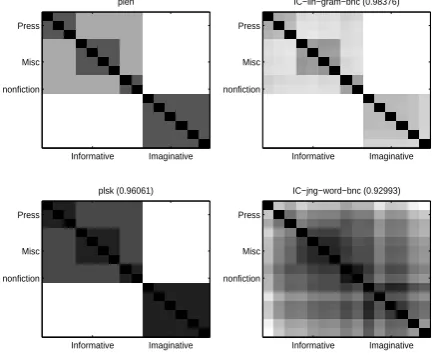
distance entries, has a much lower alignment score with the plen matrix, and doesn’t reveal appar-ent blocks. This partially explains the bad perfor-mance of the Jiang distance measure on the Brown corpus (see Section 4). The diagrams also show the high closeness between the best performing IC measure and the simple path length based mea-sure.
plen
Informative Imaginative Press
Misc
nonfiction
IC−lin−gram−bnc (0.98376)
Informative Imaginative Press
Misc
nonfiction
plsk (0.96061)
Informative Imaginative Press
Misc
nonfiction
IC−jng−word−bnc (0.92993)
Informative Imaginative Press
Misc
[image:9.595.72.290.185.363.2]nonfiction
Figure 5: Distance Matrices on Brown. Values in bracket is the alignment with theplenmatrix
An alternative to structural distance measures would be distance measures between the gen-res based on pairwise cosine similarities between them. To assess this, we aggregated all character 4-gram training vectors of each genre and calcu-lated standard cosine similarities. Note that these similarities are based on the documents only and do not make use of the Brown hierarchy at all. Af-ter converting the similarities to distance, we plug the distance matrix into our structural SVM. How-ever, accuracy on the Brown corpus (15 genres) was almost the same as for a flat SVM. Inspecting the distance matrix visually, we determined that the cosine similarity could clearly distinguish tween Fiction and Non-Fiction texts but not be-tween any other genres. This also indicates that the genre structural hierarchy clearly gives infor-mation not present in the simple character 4-gram features we use. For a more detailed discussion of the problems of the currently prevalently used character n-grams as features for genre classifica-tion, we refer the reader to (Sharoff et al., 2010).
6 Conclusions
In this paper, we have evaluated structural learn-ing approaches to genre classification uslearn-ing
sev-eral different genre distance measures. Although we were able to improve on non-structural ap-proaches for the Brown corpus, we found it hard to improve over flat SVMs on other corpora. As po-tential reasons for this negative result, we suggest that current genre hierarchies are either not of suf-ficient depth or are visually or distributionally im-balanced. We think further investigation into the relationship between hierarchy balance and struc-tural learning is warranted. Further investigation is also needed into the appropriateness of n-gram features for genre identification as well as good measures of genre distance.
In the future, an important task would be the re-finement or unsupervised generation of new hier-archies, using information theoretic or data-driven approaches. For a full assessment of hierarchical learning for genre classification, the field of genre studies needs a testbed similar to the Reuters or 20 Newsgroups datasets used in topic-based IR with a balanced genre hierarchy and a representative cor-pus of reliably annotated webpages.
With regard to algorithms, we are also inter-ested in other formulations for structural SVMs and their large-scale implementation as well as the combination of different distance measures, for example in ensemble learning.
Acknowledgements
We would like to thank the authors of each corpus collection, who invested a lot of effort into produc-ing them. We are also grateful to Google Inc. for supporting this research via their Google Research Awards programme.
References
Boser, B. E., Guyon, I. M., and Vapnik, V. N. (1992). A training algorithm for optimal mar-gin classifiers. InCOLT ’92: Proceedings of the fifth annual workshop on Computational learning theory, pages 144–152, New York, NY, USA. ACM.
Crammer, K. and Singer, Y. (2002). On the algo-rithmic implementation of multiclass kernel-based vector machines. J. Mach. Learn. Res., 2:265–292.
Process-ing Systems, NIPS’01, pages 367–373. MIT Press.
Crowston, K., Kwasnik, B., and Rubleske, J. (2009). Problems in the use-centered de-velopment of a taxonomy of web genres. In Mehler, A., Sharoff, S., and Santini, M., editors, Genres on the Web: Com-putational Models and Empirical Studies. Springer, Berlin/New York.
Dekel, O., Keshet, J., and Singer, Y. (2004). Large margin hierarchical classification. In ICML ’04: Proceedings of the twenty-first in-ternational conference on Machine learning, page 27, New York, NY, USA. ACM.
Dietterich, T. G. (1998). Approximate statistical tests for comparing supervised classification learning algorithms. Neural Computation, 10:1895–1923.
Giesbrecht, E. and Evert, S. (2009). Part-of-Speech (POS) Tagging - a solved task? An evaluation of POS taggers for the Web as corpus. In Proceedings of the Fifth Web as Corpus Workshop (WAC5), pages 27–35, Donostia-San Sebastián.
Jiang, J. J. and Conrath, D. W. (1997). Semantic similarity based on corpus statistics and lexi-cal taxonomy.CoRR, cmp-lg/9709008.
Joachims, T. (1999). Making large-scale SVM learning practical. In Schölkopf, B., Burges, C., and Smola, A., editors, Advances in Kernel Methods – Support Vector Learning, pages 41–56. MIT Press.
Joachims, T., Finley, T., and Yu, C.-N. (2009). Cutting-plane training of structural svms. Machine Learning, 77(1):27–59.
Kanaris, I. and Stamatatos, E. (2009). Learning to recognize webpage genres. Information Pro-cessing and Management, 45:499–512.
Karlgren, J. and Cutting, D. (1994). Recogniz-ing text genres with simple metrics usRecogniz-ing dis-criminant analysis. InProc. of the 15th. Inter-national Conference on Computational Lin-guistics (COLING 94), pages 1071 – 1075, Kyoto, Japan.
Keerthi, S. S., Sundararajan, S., Chang, K.-W., Hsieh, C.-J., and Lin, C.-J. (2008). A se-quential dual method for large scale multi-class linear svms. InKDD ’08: Proceeding of the 14th ACM SIGKDD international confer-ence on Knowledge discovery and data min-ing, pages 408–416, New York, NY, USA. ACM.
Kessler, B., Nunberg, G., and Schütze, H. (1997). Automatic detection of text genre. In Pro-ceedings of the 35th ACL/8th EACL, pages 32–38.
Kuˇcera, H. and Francis, W. N. (1967). Computa-tional analysis of present-day American En-glish. Brown University Press, Providence.
Leacock, C. and Chodorow, M. (1998). Combin-ing local context and WordNet similarity for word sense identification, pages 305–332. In C. Fellbaum (Ed.), MIT Press.
Lee, D. (2001). Genres, registers, text types, do-mains, and styles: clarifying the concepts and navigating a path through the BNC jun-gle. Language Learning and Technology, 5(3):37–72.
Lin, D. (1998). An information-theoretic defini-tion of similarity. In ICML ’98: Proceed-ings of the Fifteenth International Confer-ence on Machine Learning, pages 296–304, San Francisco, CA, USA. Morgan Kaufmann Publishers Inc.
Meyer zu Eissen, S. and Stein, B. (2004). Genre classification of web pages. In Proceedings of the 27th German Conference on Artificial Intelligence, Ulm, Germany.
Pedersen, T., Pakhomov, S. V. S., Patwardhan, S., and Chute, C. G. (2007). Measures of seman-tic similarity and relatedness in the biomed-ical domain. J. of Biomedical Informatics, 40(3):288–299.
Santini, M. (2007). Automatic Identification of Genre in Web Pages. PhD thesis, University of Brighton.
Shao, K.-T. and Sokal, R. R. (1990). Tree balance. Systematic Zoology, 39(3):266–276.
Sharoff, S., Wu, Z., and Markert, K. (2010). The Web library of Babel: evaluating genre col-lections. InProc. of the Seventh Language Resources and Evaluation Conference, LREC 2010, Malta.
Stubbe, A. and Ringlstetter, C. (2007). Recogniz-ing genres. In Santini, M. and Sharoff, S., editors,Proc. Towards a Reference Corpus of Web Genres.
Tsochantaridis, I., Joachims, T., Hofmann, T., and Altun, Y. (2005). Large margin methods for structured and interdependent output vari-ables.J. Mach. Learn. Res., 6:1453–1484.
Vidulin, V., Luštrek, M., and Gams, M. (2007). Using genres to improve search engines. In Proc. Towards Genre-Enabled Search En-gines: The Impact of NLP. RANLP-07.
Webber, B. (2009). Genre distinctions for dis-course in the Penn TreeBank. In Proc the 47th Annual Meeting of the ACL, pages 674– 682.