Recovery of Molybdenum and Rhenium Using Selective Precipitation Method
from Molybdenite Roasting Dust in Alkali Leaching Solution
Sung-Ho Joo
1,2, Young-Uk Kim
1, Jin-Gu Kang
2, Ho-Sung Yoon
2,
Dong-Su Kim
3and Shun Myung Shin
1,2,+1Department of Resource Recycling, University of Science & Technology (UST), Daejon 305-350, Korea
2Metal Recovery Group, Mineral Resources Research Division, Korea Institute of Geoscience & Mineral Resources (KIGAM),
Daejeon 305-350, Korea
3Department of Environmental Science and Engineering, Ewha Womans University, Seoul 120-750, Korea
A study has been conducted for the separate recovery of molybdenum and rhenium from alkali leaching solution of molybdenite roasting dust by a selective precipitation method. Two kinds of synthetic alkali leaching solutions were employed and more than 85%of molybdenum was recovered as a precipitate in the experimental conditions of 243.15 K, pH 2.2, 200 rpm of agitation speed, 7,200 s of reaction time, and 1.5 of equivalence ratio between NH4OH and NaOH for NaOH leaching solution. Regarding NH4OH leaching solution, the optimal conditions for
the formation of molybdenum precipitate were found to be 243.15 K, pH 2.5, 100 rpm of agitation speed, and 18,000 s of reaction time. The precipitation efficiency of molybdenum was higher than 99% in these conditions and molybdenum was observed to be precipitated as ammonium molybdate. Contrary to the precipitating behavior of molybdenum, rhenium was precipitated very little in the given conditions, which suggested a possibility for the selective recovery of molybdenum and rhenium. [doi:10.2320/matertrans.M2012209]
(Received June 11, 2012; Accepted August 27, 2012; Published October 11, 2012)
Keywords: molybdenite, precipitation method, ammonium molybdate, molybdenum, rhenium
1. Introduction
Rhenium does not exist as an elementary substance in the earth crust but it is finely compounded with other minerals in the amount of 0.110 mg/dm3. Among several minerals
which contain rhenium in them, the content of rhenium in molybdenite (MoS2) is usually higher than 20 mg/dm3, with
the result that the by-products such as dust or waste liquid in the production process of molybdenum from molybdenite have become the major resource for rhenium production. Rhenium is mainly used as a raw material of the catalyst for the production of unleaded high-octane gasoline along with platinum and also employed as a component material of machine units such as a jet engine turbine blade after it is added to nickel and tungsten in a super alloy. Moreover, it is used as electric contacts in the electrical and electronic industries based on its peculiar property of increased electrical conductivity when it is alloyed with molybdenum and its utilization can be also found as a component infilaments and thermocouples due to its high heat-resistance.1,2)
The base mineral raw materials for recovery of rhenium are solid and liquid by-products of molybdenum, copper, lead and uranium production. Therefore, the recovery of rhenium from them is usually carried out by a hydrometallurgical process.36) The hydrometallurgical process for the
produc-tion of rhenium from the related by-products can be divided into two major successive processes, which are leaching process and recovery process. In the leaching process, the dissolution of rhenium is fulfilled from the resources and for this purpose several methods are presently being applied; process using sulfuric acid or nitric acid in the presence of various oxidants such as O3, H2O2and MnO2, high-pressure
process using an autoclave, and microbiological process.7,8)
However, all these processes have inherent demerits such as
the need of using additional oxidants for increased leaching efficiency, the request for employing high-priced equipment, and long time required for leaching. Therefore, it is necessary to develop a new way of a hydrometallurgical process which is economical and rapid for the separation and recovery of rhenium from the industrial by-products containing rhenium. In this study, based on the fact that rhenium can exist in the ionic form of ReO4¹in all pH region a selective precipitation
method was investigated from the alkali leaching solution of molybdenite roasting dust for effective separation and recovery of rhenium and molybdenum.
2. Experimental
2.1 Materials
A synthetic alkali leaching solution was employed in the experiment to maintain the consistency of study. The leaching solution was prepared by adding desired amounts of rhenium powder (>99.9%, Aldrich), sodium molybdate (>99.0%, Samchun), calcium chloride (>99.0%, Junsei), sodium aluminate (>99.0%, Samchun) and copper chloride (>99.0%, Junsei) to NaOH solution. The composition of the synthesized NaOH leaching solution is shown in Table 1. Another synthetic alkali leaching solution was prepared using NH4OH solution. Rhenium powder (>99.9%, Aldrich),
ammonium molybdate (>99.0%, Samchun), calcium sulfate (>99.0%, Junsei), aluminum sulfate (57.5%, Samchum) and copper sulfate (>99.0%, Junsei) were added to NH4OH
[image:1.595.304.549.755.785.2]solution in their desired amounts and its composition is presented in Table 2.
Table 1 Chemical composition of the NaOH leaching solution. Element Re Mo Cu Ca Al mg/dm3 207 25450 13 2 680
+Corresponding author, E-mail: shin1016@kigam.re.kr
2.2 Procedures and analyses
The precipitating behavior of molybdenum was inves-tigated using two synthetic leaching solutions. The volume of the reactor was 1 liter and the reaction temperature was controlled by a temperature regulator while it was monitored using a thermometer which was attached to a hot plate. The solution was continuously stirred with a magnetic bar while the precipitation reaction proceeded. For NaOH leaching solution, the solution pH was adjusted to 1 with H2SO4and
after the equivalence ratio of NH4OH to NaOH was adjusted
to a desired value it was heated at a certain temperature for a given period. After the precipitation reaction was completed, the precipitating behavior of rhenium and molybdenum was examined by analyzing the filtrate with an ICP-AES (Shimadzu: Model No. ICPS-7500). For NH4OH leaching
solution, the solution pH was adjusted in the range of 1.56.0 and reaction temperature was changed from 303 to 343 K while the agitation speed of solution was varied between 100400 rpm. Through the analysis of filtrate by ICP-AES, the precipitation characteristics of molybdenum and rhenium were figured out. Figure 1 shows the experimental proce-dures of the precipitation test for the two leaching solutions.
3. Results and Discussion
3.1 Precipitation of molybdenum in NaOH leaching solution
Prior to the precipitation test, the possibility of the leaching out of rhenium and molybdenum from molybdenite roasting dust in NaOH solution was examined based on thermody-namic estimation. The chemical reactions which can take place when rhenium and molybdenum are leached out from their oxides in NaOH solution are presumably suggested as follows;
ReO2þNaOHþ3=4O2NaþþReO4þ1=2H2O
ðG0¼ 74:5 kcal=molÞ ð1Þ
ReO3þNaOHþ1=4O2NaþþReO4þ1=2H2O
ðG0¼ 45:0 kcal=molÞ ð2Þ
ReO4þNaOHNaþþReO4þ1=2H2Oþ1=4O2
ðG0¼ 33:4 kcal=molÞ ð3Þ
Re2O3þ2NaOHþ2O22Naþþ2ReO4þH2O
ðG0¼ 230:8 kcal=molÞ ð4Þ
Re2O7þ2NaOH2Naþþ2ReO4þH2O
ðG0¼ 72:2 kcal=molÞ ð5Þ
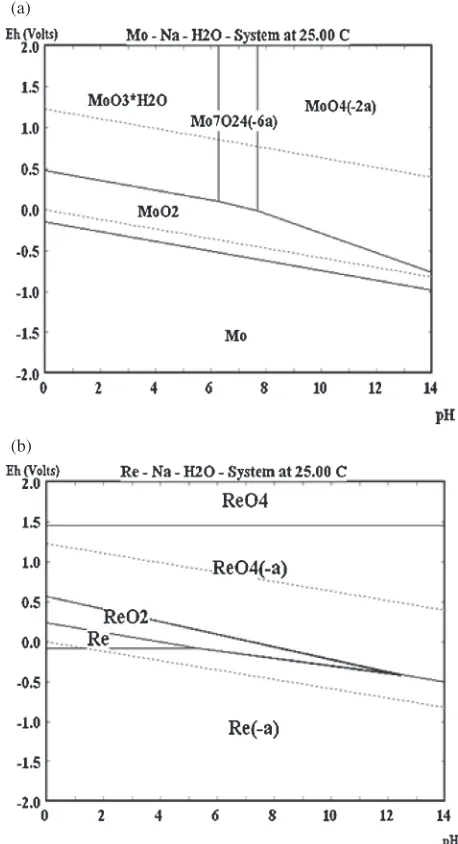
According to the suggested reactions, the rhenium oxides which existing in the molybdenite roasting dust are expected to be changed into ReO4¹ by NaOH. The EhpH diagrams
[image:2.595.311.540.72.494.2]of molybdenum and rhenium were constructed using thermo-dynamic data (Fig. 2) and applied to the understanding of the feasibilities of their leaching out based on the chemical species which subsist at each potential and pH condition.
Table 2 Chemical composition of the NH4OH leaching solution.
Element Re Mo Cu Ca Al mg/dm3 173 22100 29 4 580
Fig. 1 Flowsheet of the precipitation test for two synthetic leaching solutions.
(a)
(b)
Fig. 2 EhpH diagrams of molybdenum and rhenium in NaH2O system
[image:2.595.47.290.77.324.2]The possibility of the precipitation of molybdenum was investigated using NaOH leaching solution whose pH was controlled to 1. A preliminary test was carried out employing 50 cm3 of artificial leaching solution which was heated to
343.15 K and it was verified that a precipitate was formed in the solution. The chemical composition of the obtained precipitate was analyzed and presented in Table 3 along with the analytical result for the compositions of the leaching solution and filtrate.
As shown in Table 3, it was possible for molybdenum to be precipitated out in the leaching solution and rhenium was observed not to exist in the precipitate. However, the precipitation reaction of molybdenum was regarded to be not effective solely based on its solubility characteristics. Therefore, an experimental scheme was contrived that the molybdenum is precipitated in the form of chemical compound by adding NH4OH to NaOH leaching solution.
Table 4 shows the change of the solution composition according to the equivalence ratio of NH4OH and NaOH
when the precipitation reaction proceeded for 2 h in the conditions of 343.15 K and 300 rpm.
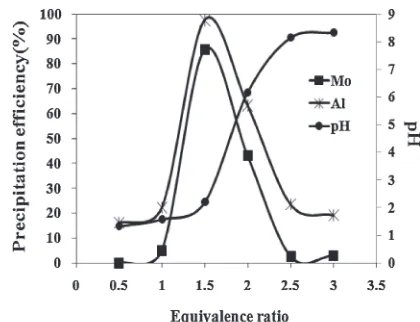
As can be seen in Table 4, more than 85%of molybdenum and aluminium were found to be precipitated at 1.5 of equivalence ratio of NH4OH and NaOH. Also, the
concen-tration of rhenium varied with the equivalence ratio, which was probably due to its adsorption on the molybdenum precipitate. Figure 3 shows the variation of the precipitation efficiencies of molybdenum and aluminium and the change of solution pH with the equivalence ratio between NH4OH
and NaOH. The precipitation efficiency of molybdenum was decreased significantly above pH 2.5 so that the pH range where molybdenum precipitated efficiently was found to be around 22.5. The precipitation efficiency of molybdenum reached 85%in the conditions of 343.15 K, pH 2.2, and 1.5 of equivalence ratio.
3.2 Precipitation of molybdenum in NH4OH leaching solution
Considering that NH4OH solution can be potentially
applicable to the leaching of rhenium and molybdenum, the precipitating behavior of rhenium and molybdenum was investigated employing a synthetic NH4OH leaching
solution. A preliminary test was conducted in the conditions of 343.15 K, pH 2, 350 rpm, and 18,000 s of reaction time using 500 cm3of solution for the verification of the formation
of molybdenum precipitate and as a result about 60% of molybdenum was examined to be precipitated. The precip-itate which was formed in NH4OH leaching solution was
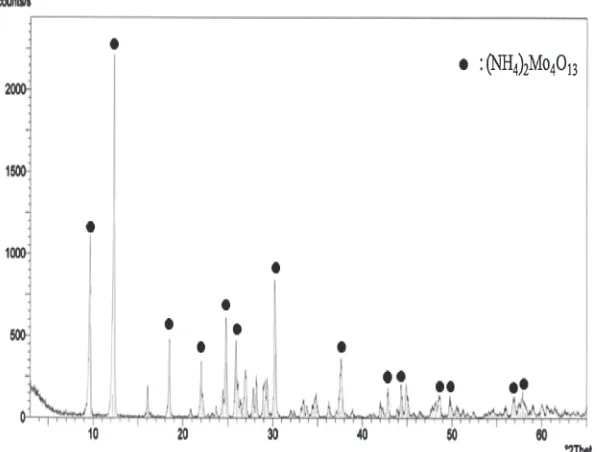
analyzed by XRD (Rigaku: Model No. Ru-200B) and it was found that the precipitate was (NH4)2Mo4O13 (Fig. 4). The
reason for the formation of crystalline ammonium molybdate in the precipitate forming reaction was understood to be due to the fact that polyanions such as Mo6O132¹and Mo6O204¹
are generated when MoO3 is dissolved in the solution of
pH 26 and these anions are subsequently polymerized by reacting with NH4+.
[image:3.595.319.529.67.228.2]3.3 Effect of reaction time
Figure 5 shows the change of the precipitation efficiencies of each element according to the retention time when the precipitation reaction was progressed in the conditions of 343.15 K, pH 6, and 300 rpm of agitation speed. As can be seen from the result, the equilibrium was nearly reached in 18,000 s after the reaction was started and more than 96%of molybdenum was observed to be precipitated in equilibrium. Therefore, the optimal reaction time for the formation of molybdenum precipitate was considered to around 5 h in the experimental conditions. Unlike molybdenum, almost no rhenium was precipitated during the entire reaction time in the given conditions.
3.4 Effect of pH
The effect of pH on the precipitation efficiencies of molybdenum, rhenium, and aluminium was investigated in the conditions of 343 K and 300 rpm (Fig. 6). The precip-itation efficiency of molybdenum reached up to 99% around pH 2.5 and it was decreased above and below this pH.
Table 3 Chemical compositions of the initial solution, filtrate and precipitate (mg/dm3).
Type Element
Re Mo Cu Al
[image:3.595.46.291.93.162.2]Initial solution 209 26200 12 640 Filtrate 174.8 14630 6.6 180 Precipitate ® 12200 3 450
Table 4 Variation of the solution composition with the equivalence ratio between NH4OH and NaOH (mg/dm3).
Equivalence ratio Element pH
Re Mo Cu Al
Initial solution 206.5 25450 13 680 1.00 0.5 186 26200 <1 570 1.33 1.0 184 24700 <1 540 1.58 1.5 175 3900 <1 18 2.20 2.0 166 14500 <1 250 6.17 2.5 172 24800 <1 520 8.15 3.0 177 24700 <1 550 8.34
[image:3.595.45.292.221.335.2]Therefore, the most appropriate pH condition for the recovery of molybdenum as a precipitate was found to be ca. pH 2.5.
[image:4.595.151.450.74.300.2]3.5 Effect of reaction temperature
Figure 7 shows the variation of the precipitation effi cien-cies of each element with reaction temperature when the precipitate forming experiment was carried out in the conditions of pH 2.5, 300 rpm, and 18,000 s of reaction time. The precipitation efficiency of molybdenum was observed to increase with temperature and reached almost 99% at 343.15 K, which was considered to be a pertinent thermal condition for a high recovery of molybdenum.
3.6 Effect of agitation intensity
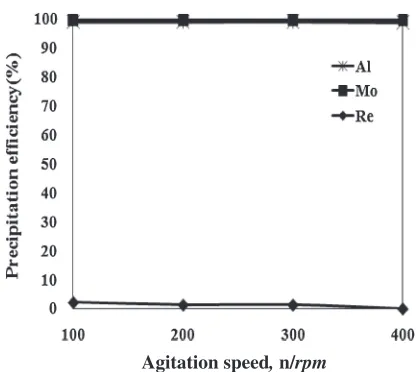
The influence of agitation intensity on the precipitation efficiencies of each element was examined in the conditions of 343 K, pH 2.5, and 18000 s of reaction time. Figure 8 shows that there was almost no difference in the precipitation efficiency of molybdenum even if the agitation intensity
Fig. 4 XRD pattern of the precipitate formed in NH4OH leaching solution.
0 10 20 30 40 50 60 70 80 90 100
0 18000 36000 54000 72000
Pr
ecipitation eff
iciency(%)
Time, t/s
Re
Mo
Al
Fig. 5 Variation of the precipitation efficiencies of molybdenum, rhenium and aluminium with reaction time.
Fig. 6 Variation of the precipitation efficiencies of molybdenum, rhenium and aluminium with pH.
0 10 20 30 40 50 60 70 80 90 100
303.15 313.15 323.15 333.15 343.15
Pr
ecipitation eff
iciency(%)
Temperature, T/K Mo Al Re
[image:4.595.66.272.350.506.2] [image:4.595.323.529.351.529.2] [image:4.595.323.529.595.759.2]was varied within the experimental conditions. Thus, lower agitation speed was thought to be better within the investigated conditions for the formation of molybdenum precipitate from the viewpoint of energy saving.
In the suggested experimental results, it was found that the precipitating behavior of aluminium was very similar to that of molybdenum, which is presumably due to the influence of molybdenum on the reactivity of aluminium in aquatic environment. However, the reason for this is not clear presently and further study will be necessary for its verification.
4. Conclusions
The feasibility of the separation and recovery of molybdenum and rhenium from molybdenite roasting dust by selective precipitation method was investigated employing
two synthetic alkali leaching solutions. For NaOH leaching solution, molybdenum was observed to be precipitated by 85%in the conditions of 343.15 K, pH 2.2, 200 rpm, 7,200 s of reaction time, and 1.5 of equivalence ratio of NH4OH and
NaOH. With regard to NH4OH leaching solution, the optimal
conditions for the formation of molybdenum precipitate were found to be 343.15 K, pH 2.5, 100 rpm, and 18,000 s of reaction time within the experimental conditions. The precipitation efficiency of molybdenum was as high as 99% in these conditions and molybdenum was found to be precipitated in the form of ammonium molybdate. Unlike molybdenum, very little amount of rhenium was precipitated in the given conditions since rhenium exists as ionic forms in the pH range of 011 except the Eh region between 00.4 V.
Acknowledgments
This research was supported by the Basic Research Project (12-3111-1) of the Korea Institute of Geoscience and Mineral Resources (KIGAM) funded by the Ministry of Knowledge Economy of Korea.
REFERENCES
1) Z. S. Abisheva, A. N. Zagorodnyaya and N. S. Bekturganov:
Hydro-metallurgy109(2011) 18.
2) A. Amer: Erzmetall.54(2001) 381385.
3) Z. S. Abisheva and A. N. Zagorodnyaya:Hydrometallurgy 63(2002)
5563.
4) S. K. Kalinin and E. E. Fain: Izv. AN KazSSR: Series Geol.6(1977) 17.
5) Z. S. Abisheva, A. N. Zagorodnyaya, A. S. Sharipova, T. N. Bukurov, K. D. Teleshev and A. B. Yudin: Tsvetnye Metally1(2004) 3035. 6) A. N. Zagorodnyaya and Z. S. Abisheva:Hydrometallurgy 65(2002)
6976.
7) F. Sh. Balgaeva and A. S. Medvedev:Russ. J. Non-Ferrous Metals48
(2007) 107109.
8) M. A. Askari Zamani, N. Hiroyoshi, M. Tsunekawa, R. Vaghar and M. Oliazadeh:Hydrometallurgy80(2005) 2331.
Agitation speed, n/rpm
[image:5.595.64.274.65.251.2]