E
ff
ect of Cr Di
ff
used Layer Formed by AIH-FPP Treatment
on Adhesion of DLC Films to a Carbon Steel Substrate
+1Shogo Takesue
1,+2, Hiroyuki Akebono
2,+3, Mizuki Furukawa
1,
Shoichi Kikuchi
3, Jun Komotori
4,+3and Hirorou Nomura
51School of Integrated Design Engineering, Graduate School of Science and Technology, Keio University, Yokohama 223-8522, Japan 2Department of Mechanical Science and Engineering, Graduate School of Engineering, Hiroshima University,
Higashi-Hiroshima 739-8527, Japan
3Department of Mechanical Engineering, Graduate School of Engineering, Kobe University, Kobe 657-8501, Japan 4Department of Mechanical Engineering, Faculty of Science and Technology, Keio University, Yokohama 223-8522, Japan 5Matsuyama Giken Co., Ltd., Ueda 386-0407, Japan
In this study, a diffusion layer of Cr was formed on the surface of a carbon steel by atmospheric-controlled induction heatingfine particle peening (AIH-FPP) treatment, followed by coating of a diamond-like carbon (DLC)film in an attempt to provide a less expensive and facile method for the production of DLC-coated steels with superior adhesion to conventional methods. Frictional wear tests and indentation tests with Vickers indenter were conducted on these DLC-coated steel specimens, and adhesion to the substrate was investigated experimentally. It was revealed that the formation of a Cr diffused layer on the surface of the substrate by AIH-FPP treatment significantly improved the adhesion of the DLCfilm to the substrate under a sliding load and a large plastic deformation. In addition, frictional wear tests revealed that the thickness of the Cr diffused layer formed by AIH-FPP treatment has a significant influence on the adhesion of the DLCfilm to the substrate. A thicker Cr diffused layer with a thickness of about 100 µm imparted better adhesion of the DLCfilm to the base material, and the superior friction and wear characteristics of the DLCfilm were sustained up to 49000 wear cycles while the specimens with a Cr diffused layer thickness of about 40 µm and without a Cr diffused layer maintained low friction coefficients up to 36000 and 8000 wear cycles, respectively. These results suggest that the proposedfilm forming method with a Cr diffused layer formed by AIH-FPP treatment is superior to the conventional method and is very efficient as a technique to improve the adhesion of DLCfilms to a carbon steel substrate. [doi:10.2320/matertrans.M2017367]
(Received November 30, 2017; Accepted January 16, 2018; Published March 2, 2018)
Keywords: surface modification, diamond-like carbon,fine particle peening, induction heating, adhesion
1. Introduction
Materials used in machines and structures should possess multiple characteristics with respect to their specific applications. To meet these requirements, a variety of surface modification processes has been developed in recent years, some of which are already in practical application. The authors have proposed an atmospheric-controlled induction heatingfine particle peening (AIH-FPP) treatment as a new method for the modification of metallic material surfaces,1,2) and fundamental researches have been performed to clarify the effect of AIH-FPP treatment.
AIH-FPP treatment involves fine particle peening for a metal held at a high temperature by high frequency induction heating under atmospheric control. It was previously reported that the shot particle elements transferred onto the surface to be processed are diffused into the substrate during heating.3) For example, when AIH-FPP treatment using Cr particles is applied to steels, a Cr diffused layer is formed on the surface, which is associated with improved corrosion resistance of the steels.46)It was also reported that when nitriding is applied to steels with a Cr diffused layer, the nitrided layer formed had higher hardness.7,8) The use of particles that are highly reactive with the substrate has recently been determined to form intermetallic compounds composed of the elements of the shot particles and substrate on the treated surface.913)
In this research, we attempted to use AIH-FPP treatment as a pretreatment for coating of a carbon-based hard thinfilm of diamond-like carbon (DLC). DLC film has high hardness, excellent wear resistance, and good anti-adhesion property; therefore, it is expected to be applicable to various sliding members.1420) However, targets for the formation of DLC films are currently limited to comparatively high hardness alloy steels and hardened steels, and thefilms are reported to be unsatisfactory with respect to adhesion when coated onto the surface of ordinary carbon steel.
The AIH-FPP treatment proposed by the authors facilitates the formation of a Cr diffused layer with high chemical affinity for a DLC film on the surface of ordinary carbon steel. Therefore, it can be considered as a method for the formation of DLCfilms that provide high adhesion at lower cost. Frictional wear tests and indentation tests with a Vickers indenter were conducted using specimens on which a DLC film was coated after the formation of a Cr diffused layer on the surface by AIH-FPP treatment using Cr particles. The adhesion of the DLCfilm to the substrate was thus evaluated, and the possibility of practical applications of the proposed method is examined and discussed.
2. Experimental Procedures
2.1 AIH-FPP treatment system
Figure 1 shows a schematic illustration of the AIH-FPP treatment system.1) An FPP nozzle and a high frequency induction heating coil are equipped in a sealed chamber. FPP treatment can be performed inside the chamber, which is replaced with an arbitrary atmosphere, while the material to +1This Paper was Originally Published in Japanese in J. Japan Inst. Met.
Mater.81(2017) 352357. References (6) and (13) were added.
+2Graduate Student, Keio University
+3Corresponding author, E-mail: akebono@hiroshima-u.ac.jp, komotori@
mech.keio.ac.jp
be treated is set into the coil and heated. The atmosphere in the chamber is replaced by supplying gas through the FPP nozzle. The temperature of the specimen can be controlled to a predetermined value by adjusting the output of the high frequency power source and on/offswitching.
2.2 Preparation of specimens
Carbon steel (S45C) was used as a test material, and the chemical composition of which is shown in Table 1. After the material was machined to a diameter of 15 mm and a thickness of 4 mm, one end face was polished with#320 to #1200 emery paper. The polished surface was then subjected to AIH-FPP treatment using Cr particles (particle diameter 30 to 50 µm). Table 2 shows the conditions of the AIH-FPP treatment, while Fig. 2 shows the thermal history during AIH-FPP treatment measured using a thermocouple welded to the specimen surface. The frequency and power of the induction heating were 200 kHz and 20 kW, respectively. After the AIH-FPP treatment, the treated surface was polished using emery paper and a SiO2 suspension, and the formation of a DLC film was then conducted. Unbalanced
magnetron sputtering (UBMS) was applied for the formation of the DLC film, and the total thickness was 1.5 µm (Cr intermediate layer 0.5 µm+DLC layer 1.0 µm). The conditions used for the DLC film formation are shown in Table 3. The average hardness of the DLC film surface layer measured with a nano-indentation tester (DUH-211, Shimadzu Corporation) was 23.1 GPa (indentation force 2 mN, indentation depth 0.07 µm).
2.3 Test methods
Sliding tests were conducted using a reciprocating frictional wear tester (Tribogear Type: 32, Shinto Scientific Co., Ltd.). The adhesion of the DLCfilm to the substrate was evaluated with respect to a sliding load. Table 4 shows the sliding test conditions employed. Indentation tests using a Vickers hardness tester (MVK-H2, Akashi Seisakusho) were
Specimen
IH coil
Shot particle
FPP nozzle
Ar gas cylinder Induction
heating inverter
Oxygen meter
Fig. 1 Schematic illustration of AIH-FPP treatment system.1)
[image:2.595.71.271.71.206.2]Table 1 Chemical composition of S45C steel (mass%).
Table 2 AIH-FPP conditions.
900
T
em
perature,
T
/
˚
C
0
Peening
Time, t/s
Gas cooling
0 10 40 100
Fig. 2 Thermal condition of AIH-FPP treatment.
Table 3 DLC coating conditions.
[image:2.595.326.528.74.205.2] [image:2.595.65.274.354.502.2]also performed on the specimens coated with DLCfilm and the peeling behavior around the indentation was observed to investigate the adhesion of the DLC film to the substrate under large plastic deformation of the substrate. These observations were performed using optical microscopy (GX51, Olympus), scanning electron microscopy (SEM; SIRION, FEI), and energy dispersive X-ray spectroscopy (EDX; QUANTAX, Bruker, acceleration voltage: 15 kV) was used for elemental analysis.
3. Results and Discussion
3.1 Observation of the Cr diffused layer formed by AIH-FPP treatment
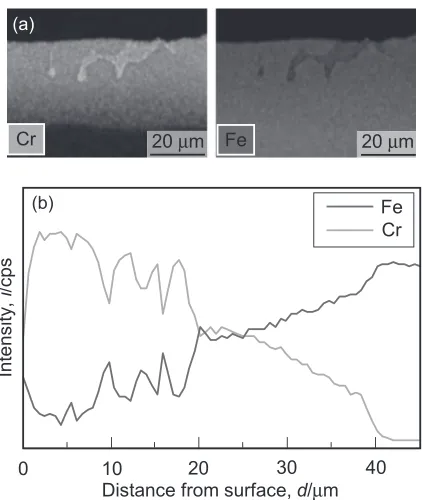
To confirm the formation of the Cr diffused layer on the surface of the specimens treated by AIH-FPP, EDX analysis was performed at longitudinal sections of the specimens subjected to AIH-FPP treatment at a peening pressure of 0.3 MPa. Mapping and line analysis results for Cr and Fe elements are shown in Figs. 3(a) and (b), respectively. Cr element was detected at the surface of the specimen subjected to AIH-FPP treatment, and the intensities of Fe and Cr gradually changed toward the substrate. These results revealed that a Cr diffused layer was formed on the surface of carbon steel by AIH-FPP treatment using Cr particles. The hardness of the Cr diffused layer measured using a Vickers hardness tester with an indentation force of 0.245 N was 229 HV, which was almost the same value as the substrate (244 HV).
3.2 Evaluation of the DLCfilm adhesion to substrate by frictional wear tests
A DLCfilm was formed on the specimen on which a Cr diffused layer was formed by AIH-FPP treatment. From this
section onward, the peening pressure in the AIH-FPP treatment was set to 0.5 MPa for test convenience. Figure 4(a) shows an optical micrograph at the longitudinal section of the specimen subjected to AIH-FPP treatment at a peening pressure of 0.5 MPa. The observation was performed after etching using 3% Nital. The white layer in the surface of the specimen after etching indicates the presence of a Cr diffused layer. The surface of the specimen after AIH-FPP treatment was uneven due to the impact of Cr particles (Fig. 4(a)). Therefore, in this study, after formation of the Cr diffused layer by AIH-FPP treatment, surface irregularities were removed by polishing, and subsequently a DLC film was coated. The resultant material is referred to as Cr/DLC series. A longitudinal section after the removal of surface irregularities is shown in Fig. 4(b). Although the thickness of the Cr diffused layer was reduced by approximately 10 µm due to polishing, the surface irregularities were removed while a sufficient thickness of the Cr diffused layer remained. The surface roughness after polishing was 0.06 µm Ra (average of 20 measurements), which is similar to that obtained after typical mirror-finish polishing.
Frictional wear tests were conducted using the prepared specimens to evaluate the adhesion of the DLC film to the substrate with respect to a sliding load. Figure 5 shows the relationship between the wear cycle and the friction coefficient. For comparison, results for a DLC coated specimen (DLC series) comprised of a DLC film formed on mirror-finished S45C steel are also shown. The results indicate that irrespective of the presence of the Cr diffused layer, both specimens show significantly outstanding sliding characteristics with a friction coefficient of approximately 0.1 at the onset of the sliding test. However, for the DLC series, 20µm
Cr Fe 20µm
(a)
Intens
ity
,
i
/cps
0 10 20 30 40
Distance from surface, d/µm Fe Cr (b)
Fig. 3 EDX analyses at the longitudinal section of AIH-FPP treated specimen (Peening pressure: 0.3 MPa). (a) Mapping of Cr and Fe elements and (b) results of line analysis.
50µm
50µm
(b) (a)
Fig. 4 Optical micrographs at the longitudinal section of AIH-FPP treated specimens (Peening pressure: 0.5 MPa). (a) Before polishing and (b) after polishing.
Wear cycles
Fric
tion c
oef
fic
ient
0 0.2 0.4 0.6 0.8 1.0
0 10000 20000 30000
DLC series Cr/DLC series
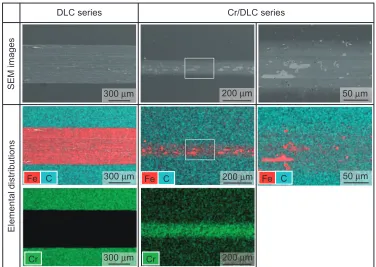
[image:3.595.65.276.67.317.2] [image:3.595.314.542.70.158.2] [image:3.595.324.528.213.360.2]the friction coefficient abruptly increased after approximately 8000 wear cycles. In contrast, the friction coefficient of the Cr/DLC series with the Cr diffused layer at the surface of the substrate was stable and maintained a low value from the onset of the test until the end. To examine the reason for this stable friction coefficient, the wear tracks formed on both specimens were observed after the end of the test (27000 wear cycles). Figure 6 shows SEM micrographs and EDX analyses of the wear tracks. From the wear track formed on the DLC series without the Cr diffused layer, Fe, the main component of the substrate, was detected, whereas C, which would indicate the presence of the DLC film, was scarcely detected. This indicates that the DLC film was peeled off during the frictional wear tests, and the substrate was completely exposed. Therefore, it is considered that the sharp increase in the friction coefficient of the DLC series shown in Fig. 5 is due to exfoliation of the DLC film. In contrast, although Fe due to peeling of the DLC film was observed locally in the wear track formed on the Cr/DLC series with the Cr diffused layer, the presence of the DLCfilm over a wide range in the wear track was confirmed by the detection of C in the EDX analysis. Therefore, most of the DLC film of the Cr/DLC series remained adhered to the substrate until the end of the frictional wear test. Cr was also observed at regions where Fe was detected, which implies that the Cr diffused layer also remains on the exposed region of the substrate due to the above mentioned peeling. Thus, the formation of a Cr diffused layer with high chemical affinity for DLCfilm on the surface of the substrate improved the adhesion between the substrate and DLC film, and because the DLCfilm was not exfoliated over a wide range in the wear track, it can be considered that most of the DLCfilm remained on the sliding surface, which explains how the low friction coefficient was maintained until the end of the test.
It was thus clarified that the proposed AIH-FPP treatment applied to form the Cr diffused layer is effective for the improvement of DLCfilm adhesion to the substrate against a sliding load.
3.3 Evaluation of the DLCfilm adhesion to substrate by indentation tests
In this section, we examine the adhesion of the DLCfilm to the substrate when the substrate is subjected to large plastic deformation using a Vickers indenter. The Vickers indenter was indented into the DLC series and the Cr/DLC series with an indentation force of 9.8 N, and the indentation was observed using SEM. The results are shown in Fig. 7. The indentation depth estimated from the size of the indentation was approximately 18 µm for both specimens. As shown in Fig. 7(a), the DLCfilm of the DLC series peeled offat the tip of indentation and along the diagonal line indicated by the arrows, and exposure of the substrate was observed. This exfoliation is probably because the hard DLCfilm could not follow the plastic deformation of the soft substrate due to low adhesion, and the exfoliation occurred at the interface
200µm 50µm
Elemental distributions
SEM
images
DLC series Cr/DLC series
300µm
Fe C
Cr
Fe C
Cr
Fe C 300µm
300µm
50µm
200µm 200µm
Fig. 6 Wear track observations.
20µm 20µm
(a) (b)
[image:4.595.110.486.69.336.2] [image:4.595.311.543.384.493.2]between the substrate and DLC film. In contrast, although microcracks of the DLC film were observed inside the indentation of the Cr/DLC series, no significant peeling or exposure of the substrate were observed around the indentation. Thus, excellent adhesion of the DLCfilm against the plastic deformation of the substrate was confirmed. On the basis of these results, the formation of a Cr diffused layer by AIH-FPP treatment was confirmed to be effective to improve adhesion of the DLC film to the substrate, even when large plastic deformation occurs in the base material.
3.4 Effect of the Cr diffused layer thickness on adhesion of DLCfilm to the substrate
The conditions of AIH-FPP treatment were varied to produce the specimen with thicker Cr diffused layers. DLC films were then formed on the specimen, and frictional wear tests were conducted to examine the effect of the Cr diffused layer thickness on the adhesion of DLCfilm to the substrate. It was previously reported that the thickness of the Cr diffused layer increases with the peening time and heating time during AIH-FPP treatment.1,4,7,8) Therefore, we attempted to form thicker Cr diffused layers by doubling the peening time and heating time (peening time 60 s, heating time 120 s) during AIH-FPP treatment.
Figure 8 shows the results of EDX analysis at the longitudinal section of the specimen subjected to AIH-FPP treatment under above conditions. Whereas the thickness of the Cr diffused layer formed by AIH-FPP treatment using the conditions described in the previous section was approximately 40 µm, the thickness was significantly increased to approximately 100 µm with the conditions applied in this section (extended peening time and heating time).
After the formation of a thick Cr diffused layer, the surface irregularities were removed by polishing, as described in the previous section, and a DLCfilm was then coated. This specimen is referred to as thick-Cr/DLC series. The specimen was then subjected to frictional wear tests under the same conditions described in Section 3.2. In this section, the test was continued until the friction coefficient increased significantly due to exfoliation of the DLCfilm. Similar tests were also performed on the Cr/DLC series until exfoliation of the DLCfilm was observed. The results of these tests are shown in Fig. 9. Both of the specimens with a Cr diffused layer preserved low friction coefficients for a long period from the onset of the test; however, the friction coefficient of the Cr/DLC series suddenly increased at approximately 36000 wear cycles. In contrast, the thick-Cr/DLC series maintained a low friction coefficient up to 49000 wear cycles,
which suggests that a thicker Cr diffused layer formed by AIH-FPP treatment results in better adhesion of the DLC film to the substrate. Possible reasons for this phenomenon include the effect of the surface Cr concentration that accompanies the increase in the Cr diffused layer thickness, the effect of the difference in microstructure due to the difference in heating time at high temperature, and the effect of the mechanical properties (Young’s modulus, hardness, etc.) of the Cr diffused layer, which may be between those of the substrate and the DLC film, so that the difference in the amount of abrupt deformation with respect to the sliding load is reduced by an increase in the thickness of the Cr diffused layer. Furthermore, depending on the treatment conditions, the substrate is quenched by the gas blown from the nozzle and its hardness is increased;21,22) therefore, there is also a possibility that the difference of deformation between the DLC film and the substrate with respect to the sliding load can be reduced. However, clarification of these points requires further studies.
4. Conclusions
In this study, a diffused layer of Cr was formed on the surface of a carbon steel substrate by AIH-FPP treatment, followed by coating of a DLCfilm in an attempt to provide a less expensive and facile method for the production of DLC-coated steels with superior adhesion to conventional methods. Frictional wear tests and indentation tests with Vickers indenter were conducted on these DLC-coated steel specimens, and adhesion to the substrate was investigated experimentally. The following conclusions were obtained.
(1) The formation of a Cr diffused layer on the surface of the substrate by AIH-FPP treatment significantly improves the adhesion of the DLCfilm to the substrate under a sliding load and a large plastic deformation occurred in the substrate compared to that with the conventional DLC film forming method.
(2) Frictional wear tests revealed that the thickness of the Cr diffused layer formed by AIH-FPP treatment has a significant influence on the adhesion of the DLCfilm to the substrate. A thicker Cr diffused layer imparts better adhesion of the DLCfilm to the base material, and the excellent friction and wear characteristics of the DLC film can be sustained for a longer period.
60µm
Cr Fe 60µm
Fig. 8 EDX analyses at the longitudinal section of AIH-FPP treated specimen.
Wear cycles
Fr
ic
tion c
oef
fic
ient
0 0.2 0.4 0.6 0.8 1.0
0 20000 40000 60000
DLC series Cr/DLC series thick-Cr/DLC series
[image:5.595.325.529.69.223.2] [image:5.595.56.282.678.761.2](3) The proposed film forming method with a Cr diffused layer formed by AIH-FPP treatment is superior to the conventional method and is very efficient as a technique to improve the adhesion of DLCfilms to a substrate.
Acknowledgements
This work has been supported by the Grant-in-Aid for Scientific Research (B) No. 15H03894 of JSPS KAKENHI Grant from 2015. The authors are grateful to Neturen Co., Ltd. for their technical support about AIH-FPP treatment.
REFERENCES
1) T. Ito, S. Kikuchi, Y. Kameyama, J. Komotori, K. Fukazawa, Y. Misaka and K. Kawasaki:J. Japan Inst. Metals74(2010) 533539.
2) S. Ota, H. Akebono, S. Kikuchi, K. Murai, J. Komotori, K. Fukazawa, Y. Misaka and K. Kawasaki:Mater. Trans.57(2016) 18011806.
3) T. Fukuoka, S. Kikuchi, J. Komotori, K. Fukazawa, Y. Misaka and K. Kawasaki:J. Japan Inst. Metals75(2011) 372378.
4) T. Fukuoka, Y. Ujiie, J. Komotori, K. Fukazawa, Y. Misaka and K. Kawasaki:Procedia Eng.10(2011) 15031508.
5) Y. Amano, S. Amano, T. Fukuoka and J. Komotori:J. Soc. Mater. Sci. Jpn.61(2012) 273279.
6) S. Kikuchi, S. Iwamae, H. Akebono, J. Komotori and K. Kadota:Surf. Coat. Tech.334(2018) 189195.
7) T. Fukuoka, S. Kikuchi, J. Komotori, K. Fukazawa, Y. Misaka and K.
Kawasaki:J. Japan Inst. Metals76(2012) 422428.
8) S. Kikuchi, T. Fukuoka, T. Sasaki, J. Komotori, K. Fukazawa, Y. Misaka and K. Kawasaki:Mater. Trans.54(2013) 344349.
9) Y. Kameyama, Y. Amano, J. Komotori, K. Fukazawa, Y. Misaka and K. Kawasaki:J. Japan Inst. Metals77(2013) 713.
10) Y. Kameyama, H. Takeshima, J. Komotori and K. Murasawa:J. Jpn. Inst. Metals79(2015) 452460.
11) S. Saito, K. Suzuki, J. Komotori, K. Fukazawa, Y. Misaka and K. Kawasaki:J. Japan Inst. Met. Mater.80(2016) 562569.
12) S. Saito, S. Takesue, J. Komotori, K. Fukazawa and Y. Misaka: J. Jpn. Soc. Abras. Technol.61(2017) 145150.
13) S. Saito, S. Takesue, J. Komotori, K. Fukazawa and Y. Misaka:J. Japan Inst. Met. Mater.81(2017) 295300.
14) Y. Kameyama, A. Niwa and J. Komotori:J. Soc. Mater. Sci. Jpn.56 (2007) 453459.
15) Y. Kameyama and J. Komotori:Wear263(2007) 13541363.
16) H. Nanbu, S. Kikuchi, Y. Kameyama and J. Komotori:J. Solid Mech. Mater. Eng.3(2009) 328335.
17) D. Du, D. Liu, Z. Ye, X. Zhang, F. Li, Z. Zhou and L. Yu:Appl. Surf. Sci.313(2014) 462469.
18) T. Omori, T. Morita, K. Okada and H. Maeda:Mater. Trans.56(2015) 389397.
19) T. Morita, K. Inoue, X. Ding, Y. Usui and M. Ikenaga:Mater. Sci. Eng. A661(2016) 105114.
20) M. Nakamura and Y. Takamori: Trans. Jpn. Soc. Mech. Eng.82(2016) 16-00157.
21) S. Kikuchi, A. Sasago and J. Komotori:J. Mater. Process. Technol.209 (2009) 61566160.