M o d e l i n g w i t h Structures in Statistical M a c h i n e Translation
Y e - Y i W a n g a n d A l e x W a i b e l School of C o m p u t e r Science
C a r n e g i e Mellon U n i v e r s i t y 5000 F o r b e s A v e n u e P i t t s b u r g h , P A 15213, U S A
{yyw, waibel}©cs, cmu. edu
A b s t r a c t
Most statistical machine translation systems employ a word-based alignment model. In this paper we d e m o n s t r a t e that word-based align- ment is a major cause of translation errors. We propose a new alignment model based on shal- low phrase structures, and the structures can be automatically acquired from parallel corpus. This new model achieved over 10% error reduc- tion for our spoken language translation task.
1 I n t r o d u c t i o n
Most (if not all) statistical machine translation systems employ a word-based alignment model (Brown et al., 1993; Vogel, Ney, and Tillman, 1996; Wang and Waibel, 1997), which treats words in a sentence as independent entities and ignores the structural relationship among them. While this independence assumption works well in speech recognition, it poses a major problem in our experiments with spoken language trans- lation between a language pair with very dif- ferent word orders. In this paper we propose a translation model that employs shallow phrase structures. It has the following advantages over word-based alignment:
• Since the translation model can directly de- pict phrase reordering in translation, it is more accurate for translation between lan- guages with different word (phrase) orders.
• The decoder of the translation system can use the phrase information and extend hypothesis by phrases (multiple words), therefore it can speed up decoding.
The paper is organized as follows. In sec- tion 2, the problems of word-based alignment
models are discussed. To alienate these prob- lems, a new alignment model based on shal- low phrase structures is introduced in section 3. In section 4, a g r a m m a r inference algorithm is presented that can automatically acquire the phrase structures used in the new model. Trans- lation performance is then evaluated in sec- tion 5, and conclusions are presented in sec- tion 6.
2 W o r d - b a s e d A l i g n m e n t M o d e l
In a word-based alignment translation model, the transformation from a sentence at the source end of a communication channel to a sentence at the target end can be described with the fol- lowing random process:
1. Pick a length for the sentence at the target end.
2. For each word position in the target sen- tence, align it with a source word.
3. Produce a word at each target word po- sition according to the source word with which the target word position has been aligned.
IBM Alignment Model 2 is a typical example of word-based alignment. Assuming a sentence
s = S l , . . . , s t at the source of a channel, the model picks a length m of the target sentence t according to the distribution P ( m I s) = e, where e is a small, fixed number. Then for each position i (0 < i _< m) in t, it finds its corre- sponding position ai in s according to an align- m e n t distribution P ( a i l i,
a~ -1, m,
s) = a(ai li, re, l). Finally, it generates a word ti at the position i of t from the source word s~, at the aligned position ai, according to a translation
z 1 m
waere denn Montag der sech und zwanzigste Juli moeglich
i t ' s going to difficulty to find meeting time i think is Monday the twenty sixth o f July possible
waere denn Montag der sech und zwanzigste Juli moeglich
i t ' s going to difficulty to find meeting time I think is Monday the twenty sixth of July possible
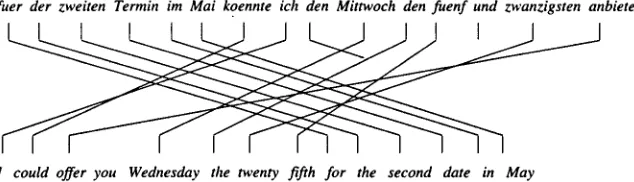
Figure 1: Word Alignment with deletion in translation: the top alignment is the one made by IBM Alignment Model 2, the bottom one is the 'ideal' alignment.
fiter der zweiten Terrain im Mai koennte ich den Mittwoch den fuenf und zwanzigsten anbieten
1 could offer ~ou Wednesday the twenty fifth for the second date in May
fuer der zweiten Termin im Mai koennte ich den Mittwoch den fuenf und zwanzigsten anbieten
I could offer you Wednesday the twenty fifth for the second date in May
Figure 2: Word Alignment of translation with different phrase order: the top alignment is the one made by IBM Alignment Model 2, the bottom one is the 'ideal' alignment.
fuer der zweiten Termin im Mai koennte ich den Mittwoch den fuenf und zwanzigsten anbieten
! could offer you Wednesday the twenty fifth for the second date in May
[image:2.612.141.479.87.275.2] [image:2.612.143.471.331.523.2] [image:2.612.146.463.580.671.2]Therefore, P ( t ] s ) is the sum of the proba- bilities of generating t from s over all possible alignments A, in which the position i in t is aligned with the position
ai
in s:P(t Is)
l l m
e y~ ... ~
l"It(tjls~J)a(ajlj, l,m)
a l ~ 0 am=Oj=l m l
e 1-I Y~ t ( t j l s i ) a ( i l j , l,m)
(1)j = l i = O
A word-based model may have severe prob- lems when there are deletions in translation (this may be a result of erroneous sentence alignment) or the two languages have different word orders, like English and German. Figure 1 and Figure 2 show some problematic alignments between English/German sentences made by IBM Model 2, together with the 'ideal' align- ments for the sentences. Here the alignment parameters penalize the alignment of English words with their G e r m a n translation equiva- lents because the translation equivalents are far away from the words.
An experiment reveals how often this kind of "skewed" alignment happens in our En- glish/German scheduling conversation parallel
corpus (Wang and Waibel, 1997). The ex-
periment was based on the following obser- vation: IBM translation Model 1 (where the alignment distribution is uniform) and Model 2 found similar Viterbi alignments when there were no movements or deletions, and they pre- dicted very different Viterbi alignments when the skewness was severe ill a sentence pair, since the alignment parameters in Model 2 penalize the long distance alignment. Figure 3 shows the Viterbi alignment discovered by Model 1 for the same sentences in Figure 21 .
We measured the distance of a Model 1 alignment a 1 and a Model 2 alignment a z
~--,Igl la ~ _ a2]. To estimate the skew-
a S A.-,i= 1
ness of the corpus, we collected the statistics about the percentage of sentence pairs (with at
~The b e t t e r alignment on a given pair of sentences does not m e a n Model 1 is a b e t t e r model. Non-uniform alignment distribution is desirable. Otherwise, language model would be the only factor t h a t determines the source sentence word order in decoding.
e~
30
25
20
15
10
5
0
0 0.5 1 1.5 2 2.5 Alignment distance > x * target sentence length
Figure 4: Skewness of Translations
least five words in a sentence) with Model 1 and Model 2 alignment distance greater than 1 / 4 , 2 / 4 , 3 / 4 , . . . , 10/4 of the target sentence length. By checking the Viterbi alignments made by both models, it is almost certain that whenever the distance is greater that 3/4 of the target sentence length, there is either a move- ment or a deletion in the sentence pair. Fig- ure 4 plots this statistic - - around 30% of the sentence pairs in our training d a t a have some degree of skewness in alignments.
3 S t r u c t u r e - b a s e d A l i g n m e n t M o d e l
To solve the problems with the word-based alignment models, we present a structure-based alignment model here. The idea is to di- rectly model the phrase movement with a rough alignment, and then model the word alignment within phrases with a detailed alignment.
Given an English sentence e = e l e 2 . . . e t , its G e r m a n translation g =
9192"" "gin
can be gen- erated by the following process:1. Parse e into a sequence of phrases, so
Z ---- ( e 1 1 , e 1 2 , • • • , e l / l ) ( e 2 1 , e 2 2 , • • . , e 2 1 2 ) • • •
(enl, enz,.--, e~l.)
= E o E I E 2 . . . E n ,
where E0 is a null phrase.
[image:3.612.325.516.60.226.2]have to form a consecutive sequence. So g may be expressed with something like
g = gllg12g21g13g22"", where gij repre- sents the j - t h word in the i-th phrase.
3. For each G e r m a n phrase Gi, 0 <_ i < q, with the probability P ( r i l i , r~ -1, E, e), align it with an English phrase E ~ .
4. For each G e r m a n phrase Gi, 0 <_ i < q, de- termine its beginning position bi in g with the distribution P(bi l " ~, 1.i-1 _q e , E ) . u 0 ~ r0~
5. Now it is time to generate the individual words in the G e r m a n phrases through de- tailed alignment. It works like IBM Model 4. For each word eij in the phrase Ei,
its fertility ¢ij has the distribution P(¢ij I . . j-1¢i0-1 E ) .
~ 3, ¢ i l , , bo, ro, e,
6. For each word eij in the phrase Ei, it gen- erates a tablet rij = {Tijl,Tij2,'''Tij¢ij}
by generating each of the words in rij
in turn with the probability P(rijk I r~.li,rJ~ -1 - , rio-l, l%, bo,qr~,e,E) f o r t h e k - t h
word in the tablet.
7. For each element risk in the tablet
vii, the permutation 7rij k determines its position in the target sentence ac- cording to the distribution P(rrij k I 7rk_ 1 ijl , 7r~l 1, 7r;-1, TO/, (~/, b(~, r~, e, E). "- .
We made the following independence assump- tions:
1. The number of target sentence phrases de- pends only on the number of phrases in the source sentence:
P ( q l e , E ) - - p n ( q [ n )
2. P(ri l i, r ~ - l , E , e )
= a ( r i l i ) x 1-I0_<j<i(1 - 5(ri, rj))
where 5(x,y) = 1 when x = y , and 5(x, y) = 0 otherwise.
This assumption states t h a t P(ri I i, rio-X,E,e) depends on i and ri. It also
1
depends on r~- with the
factor YI0<j<i(1-
(f(ri, rj)) to ensure t h a t each EnglisI~ phrase is aligned with at most one G e r m a n phrase.3. The beginning position of a target phrase depends on its distance from the beginning position of its preceding phrase, as well as
.
.
the length of the source phrase aligned with the preceding phrase:
P(bi l i, bio-l,r~,e,E)
=
I
= o (Ai I lEr,_,l)
The fertility and translation tablet of a source word depend on the word only:
P(¢ij l i,J, ¢ilj-1 , wo'~i-1 , ~o,hq rq, e, E) = n(¢ij
l
P(Tijk I Tkl 1,7":i 1 - "- , rg -1, ¢0,t bo ,q r ~ , e , E )
= l e v i )
The leftmost position of the translations of a source word depends on its distance from the beginning of the target phrase aligned with the source phrase t h a t contains t h a t source word. It also depends on the iden- tity of the phrase, and the position of the source word in the source phrase.
j-1 i - i t E ) = dl (Trijl -- bil El, j)
For a target word rijk other than the left- most Tij 1 in the translation tablet of the source eij, its position depends on its dis- tance from the position of another tablet
word 7"ij(k_l) closest to its left, the class of the target word Tijk, and the fertility of the source word eij.
p( jkl l 1, - rCil ,Tr o ,rO,¢o,b~,r~,e,E) i-1 i l = d2(rcijk - lrij(k_l) I 6(rijk), ¢ij)
here G(g) is the equivalent class for g.
3.1 P a r a m e t e r E s t i m a t i o n
EM algorithm was used to estimate the seven types of parameters: Pn, a, a, ¢, r, dl and d2. We used a subset of probable alignments in the EM learning, since the total number of alignments is exponential to the target sentence length. The subset was the neighboring align- ments (Brown et al., 1993) of the Viterbi align- ments discovered by Model 1 and Model 2. We chose to include the Model 1 Viterbi alignment here because the Model 1 alignment is closer to the "ideal" when strong skewness exists in a sentence pair.
4 F i n d i n g t h e S t r u c t u r e s
the language structures and write a g r a m m a r for them, since the primary merit of statistical machine translation is to reduce human labor. In this section we introduce a g r a m m a r infer- ence technique t h a t finds the phrases used in the structure-based alignment model. It is based on the work in (Ries, Bu¢, and Wang, 1995), where the following two operators are used:
.
.
Clustering: Clustering words/phrases with similar m e a n i n g s / g r a m m a t i c a l func- tions into equivalent classes. The mutual information clustering algorithm(Brown et al., 1992) were used for this.
Phrasing: The equivalent class sequence
Cl, c2,...c k
forms a phrase ifP(cl, c2,'" "ck)
log
P(cI, c2,'" "ck)
> 8,
P ( c , ) P ( c 2 ) " "P(ck)
where ~ is a threshold. By changing the threshold, we obtain a different number of phrases.
The two operators are iteratively applied to the training corpus in alternative steps. This results in hierarchical phrases in the form of se- quences of equivalent classes of words/phrases.
Since the algorithm only uses a monolin- gual corpus, it often introduces some language- specific structures resulting from biased usages of a specific language. In machine transla- tion we are more interested in cross-linguistic structures, similar to the case of using interlin- gua to represent cross-linguistic information in knowledge-based MT.
To obtain structures t h a t are common in both languages, a bilingual mutual information clus- tering algorithm (Wang, Lafferty, and Waibel, 1996) was used as the clustering operator. It takes constraints from parallel corpus. We also introduced an additional constraint in cluster- ing, which requires t h a t words in the same class must have at least one common potential part- of-speech.
Bilingual constraints are also imposed on the phrasing operator. We used bilingual heuris- tics to filter out the sequences acquired by the phrasing operator t h a t may not be common in multiple languages. The heuristics include:
.
.
A v e r a g e Translation Span: Given a phrase candidate, its average translation span is the distance between the leftmost and the rightmost target positions aligned with the words inside the candidate, av- eraged over all Model 1 Viterbi alignments of sample sentences. A candidate is filtered out if its average translation span is greater than the length of the candidate multiplied by a threshold. This criterion states t h a t the words in the translation of a phrase have to be close enough to form a phrase in another language.
A m b i g u i t y R e d u c t i o n : A word occur- ring in a phrase should be less ambiguous than in other random context. Therefore a phrase should reduce the ambiguity (un- certainty) of the words inside it. For each source language word class c, its translation entropy is defined as )-']~g
t(g [ c)log(g
[ c). The average per source class entropy re- duction induced by the introduction of a phrase P is therefore1
[p[ ~--~[~-'~
t(g
I v ) l o g t ( g [ c )cEP g
- ~ _ t ( g l c , P) logt(glc, P)]
g
A threshold was set up for minimum en- tropy reduction.
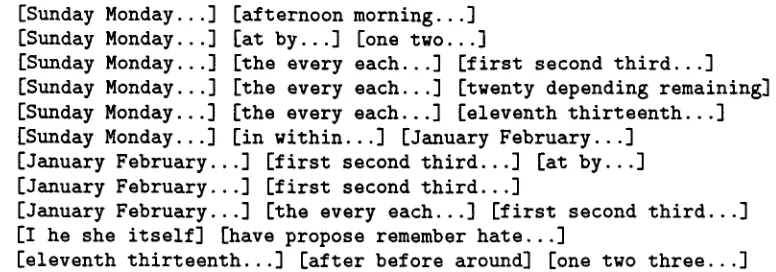
By applying the clustering operator followed with the phrasing operator, we obtained shallow phrase structures partly shown in Figure 5.
Given a set of phrases, we can deterministi- cally parse a sentence into a sequence of phrases by replacing the leftmost unparsed substring with the longest matching phrase in the set.
5 E v a l u a t i o n a n d D i s c u s s i o n
[Sunday Monday..]
[Sunday Monday..]
[Sunday Monday. .]
[Sunday Monday..]
[Sunday Monday..]
[Sunday Monday..]
[January February.
[January February.
[image:6.612.102.490.80.216.2][afternoon morning...]
[at by...] [one two...]
[the every each...] [first second third...] [the every each...] [twenty depending remaining3
[the every each...] [eleventh
thirteenth...]
[in within...] [January February...]
.] [first second third...] [at by...]
.] [first second third...]
[January February...] [the every each...] [first second third...]
[I he she itself] [have propose remember hate...]
[eleventh thirteenth...] [after before around] [one two three...]
Figure 5: Example of Acquired Phrases. Words in a bracket form a cluster, phrases are cluster sequences. Ellipses indicate t h a t a cluster has more words than those shown here.
Model Correct OK Incorrect Accuracy
Model 2 284 87 176 59.9%
Model 3 98 45 57 60.3%
S. Model 303 96 148 64.2%
Table h Translation Accuracy: a correct trans- lation gets one credit, an okay translation gets 1/2 credit, an incorrect one gets 0 credit. Since the IBM Model 3 decoder is too slow, its per- formance was not measured on the entire test set.
ity mass is more scattered in the structure-based model, reflecting the fact t h a t English and Ger- man have different phrase orders. On the other hand, the word based model tends to align a target word with the source words at similar po- sitions, which resulted in many incorrect align- ments, hence made the word translation proba- bility t distributed over many unrelated target words, as to be shown in the next subsection.
5 . 3 M o d e l C o m p l e x i t y
language model. A preprocessor splited Ger-
man compound nouns. Words that occurred
only once were taken as unknown words. This resulted in a lexicon of 1372 English and 2202 German words. The English/German lexicons were classified into 250 classes in each language and 560 English phrases were constructed upon these classes with the g r a m m a r inference algo- rithm described earlier.
We limited the maximum sentence length to be 20 words/15 phrases long, the maximum fer- tility for non-null words to be 3.
5.1 T r a n s l a t i o n A c c u r a c y
Table 1 shows the end-to-end translation perfor- mance. The structure-based model achieved an error reduction of around 12.5% over the word- based alignment models.
5.2 W o r d O r d e r a n d P h r a s e A l i g n m e n t
Table 2 shows the alignment distribution for the first German w o r d / p h r a s e in Simplified Model 2 and the structure-based model. The probabil-
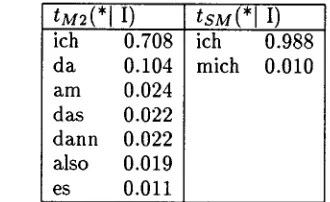
The structure-based model has 3,081,617 free parameters, an increase of a b o u t 2% over the 3,022,373 free parameters of Simplified Model 2. This small increase does not cause over-fitting, as the performance on the test d a t a suggests. On the other hand, the structure-based model is more accurate. This can be illustrated with an example of the translation probability distri- bution of the English word 'T'. Table 3 shows the possible translations of 'T' with probability greater than 0.01. It is clear t h a t the structure- based model "focuses" better on the correct translations. It is interesting to note that the German translations in Simplified Model 2 of- ten appear at the beginning of a sentence, the position where 'T' often appears in English sen- tences. It is the biased word-based alignments that pull the unrelated words together and in- crease the translation uncertainty.
We define the average translation entropy as
m n
F_. P(ei) F_, -t(gs I ei)logt(gs
l ei).
j 0 1 2 3 4 5 6 7
aM2(jl
1) 0.04 0.86 0.054 0.025 0.008 0.005 0.004 0.002asM(jl
1) 0.003 0.29 0.25 0.15 0.07 0.11 0.05 0.048 9
3.3x I0 -4 2.9xi0 -4
0.02 0.01
Table 2: The alignment distribution for the first German word/phrase in Simplified Model 2 and in the structure-based model. The second distribution reflects the higher possibility of phrase reordering in translation.
tM2(*l
I)tSM(*l
I)ich 0.708
da 0.104
am 0.024
das 0.022
dann 0.022
also 0.019
es 0.011
ich 0.988
mich 0.010
Table 3: The translation distribution of "I'. It is more uncertain in the word-based alignment model because the biased alignment distribu- tion forced the associations between unrelated English/German words.
(m, n are English and German lexicon size.) It is a direct measurement of word transla- tion uncertainty. The average translation en- tropy is 3.01 bits per source word in Sim- plified Model 2, 2.68 in Model 3, and 2.50
in the structured-based model. Therefore
information-theoretically the complexity of the word-based alignment models is higher than that of the structure-based model.
6 Conclusions
The structure-based alignment directly models the word order difference between English and German, makes the word translation distribu- tion focus on the correct ones, hence improves translation performance.
7 A c k n o w l e d g e m e n t s
We would like to thank the anonymous COL- ING/ACL reviewers for valuable comments. This research was partly supported by ATR and the Verbmobil Project. The views and conclu- sions in this document are those of the authors.
ematics of Statistical Machine Translation:
Parameter Estimation.
Computational Lin-
guistics,
19 (2) :263-311.Brown, P. F., V. J. Della-Pietra, P. V. deSouza, J. C. Lai, and R. L. Mercer. 1992. Class- Based N-gram Models of Natural Language.
Computational Linguistics,
18 (4) :467-479.Ries, Klaus, Finn Dag Bu¢, and Ye-
Yi Wang. 1995. Improved Language
Modelling by Unsupervised Acquisi-
tion of Structure. In
ICASSP
'95.
IEEE. corrected version available via
http ://www. cs. cmu. edu/~ies/icassp_gs, html.
Suhm, B., P.Geutner, T. Kemp, A. Lavie, L. Mayfield, A. McNair, I. Rogina, T. Schultz, T. Sloboda, W. Ward, M. Woszczyna, and A. Waibel. 1995. JANUS: Towards multilin- gual spoken language translation. In
Proceed-
ings of the ARPA Speech Spoken Language
Technology Workshop, Austin, TX, 1995.
Vogel, S., H. Ney, and C. Tillman. 1996. HMM-Based Word Alignment in Statistical Translation. In
Proceedings of the Seven-
teenth International Conference on Compu-
tational Linguistics: COLING-g6,
pages 836- 841, Copenhagen, Denmark.Wang, Y., J. Lafferty, and A. Waibel. 1996. Word Clustering with Parallel Spoken Lan- guage Corpora. In
Proceedings of the 4th In-
ternational Conference on Spoken Language
Processing (ICSLP'96),
Philadelphia, USA. Wang, Y. and A. Waibel. 1997. Decoding Al-gorithm in Statistical Machine Translation. In
Proceedings of the 35th Annual Meeting
of the Association for Computational Lin-
guistics and 8th Conference of the European
Chapter of the Association for Computational
Linguistics (A CL/EA CL '97),
pages 366-372, Madrid, Spain.