A n Efficient Compiler for Weighted R e w r i t e Rules
M e h r y a r M o h r i A T & T R e s e a r c h 600 M o u n t a i n A v e n u e M u r r a y Hill, 07974 N J m o h r i @ r e s e a r c h , att. c o m
R i c h a r d S p r o a t Bell L a b o r a t o r i e s 700 M o u n t a i n A v e n u e M u r r a y Hill, 07974 N J r w s @ b e l l - l a b s , c o m
A b s t r a c t
Context-dependent rewrite rules are used in many areas of natural language and speech processing. Work in computa- tional phonology has demonstrated that, given certain conditions, such rewrite rules can be represented as finite-state transducers (FSTs). We describe a new algorithm for compiling rewrite rules into FSTs. We show the algorithm to be sim- pler and more efficient than existing al- gorithms. Further, many of our appli- cations demand the ability to compile
weighted
rules intoweighted
FSTs, trans-ducers generalized by providing transi- tions with weights. We have extended the algorithm to allow for this.
1. M o t i v a t i o n
Rewrite rules are used in many areas of natural language and speech processing, including syntax, morphology, and phonology 1. In interesting ap- plications, the number of rules can be very large. It is then crucial to give a representation of these rules that leads to efficient programs.
Finite-state transducers provide just such a compact representation (Mohri, 1994). They are used in various areas of natural language and speech processing because their increased compu- tational power enables one to build very large ma- chines to model interestingly complex linguistic phenomena. They also allow algebraic operations such as union, composition, and projection which are very useful in practice (Berstel, 1979; Eilen- berg, 1974 1976). And, as originally shown by Johnson (1972), rewrite rules can be modeled as 1 Parallel rewrite rules also have interesting applica- tions in biology. In addition to their formal language theory interest, systems such as those of Aristid Lin- denmayer provide rich mathematical models for bio- logical development (Rozenberg and Sa]omaa, 1980).
finite-state transducers, under the condition that no rule be allowed to apply any more than a finite number of times to its own output.
Kaplan and Kay (1994), or equivalently Kart- tunen (1995), provide an algorithm for compiling rewrite rules into finite-state transducers, under the condition that they do not rewrite their non- contextual part 2. We here present a new algorithm for compiling such rewrite rules which is both sim- pler to understand and implement, and computa- tionally more efficient. Clarity is important since, as pointed out by Kaplan and Kay (1994), the rep- resentation of rewrite rules by finite-state trans- ducers involves many subtleties. Time and space efficiency of the compilation are also crucial. Us- ing naive algorithms can be very time consuming and lead to very large machines (Liberman, 1994). In some applications such as those related to speech processing, one needs to use
weighted
rewrite rules, namely rewrite rules to which weights are associated. These weights are then used at the final stage of applications to output the most probable analysis. Weighted rewrite rules can be compiled into
weighted
finite-state trans- ducers, namely transducers generalized by pro- viding transitions with a weighted output, under the same context condition. These transducers are very useful in speech processing (Pereira et al., 1994). We briefly describe how we have aug- mented our algorithm to handle the compilation of weighted rules into weighted finite-state trans- ducers.In order to set the stage for our own contribu- tion, we start by reviewing salient aspects of the Kaplan and Kay algorithm.
Prologue o I d( Obligatory( ¢ , <i , >))
Id(Rightcontezt(p, <, >))
Replace
Id(Leftcontezt(A, <, >))
Prologue - i
= Id(Z~< 0 <i ¢ ° < > B~,< 0) o
= Id(( 0 > p>0Z 0- > > p>0 0- > o
= [Id(~*<,>, o)Opt(Id(<a)¢°<c>c × ¢°c>cId(>a))]* o
-" I d ( ( ~ 0 A < 0 - ~ 0 < < Z~0 f] ~ 0 A < 0 - ~ 0 < < ~ 0 ) > ) o
Figure 1: Compilation of obligatory left-to-right rules, using the KK algorithm.
(1)
2. The KK Algorithm
T h e rewrite rules we consider here have the fol- lowing general form:
¢ --, p (2)
Such rules can be interpreted in the following way: ¢ is to be replaced by ¢ whenever it is preceded by A and followed by p. Thus, A and p represent the left and right contexts of application of the rules. In general, ¢, ¢, A and p are all regular expressions over the alphabet of the rules. Several types of rules can be considered depending on their being obligatory or optional, and on their direction of application, from left to right, right to left or simultaneous application.
Consider an obligatory rewrite rule of the form ¢ --+ ¢ / A p, which we will assume applies left to right across the input string. Compilation of this rule in the algorithm of Kaplan and Kay (1994) (KK for short) involves composing together six transducers, see Figure 1.
We use the notations of KK. In particular, denotes the alphabet, < denotes the set of context labeled brackets {<a, <i, <c}, > the set {>a, >i, >c}, and 0 an additional character representing deleted material. Subscript symbols of an expres- sion are symbols which are allowed to freely ap- pear anywhere in the strings represented by t h a t expression. Given a regular expression r, Id(r) is the identity transducer obtained from an automa- ton A representing r by adding o u t p u t labels to A identical to its input labels.
T h e first transducer, Prologue, freely intro- duces labeled brackets from the set {<a, <i, <~, >a, >i, >~} which are used by left and right context transducers. The last transducer,
Prologue - i , erases all such brackets.
In such a short space, we can of course not hope to do justice to the KK algorithm, and the reader who is not familiar with it is urged to con- sult their paper. However, one point that we do need to stress is the following: while the con- struction of Prologue, Prologue - i and Replace
2 3 2
is fairly direct, construction of the other transduc- ers is more complex, with each being derived via the application of several levels of regular oper- ations from the original expressions in the rules. This clearly appears from the explicit expressions we have indicated for the transducers. T h e con- struction of the three other transducers involves m a n y operations including: two intersections of automata, two distinct subtractions, and nine complementations. Each subtraction involves an intersection and a complementation algorithm 3. So, in the whole, four intersections and eleven complementations need to be performed.
Intersection and complementation are classi- cal a u t o m a t a algorithms (Aho et al., 1974; Aho et al., 1986). The complexity of intersection is quadratic. But the classical complementation al- gorithm requires the input a u t o m a t o n to be de- terministic. Thus, each of these 11 operations re- quires first the determinization of the input. Such operations can be very costly in the case of the a u t o m a t a involved in the KK algorithm 4.
In the following section we briefly describe a new algorithm for compiling rewrite rules. For rea- sons of space, we concentrate here on the com- pilation of left-to-right obligatory rewrite rules. However, our methods extend straightforwardly to other modes of application (optional, right-to-left, simultaneous, batch), or kinds of rules (two-level rules) discussed by Kaplan and Kay (1994).
3A subtraction can of course also be performed di- rectly by combining the two steps of intersection and complementation, but the corresponding algorithm has exactly the same cost as the total cost of the two operations performed consecutively.
[image:2.612.112.524.90.186.2]3 . N e w A l g o r i t h m 3.1. O v e r v i e w
In contrast to the KK algorithm which introduces "brackets everywhere only to restrict their occur- rence subsequently, our algorithm introduces con- text symbols just when and where they are needed. Furthermore, the number of intermediate trans- ducers necessary in the construction of the rules is smaller than in the KK algorithm, and each of the transducers can be constructed more directly and efficiently from the primitive expressions of the rule, ~, ~, A, p.
A transducer corresponding to the left-to- right obligatory rule ¢ --* ¢/A p can be ob- tained by composition of five transducers:
r o f o replace o 11 o 12 (3) 1. T h e transducer r introduces in a string a marker > before every instance of p. For rea- sons that will become clear we will notate this as Z* p --~ E* > p.
2. T h e transducer f introduces markers <1 and <2 before each instance of ~ that is followed by >: u u {>})'{<1, <2 }5 >. In other words, this t r a n s d u c e r / h a r k s just those ~b t h a t occur before p.
3. The replacement transducer replace replaces ~b with ~ in the context <1 ~b >, simultane- ously deleting > in all positions (Figure 2). Since >, <1, and <2 need to be ignored when determining an occurrence of ~b, there are loops over the transitions >: c, <1: ¢, <~: c at all states of ¢, or equivalently of the states of the cross product transducer ¢ × ~. 4. T h e transducer 11 admits only those strings
in which occurrences of <1 are preceded by A and deletes < l at such occurrences:
5. The transducer 12 admits only those strings in which occurrences of <2 are not preceded by A and deletes <~ at such occurrences: 2*X <2-~ ~*~.
Clearly the composition of these transducers leads to the desired result. T h e construction of the transducer replace is straightforward. In the fol- lowing, we show that the construction of the other four transducers is also very simple, and that it only requires the determinization of 3 a u t o m a t a and additional work linear (time and space) in the size of the determinized automata.
3 . 2 . M a r k e r s M a r k e r s o f T Y P E 1
Let us start by considering the problem of con- structing what we shall call a T Y P E I transducer,
Figure 2: Replacement transducer replace in the obligatory left-to-right case.
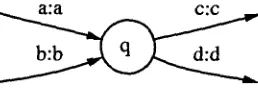
which inserts a marker after all prefixes of a string that match a particular regular expression. Given a regular expression fl defined on the alphabet E, one can construct, using classical algorithms (Aho et al., 1986), a deterministic a u t o m a t o n a repre- senting E*fl. As with the KK algorithm, one can obtain from a a transducer X = I d ( a ) simply by assigning to each transition the same o u t p u t label as the input label. We can easily transform X into a new transducer r such that it inserts an arbi- trary marker ~ after each occurrence of a pattern described by ~. To do so, we make final the non- final states of X and for any final state q of X we create a new state q~, a copy of q. Thus, q' has the same transitions as q, and qP is a final state. We then make q non-final, remove the transitions leaving q and add a t r a n s i t i o n from q to q' with input label the e m p t y word c, and o u t p u t ~ . Fig- ures 3 and 4 illustrate the transformation of X into
T .
a:a cic
Figure 3: Final state q of X with entering and leaving transitions.
ata ctc
P r o p o s i t i o n 1 Let ~ be a deterministic automa- ton representing E*/3, then the transducer r ob- tained as described above is a transducer post- marking occurrences of fl in a string ofF* by # .
Proof. T h e p r o o f is based on the observa- tion t h a t a deterministic a u t o m a t o n representing E*/~ is necessarily complete 5. Notice t h a t non- deterministic a u t o m a t a representing ~*j3 are not necessarily complete. Let q be a state of a and let u E ~* be a string reaching q6. Let v be a string described by the regular expression ft. Then, for any a E ~, uav is in ~ * ~ . Hence, uav is accepted by the a u t o m a t o n a , and, since ~ is deterministic, there exists a transition labeled with a leaving q. Thus, one can read any string u E E* using the a u t o m a t o n a . Since by definition of a , the state reached when reading a prefix u ~ of u is final iff u ~ E ~ * ~ , by construction, the transducer r in- serts the s y m b o l # after the prefix u ~ iff u ~ ends with a p a t t e r n of ft. This ends the proof of the proposition, t3
M a r k e r s o f TYPE 2
In some cases, one wishes to check t h a t any occurrence of # in a string s is preceded (or fol- lowed) by an occurrence of a p a t t e r n of 8. We shall say t h a t the corresponding transducers are of TYPE 2. T h e y play the role of a filter. Here again, they can be defined from a deterministic au- t o m a t o n representing E*B. Figure 5 illustrates the modifications to m a k e f r o m the a u t o m a t o n of fig- ure 3. T h e s y m b o l s # should only a p p e a r at final states and m u s t be erased. T h e loop # : e added at final states of Id(c~) is enough for t h a t purpose. All states of the transducer are then m a d e final since any string conforming to this restriction is acceptable: cf. the transducer !1 for A above.
#:E
Figure 5: Filter transducer, TYPE 2.
5An automaton A is complete iff at any state q and for any element a of the alphabet ~ there exists at least one transition leaving q labeled with a. In the case of deterministic automata, the transition is unique.
6We assume all states of a accessible. This is true if a is obtained by determinization.
2 3 4
M a r k e r s o f TYPE 3
In other cases, one wishes to check the reverse constraint, t h a t is t h a t occurrences of # in the string s are not preceded (or followed) by any oc- currence of a p a t t e r n of ft. T h e t r a n s f o r m a t i o n then simply consists of adding a loop at each non- final state of Id(a), and of m a k i n g all states final. Thus, a state such as t h a t of figure 6 is trans-
a : a c:c
Figure 6: Non-final s t a t e q of a .
formed into t h a t of figure 5. We shall say t h a t the corresponding transducer is of TYPE 3: cf. the transducer 12 for ~.
T h e construction of these transducers (TYPE
1-3) can be generalized in various ways. In par- ticular:
• One can add several alternative m a r k e r s { # 1 , ' " , # k } after each occurrence of a p a t - tern of 8 in a string. T h e result is then an a u t o m a t o n with transitions labeled with, for instance, ~ 1 , ' " ", ~ k after each p a t t e r n of fl: cf. transducer f for ¢ above.
• Instead of inserting a symbol, one can delete a s y m b o l which would be necessarily present after each occurrence of a p a t t e r n of 8. For any regular expression a , de- fine M arker( a, type, deletions, insertions) as the transducer of t y p e type constructed as previously described from a deterministic a u t o m a t o n repre- senting a , insertions and deletions being, respec- tively, the set of insertions and deletions the trans- ducer makes.
P r o p o s i t i o n 2 For any regular expression a, M a r k e r ( a , type, deletions, insertions) can be constructed from a deterministic automaton rep- resenting a in linear time and space with respect to the size of this automaton.
[image:4.612.378.507.197.242.2]r = [reverse(Marker(E*reverse(p), 1, {>},0))]
f = [reverse(Marker((~ U {>})*reverse(C> >), 1, {<1, <u},0))] 11 = [Marker(N*)L 2,0, {<1})]<~:<2
12 = [Marker($*A,3,@, {<2})]
Figure 7: Expressions of the r, f , ll, and 12 using M a r k e r .
(4)
(5)
(6)
(7)
number of transitions of a and that other modifi- cations consisting of adding new states and transi- tions and making states final or not are also linear. D
We just showed that M a r k e r ( a , t y p e , de- letions, insertions) can be constructed in a very efficient way. Figure 7 gives the expressions of the four transducers r, f , ll, and 12 using M a r k e r .
Thus, these transducers can be constructed very efficiently from deterministic a u t o m a t a repre- senting s ~ * r e v e r s e ( p ) , ( ~ O {>})* reverse(t> >), and E*,~. The construction of r and f requires two reverse operations. This is because these two transducers insert material before p or ¢.
4. E x t e n s i o n to Weighted Rules
In m a n y applications, in particular in areas re- lated to speech, one wishes not only to give all possible analyses of some input, but also to give some measure of how likely each of the analyses is. One can then generalize replacements by consid- ering extended regular expressions, namely, using the terminology of formal language theory, ratio- nal power series (Berstel and Reutenauer, 1988; Salomaa and Soittola, 1978).
T h e rational power series we consider here are functions mapping ~* to ~ + U {oo) which can be described by regular expressions over the alphabet (T~+ U {co}) x ~. S = (4a)(2b)*(3b) is an example of rational power series. It defines a function in the following way: it associates a non-null num- ber only with the strings recognized by the regu- lar expression ab*b. This number is obtained by adding the coefficients involved in the recognition of the string. The value associated with abbb, for instance, is (S, abbb) = 4 + 2 + 2 + 3 = 11.
In general, such extended regular expressions can be redundant. Some strings can be matched
SAs in the KK algorithm we denote by ¢> the set of the strings described by ¢ containing possibly oc- currences of > at any position. In the same way, sub- scripts such as >:> for a transducer r indicate that loops by >:> are added at all states of r. We de- note by reverse(a) the regular expression describing exactly the reverse strings of a if a is a regular expres- sion, or the reverse transducer of a if a is a transducer.
in different ways with distinct coefficients. The value associated with those strings is then the min- imum of all possible results. S' = (2a)(3b)(4b) + (5a)(3b*) matches abb with the different weights 2 + 3 + 4 -- 9 and 5 + 3 + 3 = 11. T h e mini- m u m of the two is the value associated with abb: (S', abb) = 9. Non-negative numbers in the defi- nition of these power series are often interpreted as the negative logarithm of probabilities. This explains our choice of the operations: addition of the weights along the string recognition and min, since we are only interested in that result which has the highest probability 9.
Rewrite rules can be generalized by letting ¢ be a rational power series. The result of the ap- plication of a generalized rule to a string is then a set of weighted strings which can be represented by a weighted automaton. Consider for instance the following rule, which states that an abstract nasal, denoted N, is rewritten as m in the context of a following labial:
Y ---* m / _ _ [ + l a b i a l ] (8) z Now suppose that this is only probabilistically true, and that while ninety percent of the time N does indeed become m in this environment, about ten percent of the time in real speech it be- comes n. Converting from probabilities to weights, one would say that N becomes m with weight a = - l o g ( 0 . 9 ) , and n with weight fl = - l o g ( 0 . 1 ) , in the stated environment. One could represent this by the following rule:
N --* a m + f i n / _ _ [ + l a b i a l ] (9) We define Weighted finite-state transducers as transducers such that in addition to input and out- put labels, each transition is labeled with a weight. The result of the application of a weighted transducer to a string, or more generally to an a u t o m a t o n is a weighted a u t o m a t o n . T h e corre- sponding operation is similar to the unweighted case. However, the weight of the transducer and those of the string or a u t o m a t o n need to be combined too, here added, during composition (Pereira et al., 1994).
\"_/Too
p:p/O
N:N/O~
N:m/a N:n/l~
: 0 ~ N:N/O
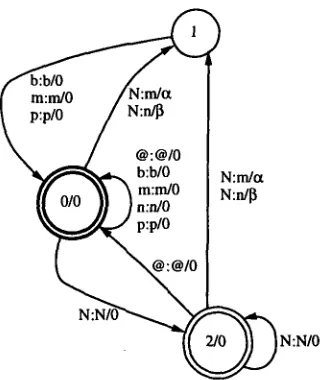
Figure 8: Transducer representing the rule 9.
We have generalized the composition opera- tion to the weighted case by introducing this com- bination of weights. The algorithm we described in the previous sections can then also be used to compile weighted rewrite rules.
As an example, the obligatory rule 9 can be represented by the weighted transducer of Fig- ure 8 10. The following theorem extends to the weighted case the assertion proved by Kaplan and Kay (1994).
T h e o r e m 1 A weighted rewrite rule of the type defined above that does not rewrite its non- contextual part can be represented by a weighted finite-state transducer.
Proof. The construction we described in the pre- vious section also provides a constructive proof of this theorem in the unweighted case. In case ¢ is a power series, one simply needs to use in that construction a weighted finite-state trans- ducer representing ¢. By definition of composition of weighted transducers, or multiplication of power series, the weights are then used in a way consis- tent with the definition of the weighted context- dependent rules, o
5. E x p e r i m e n t s
In order to compare the performance of the M- gorithm presented here with KK, we timed both algorithms on the compilation of individual rules taken from the following set (k • [0, 10]):
a --* b~ c ~
(10)
a --* b~ c k
(11)
1°We here use the symbol ~ to denote all letters different from b, rn, n, p, and N.
2 3 6
In other words we tested twenty two rules where the left context or the right context is varied in length from zero to ten occurrences of c. For our experiments, we used the alphabet of a realistic application, the text analyzer for the Bell Labora- tories German text-to-speech system consisting of 194 labels. All tests were run on a Silicon Graph- ics IRIS Indigo 4000, 100 MhZ IP20 Processor, 128 Mbytes RAM, running IRIX 5.2. Figure 9 shows the relative performance of the two algo- rithms for the left context: apparently the per- formance of both algorithms is roughly linear in the length of the left context, but KK has a worse constant, due to the larger number of operations involved. Figure 10 shows the equivalent data for the right context. At first glance the data looks similar to that for the left context, until one no- tices that in Figure 10 we have plotted the time on a log scale: the KK algorithm is hyperexponential. What is the reason for this performance degra- dation in the right context? The culprits turn out to be the two intersectands in the expression of Rightcontext(p, <, >) in Figure 1. Consider for example the righthand intersectand, namely ~ 0 > P > 0 ~ 0 - > ~ 0 , which is the complement of ~ 0 > P > 0 ~ 0 - > ~ 0 - As previously in- dicated, the complementation Mgorithm. requires determinization, and the determinization of au- tomata representing expressions of the form ~*a, where c~ is a regular expression, is often very ex- pensive, specially when the expression a is already complex, as in this case.
[image:6.612.98.258.79.269.2]q ,
o
11
/"
---nl
/
.../'/"
/
m / ' = i 1 ~ 1 1 j
0 0 0 `~'-" 0 / 0 ~ 0
0__0/0
0 0I I I I 2 4 6 $
L=tr~lm 011.~t C o m x t
Figure 9: Compilation times for rules of the form a ~ b / c k , (k E [0, 10]).
9 "
o o
./
/
I:
N , * a~,~t.vn I/
/
o/"
/./
i i / 1 1
~ 0 ~ 0 ~ 0 " . ' ' " 0
i J i i i 2 4 6 e 10
Figure 10: Compilation times for rules of the form
a ~ b /
c k, (k
E[0, 10]).
vowel < a > contains twenty five rules. In the ac- tual application of the rule compiler to these rules, one compiles the individual rules in each ruleset one by one, and composes them together in the order written, compacts them after each composi- tion, and derives a single transducer for each set. When done off-line, these operations of compo-
Table 1: Comparison in a real example.
I Rulesll KK II New I
time space time space
(s) states arcs (s) states arcs <5> 62 412 50,475 47 394 47,491 <a> 284 1,939 215,721 240 1,927 213,408
sition and compaction dominate the time corre- sponding to the construction of the transducer for each individual rule. The difference between the two algorithms appears still clearly for these two sets of rules. Table 1 shows for each algorithm the times in seconds for the overall construction, and the number of states and arcs of the output transducers.
6. C o n c l u s i o n
We briefly described a new algorithm for compiling context-dependent rewrite rules into finite-state transducers. Several additional methods can be used to make this algorithm even more efficient.
The a u t o m a t a determinizations needed for this algorithm are of a specific type. They repre-
sent expressions of the type ~*¢ where ¢ is a reg- ular expression. Given a deterministic a u t o m a t o n representing ¢, s u c h determinizations can be per- formed in a more efficient way using failure func- tions (Mohri, 1995). Moreover, the corresponding determinization is independent of ~ which can be very large in some applications. It only depends on the alphabet of the automaton representing ¢. One can devise an on-the-fly implementation of the composition algorithm leading to the final transducer representing a rule. Only the neces- sary part of the intermediate transducers is then expanded for a given input (Pereira et al., 1994).
The resulting transducer representing a rule is often subsequentiable or p-subsequentiable. It can then be determinized and minimized (Mohri, 1994). This both makes the use of the transducer time efficient and reduces its size.
We also indicated an extension of the theory of rule-compilation to the case of weighted rules, which compile into weighted finite-state transduc- ers. Many algorithms used in the finite-state the- ory and in their applications to natural language processing can be extended in the same way.
[image:7.612.95.246.87.301.2] [image:7.612.344.497.96.301.2]2
- co !O
/
/°
/°
/
/°
/
/
/
/
I I t
SOO 1;10 1120
II S~S in I:bsr S
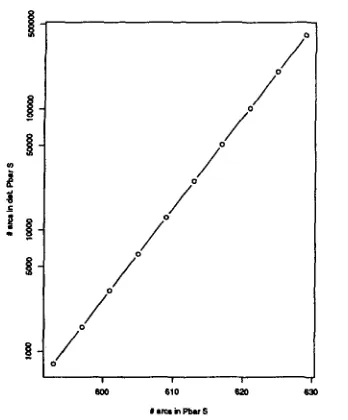
Figure 11: Number of arcs in the non- deterministic automaton r representing P S =
$ $
E~0 > P>0E>0- > E>0 versus the log of the num- ber of arcs in the automaton obtained by deter- minization of r.
recognition in the future.
Acknowledgements
We wish to thank several colleagues of AT&T/_Bell Labs, in particular Fernando Pereira and Michael Riley for stimulating discussions about this work and Bernd MSbius for providing the German pro- nunciation rules cited herein.
R e f e r e n c e s
Alfred V. Aho, John E. Hopcroft, and Jeffrey D. Ullman. 1974. The design and analysis of computer algorithms. Addison Wesley: Read- ing, MA.
Alfred V. Aho, Ravi Sethi, and Jeffrey D. Ullman. 1986. Compilers, Principles, Techniques and
Tools. Addison Wesley: Reading, MA. Jean Berstel and Christophe Reutenauer.
1988. Rational Series and Their Languages.
Springer-Verlag: Berlin-New York.
Jean Berstel. 1979. Transductions and Context- Free Languages. Teubner Studienbucher: Stuttgart.
Samuel Eilenberg. 1974-1976. Automata, Lan- guages and Machines, volume A-B. Academic Press.
238
Michael R. Garey and David S. Johnson. 1979.
Computers and Intractability. Freeman and Company, New York.
C. Douglas Johnson. 1972. Formal Aspects of Phonological Description. Mouton, Mouton, The Hague.
Ronald M. Kaplan and Martin Kay. 1994. Regu- lar models of phonological rule systems. Com- putational Linguistics, 20(3).
Lauri Karttunen. 1995. The replace operator. In
33 rd Meeting of the Association for Compu- tational Linguistics (ACL 95), Proceedings of the Conference, MIT, Cambridge, Massachus- setts. ACL.
Wener Kuich and Arto Salomaa. 1986. Semir- ings, Automata, Languages. Springer-Verlag: Berlin-New York.
Mark Liberman. 1994. Commentary on kaplan and kay. Computational Linguistics, 20(3). Robert McNaughton. 1994. The uniform halt-
ing problem for one-rule semi-thue systems. Technical Report 94-18, Department of Com- puter Science, Rensselaer Polytechnic Insti- tute, Troy, New York.
Mehryar Mohri. 1994. Compact representations by finite-state transducers. In 32 nd Meeting of the Association for Computational Linguistics (ACL 94), Proceedings of the Conference, Las Cruces, New Mexico. ACL.
Mehryar Mohri. 1995. Matching patterns of an automaton. Lecture Notes in Computer Sci- ence, 937.
Fernando C. N. Pereira, Michael Riley, and Richard Sproat. 1994. Weighted rational transductions and their application to human language processing. In ARPA Workshop on Human Language Technology. Advanced Re- search Projects Agency.
Grzegorz Rozenberg and Arto Salomaa. 1980.
The Mathematical Theory of L Systems. Aca- demic Press, New York.
Arto Salomaa and Matti Soittola. 1978.
Automata- Theoretic Aspects of Formal Power Series. Springer-Verlag: Berlin-New York. Richard Sproat. 1996. Multilingual text analy-
sis for text-to-speech synthesis. In Proceed- ings of the ECAI-96 Workshop on Extended Finite State Models of Language, Budapest, Hungary. European Conference on Artificial Intelligence.
[image:8.612.105.279.88.298.2]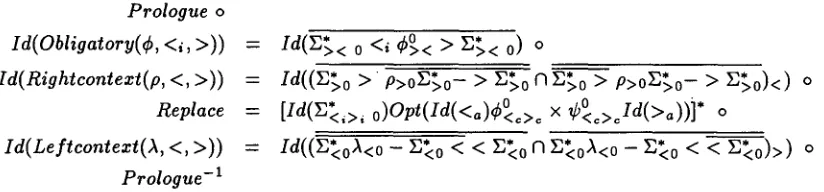
![Figure 10: Compilation times for rules of the form c k, (k E [0, 10]).](https://thumb-us.123doks.com/thumbv2/123dok_us/272605.526700/7.612.344.497.96.301/figure-compilation-times-rules-form-c-k-e.webp)