Shallow parsing on the basis of words only: A case study
Antal van den Bosch and Sabine Buchholz
ILK / Computational Linguistics and AI
Tilburg University
Tilburg, The Netherlands
Antal.vdnBosch,S.Buchholz
@kub.nl
Abstract
We describe a case study in which a memory-based learning algorithm is trained to simultaneously chunk sentences and assign grammatical function tags to these chunks. We compare the algo-rithm’s performance on this parsing task with varying training set sizes (yielding learning curves) and different input repre-sentations. In particular we compare in-put consisting of words only, a variant that includes word form information for low-frequency words, gold-standard POS only, and combinations of these. The word-based shallow parser displays an appar-ently log-linear increase in performance, and surpasses the flatter POS-based curve at about 50,000 sentences of training data. The low-frequency variant performs even better, and the combinations is best. Com-parative experiments with a real POS tag-ger produce lower results. We argue that we might not need an explicit intermediate POS-tagging step for parsing when a suffi-cient amount of training material is avail-able and word form information is used for low-frequency words.
1
Introduction
It is common in parsing to assign part-of-speech (POS) tags to words as a first analysis step provid-ing information for further steps. In many early
parsers, the POS sequences formed the only input to the parser, i.e. the actual words were not used except in POS tagging. Later, with feature-based grammars, information on POS had a more central place in the lexical entry of a word than the identity of the word itself, e.g. MAJOR and other HEAD fea-tures in (Pollard and Sag, 1987). In the early days of statistical parsers, POS were explicitly and often ex-clusively used as symbols to base probabilities on; these probabilities are generally more reliable than lexical probabilities, due to the inherent sparseness of words.
In modern lexicalized parsers, POS tagging is of-ten interleaved with parsing proper instead of be-ing a separate preprocessbe-ing module (Collins, 1996; Ratnaparkhi, 1997). Charniak (2000) notes that hav-ing his generative parser generate the POS of a con-stituent’s head before the head itself increases per-formance by 2 points. He suggests that this is due to the usefulness of POS for estimating back-off prob-abilities.
Abney’s (1991) chunking parser consists of two modules: a chunker and an attacher. The chunker divides the sentence into labeled, non-overlapping sequences (chunks) of words, with each chunk con-taining a head and (nearly) all of its premodi-fiers, exluding arguments and postmodifiers. His chunker works on the basis of POS information alone, whereas the second module, the attacher, also uses lexical information. Chunks as a sepa-rate level have also been used in Collins (1996) and Ratnaparkhi (1997).
This brief overview shows that the main reason for the use of POS tags in parsing is that they provide
useful generalizations and (thereby) counteract the sparse data problem. However, there are two objec-tions to this reasoning. First, as naturally occurring text does not come POS-tagged, we first need a mod-ule to assign POS. This tagger can base its decisions only on the information present in the sentence, i.e. on the words themselves. The question then arises whether we could use this information directly, and thus save the explicit tagging step. The second ob-jection is that sparseness of data is tightly coupled to the amount of training material used. As train-ing material is more abundant now than it was even a few years ago, and today’s computers can handle these amounts, we might ask whether there is now enough data to overcome the sparseness problem for certain tasks.
To answer these two questions, we designed the following experiments. The task to be learned is a shallow parsing task (described below). In one experiment, it has to be performed on the basis of the “gold-standard”, assumed-perfect POS taken di-rectly from the training data, the Penn Treebank (Marcus et al., 1993), so as to abstract from a par-ticular POS tagger and to provide an upper bound. In another experiment, parsing is done on the ba-sis of the words alone. In a third, a special en-coding of low-frequency words is used. Finally, words and POS are combined. In all experiments, we increase the amount of training data stepwise and record parse performance for each step. This yields four learning curves. The word-based shallow parser displays an apparently log-linear increase in perfor-mance, and surpasses the flatter POS-based curve at about 50,000 sentences of training data. The low-frequency variant performs even better, and the com-binations is best. Comparative experiments with a real POS tagger produce lower results.
The paper is structured as follows. In Section 2 we describe the parsing task, its input representation, how this data was extracted from the Penn Treebank, and how we set up the learning curve experiments using a memory-based learner. Section 3 provides the experimental learning curve results and analyses them. Section 4 contains a comparison of the effects with gold-standard and automatically assigned POS. We review related research in Section 5, and formu-late our conclusions in Section 6.
2
Task representation, data preparation,
and experimental setup
We chose a shallow parsing task as our benchmark task. If, to support an application such as infor-mation extraction, summarization, or question an-swering, we are only interested in parts of the parse tree, then a shallow parser forms a viable alterna-tive to a full parser. Li and Roth (2001) show that for the chunking task it is specialized in, their shal-low parser is more accurate and more robust than a general-purpose, i.e. full, parser.
Our shallow parsing task is a combination of chunking (finding and labelling non-overlapping syntactically functional sequences) and what we will call function tagging. Our chunks and functions are based on the annotations in the third release of the Penn Treebank (Marcus et al., 1993). Below is an example of a tree and the corresponding chunk (sub-scripts on brackets) and function (super(sub-scripts on headwords) annotation:
((S (ADVP-TMP Once) (NP-SBJ-1 he) (VP was
(VP held (NP *-1) (PP-TMP for
(NP three months)) (PP without
(S-NOM (NP-SBJ *-1) (VP being
(VP charged) ))))) .))
[ Once ] [ he
]
[ was held
] [ for
]
[ three months
] [ without
]
[ being charged
] .
a different category, as in the case of VP/S-NOM in the example.
2.1 Task representation and evaluation method
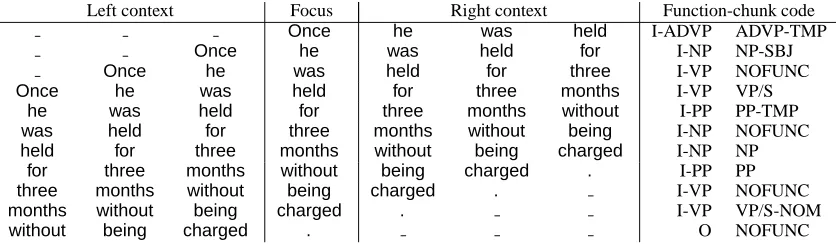
To formulate the task as a machine-learnable classi-fication task, we use a representation that encodes the joint task of chunking and function-tagging a sentence in per-word classification instances. As illustrated in Table 2.1, an instance (which corre-sponds to a row in the table) consists of the val-ues for all features (the columns) and the function-chunk code for the focus word. The features de-scribe the focus word and its local context. For the chunk part of the code, we adopt the “Inside”, “Outside”, and “Between” (IOB) encoding originat-ing from (Ramshaw and Marcus, 1995). For the function part of the code, the value is either the function for the head of a chunk, or the dummy value NOFUNC for all non-heads. For creating the POS-based task, all words are replaced by the gold-standard POS tags associated with them in the Penn Treebank. For the combined task, both types of fea-tures are used simultaneously.
When the learner is presented with new instances from heldout material, its task is thus to assign the combined function-chunk codes to either words or POS in context. From the sequence of predicted function-chunk codes, the complete chunking and function assignment can be reconstructed. How-ever, predictions can be inconsistent, blocking a straightforward reconstruction of the complete shal-low parse. We employed the folshal-lowing four rules to resolve such problems: (1) When an O chunk code is followed by a B chunk code, or when an I chunk code is followed by a B chunk code with a different chunk type, the B is converted to an I. (2) When more than one word in a chunk is given a function code, the function code of the rightmost word is taken as the chunk’s function code. (3) If all words of the chunk receive NOFUNC tags, a prior function code is assigned to the rightmost word of the chunk. This prior, estimated on the training set, represents the most frequent function code for that type of chunk.
To measure the success of our learner, we com-pute the precision, recall and their harmonic mean,
the F-score1 with =1 (Van Rijsbergen, 1979). In
the combined function-chunking evaluation, a chunk is only counted as correct when its boundaries, its type and its function are identified correctly.
2.2 Data preparation
Our total data set consists of all 74,024 sentences in the Wall Street Journal, Brown and ATIS Cor-pus subparts of the Penn Treebank III. We ran-domized the order of the sentences in this dataset, and then split it into ten 90%/10% partitionings with disjoint 10% portions, in order to run 10-fold cross-validation experiments (Weiss and Ku-likowski, 1991). To provide differently-sized ing sets for learning curve experiments, each train-ing set (of 66,627 sentences) was also clipped at the following sizes: 100 sentences, 500, 1000, 2000, 5000, 10,000, 20,000 and 50,000. All data was con-verted to instances as illustrated in Table 2.1. For the total data set, this yields 1,637,268 instances, one for each word or punctuation mark. 62,472 word types occur in the total data set, and 874 different function-chunk codes.
2.3 Classifier: Memory-based learning
Arguably, the choice of algorithm is not crucial in learning curve experiments. First, we aim at mea-suring relative differences arising from the selection of types of input. Second, there are indications that increasing the training set of language processing tasks produces much larger performance gains than varying among algorithms at fixed training set sizes; moreover, these differences also tend to get smaller with larger data sets (Banko and Brill, 2001).
Memory-based learning (Stanfill and Waltz, 1986; Aha et al., 1991; Daelemans et al., 1999b) is a supervised inductive learning algorithm for learning classification tasks. Memory-based learning treats a set of labeled (pre-classified) training instances as points in a multi-dimensional feature space, and stores them as such in an instance base in mem-ory (rather than performing some abstraction over them). Classification in memory-based learning is performed by the -NN algorithm (Cover and Hart,
1967) that searches for the ‘nearest neighbors’
according to the distance function between two
in-1F
"!$#
&%(')+*-,precision,recall
%
Left context Focus Right context Function-chunk code
Once he was held I-ADVP ADVP-TMP
Once he was held for I-NP NP-SBJ
Once he was held for three I-VP NOFUNC
Once he was held for three months I-VP VP/S
he was held for three months without I-PP PP-TMP
was held for three months without being I-NP NOFUNC
held for three months without being charged I-NP NP
for three months without being charged . I-PP PP
three months without being charged . I-VP NOFUNC
months without being charged . I-VP VP/S-NOM
[image:4.612.95.513.21.143.2]without being charged . O NOFUNC
Table 1: Encoding into instances, with words as input, of the example sentence“Once he was held for three months without being charged .”
stances . and / , 0213.546/87:9<;>=?A@CBED ?GF
13H
?
4JI
?
7 ,
whereK is the number of features,D
? is a weight for
featureL, and
F estimates the difference between the
two instances’ values at theLth feature. The classes
of the nearest neighbors then determine the class
of the new case.
In our experiments, we used a variant of the IB1 memory-based learner and classifier as implemented in TiMBL (Daelemans et al., 2001). On top of the
-NN kernel ofIB1 we used the following metrics that fine-tune the distance function and the class voting automatically: (1) The weight (importance) of a fea-tureL, D
?, is estimated in our experiments by
com-puting its gain ratio MON
? (Quinlan, 1993). This is
the algorithm’s default choice. (2) Differences be-tween feature values (i.e. words or POS tags) are es-timated by the real-valued outcome of the modified value difference metric (Stanfill and Waltz, 1986; Cost and Salzberg, 1993). (3) was set to seven.
This and the previous parameter setting turned out best for a chunking task using the same algorithm as reported by Veenstra and van den Bosch (2000). (4) Class voting among the nearest neighbours is done
by weighting each neighbour’s vote by the inverse of its distance to the test example (Dudani, 1976). In Zavrel (1997), this distance was shown to improve over standard -NN on a PP-attachment task. (5)
For efficiency, search for the -nearest neighbours is
approximated by employing TRIBL (Daelemans et al., 1997), a hybrid between pure -NN search and
decision-tree traversal. The switch point of TRIBL was set to 1 for the words only and POS only ex-periments, i.e. a decision-tree split was made on the most important feature, the focus word, respectively
focus POS. For the experiments with both words and POS, the switch point was set to 2 and the algorithm was forced to split on the focus word and focus POS. The metrics under 1) to 4) then apply to the remain-ing features.
3
Learning Curve Experiments
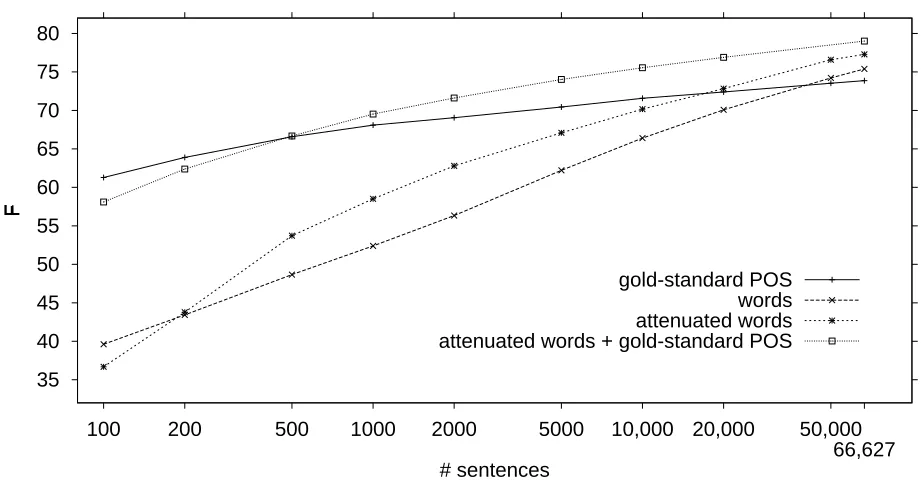
We report the learning curve results in three para-graphs. In the first, we compare the performance of a plain words input representation with that of a gold-standard POS one. In the second we intro-duce a variant of the word-based task that deals with low-frequency words. The last paragraph describes results with input consisting of words and POS tags. Words only versus POS tags only As illus-trated in Figure 1, the learning curves of both the word-based and the POS-based representation are upward with more training data. The word-based curve starts much lower but flattens less; in the tested range it has an approximately log-linear growth. Given the measured results, the word-based curve surpasses the POS-based curve at a training set size between 20,000 and 50,000 sentences. This proves two points: First, experiments with a fixed training set size might present a misleading snapshot. Sec-ond, the amount of training material available today is already enough to make words more valuable in-put than (gold-standard!) POS.
al-35 40 45 50 55 60 65 70 75 80
100 200 500 1000 2000 5000 10,000 20,000 50,000 66,627
F
P
# sentences
[image:5.612.76.537.16.256.2]gold-standard POS words attenuated words attenuated words + gold-standard POS
Figure 1: Learning curves of the main experiments on POS tags, words, attenuated words, and the combi-nation of words and POS. The y-axis represents FQ
@CB on combined chunking and function assignment. The
x-axis represents the number of training sentences; its scale is logarithmic.
gorithm. A more general shortcoming is that the word form of an unknown word often contains use-ful information that is not available in the present setup. To overcome these two problems, we applied what Eisner (1997) calls “attenuation” to all words occurring ten times or less in training material. If such a word ends in a digit, it is converted to the string “MORPH-NUM”; if the word is six charac-ters or longer it becomes “MORPH-XX” where XX are the final two letters, else it becomes “MORPH-SHORT”. If the first letter is capitalised, the atten-uated form is “MORPH-CAP”. This produces se-quences such asA number of ts were MORPH-ly MORPH-ed by traders . (A number of developments were negatively interpreted by traders). We applied this attenuation method to all training sets. All words in test material that did not occur as words in the atten-uated training material were also attenatten-uated follow-ing the same procedure.
The curve resulting from the attenuated word-based experiment is also displayed in Figure 1. The curve illustrates that the attenuated representation performs better than the pure word-based one at all reasonable training set sizes. However the effect
clearly diminuishes with more training data, so we cannot exclude that the two curves will meet with yet more training data.
Combining words with POS tags Although the word-based curve, and especially its attenuated vari-ant, end higher than the POS-based curve, POS might still be useful in addition to words. We there-fore also tested a representation with both types of features. As shown in Figure 1, the “attenuated word + standard POS” curve starts close to the gold-standard POS curve, attains break-even with this curve at about 500 sentences, and ends close to but higher than all other curves, including the “attenu-ated word” curve.
4
Input features Precision R Recall R F-score R
gold-standard POS 73.8 0.2 73.9 0.2 73.9 0.2
MBT POS 72.2 0.2 72.4 0.2 72.3 0.2
words 75.4 0.1 75.4 0.1 75.4 0.1
wordsS gold-standard POS 76.5 0.2 77.1 0.2 76.8 0.2
wordsS MBT POS 75.8 0.2 76.1 0.1 75.9 0.1
attenuated words 77.3 0.1 77.2 0.2 77.3 0.2
attenuated words S gold-standard POS 78.9 0.2 79.1 0.2 79.0 0.2
[image:6.612.113.507.25.146.2]attenuated words S MBT POS 77.6 0.2 77.7 0.2 77.6 0.2
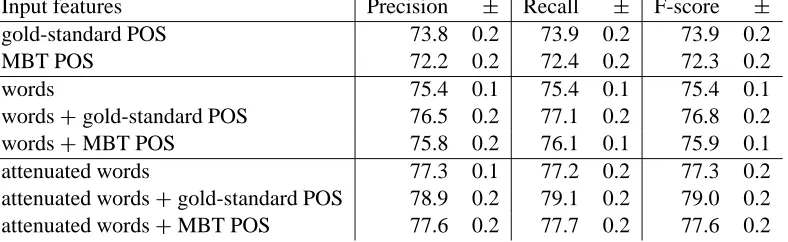
Table 2: Average precision, recall, and F-scores on the chunking-function-tagging task, with standard devi-ation, using the input features words, attenuated words, gold-standard POS, and MBT POS, and combina-tions, on the maximal training set size.
task (Church, 1988; Brill, 1993; Ratnaparkhi, 1996; Daelemans et al., 1996), and reported errors in the range of 2–6% are common. To investigate the ef-fect of using automatically assigned tags, we trained MBT, a memory-based tagger (Daelemans et al., 1996), on the training portions of our 10-fold cross-validation experiment for the maximal data and let it predict tags for the test material. The memory-based tagger attained an accuracy of 96.7% (R 0.1; 97.0%
on known words, and 80.9% on unknown words). We then used these MBT POS instead of the gold-standard ones.
The results of these experiments, along with the equivalent results using gold-standard POS, are dis-played in Table 2. As they show, the scores with au-tomatically assigned tags are always lower than with the gold-standard ones. When taken individually, the difference in F-scores of the gold-standard ver-sus the MBT POS tags is 1.6 points. Combined with words, the MBT POS contribute 0.5 points (com-pared against words taken individually); combined with attenuated words, they contribute 0.3 points. This is much less than the improvement by the gold-standard tags (1.7 points) but still significant. How-ever, as the learning curve experiments showed, this is only a snapshot and the improvement may well diminish with more training data.
A breakdown of accuracy results shows that the highest improvement in accuracy is achieved for fo-cus words in the MORPH-SHORT encoding. In these cases, the POS tagger has access to more infor-mation about the low-frequency word (e.g. its suffix) than the attenuated form provides. This suggests that
this encoding is not optimal.
5
Related Research
Ramshaw and Marcus (1995), Mu˜noz et al. (1999), Argamon et al. (1998), Daelemans et al. (1999a) find NP chunks, using Wall Street Journal training material of about 9000 sentences. F-scores range between 91.4 and 92.8. The first two articles mention that words and (automatically assigned) POS together perform better than POS alone. Chunking is one part of the task studied here, so we also computed performance on chunks alone, ignoring function codes. Indeed the learning curve of words combined with gold-standard POS crosses the POS-based curve before 10,000 sentences on the chunking subtask.
Tjong Kim Sang and Buchholz (2000) give an overview of the CoNLL shared task of chunking. The types and definitions of chunks are identical to the ones used here. Training material again consists of the 9000 Wall Street Journal sentences with automatically assigned POS tags. The best F-score (93.5) is higher than the 91.5 F-score attained on chunking in our study using attenuated words only, but using the maximally-sized training sets. With gold-standard POS and attenuated words we attain an F-score of 94.2; with MBT POS tags and atten-uated words, 92.8. In the CoNLL competition, all three best systems used combinations of classifiers instead of one single classifier. In addition, the effect of our mix of sentences from different corpora on top of WSJ is not clear.
find-ing grammatical relations in automatically tagged and manually chunked text. They report an F-score of 69.8 for a training size of 3299 words of elementary school reading comprehension tests. Buchholz et al. (1999) achieve 71.2 F-score for grammatical relation assignment on automatically tagged and chunked text after training on about 40,000 Wall Street Journal sentences. In contrast to these studies, we do not chunk before find-ing grammatical relations; rather, chunkfind-ing is per-formed simultaneously with headword function tag-ging. Measuring F-scores on the correct assign-ment of functions to headwords in our study, we at-tain 78.2 F-score using words, 80.1 using attenuated words, 80.9 using attenuated words combined with gold-standard POS, and 79.7 using attenuated words combined with MBT POS (which is slightly worse than with attenuated words only). Our function tag-ging task is easier than finding grammatical relations as we tag a headword of a chunk as e.g. a subject in isolation whereas grammatical relation assign-ment also includes deciding which verb this chunk is the subject of. A¨ıt-Mokhtar and Chanod (1997) de-scribe a sequence of finite-state transducers in which function tagging is a separate step, after POS tag-ging and chunking. The last transducer then uses the function tags to extract subject/verb and object/verb relations (from French text).
6
Conclusion
POS are normally considered useful information in shallow and full parsing. Our learning curve experi-ments show that:
T
The relative merit of words versus POS as in-put for the combined chunking and function-tagging task depends on the amount of training data available.
T
The absolute performance of words depends on the treatment of rare words. The additional use of word form information (attenuation) im-proves performance.
T
The addition of POS also improves perfor-mance. In this and the previous case, the effect becomes smaller with more training data.
Experiments with the maximal training set size show that:
T
Addition of POS maximally yields an improve-ment of 1.7 points on this data.
T
With realistic POS the improvement is much smaller.
Preliminary analysis shows that the improvement by realistic POS seems to be caused mainly by a supe-rior use of word form information by the POS tag-ger. We therefore plan to experiment with a POS tagger and an attenuated words variant that use ex-actly the same word form information. In addition we also want to pursue using the combined chunker and grammatical function tagger described here as a first step towards grammatical relation assignment.
References
S. Abney. 1991. Parsing by chunks. In Principle-Based
Parsing, pages 257–278. Kluwer Academic
Publish-ers, Dordrecht.
D. W. Aha, D. Kibler, and M. Albert. 1991. Instance-based learning algorithms. Machine Learning, 6:37– 66.
S. A¨ıt-Mokhtar and J.-P. Chanod. 1997. Subject and ob-ject dependency extraction using finite-state transduc-ers. In Proceedings of ACL’97 Workshop on
Informa-tion ExtracInforma-tion and the Building of Lexical Semantic Resources for NLP Applications, Madrid.
S. Argamon, I. Dagan, and Y. Krymolowski. 1998. A memory-based approach to learning shallow natural language patterns. In Proc. of 36th annual meeting
of the ACL, pages 67–73, Montreal.
M. Banko and E. Brill. 2001. Scaling to very very large corpora for natural language disambiguation. In
Pro-ceedings of the 39th Annual Meeting and 10th Confer-ence of the European Chapter of the Association for Computational Linguistics, Toulouse, France.
E. Brill. 1993. A Corpus-Based Approach to Language
Learning. Ph.D. thesis, University of Pennsylvania,
Department of Computer and Information Science. S. Buchholz, J. Veenstra, and W. Daelemans. 1999.
Cascaded grammatical relation assignment. In Pas-cale Fung and Joe Zhou, editors, Proceedings of
EMNLP/VLC-99, pages 239–246. ACL.
E. Charniak. 2000. A maximum-entropy-inspired parser. In Proceedings of NAACL’00, pages 132–139. K. W. Church. 1988. A stochastic parts program and
noun phrase parser for unrestricted text. In Proc. of
Second Applied NLP (ACL).
M.J. Collins. 1996. A new statistical parser based on bi-gram lexical dependencies. In Proceedings of the 34th
S. Cost and S. Salzberg. 1993. A weighted nearest neigh-bour algorithm for learning with symbolic features.
Machine Learning, 10:57–78.
T. M. Cover and P. E. Hart. 1967. Nearest neighbor pattern classification. Institute of Electrical and
Elec-tronics Engineers Transactions on Information The-ory, 13:21–27.
W. Daelemans, J. Zavrel, P. Berck, and S. Gillis. 1996.
MBT: A memory-based part of speech tagger genera-tor. In E. Ejerhed and I. Dagan, editors, Proc. of Fourth
Workshop on Very Large Corpora, pages 14–27. ACL
SIGDAT.
W. Daelemans, A. Van den Bosch, and J. Zavrel. 1997. A feature-relevance heuristic for indexing and com-pressing large case bases. In M. Van Someren and G. Widmer, editors, Poster Papers of the Ninth
Euro-pean Conference on Machine Learing, pages 29–38,
Prague, Czech Republic. University of Economics. W. Daelemans, S. Buchholz, and J. Veenstra. 1999a.
Memory-based shallow parsing. In Proceedings of
CoNLL, Bergen, Norway.
W. Daelemans, A. Van den Bosch, and J. Zavrel. 1999b. Forgetting exceptions is harmful in language learning.
Machine Learning, Special issue on Natural Language Learning, 34:11–41.
W. Daelemans, J. Zavrel, K. Van der Sloot, and A. Van den Bosch. 2001. TiMBL: Tilburg memory based learner, version 4.0, reference guide. ILK Techni-cal Report 01-04, Tilburg University. available from http://ilk.kub.nl.
S.A. Dudani. 1976. The distance-weighted U -nearest
neighbor rule. In IEEE Transactions on Systems, Man,
and Cybernetics, volume SMC-6, pages 325–327.
J. Eisner. 1997. Three new probabilistic models for de-pendency parsing: An exploration. In Proceedings of
the 16th International Conference on Computational Linguistics (COLING-96).
L. Ferro, M. Vilain, and A. Yeh. 1999. Learning trans-formation rules to find grammatical relations. In
Pro-ceedings of the Third Computational Natural Lan-guage Learning workshop (CoNLL), pages 43–52.
X. Li and D. Roth. 2001. Exploring evidence for shallow parsing. In Proceedings of the Fifth Computational
Natural Language Learning workshop (CoNLL).
M. Marcus, B. Santorini, and M.A. Marcinkiewicz. 1993. Building a large annotated corpus of en-glish: The Penn Treebank. Computational Linguistics, 19(2):313–330.
M. Mu˜noz, V. Punyakanok, D. Roth, and D. Zimak. 1999. A learning approach to shallow parsing. In Pas-cale Fung and Joe Zhou, editors, Proceedings of the
1999 Joint SIGDAT Conference on Empirical Meth-ods in Natural Language Processing and Very Large Corpora, pages 168–178.
C. Pollard and I. Sag. 1987. Information-Based Syntax
and Semantics, Volume 1: Fundamentals, volume 13
of CSLI Lecture Notes. Center for the Study of Lan-guage and Information, Stanford.
J.R. Quinlan. 1993. C4.5: Programs for Machine
Learn-ing. Morgan Kaufmann, San Mateo, CA.
L.A. Ramshaw and M.P. Marcus. 1995. Text chunking using transformation-based learning. In Proceedings
of the 3rd ACL/SIGDAT Workshop on Very Large Cor-pora, Cambridge, Massachusetts, USA, pages 82–94.
A. Ratnaparkhi. 1996. A maximum entropy part-of-speech tagger. In Proc. of the Conference on Empirical
Methods in Natural Language Processing, May 17-18, 1996, University of Pennsylvania.
A. Ratnaparkhi. 1997. A linear observed time statis-tical parser based on maximum entropy models. In
Proceedings of the Second Conference on Empirical Methods in Natural Language Processing, EMNLP-2, Providence, Rhode Island, pages 1–10.
C. Stanfill and D. Waltz. 1986. Toward memory-based reasoning. Communications of the ACM,
29(12):1213–1228, December.
E. Tjong Kim Sang and S. Buchholz. 2000. Introduction to the CoNLL-2000 shared task: Chunking. In
Pro-ceedings of CoNLL-2000 and LLL-2000, pages 127–
132, Lisbon, Portugal.
C.J. Van Rijsbergen. 1979. Information Retrieval. But-tersworth, London.
J. Veenstra and Antal van den Bosch. 2000. Single-classifier memory-based phrase chunking. In
Proceed-ings of CoNLL-2000 and LLL-2000, pages 157–159,
Lisbon, Portugal.
S. Weiss and C. Kulikowski. 1991. Computer systems
that learn. San Mateo, CA: Morgan Kaufmann.
J. Zavrel. 1997. An empirical re-examination of weighted voting for k-NN. In Proceedings of the
7th Belgian-Dutch Conference on Machine Learning,