Generalized Algorithms for Constructing Statistical Language Models
Cyril Allauzen, Mehryar Mohri, Brian Roark
AT&T Labs – Research
180 Park Avenue
Florham Park, NJ 07932, USA
allauzen,mohri,roark @research.att.comAbstract
Recent text and speech processing applications such as speech mining raise new and more general problems re-lated to the construction of language models. We present and describe in detail several new and efficient algorithms to address these more general problems and report ex-perimental results demonstrating their usefulness. We give an algorithm for computing efficiently the expected counts of any sequence in a word lattice output by a speech recognizer or any arbitrary weighted automaton; describe a new technique for creating exact representa-tions of -gram language models by weighted automata whose size is practical for offline use even for a vocab-ulary size of about 500,000 words and an -gram order
; and present a simple and more general technique for constructing class-based language models that allows each class to represent an arbitrary weighted automaton. An efficient implementation of our algorithms and tech-niques has been incorporated in a general software library for language modeling, the GRM Library, that includes many other text and grammar processing functionalities.
1
Motivation
Statistical language models are crucial components of many modern natural language processing systems such as speech recognition, information extraction, machine translation, or document classification. In all cases, a language model is used in combination with other in-formation sources to rank alternative hypotheses by as-signing them some probabilities. There are classical techniques for constructing language models such as -gram models with various smoothing techniques (see Chen and Goodman (1998) and the references therein for a survey and comparison of these techniques).
In some recent text and speech processing applications, several new and more general problems arise that are re-lated to the construction of language models. We present new and efficient algorithms to address these more gen-eral problems.
Counting. Classical language models are constructed by deriving statistics from large input texts. In speech mining applications or for adaptation purposes, one often needs to construct a language model based on the out-put of a speech recognition system. But, the outout-put of a recognition system is not just text. Indeed, the word
er-ror rate of conversational speech recognition systems is still too high in many tasks to rely only on the one-best output of the recognizer. Thus, the word lattice output by speech recognition systems is used instead because it contains the correct transcription in most cases.
A word lattice is a weighted finite automaton (WFA) output by the recognizer for a particular utterance. It contains typically a very large set of alternative transcrip-tion sentences for that utterance with the corresponding weights or probabilities. A necessary step for construct-ing a language model based on a word lattice is to derive the statistics for any given sequence from the lattices or WFAs output by the recognizer. This cannot be done by simply enumerating each path of the lattice and counting the number of occurrences of the sequence considered in each path since the number of paths of even a small au-tomaton may be more than four billion. We present a simple and efficient algorithm for computing the expected
count of any given sequence in a WFA and report
experi-mental results demonstrating its efficiency.
Representation of language models by WFAs. Clas-sical -gram language models admit a natural representa-tion by WFAs in which each state encodes a left context of width less than . However, the size of that represen-tation makes it impractical for offline optimizations such as those used in large-vocabulary speech recognition or general information extraction systems. Most offline rep-resentations of these models are based instead on an ap-proximation to limit their size. We describe a new tech-nique for creating an exact representation of -gram lan-guage models by WFAs whose size is practical for offline use even in tasks with a vocabulary size of about 500,000 words and for .
(Kaplan and Kay, 1994; Mohri and Sproat, 1996). Our approach allows us to deal efficiently with more complex classes such as weighted regular languages.
We have fully implemented the algorithms just men-tioned and incorporated them in a general software li-brary for language modeling, the GRM Lili-brary, that in-cludes many other text and grammar processing function-alities (Allauzen et al., 2003). In the following, we will present in detail these algorithms and briefly describe the corresponding GRM utilities.
2
Preliminaries
Definition 1 A system is a semiring
(Kuich and Salomaa, 1986) if: is a
commuta-tive monoid with identity element ; is a monoid
with identity element ; distributes over ; and is an
annihilator for : for all ! " #$ . Thus, a semiring is a ring that may lack negation. Two semirings often used in speech processing are: the log
semiring%&' (*),+.-0/123 456-0 1 (Mohri, 2002) which is isomorphic to the familiar real or probability semiring (87965:; <= via a >@?1A morphism with, for allB CD(E)F+.-0/ :
; 23G4 CHID>@?1AJ LKNMPOQ RISPQ6,KTMPOQ UICTU
and the convention that: KTMPOQ UI-# and
ID>@?1A 1VW- , and the tropical semiring XYY Z([7\) +.-0/1G]!^@_`6-G1 which can be derived from the log semiring using the Viterbi approximation.
Definition 2 A weighted finite-state transducera over a
semiring is an 8-tuple abc edfg!GhGiH jk lQUmP
where: d is the finite input alphabet of the transducer;
f is the finite output alphabet;g is a finite set of states; h0nog the set of initial states; ipnqg the set of final
states;jrn0gs:D td)u+v=/wx:y fz)u+wvN/.{:k\:Vg a finite
set of transitions;l|<h}~ the initial weight function;
andm|i} the final weight function mappingi to
.
A Weighted automaton ' edg!GhGiH jk lQUmP is de-fined in a similar way by simply omitting the output la-bels. We denote by nd the set of strings accepted by an automaton and similarly by Z the strings de-scribed by a regular expression .
Given a transition Fj , we denote by = its input label,x= its origin or previous state and= its desti-nation state or next state,"N its weight,P= its output label (transducer case). Given a stateDg , we denote byjV the set of transitions leaving .
A path'1x=NU. is an element of jk with con-secutive transitions: L SxwZ,P=NN= . We extend and to paths by setting: V and
¡ F¢¡.. A cycle is a path whose origin and destination states coincide: ;¡ . We denote by
Z¤ .¥¦ the set of paths from to¤¥ and by Z¤U§¡G1¥¨ and£
Z¤U§¡U© G5¥¦ the set of paths from to¥ with in-put label §&&d and output label© (transducer case). These definitions can be extended to subsetsª$ ªk¥¡n«g , by: £
ªG§Q ª¬¥®)8¯°5±x²t¯U³L°5±`³
£
Z¤U§¡G.¥ . The label-ing functions (and similarly ) and the weight func-tion can also be extended to paths by defining the la-bel of a path as the concatenation of the lala-bels of its constituent transitions, and the weight of a path as the
-product of the weights of its constituent transitions: S NNU ," ´ µ=N0" . We also extend to any finite set of paths ¶ by setting:
"¶;9¸·¹ °º
" . The output weight associated by to each input string§yd is:
St Z§B[ »
¹
°5¼{½@¾=²¿5²ÀÁ
lQ ¡ ¨xà <Ãm L ¨
St Z§B is defined to be when
£
ZhU§Q i9k'Ä . Simi-larly, the output weight associated by a transducera to a pair of input-output string L§¡U©< is:
a;Å L§QG©< »
¹
°5¼8½@¾=²¿²Æw²ÀQÁ
l¡ Çx L¡," P,mB Z L
aSÅ L§¡U©< when
£
ZhU§¡U© Gi9¢Ä . A successful
path in a weighted automaton or transducerÈ is a path from an initial state to a final state. È is unambiguous if for any string§yd there is at most one successful path labeled with§ . Thus, an unambiguous transducer defines a function.
For any transducera , denote by¶!É1 Za the automaton obtained by projectinga on its output, that is by omitting its input labels.
Note that the second operation of the tropical semiring and the log semiring as well as their identity elements are identical. Thus the weight of a path in an automaton over the tropical semiring does not change if is viewed as a weighted automaton over the log semiring or vice-versa.
3
Counting
This section describes a counting algorithm based on general weighted automata algorithms. Let
gkGhGiHd Ê.GË lGm¤ be an arbitrary weighted automa-ton over the probability semiring and let be a regular expression defined over the alphabetd . We are interested in counting the occurrences of the sequences§## L in while taking into account the weight of the paths where they appear.
3.1 Definition
When is deterministic and pushed, or stochastic, it can be viewed as a probability distribution£
0 a:ε/1 b:ε/1
1/1 X:X/1
[image:3.612.138.235.76.135.2]a:ε/1 b:ε/1
Figure 1: Counting weighted transducer a with dÌ
+BC/ . The transition weights and the final weight at state are all equal to .
d; .
1 The weight
St Z§B associated by to each string§ is then£
Z§B. Thus, we define the count of the sequence § in ,Í L§ , as:
Í L§B[ÌÎ
Ï
°5ÐBÑ ÒÓ{Ò
¿ SÅ L§
where ÒÓ{Ò
¿ denotes the number of occurrences of§ in the string
Ó
, i.e., the expected number of occurrences of § given . More generally, we will define the count of§ as above regardless of whether is stochastic or not.
In most speech processing applications, may be an acyclic automaton called a phone or a word lattice out-put by a speech recognition system. But our algorithm is general and does not assume to be acyclic.
3.2 Algorithm
We describe our algorithm for computing the expected counts of the sequences§EF L and give the proof of its correctness.
LetÔ be the formal power series (Kuich and Salomaa, 1986) Ô over the probability semiring defined byÔ
Õ
¬:§y:
Õ
, where§yD L. Lemma 1 For allÖ dS , Ô Ö
Ò
Ö
Ò
¿ .
Proof. By definition of the multiplication of power se-ries in the probability semiring:
Ô Ö × Î
Ï
¿ ØÙ`Ú
Õ
Ó
:E L§QG§BS:
Õ
GÛ¤
Ï
¿ ØÙ`ÚD
Ò
Ö
Ò
¿
This proves the lemma.
Ô is a rational power series as a product and closure of the polynomial power series
Õ
and§ (Salomaa and Soit-tola, 1978; Berstel and Reutenauer, 1988). Similarly, since is regular, the weighted transduction defined by
ed\:+=v=/w ZW:N ed\:F+vN/.G is rational. Thus, by the theorem of Sch¨utzenberger (Sch¨utzenberger, 1961), there exists a weighted transducera defined over the alphabet
d and the probability semiring realizing that transduc-tion. Figure 1 shows the transducer a in the particular case ofd*µ+B C/ .
1There exist a general weighted determinization and weight
pushing algorithms that can be used to create a deterministic and pushed automaton equivalent to an input word or phone lattice (Mohri, 1997).
Proposition 1 Let be a weighted automaton over the
probability semiring, then:
¶ É *Ü[aÅÅ L§ Í L§B
Proof. By definition ofa , for anyÖ d9 ,a;Å Ö U§
Ô
U§B , and by lemma 1, a;Å
Ö
G§B
Ò
Ö
Ò
¿ . Thus, by definition of composition:
¶ É ZÜ[atÅ L§BÝ Î
¹
°5¼{½¦¾N²ÀQÁt²ZÚPÙZÞ ¹.ß
;Å Ö H:
Ò
Ö
Ò
¿
Î
ÚB°5ÐBÑ
Ò
Ö
Ò
¿ ;t Ö à Í L§
This ends the proof of the proposition.
The proposition gives a simple algorithm for computing the expected counts of in a weighted automaton based on two general algorithms: composition (Mohri et al., 1996) and projection of weighted transducers. It is also based on the transducera which is easy to construct. The size ofa is iná
Ò
d
Ò
6
Ò
â
Ò
, whereâ is a finite automaton accepting . With a lazy implementation of
a , only one transition can be used instead of
Ò
d
Ò
, thereby reducing the size of the representation ofa toá
Ò
â
Ò
. The weighted automatonã ¶
É
Ü;a containsv -transitions. A general v-removal algorithm can be used to compute an equivalent weighted automaton with nov -transition. The computation of ã Å L§B for a given§ is done by composingã with an automaton representing§ and by using a simple shortest-distance algorithm (Mohri, 2002) to compute the sum of the weights of all the paths of the result.
For numerical stability, implementations often replace probabilities withID>¦?5A probabilities. The algorithm just described applies in a similar way by takingID>@?1A of the weights ofa (thus all the weights ofa will be zero in that case) and by using the log semiring version of com-position andv -removal.
3.3 GRM Utility and Experimental Results
An efficient implementation of the counting algorithm was incorporated in the GRM library (Allauzen et al., 2003). The GRM utilitygrmcountcan be used in par-ticular to generate a compact representation of the ex-pected counts of the -gram sequences appearing in a word lattice (of which a string encoded as an automaton is a special case), whose order is less or equal to a given integer. As an example, the following command line:
grmcount -n3 foo.fsm > count.fsm creates an encoded representationcount.fsmof the -gram sequences,äå , which can be used to construct a trigram model. The encoded representation itself is also given as an automaton that we do not describe here.
Our experiments show thatgrmcountis quite efficient. We tested this utility with 41,000 weighted automata out-puts of our speech recognition system for the same num-ber of speech utterances. The total numnum-ber of transitions of these automata was =æJæ M. It took about 1h52m, in-cluding I/O, to compute the accumulated expected counts of all -gram, çäèå , appearing in all these automata on a single processor of a 1GHz Intel Pentium processor Linux cluster with 2GB of memory and 256 KB cache. The time to compute these counts represents just
éUê th of the total duration of the 41,000 speech utterances used in our experiment.
4
Representation of
ë-gram Language
Models with WFAs
Standard smoothed -gram models, including backoff (Katz, 1987) and interpolated (Jelinek and Mercer, 1980) models, admit a natural representation by WFAs in which each state encodes a conditioning history of length less than . The size of that representation is often pro-hibitive. Indeed, the corresponding automaton may have
Ò
d
Òì
states and
Ò
d
Òì
transitions. Thus, even if the vo-cabulary size is just 1,000, the representation of a classi-cal trigram model may require in the worst case up to one billion transitions. Clearly, this representation is even less adequate for realistic natural language processing appli-cations where the vocabulary size is in the order of several hundred thousand words.
In the past, two methods have been used to deal with this problem. One consists of expanding that WFA on-demand. Thus, in some speech recognition systems, the states and transitions of the language model automaton are constructed as needed based on the particular input speech utterances. The disadvantage of that method is that it cannot benefit from offline optimization techniques that can substantially improve the efficiency of a rec-ognizer (Mohri et al., 1998). A similar drawback af-fects other systems where several information sources are combined such as a complex information extraction sys-tem. An alternative method commonly used in many ap-plications consists of constructing instead an approxima-tion of that weighted automaton whose size is practical for offline optimizations. This method is used in many large-vocabulary speech recognition systems.
In this section, we present a new method for creat-ing an exact representation of -gram language models with WFAs whose size is practical even for very large-vocabulary tasks and for relatively high -gram orders. Thus, our representation does not suffer from the disad-vantages just pointed out for the two classical methods.
We first briefly present the classical definitions of -gram language models and several smoothing techniques commonly used. We then describe a natural representa-tion of -gram language models using failure transitions. This is equivalent to the on-demand construction referred
to above but it helps us introduce both the approximate solution commonly used and our solution for an exact of-fline representation.
4.1 Classical Definitions
In an -gram model, the joint probability of a string
ê
=NRS is given as the product of conditional proba-bilities:
íàî Z
ê
N=R ×
ï
@Ù
ê
íî L
Òð
(1)
where the conditioning history
ð
consists of zero or more words immediately preceding and is dictated by the order of the -gram model.
Let Í
ð
denote the count of -gram
ð
and let
ñ
íî L
Òð
be the maximum likelihood probability of given
ð
, estimated from counts.
ñ
íî
is often adjusted to reserve some probability mass for unseen -gram se-quences. Denote by ò
íî Z
Òð
the adjusted conditional probability. Katz or absolute discounting both lead to an adjusted probabilityò
íî . For all -grams
ð
«
ð
¥ where
ð
d
for someó
, we refer to
ð
¥ as the backoff -gram of
ð
. Conditional probabilities in a backoff model are of the form:
ôõTö¨÷øùPúcû ürý
ôõTö¨÷øùPú þÿ
öLù÷ú
ô`õTö¨÷øù ¨ú õþ (2)
where is a factor that ensures a normalized model. Conditional probabilities in a deleted interpolation model are of the form:
ô`õTö¨÷øùPúQûü ö
úô`õTö¨÷øù¤ú
ô`õNö¨÷øù ú#þÿ
öLù÷ú!"
ô`õNö¨÷øù ú õþ
(3) where is the mixing parameter between zero and one. In practice, as mentioned before, for numerical sta-bility, ID>¦?5A probabilities are used. Furthermore, due the Viterbi approximation used in most speech process-ing applications, the weight associated to a strprocess-ing§ by a weighted automaton representing the model is the mini-mum weight of a path labeled with§ . Thus, an -gram language model is represented by a WFA over the tropical semiring.
4.2 Representation with Failure Transitions
w wi-2 i-1 w wi-1 i
wi
wi-1
φ
wi
φ
wi
ε
[image:5.612.328.524.72.154.2]φ wi
Figure 2: Representation of a trigram model with failure transitions.
The set of states of the WFA representing a backoff or interpolated model is defined by associating a state$ to each sequence of length less than found in the corpus:
gµµ+ | ÒðxÒ&%
('_*) Í
ð
,+*</
Its transition setj is defined as the union of the following set of failure transitions:
+¤ Z-³Å.#¡NID>@?1A /0¤ 1³ZH|1-³xDg$/ and the following set of regular transitions:
+1 Z2JG9NID>¦?5AB íî
L Òð
UG32-|51VDg!
Í
ð
,+P/ where 2- is defined by:
4 65
û
ü87 65
þÇÿ9;:*øù1÷ø<:
4
7
³
5
þÇÿ{øù÷øû
4
= õxùûE÷> ù (4)
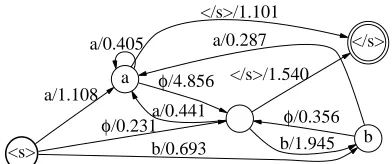
Figure 2 illustrates this construction for a trigram model. Treating v -transitions as regular symbols, this is a deterministic automaton. Figure 3 shows a complete Katz backoff bigram model built from counts taken from the following toy corpus and using failure transitions:
?
s@ b a a a a
?
/s@
?
s@ b a a a a
?
/s@
?
s@ a
?
/s@
where
?
s@ denotes the start symbol and
?
/s@ the end sym-bol for each sentence. Note that the start symsym-bol
?
s@ does not label any transition, it encodes the history
?
s@. All transitions labeled with the end symbol
?
/s@ lead to the single final state of the automaton.
4.3 Approximate Offline Representation
The common method used for an offline representation of an -gram language model can be easily derived from the representation using failure transitions by simply replac-ing each# -transition by anv -transition. Thus, a transition that could only be taken in the absence of any other alter-native in the exact representation can now be taken re-gardless of whether there exists an alternative transition. Thus the approximate representation may contain paths whose weight does not correspond to the exact probabil-ity of the string labeling that path according to the model.
</s>
a
</s>/1.101
a/0.405
φ/4.856 </s>/1.540 a/0.441
b b/1.945 a/0.287
φ/0.356
<s> a/1.108
[image:5.612.113.258.73.152.2]φ/0.231 b/0.693
Figure 3: Example of representation of a bigram model with failure transitions.
Consider for example the start state in figure 3, labeled with
?
s@. In a failure transition model, there exists only one path from the start state to the state labeled , with a cost of 1.108, since the# transition cannot be traversed with an input of . If the# transition is replaced by an
v -transition, there is a second path to the state labeled – taking thev -transition to the history-less state, then the
transition out of the history-less state. This path is not part of the probabilistic model – we shall refer to it as an
invalid path. In this case, there is a problem, because the
cost of the invalid path to the state – the sum of the two transition costs (0.672) – is lower than the cost of the true path. Hence the WFA with v -transitions gives a lower cost (higher probability) to all strings beginning with the symbol . Note that the invalid path from the state labeled
?
s@ to the state labeledC has a higher cost than the correct path, which is not a problem in the tropical semiring.
4.4 Exact Offline Representation
This section presents a method for constructing an ex-act offline representation of an -gram language model whose size remains practical for large-vocabulary tasks.
The main idea behind our new construction is to mod-ify the topology of the WFA to remove any path contain-ingv-transitions whose cost is lower than the correct cost associated by the model to the string labeling that path. Since, as a result, the low cost path for each string will have the correct cost, this will guarantee the correctness of the representation in the tropical semiring.
Our construction admits two parts: the detection of the invalid paths of the WFA, and the modification of the topology by splitting states to remove the invalid paths.
To detect invalid paths, we determine first their initial non-v transitions. Let jBA denote the set of v-transitions of the original automaton. Let
£
¯ be the set of all paths x=NU. jI$j A
,(+z , leading to state such that for all,çN=G ,¡
is the destination state of somev -transition.
Lemma 2 For an -gram language model, the number
of paths in
£
¯ is less than the -gram order: Ò£
¯
Ò&% .
Proof. For all`!
£
¯ , let "q¥
w. By definition, there is some¥ j A such that.¥xzxw¨x 2C. By definition ofv -transitions in the model,
Òð
Ò9%
yI0 for all. It follows from the definition of regular transitions thatwL[ 2CD- . Hence,
ð
H ð&E
ð
q’ r’ π’ q e r e’ π
Figure 4: The path is invalid if=Qv , xµ ¥,
£0F
, and either (i)G1¥àHG and"
%
"Q¥@ or (ii) w¥Â 0v and"
%
"¡¥¥Â.
E
, for all GU
E
£
¯ . Then,
£
¯Sµ+=9|5
£
¯IP/5) +1/ . The history-less state has no incoming non-v paths, therefore, by recursion,
Ò £ ¯ Ò Ò £ ¯I Ò 60 Òð ÒJ% . We now define transition setsK ¯U¯ ³ (originally empty) following this procedure: for all states Gµg and all
so¡=NG.E £LF
, if there exists another path¥ and transition ,j;A such that=¬x ,¡¡¥@¬¡N, and¡¥Ç , and either (i){¥Â` and"
%
"¥@ or (ii) there exists¥[,j A such that¡.¥Â8¥Â and.¥Â and"=
%
"Q¥¨w¥Â, then we add to the set: KNM Þ
¹wß M Þ ¹ ³ ßO KNM Þ ¹wß M Þ ¹ ³ ß
)+.w/ . See figure 4 for an illustration of this condition. Using this procedure, we can determine the set:
P
ju`s+"jQ|QP.¥eG9RKk¯U¯U³Å/ .
This set provides the first non-v transition of each invalid path. Thus, we can use these transitions to eliminate in-valid paths.
Proposition 2 The cost of the construction of
P
jV for all yg is É Ò d Ò@Ò g Ò
, where is the n-gram order.
Proof. For each,\g and each
£
¯ , there are at most
Ò
d
Ò
possible states ¥ such that for some #j A,
¡=¡µ.¥ andN¡µ . It is trivial to see from the proof of lemma 2 that the maximum length of is . Hence, the cost of finding all{¥ for a given is
Ò
d
Ò
. Therefore, the total cost is
É Ò d Ò¦Ò g Ò .
For all non-empty
P
jV, we create a new state
P
and for allD
P
j we set¡=
P
. We create a transition
P
¤ vG< , and for all«j IjSA such that=Sç , we set=à
P
. For all#j A such that=r and
Ò K ¯ M ÞT ß Ò
r , we set=
P
. For allu*j A such that N¡ and
Ò K ¯ M ÞT ß Ò
+« , we create a new intermediate backoff stateU and set=`VU ; then for all¤¥yjV
P
, if w¥!WRK
¯
M
ÞT
ß, we add a transition
X UPU5¥ÇeG"w¥@tU¥ÂL toj .
Proposition 3 The WFA over the tropical semiring
mod-ified following the procedure just outlined is equivalent to the exact online representation with failure transitions.
Proof. Assume that there exists a stringY for which the WFA returns a weight P
ZYw less than the correct weight " ZY that would have been assigned to Y by the exact online representation with failure transitions. We will call an v -transition within a path ¸Ì NN
in-valid if the next non-v transition
E
,[\+o, has the la-bel , and there is a transition with¡= ¡L and
b ε/0.356
a a/0.287 a/0.441 ε/0 ε/4.856 a/0.405 </s> </s>/1.101 <s> b/0.693 a/1.108
ε/0.231b/1.945 </s>/1.540
Figure 5: Bigram model encoded exactly with v -transitions.
=9q . Let be a path through the WFA such that ;VY and" ;
P
ZYw , and has the least number of invalidv -transitions of all paths labeled with Y with weight P
ZY. Let be the last invalidv -transition taken in path . Letx¥ be the valid path leavingx¤¨ such that
¥Â!W @7¡ NN . "Q¥Â(+¸" N=G , otherwise there would be a path with fewer invalidv -transitions with weight P
ZYw. LetG be the first state where paths ¥ and @7x N=G intersect. ThenG"«
E
for some[(+0. By definition,¦7¡x=NG
E
£LF
, since intersection will occur before anyv -transitions are traversed in . Then it must be the case that¦7¡V]K
ì
ÞT C
ß
M ÞTC
ß, requiring the path to be removed from the WFA. This is a contradiction.
4.5 GRM Utility and Experimental Results
Note that some of the new intermediate backoff states (U) can be fully or partially merged, to reduce the space re-quirements of the model. Finding the optimal configu-ration of these states, however, is an NP-hard problem. For our experiments, we used a simple greedy approach to sharing structure, which helped reduce space dramati-cally.
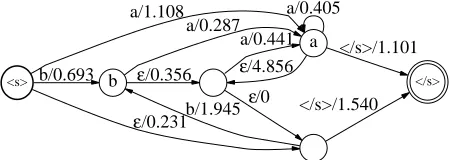
Figure 5 shows our example bigram model, after ap-plication of the algorithm. Notice that there are now two history-less states, which correspond to and
P
in the al-gorithm (noU was required). The start state backs off to
, which does not include a transition to the state labeled , thus eliminating the invalid path.
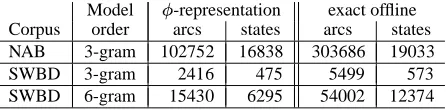
Table 1 gives the sizes of three models in terms of transitions and states, for both the failure transition and
v -transition encoding of the model. The DARPA North American Business News (NAB) corpus contains 250 million words, with a vocabulary of 463,331 words. The Switchboard training corpus has 3.1 million words, and a vocabulary of 45,643. The number of transitions needed for the exact offline representation in each case was be-tween 2 and 3 times the number of transitions used in the representation with failure transitions, and the number of states was less than twice the original number of states. This shows that our technique is practical even for very large tasks.
[image:6.612.319.544.75.155.2]fig-Model ^ -representation exact offline Corpus order arcs states arcs states NAB 3-gram 102752 16838 303686 19033 SWBD 3-gram 2416 475 5499 573 SWBD 6-gram 15430 6295 54002 12374
Table 1: Size of models (in thousands) built from the NAB and Switchboard corpora, with failure transitions
# versus the exact offline representation.
ure 3, with v-transitions in the place of failure tran-sitions. The utility grmshrink removes transitions from the model according to the shrinking methods of Seymore and Rosenfeld (1996) or Stolcke (1998). The utilitygrmconverttakes a backoff model produced by grmmakeorgrmshrinkand converts it into an exact model using either failure transitions or the algorithm just described. It also converts the model to an interpolated model for use in the tropical semiring. As an example, the following command line:
grmmake -n3 counts.fsm > model.fsm creates a basic Katz backoff trigram model from the counts produced by the command line example in the ear-lier section. The command:
grmshrink -c1 model.fsm > m.s1.fsm shrinks the trigram model using the weighted difference method (Seymore and Rosenfeld, 1996) with a threshold of 1. Finally, the command:
grmconvert -tfail m.s1.fsm > f.s1.fsm outputs the model represented with failure transitions.
5
General class-based language modeling
Standard class-based or phrase-based language models are based on simple classes often reduced to a short list of words or expressions. New spoken-dialog applications require the use of more sophisticated classes either de-rived from a series of regular expressions or using general clustering algorithms. Regular expressions can be used to define classes with an infinite number of elements. Such classes can naturally arise, e.g., dates form an infinite set since the year field is unbounded, but they can be eas-ily represented or approximated by a regular expression. Also, representing a class by an automaton can be much more compact than specifying them as a list, especially when dealing with classes representing phone numbers or a list of names or addresses.
This section describes a simple and efficient method for constructing class-based language models where each class may represent an arbitrary (weighted) regular lan-guage.
Let Í . Í É5NN=N Í
ì be a set of
classes and assume that each class Í corresponds to a stochastic weighted automaton defined over the log semiring. Thus, the weightZt Z associated by to a string can be in-terpreted asID>¦?5A of the conditional probability
£
L
Ò
Í e.
Each classÍ defines a weighted transduction:
IB} Í
This can be viewed as a specific obligatory weighted context-dependent rewrite rule where the left and right contexts are not restricted (Kaplan and Kay, 1994; Mohri and Sproat, 1996). Thus, the transduction corresponding to the classÍ
can be viewed as the application of the fol-lowing obligatory weighted rewrite rule:
} Í _ v v
The direction of application of the rule, left-to-right or right-to-left, can be chosen depending on the task2. Thus,
these classes can be viewed as a set of batch rewrite rules (Kaplan and Kay, 1994) which can be compiled into weighted transducers. The utilities of the GRM Library can be used to compile such a batch set of rewrite rules efficiently (Mohri and Sproat, 1996).
Leta be the weighted transducer obtained by compil-ing the rules correspondcompil-ing to the classes. The corpus can be represented as a finite automaton . To apply the rules defining the classes to the input corpus, we just need to compose the automaton witha and project the result on the output:
X
q\¶É LÜ[a
X
can be made stochastic using a pushing algorithm (Mohri, 1997). In general, the transducer a may not be unambiguous. Thus, the result of the application of the class rules to the corpus may not be a single text but an automaton representing a set of alternative sequences. However, this is not an issue since we can use the gen-eral counting algorithm previously described to construct a language model based on a weighted automaton. When
sr)
ì
¦Ù¡
Ze, the language defined by the classes, is a code, the transducera is unambiguous.
Denote now by X
`
the language model constructed from the new corpus X
. To construct our final class-based language model
`
, we simply have to compose X
`
witha `
and project the result on the output side:
`
\¶É1
X
`
Ü[a
A more general approach would be to have two trans-ducersa¡ andaÉ , the first one to be applied to the corpus and the second one to the language model. In a proba-bilistic interpretation,a8 should represent the probability distribution£
Í
Ò
anda É the probability distribution
£
L
Ò
Í
. By usinga
za anda
É
a `
, we are in fact making the assumptions that the classes are equally prob-able and thus that £
Í
Ò
Ã
£
Z
Ò
Í _ d
ì
E
Ù¡
£
L
Ò
Í
E
. More generally, the weights ofaà andaÉ could be the re-sults of an iterative learning process. Note however that
2The simultaneous case is equivalent to the left-to-right one
0/0 returns:returns/0 batman:<movie>/0.510
1 batman:<movie>/0.916
[image:8.612.113.271.84.141.2]returns:ε/0
Figure 6: Weighted transducera obtained from the com-pilation of context-dependent rewrite rules.
0 batman 1 returns 2
0
1 <movie>/0.510
3
<movie>/0.916 2/0 returns/0
ε/0
Figure 7: Corpora and
X
.
we are not limited to this probabilistic interpretation and that our approach can still be used if a[ andaÉ do not represent probability distributions, since we can always push X
and normalize
`
.
Example. We illustrate this construction in the simple case of the following class containing movie titles:
%
movie+s+ batmanGJ batman returns <a/
The compilation of the rewrite rule defined by this class and applied left to right leads to the weighted transducer
a given by figure 6. Our corpus simply consists of the sentence “batman returns” and is represented by the au-tomaton given by figure 7. The corpus
X
obtained by composing witha is given by figure 7.
6
Conclusion
We presented several new and efficient algorithms to deal with more general problems related to the construc-tion of language models found in new language process-ing applications and reported experimental results show-ing their practicality for constructshow-ing very large models. These algorithms and many others related to the construc-tion of weighted grammars have been fully implemented and incorporated in a general grammar software library, the GRM Library (Allauzen et al., 2003).
Acknowledgments
We thank Michael Riley for discussions and for having implemented an earlier version of the counting utility.
References
Cyril Allauzen, Mehryar Mohri, and Brian Roark. 2003. GRM Library-Grammar Library.
http://www.research.att.com/sw/tools/grm, AT&T Labs - Research.
Jean Berstel and Christophe Reutenauer. 1988. Rational Series
and Their Languages. Springer-Verlag: Berlin-New York.
Peter F. Brown, Vincent J. Della Pietra, Peter V. deSouza, Jenifer C. Lai, and Robert L. Mercer. 1992. Class-based n-gram models of natural language. Computational
Linguis-tics, 18(4):467–479.
Stanley Chen and Joshua Goodman. 1998. An empirical study of smoothing techniques for language modeling. Technical Report, TR-10-98, Harvard University.
Frederick Jelinek and Robert L. Mercer. 1980. Interpolated estimation of markov source parameters from sparse data. In Proceedings of the Workshop on Pattern Recognition in
Practice, pages 381–397.
Ronald M. Kaplan and Martin Kay. 1994. Regular models of phonological rule systems. Computational Linguistics, 20(3).
Slava M. Katz. 1987. Estimation of probabilities from sparse data for the language model component of a speech recog-niser. IEEE Transactions on Acoustic, Speech, and Signal
Processing, 35(3):400–401.
Werner Kuich and Arto Salomaa. 1986. Semirings, Automata,
Languages. Number 5 in EATCS Monographs on
Theoreti-cal Computer Science. Springer-Verlag, Berlin, Germany.
Mehryar Mohri and Richard Sproat. 1996. An Efficient Com-piler for Weighted Rewrite Rules. Inbc th Meeting of the
Association for Computational Linguistics (ACL ’96), Pro-ceedings of the Conference, Santa Cruz, California. ACL.
Mehryar Mohri, Fernando C. N. Pereira, and Michael Riley. 1996. Weighted Automata in Text and Speech Processing. In Proceedings of the 12th biennial European Conference on
Artificial Intelligence (ECAI-96), Workshop on Extended fi-nite state models of language, Budapest, Hungary. ECAI.
Mehryar Mohri, Michael Riley, Don Hindle, Andrej Ljolje, and Fernando C. N. Pereira. 1998. Full expansion of context-dependent networks in large vocabulary speech recognition. In Proceedings of the International Conference on Acoustics,
Speech, and Signal Processing (ICASSP).
Mehryar Mohri. 1997. Finite-State Transducers in Language and Speech Processing. Computational Linguistics, 23:2.
Mehryar Mohri. 2002. Semiring Frameworks and Algorithms for Shortest-Distance Problems. Journal of Automata,
Lan-guages and Combinatorics, 7(3):321–350.
Hermann Ney, Ute Essen, and Reinhard Kneser. 1994. On structuring probabilistic dependences in stochastic language modeling. Computer Speech and Language, 8:1–38.
Arto Salomaa and Matti Soittola. 1978. Automata-Theoretic
Aspects of Formal Power Series. Springer-Verlag: New
York.
Marcel Paul Sch¨utzenberger. 1961. On the definition of a fam-ily of automata. Information and Control, 4.
Kristie Seymore and Ronald Rosenfeld. 1996. Scalable backoff language models. In Proceedings of the International
Con-ference on Spoken Language Processing (ICSLP).
Andreas Stolcke. 1998. Entropy-based pruning of backoff lan-guage models. In Proc. DARPA Broadcast News
[image:8.612.117.256.182.262.2]