Underspecified Beta Reduction
Manuel Bodirsky Katrin Erk Joachim Niehren
Programming Systems Lab Saarland University D-66041 Saarbr¨ucken, Germany
{bodirsky|erk|niehren}@ps.uni-sb.de
Alexander Koller
Department of Computational Linguistics Saarland University
D-66041 Saarbr¨ucken, Germany [email protected]
Abstract
For ambiguous sentences, traditional semantics construction produces large numbers of higher-order formulas, which must then be -reduced individ-ually. Underspecified versions can pro-duce compact descriptions of all read-ings, but it is not known how to perform -reduction on these descriptions. We show how to do this using -reduction constraints in the constraint language for -structures (CLLS).
1 Introduction
Traditional approaches to semantics construction (Montague, 1974; Cooper, 1983) employ formu-las of higher-order logic to derive semantic rep-resentations compositionally; then -reduction is applied to simplify these representations. When the input sentence is ambiguous, these approaches require all readings to be enumerated and -reduced individually. For large numbers of read-ings, this is both inefficient and unelegant.
Existing underspecification approaches (Reyle, 1993; van Deemter and Peters, 1996; Pinkal, 1996; Bos, 1996) provide a partial solution to this problem. They delay the enumeration of the read-ings and represent them all at once in a single, compact description. An underspecification for-malism that is particularly well suited for describ-ing higher-order formulas is the Constraint Lan-guage for Lambda Structures, CLLS (Egg et al., 2001; Erk et al., 2001). CLLS descriptions can be derived compositionally and have been used to deal with a rich class of linguistic phenomena (Koller et al., 2000; Koller and Niehren, 2000).
They are based on dominance constraints (Mar-cus et al., 1983; Rambow et al., 1995) and extend them with parallelism (Erk and Niehren, 2000) and binding constraints.
However, lifting -reduction to an operation on underspecified descriptions is not trivial, and to our knowledge it is not known how this can be done. Such an operation – which we will call
un-derspecified -reduction – would essentially -reduce all described formulas at once by deriv-ing a description of the reduced formulas. In this paper, we show how underspecified -reductions can be performed in the framework of CLLS.
Our approach extends the work presented in (Bodirsky et al., 2001), which defines -reduction
constraints and shows how to obtain a complete
solution procedure by reducing them to paral-lelism constraints in CLLS. The problem with this previous work is that it is often necessary to perform local disambiguations. Here we add a new mechanism which, for a large class of de-scriptions, permits us to perform underspecified -reduction steps without disambiguating, and is still complete for the general problem.
Plan. We start with a few examples to show
what underspecified -reduction should do, and why it is not trivial. We then introduce CLLS and -reduction constraints. In the core of the paper we present a procedure for underspecified -reduction and apply it to illustrative examples.
2 Examples
In this section, we show what underspecified -reduction should do, and why the task is nontriv-ial. Consider first the ambiguous sentence Every
student didn’t pay attention. In first-order logic,
!
#"
%$
&
'
)+* )+
)
)+$
)+
),
[image:2.595.86.485.53.179.2]
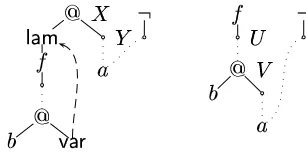
Figure 1: Underspecified -reduction steps for ‘Every student did not pay attention’
.
0/ 1
'
2
34
Figure 2: Description of ‘Every student did not pay attention’
576 &
5
6
'
5988
6:576 &
5
'
5988
A classical compositional semantics construction first derives these two readings in the form of two HOL-formulas:
6&. 0/
1 8
5;6
<=
58
66&. 0/
> &
8
5;6
<=
588
where
.
0/ 1
is an abbreviation for the term
.
/ 1@?
BACD 6:576
A
5
D
588
An underspecified description of both readings is shown in Figure 2. For now, notice that the graph has all the symbols of the two HOL formulas as node labels, that variable binding is indicated by dashed arrows, and that there are dotted lines indi-cating an “outscopes” relation; we will fill in the details in Section 3.
Now we want to reduce the description in Fig-ure 2 as far as possible. The first -reduction step, with the redex at 34
is straightforward. Even though the description is underspecified, the re-ducing part is a completely known -term. The result is shown on the left-hand side of Figure 1. Here we have just one redex, starting at
, which binds a single variable. The next reduction step is less obvious: The
operator could either be-long to the context (the part between@
and% )
E
F
G
E
F
G
3
H
[image:2.595.335.488.220.297.2]I
Figure 3: Problems with rewriting of descriptions
or to the argument (below #"
). Still, it is not dif-ficult to give a correct description of the result: it is shown in the middle of Fig. 1. For the final step, which takes us to the rightmost description, the redex starts at ),*
. Note that now the
might be part of the body or part of the context of this redex. The end result is precisely a description of the two readings as first-order formulas.
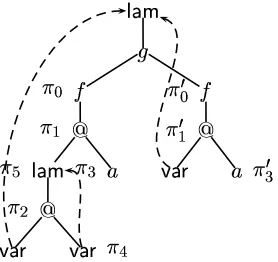
So far, the problem does not look too difficult. Twice, we did not know what exactly the parts of the redex were, but it was still easy to derive cor-rect descriptions of the reducts. But this is not always the case. Consider Figure 3, an abstract but simple example. In the left description, there are two possible positions for the
: above3 or below
. Proceeding na¨ıvely as above, we arrive at the right-hand description in Fig. 3. But this de-scription is also satisfied by the termE 6
6JF6
G
888 , which cannot be obtained by reducing any of the terms described on the left-hand side. More gen-erally, the na¨ıve “graph rewriting” approach is unsound; the resulting descriptions can have too many readings. Similar problems arise in (more complicated) examples from semantics, such as the coordination in Fig. 8.
[image:2.595.123.241.220.297.2]“ -reduction constraint” that ensures that the re-duced terms are captured correctly. Then we use a saturation calculus to make the description more explicit.
3 Tree descriptions in CLLS
In this section, we briefly recall the definition of the constraint language for -structures (CLLS). A more thorough and complete introduction can be found in (Egg et al., 2001).
We assume a signature K
? L E%M&N#MPOPOPORQ of function symbols, each equipped with an arity 6E 8TSVU
. A tree W consists of a finite set of nodesXZY;[]\ , each of which is labeled by a sym-bol ^_\
6
X
8
Y`K . Each node X has a sequence of childrenX+a
MPOPOPO7M
XbTYc[]\ whereb ?d&6
^e\
6
X
88
is the arity of the label ofX . A single nodef , the root ofW , is not the child of any other node.
3.1 Lambda structures
The idea behind -structures is that a -term can be considered as a pair of a tree which represents the structure of the term and a binding function encoding variable binding. We assumeK contains symbols
-(arity 0, for variables), g
(arity 1, for abstraction),
(arity 2, for application), and analogous labels for the logical connectives.
Definition 1. A -structure h is a pair
6
W
M
8
of a treeW and a binding function that maps every nodeX with label
to a node with label
,
, ori dominatingX .
E
The binding function explicitly
maps nodes representing variables to the nodes representing their binders. When we draw -structures, we
rep-resent the binding function using dashed arrows, as in the picture to the right, which represents the
-term
5
OjE 6k598
.
A -structure corresponds uniquely to a closed
-term modulo l -renaming. We will freely consider -structures as first-order model struc-tures with domain []\ . This structure defines the following relations. The labeling relation
Xnm
E
6
X
MPOPOPO M X#o
8
holds in W if ^_\
6
X
8p?
E
and
XBq
?
Xr for all atsur]sub . The dominance re-lation X9vxw<Xy holds iff there is a pathXyy such that
X9X yy
?
X y. Inequality z
?
is simply inequality of nodes; disjointness X {2Xy holds iff neither X9vxw<Xy norX
y
v
w
X .
3.2 Basic constraints
Now we define the constraint language for -structures (CLLS) to talk about these relations. 3 M M )
are variables that will denote nodes of a
-structure.
|
m1m
?
3
v w ~}=3
z
?
~}=3
{
~} |tt|
y
} 3
m
E 63 MPOPOPO M 3
o
8 6J6E 8+?
b
8
}
63 8? } 9
634 8?@L 3 MPOPOPORM 3
o
Q
A constraint |
is a conjunction of literals (for dominance, labeling, etc). We use the abbrevi-ations 3
vx
for 3 vxw
3
z
?
and 3 ?
for 3 v w
v w
3
. The -binding literal
63 8?
expresses that
denotes a node which the binding function maps to 3
. The inverse
-binding literal9
634 8?@L 3 MPOPOPO M 3
o
Q
states that
3 MPOPOPO M 3
o denote the entire set of vari-able nodes bound by 34
. A pair
6
h
M 8
of a -structureh and a variable assignment
satisfies a
-structure iff it satisfies each literal, in the obvi-ous way.
3
3 3 !
Figure 4: The constraint graph of
63 8?CL 3 M 34! Q
3
vxw 3
3
vxw 34!
We draw constraints as graphs (Fig. 4) in which nodes represent variables. Labels and solid lines indicate labeling literals, while dotted lines repre-sent dominance. Dashed arrows indicate the bind-ing relation; disjointness and inequality literals are not represented. The informal diagrams from Section 2 can thus be read as constraint graphs, which gives them a precise formal meaning.
3.3 Segments and Correspondences
Finally, we define segments of -structures and correspondences between segments. This allows
us to define parallelism and -reduction con-straints.
A segment is a contiguous part of a -structure that is delineated by several nodes of the structure. Intuitively, it is a tree from which some subtrees have been cut out, leaving behind holes.
Definition 2 (Segments). A segment l of a -structure 6
W
M
8
is a tupleX J
X
OPOPO M
in []\ such that X
v w X#q andX#qJ{2X hold in W for asrz
?
sb . The root
6 l 8 is X , and #6 l 8? X MPOPOPO M
XBo is its (possibly empty) se-quence of holes. The set
6
l
8
of nodes ofl is
6 l 8_?dL XY;[ } 6 l 8 vxw<X M
and notX
q
vxnX for all asr_sb
Q
To exempt the holes of the segment, we define
6 l 8? 6 l 86 l 8 . If 6 l 8
is a singleton sequence then we write 6
l
8
for the unique hole ofl , i.e. the unique node with
6 l 8 Y #6 l 8 .
For instance, l
? X X ! M X
[image:4.595.354.493.63.194.2]is a segment in Fig. 5; its root is X
, its holes areX
!
andX
, and it contains the nodes
6 l 8_?L X M X $ M X ! M X Q . Two tree segments l
M
overlap properly iff
x 6 l 8 x 6 8 z ?
. The syntactic equivalent of a segment is a segment term 34PR3
MPOPOPO
3
o . We use the letters
M ¡¢M¤£2M
[ for them and extend
6 8 ,6 8
, and 6
8
correspondingly.
A correspondence function is intuitively an iso-morphism between segments, mapping holes to holes and roots to roots and respecting the struc-tures of the trees:
Definition 3. A correspondence function be-tween the segments l
M
is a bijective mapping
¥ m¦ 6 l 8 6 8
such that ¥
maps the r-th hole ofl to ther -th hole of for eachr, and for every
XZYZx
6
l
8
and every label
E , Xnm E 6 X+a MPOPOPORM Xb 8n§ ¥ 6 X 8 m E 6 ¥ 6 X+a 8 MPOPOPO ¥ 6 Xb 88 O
There is at most one correspondence function between any two given segments. The
correspon-dence literal co 6£(M [ 8<6 3 8?
expresses that a correspondence function ¥
between the segments denoted by£
and[ exists, that
3
and
denote nodes within these segment, and that these nodes are related by¥
.
Together, these constructs allow us to define
parallelism, which was originally introduced for
the analysis of ellipsis (Egg et al., 2001). The par-allelism relation l¨ holds iff there is a corre-spondence function between l and that satis-fies some natural conditions on -binding which we cannot go into here. To model parallelism in the presence of global -binders relating multiple parallel segments, Bodirsky et al. (2001) general-ize parallelism to group parallelism. Group par-allelism 6 l MPOPOPO M l o 8 ¨
6 MPOPOPO M
o 8 is entailed N E g G E G X Xy X X $ X y X ! X " X Xy
Figure 5:E 66
5 Oª© 6k5988<6
G
88 ¬«
E 6 © 6
G
88
by the conjunction
o
q>
l q ¨ q of ordinary par-allelisms, but imposes slightly weaker restrictions on -binding. By way of example, consider the -structure in Fig. 5, where
6 X X M X != X " M X 8 ¨ 6 Xy Xy M Xy Xy " M Xy " 8 holds.
On the syntactic side, CLLS provides
group parallelism literals 6
MPOPOPO M o
8
¨
6¡ MPOPOPO®M ¡
o
8
to talk about (group) parallelism.
4 Beta reduction constraints
Correspondences are also used in the definition of
-reduction constraints (Bodirsky et al., 2001).
A -reduction constraint describes a single -reduction step between two -terms; it enforces correct reduction even if the two terms are only partially known.
Standard -reduction has the form
£ 66
5 Oª¡ 8
8
¬«
£ 6¡°¯5 ²±
8³5
free for
O
The reducing -term consists of context
£
which contains a redex 6
5 Oª¡ 8
. The redex itself is an occurrence of an application of a -abstraction
5
Oª¡
with body
¡
to argument . -reduction then replaces all occurrences of the bound vari-able
5
in the body by the argument while preserv-ing the context.
We can partition both redex and reduct into ar-gument, body, and context segments. Consider Fig. 5. The -structure contains the reducing -term
E 66
5 Oª© 6k588<6
G
88
starting atX
. The reduced term can be found at X y
. Writing ´
M
´ y for the context, ,M
y for the body and l
M
l y for the ar-gument tree segments of the reducing and the re-duced term, respectively, we find
Because we have both the reducing term and the reduced term as parts of the same -structure, we can express the fact that the structure below X y
can be obtained by -reducing the structure be-low X
by requiring that l corresponds to l y, to y, and
´ to´
y, again modulo binding. This is indeed true in the given -structure, as we have seen above.
More generally, we define the -reduction re-lation
6
´
M,M
l
8
«
6
´ y M
y
M
l y
MPOPOPOM l y
o
8
for a body withb holes (for the variables bound in the redex). The -reduction relation holds iff two conditions are met: 6
´
M,M
l
8
must form a re-ducing term, and the structural equalities that we have noted above must hold between the tree seg-ments. The latter can be stated by the following group parallelism relation, which also represents the correct binding behaviour:
6
´
M,M
l
MPOPOPOnM
l
8
¨
6
´%y M
y
M
l y
MPOPOPO®M l yo
8
Note that any -structure satisfying this relation must contain both the reducing and the reduced term as substructures. Incidentally, this allows us to accommodate for global variables in -terms; Fig. 5 shows this for the global variable©
. We now extend CLLS with -reduction con-straints
6£(M ¡¶M
8
«
6£
y
M ¡
y
M
y
MPOPOPO®M
y
o
8 M
which are interpreted by the -reduction relation. The reduction steps in Section 2 can all be represented correctly by -reduction constraints. Consider e.g. the first step in Fig. 1. This is
repre-sented by the constraint 6@
M
%!
M
" 8
«
62!P)+ M )+P), M )+ 8
. The entire middle con-straint in Fig. 1 is entailed by the -reduction lit-eral. If we learn in addition that e.g.
vxw
, the -reduction literal will entail)
vxw )
because the segments must correspond. This correlation between parallel segments is the exact same ef-fect (quantifier parallelism) that is exploited in the CLLS analysis of “Hirschb¨uhler sentences”, where ellipses and scope interact (Egg et al., 2001).
-reduction constraints also represent the prob-lematic example in Fig. 3 correctly. The spuri-ous solution of the right-hand constraint does not
usb(| , X) =
if all syntactic redexes in|
below3 are reduced then return 6
|
M 3 8
else
pick a formularedex· 6£(M ¡¶M
8
in| that is unreduced, with3 ?
6 £ 8 in|
add 6£(M ¡¶M
8
«
6£
y
M ¡
y
M
y
MPOPOPO®M
yo
8
to|
where
£
y
M ¡
y
M
¸y
MPOPOPO M
¸yo are new segment terms with fresh variables add3
{2 6 £
y
8
to| for all|
y9Y solve
6
|
8
dousb
6
|
y
M
6
£
y
[image:5.595.307.528.61.232.2]88 end
Figure 6: Underspecified -reduction
satisfy the -reduction constraint, as the bodies would not correspond.
5 Underspecified Beta Reduction
Having introduced -reduction constraints, we now show how to process them. In this section, we present the procedureusb, which performs a sequence of underspecified -reduction steps on CLLS descriptions. This procedure is parameter-ized by another proceduresolvefor solving -reduction constraints, which we discuss in the fol-lowing section.
A syntactic redex in a constraint |
is a subfor-mula of the following form:
redex·
6 £(M ¡¶M
8_? df
6£ 8
m
6
M
6
88
m
@6
6¡ 88
6 8+?¹#6 ¡ 8
A context £
of a redex must have a unique hole 6 £ 8
. An b -ary redex has b occurrences of the bound variable, i.e. the length of#6¡ 8
isb . We call a redex linear ifb
?
a .
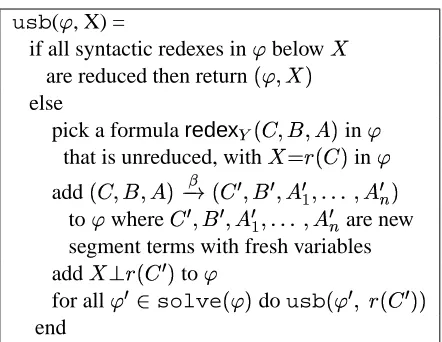
The algorithm º9»¼ is shown in Figure 6. It starts with a constraint|
and a variable3
, which denotes the root of the current -term to be re-duced. (For example, for the redex in Fig. 2, this root would be
Intuitively, thesolveprocedure adds entailed literals to |
, making the new -reduction literal more explicit. When presented with the left-hand constraint in Fig. 1 and the root variable
@ ,usb
will add a -reduction constraint for the redex at ®
; thensolvewill derive the middle constraint. Finally, usb will call itself recursively with the new root variable 2!
and try to resolve the redex at),
, etc. The partial solving steps do essentially the same as the na¨ıve graph rewriting approach in this case; but the new algorithm will behave differently on problematic constraints as in Fig. 3.
6 A single reduction step
In this section we present a proceduresolvefor solving -reduction constraints. We go through several examples to illustrate how it works. We have to omit some details for lack of space; they can be found in (Bodirsky et al., 2001).
The aim of the procedure is to make explicit information that is implicit in -reduction con-straints: it introduces new corresponding vari-ables and copies constraints from the reducing term to the reduced term.
We build upon the solver for -reduction con-straints from (Bodirsky et al., 2001). This solver is complete, i.e. it can enumerate all solutions of a constraint; but it disambiguates a lot, which we want to avoid in underspecified -reduction. We obtain an alternative procedure solve by dis-abling all rules which disambiguate and adding some new non-disambiguating rules. This al-lows us to perform a complete underspecified -reduction for many examples from underspecified semantics without disambiguating at all. In those cases where the new rules alone are not sufficient, we can still fall back on the complete solver.
6.1 Saturation
Our constraint solver is based on saturation with a given set of saturation rules. Very briefly, this means that a constraint is seen as the set of its lit-erals, to which more and more literals are added according to saturation rules. A saturation rule of the form |
½7o q>
|
q says that we can add one of the |
q to any constraint that contains at least the literals in|
. We only apply rules where each possible choice adds new literals to the set; a constraint is saturated under a set ¾ of saturation
rules if no rule in¾ can add anything else.solve returns the set of all possible saturations of its in-put. If the rule system contains nondeterminis-tic distribution rules, withbÀ¿Áa , this set can be non-singleton; but the rules we are going to intro-duce are all deterministic propagation rules (with
b
?
a ).
6.2 Solving Beta Reduction Constraints
The main problem in doing underspecified -reduction is that we may not know to which part of a redex a certain node belongs (as in Fig. 1). We address this problem by introducing
under-specified correspondence literals of the form
co6'L6
£
M
[
8 MPOPOPOM
6
£
o
M
[o
8
Q
8<63 8?
O
Such a literal is satisfied if the tree segments denoted by the £
’s and by the [ ’s do not overlap properly, and there is an r for which co
6 £
q
M
[q 8<6
3
8e?
is satisfied.
In Fig. 7 we present the rules UB for under-specified -reduction; the first five rules are the core of the algorithm. To keep the rules short, we use the following abbreviations (withasr_sb ):
beta ?2ÂÃÅÄÆ6 £2M ¡¢M
8
«
6
£
y
M ¡
y
M
¸y
MPOPOPO M ¸y
o
8
coq ?2ÂÃÅÄ
co6'L6 £(M¤£
y
8 M 6 ¡¶M ¡
y
8 M 6
M
y
q
8 Q 8
The procedure solve consists of UB together with the propagation rules from (Bodirsky et al., 2001). The rest of this section shows how this procedure operates and what it can and cannot do. First, we discuss the five core rules. Rule (Beta) states that whenever the -reduction rela-tion holds, group parallelism holds, too. (This al-lows us to fall back on a complete solver for group parallelism.) Rule (Var) introduces a new variable as a correspondent of a redex variable, and (Lab) and (Dom) copy labeling and dominance literals from the redex to the reduct. To understand the exceptions they make, consider e.g. Fig. 5. Every node belowX
has a correspondent in the reduct, except forX
. Every labeling relation in the redex also holds in the reduct, except for the labelings of the
-nodeX
, the
-nodeX
, and the
-node
X
"
(Beta) Ç1È%ÉËÊ7ÉËÌ%ÍeÎ
Ï
ÇÐÈ%ÑÒÉkÊÑÒÉkÌÑÓ&ÉÅÔµÔÅÔ0ÉkÌÑ ÕRÍ
Ï
ÇÐÈ%ÉJÊ7ÉkÌ ÉÅÔÅÔ'ÔRÉÒÌÍgÖ¢Ç1È%Ñ:ÉËÊÑ:ÉkÌ#ÑÓÉÅÔµÔµÔ0ÉÒÌ#Ñ ÕÍ
(Var) beta× redexØ ÇÐÈ%ÉJÊ7ÉkÌÍ×_ÙÇÐÈ9Í1Ú¤ÛܸצÜnÝ ·
ÏpÞ
Ü ÑÔcoßJÇ1ÜÍ
Ü Ñ
(Lab) beta× redexØ ÇÐÈ%ÉJÊ7ÉkÌÍצÜgàáâ0Ç1Ü
Ó
É'ÔÅÔÅÔÉkÜxã'ÍRצä ãåæ
à co ßËÇÐÜ
å
Í
Ü#Ñ
å
×eÜgàÝ ç
ÇÐÈ9Í0×eÜàRè
é
çê ÇÐÊ®Í
Ï
ÜBÑ
à
áâ0Ç1ÜBÑÓ ÉµÔÅÔµÔ0ÉkÜ#Ñ
ã
Í
(Dom) beta× änë å&æ
Ó coßËÇÐÜ
å
Í
Ü#Ñ
å
צÜ
Ó
Ú Û Ü
ë
Ï
Ü#ÑÓÚ Û ÜBÑ
ë
(ì .Inv) beta× redexØ Ç1È%ÉËÊnÉÒÌ%Í'×Bìí
Ó
Ç1Ügà Í ®î
Ü
Ó
ÉÅÔµÔµÔ0ÉkÜgï,ð<× ä ïå&æ
à co
Ó
Ç1Ü
å
Í
Ü
Ñ
å
Ï
ìí
Ó
ÇÐÜ
Ñ
à
Í
®î
Ü
ÑÓ
ÉÅÔ'ÔÅÔRÉËÜ
Ñ
ï
ð redex linear
(Par.part) betaÕ
× coßËÇ1ÜÍ
Ü Ñ ×
·
éñ
ÇÐÌ%ÍצÜBÚ¤Û
·
Ï
Ü Ñ è éò
ÇÐÊ ÑÍ 9ó
q
ó
o
(Par.all) coÇ
î
Ç1ôeÉËô
Ñ
ÍËÉÅÔ'ÔÅÔJð&ÍJÇÐÜ%Í
Ü
Ñ
×¦Ü éõñ
ÇÐô+Í
Ï
Ü
Ñ
éõñ ÇÐô
Ñ
Í0× coÇÐôeÉËô
Ñ
ÍËÇ1ÜÍ
Ü
Ñ
Figure 7: New saturation rules UB for constraint solving during underspecified -reduction.
it is restricted to linear redexes; for the nonlinear case, we have to take recourse to disambiguation. It can be shown that the rules in UB are sound in the sense that they are valid implications when interpreted over -structures.
6.3 Some Examples
To see what the rules do, we go through the first reduction step in Fig. 1. The -reduction con-straint that belongs to this reduction is
6 £(M ¡¶M
8
«
6 £
y
M ¡
y
M
²y
8
with £ ? @¤% M ¡ ? ®¤% M
? #" M
£
y
? 2!=P)+ Mö¡
y
? ),=P)+ M ²y
? ),
Now saturation can add more constraints, for example the following:
Ç
Í
·=÷
Ý
· Ó
Ç
$
Í
·=÷
Ý
·=ø
Ç
!
Í
·ù
Ý
· Ó
Ç
ÍúÜ
÷
áûüÇÐÜ
ù
Í (Lab)
Ç
Í
Þ
Ü
÷
Ôco
Ó
Ç
·=÷
Í
Ü
÷ (Var)
Ç
Íúý
ë
Ú Û Ü
÷ (Dom)
Ç
"
Í
Þ
Ü
ù
Ôco
Ó
Ç
·ù
Í
Ü
ù (Var)
We get (1), (2), (5) by propagation rules from (Bodirsky et al., 2001): variables bearing differ-ent labels must be differdiffer-ent. Now we can apply (Var) to get (3) and (4), then (Lab) to get (6). Fi-nally, (7) shows one of the dominances added by (Dom). Copies of all other variables and literals can be computed in a completely analogous fash-ion. In particular, copying gives us another redex starting at
),*
, and we can continue with the algo-rithmusbin Figure 6.
Note what happens in case of a nonlinear redex, as in the left picture of Fig. 8: as the redex is þ -ary, the rules produce two copies of the
labeling constraint, one via co
and one via co!
. The result is shown on the right-hand side of the figure. We will return to this example in a minute.
6.4 More Complex Examples
The last two rules in Fig. 7 enforce consistency between scoping in the redex and scoping in the
reduct. The rules use literals that were introduced in (Bodirsky et al., 2001), of the forms3
Y
6
8
, 3
Yÿ 6¡ 8
, etc., where ,
¡
are segment terms. We take
3
YZ
6
8
to mean that
3
must be inside the tree segment denoted by , and we take
3
Y
ÿ
6¡ 8
(i for ’interior’) to mean that3 Y
6¡ 8 and
3
denotes neither the root nor a hole of
¡
. As an example, reconsider Fig. 3: by rule (Par.part), the reduct (right-hand picture of Fig. 3) cannot represent the term
E 6
6JF06
G
888
because that would require the
operator to be inÿ 6 ¡
y
8
. Similarly in Fig. 8, where we have introduced two copies of the
label. If the
in the redex on the left ends up as part of the context, there should be only one copy in the reduct. This is brought about by the rule (Par.all) and the fact that correspondence is a function (which is enforced by rules from (Erk et al., 2001) which are part of the solver in (Bodirsky et al., 2001)). Together, they can be used to infer that ),
can have only one correspondent in the reduct context.
7 Conclusion
In this paper, we have shown how to perform an underspecified -reduction operation in the CLLS framework. This operation transforms underspec-ified descriptions of higher-order formulas into descriptions of their -reducts. It can be used to essentially -reduce all readings of an ambiguous sentence at once.
/<&/
(-1
)
/<&/
(>
y
)
y
yy
)
yy
Figure 8: “Peter and Mary do not laugh.”
ity in the source sentence, which one would like to get rid of by -reducing the source sentence. Our approach can achieve this goal: Adding -reduction constraints for the source sentence leaves the original copy intact, and the target sen-tence still contains the ambiguity.
Under the simplifying assumption that all re-dexes are linear, we can show that it takes time 6
b
8
to perform steps of underspecified -reduction on a constraint with b variables. This is feasible for large as long as b
U
, which should be sufficient for most reasonable sen-tences. If there are non-linear redexes, the present algorithm can take exponential time because sub-terms are duplicated. The same problem is known in ordinary -calculus; an interesting question to pursue is whether the sharing techniques devel-oped there (Lamping, 1990) carry over to the un-derspecification setting.
In Sec. 6, we only employ propagation rules; that is, we never disambiguate. This is concep-tually very nice, but on more complex examples (e.g. in many cases with nonlinear redexes) dis-ambiguation is still needed.
This raises both theoretical and practical issues. On the theoretical level, the questions of com-pleteness (elimination of all redexes) and conflu-ence still have to be resolved. To that end, we first have to find suitable notions of completeness and confluence in our setting. Also we would like to handle larger classes of examples without dis-ambiguation. On the practical side, we intend to implement the procedure and disambiguate in a controlled fashion so we can reduce completely and still disambiguate as little as possible.
References
M. Bodirsky, K. Erk, A. Koller, and J. Niehren. 2001. Beta reduction constraints. In Proc. 12th Rewriting
Techniques and Applications, Utrecht.
J. Bos. 1996. Predicate logic unplugged. In
Proceed-ings of the 10th Amsterdam Colloquium.
R. Cooper. 1983. Quantification and Syntactic
The-ory. Reidel, Dordrecht.
M. Egg, A. Koller, and J. Niehren. 2001. The con-straint language for lambda structures. Journal of
Logic, Language, and Information. To appear.
K. Erk and J. Niehren. 2000. Parallelism constraints. In Proc. 11th RTA, LNCS 1833.
K. Erk, A. Koller, and J. Niehren. 2001. Processing underspecified semantic representations in the Con-straint Language for Lambda Structures. Journal of
Language and Computation. To appear.
A. Koller and J. Niehren. 2000. On underspecified processing of dynamic semantics. In Proc. 18th
COLING, Saarbr ¨ucken.
A. Koller, J. Niehren, and K. Striegnitz. 2000. Re-laxing underspecified semantic representations for reinterpretation. Grammars, 3(2/3). Special Issue on MOL’99. To appear.
J. Lamping. 1990. An algorithm for optimal lambda calculus reduction. In ACM Symp. on Principles of
Programming Languages.
M. P. Marcus, D. Hindle, and M. M. Fleck. 1983. D-theory: Talking about talking about trees. In Proc.
21st ACL.
R. Montague. 1974. The proper treatment of quantifi-cation in ordinary English. In Formal Philosophy.
Selected Papers of Richard Montague. Yale UP.
M. Pinkal. 1996. Radical underspecification. In Proc.
10th Amsterdam Colloquium.
O. Rambow, K. Vijay-Shanker, and D. Weir. 1995. D-Tree Grammars. In Proceedings of ACL’95.
U. Reyle. 1993. Dealing with ambiguities by under-specification: construction, representation, and de-duction. Journal of Semantics, 10.
K. van Deemter and S. Peters. 1996. Semantic
Am-biguity and Underspecification. CSLI Press,