Building Deep Dependency Structures with a Wide-Coverage CCG Parser
Stephen Clark, Julia Hockenmaier and Mark Steedman Division of Informatics
University of Edinburgh Edinburgh EH8 9LW, UK
stephenc, julia, steedman @cogsci.ed.ac.uk
Abstract
This paper describes a wide-coverage sta-tistical parser that uses Combinatory Cat-egorial Grammar (CCG) to derive de-pendency structures. The parser differs from most existing wide-coverage tree-bank parsers in capturing the long-range dependencies inherent in constructions such as coordination, extraction, raising and control, as well as the standard local predicate-argument dependencies. A set of dependency structures used for train-ing and testtrain-ing the parser is obtained from a treebank of CCG normal-form deriva-tions, which have been derived (semi-) au-tomatically from the Penn Treebank. The parser correctly recovers over 80% of la-belled dependencies, and around 90% of unlabelled dependencies.
1 Introduction
Most recent wide-coverage statistical parsers have used models based on lexical dependencies (e.g. Collins (1999), Charniak (2000)). However, the de-pendencies are typically derived from a context-free phrase structure tree using simple head percolation heuristics. This approach does not work well for the long-range dependencies involved in raising, con-trol, extraction and coordination, all of which are common in text such as the Wall Street Journal.
Chiang (2000) uses Tree Adjoining Grammar as an alternative to context-free grammar, and here we use another “mildly context-sensitive” for-malism, Combinatory Categorial Grammar (CCG,
Steedman (2000)), which arguably provides the most linguistically satisfactory account of the de-pendencies inherent in coordinate constructions and extraction phenomena. The potential advantage from using such an expressive grammar is to facili-tate recovery of such unbounded dependencies. As well as having a potential impact on the accuracy of the parser, recovering such dependencies may make the output more useful.
CCG is unlike other formalisms in that the stan-dard predicate-argument relations relevant to inter-pretation can be derived via extremely non-standard surface derivations. This impacts on how best to de-fine a probability model for CCG, since the “spuri-ous ambiguity” of CCG derivations may lead to an exponential number of derivations for a given con-stituent. In addition, some of the spurious deriva-tions may not be present in the training data. One solution is to consider only the normal-form (Eis-ner, 1996a) derivation, which is the route taken in Hockenmaier and Steedman (2002b).1
Another problem with the non-standard surface derivations is that the standard PARSEVAL per-formance measures over such derivations are unin-formative (Clark and Hockenmaier, 2002). Such measures have been criticised by Lin (1995) and Carroll et al. (1998), who propose recovery of head-dependencies characterising predicate-argument re-lations as a more meaningful measure.
If the end-result of parsing is interpretable predicate-argument structure or the related depen-dency structure, then the question arises: why build
derivation structure at all? A CCG parser can
directly build derived structures, including
long-1
Another, more speculative, possibility is to treat the alter-native derivations as hidden and apply the EM algorithm.
range dependencies. These derived structures can be of any form we like—for example, they could in principle be standard Penn Treebank structures. Since we are interested in dependency-based parser evaluation, our parser currently builds dependency structures. Furthermore, since we want to model the dependencies in such structures, the probability model is defined over these structures rather than the derivation.
The training and testing material for this CCG parser is a treebank of dependency structures, which have been derived from a set of CCG deriva-tions developed for use with another (normal-form) CCG parser (Hockenmaier and Steedman, 2002b). The treebank of derivations, which we call CCG-bank (Hockenmaier and Steedman, 2002a), was in turn derived (semi-)automatically from the hand-annotated Penn Treebank.
2 The Grammar
In CCG, most language-specific aspects of the gram-mar are specified in the lexicon, in the form of syn-tactic categories that identify a lexical item as either a functor or argument. For the functors, the category specifies the type and directionality of the arguments and the type of the result. For example, the follow-ing category for the transitive verb bought specifies its first argument as a noun phrase (NP) to its right and its second argument as an NP to its left, and its result as a sentence:
(1) bought :=S NP NP
For parsing purposes, we extend CCG categories to express category features, and head-word and de-pendency information directly, as follows:
(2) bought :=Sdclbought NP1 NP2
The featuredcl specifies the category’s S result as a
declarative sentence, bought identifies its head, and the numbers denote dependency relations. Heads and dependencies are always marked up on atomic categories (S, N, NP, PP, and conj in our implemen-tation).
The categories are combined using a small set of typed combinatory rules, such as functional applica-tion and composiapplica-tion (see Steedman (2000) for de-tails). Derivations are written as follows, with under-lines indicating combinatory reduction and arrows
indicating the direction of the application:
(3) Marks bought Brooks
NPMarks Sdclbought
NP1 NP2 NPBrooks
Sdclbought NP1
Sdclbought
Formally, a dependency is defined as a 4-tuple:
hf fsha , where hf is the head word of the
func-tor,2 f is the functor category (extended with head
and dependency information), s is the argument slot, and hais the head word of the argument—for exam-ple, the following is the object dependency yielded by the first step of derivation (3):
(4)
bought
Sdclbought NP1 NP2
2Brooks
Variables can also be used to denote heads, and used via unification to pass head information from one category to another. For example, the expanded category for the control verb persuade is as follows:
(5) persuade := Sdcl
persuade NP
1Sto
2 NP
X NP
X,3 The head of the infinitival complement’s subject is identified with the head of the object, using the vari-able X. Unification then “passes” the head of the ob-ject to the subob-ject of the infinitival, as in standard unification-based accounts of control.3
The kinds of lexical items that use the head pass-ing mechanism are raispass-ing, auxiliary and control verbs, modifiers, and relative pronouns. Among the constructions that project unbounded dependencies are relativisation and right node raising. The follow-ing category for the relative pronoun category (for words such as who, which, that) shows how heads are co-indexed for object-extraction:
(6) who := NPX NPX,1Sdcl2 NPX
The derivation for the phrase The company that
Marks wants to buy is given in Figure 1 (with the
features on S categories removed to save space, and the constant heads reduced to the first letter). Type-raising ( ) and functional composition ( ), along
2
Note that the functor does not always correspond to the lin-guistic notion of a head.
3
The company that Marks wants to buy
NPx Nx,1 Nc NPx NPx,1 S2 NPx NPm Sw NPx,1 S2 NPx Sy NPx,1 Sy,2 NPx Sb NP1 NP2
NPc Sx Sx NPm Sb NP NP
Sw NP
NP
Sw NP
NPx NPx
NPc
Figure 1: Relative clause derivation
with co-indexing of heads, mediate transmission of the head of the NP the company onto the object of
buy. The corresponding dependencies are given in
the following figure, with the convention that arcs point away from arguments. The relevant argument slot in the functor category labels the arcs.
1
2
2 2
2
1 1
1 1
The company that Marks wants to buy
Note that we encode the subject argument of the
to category as a dependency relation (Marks is a
“subject” of to), since our philosophy at this stage is to encode every argument as a dependency, where possible. The number of dependency types may be reduced in future work.
3 The Probability Model
The DAG-like nature of the dependency structures makes it difficult to apply generative modelling tech-niques (Abney, 1997; Johnson et al., 1999), so we have defined a conditional model, similar to the model of Collins (1996) (see also the condi-tional model in Eisner (1996b)). While the model of Collins (1996) is technically unsound (Collins, 1999), our aim at this stage is to demonstrate that accurate, efficient wide-coverage parsing is possible with CCG, even with an over-simplified statistical model. Future work will look at alternative models.4
4
The reentrancies creating the DAG-like structures are fairly limited, and moreover determined by the lexical categories. We conjecture that it is possible to define a generative model that includes the deep dependencies.
The parse selection component must choose the most probable dependency structure, given the sen-tence S. A sensen-tence S
w1t1
w2t2
wntn
is assumed to be a sequence of word, pos-tag pairs. For our purposes, a dependency structure π is a
CD pair, where C c1
c2cn is the
se-quence of categories assigned to the words, and
D!
hfi fisihai#"i 1
m
$ is the set of
de-pendencies. The probability of a dependency struc-ture can be written as follows:
(7) Pπ% PC D"S
& PC "S
PD "CS
The probability PC "S
can be approximated as
follows:
(8) PC "S
&' ∏
n i( 1
Pci
"Xi
where Xi is the local context for the ith word. We have explained elsewhere (Clark, 2002) how suit-able features can be defined in terms of the
word, pos-tag pairs in the context, and how maximum
en-tropy techniques can be used to estimate the proba-bilities, following Ratnaparkhi (1996).
We assume that each argument slot in the cat-egory sequence is filled independently, and write
PD
"CS
as follows:
(9) PD "CS
% ∏
m i( 1
Pha
i"CS
where hai is the head word filling the argument slot of the ith dependency, and m is the number of de-pendencies entailed by the category sequence C.
3.1 Estimating the dependency probabilities
sen-tence, what is the probability that the words are in a particular dependency relationship?
We again follow Collins in defining the following functions, where ) is the set of words in the data,
and* is the set of lexical categories.
+
C ,a -b
./-,c -d.
for a
-c021 and b-d043 is the number of times that word-category pairs,a
-b. and ,c
-d. are in the same word-category sequence in the training data.
+
C R -,a
-b ./-,c
-d.
is the number of times that ,a
-b. and ,c
-d. are in the same word-category sequence, with a and
c in dependency relation R.
+
F R5 ,a
-b ./-,c
-d.
is the probability that a and c are in de-pendency relation R, given that,a
-b. and ,c
-d. are in the same word-category sequence.
The relative frequency estimate of the probability
FR
"
ab
cd
is as follows:
(10) ˆFR
"
ab
cd
6
C7R8:9a8b;<89c8d;>=
C7<9a8b;<89c8d;>=
The probability Pha
i"CS
can now be
approxi-mated as follows:
(11) Pha
i"CS ?'
ˆ
F7R@9h
fi8fi;<89h
ai8c
ai;>= ∑n
jA 1
ˆ
F7R@9h
fi8fi;<8:9wj8cj;>=
where cai is the lexical category of the argument head ai. The normalising factor ensures that the probabilities for each argument slot sum to one over all the word-category pairs in the sequence.5 This
factor is constant for the given category sequence, but not for different category sequences. However, the dependency structures with high enough PC
"S
to be among the highest probability structures are likely to have similar category sequences. Thus we ignore the normalisation factor, thereby simplifying the parsing process. (A similar argument is used by Collins (1996) in the context of his parsing model.)
The estimate in equation 10 suffers from sparse data problems, and so a backing-off strategy is em-ployed. We omit details here, but there are four lev-els of back-off: the first uses both words and both categories; the second uses only one of the words and both categories; the third uses the categories only; and a final level substitutes pos-tags for the categories.
One final point is that, in practice, the number of dependencies can vary for a given category sequence (because multiple arguments for the same slot can
5
One of the problems with the model is that it is deficient, as-signing probability mass to dependency structures not licensed by the grammar.
be introduced through coordination), and so a geo-metric mean of pπ is used as the ranking function,
averaged by the number of dependencies in D.
4 The Parser
The parser analyses a sentence in two stages. First, in order to limit the number of categories assigned to each word in the sentence, a “supertagger” (Ban-galore and Joshi, 1999) assigns to each word a small number of possible lexical categories. The supertag-ger (described in Clark (2002)) assigns to each word all categories whose probabilities are within some constant factor, β, of the highest probability cate-gory for that word, given the surrounding context. Note that the supertagger does not provide a single category sequence for each sentence, and the final sequence returned by the parser (along with the de-pendencies) is determined by the probability model described in the previous section. The supertagger is performing two roles: cutting down the search space explored by the parser, and providing the category-sequence model in equation 8.
The supertagger consults a “category dictionary” which contains, for each word, the set of categories the word was seen with in the data. If a word ap-pears at least K times in the data, the supertagger only considers categories that appear in the word’s category set, rather than all lexical categories.
The second parsing stage applies a CKY bottom-up chart-parsing algorithm, as described in Steedman (2000). The combinatory rules currently used by the parser are as follows: functional ap-plication (forward and backward), generalised for-ward composition, backfor-ward composition, gener-alised backward-crossed composition, and type-raising. There is also a coordination rule which con-joins categories of the same type.6
Type-raising is applied to the categories NP, PP, and SadjB NP (adjectival phrase); it is currently
implemented by simply adding pre-defined sets of type-raised categories to the chart whenever an NP,
PP or SadjB NP is present. The sets were chosen
on the basis of the most frequent type-raising rule instantiations in sections 02-21 of the CCGbank, which resulted in 8 type-raised categories for NP,
6
and 2 categories each for PP and SadjB NP.
As well as combinatory rules, the parser also uses a number of lexical rules and rules involving punc-tuation. The set of rules consists of those occurring roughly more than 200 times in sections 02-21 of the CCGbank. For example, one rule used by the parser is the following:
(12) SingB NPC NP
X NP
X
This rule creates a nominal modifier from an ing-form of a verb phrase.
A set of rules allows the parser to deal with com-mas (all other punctuation is removed after the su-pertagging phase). For example, one kind of rule treats a comma as a conjunct, which allows the NP object in John likes apples, bananas and pears to have three heads, which can all be direct objects of
like.7
The search space explored by the parser is re-duced by exploiting the statistical model. First, a constituent is only placed in a chart cell if there is not already a constituent with the same head word, same category, and some dependency structure with a higher or equal score (where score is the geomet-ric mean of the probability of the dependency struc-ture). This tactic also has the effect of eliminat-ing “spuriously ambiguous” entries from the chart— cf. Komagata (1997). Second, a constituent is only placed in a cell if the score for its dependency struc-ture is within some factor,α, of the highest scoring dependency structure for that cell.
5 Experiments
Sections 02-21 of the CCGbank were used for train-ing (39161 sentences); section 00 for development
(1901 sentences); and section 23 for testing (2379
sentences).8Sections 02-21 were also used to obtain
the category set, by including all categories that ap-pear at least 10 times, which resulted in a set of 398 category types.
The word-category sequences needed for estimat-ing the probabilities in equation 8 can be read di-rectly from the CCGbank. To obtain dependencies
7
These rules are currently applied deterministically. In fu-ture work we will investigate approaches which integrate the rule applications with the statistical model.
8
A small number of sentences in the Penn Treebank do not appear in the CCGbank (see Hockenmaier and Steedman (2002a)).
for estimating PD "CS
, we ran the parser over the
trees, tracing out the combinatory rules applied dur-ing the derivation, and outputtdur-ing the dependencies. This method was also applied to the trees in section 23 to provide the gold standard test set.
Not all trees produced dependency structures, since not all categories and type-changing rules in the CCGbank are encoded in the parser. We obtained dependency structures for roughly 95% of the trees in the data. For evaluation purposes, we increased the coverage on section 23 to 990% (2352
sen-tences) by identifying the cause of the parse failures and adding the additional rules and categories when creating the gold-standard; so the final test set con-sisted of gold-standard dependency structures from 2352 sentences. The coverage was increased to
en-sure the test set was representative of the full section. We emphasise that these additional rules and cate-gories were not made available to the parser during testing, or used for training.
Initially the parser was run withβ 0
01 for the
supertagger (an average of 38 categories per word),
K 20 for the category dictionary, and α 0 001
for the parser. A time-out was applied so that the parser was stopped if any sentence took longer than 2 CPU minutes to parse. With these parameters, 2098 of the 2352 sentences received some
anal-ysis, with 206 timing out and 48 failing to parse. To deal with the 48 no-analysis cases, the cut-off for the category-dictionary, K, was increased to 100. Of the 48 cases, 23 sentences then received an anal-ysis. To deal with the 206 time-out cases, β was increased to 005, which resulted in 181 of the 206
sentences then receiving an analysis, with 18 failing to parse, and 7 timing out. So overall, almost 98% of the 2 352 unseen sentences were given some
analy-sis.
To return a single dependency structure, we chose the most probable structure from the Sdcl categories
spanning the whole sentence. If there was no such category, all categories spanning the whole string were considered.
6 Results
and recall figures over the dependencies. Recall that a dependency is defined as a 4-tuple: a head of a functor, a functor category, an argument slot, and a head of an argument. Figures were calculated for la-belled dependencies (LP,LR) and unlala-belled depen-dencies (UP,UR). To obtain a point for a labelled de-pendency, each element of the 4-tuple must match exactly. Note that the category set we are using dis-tinguishes around 400 distinct types; for example, tensed transitive buy is treated as a distinct category from infinitival transitive buy. Thus this evaluation criterion is much more stringent than that for a stan-dard pos-tag label-set (there are around 50 pos-tags used in the Penn Treebank).
To obtain a point for an unlabelled dependency, the heads of the functor and argument must appear together in some relation (either as functor or argu-ment) for the relevant sentence in the gold standard. The results are shown in Table 1, with an additional column giving the category accuracy.
LP % LR % UP % UR% category % no∆ 81D3 82D1 89D1 90D1 90D6 with∆ 81D9 81D8 90D1 89D9 90D3
Table 1: Overall dependency results for section 23
As an additional experiment, we conditioned the dependency probabilities in 10 on a “distance mea-sure” (∆). Distance has been shown to be a use-ful feature for context-free treebank style parsers (e.g. Collins (1996), Collins (1999)), although our hypothesis was that it would be less useful here, be-cause the CCG grammar provides many of the con-straints given by∆, and distance measures are biased against long-range dependencies.
We tried a number of distance measures, and the one used here encodes the relative position of the heads of the argument and functor (left or right), counts the number of verbs between argument and functor (up to 1), and counts the number of punctu-ation marks (up to 2). The results are also given in Table 1, and show that, as expected, adding distance gives no improvement overall.
An advantage of the dependency-based evalua-tion is that results can be given for individual de-pendency relations. Labelled precision and recall on Section 00 for the most frequent dependency types are shown in Table 2 (for the model without distance
measures).9 The columns # deps give the total
num-ber of dependencies, first the numnum-ber put forward by the parser, and second the number in the gold stan-dard. F-score is calculated as (2*LP*LR)/(LP+LR). We also give the scores for the dependencies cre-ated by the subject and object relative pronoun cat-egories, including the headless object relative pro-noun category.
We would like to compare these results with those of other parsers that have presented dependency-based evaluations. However, the few that exist (Lin, 1995; Carroll et al., 1998; Collins, 1999) have used either different data or different sets of dependen-cies (or both). In future work we plan to map our CCG dependencies onto the set used by Carroll and Briscoe and parse their evaluation corpus so a direct comparison can be made.
As far as long-range dependencies are concerned, it is similarly hard to give a precise evaluation. Note that the scores in Table 2 currently conflate extracted and in-situ arguments, so that the scores for the di-rect objects, for example, include extracted objects. The scores for the relative pronoun categories give a good indication of the performance on extraction cases, although even here it is not possible at present to determine exactly how well the parser is perform-ing at recoverperform-ing extracted arguments.
In an attempt to obtain a more thorough anal-ysis, we analysed the performance of the parser on the 24 cases of extracted objects in the gold-standard Section 00 (development set) that were passed down the object relative pronoun category
NPX NPXSdclB NPX.
10 Of these, 10 (41.7%)
were recovered correctly by the parser; 10 were in-correct because the wrong category was assigned to the relative pronoun, 3 were incorrect because the relative pronoun was attached to the wrong noun, and 1 was incorrect because the wrong category was assigned to the predicate from which the object was
9
Currently all the modifiers in nominal compounds are anal-ysed in CCGbank as N N, as a default, since the structure of the compound is not present in the Penn Treebank. Thus the scores for N N are not particularly informative. Removing these
rela-tions reduces the overall scores by around 2%. Also, the scores in Table 2 are for around 95% of the sentences in Section 00, be-cause of the problem obtaining gold standard dependency struc-tures for all sentences, noted earlier.
10
Functor Relation LP % # deps LR % # deps F-score
NX NX,1 1 nominal modifier 92
D9 6-769 95D1 6-610 94.0
NPX NX,1 1 determiner 95
D7 3-804 95D8 3-800 95.7
NPX NPX,1
NP2 2 np modifying preposition 84
D2 2-046 77D3 2-230 80.6
NPX NPX,1
NP2 1 np modifying preposition 75
D8 2-002 74D2 2-045 75.0
SX NPY
SX,1 NPY
NP2 2 vp modifying preposition 60
D3 1-368 75D8 1-089 67.2
SX NPY
SX,1 NPY
NP2 1 vp modifying preposition 54
D8 1-263 69D4 997 61.2
Sdcl NP1
B NP2 1 transitive verb 74
D8 967 86D4 837 80.2
Sdcl NP1
B NP2 2 transitive verb 77
D4 913 83D6 846 80.4
SX NPY
SX,1 NPY
1 adverbial modifier 77
D0 683 75D6 696 76.3
PP NP1 1 preposition complement 70
D9 729 67D2 769 69.0
Sb
NP1 NP2 2 infinitival transitive verb 82
D1 608 85D4 584 83.7
Sdcl
NPX,1 S b2
NPX 2 auxiliary 98
D4 447 97D6 451 98.0
Sdcl
NPX,1 S b2
NPX 1 auxiliary 92
D1 455 91D7 457 91.9
Sb
NP1 NP2 1 infinitival transitive verb 79
D6 417 78D3 424 78.9
NPX NX,1 NP2 1 s genitive 93
D2 366 94D5 361 93.8
NPX NX,1 NP2 2 s genitive 91
D2 365 94D6 352 92.9
StoX
NPY,1 S bX,2
NPYB 1 to-complementiser 85
D6 320 81D1 338 83.3
Sdcl
NP1B S
dcl2 1 sentential complement verb 87D1 372 90D0 360 88.5
NPX NPX,1 S dcl2
NPX 1 subject relative pronoun 73
D8 237 69D2 253 71.4
NPX NPX,1 S
dcl2 NPX
2 subject relative pronoun 95
D2 229 86D9 251 90.9
NPX NPX,1 S
dcl2
NPX 1 object relative pronoun 66
D7 15 45D5 22 54.1
NPX NPX,1 S
dcl2
NPX 2 object relative pronoun 85
D7 14 63D2 19 72.8
NP S dcl1
NP 1 headless object relative pronoun 100
D0 10 83D3 12 90.9
Table 2: Results for section 00 by dependency relation
extracted. The tendency for the parser to assign the wrong category to the relative pronoun in part reflects the fact that complementiser that is fifteen times as frequent as object relative pronoun that. However, the supertagger alone gets 74% of the ob-ject relative pronouns correct, if it is used to provide a single category per word, so it seems that our de-pendency model is further biased against object ex-tractions, possibly because of the technical unsound-ness noted earlier.
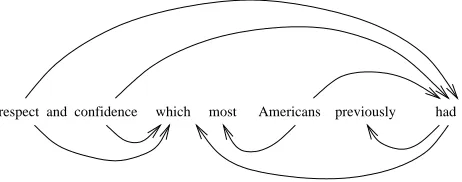
It should be recalled in judging these figures that they are only a first attempt at recovering these long-range dependencies, which most other wide-coverage parsers make no attempt to recover at all. To get an idea of just how demanding this task is, it is worth looking at an example of object relativiza-tion that the parser gets correct. Figure 2 gives part of a dependency structure returned by the parser for a sentence from section 00 (with the relations omit-ted).11 Notice that both respect and confidence are
objects of had. The relevant dependency quadruples found by the parser are the following:
11
The full sentence is The events of April through June
dam-aged the respect and confidence which most Americans previ-ously had for the leaders of China.
[image:7.612.314.545.312.403.2]respect and confidence which most Americans previously had
Figure 2: A dependency structure recovered by the parser from unseen data
(13) ,which - NPX
NPX,1 S dcl2
NPX -2-had. ,which
- NPX
NPX,1 S dcl2
NPX
-1-confidence. ,which
- NPX
NPX,1 S dcl2
NPX
-1-respect. ,had
- Sdclhad
NP1B NP2
-2-confidence. ,had
- Sdclhad
NP1B NP2
-2-respect. 7 Conclusions and Further Work
This paper has shown that accurate, efficient wide-coverage parsing is possible with CCG. Along with Hockenmaier and Steedman (2002b), this is the first CCG parsing work that we are aware of in which almost 98% of unseen sentences from the CCGbank can be parsed.
dependen-cies is necessary for any parser that aims to port wide-coverage semantic analysis—say to sup-port question-answering in any domain in which the difference between questions like Which company
did Marks sue? and Which company sued Marks?
matters. An advantage of our approach is that the recovery of long-range dependencies is fully inte-grated with the grammar and parser, rather than be-ing relegated to a post-processbe-ing phase.
Because of the extreme naivety of the statistical model, these results represent no more than a first attempt at combining wide-coverage CCG parsing with recovery of deep dependencies. However, we believe that the results are promising.
In future work we will present an evaluation which teases out the differences in extracted and in-situ arguments. For the purposes of the statistical modelling, we are also considering building alterna-tive structures that include the long-range dependen-cies, but which can be modelled using better moti-vated probability models, such as generative mod-els. This will be important for applying the parser to tasks such as language modelling, for which the pos-sibility of incremental processing of CCG appears particularly attractive.
Acknowledgements
Thanks to Miles Osborne and the ACL-02 refer-ees for comments. Various parts of the research were funded by EPSRC grants GR/M96889 and GR/R02450 and EU (FET) grant MAGICSTER.
References
Steven Abney. 1997. Stochastic attribute-value gram-mars. Computational Linguistics, 23(4):597–618.
Srinivas Bangalore and Aravind Joshi. 1999. Supertag-ging: An approach to almost parsing. Computational Linguistics, 25(2):237–265.
John Carroll, Ted Briscoe, and Antonio Sanfilippo. 1998. Parser evaluation: a survey and a new proposal. In Proceedings of the 1st LREC Conference, pages 447– 454, Granada, Spain.
Eugene Charniak. 2000. A maximum-entropy-inspired parser. In Proceedings of the 1st Meeting of the NAACL, pages 132–139, Seattle, WA.
David Chiang. 2000. Statistical parsing with an automatically-extracted Tree Adjoining Grammar. In
Proceedings of the 38th Meeting of the ACL, pages 456–463, Hong Kong.
Stephen Clark and Julia Hockenmaier. 2002. Evaluating a wide-coverage CCG parser. In Proceedings of the LREC Beyond PARSEVAL workshop (to appear), Las Palmas, Spain.
Stephen Clark. 2002. A supertagger for Combinatory Categorial Grammar. In Proceedings of the 6th Inter-national Workshop on Tree Adjoining Grammars and Related Frameworks (to appear), Venice, Italy.
Michael Collins. 1996. A new statistical parser based on bigram lexical dependencies. In Proceedings of the 34th Meeting of the ACL, pages 184–191, Santa Cruz, CA.
Michael Collins. 1999. Head-Driven Statistical Models for Natural Language Parsing. Ph.D. thesis, Univer-sity of Pennsylvania.
Jason Eisner. 1996a. Efficient normal-form parsing for Combinatory Categorial Grammar. In Proceedings of the 34th Meeting of the ACL, pages 79–86, Santa Cruz, CA.
Jason Eisner. 1996b. Three new probabilistic models for dependency parsing: An exploration. In Proceed-ings of the 16th COLING Conference, pages 340–345, Copenhagen, Denmark.
Julia Hockenmaier and Mark Steedman. 2002a. Acquir-ing compact lexicalized grammars from a cleaner tree-bank. In Proceedings of the Third LREC Conference (to appear), Las Palmas, Spain.
Julia Hockenmaier and Mark Steedman. 2002b. Gener-ative models for statistical parsing with Combinatory Categorial Grammar. In Proceedings of the 40th Meet-ing of the ACL (to appear), Philadelphia, PA.
Mark Johnson, Stuart Geman, Stephen Canon, Zhiyi Chi, and Stefan Riezler. 1999. Estimators for stochastic ‘unification-based’ grammars. In Proceedings of the 37th Meeting of the ACL, pages 535–541, University of Maryland, MD.
Nobo Komagata. 1997. Efficient parsing for CCGs with generalized type-raised categories. In Proceedings of the 5th International Workshop on Parsing Technolo-gies, pages 135–146, Boston, MA.
Dekang Lin. 1995. A dependency-based method for evaluating broad-coverage parsers. In Proceedings of IJCAI-95, pages 1420–1425, Montreal, Canada.
Adwait Ratnaparkhi. 1996. A maximum entropy part-of-speech tagger. In Proceedings of the EMNLP Con-ference, pages 133–142, Philadelphia, PA.