Influence of Rolling Routes on Press Formability
of a Rolled AZ31 Mg Alloy Sheet
Yasumasa Chino
1;*, Kensuke Sassa
1, Akira Kamiya
1and Mamoru Mabuchi
2 1Materials Research Institute for Sustainable Development, National Institute of Advanced Industrial Science and Technology, Nagoya 463-8560, Japan
2Department of Energy Science and Technology, Graduate School of Energy Science, Kyoto University, Kyoto 606-8501, Japan
Microstructure, tensile properties and press formability of AZ31 Mg alloy sheets processed by unidirectional rolling, reverse rolling and cross rolling were investigated. The intensity in (0002) plane texture for the reverse-rolled and the cross-rolled specimens was lower than that for the unidirectional-rolled specimen. In addition, the Erichsen values of the formers were larger than those of the latter. The superior press formability for the formers could not be explained from the viewpoint of the elongation to failure,n-value, averager-value and planar anisotropy of ther-value, but it was related to a reduction in directional dependence of the thickness-direction strain and width-direction strain normalized by the tensile-direction strain ("t="Land"w="L). Therefore, it is suggested that the minor texture formation due to reverse rolling and cross rolling gives rise to the reduction in anisotropy of strain, resulting in the superior press formability for the reverse-rolled and cross-rolled specimens. [doi:10.2320/matertrans.47.2555]
(Received June 8, 2006; Accepted August 21, 2006; Published October 15, 2006)
Keywords: magnesium alloys, rolling, mechanical properties, deformation and fracture, press formability, texture
1. Introduction
Magnesium alloys are currently the lightest alloys used as structural metallic alloys, and Mg products have been applied for structural uses such as automobile parts.1) For their greater applicability, it is required to advance rolling technologies for mass production of high performance Mg alloy sheets. Critical requirements for the Mg sheets are not only high strength, but also high press formability. It is known that grain refinement gives rise to both high strength and high ductility.2,3)However, rolled Mg alloys often exhibit
poor press formability,4,5) in spite of fine-grained
micro-structure. Because the critical resolved shear stresses for non-basal slips are much higher than that for a non-basal slip near room temperature,6) formability of Mg alloys strongly
depends on a texture. For example, when a rolled Mg alloy sheet shows a strong basal texture,7,8) the rolled Mg alloy
sheets exhibit the low press formability.9)
Mukaiet al.10)showed that ductility of AZ31 Mg alloy is increased due to a control of texture. Yukutakeet al.11)and Iwanagaet al.12)revealed that the press formability of AZ31 alloy is strongly affected by a texture variation. Recently, it was reported that the (0002) texture intensity of a rolled AZ31 Mg alloy is reduced by a differential speed roll-ing,13–15) resulting in improvement of press formability.13)
These studies suggest that the press formability of rolled Mg alloys can be improved by innovation of rolling process. Furthermore, Singh et al.16)showed that the (0002) texture
intensity of the rolled pure Mg is reduced by cross rolling. In the previous paper,17) we revealed that a cross-rolled
AZ31 Mg alloy sheet exhibits better press formability, compared with a unidirectional-rolled sheet and that the improved press formability is attributed to a reduction in (0002) texture intensity. However, mechanisms of the improvement of press formability are still unknown.
In the present paper, texture measurement, tensile tests and
Erichsen tests are conducted for AZ31 Mg alloy sheets processed by unidirectional rolling, reverse rolling or cross rolling to estimate influence of rolling routes on the press formability.
2. Experimental Procedure
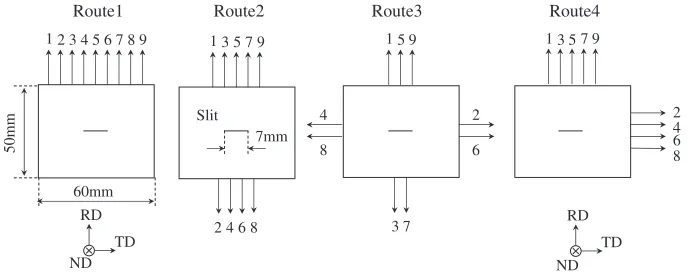
AZ31B Mg alloy blocks with 60506mm were prepared with heat treatment at 673 K for 24 h. The blocks were heated at 673 K for 30 min, and they were rolled at the rolling reduction of 18% without a lubricant. In the present investigation, four rolling routes were conducted, as shown in Fig. 1, the route 1 is unidirectional rolling, the route 2 is reverse rolling, the route 3 is cross rolling where each rolling direction changes at 90 degree clockwise and the route 4 is another cross rolling where each rolling direction changes at 90 degree alternately. These treatments were repeated nine times, and finally the sheets were rolled to 1 mm in thickness. After rolling, the rolled sheets were annealed at 673 K for 30 min.
Macroscopic flow introduced during rolling was observed by the distortion of a slit with a width of 0.3 mm and a length of 7 mm. The slit was introduced into the specimen before rolling along the transverse direction (TD), as shown in Fig. 1.
Microstructure of the rolled Mg alloy sheets was inves-tigated by optical microscopy. Also, the (0002) pole figure of the rolled Mg alloy sheets was investigated by the Schulz reflection method. The rolled specimens mechanically grounded to a thickness of 0.5 mm were used to measure the pole figure at the center through a thickness.
The circular blank with a diameter of 60 mm were machined from the rolled Mg alloy sheets. The Erichsen tests using a hemispherical punch with a diameter of 20 mm were carried out at 433–513 K to investigate press form-ability of the rolled Mg alloy sheets, and the Erichsen value, which was defined as a punch stroke at fracture initiation, was measured. The punch speed was 5 mm/min, and the blank-*Corresponding author, E-mail: [email protected]
holder force was 10 kN. The graphite grease was used as a lubricant agent.
Tensile specimens with 10 mm in gage length, 5 mm in gage width and 1 mm in gage thickness were machined from the rolled sheets. Tensile tests were carried out at 433 and 493 K, where the angle between the tensile direction and the rolling direction was 0, 45 and 90 degrees. Also, additional tensile tests were conducted at 433 and 493 K to investigate the Lankford value (r-value). By using micrometer, the thickness-direction strain and width-direction strain were measured for ther-value using the specimens deformed to a true tensile-direction strain of 9%.
3. Results
The cross sections with a slit in the specimens rolled by various routes are shown in Fig. 2, where the rolling direction (RD)-normal direction (ND) plane is observed. The inclina-tion of a slit depended on the rolling route. Namely, the inclination of a slit in the route 1 specimen largely increased with a distance from the center. However, the inclination of a slit in the other specimens was smaller than that in the route 1 specimen. Especially, the inclination of a slit in the route 2 and route 3 specimens was negligible. It is evident that the
cross rolling affects the plastic flow during rolling.
Microstructures of RD-TD plane of the rolled specimens are shown in Fig. 3. The average grain size of RD-TD plane, TD-ND plane and ND-RD plane was 15.6mmfor the route 1 specimen, 16.0mmfor the route 2 specimen, 15.0mmfor the route 3 specimen and 18.0mm for the route 4 specimen, respectively. Thus, the grain size was hardly affected by the rolling route.
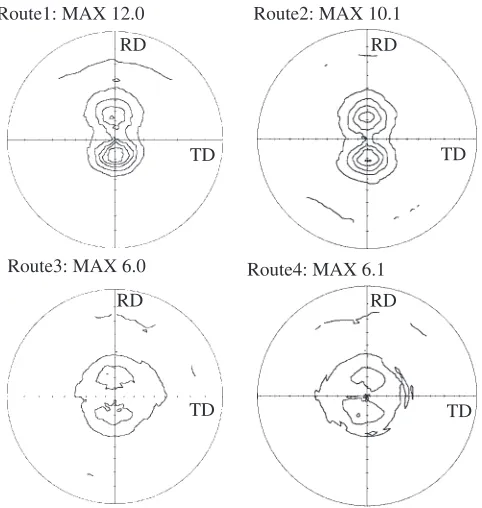
Figure 4 shows the (0002) plane texture in the rolled specimens. Splitting of the (0002) plane texture along to the rolling direction was observed in all the specimens. The double-peak texture of (0002) plane has been reported in the other studies.18,19)It is noted that the texture intensities of the route 2, route 3 and route 4 specimens were weaker than that of the route 1 specimen, and in particular, the texture intensities of the route 3 and route 4 specimens were approximately half of that of the route 1 specimen. The fact that the route 2, route 3 and route 4 specimens showed lower texture intensities than the route 1 specimen is probably related to the deference in plastic flow during rolling, as shown in Fig. 2.
The results of Erichsen tests at 433–513 K are summarized in Fig. 5. It is found from Fig. 5 that the route 2, route 3 and route 4 specimens exhibited the larger Erichsen values at all the testing temperatures than the route 1 specimen. In particular, the Erichsen values at 493 K for the route 2, route 3 and route 4 specimens were larger by a factor of 1.6 than that for the route 1 specimen. As shown in Fig. 4, the intensities in (0002) plane texture for the route 2, route 3 and route 4 specimens were lower than that for the route 1 specimen. Therefore, it is suggested that the improvement of press formability by reverse rolling and cross rolling is related to the lower intensity in (0002) plane texture.
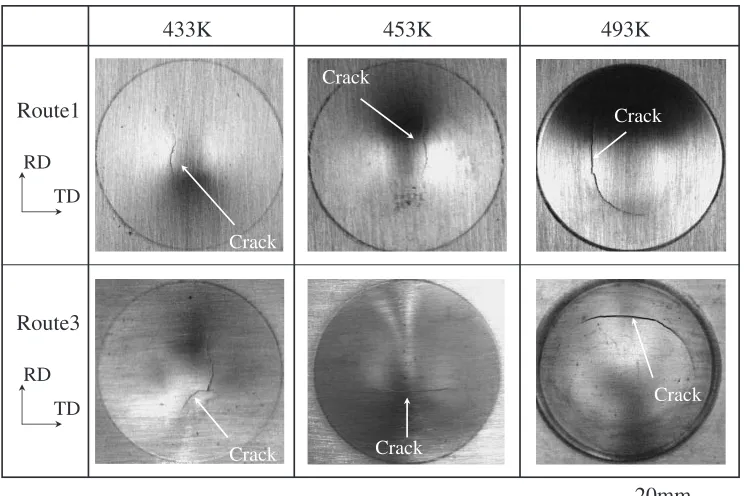
The top view of the route 1 and route 3 specimens after the Erichsen tests at 433, 453 and 493 K is shown in Fig. 6. Crack occurred parallel to the rolling direction at all the testing temperatures for the route 1 specimen, while the surface crack was not always observed parallel to the rolling direction for the route 3 specimen. This indicates that a reduction in texture intensity strongly affects an isotropic plastic flow during press forming.
The 0.2% yield stress and elongation to failure by tensile tests for the route 1 and route 3 specimens are shown in Fig. 7, where is the angle between rolling direction and tensile direction. The route 1 specimen showed the larger
Route1 Route2 Route3 Route4
RD
TD ND
1 2 3 4 5 6 7 8 9 1 3 5 7 9
2 4 6 8
1 5 9
2
6
3 7 4
8
RD
TD ND 1 3 5
2
8 7 9
4 6
60mm
50mm
Slit
7mm
Fig. 1 Schematic illustration of four rolling routes.
Route1
Route2
Route3
Route4
1mm
RD ND
TD
[image:2.595.127.472.73.210.2] [image:2.595.54.286.249.447.2]dependence of 0.2% yield stress, compared with the route 3 specimen. The large dependence of yield stress for the unidirectional-rolled Mg alloy has been reported in the other studies.11,20)The largedependence of yield stress is due to
spread of (0002) plane texture to the rolling direction.20)On
the other hand, a difference in elongation to failure between the route 1 specimen and the route 3 specimen was rather small or negligible at both testing temperatures. The same trend was found in the route 2 and route 4 specimens. It should be noted that the superior press formability for the cross-rolled and reverse-rolled specimens cannot be ex-plained from the data of elongation to failure.
4. Discussion
It is known that press formability of metal sheets is strongly affected by the strain hardening exponent (n
-40µm 40µm
40µm 40µm
Route1
Route2
Route3
Route4
Fig. 3 Microstructures of the rolled AZ31 Mg alloy processed by the various rolling routes, where the RD-TD plane is observed.
Route1: MAX 12.0
RD
TD
Route2: MAX 10.1
RD
TD
Route3: MAX 6.0
RD
TD
Route4: MAX 6.1
RD
TD
Fig. 4 The (0002) plane texture of the rolled AZ31 Mg alloys processed by the various rolling route.
Erichsen v
alue
0 4 8 12 16
Testing temperature, T/ K
420 440 460 480 500 520
Route 1 Route 2 Route 3 Route 4
[image:3.595.99.498.78.397.2] [image:3.595.50.291.436.690.2] [image:3.595.313.544.439.584.2]value)21)and the Lankford value (r-value).22–25)Hence, it is worthwhile to investigate anisotropy of then-value and the r-value for the rolled Mg specimens. Figure 8 shows the calculatedn-values by using results of Fig. 7, whereis the angle between rolling direction and tensile direction. From Fig. 8, it was difficult to find clear difference in n-value between the route 1 specimen and the route 3 specimen.
Ther-value (r), averager-value (rr) and planar anisotropy ofr-value (r) are given by22)
r¼"w="t ð1Þ
rr¼ jðr0þr90þ2r45Þ=4j ð2Þ
r¼ jðr0þr902r45Þ=2j ð3Þ
where "w is the true width-direction strain, "t is the true
thickness-direction strain, r0, r45 and r90 is the r-value in which the angle between the rolling direction and the tensile direction is 0, 45 and 90 degrees, respectively. The average
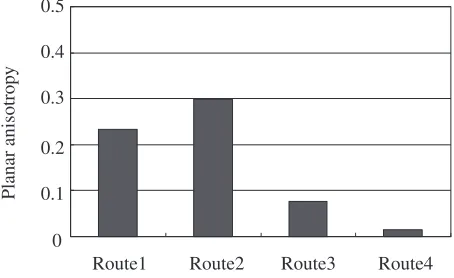
r-value at 433 K for the rolled specimens is shown in Fig. 9 and the planar anisotropy ofr-value at 433 K for the rolled specimens are shown in Fig. 10, respectively. It is noted that there is minor difference in the averager-value in the rolled specimens, and the planar anisotropy of the route 2 specimen is almost the same value with that of the route 1 specimen. It is reported22,23) that texture development of a rolled Al
alloy is suppressed by shear rolling such as single-roll drive rolling, and a shear-rolled Al alloy specimen shows a larger average and a lower planar anisotropy ofr-value, compared with a unidirectional-rolled Al alloy specimen, resulting in the high press formability. Also, it is shown that a steel sheet with a low planar anisotropy of r-value exhibits a small earing during deep drowning.25) In the present research, however, the differences in the averager-value and the planer anisotropy were almost negligible in the Mg alloy sheets processed by the various rolling route. Thus, the press formability in the rolled Mg alloy sheets cannot be explained
Route1
Route3
Crack
Crack
Crack
Crack
Crack Crack
RD
TD RD
TD
433K
453K
493K
20mm
Fig. 6 The top view of the route 1 and route 3 specimens after the Erichsen tests at 433, 453 and 493 K.
0° 15° 30° 45° 60° 75° 90° Angle,
60 70 80 90 100 110 (a)
0.2% yield stress,
/
MP
a
σ
15° 30° 45° 60° 75° 90° Angle,
60 (b)
90
80
70
Elongation (%)
0° Route1 (433 K) Route3 (433 K)
Route1 (493 K) Route3 (493 K)
θ θ
[image:4.595.112.484.71.319.2] [image:4.595.129.467.364.518.2]from the viewpoint of the average r-value and the planar anisotropy ofr-value, contrast to the Al and steel sheets.
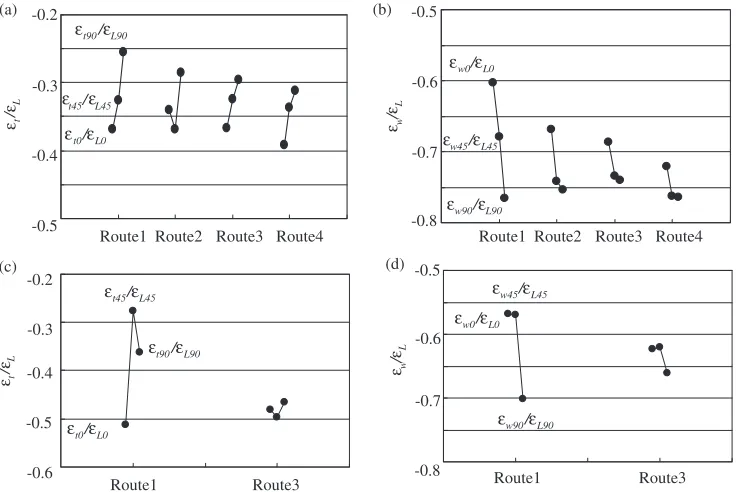
Figures 11(a)&(b) shows the directional dependence of the thickness-direction strain normalized by the tensile-direction strain ("t="L) and width-direction strain normalized by the
tensile-direction strain ("w="L) at 433 K for the rolled
specimens, where "t0="L0, "t45="L45 and "t90="L90 is the thickness-direction strain normalized by the tensile-direction strain where the angle between the rolling direction and the tensile direction is 0, 45 and 90 deg, and"w0="L0,"w45="L45 and"w90="L90is the width-direction strain normalized by the tensile-direction strain where the angle between the rolling direction and the tensile direction is 0, 45 and 90 deg, respectively. It is of interest to note that the direction dependence in "t="L and"w="L for the route 1 specimen is
larger than those for the other specimens. When a sheet with the large anisotropy of strain is deformed in biaxial tensile stress field, large local deformation in three dimensions is necessary for continuity of strain. However, it is difficult to obtain large local deformation in three dimensions for Mg because there is large difference in critical shear stress between the basal plane slip and the non-basal plane slip. Therefore, the large anisotropy in "t and"w is likely to be
responsible for the poor press formability for the route 1 specimen. Inspection of Figs. 11(a)&(b) reveals the
aniso-tropy in"w="Lfor the route 1 specimen is significantly larger
than those for the other specimens, in particular,"w="L at 0
[image:5.595.55.284.72.245.2]degree for the route 1 specimen is the lowest. As shown in Fig. 6, crack occurred parallel to the rolling direction for the route 1 specimen. This fracture mode is probably attributed to the low width-direction strain at 0 degree for the route 1 specimen.
Figures 11(c)&(d) shows the directional dependence of the thickness-direction strain normalized by the tensile-direction strain ("t="L) and the width-direction strain normalized by the
tensile-direction strain ("w="L) at 493 K for the route 1 and
route 3 specimens. The variation in"t="Land"w="Lat 493 K
is smaller than that in "t="L and"w="Lat 433 K. As shown
in Fig. 5, the Erichsen value at 493 K for the route 3 specimen was larger by a factor of 1.6 than that for the route 1 specimen. This suggests that the variation in"t="Land"w="L
strongly affects the press formability of the rolled Mg sheets. The reason for low anisotropy in "t="L and"t="L of the
reverse-rolled and cross-rolled specimens is an open research question, but should be related to low texture intensity of the (0002) plane as shown in Fig. 4, which should promote homogeneous deformation of the rolled Mg alloys. Further research is needed for quantitative understanding of the relationship between the texture and the thickness-direction and the width-direction strain. Anyway, it is conclusively demonstrated that reverse rolling and cross rolling is effective to improve the press formability of the rolled Mg alloy sheets because anisotropy in"t="Land"t="Lis reduced
due to the minor texture formation.
5. Conclusions
Unidirectional rolling, reverse rolling and cross rolling were carried out on AZ31 Mg alloy, and the microstructure, press formability and mechanical properties of the rolled Mg alloy sheets were investigated at 433–513 K. The results are concluded as follows.
(1) The intensities in (0002) plane texture for the specimens processed by reverse rolling and cross rolling were lower than that for the specimen processed by the unidirectional rolling. This is related to a deference of plastic flow during rolling.
(2) As a result of the Erichsen tests, the specimens processed by reverse and cross rolling exhibited higher
30° 60° 90° Angle, θ
0°
Route1 (433 K) Route3 (433 K)
Route1 (493 K) Route3 (493 K)
n
-v
alue
0 0.1 0.2 0.3
Fig. 8 The variation inn-value at 433 and 493 K as a function of the angle between the rolling direction and the tensile direction for the route 1 and route 3 specimens, whereis the angle between rolling direction and tensile direction.
Route1 Route2 Route3 Route4
A
v
erage
r
- v
alue
0 0.5 1.5 2.0 2.5
1.0
Fig. 9 The average r-value at 433 K for the rolled AZ31 Mg alloy processed by the various rolling routes.
Planar anisotrop
y
0.1 0.2 0.5
Route1 Route2 Route3 Route4
0 0.4
[image:5.595.314.541.76.215.2]0.3
[image:5.595.56.285.313.438.2]press formability than the specimen processed by the unidirectional rolling.
(3) Differences in elongation to failure and strain hardening exponent between the unidirectional-rolled and cross-rolled specimens were negligible. In addition, differ-ences in average r-value and planer anisotropy of r -value between them were small. Therefore, the press formability in the rolled Mg alloy sheets could not be explained from the viewpoint of the elongation to failure, strain hardening exponent, averager-value and planar anisotropy of ther-value.
(4) The anisotropy in thickness-direction strain normalized by tensile-direction strain and width-direction strain normalized by tensile-direction strain was large for the unidirectional-rolled specimen. This is likely to be responsible for the poor press formability for the unidirectional-rolled specimen.
(5) Therefore, it is suggested that the minor texture formation for the reverse-rolled and cross-rolled speci-mens gives rise to a reduction in anisotropy of strain, resulting in the superior press formability.
REFERENCES
1) E. Aghion and B. Bronfin: Mater. Sci. Forum350–351(2000) 19–30. 2) K. Kubota, M. Mabuchi and K. Higashi: J. Mater. Sci.34(1999) 2255–
2262.
3) A. Yamashita, Z. Horita and T. G. Langdon: Mater. Sci. Eng. A300
(2001) 142–147.
4) H. Nishimura, O. Hasegawa, N. Koiso and K. Matsumoto: J. Jpn. Inst. Light Metals53(2003) 302–308.
5) E. Yukutake, J. Kaneko and M. Sugamata: J. JSTP44(2003) 276–280.
6) J. C. McDonald and P. W. Bakarian: Trans. Met. Soc. AIME 233
(1965) 95–103.
7) T. Murakami: J. Jpn. Inst. Light Metals52(2002) 536–540. 8) G. S. Rao and Y. V. R. K. Prasad: Metall. Trans. A13(1982) 2219–
2226.
9) J. Kaneko, M. Sugamata, M. Numa, Y. Nishikawa and H. Takada: J. Jpn. Inst. Metals64(2000) 141–147.
10) T. Mukai, M. Yamanoi, H. Watanabe and K. Higashi: Scripta Mater.45
(2001) 89–94.
11) E. Yukutake, J. Kaneko and M. Sugamata: Mater. Trans.44(2003) 452–457.
12) K. Iwanaga, H. Tashiro, H. Okamoto and K. Shimizu: J. Mater. Process Tech.155–156(2004) 1313–1316.
13) Y. Chino, M. Mabuchi, R. Kishihara, H. Hosokawa, Y. Yamada, C. E. Wen, K. Shimojima and H. Iwasaki: Mater. Trans.43(2002) 2554–2560.
14) H. Watanabe, T. Mukai and K. Ishikawa: J. Mater. Sci.39(2004) 1477– 1480.
15) S. H. Kim, B. S. You, C. D. Yim and Y. M. Seo: Mater. Lett.59(2005) 3876–3880.
16) A. K. Singh and R. A. Schwarzer: Z. Metallkd.96(2005) 345–351. 17) Y. Chino, J. S. Lee, K. Sassa, A. Kamiya and M. Mabuchi: Mater. Lett.
60(2006) 173–176.
18) J. A. del Valle, M. T. Pe´rez-Prado, J. R. Bartolome´, F. Pen˜alba and O. A. Ruano: Mater. Trans.44(2003) 2625–2630.
19) A. Styczynski, Ch. Hartig, J. Bohlen and D. Letzig: Scripta Mater.50
(2004) 943–947.
20) J. Koike and R. Ohyama: Acta Mater.53(2005) 1963–1972. 21) G. E. Dieter:Mechanical metallurgy(SI Metric Edition),
(McGraw-Hill Book Company, Singapore, 1988) pp. 275–324.
22) J. Hu, K. Ikeda and T. Murakami: J. Jpn. Inst. Metals60(1996) 1130– 1135.
23) T. Sakai, S. Hamada and Y. Saito: Scripta Mater.44(2001) 2569–2573. 24) M. Y. Huh, S. Y. Cho and O. Engler: Mater. Sci. Eng. A315(2001) 35–
46.
25) K. Okuda, C. Fujinaga, A. Tosaka, O. Furukimi and H. Kuguminato: Tetsu-to-Hagane86(2000) 32–37.
Route1 Route2 Route3 Route4 -0.8
-0.5
w90/ L90 w45/ L45
w0/ L0 -0.6
w
/L
-0.7
Route1 Route2 Route3 Route4 -0.2
-0.3
-0.4
-0.5
t
/
εε εε
εε
εε
L
t90 / L90
t45/ L45
t0/ L0
(a) (b)
Route1 Route3
-0.8 -0.5
w90/ L90 w45/ L45
w0/ L0 -0.6
w
/L
-0.7
Route1 Route3
-0.2
-0.3
-0.4
-0.6
t
/L
t90 / L90 t45/ L45
t0/ L0 -0.5
(c) (d)
ε ε
ε ε
ε ε
ε ε
ε ε ε ε
ε ε ε
ε ε ε
ε ε
ε ε
[image:6.595.116.484.73.319.2]ε ε