Domain-Specific Knowledge Acquisition from Text
D a n M o l d o v a n , R o x a n a G i r j u a n d V a s i l e R u s D e p a r t m e n t of C o m p u t e r Science a n d E n g i n e e r i n g
U n i v e r s i t y of S o u t h e r n M e t h o d i s t U n i v e r s i t y Dallas, Texas, 75275-0122
{ moldovan, roxana, rus} @seas.smu.edu
A b s t r a c t
In many knowledge intensive applications, it is nec- essary to have extensive domain-specific knowledge in addition to general-purpose knowledge bases. This paper presents a methodology for discovering domain-specific concepts and relationships in an at- tempt to extend WordNet. The method was tested on five seed concepts selected from the financial
domain:
interest rate, stock market, inflation, eco-
nomic growth, and employment.
1 D e s i d e r a t a f o r A u t o m a t e d K n o w l e d g e A c q u i s i t i o n T h e n e e d for k n o w l e d g e
The knowledge is infinite and no matter how large a knowledge base is, it is not possible to store all the concepts and procedures for all domains. Even if that were possible, the knowledge is generative and there are no guarantees that a system will have the latest information all the time. And yet, if we are to build common-sense knowledge processing systems in the future, it is necessary to have general-purpose and domain-specific knowledge that is up to date. Our inability to build large knowledge bases without much effort has impeded many ANLP developments. The most successful current Information Extrac- tion systems rely on hand coded linguistic rules rep- resenting lexico-syntactic patterns capable of match- ing natural language expressions of events. Since the rules are hand-coded it is difficult to port sys- tems across domains. Question answering, inference, summarization, and other applications can benefit from large linguistic knowledge bases.
T h e basic i d e a
A possible solution to the problem of rapid develop- ment of flexible knowledge bases is to design an au- tomatic knowledge acquisition system that extracts knowledge from texts for the purpose of merging it with a core ontological knowledge base. The attempt to create a knowledge base manually is time con- suming and error prone, even for small application domains, and we believe that automatic knowledge acquisition and classification is the only viable solu- tion to large-scale, knowledge intensive applications.
This paper presents an interactive method that ac- quires new concepts and connections associated with
user-selected
seed
concepts, and adds them to theWordNet linguistic knowledge structure (Fellbaum 1998). The sources of the new knowledge are texts acquired from the Internet or other corpora. At the present time, our system works in a semi-automatic mode, in the sense that it acquires concepts and re- lations automatically, but their validation is done by the user.
We believe that domain knowledge should not be acquired in a vacuum; it should expand an existent ontology with a skeletal structure built on consistent and acceptable principles. The method presented in this paper is applicable to any Machine Readable Dictionary. However, we chose WordNet because it is freely available and widely used.
R e l a t e d w o r k
This work was inspired in part by Marti Hearst's paper (Hearst 1998) where she discovers manually lexico-syntactic patterns for the HYPERNYMY rela- tion in WordNet.
Much of the work in pattern extraction from texts was done for improving the performance of Infor- mation Extraction systems. Research in this area was done by (Kim and Moldovan 1995) (Riloff 1996),
(Soderland 1997) and others.
The MindNet (Richardson 1998) project at Mi- crosoft is an attempt to transform the Longman Dic- tionary of Contemporary English (LDOCE) into a form of knowledge base for text processing.
Woods studied knowledge representation and clas- sification for long time (Woods 1991), and more re- cently is trying to automate the construction of tax- onomies by extracting concepts directly from texts (Woods 1997).
2 K A T S y s t e m
2.1 D i s c o v e r n e w c o n c e p t s
S e l e c t s e e d c o n c e p t s . New domain knowledge can be acquired around some seed concepts t h a t a user considers i m p o r t a n t . In this paper we focus on the
financial domain, and use:
interest rate, stock mar-
ket, inflation, economic growth,
andemployment as
seed concepts. T h e knowledge we seek to acquire re- lates to one or more of these concepts, and consists of new concepts not defined in WordNet and new re- lations t h a t link these concepts with other concepts, some of which are in WordNet.
For example, from the sentence:
When the US
economy enters a boom, mortgage interest rates rise,
the system discovers: (1) the new concept
mortgage
interest rate
not defined in WordNet but related to the seed conceptinterest rate,
and (2) the s t a t e of theUS economy
and the value ofmortgage interest
rate are
in a DIRECT RELATIONSHIP.In WordNet, a concept is represented as a synset t h a t contains words sharing the same meaning. In our experiments, we extend the seed words to their
corresponding synset. For example,
stock market
iss y n o n y m with
stock exchange and securities market,
and we aim to learn concepts related to all these
terms, not only to
stock market.
E x t r a c t s e n t e n c e s . Queries are formed with each seed concept to e x t r a c t documents from the I n t e r n e t and other possible sources. T h e documents retrieved are further processed such t h a t only the sentences t h a t contain the seed concepts are retained. This way, an arbitrarily large corpus .4 is formed of sen- tences containing the seed concepts. We limit the size of this corpus to 1000 sentences p e r seed con- cept.
P a r s e s e n t e n c e s . Each sentence in this corpus is first part-of-speech (POS) tagged then parsed. We use Brill's P O S tagger and our own parser. T h e out- put of the P O S tagger for the example above is:
When/WRB the/DW
U.~./NNPeconomy/NN en-
ters/VBZ a/DT boom/NN ,/, mortgage/NN inter-
est_rates/NNS rise/vBP ./.
T h e syntactic parser output is:
TOP (S (SBAR (WHADVP (WRB When)) (S (NP (DT
the)
(NNPU.S.)
(NNeconomy))
(VP (VBZenters)
(NP(DT a) (NN
boom) (,
,))))) (NP (NNmortgage)
(NNSinterest_rates))
(VP (VI3Prise)))
E x t r a c t n e w c o n c e p t s . In this p a p e r only noun
concepts are considered. Since, most likely, one-
word nouns are already defined in WordNet, the fo-
cus here is on
compound nouns and nouns with mod-
ifiers
t h a t have meaning but are not in WordNet. T h e new concepts directly related to the seeds are e x t r a c t e d from the noun phrases (NPs) t h a t containthe seeds. In the e x a m p l e above, we see t h a t the
seed belongs to the NP:
mortgage interest rate.
This way, a list of N P s containing the seeds is assembled a u t o m a t i c a l l y from the parsed texts. Ev- ery such NP is considered a potential new concept. This is only the "raw material" from which actual concepts are discovered.
In some noun phrases the seed is the head noun,
i.e.
[word, word,..see~,
whereword
can be a noun oran adjective. For example,
[interest rate]
is in Word-Net, but
[short term nominal interest rate]
is not inWordNet. Most of the new concepts related to a seed are generated this way. In other cases the seed
is not the head noun i.e.
[word, word,..seed, word,
wor~.
For example[interest rate peg],
or[interna-
tional interest rate differentia~.
T h e following procedures are used to discover con- cepts, and are applicable in b o t h cases:
Procedure 1.1.
WordNet reduction.
Search NP forwords collocations t h a t are defined in WordNet as
concepts. Thus
[long term interest rate]
becomes[long_term interest_rate], [prime interest rate] be-
comes
[prime_interest_rate],
as all h y p h e n a t e d con- cepts are in WordNet.Procedure 1.2.
Dictionary reduction.
For eachNP, search further in other on-line dictionaries for more compound concepts, and if found, hyphen- ate the words. M a n y domain-specific dictionaries
are available on-line. For example,
[mortgage inter-
est_rate]
becomes[mortgage_interest_rate],
since it isdefined in the on-line dictionary
OneLook Dictionar-
ies
( h t t p : / / w w w . o n e l o o k . c o m ) .Procedure 1.3.
User validation.
Since currently welack a formal definition of a concept, it is not possible to completely a u t o m a t e the discovery of concepts. T h e h u m a n inspects the list of noun phrases and decides whether to accept or decline each concept.
2.2 D i s c o v e r l e x l c o - s y n t a c t i c p a t t e r n s Texts represent a rich source of information from which in addition to concepts we can also discover relations between concepts. We are interested in dis- covering semantic relationships t h a t link the con- cepts extracted above with other concepts, some of
which m a y be in WordNet. T h e approach is to
Pick a s e m a n t i c r e l a t i o n R. These can be Word- Net semantic relations or any other relations defined by the user. So far, we have experimented with the WordNet HYPERNYMY (or so-called IS-A) relation, and three other relations. By inspecting a few sen-
tences containing interest rate one can notice that
INFLUENCE is a frequently used relation. The two
other relations are CAUSE and
EQUIVALENT.
Pick a p a i r o f c o n c e p t s Ci, C# a m o n g w h i c h R holds. These may be any noun concepts. In the context of finance domain, some examples of con- cepts linked by the INFLUENCE relation are:
interest rate INFLUENCES earnings, or credit worthiness INFLUENCES interest rate.
E x t r a c t l e x i c o - s y n t a c t i c p a t t e r n s Ci :P Cj. Search any corpus B, different from ,4 for all in- stances where Ci and Cj occur in the same sentence. Extract the lexico-syntactic patterns that link the
two concepts. For example~ from the sentence : The
graph indicates the impact on earnings from several different interest rate scenarios, the generally appli- cable pattern extracted is:
impact on NP2 from NP1
This pattern corresponds unambiguously to the re- lation R we started with, namely INFLUENCE. Thus we conclude: INFLUENCE(NPI, NP2).
Another example is: As the credit worthiness de-
creases, the interest rate increases. From this sen- tence we extract another lexical pattern that ex- presses the INFLUENCE relation:
[as NP1 vbl, NP2 vb$] & [vbl and vb2 are antonyms] This pattern is rather complex since it contains not only the lexical part but also the verb condition that needs to be satisfied.
This procedure repeats for all relations R.
2.3 Discover n e w r e l a t i o n s h i p s b e t w e e n c o n c e p t s
Let us denote with Cs the seed-related concepts
found with Procedures 1.1 through 1.3. We search now corpus ,4 for the occurrence of patterns ~ dis- covered above such that one of their two concepts is a concept Cs.
Search corpus ,4 for a p a t t e r n ~. Using a lexico- syntactic pattern P, one at a time, search corpus ,4 for its occurrence. If found, search further whether
or not one of the NPs is a seed-related concept Cs.
I d e n t i f y n e w c o n c e p t s Cn. Part of the pattern 7 ~
are two noun phrases, one of which is Cs. The head
noun from the other noun phrase is a concept Cn we
are looking for. This may be a WordNet concept, and if it is not it will be added to the list of concepts discovered.
F o r m r e l a t i o n R(Cs, Cn). Since each pattern 7 ~ is a linguistic expression of its corresponding seman-
tic relation R, we conclude R(Cs,Cn) (this is in-
terpreted "C8 is relation R Cn)'). These steps are repeated for all patterns.
User intervention to accept or reject relationships is necessary mainly due to our system inability of handling coreference resolution and other complex linguistic phenomena.
2.4 K n o w l e d g e classification a n d
i n t e g r a t i o n
Next, a taxonomy needs to be created that is con- sistent with WordNet. In addition to creating a taxonomy, this step is also useful for validating the concepts acquired above. The classification is based
on the subsumption principle (Schmolze and Lipkis
1983), (Woods 1991).
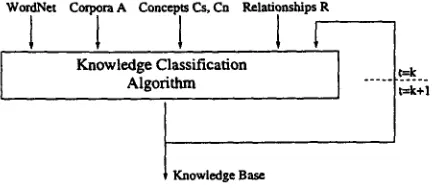
This algorithm provides the overall steps for the classification of concepts within the context of Word- Net. Figure 1 shows the inputs of the Classification Algorithm and suggests that the classification is an iterative process. In addition to WordNet, the in- puts consist of the corpus ,4, the sets of concepts Cs and Cn, and the relationships 7~. Let's denote with C = Cs U Cn the union of the seed related concepts with the new concepts. All these concepts need to be classified.
Wo,aN=l C°~Tr~ A Co.=i= ~. C°, V.=~tio.~=a~[ I R [ I
t
Knowledge Classification
¢--k
Algorithm
'1 ... ~i;]
Figure 1:
The knowledge classification diagram
Step 1. From the set of relationships 7"~ discovered in Part 3, pick all the HYPERNYMY relations. From the way these relations were developed, there are two possibilities:
(1)
A HYPERNYMY relation links a WordNet conceptCw with another concept from the set C denoted
with CAw , or
(2)
A HYPERNYMY relation links a concept Cs witha concept Cn.
Concepts C~w are immediately linked to Word- Net and added to the knowledge base. The concepts from case (2) are also added to the knowledge base but they form at this point only some isolated islands since are not yet linked to the rest of the knowledge base.
[image:3.612.353.570.422.516.2][Asian_country interest_rate ]
IIS-A TIS-A
[Japan discount_rate ]a)
[country interest_rate ]
[Japan discount_rate ] [Germany prime interest_rate ]
[image:4.612.283.522.96.172.2]b)
Figure 2:
Relative classification of two conceptsconcepts in the set Cn with any WordNet concepts. Altough concepts C , are not seed-based concepts, they are related to at least one Cs concept via a re- lationship (as found in Task 3). Here we seek to find HYPERNYMY links between them and WordNet con- cepts. If such C,~ concepts exist, denote them with C~w. The union Chw = C~w LJ C2w represents all concepts from the set C that are linked to WordNet without any further effort. We focus now on the rest of concepts, Cc -- C N Chw, that are not yet linked to any WordNet concepts.
Step 3. Classify all concepts in set Ce using Pro- cedures 4.1 through 4.5 below.
Step 4. Repeat Step 3 for all the concepts in set Cc several times till no more changes occur. This reclassification is necessary since the insertion of a concept into the knowledge base may perturb the ordering of other surrounding concepts in the hier- archy.
Step 5. Add the rest of relationships 7~ other than the HYPERNYMY to the new knowledge base. The HYPERNYMY relations have already been used in the Classification Algorithm, but the other rela-
tions, i.e. I N F L U E N C E , CAUSE and EQUIVALENT need
to be added to the knowledge base.
C o n c e p t c l a s s i f i c a t i o n p r o c e d u r e s
Procedure 4.1. Classify a concept of the form [word,
head] with respect to concept [head].
It is assumed here that the [head] concept exists in WordNet simply because in many instances the "head" is the "seed" concept, and because frequently the head is a single word common noun usually de- fined in WordNet. In this procedure we consider only those head nouns that do not have any hyponyms since the other case when the head has other con- cepts under it is more complex and is treated by Procedure 4.4. Here "word" is a noun or an adjec- tive.
The classification is based on the simple idea that a compound concept [word, head] is onto- logically subsumed by concept [head]. For exam-
ple, mortgage_interest_rate is a kind of interest_rate,
thus linked by a relation nYPERNYMY(interest_rate, mortgage_interest_rate).
Procedure 4.2. Classify a concept [wordx, headx]
with respect to another concept [words, head2].
For a relative classification of two such concepts, the ontological relations between headz and head2 and between word1 and words, if exist, are extended to the two concepts. We distinguish here three possi- bilities:
1. heady subsumes heads and word1 subsumes word2. In this case [wordz, headl] subsumes [word2, heads]. The subsumption may not al- ways be a direct connection; sometimes it may consist of a chain of subsumption relations since subsumption is (usually) a transitive relation (Woods 1991). An example is shown in Fig-
ure 2a; in WordNet, Asian_country subsumes
Japan and interest_rate subsumes discount_rate. A particular case of this is when head1 is iden- tical with head2.
2. Another case is when there is no direct sub- sumption relation in WordNet between word1 and words, a n d / o r head1 and heads, but there are a common subsuming concepts, for each
pair. When such concepts are found, pick
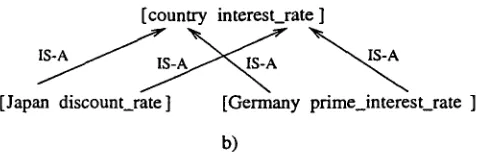
the most specific common subsumer (MSCS) concepts of word1 and words, and of head1 and head2, respectively. Then form a concept [MSCS(wordz, words), MSCS(headl, head2)] and place [word1 headz] and [words heads] un- der it. This is exemplified in Figure 2b. In
WordNet, country Subsumes Japan and Ger-
many, and interest_rate subsumes discount_rate and prime_interest_rate.
3. In all other cases, no subsumption relation is es- tablished between the two concepts. For exam-
ple, we cannot say whether Asian_country dis-
count_rate is more or less abstract then Japan interest_rate.
Procedure 4.3. Classify concept [word1 words head].
Several poss!bilities exist:
1. When there is already a concept [words head] in the knowledge base under the [head], then place [wordl words head] under concept [words head].
2. When there is already a concept [wordz head] in the knowledge base under the [head], then place [wordl word2 head] under concept [wordl head].
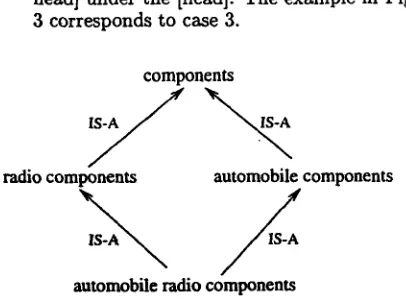
4. When neither [wordl head] nor [words head] are in the knowledge base, then place [wordl word~ head] under the [head]. T h e example in Figure 3 corresponds to case 3.
components
;y/
radio components automobile components
/
[image:5.612.104.307.125.277.2]automobile radio components
Figure 3:
Classification of a c o m p o u n d concept with r e s p e c t t o its ~ c o n c e p t sSince we do not deal here with the sentence seman- tics, it is not possible to completely determine the meaning of [word1 word2 head], as it may be either [((word1 word2) head)] or [(word1 (words head))] of- ten depending on the sentence context.
In the example of Figure 3 there is only one mean-
ing, i.e.
[(automobile radio) components].
However,in the case of
~erformance skiing equipment]
thereare two valid interpretations, namely
[(performance
skiing) equipment] and ~erformance (skiing equip-
ment)].Procedure 4.4
Classify a concept [word1, head] with
respect
to a concept
h/erarchy underthe ~aead].
T h e task here is to identify the most specific sub- sumer (MSS) from all the concepts under the head that subsumes [wordx, head]. By default, [wordl head] is placed under [head], however, since it may be more specific than other hyponyms of [head], a more complex classification analysis needs to be im- plemented.
In the previous work on knowledge classification it was assumed t h a t the concepts were accompanied by rolesets and values (Schmolze and Lipkis 1983), (Woods 1991), and others. Knowledge classifiers are part of almost any knowledge representation system. However, the problem we face here is more diffi- cult. While in build-by-hand knowledge representa- tion systems, the relations and values defining con- cepts are readily available, here we have to extract them from text. Fortunately, one can take advantage of the glossary definitions that are associated with concepts in WordNet and other dictionaries. One approach is to identify a set of semantic relations into which the verbs used in the gloss definitions are mapped into for the purpose of working with a man- ageable set of relations that may describe the con- cepts restrictions. In WordNet these basic relations
are already identified and it is easy to map every verb into such a semantic relation.
As far as the newly discovered concepts are con- cerned, their defining relations need to be retrieved from texts. H u m a n assistance is required, at least for now, to pinpoint the most characteristic relations t h a t define a concept.
Below is a two step algorithm t h a t we envision for the relative classification of two concepts A and B.
Let's us denote with
ARaCa and BRbCb
the rela-tionships t h a t define concepts A and B respectively. These are similar t o rolesets and values.
1. E x t r a c t relations (denoted by verbs) be- tween concept and o t h e r gloss concepts.
ARalC~I
BRblCbl
ARa2Ca2
BRb2Cb2
AR,~Cam
B Rbn Cb,,
2. A subsumes B ff and only if
(a) Relations Rai subsume Rbl, for 1 < i < m. (b) Col subsumes or is a m e r o n y m of
Cbi.
(c) Concept B has more relations t h a n concept A, i.e.
m < n .
Example: In
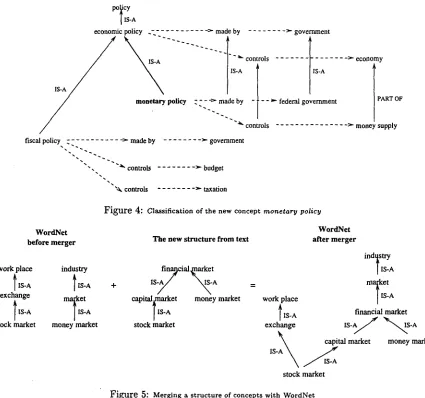
Figure 4 it is shown t h e classificationof concept
monetary policy
t h a t has been discovered.By default this concept is placed u n d e r
policy.
How-ever in WordNet there is a hierarchy
fiscal policy -
IS-A -
economic policy -
IS-A -policy.
T h e questionis where exactly t o place
monetary policy in
this hi-erarchy.
T h e gloss of
economic policy
indicates t h a t it isM A D E B Y
Government,
and t h a t it C O N T R O L S eco- nomicgrowth-
(here we simplified t h e explanationand used
economy
instead ofeconomic growth).
T h egloss
of fiscal policy
leads to relations MADE BY Gov-ernment,
CONTROLSbudget,
and CONTROLS taxa-tion.
The conceptmoney supply
was found by Pro- cedure 1.2 in several dictionaries, and its dictionarydefinition leads t o relations MADE B Y
Federal Gov-
ernment,
and CONTROLSmoney supply. In
Word- NetGovernment
subsumesFederal Government,
andeconomy
HAS PARTmoney.
All necessary conditionsare satisfied for
economic policy
to subsumemone-
tary policy.
However,fiscal policy
does not subsumemonetary policy
sincemonetary policy
does not con-trol
budget
ortaxation,
or any of their hyponyms.Procedure 4.5 Merge a s t r u c t u r e
of concepts with
the rest
of
theknowledge base.
po~cy
| IS-Aeconomic policy .~ . . . >" made by . . . :" government
monetary policy = - - -> madeby
fiscal policy : ~ . . . > made by . . . >- government
" ' . "~" controls . . . ~" budget
"-k controls ... : " taxation
WordNet before merger
work place t lS-A exchange
I IS-A stock market
industry t lS-A market
IS-A money market
Figure 4: Classification of the new concept monetary policy
WordNet
The new structure from text after merger
Taltarke'
eapital~market money market [IS-A
stock market
work place t lS-A exchange
A ~ capital market IS-
stock market
ind~su'y
[ IS-A ma[ket
IS-A
financial market
money market
Figure 5: Merging a structure of concepts with WordNet
bridging whenever possible the structure concepts and the main knowledge base concepts. It is possi- ble that as a result of this merging procedure, some HYPERNYMY relations either from the structure or the main knowledge base will be destroyed to keep the consistency. An example is shown in Figure 5.
Example : The following HYPERNYMY relation- ships were discovered in P a r t 3:
HYPERNYMY(financial market,capital market)
HYPERNYMY(fInancial
market,money market) HYPERNYMY(capital market,stock market)The structure obtained from these relationships along with a part of WordNet hierarchy is shown in Figure 5. An a t t e m p t is made to merge the new structure with WordNet. To these relations it cor- responds a structure as shown in Figure 5. An at- t e m p t is made to merge this structure with Word-
Net. Searching WordNet for all concepts in the
structure we find money market and stock market
in WordNet where as capital market and financial
market are not. Figure 5 shows how the structure merges with WordNet and moreover how concepts
that were unrelated in WordNet (i.e. stock market
and money market) become connected through the new structure. It is also interesting to notice that the
IS-A link in WordNet from money market to market
is interrupted by the insertion of financial market
in-between them.
3 I m p l e m e n t a t i o n a n d R e s u l t s
The KAT Algorithm has been implemented, and when given some seed concepts, it produces new con- cepts, patterns and relationships between concepts in an interactive mode. Table 1 shows the number of concepts extracted from a 5000 sentence corpus, in which each sentence contains at least one of the five seed concepts.
[I R e l a t i o n s I L e x i c o - s y n t a c t i c P a t t e r n s E x a m p l e s
H W o r d N e t Relations
HYPERNYMY I N P 1 [ < b e > ] a k i n d of N P 2 T h u s , L I B O R is a k i n d of interest rate, as i t is c h a r g e d
I
::~ HYPERNYMY(NPI,NP2) on deposits between banks in the Eurodolar market.N e w R e l a t i o n s CAUSE
INFLUENCE
N P I [<be>] cause N P 2 =~ CAUSE(NPI,NP2)
N P 1 i m p a c t on N P 2 INFLU~NCZ(NP1,NP2) As N P 1 vb, so < d o > N P 2
=> INFLUENCE(NPI,NP2) N P 1 < b e > associated with N P 2 => INFLUENCE(NP1,NP2) INFLUENCE(NP2,NPI)
As/if/when N P 1 vbl, N P 2 vb2. -{-
vbl, vb2 ---- antonyms / go in
opposite directions
::~ INFLUENCE(NPI,NP2)
the effect(s) of NP1 on/upon NP2 ::> INFLUENCE(NPI,NP2)
inverse relationship between
N P I and N P 2
=> INFLUENCE(NP1,NP2) =~ INFLUENCE(NP2,NP1) N P 2 < b e > function of N P 1 =# INFLUENCZ(NP1,NP2) N P 1 (and thus NP2)
:~ INFLUENCE(NPI,NP2)
P h i l l i p s , a B r i t i s h e c o n o m i s t , s t a t e d in 1958 t h a t h i g h i n f l a t i o n c a u s e s low u n e m p l o y m e n t rates.
T h e B a n k of I s r a e l governor said t h a t t h e t i ; h t economic policy would h a v e a n i m m e d i a t e i m p a c t on i n f l a t i o n t h i s year. A s t h e economy picks u p s t e a m , so d o e s inflation.
H i g h e r interest rates are n o r m a l l y a s s o c i a t e d w i t h w e a k e r bond markets.
O n t h e o t h e r h a n d , if interest rates go d o w n , bonds go u p , a n d y o u r b o n d b e c o m e s m o r e v a l u a b l e .
T h e effects of inflation on debtors a n d creditors v a r i e s as t h e a c t u a l i n f l a t i o n is c o m p a r e d to t h e e x p e c t e d one.
T h e r e e x i s t s a n inverse r e l a t i o n s h i p b e t w e e n u n e m p l o y m e n t rates a n d inflation, b e s t i l l u s t r a t e d b y t h e P h i l l i p s C u r v e .
Irish e m p l o y m e n t is also l a r g e l y a f u n c t i o n of t h e p a s t h i g h birth rate.
We b e l i e v e t h a t t h e Treasury bonds ( a n d t h u s interest rates) a r e in a d o w n w a r d cycle.
Table 2: E x a m p l e s of l e x i c o - s y n t a c t i c p a t t e r n s a n d s e m a n t i c r e l a t i o n s d e r i v e d f r o m t h e 5000 s e n t e n c e c o r p u s
l a I b l c I d I e II
c o n c e p t s ( N P s ) 773 382 833 921 . T o t a l c o n c e p t s e x t r a c t e d w i t h P r o c e d u r e l
Concepts f o u n d
in W o r d N e t 2 0 1 0 2
Concepts C o n c e p t s
f o u n d in w i t h seed 6 0 3 0 0
on-line h e a d dictionaries, C o n c e p t s
but not in w i t h seed 7 0 1 1 1
W o r d N e t n o t h e a d
I C°ncepts
accepted
Ib y h u m a n 78 62 58 60 37
Table 1: R e s u l t s s h o w i n g the n u m b e r of n e w c o n c e p t s l e a r n e d from t h e c o r p u s r e l a t e d to (a) interest rate, (b) stock market, (c) inflation, (d) economic 9rowth, a~ld (e) employment.
processing in P a r t 1 is taken by the parser. T h e hu- m a n intervention to accept or decline concepts takes about 4 min./seed.
T h e next step was to search for lexico-syntactic patterns. We considered one WordNet semantic re- lation, HYPERNYMY and three other relations t h a t we found relevant for the domain, namely INFLU- ENCE, CAUSE and EQUIVALENT. For each relation, a pair of related words was selected and searched for on the Internet. T h e first 500 sentences/relation were retained. A h u m a n selected and validated semi- automatically the patterns for each sentence. A sam- ple of the results is shown in Table 2. A t o t a l of 22 p a t t e r n s were obtained and their selection and vali- dation t o o k approximately 35 minutes/relation.
Next, the p a t t e r n s are searched for on the 5000 sentence corpus ( P a r t 3). T h e procedure provided
a total of 43 new concepts a n d 166 relationships in which at least one of the seeds occurred. From these relationships, by inspection, we have accepted 63 and rejected 102, procedure which t o o k a b o u t 7 minutes. Table 3 lists some of the 63 relationships discovered.
Relationships. E x a m p l e s HYPEaNYMY(interest r a t e , LIBOR)
HYPERNYMY(leading s t o c k m a r k e t , N e w York S t o c k E x c h a n g e )
HYPERNYMY(market risks, i n t e r e s t r a t e risk) HYPERNYMY(Capital m a r k e t s , s t o c k m a r k e t s ) CAUSE(inflation, u n e m p l o y m e n t )
CAUSE(labour s h o r t a g e , w a g e i n f l a t i o n ) CAUSE(excessive d e m a n d , i n f l a t i o n
INFLUENCE_DIRECT_PROPORTIONALYI e c o n o m y , i n f l a t i o n ) INFLUENCE_DIRECT_PROPORT1ONALY s e t t l e m e n t s , i n t e r e s t r a t e ) INFLUENCE..DIRECT..PROPORTIONALY~ U.S. i n t e r e s t r a t e s , d o l l a r s ) INFLUENCE_DIRECT_PROPORTIONALY~ oil prices, i n f l a t i o n )
INFLUENCE_DIRECT_PROPORTIONALY' i n f l a t i o n , n o m i n a l i n t e r e s t r a t e s ) INFLUENCE..DIRECT_PROPORTIONALY~ d e f l a t i o n , real i n t e r e s t r a t e s )
I N F L U E N C E - D I R E C T - P R O P O R T I O N A L Y c u r r e n c l e s , l n f l a t i o n )
INFLUENCE_INVERSE_PROPORTIONALY u n e m p l o y m e n t r a t e s , i n f l a t i o n ) INFLUENCE_INVERSE-PKOPOKTIONALY m o n e t a r y policies, i n f l a t i o n ) INFLUENCE_INVERSE_PROPORTIONALY economy, i n t e r e s t r a t e s ) INFLUENCE_INVERSE..PROPORTIONALY i n f l a t i o n , u n e m p l o y m e n t r a t e s ) INFLUENCE.JNVERSE-PROPORTIONALY c r e d i t w o r t h i n e s s , i n t e r e s t r a t e ) INFLUENCE_INVERSE-PROPORTIONALYlinterest r a t e s , b o n d s )
INFLUENCE(Internal R e v e n u e Service, i n t e r e s t r a t e s ) INFLUENCE(economic g r o w t h , s h a r e prices)
EQUIVALENT(big m i s t a k e s , h i g h i n f l a t i o n r a t e s of 1970s) EQUIVALENT(fixed i n t e r e s t r a t e , c o u p o n )
[image:7.612.107.558.86.329.2] [image:7.612.102.322.363.490.2] [image:7.612.338.588.451.682.2]4 A p p l i c a t i o n s
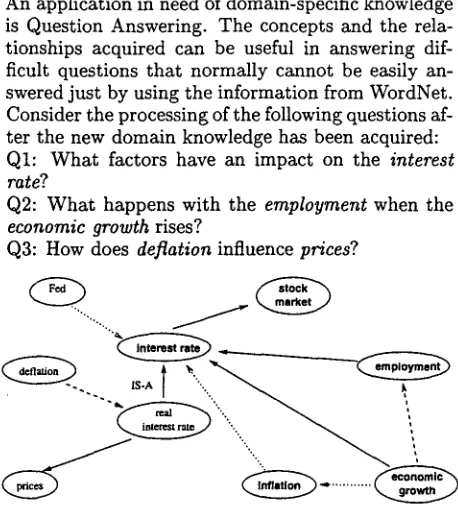
An application in need of domain-specific knowledge is Question Answering. The concepts and the rela- tionships acquired can be useful in answering dif- ficult questions that normally cannot be easily an- swered just by using the information from WordNet. Consider the processing of the following questions af- ter the new domain knowledge has been acquired:
QI: W h a t factors have an impact on the interest
rate?
Q2: W h a t happens with the employment when the
economic growth rises?
Q3: How does deflation influence prices?
"'"'"-... J
[image:8.612.79.308.113.372.2]ISA " ~
Figure 6:
A sample of concepts and relations acquired from t h e 5000 sentence corpus. Legend: continue lines represent influence inverse proportionally, dashed lines represent influence directproportionally, and dotted lines represent influence (the direction
of the relationship was not specified in the text).
Figure 6 shows a portion of the new domain
knowledge that is relevant to these questions. The first question can be easily answered by extracting
the relationships that point to the concept interest
rate. T h e factors that influence the interest rate are Fed, inflation, economic growth, and employment.
The last two questions ask for more detailed infor- mation about the complex relationship among these
concepts. Following the path from the deflation con-
cept up to prices, the system learns that deflation in-
fluences direct proportionally real interest rate, and
real interest rate has an inverse proportional impact on prices. Both these relationships came from the
sentence: Thus, the deflation and the real interest
rate are positively correlated, and so a higher real interest rate leads to falling prices.
This m e t h o d may be adapted to acquire infor- mation when the question concepts are not in the knowledge base. Procedures may be invoked to dis- cover these concepts and the relations in which they may be used.
5
C o n c l u s i o n s
T h e knowledge acquisition technology described above is applicable to any domain, by simply select- ing appropriate seed concepts. We started with five
concepts interest rate, stock market, inflation, eco-
nomic growth, and employment and from a corpus
of 5000 sentences we acquired a total of 362 con- cepts of which 319 contain the seeds and 43 relate to these via selected relations. T h e r e were 22 dis- tinct le:dco-syntactic patterns discovered used in 63 instances. Most importantly, the new concepts can be integrated with an existing ontology.
The method works in an interactive mode where the user accepts or declines concepts, patterns and relationships. T h e manual operation took on aver- age 40 minutes per seed for the 5000 sentence corpus. KAT is useful considering t h a t most of the knowl- edge base construction t o d a y is done manually.
Complex linguistic phenomena such as corefer- ence resolution, word sense disambiguation, and oth- ers have to be dealt with in order to increase the automation of the knowledge acquisition system. Without a good handling of these problems the re- sults are not always accurate and human interven- tion is necessary.
R e f e r e n c e s
Christiane Fellbaum. WordNet - An Electronic Lezical
Database, MIT Press, Cambridge, MA, 1998. Marti Hearst. Automated Discovery of WordNet Rela-
tions. In WordNet: An Electronic Lezical Database
and Some of its Applications, editor Fellbaum, C., MIT Press, Cambridge, MA, 1998.
J. Kim and D. Moldovan. Acquisition of Linguistic Patterns for knowledge-based information extraction.
IEEE Transactions on Knowledge and Data Engineer- ing 7(5): pages 713-724.
R. MacGregor. A Description Classifier for the Predicate
Calculus. Proceedings of the 12th National Conference
on Artificial Intelligence (AAAI94), pp. 213-220, 1994. Stephen D. Richardson, William B. Dolan, Lucy Vander- wende. MindNet: acquiring and structuring seman- tic information from text. Proceedings of ACL-Coling 1998, pages 1098-1102.
Ellen Riloff. Automatically'Generating Extraction Pat-
terns from Untagged Text. In Proceedings of the Thir-
teenth National Conference on Artificial Intelligence,
1044-1049. The AAAI Press/MIT Press.
J.G. Schmolze and T. Lipkis. Classification in the KL-
ONE knowledge representation system. Proceedings
of 8th Int'l Joint Conference on Artificial Intelligence
(IJCAI83), 1983.
S. Soderland. Learning to extract text-based informa-
tion from the world wide web. In the Proceedings of
the Third International Conference on Knowledge Dis- cover# and Data Mining (KDD-97).
Text REtrieval Conference. http://trec.nist.gov 1999 W.A. Woods. Understanding Subsumption and Taxon-
omy: A Framework for Progress. In the Principles
of Semantic Networks: Explorations in the Represen- tation of Knowledge, Morgan Kaufmann, San Mateo, Calif. 1991, pages 45-94.
W.A. Woods. A Better way to Organize Knowledge.