Multigraph Clustering for Unsupervised Coreference Resolution
Sebastian Martschat
Heidelberg Institute for Theoretical Studies gGmbH Schloss-Wolfsbrunnenweg 35
69118 Heidelberg, Germany
Abstract
We present an unsupervised model for coreference resolution that casts the prob-lem as a clustering task in a directed la-beled weighted multigraph. The model outperforms most systems participating in the English track of the CoNLL’12 shared task.
1 Introduction
Coreference resolution is the task of determining which mentions in a text refer to the same en-tity. With the advent of machine learning and the availability of annotated corpora in the mid 1990s the research focus shifted from rule-based approaches to supervised machine learning tech-niques. Quite recently, however, rule-based ap-proaches regained popularity due to Stanford’s multi-pass sieve approach which exhibits state-of-the-art performance on many standard coref-erence data sets (Raghunathan et al., 2010) and also won the CoNLL-2011 shared task on coref-erence resolution (Lee et al., 2011; Pradhan et al., 2011). These results show that carefully crafted rule-based systems which employ suitable inference schemes can achieve competitive perfor-mance. Such a system can be considered unsuper-vised in the sense that it does not employ training data for optimizing parameters.
In this paper we present a graph-based approach for coreference resolution that models a document to be processed as a graph. The nodes are men-tions and the edges correspond to relamen-tions be-tween mentions. Coreference resolution is per-formed via graph clustering. Our approach be-longs to a class of recently proposed graph models for coreference resolution (Cai and Strube, 2010;
Sapena et al., 2010; Martschat et al., 2012) and is designed to be a simplified version of existing approaches. In contrast to previous models be-longing to this class we do not learn any edge weights but perform inference on the graph struc-ture only which renders our model unsupervised. On the English data of the CoNLL’12 shared task the model outperforms most systems which partic-ipated in the shared task.
2 Related Work
Graph-based coreference resolution. While not developed within a graph-based framework, factor-based approaches for pronoun resolution (Mitkov, 1998) can be regarded as greedy clus-tering in a multigraph, where edges representing factors for pronoun resolution have negative or positive weight. This yields a model similar to the one presented in this paper though Mitkov’s work has only been applied to pronoun resolu-tion. Nicolae and Nicolae (2006) phrase coref-erence resolution as a graph clustering problem: they first perform pairwise classification and then construct a graph using the derived confidence val-ues as edge weights. In contrast, work by Culotta et al. (2007), Cai and Strube (2010) and Sapena et al. (2010) omits the classification step entirely. Sapena et al. (2010) and Cai and Strube (2010) perform coreference resolution in one step using graph partitioning approaches. These approaches participated in the recent CoNLL’11 shared task (Pradhan et al., 2011; Sapena et al., 2011; Cai et al., 2011b) with excellent results. The ap-proach by Cai et al. (2011b) has been modified by Martschat et al. (2012) and ranked second in the English track at the CoNLL’12 shared task (Prad-han et al., 2012). The top performing system at the CoNLL’12 shared task (Fernandes et al., 2012)
also represents the problem as a graph by per-forming inference on trees constructed using the multi-pass sieve approach by Raghunathan et al. (2010) and Lee et al. (2011), which in turn won the CoNLL’11 shared task.
Unsupervised coreference resolution. Cardie and Wagstaff (1999) present an early approach to unsupervised coreference resolution based on a straightforward clustering approach. Angheluta et al. (2004) build on their approach and devise more sophisticated clustering algorithms. Haghighi and Klein (2007), Ng (2008) and Charniak and El-sner (2009) employ unsupervised generative mod-els. Poon and Domingos (2008) present a Markov Logic Network approach to unsupervised corefer-ence resolution. These approaches reach competi-tive performance on gold mentions but not on sys-tem mentions (Ng, 2008). The multi-pass sieve approach by Raghunathan et al. (2010) can also be viewed as unsupervised.
3 A Multigraph Model
We aim for a model which directly represents the relations between mentions in a graph structure. Clusters in the graph then correspond to entities.
3.1 Motivation
To motivate the choice of our model, let us con-sider a simple made-up example.
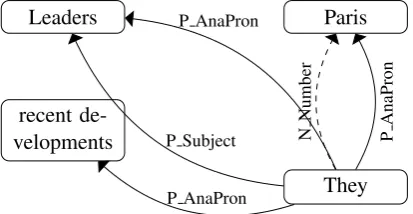
Leaders met inParis to discuss recent developments.Theyleft the city today.
We want to model thatParisis not a likely candi-date antecedent forTheydue to number disagree-ment, but that Leaders and recent developments
are potential antecedents for They. We want to express that Leadersis the preferred antecedent, sinceLeadersandTheyare in a parallel construc-tion both occupying the subject posiconstruc-tion in their respective sentences.
In other words, our model should express the following relations for this example:
• number disagreement for (They,Paris), which
indicates that the mentions are not coreferent,
• the anaphor being a pronoun for (They,
Lead-ers), (They, recent developments) and (They,
Paris), which is a weak indicator for corefer-ence if the mentions are close to each other,
• syntactic parallelism for (They,Leaders): both mentions are in a parallel construction in
adja-cent sentences (both in the subject slot), which is also a weak coreference indicator.
We denote these relations as N Number, P AnaPron and P Subject respectively. The graphical structure depicted in Figure 1 mod-els these relations between the four mentions
Leaders,Paris,recent developmentsandThey.
Leaders
recent de-velopments
They Paris
P AnaPron
P Subject
P AnaPron
N
Number
P
[image:2.595.314.521.173.280.2]AnaPron
Figure 1: An example graph modeling relations between mentions.
A directed edge from a mention m ton
indi-cates thatnprecedesmand that there is some
rela-tion betweenmandnthat indicates coreference or non-coreference. Labeled edges describe the rela-tions between the menrela-tions, multiple relarela-tions can hold between a pair. Edges may be weighted.
3.2 Multigraphs for Coreference Resolution Formally, the model is adirected labeled weighted multigraph. That is a tuple D = (R, V, A, w) where
• Ris the set of labels (in our case relations such
as P Subject that hold between mentions),
• V is the set of nodes (the mentions extracted
from a document),
• A ⊆V ×V ×Ris the set of edges (relations between two mentions),
• wis a mappingw: A→R∪ {±∞}(weights for edges).
Many graph models for coreference resolution op-erate onA=V×V. Our multigraph model allows us to have multiple edges with different labels be-tween mentions.
To have a notion oforderwe employ a directed graph: We only allow an edge fromm tonifm
appears later in the text thann.
To perform coreference resolution for a docu-mentd, we first construct a directed labeled
clustered to obtain the mentions that refer to the same entity (Section 3.5).
3.3 Graph Construction
Given a setM of mentions extracted from a
doc-ument d, we set V = M, i.e. the nodes of the
graph are the mentions. To construct the edges
A, we consider each pair(m, n)of mentions with
n ≺ m. We then check for every relation r ∈ R
if r holds for the pair (m, n). If this is the case we add the edge (m, n, r) to A. For simplicity,
we restrict ourselves to binary relations that hold between pairs of mentions (see Section 4).
The graph displayed in Figure 1 is the graph constructed for the mentions Leaders, Paris, re-cent developments and They from the example sentence at the beginning of this Section, where
R={P AnaPron, P Subject, N Number}.
3.4 Assigning Weights
Depending on whether a relationr ∈ Ris
indica-tive for non-coreference (e.g. number disagree-ment) or for coreference (e.g. string matching) it should be weighted differently. We therefore di-vide R into a set of negative relationsR− and a
set ofpositive relationsR+.
Previous work on multigraphs for coreference resolution disallows any edge between mentions for which a negative relations holds (Cai et al., 2011b; Martschat et al., 2012). We take a sim-ilar approach and set w(m, n, r) = −∞ for (m, n, r)∈Awhenr ∈R−1.
Work on graph-based models similar to ours re-port robustness with regard to the amount of train-ing data used (Cai et al., 2011b; Cai et al., 2011a; Martschat et al., 2012). Motivated by their obser-vations we treat every positive relation equally and setw(m, n, r) = 1for(m, n, r)∈Aifr∈R+.
In contrast to previous work on similar graph models we do not learn any edge weights from training data. We compare this unsupervised scheme with supervised variants empirically in Section 5.
3.5 Clustering
To describe the clustering algorithm used in this work we need some additional terminology. If there exists an edge(m, n, r)∈Awe say thatnis achildofm.
1We experimented with different weighting schemes for negative relations on development data (e.g. setting
w(m, n, r) =−1) but did not observe a gain in performance.
In the graph constructed according to the pro-cedure described in Section 3.3, all children of a mentionmare candidate antecedents form. The
relations we employ are indicators for coreference (which get a positive weight) and indicators for non-coreference (which get a negative weight). We aim to employ a simple and efficient cluster-ing scheme on this graph and therefore choose 1-nearest-neighbor clustering: for every m, we
choose as antecedentm’s childnsuch that the sum
of edge weights is maximal and positive. We break ties by choosing the closest mention.
In the unsupervised setting described in Section 3.4 this algorithm reduces to choosing the child that is connected via the highest number of posi-tive relations and via no negaposi-tive relation.
For the graph depicted in Figure 1 this algorithm computes the clusters {They, Leaders}, {Paris}
and{recent developments}.
4 Relations
The graph model described in Section 3 is based on expressing relations between pairs of mentions via edges built from such relations. We now de-scribe the relations currently used by our system. They are well-known indicators and constraints for coreference and are taken from previous work (Cardie and Wagstaff, 1999; Soon et al., 2001; Rahman and Ng, 2009; Lee et al., 2011; Cai et al., 2011b). All relations operate on pairs of mentions (m, n), wheremis the anaphor andnis a
candi-date antecedent. If a relationr holds for(m, n), the edge(m, n, r)is added to the graph. We final-ized the set of relations and their distance thresh-olds on development data.
4.1 Negative Relations
Negative relations receive negative weights. They allow us to introduce well-known constraints such as agreement into our model.
(1) N Gender, (2) N Number: Two mentions do not agree in gender or number. We compute number and gender for common nouns us-ing the number and gender data provided by Bergsma and Lin (2006).
(3) N SemanticClass: Two mentions do not agree in semantic class (we only use the top categories Object, Date and Person from WordNet (Fellbaum, 1998)).
than one.
(5) N Speaker12Pron: Two first person pro-nouns or two second person propro-nouns with dif-ferent speakers, or one first person pronoun and one second person pronoun with the same speaker2.
(6) N ContraSubObj: Two mentions are in the subject/object positions of the same verb, the anaphor is a non-possessive/reflexive pronoun. (7) N Mod: Two mentions have the same syntac-tic heads, and the anaphor has a nominal mod-ifier which does not occur in the antecedent. (8) N Embedding: Two mentions where one
em-beds the other, which is not a reflexive or pos-sessive pronoun.
(9) N 2PronNonSpeech: Two second person pronouns without speaker information and not in direct speech.
4.2 Positive Relations
Positive relations are coreference indicators which are added as edges with positive weights.
(10) P NonPron StrMatch: Applies only if the anaphor is definite or a proper name3. This
re-lation holds if after discarding stop words the strings of mentions completely match.
(11) P HeadMatch: If the syntactic heads of mentions match.
(12) P Alias: If mentions are aliases of each other (i.e. proper names with partial match, full names and acronyms, etc.).
(13) P Speaker12Pron: If the speaker of the sec-ond person pronoun is talking to the speaker of the first person pronoun (applies only to first/second person pronouns).
(14) P DSPron: One mention is a speak verb’s subject, the other mention is a first person pro-noun within the corresponding direct speech. (15) P ReflPronSub: If the anaphor is a reflexive
pronoun, and the antecedent is the subject of the sentence.
(16) P PossPronSub: If the anaphor is a posses-sive pronoun, and the antecedent is the subject of the anaphor’s sentence or subclause. (17) P PossPronEmb: The anaphor is a
posses-2Like all relations using speaker information, this relation depends on the gold speaker annotation layer in the corpus.
3This condition is necessary to cope with the high-recall output of the mention tagger.
sive pronoun embedded in the antecedent. (18) P AnaPron: If the anaphor is a pronoun and
none of the mentions is a first or second per-son pronoun. This relation is restricted to a sentence distance of 3.
(19) P VerbAgree: If the anaphor is a third per-son pronoun and has the same predicate as the antecedent. This relation is restricted to a sen-tence distance of 1.
(20) P Subject, (21) P Object: The anaphor is a third person pronoun and both mentions are subjects/objects. These relations are restricted to a sentence distance of 1.
(22) P Pron StrMatch: If both mentions are pronouns and their strings match.
(23) P Pron Agreement: If both mentions are different pronoun tokens but agree in number, gender and person.
5 Evaluation
5.1 Data and Evaluation Metrics
We use the data provided for the English track of the CoNLL’12 shared task on multilingual coref-erence resolution (Pradhan et al., 2012) which is a subset of the upcoming OntoNotes 5.0 release and comes with various annotation layers provided by state-of-the-art NLP tools. We used the official dev/test split for development and evaluation. We evaluate the model in a setting that corresponds to the shared task’sclosed track, i.e. we use only WordNet (Fellbaum, 1998), the number and gen-der data of Bergsma and Lin (2006) and the pro-vided annotation layers. To extract system men-tions we employ the mention extractor described in Martschat et al. (2012).
We evaluate our system with the coreference resolution evaluation metrics that were used for the CoNLL shared tasks on coreference, which are MUC (Vilain et al., 1995), B3 (Bagga and Bald-win, 1998) and CEAFe (Luo, 2005). We also
re-port the unweighted average of the three scores, which was the official evaluation metric in the shared tasks. To compute the scores we employed the official scorer supplied by the shared task or-ganizers.
5.2 Results
MUC B3 CEAF
e average
R P F1 R P F1 R P F1
CoNLL’12 English development data
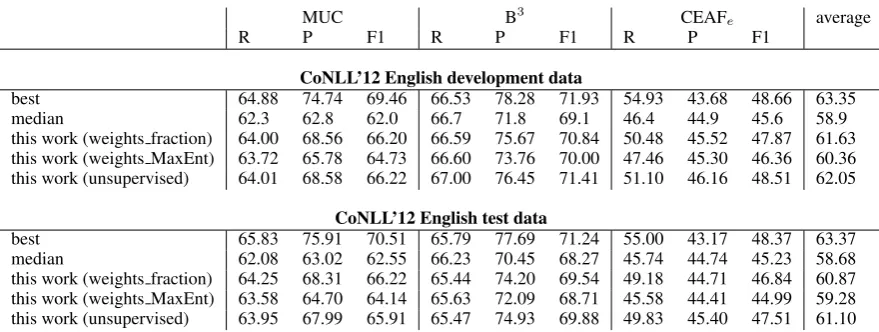
best 64.88 74.74 69.46 66.53 78.28 71.93 54.93 43.68 48.66 63.35
median 62.3 62.8 62.0 66.7 71.8 69.1 46.4 44.9 45.6 58.9
this work (weights fraction) 64.00 68.56 66.20 66.59 75.67 70.84 50.48 45.52 47.87 61.63 this work (weights MaxEnt) 63.72 65.78 64.73 66.60 73.76 70.00 47.46 45.30 46.36 60.36 this work (unsupervised) 64.01 68.58 66.22 67.00 76.45 71.41 51.10 46.16 48.51 62.05
CoNLL’12 English test data
[image:5.595.78.518.69.235.2]best 65.83 75.91 70.51 65.79 77.69 71.24 55.00 43.17 48.37 63.37 median 62.08 63.02 62.55 66.23 70.45 68.27 45.74 44.74 45.23 58.68 this work (weights fraction) 64.25 68.31 66.22 65.44 74.20 69.54 49.18 44.71 46.84 60.87 this work (weights MaxEnt) 63.58 64.70 64.14 65.63 72.09 68.71 45.58 44.41 44.99 59.28 this work (unsupervised) 63.95 67.99 65.91 65.47 74.93 69.88 49.83 45.40 47.51 61.10
Table 1: Results of different systems on the CoNLL’12 English data sets.
CoNLL’12 shared task, which are denoted asbest
and median respectively. best employs a struc-tured prediction model with learned combinations of 70 basic features. We also compare with two supervised variants of our model which use the same relations and the same clustering algorithm as the unsupervised model: weights fraction sets the weight of a relation to the fraction of posi-tive instances in training data (as in Martschat et al. (2012)). weights MaxEnttrains a mention-pair model (Soon et al., 2001) via the maximum en-tropy classifier implemented in the BART toolkit (Versley et al., 2008) and builds a graph where the weight of an edge connecting two mentions is the classifier’s prediction4. We use the official
CoNLL’12 English training set for training. Our unsupervised model performs considerably better than the median system from the CoNLL’12 shared task on both data sets according to all met-rics. It also seems to be able to accommodate well for the relations described in Section 4 since it out-performs both supervised variants5. The model
performs worse thanbest, the gap according to B3 and CEAFe being considerably smaller than
ac-cording to MUC. While we observe a decrease of 1 point average score when evaluating on test data the model still would have ranked fourth in the En-glish track of the CoNLL’12 shared task with only 0.2 points difference in average score to the sec-ond ranked system.
4The classifier’s output is a numberp
∈[0,1]. In order to have negative weights we use the transformationp0= 2p−1.
5Compared with the supervised variants all improvements in F1 score are statistically significant according to a paired t-test (p < 0.05) except for the difference in MUC F1 to weights fraction.
6 Error Analysis
In order to understand weaknesses of our model we perform an error analysis on the development data. We distinguish betweenprecisionandrecall
errors. For an initial analysis we split the errors according to the mention type of anaphor and an-tecedent (name, nominal and pronoun).
6.1 Precision Errors
Our system operates in a pairwise fashion. We therefore count one precision error whenever the clustering algorithm assigns two non-coreferent mentions to the same cluster. Table 2 shows the
NAM NOM PRO
NAM 3413 (21%) 67 (66%) 11 (46%) NOM 43 (67%) 2148 (49%) 9 (89%) PRO 868 (32%) 1771 (55%) 5308 (24%)
Table 2: Number of clustering decisions made ac-cording to mention type (rows anaphor, columns antecedent) and percentage of wrong decisions.
number of clustering decisions made according to the mention type and in brackets the fraction of de-cisions that erroneously assign two non-coreferent mentions to the same cluster. We see that two main sources of error are nominal-nominal pairs and the resolution of pronouns. We now focus on gain-ing further insight into the system’s performance for pronoun resolution by investigating the perfor-mance per pronoun type. The results are displayed in Table 3. We obtain good performance forI and
Anaphor all anaphoric I 1260 (13%) 1239 (11%) my 192 (14%) 181 (9%)
he 824 (14%) 812 (13%)
. . . .
they 764 (29%) 725 (26%)
. . . .
[image:6.595.105.257.62.153.2]you 802 (41%) 555 (15%) it 1114 (64%) 720 (44%)
Table 3: Precision statistics for pronouns. Rows are pronoun surfaces, columns number of cluster-ing decisions and percentage of wrong decisions for all and only anaphoric pronouns respectively.
to work well for he. In contrast, the local, shal-low approach we currently employ is not able to resolve highly ambiguous pronouns such as they,
youoritin many cases. The reduction in error rate when only considering anaphoric pronouns shows that our system could benefit from an improved detection of expletiveitandyou.
6.2 Recall Errors
Estimating recall errors by counting all missing pairwise links would consider each entity many times. Therefore, we instead count one recall er-ror for a pair(m, n)of anaphormand antecedent nif (i) m andnare coreferent, (ii)m andnare
not assigned to the same cluster, (iii)mis the first mention in its cluster that is coreferent withn, and
(iv)nis the closest mention coreferent withmthat
is not inm’s cluster.
This can be illustrated by an example. Consid-ering mentionsm1, . . . , m5, assume thatm1,m3,
m4 andm5 are coreferent but the system clusters are{m2, m3}and{m4, m5}. We then count two recall errors: one for the missing link fromm3 to
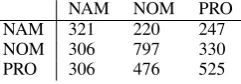
m1 and one for the missing link fromm4tom3. According to this definition we count 3528 re-call errors on the development set. The distribu-tion of errors is displayed in Table 4. We see that
NAM NOM PRO
NAM 321 220 247
NOM 306 797 330
PRO 306 476 525
Table 4: Number of recall errors according to mention type (rows anaphor, columns antecedent).
the main source of recall errors are missing links of nominal-nominal pairs. We randomly extracted 50 of these errors and manually assigned them to different categories.
29 errors: missing semantic knowledge. In these cases lexical or world knowledge is needed to build coreference links between mentions with dif-ferent heads. For example our system misses the link betweenthe saunaandthe hotbox sweatbox. 14 errors: too restrictive N Mod. In these cases the heads of the mentions matched but no link was built due to N Mod. An example is the missing link betweenour island’s last remaining forest of these giant treesandthe forest of Chilan.
4 errors: too cautious string match. We only apply string matching for common nouns when the noun is definite.
Three errors could not be attributed to any of the above categories.
7 Conclusions and Future Work
We presented an unsupervised graph-based model for coreference resolution. Experiments show that our model exhibits competitive performance on the English CoNLL’12 shared task data sets.
An error analysis revealed that two main sources of errors of our model are the inaccurate resolution of highly ambiguous pronouns such as
it and missing links between nominals with dif-ferent heads. Future work should investigate how semantic knowledge and more complex relations capturing deeper discourse properties such as co-herence or information status can be added to the model. Processing these features efficently may require a more sophisticated clustering algorithm. We are surprised by the good performance of this unsupervised model in comparison to the state-of-the-art which uses sophisticated machine learning techniques (Fernandes et al., 2012) or well-engineered rules (Lee et al., 2011). We are not sure how to interpret these results and want to leave different interpretations for discussion:
• our unsupervised model is really that good (hopefully),
• the evaluation metrics employed are to be questioned (certainly),
• efficiently making use of annotated training data still remains a challenge for the state-of-the-art (likely).
Acknowledgments
[image:6.595.122.243.619.661.2]References
Roxana Angheluta, Patrick Jeuniaux, Rudradeb Mitra, and Marie-Francine Moens. 2004. Clustering al-gorithms for noun phrase coreference resolution. In
Proceedings of the 7`emes Journ´ees Internationales d’Analyse Statistique des Donn´ees Textuelles, Lou-vain La Neuve, Belgium, 10–12 March 2004, pages 60–70.
Amit Bagga and Breck Baldwin. 1998. Algorithms
for scoring coreference chains. In Proceedings
of the 1st International Conference on Language Resources and Evaluation, Granada, Spain, 28–30 May 1998, pages 563–566.
Shane Bergsma and Dekang Lin. 2006.
Bootstrap-ping path-based pronoun resolution. InProceedings
of the 21st International Conference on Computa-tional Linguistics and 44th Annual Meeting of the Association for Computational Linguistics,Sydney, Australia, 17–21 July 2006, pages 33–40.
Jie Cai and Michael Strube. 2010. End-to-end coref-erence resolution via hypergraph partitioning. In
Proceedings of the 23rd International Conference on Computational Linguistics, Beijing, China, 23– 27 August 2010, pages 143–151.
Jie Cai, ´Eva M´ujdricza-Maydt, Yufang Hou, and Michael Strube. 2011a. Weakly supervised graph-based coreference resolution for clinical data. In
Proceedings of the 5th i2b2 Shared Tasks and Work-shop on Challenges in Natural Language Processing for Clinical Data,Washington, D.C., 20-21 October 2011.
Jie Cai, ´Eva M´ujdricza-Maydt, and Michael Strube.
2011b. Unrestricted coreference resolution via
global hypergraph partitioning. In Proceedings of
the Shared Task of the 15th Conference on Computa-tional Natural Language Learning,Portland, Oreg., 23–24 June 2011, pages 56–60.
Claire Cardie and Kiri Wagstaff. 1999. Noun phrase
coreference as clustering. In Proceedings of the
1999 SIGDAT Conference on Empirical Methods in Natural Language Processing and Very Large Cor-pora, College Park, Md., 21–22 June 1999, pages 82–89.
Eugene Charniak and Micha Elsner. 2009. EM works
for pronoun anaphora resolution. InProceedings of
the 12th Conference of the European Chapter of the Association for Computational Linguistics,Athens, Greece, 30 March – 3 April 2009, pages 148–156.
Aron Culotta, Michael Wick, and Andrew McCal-lum. 2007. First-order probabilistic models for
coreference resolution. In Proceedings of Human
Language Technologies 2007: The Conference of the North American Chapter of the Association for Computational Linguistics, Rochester, N.Y., 22–27 April 2007, pages 81–88.
Christiane Fellbaum, editor. 1998. WordNet: An
Elec-tronic Lexical Database. MIT Press, Cambridge, Mass.
Eraldo Fernandes, C´ıcero dos Santos, and Ruy Milidi´u. 2012. Latent structure perceptron with feature in-duction for unrestricted coreference resolution. In
Proceedings of the Shared Task of the 16th Confer-ence on Computational Natural Language Learning,
Jeju Island, Korea, 12–14 July 2012, pages 41–48. Aria Haghighi and Dan Klein. 2007. Unsupervised
coreference resolution in a nonparametric Bayesian
model. InProceedings of the 45th Annual Meeting
of the Association for Computational Linguistics,
Prague, Czech Republic, 23–30 June 2007, pages 848–855.
Heeyoung Lee, Yves Peirsman, Angel Chang, Nathanael Chambers, Mihai Surdeanu, and Dan Ju-rafsky. 2011. Stanford’s multi-pass sieve corefer-ence resolution system at the CoNLL-2011 shared
task. In Proceedings of the Shared Task of the
15th Conference on Computational Natural Lan-guage Learning,Portland, Oreg., 23–24 June 2011, pages 28–34.
Xiaoqiang Luo. 2005. On coreference resolution
performance metrics. In Proceedings of the
Hu-man Language Technology Conference and the 2005 Conference on Empirical Methods in Natural Lan-guage Processing, Vancouver, B.C., Canada, 6–8 October 2005, pages 25–32.
Sebastian Martschat, Jie Cai, Samuel Broscheit, ´Eva M´ujdricza-Maydt, and Michael Strube. 2012. A multigraph model for coreference resolution. In
Proceedings of the Shared Task of the 16th Confer-ence on Computational Natural Language Learning,
Jeju Island, Korea, 12–14 July 2012, pages 100–106. Ruslan Mitkov. 1998. Robust pronoun resolution with
limited knowledge. InProceedings of the 17th
In-ternational Conference on Computational Linguis-tics and 36th Annual Meeting of the Association for Computational Linguistics, Montr´eal, Qu´ebec, Canada, 10–14 August 1998, pages 869–875. Vincent Ng. 2008. Unsupervised models for
corefer-ence resolution. In Proceedings of the 2008
Con-ference on Empirical Methods in Natural Language Processing, Waikiki, Honolulu, Hawaii, 25–27 Oc-tober 2008, pages 640–649.
Cristina Nicolae and Gabriel Nicolae. 2006. BestCut: A graph algorithm for coreference resolution. In
Proceedings of the 2006 Conference on Empirical Methods in Natural Language Processing, Sydney, Australia, 22–23 July 2006, pages 275–283. Hoifung Poon and Pedro Domingos. 2008. Joint
Sameer Pradhan, Lance Ramshaw, Mitchell Marcus, Martha Palmer, Ralph Weischedel, and Nianwen Xue. 2011. CoNLL-2011 Shared Task: Modeling
unrestricted coreference in OntoNotes. In
Proceed-ings of the Shared Task of the 15th Conference on Computational Natural Language Learning, Port-land, Oreg., 23–24 June 2011, pages 1–27.
Sameer Pradhan, Alessandro Moschitti, and Nianwen Xue. 2012. CoNLL-2012 Shared Task: Modeling multilingual unrestricted coreference in OntoNotes. InProceedings of the Shared Task of the 16th Con-ference on Computational Natural Language
Learn-ing,Jeju Island, Korea, 12–14 July 2012, pages 1–
40.
Karthik Raghunathan, Heeyoung Lee, Sudarshan Ran-garajan, Nathanael Chambers, Mihai Surdeanu, Dan Jurafsky, and Christopher Manning. 2010. A
multi-pass sieve for coreference resolution. In
Proceed-ings of the 2010 Conference on Empirical Methods in Natural Language Processing,Cambridge, Mass., 9–11 October 2010, pages 492–501.
Altaf Rahman and Vincent Ng. 2009. Supervised
mod-els for coreference resolution. InProceedings of the
2009 Conference on Empirical Methods in Natural Language Processing,Singapore, 6–7 August 2009, pages 968–977.
Emili Sapena, Llu´ıs Padr´o, and Jordi Turmo. 2010. A global relaxation labeling approach to coreference
resolution. In Proceedings of Coling 2010: Poster
Volume,Beijing, China, 23–27 August 2010, pages 1086–1094.
Emili Sapena, Llu´ıs Padr´o, and Jordi Turmo. 2011. RelaxCor participation in CoNLL shared task on
coreference resolution. In Proceedings of the
Shared Task of the 15th Conference on Computa-tional Natural Language Learning,Portland, Oreg., 23–24 June 2011, pages 35–39.
Wee Meng Soon, Hwee Tou Ng, and Daniel Chung Yong Lim. 2001. A machine learning ap-proach to coreference resolution of noun phrases.
Computational Linguistics, 27(4):521–544.
Yannick Versley, Simone Paolo Ponzetto, Massimo Poesio, Vladimir Eidelman, Alan Jern, Jason Smith, Xiaofeng Yang, and Alessandro Moschitti. 2008. BART: A modular toolkit for coreference
resolu-tion. In Companion Volume to the Proceedings of
the 46th Annual Meeting of the Association for Com-putational Linguistics,Columbus, Ohio, 15–20 June 2008, pages 9–12.
Marc Vilain, John Burger, John Aberdeen, Dennis Con-nolly, and Lynette Hirschman. 1995. A
model-theoretic coreference scoring scheme. In