Exploiting Syntactic Patterns as Clues in Zero-Anaphora Resolution
Ryu Iida, Kentaro Inui and Yuji Matsumoto
Graduate School of Information Science, Nara Institute of Science and Technology 8916-5 Takayama, Ikoma, Nara, 630-0192, Japan
{ryu-i,inui,matsu}@is.naist.jp
Abstract
We approach the zero-anaphora resolu-tion problem by decomposing it into intra-sentential and inter-sentential zero-anaphora resolution. For the former prob-lem, syntactic patterns of the appearance of zero-pronouns and their antecedents are useful clues. Taking Japanese as a target language, we empirically demonstrate that incorporating rich syntactic pattern fea-tures in a state-of-the-art learning-based anaphora resolution model dramatically improves the accuracy of intra-sentential zero-anaphora, which consequently im-proves the overall performance of zero-anaphora resolution.
1 Introduction
Zero-anaphora is a gap in a sentence that has an anaphoric function similar to a form (e.g. pro-noun) and is often described as “referring back” to an expression that supplies the information nec-essary for interpreting the sentence. For example, in the sentence “There are two roads to eternity, a straight and narrow, and a broad and crooked,” the gaps in “a straight and narrow (gap)” and “a broad and crooked (gap)” have a zero-anaphoric relationship to “two roads to eternity.”
The task of identifying zero-anaphoric relations in a given discourse, zero-anaphora resolution, is essential in a wide range of NLP applications. This is the case particularly in such a language as Japanese, where even obligatory arguments of a predicate are often omitted when they are inferable from the context. In fact, in our Japanese newspa-per corpus, for example, 45.5% of the nominative arguments of verbs are omitted. Since such gaps
can not be interpreted only by shallow syntac-tic parsing, a model specialized for zero-anaphora resolution needs to be devised on the top of shal-low syntactic and semantic processing.
Recent work on zero-anaphora resolution can be located in two different research contexts. First, zero-anaphora resolution is studied in the con-text of anaphora resolution (AR), in which zero-anaphora is regarded as a subclass of zero-anaphora. In AR, the research trend has been shifting from rule-based approaches (Baldwin, 1995; Lappin and Le-ass, 1994; Mitkov, 1997, etc.) to empirical, or corpus-based, approaches (McCarthy and Lehnert, 1995; Ng and Cardie, 2002a; Soon et al., 2001; Strube and M¨uller, 2003; Yang et al., 2003) be-cause the latter are shown to be a cost-efficient solution achieving a performance that is compa-rable to best performing rule-based systems (see the Coreference task in MUC1and the Entity De-tection and Tracking task in the ACE program2). The same trend is observed also in Japanese zero-anaphora resolution, where the findings made in rule-based or theory-oriented work (Kameyama, 1986; Nakaiwa and Shirai, 1996; Okumura and Tamura, 1996, etc.) have been successfully incorporated in machine learning-based frame-works (Seki et al., 2002; Iida et al., 2003).
Second, the task of zero-anaphora resolution has some overlap with Propbank3-style semantic role labeling (SRL), which has been intensively studied, for example, in the context of the CoNLL SRL task4. In this task, given a sentence “To at-tract younger listeners, Radio Free Europe inter-sperses the latest in Western rock groups”, an SRL
1http://www-nlpir.nist.gov/related projects/muc/ 2http://projects.ldc.upenn.edu/ace/
3
http://www.cis.upenn.edu/˜mpalmer/project pages/ACE.htm
4http://www.lsi.upc.edu/˜srlconll/
model is asked to identify the NP Radio Free Eu-rope as the A0 (Agent) argument of the verb at-tract. This can be seen as the task of finding the zero-anaphoric relationship between a nomi-nal gap (the A0 argument of attract) and its an-tecedent (Radio Free Europe) under the condition that the gap and its antecedent appear in the same sentence.
In spite of this overlap between AR and SRL, there are some important findings that are yet to be exchanged between them, partly because the two fields have been evolving somewhat indepen-dently. The AR community has recently made two important findings:
• A model that identifies the antecedent of an anaphor by a series of comparisons between candidate antecedents has a remarkable ad-vantage over a model that estimates the ab-solute likelihood of each candidate indepen-dently of other candidates (Iida et al., 2003; Yang et al., 2003).
• An AR model that carries out antecedent identification before anaphoricity determina-tion, the decision whether a given NP is anaphoric or not (i.e. discourse-new), sig-nificantly outperforms a model that executes those subtasks in the reverse order or simulta-neously (Poesio et al., 2004; Iida et al., 2005).
To our best knowledge, however, existing SRL models do not exploit these advantages. In SRL, on the other hand, it is common to use syntactic features derived from the parse tree of a given in-put sentence for argument identification. A typ-ical syntactic feature is the path on a parse tree from a target predicate to a noun phrase in ques-tion (Gildea and Jurafsky, 2002; Carreras and Mar-quez, 2005). However, existing AR models deal with intra- and inter-sentential anaphoric relations in a uniform manner; that is, they do not use as rich syntactic features as state-of-the-art SRL models do, even in finding intra-sentential anaphoric rela-tions. We believe that the AR and SRL communi-ties can learn more from each other.
Given this background, in this paper, we show that combining the aforementioned techniques de-rived from each research trend makes signifi-cant impact on zero-anaphora resolution, taking Japanese as a target language. More specifically, we demonstrate the following:
• Incorporating rich syntactic features in a state-of-the-art AR model dramatically
im-proves the accuracy of intra-sentential zero-anaphora resolution, which consequently im-proves the overall performance of zero-anaphora resolution. This is to be considered as a contribution to AR research.
• Analogously to inter-sentential anaphora, de-composing the antecedent identification task into a series of comparisons between candi-date antecedents works remarkably well also in intra-sentential zero-anaphora resolution. We hope this finding to be adopted in SRL. The rest of the paper is organized as follows. Section 2 describes the task definition of zero-anaphora resolution in Japanese. In Section 3, we review previous approaches to AR. Section 4 described how the proposed model incorporates effectively syntactic features into the machine learning-based approach. We then report the results of our experiments on Japanese zero-anaphora resolution in Section 5 and conclude in Section 6.
2 Zero-anaphora resolution
In this paper, we consider only zero-pronouns that function as an obligatory argument of a predicate for two reasons:
• Providing a clear definition of zero-pronouns appearing in adjunctive argument positions involves awkward problems, which we be-lieve should be postponed until obligatory zero-anaphora is well studied.
• Resolving obligatory zero-anaphora tends to be more important than adjunctive zero-pronouns in actual applications.
A zero-pronoun may have its antecedent in the dis-course; in this case, we say the zero-pronoun is anaphoric. On the other hand, a zero-pronoun whose referent does not explicitly appear in the discourse is called a non-anaphoric zero-pronoun. A zero-pronoun may be non-anaphoric typically when it refers to an extralinguistic entity (e.g. the first or second person) or its referent is unspecified in the context.
The following are Japanese examples. In sen-tence (1), zero-pronoun φi is anaphoric as its an-tecedent, ‘shusho (prime minister)’, appears in the same sentence. In sentence (2), on the other hand,
φj is considered non-anaphoric if its referent (i.e. the first person) does not appear in the discourse.
(1) shushoi-wa houbeisi-te ,
ryoukoku-no gaikou-o
both countries-BETWEEN diplomacy-OBJ
(φi-ga) suishinsuru
(φi-NOM) promote-ADNOM
houshin-o akirakanisi-ta .
plan-OBJ unveil-PAST PUNC
The prime minister visited the united states and unveiled the plan to push diplomacy between the two countries.
(2) (φj-ga) ie-ni kaeri-tai .
(φj-NOM) home-DAT want to go back PUNC
(I) want to go home.
Given this distinction, we consider the task of zero-anaphora resolution as the combination of two sub-problems, antecedent identification and anaphoricity determination, which is analogous to NP-anaphora resolution:
For each zero-pronoun in a given dis-course, find its antecedent if it is anaphoric; otherwise, conclude it to be non-anaphoric.
3 Previous work
3.1 Antecedent identification
Previous machine learning-based approaches to antecedent identification can be classified as ei-ther the candidate-wise classification approach or the preference-based approach. In the former ap-proach (Soon et al., 2001; Ng and Cardie, 2002a, etc.), given a target anaphor, TA, the model esti-mates the absolute likelihood of each of the candi-date antecedents (i.e. the NPs preceding TA), and selects the best-scored candidate. If all the can-didates are classified negative, TA is judged non-anaphoric.
In contrast, the preference-based ap-proach (Yang et al., 2003; Iida et al., 2003) decomposes the task into comparisons of the preference between candidates and selects the most preferred one as the antecedent. For exam-ple, Iida et al. (2003) proposes a method called the tournament model. This model conducts a tournament consisting of a series of matches in which candidate antecedents compete with each other for a given anaphor.
While the candidate-wise classification model computes the score of each single candidate inde-pendently of others, the tournament model learns the relative preference between candidates, which is empirically proved to be a significant advan-tage over candidate-wise classification (Iida et al., 2003).
3.2 Anaphoricity determination
There are two alternative ways for anaphoric-ity determination: the single-step model and the two-step model. The single-step model (Soon et al., 2001; Ng and Cardie, 2002a) determines the anaphoricity of a given anaphor indirectly as a by-product of the search for its antecedent. If an appropriate candidate antecedent is found, the anaphor is classified as anaphoric; otherwise, it is classified as non-anaphoric. One disadvantage of this model is that it cannot employ the preference-based model because the preference-preference-based model is not capable of identifying non-anaphoric cases.
The two-step model (Ng, 2004; Poesio et al., 2004; Iida et al., 2005), on the other hand, car-ries out anaphoricity determination in a separate step from antecedent identification. Poesio et al. (2004) and Iida et al. (2005) claim that the lat-ter subtask should be done before the former. For example, given a target anaphor (TA), Iida et al.’s selection-then-classification model:
1. selects the most likely candidate antecedent (CA) of TA using the tournament model, 2. classifies TA paired with CA as either
anaphoric or non-anaphoric using an anaphoricity determination model. If the CA-TA pair is classified as anaphoric, CA is identified as the antecedent of TA; otherwise, TA is conclude to be non-anaphoric.
The anaphoricity determination model learns the non-anaphoric class directly from non-anaphoric training instances whereas the single-step model cannot not use non-anaphoric cases in training.
4 Proposal
4.1 Task decomposition
We approach the zero-anaphora resolution prob-lem by decomposing it into two subtasks: intra-sentential and inter-intra-sentential zero-anaphora reso-lution. For the former problem, syntactic patterns in which zero-pronouns and their antecedents ap-pear may well be useful clues, which, however, does not apply to the latter problem. We there-fore build a separate component for each sub-task, adopting Iida et al. (2005)’s selection-then-classification model for each component:
2. Intra-sentential anaphoricity determination: Estimate plausibilityp1thatC1∗is the true
an-tecedent, and returnC1∗ifp1 ≥θintra(θintra is a preselected threshold) or go to 3 other-wise
3. Inter-sentential antecedent identification: Select the most-likely candidate antecedent
C2∗ from the candidates appearing outside of
Sby the inter-sentential tournament model. 4. Inter-sentential anaphoricity determination:
Estimate plausibility p2 that C2∗ is the true
antecedent, and return C2∗ if p2 ≥ θinter (θinter is a preselected threshold) or return non-anaphoricotherwise.
4.2 Representation of syntactic patterns
In the first two of the above four steps, we use syn-tactic pattern features. Analogously to SRL, we extract the parse path between a zero-pronoun to its antecedent to capture the syntactic pattern of their occurrence. Among many alternative ways of representing a path, in the experiments reported in the next section, we adopted a method as we describe below, leaving the exploration of other al-ternatives as future work.
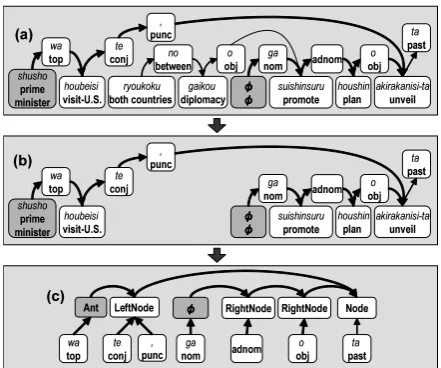
Given a sentence, we first use a standard depen-dency parser to obtain the dependepen-dency parse tree, in which words are structured according to the de-pendency relation between them. Figure 1(a), for example, shows the dependency tree of sentence (1) given in Section 2. We then extract the path between a zero-pronoun and its antecedent as in Figure 1(b). Finally, to encode the order of sib-lings and reduce data sparseness, we further trans-form the extracted path as in Figure 1(c):
• A path is represented by a subtree consist-ing of backbone nodes: φ (zero-pronoun), Ant (antecedent), Node (the lowest common ancestor), LeftNode (left-branch node) and RightNode.
• Each backbone node has daughter nodes, each corresponding to a function word asso-ciated with it.
• Content words are deleted.
This way of encoding syntactic patterns is used in intra-sentential anaphoricity determination. In antecedent identification, on the other hand, the tournament model allows us to incorporate three paths, a path for each pair of a zero-pronoun and left and right candidate antecedents, as shown in
!#"$" %& '' '' '' ''
(&(%)* +, * -.% , 0/.1 /1
2(
3
,4-56 &7(( /85+9
2 % /:; < +5 * 51 =>@? !#"$" %& '' '' '' ''
(&(%)* +, .% , /1 2 < +5 * 51 =AB? C D EF 3
GH89F
[image:4.595.306.527.61.245.2]3 '' '' FI 3 G H89FI 3 /.1 2 < +5 * 51 =JK? * -* -3 0 -3 0 -3
Figure 1: Representation of the path between a zero-pronoun to its antecedent
! "# $ % & '() * + , %- & (.) %% %* , %/0&
1%
1
1" 1%
1
0,
1
1#
$ 1"
1&
(.)
1&
(.) 1"
1
1/&
235476 235856 2359!6 : ;< #= <0 ) , % ,
1:
;< 1#=
<0
[image:4.595.308.526.299.452.2])
Figure 2: Paths used in the tournament model
Figure 25.
4.3 Learning algorithm
As noted in Section 1, the use of zero-pronouns in Japanese is relatively less constrained by syn-tax compared, for example, with English. This forces the above way of encoding path information to produce an explosive number of different paths, which inevitably leads to serious data sparseness.
This issue can be addressed in several ways. The SRL community has devised a range of variants of the standard path representation to reduce the complexity (Carreras and Marquez, 2005). Applying Kernel methods such as Tree kernels (Collins and Duffy, 2001) and Hierarchi-cal DAG kernels (Suzuki et al., 2003) is another strong option. The Boosting-based algorithm
pro-5
[image:5.595.75.291.63.133.2]
Figure 4: Tree representation of features for the tournament model.
posed by Kudo and Matsumoto (2004) is designed to learn subtrees useful for classification.
Leaving the question of selecting learning al-gorithms open, in our experiments, we have so far examined Kudo and Matsumoto (2004)’s al-gorithm, which is implemented as the BACT sys-tem6. Given a set of training instances, each of which is represented as a tree labeled either pos-itive or negative, the BACT system learns a list of weighted decision stumps with a Boosting al-gorithm. Each decision stump is associated with tuple ht, l, wi, where t is a subtree appearing in the training set,la label, andwa weight, indicat-ing that if a given input includest, it giveswvotes tol. The strength of this algorithm is that it deals with structured feature and allows us to analyze the utility of features.
In antecedent identification, we train the tour-nament model by providing a set of labeled trees as a training set, where a label is either left or right. Each labeled tree has (i) path trees TL,
TR and TI (as given in Figure 2) and (ii) a set nodes corresponding to the binary features sum-marized in Table 3, each of which is linked to the root node as illustrated in Figure 4. This way of organizing a labeled tree allows the model to learn, for example, the combination of a subtree of TL and some of the binary features. Anal-ogously, for anaphoricity determination, we use trees (TC, f1, . . . , fn), where TC denotes a path subtree as in Figure 1(c).
5 Experiments
We conducted an evaluation of our method using Japanese newspaper articles. The following four models were compared:
1. BM: Ng and Cardie (2002a)’s model, which identify antecedents by the candidate-wise classification model, and determine anaphoricity using the one-step model.
6http://chasen.org/˜taku/software/bact/
2. BM STR: BM with the syntactic features such as those in Figure 1(c).
3. SCM: The selection-then-classification model explained in Section 3.
4. SCM STR: SCM with all types of syntactic features shown in Figure 2.
5.1 Setting
We created an anaphoric relation-tagged corpus consisting of 197 newspaper articles (1,803 sen-tences), 137 articles annotated by two annotators and 60 by one. The agreement ratio between two annotators on the 197 articles was 84.6%, which indicated that the annotation was sufficiently reli-able.
In the experiments, we removed from the above data set the zero-pronouns to which the two annotators did not agree. Consequently, the data set contained 995 intra-sentential anaphoric zero-pronouns, 754 inter-sentential anaphoric pronouns, and 603 non-anaphoric zero-pronouns (2,352 zero-zero-pronouns in total), with each anaphoric zero-pronoun annotated to be linked to its antecedent. For each of the following exper-iments, we conducted five-fold cross-validation over 2,352 zero-pronouns so that the set of the zero-pronouns from a single text was not divided into the training and test sets.
In the experiments, all the features were auto-matically acquired with the help of the follow-ing NLP tools: the Japanese morphological ana-lyzer ChaSen7and the Japanese dependency struc-ture analyzer CaboCha8, which also carried out named-entity chunking.
5.2 Results on intra-sentential zero-anaphora resolution
In both intra-anaphoricity determination and an-tecedent identification, we investigated the effect of introducing the syntactic features for improv-ing the performance. First, the results of an-tecedent identification are shown in Table 1. The comparison between BM (SCM) with BM STR (SCM STR) indicates that introducing the struc-tural information effectively contributes to this task. In addition, the large improvement from BM STR to SCM STR indicates that the use of the preference-based model has significant impact on intra-sentential antecedent identification. This
7
http://chasen.naist.jp/hiki/ChaSen/
Figure 3: Feature set.
Feature Type Feature Description
Lexical HEAD BF characters of right-most morpheme in NP (PRED). Grammatical PRED IN MATRIX 1 if PRED exists in the matrix clause; otherwise 0.
PRED IN EMBEDDED 1 if PRED exists in the relative clause; otherwise 0.
PRED VOICE 1 if PRED contains auxiliaries such as ‘(ra)reru’; otherwise 0.
PRED AUX 1 if PRED contains auxiliaries such as ‘(sa)seru’, ‘hosii’, ‘morau’, ‘itadaku’, ‘kudasaru’, ‘yaru’ and ‘ageru’.
PRED ALT 1 ifPRED VOICEis 1 orPRED AUXis 1; otherwise 0.
POS Part-of-speech of NP followed by IPADIC (Asahara and Matsumoto, 2003).
DEFINITE 1 if NP contains the article corresponding to DEFINITE ‘the’, such as ‘sore’ or ‘sono’; otherwise 0.
DEMONSTRATIVE 1 if NP contains the article corresponding to DEMONSTRATIVE ‘that’ or
‘this’, such as ‘kono’, ‘ano’; otherwise 0.
PARTICLE Particle followed by NP, such as ‘wa (topic)’, ‘ga (subject)’, ‘o (object)’. Semantic NE Named entity of NP: PERSON, ORGANIZATION, LOCATION, ARTIFACT,
DATE, TIME, MONEY, PERCENTor N/A.
EDR HUMAN 1 if NP is included among the concept ‘a human being’ or ‘atribute of a human being’ in EDR dictionary (Jap, 1995); otherwise 0.
PRONOUN TYPE Pronoun type of NP. (e.g. ‘kare (he)’→PERSON, ‘koko (here)’→LOCATION, ‘sore (this)’→OTHERS)
SELECT REST 1 if NP satisfies selectional restrictions in Nihongo Goi Taikei (Japanese Lexi-con) (Ikehara et al., 1997); otherwise 0.
COOC the score of well-formedness model estimated from a large number of triplets hNoun, Case, Predicateiproposed by Fujita et al. (2004)
Positional SENTNUM Distance between NP and PRED.
BEGINNING 1 if NP is located in the beggining of sentence; otherwise 0.
END 1 if NP is located in the end of sentence; otherwise 0.
PRED NP 1 if PRED precedes NP; otherwise 0.
NP PRED 1 if NP precedes PRED; otherwise 0.
DEP PRED 1 if NPidepends on PRED; otherwise 0.
DEP NP 1 if PRED depends on NPi; otherwise 0.
IN QUOTE 1 if NP exists in the quoted text; otherwise 0.
Heuristic CL RANK a rank of NP in forward looking-center list based on Centering Theory (Grosz et al., 1995)
CL ORDER a order of NP in forward looking-center list based on Centering Theory (Grosz
et al., 1995)
NP and PRED stand for a bunsetsu-chunk of a candidate antecedent and a bunsetsu-chunk of a predicate which has a target
zero-pronoun respectively.
finding may well contribute to semantic role label-ing because these two tasks have a large overlap as discussed in Section 1.
Second, to evaluate the performance of intra-sentential zero-anaphora resolution, we plotted recall-precision curves altering threshold parame-ter andθinterfor intra-anaphoricity determination as shown in Figure 5, where recallRand precision
P were calculated by:
R = # of detected antecedents correctly
# of anaphoric zero-pronouns ,
P = # of detected antecedents correctly
# of zero-pronouns classified as anaphoric.
The curves indicate the upperbound of the perfor-mance of these models; in practical settings, the parameters have to be trained beforehand.
Figure 5 shows that BM STR (SCM STR) out-performs BM (SCM), which indicates that in-corporating syntactic pattern features works re-markably well for intra-sentential zero-anaphora
Table 1: Accuracy of antecedent identification.
BM BM STR SCM SCM STR
48.0% 63.5% 65.1% 70.5%
(478/995) (632/995) (648/995) (701/995)
resolution. Futhermore, SCM STR is signif-icantly better than BM STR. This result sup-ports that the former has an advantage of learn-ing non-anaphoric zero-pronouns (181 instances) as negative training instances in intra-sentential anaphoricity determination, which enables it to re-ject non-anaphoric zero-pronouns more accurately than the others.
5.3 Discussion
0 0.2 0.4 0.6 0.8 1
0 0.1 0.2 0.3 0.4 0.5 0.6 0.7 0.8
precision
recall BM BM_STR
SCM SCM_STR
[image:7.595.311.520.65.216.2]BM BM_STR SCM SCM_STR
Figure 5: Recall-precision curves of intra-sentential zero-anaphora resolution.
0 0.2 0.4 0.6 0.8 1
0 0.1 0.2 0.3 0.4 0.5 0.6 0.7 0.8
precision
recall SCM_STR
IN_Q OUT_Q
SCM_STR IN_Q OUT_Q
Figure 6: Recall-precision curves of resolving in-quote and out-in-quote zero-pronouns.
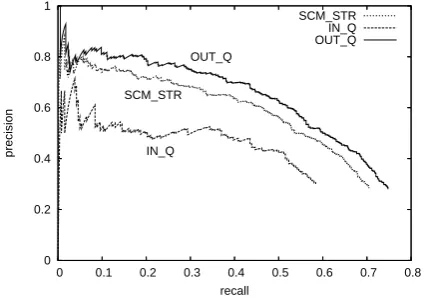
(262 pronouns) and the rest (733 zero-pronouns), where “IN Q” denotes the former (in-quote zero-pronouns) and “OUT Q” the latter. The accuracy on the IN Q problems is consider-ably lower than that on the OUT Q cases, which indicates that we should deal with in-quote cases with a separate model so that it can take into ac-count the nested structure of discourse segments introduced by quotations.
5.4 Impact on overall zero-anaphora resolution
We next evaluated the effects of introducing the proposed model on overall zero-anaphora resolu-tion including inter-sentential cases.
As a baseline model, we implemented the origi-nal SCM, designed to resolve intra-sentential zero-anaphora and inter-sentential zero-zero-anaphora si-multaneously with no syntactic pattern features. Here, we adopted Support Vector Machines (Vap-nik, 1998) to train the classifier on the baseline
0 0.2 0.4 0.6 0.8 1
0 0.05 0.1 0.15 0.2 0.25 0.3 0.35 0.4 0.45 0.5
precision
recall SCM
SCM_STR
θintra=0.022
0.013
[image:7.595.74.287.65.216.2]0.009 0.005 -0.006 SCM SCM_STR
Figure 7: Recall-precision curves of overall zero-anaphora resolution.
0 0.05 0.1 0.15 0.2 0.25 0.3
-0.05 -0.04 -0.03 -0.02 -0.01 0 0.01 0.02 0.03 0.04 0.05
AUC
threshold θintra
SCM SCM_STR
SCM SCM_STR
Figure 8: AUC curves plotted by alteringθintra.
model and the inter-sentential zero-anaphora res-olution in the SCM using structural information.
For the proposed model, we plotted several recall-precision curves by selecting different value for threshold parametersθintraandθinter. The re-sults are shown in Figure 7, which indicates that the proposed model significantly outperforms the original SCM ifθintrais appropriately chosen.
We then investigated the feasibility of parameter selection forθintraby plotting the AUC values for different θintra values. Here, each AUC value is the area under a recall-precision curve. The results are shown in Figure 8. Since the original SCM does not useθintra, the AUC value of it is constant, depicted by the SCM. As shown in the Figure 8, the AUC-value curve of the proposed model is not peaky, which indicates the selection of parameter
[image:7.595.74.287.272.421.2] [image:7.595.311.520.287.439.2]6 Conclusion
In intra-sentential zero-anaphora resolution, syn-tactic patterns of the appearance of zero-pronouns and their antecedents are useful clues. Taking Japanese as a target language, we have empirically demonstrated that incorporating rich syntactic pat-tern features in a state-of-the-art learning-based anaphora resolution model dramatically improves the accuracy of intra-sentential zero-anaphora, which consequently improves the overall perfor-mance of zero-anaphora resolution.
In our next step, we are going to address the is-sue of how to find zero-pronouns, which requires us to design a broader framework that allows zero-anaphora resolution to interact with predicate-argument structure analysis. Another important issue is how to find a globally optimal solution to the set of zero-anaphora resolution problems in a given discourse, which leads us to explore methods as discussed by McCallum and Well-ner (2003).
References
M. Asahara and Y. Matsumoto, 2003. IPADIC User Manual. Nara Institute of Science and Technology, Japan. B. Baldwin. 1995. CogNIAC: A Discourse Processing
En-gine. Ph.D. thesis, Department of Computer and
Informa-tion Sciences, University of Pennsylvania.
X. Carreras and L. Marquez. 2005. Introduction to the conll-2005 shared task: Semantic role labeling. In Proceedings
of the Ninth CoNll, pages 152–164.
M. Collins and N.l Duffy. 2001. Convolution kernels for natural language. In Proceedings of the NIPS, pages 625– 632.
A. Fujita, K. Inui, and Y. Matsumoto. 2004. Detection of in-correct case assignments in automatically generated para-phrases of japanese sentences. In Proceeding of the first
IJCNLP, pages 14–21.
D. Gildea and D. Jurafsky. 2002. Automatic labeling of se-mantic roles. In Computational Linguistics, pages 245– 288.
B. J. Grosz, A. K. Joshi, and S. Weinstein. 1995. Center-ing: A framework for modeling the local coherence of discourse. Computational Linguistics, 21(2):203–226. R. Iida, K. Inui, H. Takamura, and Y. Matsumoto. 2003.
In-corporating contextual cues in trainable models for coref-erence resolution. In Proceedings of the 10th EACL
Work-shop on The Computational Treatment of Anaphora, pages
23–30.
R. Iida, K. Inui, and Y. Matsumoto. 2005. Anaphora resolu-tion by antecedent identificaresolu-tion followed by anaphoricity determination. ACM Transactions on Asian Language
In-formation Processing (TALIP), 4:417–434.
S. Ikehara, M. Miyazaki, S. Shirai A. Yokoo, H. Nakaiwa, K. Ogura, Y. Ooyama, and Y. Hayashi. 1997. Nihongo
Goi Taikei (in Japanese). Iwanami Shoten.
Japan Electronic Dictionary Research Institute, Ltd. Japan, 1995. EDR Electronic Dictionary Technical Guide. M. Kameyama. 1986. A property-sharing constraint in
cen-tering. In Proceedings of the 24th ACL, pages 200–206.
T. Kudo and Y. Matsumoto. 2004. A boosting algorithm for classification of semi-structured text. In Proceedings of
the 2004 EMNLP, pages 301–308.
S. Lappin and H. J. Leass. 1994. An algorithm for pronominal anaphora resolution. Computational
Linguis-tics, 20(4):535–561.
A. McCallum and B. Wellner. 2003. Object consolidation by graph partitioning with a conditionally trained distance metric. In Proceedings of the KDD-2003 Workshop on
Data Cleaning, Record Linkage, and Object Consolida-tion, pages 19–24.
J. F. McCarthy and W. G. Lehnert. 1995. Using decision trees for coreference resolution. In Proceedings of the
14th IJCAI, pages 1050–1055.
R. Mitkov. 1997. Factors in anaphora resolution: they are not the only things that matter. a case study based on two different approaches. In Proceedings of the
ACL’97/EACL’97 Workshop on Operational Factors in Practical, Robust Anaphora Resolution.
H. Nakaiwa and S. Shirai. 1996. Anaphora resolution of japanese zero pronouns with deictic reference. In
Pro-ceedings of the 16th COLING, pages 812–817.
V. Ng. 2004. Learning noun phrase anaphoricity to improve coreference resolution: Issues in representation and opti-mization. In Proceedings of the 42nd ACL, pages 152– 159.
V. Ng and C. Cardie. 2002a. Improving machine learning approaches to coreference resolution. In Proceedings of
the 40th ACL, pages 104–111.
M. Okumura and K. Tamura. 1996. Zero pronoun resolu-tion in japanese discourse based on centering theory. In
Proceedings of the 16th COLING, pages 871–876.
M. Poesio, O. Uryupina, R. Vieira, M. Alexandrov-Kabadjov, and R. Goulart. 2004. Discourse-new detectors for defi-nite description resolution: A survey and a preliminary proposal. In Proceedings of the 42nd ACL Workshop on
Reference Resolution and its Applications, pages 47–54.
K. Seki, A. Fujii, and T. Ishikawa. 2002. A probabilistic method for analyzing japanese anaphora integrating zero pronoun detection and resolution. In Proceedings of the
19th COLING, pages 911–917.
W. M. Soon, H. T. Ng, and D. C. Y. Lim. 2001. A ma-chine learning approach to coreference resolution of noun phrases. Computational Linguistics, 27(4):521–544. M. Strube and C. M¨uller. 2003. A machine learning
ap-proach to pronoun resolution in spoken dialogue. In
Pro-ceedings of the 41st ACL, pages 168–175.
J. Suzuki, T. Hirao, Y. Sasaki, and E. Maeda. 2003. Hierar-chical directed acyclic graph kernel: Methods for struc-tured natural language data. In Proceeding of the 41st
ACL, pages 32–39.
V. N. Vapnik. 1998. Statistical Learning Theory. Adaptive and Learning Systems for Signal Processing Communica-tions, and control. John Wiley & Sons.
X. Yang, G. Zhou, J. Su, and C. L. Tan. 2003. Coreference resolution using competition learning approach. In