A Collaborative Framework for Collecting Thai Unknown Words from
the Web
Choochart Haruechaiyasak, Chatchawal Sangkeettrakarn, Pornpimon Palingoon Sarawoot KongyoungandChaianun Damrongrat
Information Research and Development Division (RDI) National Electronics and Computer Technology Center (NECTEC) Thailand Science Park, Klong Luang, Pathumthani 12120, Thailand
Abstract
We propose a collaborative framework for collecting Thai unknown words found on Web pages over the Internet. Our main goal is to design and construct a Web-based system which allows a group of in-terested users to participate in construct-ing a Thai unknown-word open dictionary. The proposed framework provides sup-porting algorithms and tools for automati-cally identifying and extracting unknown words from Web pages of given URLs. The system yields the result of unknown-word candidates which are presented to the users for verification. The approved unknown words could be combined with the set of existing words in the lexicon to improve the performance of many NLP tasks such as word segmentation, infor-mation retrieval and machine translation. Our framework includes word segmenta-tion and morphological analysis modules for handling the non-segmenting charac-teristic of Thai written language. To take advantage of large available text resource on the Web, our unknown-word boundary identification approach is based on the sta-tistical string pattern-matching algorithm.
Keywords: Unknown words, open dictio-nary, word segmentation, morphological analysis, word-boundary detection.
1 Introduction
The advent of the Internet and the increasing pop-ularity of the Web have altered many aspects of natural language usage. As more people turn to the
Internet as a new communicating channel, the tex-tual information has increased tremendously and is also widely accessible. More importantly, the available information is varied largely in terms of topic difference and multi-language characteristic. It is not uncommon to find a Web page written in Thai lies adjacent to a Web page written in English via a hyperlink, or a Web page containing both Thai and English languages. In order to perform well in this versatile environment, an NLP system must be adaptive enough to handle the variation in language usage. One of the problems which re-quires special attention is unknown words.
As with most other languages, unknown words also play an extremely important role in Thai-language NLP. Unknown words are viewed as one of the problematic sources of degrading the per-formance of traditional NLP applications such as MT (Machine Translation), IR (Information Re-trieval) and TTS (Text-To-Speech). Reduction in the amount of unknown words or being able to correctly identify unknown words in these sys-tems would help increase the overall system per-formance.
The problem of unknown words in Thai lan-guage is perhaps more severe than in English or other latin-based languages. As a result of the information technology revolution, Thai people have become more familiar with other foreign lan-guages especially English. It is not uncommon to hear a few English words over a course of con-versation between two Thai people. The foreign words along with other Thai named entities are among the new words which are continuously cre-ated and widely circulcre-ated. To write a foreign word, the transliterated form of Thai alphabets is often used. The Royal Institute of Thailand is the official organization in Thailand who has
sibility and authority in defining and approving the use of new words. The process of defining a new word is manual and time-consuming as each word must be approved by a working group of linguists. Therefore, this traditional approach of construct-ing the lexicon is not a suitable solution, especially for systems running on the Web environment.
Due to the inefficiency of using linguists in defining new lexicon, there must be a way to au-tomatically or at least semi-auau-tomatically collect new unknown words. In this paper, we propose a collaborative framework for collecting unknown words from Web pages over the Internet. Our main purpose is to design and construct a system which automatically identifies and extracts un-known words found on Web pages of given URLs. The compiled list of unknown-word candidates is to be verified by a group of participants. The ap-proved unknown words are then added to the ex-isting lexicon along with the other related infor-mation such as meaning and POS (part of speech).
This paper focuses on the underlying algorithms for supporting the process of identifying and ex-tracting unknown words. The overall process is composed of two steps: unknown-word detection and unknown-word boundary identification. The first step is to detect the locations of unknown-word occurrences from a given text. Since Thai language belongs to the class of non-segmenting language group in which words are written contin-uously without using any explicit delimiting char-acter, detection of unknown words could be ac-complished mainly by using a word-segmentation algorithm with a morphological analysis. By us-ing a dictionary-based word-segmentation algo-rithm, locations of words which are not previ-ously included in the dictionary will be easily de-tected. These unknown words belong to the class ofexplicitunknown words and often represent the transliteration of foreign words.
The other class of unknown words is hidden
unknown words. This class includes new words which are created through the combination of some existing words in the lexicon. The hidden
unknown words are usually named entities such as a person’s name and an organization’s name. Thehiddenunknown words could be identified us-ing the approaches such as n-gram generation and phrase chunking. The scope of this paper focuses only on the extraction of the explicit unknown words. However, the design of our framework also
includes the extraction ofhiddenunknown words. We will continue to explore this issue in our future works.
Once the location of an unknown word is de-tected, the second step involves the identification of its boundary. Since we use the Web as our main resource, we could take advantage of its large availability of textual contents. We are interested in collecting unknown words which occur more than once throughout the corpus. Unknown words which occur only once in the large corpus are not considered as being significant. These words may be unusual words which are not widely accepted, or could be misspelling words. Using this assump-tion, our approach for identifying the unknown-word boundary is based on a statistical pattern-matching algorithm. The basic idea is that the same unknown word which occurs more than once would likely to appear in different surrounding contexts. Therefore, a group of characters which form the unknown word could be extracted by an-alyzing the string matching patterns.
To evaluate the effectiveness of our proposed framework, experiments using a real data set col-lected from the Web are performed. The experi-ments are designed to test each of the two main steps of the framework. Variation of morphologi-cal analysis are tested for the unknown-word de-tection. The detection rate of unknown words were found to be as high as approximately 96%. Three variations of string pattern-matching tech-niques were tested for unknown-word boundary identification. The identification accuracy was found to be as high as approximately 36%. The relatively low accuracy is not the major concern since the unknown-word candidates are to be ver-ified and corrected by users before they are ac-tually added to the dictionary. The system is implemented via the Web-browser environment which provides user-friendly interface for verifi-cation process.
2 Previous Works
The research and study in unknown-word prob-lem have been extensively done over the past decades. Unknown words are viewed as prob-lematic source in the NLP systems. Techniques in identifying and extracting unknown words are somewhat language-dependent. However, these techniques could be classified into two major cat-egories, one for segmenting languages and an-other for non-segmenting languages. Segment-ing languages, such as latin-based languages, use delimiting characters to separate written words. Therefore, once the unknown words are detected, their boundaries could be identified relatively eas-ily when compared to those for non-segmenting languages.
Some examples of techniques involving segmenting languages are listed as follows. Toole (2000) used multiple decision trees to identify names and misspellings in English texts. Features used in constructing the decision trees are, for example, POS (Part-Of-Speech), word length, edit distance and character sequence frequency. Similarly, a decision-tree approach was used to solve the POS disambiguation and unknown word guessing in (Orphanos and Christodoulakis, 1999). The research in the unknown-word problem for segmenting lan-guages is also closely related to the extraction of named entities. The difference of these techniques to those in non-segmenting languages is that the approach needs to parse the written text in word-level as opposed to character-level.
The research in unknown-word problem for non-segmenting languages is highly active for Chinese and Japanese. Many approaches have been proposed and experimented with. Asahara and Matsumoto (2004) proposed a technique of SVM-based chunking to identify unknown words from Japanese texts. Their approach used a sta-tistical morphological analyzer to segment texts into segments. The SVM was trained by using POS tags to identify the unknown-word bound-ary. Chen and Ma (2002) proposed a practical unknown word extraction system by considering both morphological and statistical rule sets for word segmentation. Chang and Su (1997) pro-posed an unsupervised iterative method for ex-tracting unknown lexicons from Chinese text cor-pus. Their idea is to include the potential unknown words to the augmented dictionary in order to
im-prove the word segmentation process. Their pro-posed approach also includes both contextual con-straints and the joint character association metric to filter the unlikely unknown words. Other ap-proaches to identify unknown words include sta-tistical or corpus-based (Chen and Bai, 1998), and the use of heuristic knowledge (Nie et al. , 1995) and contextual information (Khoo and Loh, 2002). Some extensions to unknown-word identification have been done. An example include the determi-nation of POS for unknown words (Nakagawa et al. , 2001).
The research in unknown words for Thai guage has not been widely done as in other lan-guages. Kawtrakul et al. (1997) used the combina-tion of a statistical model and a set of context sen-sitive rules to detect unknown words. Our frame-work has a different goal from previous frame-works. We consider unknown-word problem as collaborative task among a group of interested users. As more textual content is provided to the system, new un-known words could be extracted with more accu-racy. Thus, our framework can be viewed as col-laborative and statistical or corpus-based.
3 Unknown-Word Problem in Word Segmentation Algorithms
Similar to Chinese, Japanese and Korea, Thai guage belongs to the class of non-segmenting lan-guages in which words are written continuously without using any explicit delimiting character. To handle non-segmenting languages, the first re-quired step is to perform word segmentation. Most word segmentation algorithms use a lexicon or dictionary to parse texts at the character-level. A typical word segmentation algorithm yields three types of results: known words, ambiguous seg-ments, and unknown segments. Known words are existing words in the lexicon. Ambiguous seg-ments are caused by the overlapping of two known words. Unknown segments are the combination of characters which are not defined in the lexicon.
In this paper, we are interested in extracting the unknown words with high precision and re-call results. Three types of unknown words are
hidden, explicit and mixed (Kawtrakul et al. , 1997). Hidden unknown words are composed by different words existing in the lexicon. To illus-trate the idea, let us consider an unknown word
ex-ist in a dictionary, then ABCD is considered as a hidden unknown word. The explicit unknown words are newly created words by using differ-ent characters. Let us again consider an unknown word ABCD. Suppose that there is no substring ofABCD(i.e.,AB,BC,CD,ABC,BCD) exists in the dictionary, thenABCDis considered as explicit unknown words. The mixed unknown words are composed of both existing words in a dictionary and non-existing substrings. From the example of unknown stringABCD, if there is at least one sub-string ofABCD(i.e.,AB,BC,CD,ABC,BCD) ex-ists in the dictionary, thenABCDis considered as a mixed unknown word.
It can be immediately seen that the detection of thehiddenunknown words are not trivial since the parser would mistakenly assume that all the frag-ments of the words are valid, i.e., previously de-fined in the dictionary. In this paper, we limit our-self to the extraction of theexplicitandmixed un-known words. This type of unun-known words usu-ally represent the transliteration of foreign words. Detection of these unknown words could be ac-complished mainly by using a word-segmentation algorithm with a morphological analysis. By using a dictionary-based word-segmentation algorithm, locations of words which are not previously de-fined in the lexicon could be easily detected.
4 The Proposed Framework
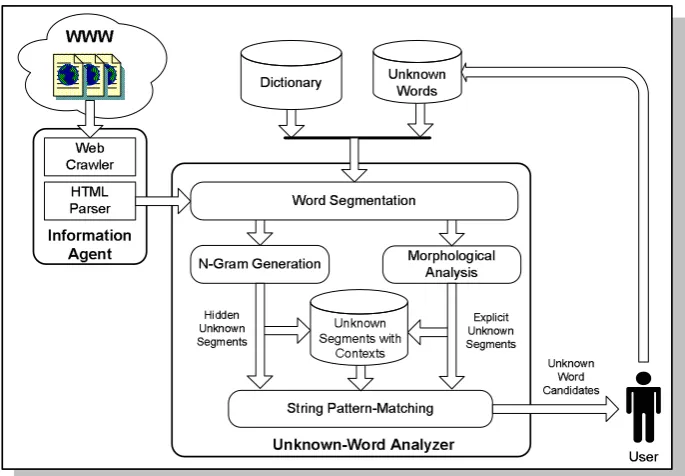
The overall framework is shown in Figure 1. Two major components are information agent and unknown-word analyzer. The details of each com-ponent are given as follows.
• Information agent: This module is com-posed of a Web crawler and an HTML parser. It is responsible for collecting HTML sources from the given URLs and extracting the tex-tual data from the pages. Our framework is designed to support multi-user and collabora-tive environment. The advantage of this de-sign approach is that unknown words could be collected and verified more efficiently. More importantly, it allows users to select the Web pages which suit their interests.
• Unknown-word analyzer: This module is composed of many components for analyzing and extracting unknown words. Word seg-mentation module receives text strings from the information agent and segments them
into a list of words. N-gram generation module is responsible for generating hidden unknown-word candidates. Morphological analysis module is used to form initial ex-plicit unknown-word segments. String pat-tern matching unit performs unknown-word boundary identification task. It takes the intermediate unknown segments and iden-tifies their boundaries by analyzing string matching patterns The results are processed unknown-word candidates which are pre-sented to linguists for final post-processing and verification. New unknown words are combined with the dictionary to iteratively improve the performance of the word seg-mentation module. Details of each compo-nent are given in the following subsections.
4.1 Unknown-Word Detection
As previously mentioned in Section 3, applying a word-segmentation algorithm on a text string yields three different segmented outputs: known, ambiguous, and unknown segments. Since our goal is to simply detect the unknown segments without solving or analyzing other related issues in word segmentation, using thelongest-matching
word segmentation algorithm previously proposed by Poowarawan (1986) is sufficient. An exam-ple to illustrate the word-segmentation process is given as follows.
Let the following string denotes a text string written in Thai language:
{a1a2...aib1b2...bjc1c2...ck}. Suppose that
{a1a2...ai} and {c1c2...ck} are known words
from the dictionary, and {b1b2...bj} be an
un-known word. For the explicit unknown-word case, applying the word-segmentation algo-rithm would yield the following segments:
{a1a2...ai}{b1}{b2}...{bj}{c1c2...ck}. It can be
!"#
$%& '( ) ! *+,# -./ .0
102
30 04
56789:9; <=>=?@= ABCDB=;E F9GGB=
<=>=?@= ABCDB=;E
<=>=?@= H?IG JK=G9GK;BE 0L00
M2 04 /0
NOPOQRO STUVTOWXRYWZ
[image:5.595.125.468.57.295.2][QOWT\WX
Figure 1: The proposed framework for collecting Thai unknown words.
ple, a merging of two characters per segment would give the following unknown segments:
{b1b2}{b3b4}...{bj−1bj}. In the following
experi-ment section, the merging of two to five characters per segment including the merging of all unknown segments without limitation will be compared.
Morphological analysis is applied to guaran-tee grammatically correct word boundaries. Sim-ple morphological rules are used in the frame-work. The rule set is based on two types of characters, front-dependent characters and rear-dependent characters. Front-rear-dependent characters are characters which must be merged to the seg-ment leading them. Rear-dependent characters are characters which must be merged to the seg-ment following them. In Thai written language, these dependent characters are some vowels and tonal characters which have specific grammatical constraints. Applying morphological analysis will help making the unknown segments more reliable.
4.2 Unknown-Word Boundary Identification
Once the unknown segments are detected, they are stored into a hashtable along with their con-textual information. Our unknown-word bound-ary identification approach is based on a string pattern-matching algorithm previously proposed by Boyer and Moore (1977). Consider the unknown-word boundary identification as a string pattern-matching problem, there are two possible strategies: considering the longest matching
pat-tern and considering the most frequent matching pattern as the unknown-word candidates. Both strategies could be explained more formally as fol-lows.
Given a set of N text strings, {S1S2...SN},
where Si, is a series of leni characters
de-noted by {ci,1ci,2...ci,leni} and each is marked
with an unknown-segment position, posi, where
1≤posi≤leni. Given a new string, Sj, with
an unknown-segment position, posj, the longest
pattern-matching strategy iterates through each string,S1toSN and records thelongeststring
pat-tern which occur in both Sj and the other string
in the set. On the other hand, the most fre-quent pattern-matching strategy iterates through each string, S1 to SN, but records the matching
pattern which occur most frequently.
Figure 2: Example of Web-Based Interface
5 Experiments and Results
In this section, we evaluate the performance of our proposed framework. The corpus used in the experiments is composed of 8,137newspaper ar-ticles collected from a top-selling Thai newspa-per’s Web site (Thairath, 2003) during 2003. The corpus contains a total of 78,529unknown words of which 14,943 are unique. This corpus was focused on unknown words which are transliter-ated from foreign languages, e.g., English, Span-ish, Japanese and Chinese. We use the publicly available Thai dictionary LEXiTRON, which con-tains approximately 30,000 words, in our frame-work (Lexitron, 2006).
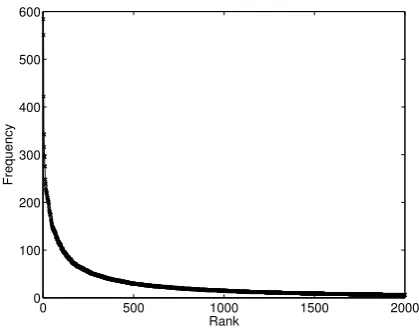
We first analyze the unknown-word set to ob-serve its characteristics. Figure 3 shows the plot of unknown-word frequency distribution. Not sur-prisingly, the frequency of unknown-word usage follows a Zipf-like distribution. This means there are a group of unknown words which are used very often, while some unknown words are used only a few times over a time period. Based on the fre-quency statistics of unknown words, only about
3%(2,375words out of78,529) occur only once in the corpus. Therefore, this finding supports the use of statistical pattern-matching algorithm described in previous section.
5.1 Evaluation of Unknown-Word Detection Approaches
As discussed in Section 4, multiple unknown seg-ments could be merged to form a representative unknown segment. The merging will help reduce the complexity in the unknown-word boundary identification as fewer segments will be checked for the same set of unknown words.
The following variations of merging approach are compared.
• No merging (none): No merging process is
0 500 1000 1500 2000 0
100 200 300 400 500 600
Rank
Frequency
Figure 3: Unknown-word frequency distribution.
applied.
• N-character Merging (N-char): Allow the maximum ofNcharacters per segment.
• Merging all segments (all): No limit on num-ber of characters per segment.
We measure the performance of unknown-word detection task by using two metrics. The first is the detection rate (or recall) which is equal to the number of detected unknown words divided by the total number of previously tagged unknown words in the corpus. The second is the averaged de-tected positions per word. The second metric di-rectly represents the overhead or the complexity to the unknown-word boundary identification pro-cess. This is because all detected positions from a single unknown word must be checked by the process. The comparison results are shown in Fig-ure 4. As expected, the approach nonegives the maximum detection rate of 96.6%, while the ap-proach all yields the lowest detection rate. An-other interesting observation is that the approach
[image:6.595.311.521.223.388.2]ap-]^_^`_abc de_^ fg h
i j^kel^m ]^_^`_^m nboa_abco n^k p b km
qrsr qtsu qusq qvsq qwsr xtsy
[image:7.595.76.288.283.449.2]tsq wsqu wsru wsyr wsuv zsq cbc^ ~`ek ~`ek ~`ek ~`ek e
Figure 4: Unknown-word detection results
proachnone, however, its averaged detected posi-tions per word is about three times lower. There-fore to reduce the complexity during the unknown-word boundary identification process, one might want to consider using the merging approach of
2-char.
none5 2−char 3−char 4−char 5−char all 10
15 20 25 30 35 40
Unknown−Segment Merging Approach
Word−Boundary Identification Accuracy(%)
long freq freq−morph
Figure 5: Comparison between different unknown-word boundary detection approaches.
5.2 Evaluation of Unknown-Word Boundary
Identification
The unknown-word boundary identification is based on string pattern-matching algorithm. The following variations of string pattern-matching technique are compared.
• Longest matching pattern (long): Select the longest-matching unknown-word candidate
• Most-frequent matching pattern (freq): Se-lect the most-frequent-matching unknown-word candidate
• Most-frequent matching pattern with mor-phological analysis (freq-morph): Similar the the approach freq but with additional morphological analysis to guarantee that the word boundaries are grammatically correct.
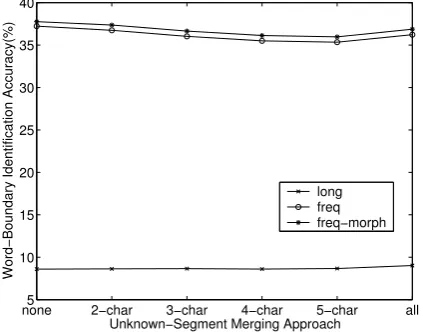
The comparison among all variations of string pattern-matching approaches are performed across all unknown-segment merging approach. The re-sults are shown in Figure 5. The performance met-ric is the word-boundary identification accuracy which is equal to the number of unknown words correctly extracted divided by the total number of tested unknown segments. It can be observed that the selection of different merging approaches does not really effect the accuracy of the unknown-word boundary identification process. But since the approach nonegenerates approximately 6 po-sitions per unknown segment on average, it would be more efficient to perform a merging approach which could reduce the number of positions down by at least 3 times.
The plot also shows the comparison among three approaches of string pattern-matching. Fig-ure 6 summarizes the accuracy results of each string pattern-matching approach by taking the av-erage on all different merging approaches. The ap-proach long performed poorly with the averaged accuracy of8.68%. This is not surprising because selection of the longest matching pattern does not mean that its boundary will be identified correctly. The approaches freq and freq-morph yield simi-lar accuracy of about 36%. The freq-morph im-proves the performance of the approach freq by less than 1%. The little improvement is due to the fact that the matching strings are mostly gram-matically correct. However, the error is caused by the matching collocations of the unknown-word context. If an unknown word occurs together ad-jacent to another word very frequently, they will likely be extracted by the algorithm. Our solu-tion to this problem is by providing the users with a user-friendly interface so unknown-word candi-dates could be easily filtered and corrected.
6 Conclusion
[image:8.595.126.472.65.122.2] ¡ ¢¡ £ ¢¡ ¤¥
Figure 6: Unknown-word boundary identification results
is composed of an information agent and an unknown-word analyzer. The task of the infor-mation agent is to collect and extract textual data from Web pages of given URLs. The word analyzer involves two processes: unknown-word detection and unknown-unknown-word boundary identification. Due to the non-segmenting char-acteristic of Thai written language, the unknown-word detection is based on a unknown-word-segmentation algorithm with a morphological analysis. To take advantage of large available text resource from the Web, the unknown-word boundary identification is based on the statistical pattern-matching algo-rithm.
We evaluate our proposed framework on a col-lection of Web Pages obtained from a Thai news-paper’s Web site. The evaluation is divided to test each of the two processes underlying the frame-work. For the unknown-word detection, the detec-tion rate is found to be as high as96%. In addition, by merging a few characters into a segment, the number of required unknown-word extraction is reduced by at least 3 times, while the detection rate is relatively maintained. For the unknown-word boundary identification, considering the highest frequent occurrence of string pattern is found to be the most effective approach. The identification accuracy was found to be as high as approximately
36%. The relatively low accuracy is not the major concern since the unknown-word candidates are to be verified and corrected by users before they are actually added to the dictionary.
References
Masayuki Asahara and Yuji Matsumoto. 2004. Japanese unknown word identification by character-based chunking. Proceedings of the 20th Inter-national Conference on Computational Linguistics (COLING-2004), 459–465.
R. Boyer and S. Moore. 1977. A fast string searching algorithm. Communications of the ACM, 20:762– 772.
Jing-Shin Chang and Keh-Yih Su. 1997. An Unsu-pervised Iterative Method for Chinese New Lexicon
Extraction. International Journal of Computational Linguistics & Chinese Language Processing, 2(2).
Keh-Jianne Chen and Ming-Hong Bai. 1998. Un-known Word Detection for Chinese by a Corpus-based Learning Method.Computational Linguistics and Chinese Language Processing, 3(1):27–44.
Keh-Jianne Chen and Wei-Yun Ma. 2002. Unknown Word Extraction for Chinese Documents. Proceed-ings of the 19th International Conference on Com-putational Linguistics (COLING-2002), 169–175.
Asanee Kawtrakul, Chalatip Thumkanon, Yuen Poovo-rawan, Patcharee Varasrai, and Mukda Suktarachan. 1997. Automatic Thai Unknown Word Recogni-tion.Proceedings of the Natural Language Process-ing Pacific Rim Symposium, 341–348.
Christopher S.G. Khoo and Teck Ee Loh. 2002. Us-ing statistical and contextual information to iden-tify two-and three-character words in Chinese text.
Journal of the American Society for Information Sci-ence and Technology, 53(5):365–377.
Lexitron Version 2.1, Thai-English Dictionary. Source available: http://lexitron.nectec.or.th, February 2006.
Tetsuji Nakagawa, Taku Kudoh and Yuji Matsumoto. 2001. Unknown Word Guessing and Part-of-Speech Tagging Using Support Vector Machines. Proceed-ings of the Sixth Natural Language Processing Pa-cific Rim Symposium (NLPRS 2001), 325–331.
Jian-Yun Nie, Marie-Louise Hannan and Wanying Jin. 1995. Unknown Word Detection and Segmentation of Chinese Using Statistical and Heuristic Knowl-edge.Communications of COLIPS, 5(1&2):47–57.
Giorgos S. Orphanos and Dimitris N. Christodoulakis. 1999. POS Disambiguation and Unknown Word Guessing with Decision Trees. Proceedings of the EACL, 134–141.
Yuen Poowarawan. 1986. Dictionary-based Thai Syl-lable Separation.Proceedings of the Ninth Electron-ics Engineering Conference.
Thairath Newspaper. Source available: http://www.thairath.com.