Three Dimensional Evolution of SN 1987A in a
Self-Gravitating Disk
L. Zaninetti
Dipartimento di Fisica, via P. Giuria 1, Turin, Italy Email: [email protected]
Received February 16, 2013; revised March 19, 2013; accepted March 28, 2013
Copyright © 2013 L. Zaninetti. This is an open access article distributed under the Creative Commons Attribution License, which permits unrestricted use, distribution, and reproduction in any medium, provided the original work is properly cited.
ABSTRACT
The introduction of an exponential or power law gradient in the interstellar medium (ISM) allows to produce an asym- metric evolution of the supernova remnant (SNR) when the framework of the thin layer approximation is adopted. Un- fortunately both the exponential and power law gradients for the ISM do not have a well defined physical meaning. The physics conversely is well represented by an isothermal self-gravitating disk of particles whose velocity is everywhere Maxwellian. We derived a law of motion in the framework of the thin layer approximation with a control parameter of the swept mass. The photon’s losses, which are often neglected in the thin layer approximation, are modeled trough velocity dependence. The developed framework is applied to SNR 1987A and the three observed rings are simulated.
Keywords: Supernovae; General Supernovae; Individual (SN 1987A) ISM; Supernova Remnants
1. Introduction
The expansion of supernova remnant (SNR) is usually explained by the theory of the shock waves, as an ex- ample [1,2], which analyzes self-similar solutions with varying inverse power law exponents for the density profile of the advancing matter, , and ambient medium,
n R s
R . The SNRs conversely often present a weak departure from the circular symmetry, as an example, in SN 1006 1006 a ratio of 1.2 between maximum and minimum radius which has been measured, see [3] or great asymmetry as the triple ring of SN 1987A 1987a, see [4,5].
The asymmetries of SNRs are hardly explained by the shock theory which is usually developed in spherical or planar symmetry. The presence of gradients in the den- sity of the medium allows to explain such asymmetries when the conservation of the momentum is adopted. As an example an exponential decay allows to model SN1006 1006 and SN 1987A 1987a, see [6]. At the same time the various gradients that can be adopted such as Gaussian, power law and exponential do not have a precise physical basis. The auto-gravitating Maxwellian medium provides a gradient given by the secant law. In this paper we will answer the following questions.
Is it possible to deduce an analytical formula for the temporal evolution of an SN in the presence of a ver- tical profile density as given by an ISD?
Is it possible to deduce an equation of motion for SN with an adjustable parameter that can be found from a numerical analysis of the diameter—time relation- ship?
Is it possible to simulate the appearance of the triple ring system of SN 1987A 1987a?
2. A Modified Thin Layer Approximation
The thin layer approximation with non cubic dependence (NCD), , in classical physics assumes that only a frac- tion of the total mass enclosed in the volume of the ex- pansion accumulates in a thin shell just after the shock
p
front. The global mass between 0 and R0 is
3 0
4
π
3 R where is the density of the ambient medium. The swept mass included in the thin layer which characterizes the expansion is
1
3
0 0
4
π .
3
p M R
(1)
The mass swept between 0 and R is
1
3
4
π .
3
p M R
(2)
after the initial radius R0,
0 0,
MVM V (3) where and V are the radius and velocity of the ad- vancing shock. The velocity is
R 1 0 0 . p M V V M
(4)
The velocity as a function of the radius when the ex- pansion starts at the origin of the coordinates is:
3 0 0 . p R V V R
(5)
The velocity can be expressed as d ,
d
R V
t
(6)
and the integration between R, and t R0, t0 gives
1 1 1 1 1
1 3 1 3 3
0 0 0
3 3
p p p
pR p pR p V R t t 0 . (7) We solve the previous equation for R and we obtain
1 3 1
3 1
1
30 3 0 0 0 .
p p
p p
R t R p V R t t p (8)
The velocity is:
N V
D
(9)
where
1 3 1 3 1 1
3 30 3 0 0 0 0
p p
p p
N R p V R t t p V R 1 0
p p
1 p
1 1
1 1
1 3 3 3
0 0 0 0 0
3 3
0 0 0 0 0 0
3
3 .
p p
p p
D R p V R t V R tp
V R t V R t p
Equation (8) can also be solved with a solution of type
0
R K t t , being a constant, and the asymptotic result is:
k
= 3
0 03
0
3 .p p p p V R t t R t p
(10)
The asymptotic solution for the velocity is
33 33 3 33
330 0 0
3 .
p
p p p p
p
V t p p V R t t (11)
3. Asymmetrical Law of Motion with NCD
Given the Cartesian coordinate system
x y z, ,
, the plane z0 will be called the equatorial plane,
sin
z R , where is the latitude angle which has range , and is the distance from the
origin. In our framework, the polar angle of the spherical coordinate system is
90 90
R
90. Here we adopt the density profile of a thin self-gravitating disk of gas which is cha- racterized by a Maxwellian distribution in velocity and distribution which varies only in the z-direction (ISD). The number density distribution is
20sech n , 2 z n z h
(12)
where 0 is the density at , is a scaling pa-
rameter and is the hyperbolic secant ([7,8]). On assuming that the expansion starts at , we can write
n z0 h
z sech 0
= sz R in and therefore
2
0sech n sin , = , 2 R n R h
(13)
where R is the radius of the advancing shell.
The 3D expansion that starts at the origin of the co- ordinates will be characterized by the following proper- ties
Dependence of the momentary radius of the shell on the polar angle that has a range 90 90.
Independence of the momentary radius of the shell from , the azimuthal angle in the x-y plane, that has a range 0 360.
The mass swept, M , along the solid angle , be- tween 0 and R is
30 0
4
π ,
3 H m 3 0 H
R m nI R R n m
M (14)
where
0
2sech2 sin d ,
2
R m R
r
R r r
h
I (15)
where R0 is the initial radius and mH the mass of the hydrogen. The integral is
1 sin 2 1 in 24 s 1 e 4
sin
r h m
hr I R hr
sin 2 28 ln 1 e sin
r h h r
(16)
sin 3 3 28 Li e sin ,
r h h
(17)
where
2 2 =1 , Li n n z z n
(18)is the dilogarithm, see [9-11].
The conservation of the momentum gives
where is the velocity at and 0 is the initial
velocity at 0 where is the NCD parameter.
This means that only a fraction of the total mass enclosed in the volume of the expansion accumulates in a thin shell just after the shock front. The emission of photons produces losses in the momentum carried by the advanc- ing shell here assumed to be proportional to . The generalized conservation law is now
R R
p
R R R
2 R R
1
12
0 p ,
p
l 0
M R R C R R M R R
es
(20)
where l is a constant. At the moment of writing is not possible to deduce the parameter l which controls the
quantity of momentum carried away by the photons due to the presence of the parameter which controls the quantity of swept mass during the expansion. According to the previous generalized Equation (20) an analytical expression for can be found but it is complex and therefore we omit it. In this differential equation of the first order R the variable can be separated and the integration term by term giv
C
C
p
V R
in
0
1
1 2
0 0 0
d
R p p
l
R M R C R r M R R t t
,
(21)where is the time and 0 the time at . We there-
fore have an equation of the type
t t R0
1 3 1
0 0 0
, , 3 p p ,
NL
R R h R V t t
0
(22)
where
R R h, 0, NL has an analytical but complexform. In our case in order to find the root of the nonlinear Equation (22) the FORTRAN SUBROUTINE ZRIDDR from [12] has been used.
The physical units have not yet been specified, for length and for time are perhaps an acceptable astrophysical choice. On adopting the previous units, the initial velocity is expressed in pc/yr and should be converted into
pc yr
0 V
km
1 V
s; this means that V0 = 1.020738 ×
10−6V
1 where is the initial velocity expressed in
km s.
4. Application to SN 1987A
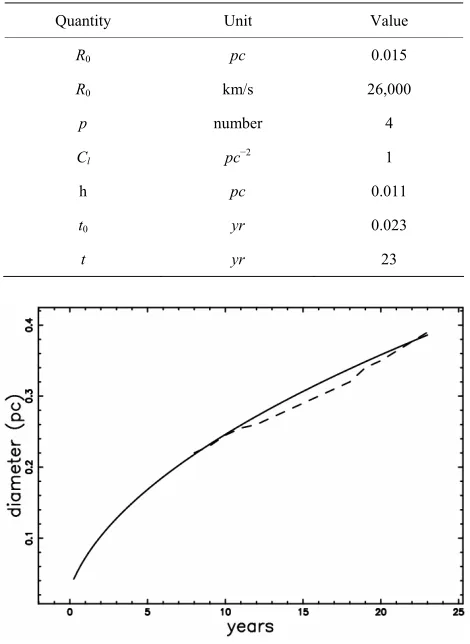
4.1. The SimulationThe SN 1987A exploded in the Large Magellanic Cloud in 1987. The observed image is complex and we will fol- low the nomenclature of [13] which distinguish between torus only, torus +2 lobes and torus +4 lobes. In parti- cular we concentrate on the torus which is characterized by a distance from the center of the tube and the radius of the tube. Table 2 of [13] reports the relationship between distance of the torus in arcsec and time since the explo- sion in days. Figure 3 in [14] reports diameter in pc ver- sus year when the counting pixels is adopted. Table 1 re-
ports the data used in the simulation, Figures 1 and 2
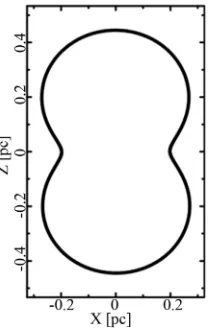
report the diameter and the velocity in the equatorial plane respectively as well the observational data as found by the counting pixels method, see [14]. Figure 3 reports the asymmetric expansion in a section crossing the center,
Figures 4 and 5 report the radius and the velocity res- pectively as a function of the position angle θ.
The swept mass in our model is not constant but varies with the value of latitude, see Figure 6.
4.2. The Image
We assume that the emissivity is proportional to the num- ber density.
,j KC s (23)
[image:3.595.306.541.367.689.2]where j is the emission coefficient and K is a cons- tant function. This can be the case of synchrotron radi- ation in presence of an isotropic distribution of electrons with a power law distribution in energy, N E
,Table 1. Numerical value of the parameters of the simula- tion for SN 1987A.
Quantity Unit Value
R0 pc 0.015
R0 km/s 26,000
p number 4
Cl pc−2 1
h pc 0.011
t0 yr 0.023
t yr 23
Figure 2. Velocity as a function of time for a self-gravitating medium (full line) when θ= 0.001 (equatorial plane) and as- tronomical data of torus only as extracted from Figure 3 in [14] (empty stars). Physical parameters as in Table 1.
Figure 3. Section of SN 1987A in the x-z plane. The hori- zontal and vertical axis are in pc. Physical parameters as in Table 1.
[image:4.595.308.539.299.469.2]Figure 4. Radius in pc of SN 1987A as a function of the po- sition angle in degrees for a self-gravitating medium. Physi- cal parameters as in Table 1.
Figure 5. Velocity in km/s of SN 1987A as a function of the position angle in degrees for a self-gravitating medium. Phy- sical parameters as in Table 1.
Figure 6. Swept mass of SN 1987A in arbitrary units as a function of the position angle in degrees, for a self-gravita- ting medium. Physical parameters as in Table 1.
f,s
N E dE K E (24)
where Ks is a constant. The source of synchrotron lu-
minosity is assumed here to be the flux of kinetic energy, ,
m
L
3
1 , 2
m
L AV (25)
where A is the considered area, see formula (A28) in [15]. In our case A4πR2, which means
2 3
1
4π , 2
m
L RV
nd (26)
where R is the instantaneous radius of the SNR a
is the density in the advancing layer in which the synchrotron emission takes place. The total observed luminosity can be expressed as
,
tot m
[image:4.595.121.227.321.485.2] [image:4.595.59.289.532.700.2]where is a constant of conversion from the mecha- nical luminosity to the total observed luminosity in syn- chrotron emission.
The numerical algorithm which allows us to build a complex image is now outlined.
An empty (value = 0) memory grid
i j k, ,
which contains NDIM3 pixels is considered
We first generate an internal 3D surface by rotating the ideal image 180 around the polar direction and
a second external surface at a fixed distance R
from the first surface. As an example, we fixed
12
R R
, where R is the momentary radius of expansion. The points on the memory grid which lie between the internal and external surfaces are me- morized on
i j k, ,
with a variable integer num- ber according to formula (26) and density pro- portional to the swept mass, see Figure 6. Each point of
i j k, ,
has spatial coordinates, ,
x y z which can be represented by the following
1 3 matrix, A,
.
x
A y
z
(28)
The orientation of the object is characterized by the Euler angles
, ,
and therefore by a total 3 3rotation matrix, , see [16]. The matrix point is re- presented by the following matrix, ,
E
1 3 B
. (29)
B E A
The intensity map is obtained by summing the points of the rotated images along a particular direction.
The effect of the insertion of a threshold intensity,
tr
I , given by the observational techniques, is now analyzed. The threshold intensity can be parametrized to Imax, the maximum value of intensity characte- rizing the map.
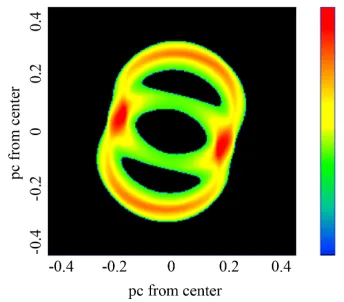
The image of SN 1987A having polar axis along the z-direction, is shown in Figure 7. The image for a realis- tically rotated SN 1987A is shown in Figure 8 and a comparison should be done with the observed triple ring system as reported in Figure 1 of [5] where the outer lobes are explained by light-echo effects.
Two cuts of intensity are reported in Figure 9, and is interesting to note that the polar cut is characterized by four spikes. Here conversely the two outer lobes are ex- plained by the image theory applied to a thin advancing shell.
5. Conclusions
5.1. Law of Motion [image:5.595.339.508.83.234.2]The presence of a thin self-gravitating disk of gas which is characterized by a Maxwellian distribution in velocity
[image:5.595.337.509.312.463.2]Figure 7. Map of the theoretical intensity of SN 1987A in the presence of a self-gravitating medium. Physical parame- ters as in Table 1. The three Euler angles characterizing the orientation are Φ = 180˚, Θ = 90˚ and Ψ = 0˚. This combina- tion of Euler angles corresponds to the rotated image with the polar axis along the z-axis.
Figure 8. Model map of SN 1987A 1987a rotated in accor- dance with the observations, for a self-gravitating medium. Physical parameters as in Table 1. the orientation of the observer are Φ = 105˚, Θ = 55˚ and Ψ = −165˚. This com- bination of Euler angles corresponds to the observed image. In this map ItrImax 4 .
[image:5.595.313.532.525.697.2]and distribution of density which varies only in the z- direction produces an axial symmetry in the temporal evolution of a SN. The resulting Equation (22) has a form which can be solved numerically. The results de- pend from the chosen latitude and more precisely the radius as function of the time is maximum at the poles and minimum at the equator. A comparison between the observed radius and the velocity at the equator, see [14], gives an agreement of 92% for the theoretical versus ob- served radius and of 62% for the theoretical versus ob- served velocity. This is the first result that confirms the rationality of the method here presented. The momentum carried away by the photons can be modeled by intro- ducing a reasonable form for the photon’s losses, see Equation (20).
5.2. Images
The combination of different processes such as the bipo- lar 3D shape , the thin layer approximation (which means advancing layer having thickness 1 10 of the mo- mentary radius), the conversion of the rate of kinetic en- ergy into luminosity and the observer’s point of view allows to simulate the observed triple ring morphology of SN 1987A 1987a. The framework here adopted is similar to that adopted to explain the asymmetric shape of the nebula around -Carinae (Homunculus), see [17,18]. We therefore suggest that the astronomers should map the non rotated radius and velocity of SN 1987A 1987a fol- lowing the outlines of Table 1 in [19]. These maps, if rea- lized, will produce a clearer framework for the observed triple ring. The suggested similarity of the triple ring sys- tem of SN 1987A 1987a with -Carinae is the second
result which ensures the rationality of the method here presented.
REFERENCES
[1] R. A. Chevalier, “Self-Similar Solutions for the Interaction of Stellar Ejecta with an External Medium ApJ 1982258, 790,” 1982.
[2] R. A. Chevalier, “The Radio and X-Ray Emission from Type II Supernovae ApJ 259, 302,” 1982.
[3] S. P. Reynolds and D. M. Gilmore, “Radio Observations of the Remnant of the Supernova of A.D. 1006. I—Total Intensity Observations AJ 92, 1138,” 1986.
[4] T. Morris and P. Podsiadlowski, “The Triple-Ring Nebula around SN 1987A: Fingerprint of a Binary Merger Sci- ence 315, 1103 (Preprint arXiv:astro-ph/0703317) Three
Dimensional Evolution of SN 1987A in a Self-Gravita- ting Disk,” 2007.
[5] A. Tziamtzis, P. Lundqvist, P. Gröningsson and S. Nasou- di-Shoar, “The Outer Rings of SN 1987A A&A 527 A35 (Preprint 1008.3387),” 2011.
[6] L. Zaninetti, “On the Spherical-Axial Transition in Super- nova Remnants Astrophysics and Space Science 337, 581 (Preprint 1109.4012),” 2012.
[7] G. Bertin, “Dynamics of Galaxies,” Cambridge Universi- ty Press, Cambridge, 2000.
[8] P. Padmanabhan, “Theoretical Astrophysics. Vol. III: Ga- laxies and Cosmology,” Cambridge University Press, Cam- bridge, 2002.
[9] C. J. Hill, “Ueber Die Integration Logarithmisch-Rationaler Differentiale,” Journal für die Reine und Angewandte Mathematik, Vol. 1828, No. 3, 2009, pp. 101-159. doi:10.1515/crll.1828.3.101
[10] L. Lewin, “Polylogarithms and Associated Functions,” New York, North Holland, 1981.
[11] F. W. J. Olver, D. W. Lozier, R. F. Boisvert and C. W. Clark, “NIST Handbook of Mathematical Functions,” Cambri- dge University Press, Cambridge, 2010.
[12] W. H. Press, S. A. Teukolsky, W. T. Vetterling and B. P. Flan- nery, “Numerical Recipes in FORTRAN. The Art of Sci- entific Computing,” Cambridge University Press, Cambri- dge, 1992.
[13] J. L. Racusin, S. Park, S. Zhekov, D. N. Burrows, G. P. Gar- mire and R. McCray, “X-Ray Evolution of SNR 1987A: The Radial Expansion ApJ 703, 1752 (Preprint 0908. 2097),” 2009.
[14] B. T. Chiad, L. M. Karim and L. T. Ali, “Study the Radial Expansion of SN 1987A Using Counting Pixels Method,”
International Journal of Astronomy and Astrophysics, Vol. 2, 2012, pp. 199-203.
[15] D. S. De Young, “The Physics of Extragalactic Radio Sources,” University of Chicago Press, Chicago, 2002. [16] H. Goldstein, C. Poole and J. Safko, “Classical Mechani-
cs,” Addison-Wesley, San Francisco, 2002.
[17] L. Zaninetti, “On the 3D Structure of the Nebula around Ca- rinae Advances in Space Research 46, 1341 (Preprint 1010.2364),” 2010.
[18] L. Zaninetti, “Interaction of Planetary Nebulae, Eta-Cari- nae and Supernova Remnants with the Interstellar Me- dium,” In: B. Cancellieri and V Mamedov, Eds., Inter- stellar Medium: New Research, Nova Publishers, New York, 2012, pp. 91-146.