Munich Personal RePEc Archive
India’s Trade and Gravity Model: A
Static and Dynamic Panel Data
Tripathi, Sabyasachi and Leitão, Nuno Carlos
Institute for Social and Economic Change, Polytechnic Institute of
Santarém, CEFAGE, University of Évora
March 2013
Online at
https://mpra.ub.uni-muenchen.de/45502/
1
India’s
Trade and Gravity Model: A Static and
Dynamic Panel Data
Sabyasachi Tripathi
Institute for Social and Economic Change, Bangalore, India E-mail: [email protected]
Nuno Carlos Leitão
Polytechnic Institute of Santarém, and CEFAGE, University of Évora, Portugal E-mail: [email protected]
Abstract
This paper examines the India’s trade flows using a gravity model for the period 1998-2012. We selected the following major trade partners: China PRP, United Arab Emirates, United States, Saudi Arab, Switzerland, Singapore, Germany, Hong Kong, Indonesia, Iraq, Japan, Belgium, Kuwait, Korea RP, Nigeria, Australia, United Kingdom, Iran, South Africa, and Qatar. In this research we apply a static and dynamic panel. We find evidence that political globalization and cultural proximity have a positive influence in bilateral trade. We also introduce economic size and common border these proxies confirming a positive impact of bilateral trade. These results
show that the gravity model can explain the pattern of bloc’s trade.
2
1.
Introduction
The Approach to the Twelfth Five-Year Plan (2012-17) has pointed out that India’s
international trade volumes have been growing faster than GDP and will continue to do so. Exports of goods and services, as a percentage of GDP have increased from 14 per cent in 2000-01 to 22 per cent in 22000-010-11, which indicates the increased openness of the economy in the past few years. World Development Indicators (WDI) published by World Bank reveals that since
1991 trade reforms have made significant improvement on India’s trade to GDP ratio from 13.9
percent in 1991 to 40.5 percent in 2011. In addition, WDI also shows that India’s export value index (or import value index) in percentage of the average for the base period (2000) has increased from 41.8 (or 39.7) percent in 1991 to 700.7 (or 886.4) in 2011.
Recent India’s foreign trade policy are mainly focused in increasing volume of bilateral trade with several economic cooperation arrangements with different countries (e.g., East Asia, South and South East Asia, etc.). India also aggressively looking for the new and emerging markets to increase the market share by introducing a new post-export Export Promotion Capital Goods (EPCG) scheme which mainly reduces the transport cost in trade. A numerous policy reforms have been made in export sector in India to facilitate the brand and quality of the export
commodities to create international awareness of the “Made in India” label in a globalised
market place. In fact, recently, foreign investment in retail trade somewhat is relaxed for the
greater promotion of India’s foreign trade.
However, the recent past downturn in the industrialized countries have also created uncertainty about the export markets in industrialized economy. The growth rate of export is reduced from 40.5 per cent in 2010-11 to 20.9 per cent in 2011-12 (RBI, 2012). On the other hand, the share of
India’s world export is very low and only just over one per cent. Even more, the export growth rate of India is far lesser than China’s economy with lower level of competitiveness. Therefore,
to increase the export which is declined due to falling demand from developed countries, India’s trade policies are mainly focused to diversify the markets to other countries (such as, Latin America, Africa, parts of Asia and Oceania).
In this backdrop, the paper attempts to identify the relevant determinants of India’s bilateral trade
3
2012. We consider these major 20 trading partners, as India’s 70 per cent bilateral trade in 2011-12 are mostly directed to these countries. The study uses Tobit model, static (random-effect), and dynamic (GMM-system) panel data approach for the estimation by considering country-specific characteristics (per capita income, geographical distances, cultural proximity, and political
globalization). The results are extremely important for policy implication for recent India’s
bilateral trade direction and to reduce the uncertainty.
The structure of the paper is a follows. The next section reviews the empirical studies on trade and gravity model from international and Indian perspectives. Section 3 discusses methodological issues regarding the econometric specification and estimation of the empirical gravity model. Estimated results are reported in Section 4. Major conclusions and implications are presented in section 5.
2.
Literature Review and Empirical Studies
The gravity model has been able to capture more and more adherents in academia. This model is
analogous to Newton’s Law of Gravity, which states that the gravity between two objects is directly related to their masses and inversely related to the distance them.
ij j i ij
D Y Y G
F (1)
Where Fij denotes the flow from country i to country j. Yi and Yj are the economic sizes of the two countries, usually measured as the gross domestic product (GDP), or per-capita GDP. Dij is the distance between countries. G is a gravitational constant.
In order to facilitate the econometric estimations, we apply logs the gravity equation (1) and hence, we obtain a linear relationship as follows:
Ln Fij = ln G + α ln Yi +β ln Yj –δ ln Dij (2)
Where lnG corresponds to the intercept, while α, β and δare elasticity’s.
4
language) should be consider in gravity equation. The empirical model use dummy variables to the cultural distance, language and to the border. The cost of transport is measure usually of geographical distance. According to previous studies (Balassa, 1966; Balassa and Bauwens, 1987) there is a negative correlation between geographical distance and trade, i.e., an increase in bilateral trade is explained when the transportation cost decrease
The similarities of the countries encourage bilateral trade. The study Frankel and Rose (1998) demonstrates the importance of these qualitative variables to analyze the regional trading agreements (RTAs). Balassa (1966) and Balassa and Bauwens (1987) found a positive sign. The issue of product differentiation was introduced by Anderson (1979). In this context, Bergstrand (1985) applied the income per capita to specify the supply side of economies.
Kepaptsoglou et al. (2010) provide an excellent review of early contributors to empirical literature on gravity models for a 10-Year (1999-2009) period. They argue that gravity model is very popular among researchers and has been extensively used for assessing trade policy implications for the last 40 years because of its considerable empirical robustness and explanatory power.
Among the selected Indian empirical studies, Tharakan et al. (2005) apply the gravity model specification to evaluate the determinants of India’s bilateral software. Using Tobit model for the
period of 1997–2001, the authors find that distance to be insignificant in comparing Indian software exports to overall goods trade flows. De (2013) estimates a gravity model to analyze the
5
trade flows from the sample of 146 countries, Batra (2004) finds that higher economic size of a
country pair and geographical proximity positively influence India’s bilateral trade flows. Using
gravity model, Bhattacharya’s (2004) paper do a comparative analysis and simulates the increase in India-Bangladesh bilateral trade under four hypothetical scenarios of differing tariff rate cuts. The author finds that in free trade regime India's exports will be more than the increase in its imports from Bangladesh.
3.
Econometric Model
Following the literature, our study applies a gravity equation with panel data. The dependent
variable used is India’s bilateral trade and the following countries: China PRP, United Arab Emirates, United States, Saudi Arab, Switzerland, Singapore, Germany, Hong Kong, Indonesia, Iraq, Japan, Belgium, Kuwait, Korea RP, Nigeria, Australia, United Kingdom, Iran, South Africa, and Qatar for the period 1998-2012. The data for the explanatory variables are sourced from the World Bank and Dreher et al. (2008) and, the source used for the dependent variable is Directorate General of Commercial Intelligence and Statistics (DGCI&S), Kolkata, under the Ministry of Commerce, GOI, at 8 digit level Harmonized System Codes (HS Code).
3.1. Static and Dynamic Panel Data
6
3.2. Explanatory variables and testing of hypotheses
Based on the literature, we formulate the following hypothesis:Hypothesis 1: The larger economic dimension increases trade.
According to the literature (Anderson, 2011, Leitão et al., 2012, Faustino and Proença, 2011) we expect a positive sign.
In this paper we use the following proxies to market size:
- GDPi is the absolute value of India’s GDP per capita (PP, in current international dollars).
- GDPk is the absolute value GDP per capita of trade partner k (PP, in current international dollars).
Hypothesis 2: Trade increases when partners are geographically close.
- DIST (Geographical Distance): This is the geographical distance between India and partner country. According to the gravity model, a negative sign is expected.
Ghatak et al. (2009) and Martinez-Zarzoso and Lehman-Nowak (2003) found a negative relationship between distance and bilateral trade. For Indian case, Tharakan et al. (2005), De (2013), Bhattacharyya and Banerjee (2006), and Batra (2004) have found a negative relationship between
distance and India’s bilateral trade. The geographic distance between India and each partner in km (DIST) is the variable used. This variable is collected in CEPII dataset.
- BORDER , this a dummy variable takes values 1 and 0. Equals 1 if the partner-country shares a border with India and 0, otherwise. In our sample only China shares common border with India.
According to previous studies, a positive sign is expected.
Hypothesis 3: Cultural and Political globalizations promote bilateral trade.
We decided to introduce globalization as a control variable, since this provides information about the economic structures of countries. According to Dreher (2008) the cultural proximity is measured
7
country, membership in international. These variables are collected in http://globalization.kof.ethz.ch/.
3.3. Model Specification
The econometric model of India’s trade takes the following representation:
it i it
it X t
y
0
1
(3)Where yit is the India’s bilateral trade respectively, and X is a set of explanatory variables. All
variables are in the logarithm form; i is the unobserved time-invariant specific effects; tcaptures
a common deterministic trend; it is a random disturbance assumed to be normal, and identically
distributed with E (it)=0; Var (it)=2 0.
The model can be rewritten in the following dynamic representation:
it i it
it it
it y X X t
y 1
0
1
1 1
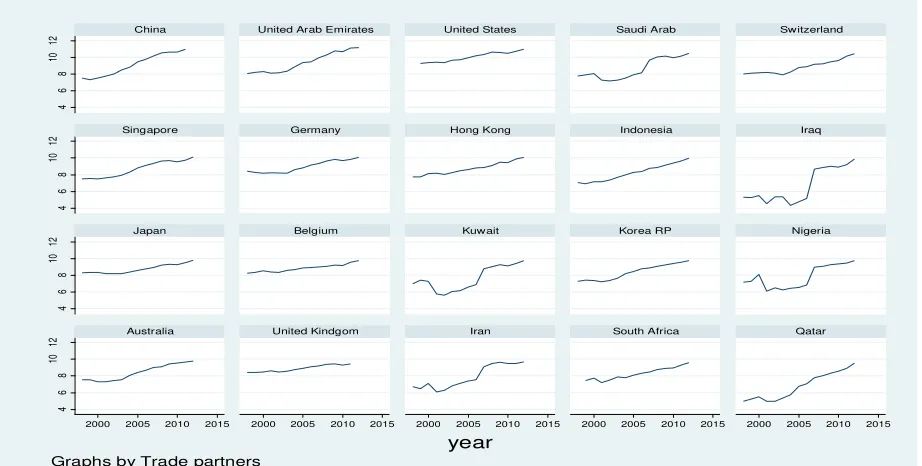
(4) [image:8.612.76.537.439.672.2]In figure 1, we can observe the panel data line plot for dependent variable.
Figure 1: Panel data line plot: Bilateral trade between India and trade partners
4 6 8 10 12 4 6 8 10 12 4 6 8 10 12 4 6 8 10 12
2000 2005 2010 2015 2000 2005 2010 2015 2000 2005 2010 2015 2000 2005 2010 2015 2000 2005 2010 2015 China United Arab Emirates United States Saudi Arab Switzerland
Singapore Germany Hong Kong Indonesia Iraq
Japan Belgium Kuwait Korea RP Nigeria
Australia United Kindgom Iran South Africa Qatar
year
Graphs by Trade partners
8
4.
Empirical Results
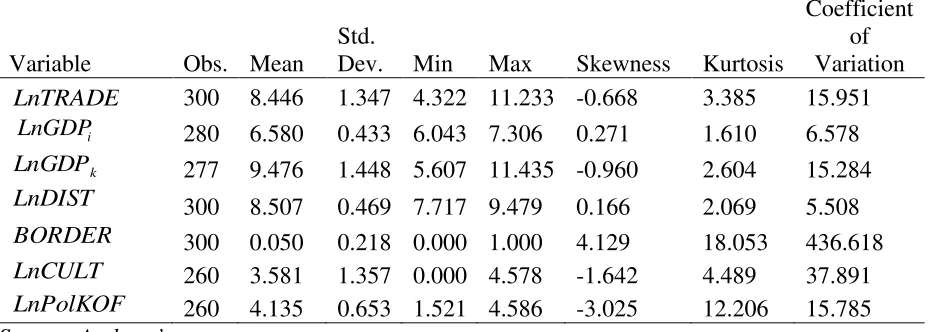
[image:9.612.73.538.169.335.2]Table 1 presents summary statistics for each variable.
Table 1: Descriptive statistics for panel data
Variable Obs. Mean
Std.
Dev. Min Max Skewness Kurtosis
Coefficient of Variation
LnTRADE 300 8.446 1.347 4.322 11.233 -0.668 3.385 15.951
i
LnGDP 280 6.580 0.433 6.043 7.306 0.271 1.610 6.578
k
LnGDP 277 9.476 1.448 5.607 11.435 -0.960 2.604 15.284
LnDIST 300 8.507 0.469 7.717 9.479 0.166 2.069 5.508
BORDER 300 0.050 0.218 0.000 1.000 4.129 18.053 436.618
LnCULT 260 3.581 1.357 0.000 4.578 -1.642 4.489 37.891
LnPolKOF 260 4.135 0.653 1.521 4.586 -3.025 12.206 15.785
Source: Authors’
LnTRADE, LnGDPi, LnDIST, and LnGDPk appear to have only little differences in their
means, implying a more symmetrical distribution. However it is not the case forLnCULT,
LnPolKOF and BORDER, where the difference is significant.
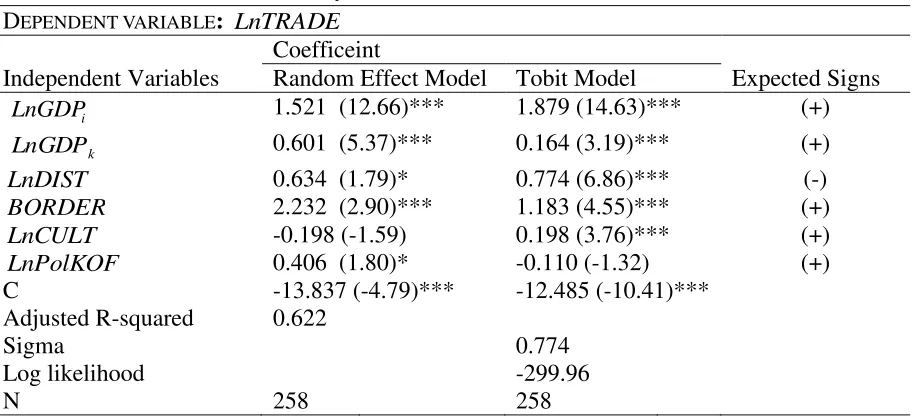
The results of random effects and Tobit model estimator are reported in Table 2. The random
effect model performs well, explaining up to 62 per cent of sample variation in the India’s
bilateral trade.
Market size variables: GDP per capita of India’s bilateral trade partners (GDPk ) and India’s
GDP per capita (GDPi), both have the positive and significant (at 1 percent level) effect on
India’s bilateral trade. The results are consistent in random effects and Tobit models. In Tobit model, the estimated values of the coefficients show that, in particular, a 10 per cent increase in
GDP per capita of India’s trade partners (or India’s GDP per capita) is associated with 1.6 (or 19)
9
Table 2: India’s trade and Gravity: Random Effects and Tobit Model
DEPENDENT VARIABLE: LnTRADE
Coefficeint
Independent Variables Random Effect Model Tobit Model Expected Signs
i
LnGDP 1.521 (12.66)*** 1.879 (14.63)*** (+)
k
LnGDP 0.601 (5.37)*** 0.164 (3.19)*** (+)
LnDIST 0.634 (1.79)* 0.774 (6.86)*** (-)
BORDER 2.232 (2.90)*** 1.183 (4.55)*** (+)
LnCULT -0.198 (-1.59) 0.198 (3.76)*** (+)
LnPolKOF 0.406 (1.80)* -0.110 (-1.32) (+)
C -13.837 (-4.79)*** -12.485 (-10.41)*** Adjusted R-squared 0.622
Sigma 0.774
Log likelihood -299.96
N 258 258
Z-statistics for Random Effect model and t-statistics for Tobit model (heteroskedasticity corrected) are in round brackets.
***/*- statistically significant at the 1%, and 10% level, respectively.
Geographical proximity variables: geographical distance between India and partner country (DIST) and border dummy (BORDER), both have the positive and statistically significant
effect on India’s bilateral trade in both the models. The results in Tobit model indicates that an
increase of 10 per cent in the geographical distance between India and partner country (or India made border with partner trade) leads to 7.7 (or 11.8) per cent increase in the India’s bilateral trade. Though, the sign of the coefficient of border dummy supports the expected hypothesis, but the sign of the coefficient of distance variable runs against the predicted hypothesis. The results indicate that geographical proximity does not matter for India’s bilateral trade. However, the
significance level of the distance variable (DIST) is reduced from 1 per cent in Tobit model to
10 per cent random effect model.
The estimated coefficient of the political globalization (PolKOF) in random effect model is
10
with our predicted hypothesis. An increase of 10 per cent in political globalization leads to 4 per
cent increase in India’s bilateral trade.
The coefficient of cultural proximity (CULT) is positive (as predicted) and statistically
significant (at 1 per cent level) in Tobit model. The coefficient 0.198 indicates that with a 10 per cent increase in cultural proximity of India’s trading partner, India’s bilateral trade increases by about 2 per cent. This result suggests that cultural proximity of the trading partner promotes
India’s bilateral trade.
Table 3: India’s trade and Gravity: GMM-System
DEPENDENT VARIABLE: LnTRADE
Independent Variables Coefficient Expect Signs
1
t
LnTRADE 0.582 (29.14)*** (+)
i
LnGDP 0.439 (3.00)*** (+)
k
LnGDP 0.624 (5.15)*** (+)
LnDIST -1.337 (-0.78) (-)
BORDER -0.481 (-0.15) (+)
LnCULT 0.028 (0.12) (+)
LnPolKOF 1.603 (3.53)*** (+)
C -0.628 (-0.05)
Arellano-Bond test for Ar(2) (P-value) 0.163 Sargan test (P-value) 1.00
N 238
The null hypothesis that each coefficient is equal to zero is tested using one-step robust standard error. Z-statistics (heteroskedasticity corrected) are in round brackets. P-values are in square
brackets; *** - statistically significant at the 1 per cent level. Ar(2) is tests for second–order
serial correlation in the first-differenced residuals, asymptotically distributed as N(0,1) under the null hypothesis of no serial correlation (based on the efficient two-step GMM estimator). The
Sargan test addresses the over- identifying restrictions, asymptotically distributed X2 under the
null of the instruments’ validity (with the two-step estimator).
[image:11.612.68.507.252.451.2]11
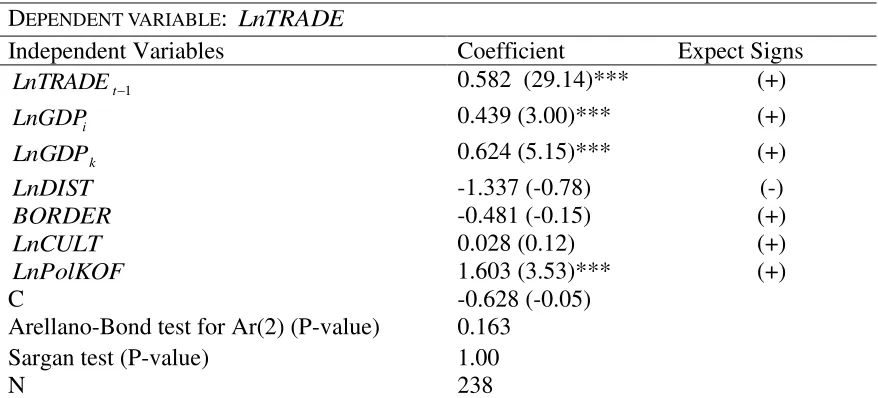
The lagged dependent variable (LnTRADEt1) presents a positive sign. As expected, the
variablesLnGDPi, and LnGDPk have a significant and a positive effect on bilateral trade. These
variables are also introduced to control for relative size effects. Our result is according to previous studies (Helpman 1987, Hummels and Levinshon 1995, and Greenaway et al., 1994). The coefficient of political globalization (LnPolKOF) is positively correlated with bilateral
trade, i.e., political globalization encourage bilateral trade.
5.
Conclusions
The objective of this paper is to analyze the determinants of India’s bilateral trade flows to the major 20 trading partners by using a gravity model for the period of 1998 to 2012. We apply a Tobit, random effects and GMM system estimator for the analyses. In this research we use a dynamic panel (GMM system estimator) to solve the problems of serial correlation, heteroskedasticity and endogeneity for some explanatory variables.
Market size variables: GDP per capita of India’s bilateral trade partners (LnGDPk ) and India’s
GDP per capita (LnGDPi), both have the positive and significant effect on India’s bilateral trade
flows, when we use Tobit, random effect, and system GMM. The results are according to the literature (Kabir, and Salim, 2010; Anderson, 2011; Leitão et al., 2012; Faustino and Proença, 2011; Batra, 2004; De, 2013; and Bhattacharyya and Banerjee, 2006). The results conclude that higher GDP (for the country pairing) increases trade.
Geographical proximity variables: geographical distance between India and partner country
(LnDIST) and border dummy (BORDER), both have the positive and statistically significant
effect on India’s bilateral trade in Tobit and random effect models. The positive effect of
distance variable on India’s bilateral trade does not support the findings of the past studies (Ghatak et al., 2009; Martinez-Zarzoso et al., 2003; Tharakan et al., 2005; Bhattacharyya and Banerjee; 2006; and Batra, 2004). The results indicate that the India’s bilateral trade increases with geographical proximity only for the major trading partners.
Finally, the results show the political globalization (LnPolKOF) and cultural proximity
12
to the findings of Dreher (2008). The results are extremely important for recent India’s bilateral
trade direction and for reduction of uncertainty.
References
Anderson, J.E., 1979. A theoretical foundation for the gravity equation. The American Economic Review 69(1), 106-116.
Anderson, J.E., 2011. The Gravity Model. Annual Review of Economics 3(1), 133-160.
Anderson, J. E., Wincoop, E.V., 2003. Gravity with gravitas: a solution to the border puzzle. American Economic Review 93(1), 170-192,
Arellano, M., Bond, S., 1991. Some tests of specification for panel data: Monte Carlo evidence and an application to employment equations. Review of Economic Studies 58(2), 277-297. Arellano, M., Bover, O., 1995. Another look at the instrumental variable estimation of
error-components models. Journal of Econometrics 68(1), 29-52.
Balassa, B., 1966. Tariff reductions and trade in manufactures among industrial countries. American Economic Review 56(3), 466-473.
Balassa, B., Bauwens, L., 1987. Intra-industry specialization in multi-country and multi-industry framework. The Economic Journal 97 (388), 923-939.
Batra, A., 2004. India’s global trade potential: the gravity model approach. Working Paper No. 151, Indian Council for Research on International Economic Relations.
Bergstrand, H.,1985. The gravity equation in international trade: some microeconomic foundations and empirical evidence. Review of Economics and Statistics 67(3), 474-481. Bhattacharya, S. K., 2004. Does Bangladesh benefit from preferential trade with India? a gravity
analysis. Economic and Political Weekly 39 (48), 5152-5162.
Bhattacharyya, R., Banerjee, T., 2006. Does the gravity model explain India’s direction of trade? A panel data approach. Working Paper No. 2006-09-01, Indian Institute of Management, Ahmadabad.
Blundell, R., Bond, S., 1998. Initial conditions and moment restrictions in dynamic panel data models. Journal of Econometrics 87(1), 115-143.
Blundell, R., Bond, S., 2000. GMM estimation with persistent panel data: an application to production functions. Econometric Reviews, 19(3), 321-340.
Caves, R., 1981. Intra-industry trade and market structure in the industrial countries. Oxford Economic Papers 33 (2), 203-223.
De, P., 2013. Assessing barriers to trade in services in India: an empirical investigation. Journal of Economic Integration 28 (1), 108- 143.
Dreher, A., Gaston, N., Martens, P., 2008. Measuring Globalisation – Gauging its Consequences. Springer, New York.
Eichengreen, B., Irwin, D. 1998. The role of history in bilateral flows. In: Frankel, J. A. (Eds.), The Regionalization of the World Economy, University of Chicago, Press.
13
Frankel, J. A., Rose, A. K., 1998. The endogeneity of the optimum currency area criteria. The Economic Journal 108(449), 1009-1025.
Ghatak, S., Silaghi, M., Daly, V., 2009. Trade and migration flows between some CEE countries and the UK. The Journal of International Trade and Economic Development 18(1), 61-78. Greenaway, D., Hine, R., Milner, C., 1994. Country-specific factors and the pattern of horizontal
and vertical intra-industry trade in UK, Wetwirtschaftliches Archiv 130(1),77-100.
Helpman, E., 1987. Imperfect competition and international trade: evidence from fourteen industrial Countries. Journal of the Japanese and International Economics 1(1), 62–81. Hummels, D., Levinsohn. J., 1995, Monopolistic competition and international trade:
reconsidering the evidence. Quarterly Journal of Economics 110 (3), 799-836.
Kabir, M., Salim, R., 2010. Can gravity model explain BIMSTEC’s trade? Journal of Economic Integration 25(1), 144–166.
Kepaptsoglou, K., Karlaftis, M. G., Tsamboulas, D., 2010. The gravity model specification for modeling international trade flows and free trade agreement effects: a 10-year review of empirical studies. The Open Economics Journal 2010 (3), 1-13.
Leitão, N. C., Dima, B., Dima, S., 2012. Immigration and trade" Ekonomska
istraživanja=Economic Research 25(1), 134-143.
Martinez-Zarzoso, I., Lehman-Nowak, F., 2003. Augmented gravity model: an empirical application to Mercosur-European Union Trade flows, Journal of Applied Economics 6(2), 291–316.
Poyhonen, P., 1963. A tentative model for the volume of trade between countries. Weltwirtschaftliches Archiv 90 (1), 93-99.
Rauch, J., 1999. Networks versus markets in international trade. Journal of International Economics 48 (1), 7-35.
Reserve Bank of India, 2012. India’s Foreign Trade: 2011-12. Monthly Bulletin, June.
Tharakan, P. K. M., Beveren, I. V., Ourti, T. V., 2005. Determinants of India’s software exports and goods exports. The Review of Economics and Statistics 87(4), 776–780.
Tinbergen, J., 1962. Shaping the World Economy: Suggestions for an International Economic Policy. The Twentieth Century Fund, New York.
Toh, K., 1982. A cross-section analysis of intra- industry trade in U.S manufacturing industries. Weltwirtschaftliches Archiv 118 (2), 281-301.