Study on Spatial Distribution of OM, N, P in Surface Soil
around Lake Chaohu
Ronggui Fan1, Changchun Wang1,2, Zhaosheng Chu2*, Shuqin Chen3
1
College of Environmental Sciences and Engineering, Liaoning Technical University, Fuxin, China
2
Chinese Research Academy of Environmental Sciences, Beijing, China
3
Anqing Normal College, Anqing, China Email: *[email protected], [email protected]
Received March 22, 2013; revised April 21, 2013; accepted May 15, 2013
Copyright © 2013 Ronggui Fan et al. This is an open access article distributed under the Creative Commons Attribution License, which permits unrestricted use, distribution, and reproduction in any medium, provided the original work is properly cited.
ABSTRACT
The concentration of total nitrogen (TN), total phosphorus (TP) and organic material (OM) at sixty grid division in Lake Chaohu basin around the lake was studied, in order to investigate their spatial distribution characteristics. The results showed that the average concentrations of TN, TP and OM were 1027 mg/kg, 483 mg/kg, 1.95%, and their concentra- tions ranged from 253 mg/kg to 2273 mg/kg, 223 mg/kg to 1173 mg/kg and 0.291% to 5.48%, respectively. The high concentration areas were located at the basins of Tuogao river and Zhao river while the low concentration areas were located at basins of Pai river, Nanfei river and Dianpu river. The concentrations of TN and OM were higher in East part than in West part. The spatial distribution of TN, TP and OM concentrations of the surface soil showed inconsistent with those of the water quality of the inflow rivers and the lake and the TN and TP of lake sediment studied.
Keywords: Chaohu Lake; Soil; Total Nitrogen; Total Phosphorus; Organic Material; Spatial Distribution
1. Introduction
The nitrogen, phosphorus and other various nutrients were mainly stored in soil in terrestrial ecosystems. The basin soil and soil nutrient loss not only affect agricul- tural production, it is also an important source of the wa- ter environment pollution now [1-3]. Lake Chaohu is one of the five largest freshwater lakes in China. Because of the effect of unreasonable human activities for a long time, the basin of Lake Chaohu faced with severe envi- ronmental pollution and water eutrophication. It has af- fected the basin sustainable development of the social economy. In recent years, the authorities spent a great deal of manpower, material and financial resources to manage the basin pollution and water eutrophication. With the deepening of the basin of Lake Chaohu point source pollution control, agricultural non-point source pollution problem has become increasingly prominent [4,5]. The nitrogen (N), phosphorus (P) and organic ma- terial (OM) in the soil are the mainly effect factors of the watershed non-point source pollution. This survey of research is carried out in the Lake Chaohu surrounding area. The purpose of this research is to investigate the spatial distribution characteristics of the N, P and OM concentrations of the surface soil.
2. Materials and Methods
2.1. Study on the Regional General Situation
The basin of Lake Chaohu was located between Yangtze River and Huai River in the middle of the two rivers in Anhui Province. The lake body belonged to the Yangtze River downstream left bank river system, and its drain- age area was about 13,349 km2. The whole topography was long from west to east, narrow from north to south, high in west part, low in east part, and low-lying and flat in the middle part. This kind of topography formed the basin of Lake Chaohu. Low mountains, low hilly hills and hilly mounds in the basin’s area were 2617 km2, but the obvious soil erosion was about 1500 km2. Low moun- tains and hilly mounds were the main source of soil ero- sion [6]. The basin river system assumed radiated, and the network of rivers and lakes density was high. The whole basin had a total of 33 rivers, and they belonged to Hangpu river, Fengle river, Pai river, Nanfei river, Dian- pu river, Tuogao river, Baishitian river and Yuxi river, etc. 7 river systems respectively.
2.2. Research Methods
According to the 7 major river systems of Lake Chaohu *
R. G. FAN ET AL. 586
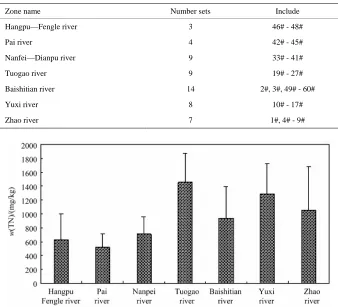
region division, we maked a sample survey of the surface soil of Lake Chaohu basin around 3000 km2 in Septem- ber, 2008. Taking 6 km × 6 km as the sampling unit, we gathered 5 surface soil type (20 cm) form sampling unit nearness center position and periphery 1 - 2 km place, and used the quartering mixes uniform. We together got 60 mixture samples from 7 river systems and distribution of sampling sites around Lake Chaohu (Table 1). After the collection, the samples should be stored by nature airing, crushed, and through 100 mesh screen. The TN, TP, and OM were measured using the Hybrid Catalysis K2SO4-CuSO4-Se [7], SMT Protocol Method [8], Potas-
sium Bichromate Capacity Method-External Heating Me- thod [9], respectively. We should use the SPASS17.0 Re- gression Analysis to make relevant analysis.
3. Results and Analysis
3.1. Spatial Distribution Characteristics of Soil Total Nitrogen
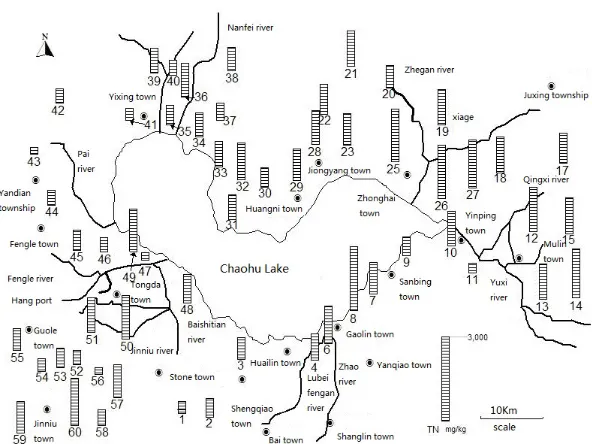
There was a large change in variation of total nitrogen of surface soil around Lake Chaohu (Figures 1 and 2). The average concentrations of TN were 1027 mg/kg and its concentrations ranged from 253 mg/kg to 2273 mg/kg and 46.3%, respectively.
[image:2.595.128.466.410.717.2]From the result of the basin of 7 major river systems, we can make a conclusion that the average concentra- tions of TN were Tuogao river (1477 mg/kg), Yuxi river (1288 mg/kg), Zhao river (1156 mg/kg), Baishitian river (808 mg/kg), Nanfei river, Dianpu river (744 mg/kg), Hangpu river, Fengle river (619 mg/kg), and Pai river (520 mg/kg) from high to low. It showed that the varia- tion of concentrations of TN of the basin of Hangpu river, Fengle river were the highest in this area, they were lower in the basin of Zhao river, and the basin of Tuogao river was the lowest one. Their variation coefficients were 60.3%, 59.6%, and 29.3%, respectively. The high concentration areas were located at the basins of Tuogao river, Zhao river and the east of Yuxi river while the low concentration areas were located at basins of Hangpu river, Fengle river, Pai river, Nanfei river and Dianpu river. The highest concentration area was located at the basins of Tuogao river while the lowest concentration area was located at basins of Pai river. In the point of view from the regional division, the east of Lake Chaohu, Tuogao river, Yuxi river, Zhao river belonged to East part, while the west of Lake Chaohu, Nanfei river, Pai river, Hangpu river, Fengle river, Baitianshi river be- longed to West part. The average concentrations of TN of the surface soil were higher in East part than in West
Table 1. Seven rivers and distribution of sampling sites around Lake Chaohu.
Zone name Number sets Include
Hangpu—Fengle river 3 46# - 48#
Pai river 4 42# - 45#
Nanfei—Dianpu river 9 33# - 41#
Tuogao river 9 19# - 27#
Baishitian river 14 2#, 3#, 49# - 60#
Yuxi river 8 10# - 17#
[image:2.595.126.468.411.717.2]Zhao river 7 1#, 4# - 9#
Figure 2. Distribution of total nitrogen concentration of surface soil around Lake Chaohu.
part (1307 mg/kg > 673 mg/kg).
3.2. The Spatial Distribution Characteristics of the Soil Total Phosphorus
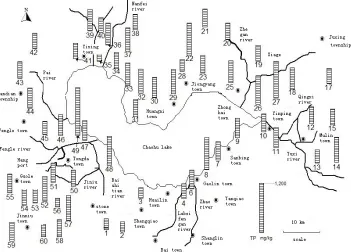
There was a large change in variation of total phosphorus of surface soil around Lake Chaohu (Figures 3 and 4). The average concentrations of TP were 483 mg/kg, and their concentrations ranged from 223 mg/kg to 1173 mg/ kg, and 34.1%, respectively.
From the result of the basin of 7 major river systems, we can make a conclusion that the average concentra- tions of TP were Tuogao river (586 mg/kg), Yuxi river (458 mg/kg), Hangpu river, Fengle river (573 mg/kg), Baishitian river (504 mg/kg), Zhao river (486 mg/kg), Nanfei river, Dianpu river (420 mg/kg), and Pai river (382 mg/kg) from high to low. It showed that the varia- tion of concentrations of TP of the basin of Baishitian river were the highest in this area, they were lower in the basin of Zhao river, and the basin of Pai river was the lowest one. Their variation coefficients were 48.6%, 35.5%, and 10.6%, respectively. The high concentration areas were located at the basins of Tuogao river, Zhao river, Baishitian river and Hangpu, Fengle river while the low concentration areas were located at basins of Pai river, Nanfei, Dianpu river and Yuxi river. The highest concentration area was located at the basins of Tuogao river while the lowest concentration area was located at basins of Pai river. The highest and lowest areas of TP were similar to the area of TN. While in the point of view from the regional division, the average concentrations of TP of the surface soil in East part (477 mg/kg) were similar to those in West part (470 mg/kg). There was no significant difference between them.
3.3. The Spatial Distribution Characteristics of the Soil Organic Material
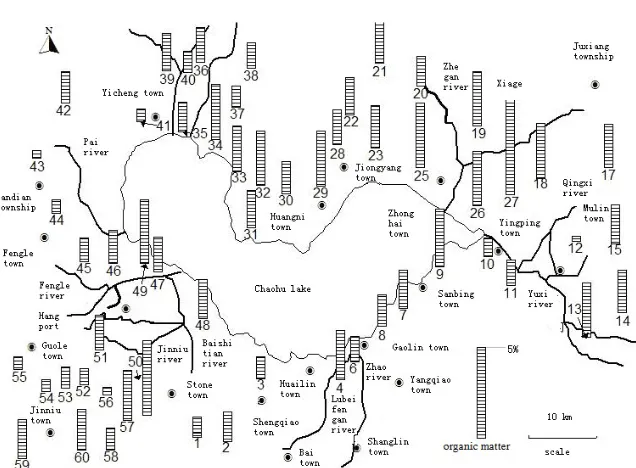
There was a large change in variation of Organic Mate- rial of surface soil around Lake Chaohu (Figures 5 and 6). The average concentrations of OM were 1.95%, and its concentrations ranged from 0.291% to 5.48%, and the coefficient of variation was 34.1%.
R. G. FAN ET AL. 588
[image:4.595.118.469.279.531.2]Figure 3. Variation of total phosphorus content of surface soil around Lake Chaohu.
Figure 4. Distribution of total phosphorus concentration of surface soil around Lake Chaohu.
[image:4.595.137.458.559.719.2]Figure 6. Distribution of organic material concentration of surface soil in Chaohu Lake.
There was a large difference between the two parts.
4. Discussion
4.1. The Spatial Distribution of Variation of TN, TP and OM Content of Surface Soil
The spatial distribution in Lake Chaohu basin around the lake of theTN, TP and OM concentrations of the surface soil showed obvious region change. From the result of the basin of 7 major river systems, we can see the high concentration areas were located at the East part basins of Tuogao river and Zhao river while the low concentra- tion areas were located at the West part basins of Pai river, Nanfei river and Dianpu river. Zhou Huiping’s study of the spatial distribution of theTP in Lake Chaohu basin around in 2003 [10], and Hu Hongxiang [11-13] and other person’s study of the spatial distribution of the TN, and TP of the basin of Ma Anshan in Lake Chaohu in 2006,and 2007 were also displayed the similar rules. In the surrounding area of Lake Chaohu, the basin of Nanfei river, Dianpu river, and Pai river located near the developed industry place of He Fei etc., the capacity of soil cultivation was low while the basin of Hangpu river, Fengle river, and Baishitian river cultivated a large scale agricultural crops. Therefore, such as the place capacity of soil cultivation was very high. The capacity of soil cultivation may be the most significant effect factor of the Nitrogen, Phosphorus, and Organic Material. In addi- tion, the high background value of TP in the basin of Lake Chaohu was also a significant effect factor for the regional distribution difference [14]. From the type of land planted, the main types of crops were Vegetable Field, Double-season Rice, Rice-rape Rotation, Cotton
Field, Wasteland, and so on. The soil of Vegetable Field contained the highest concentrations of Nitrogen, Phos- phorus, and Organic Material. While in the Rice Paddy, Rice-rape Rotation and Cotton Field, the contents of TN, TP, and OM were closely (see Table 2).
4.2. The Effect of Water Quality and Sediment in Surface Soil around Chaohu Lake
R. G. FAN ET AL. 590
Table 2. Contents of total nitrogen, total phosphorus and organic material in soil for different using ways.
Type The average of
TP (mg/kg)
The average of TN (mg/kg)
The average of OM (%)
Vegetable field 782 2273 3.19
Double-season rice 442 1033 2.21
Rice-rape rotation 470 1118 1.96
Cotton field 442 1018 2.07
River sediment 606 1006 2.36
Wasteland 445 902 1.91
river [15]. It is thus clear that this characteristic also showed inconsistent with those of the spatial distribution of the TN, and TP concentrations of the soil of Lake Chaohu and the surface soil around Lake Chaohu.
5. Conclusion
The results showed that the average concentrations of TN, TP and OM were 1027 mg/kg, 483 mg/kg, 1.95%, and their concentrations ranged from 253 mg/kg to 2273 mg/kg, 223 mg/kg to 1173 mg/kg and 0.291% to 5.48%, respectively. The spatial distribution characteristics of Organic Material content of surface soil were related to the content of TN strikingly (w (OM) = 14.483·w (TN) + 5815.1, R2 = 0.88, P < 0.05). The high concentration areas were located at the basins of Tuogao river and Zhao river while the low concentration areas were located at the basins of Pai river, Nanfei river and Dianpu river. The concentrations of TN and OM were higher in East part than in West part. The spatial distribution of theTN, TP and OM concentrations of the surface soil showed incon- sistent with those of the water quality of the inflow rivers and the lake and the TN and TP of lake sediment studied.
REFERENCES
[1] A. N. Sharpley, S. C. Chapra, R. Wedepohl, et al., “Manag- ing Agricultural Phosphorus for Protection of Surface Wa- ters: Issues and Options,” Journal of Environmental Qua- lity, Vol. 23, No. 3, 1994, pp. 437-451.
doi:10.2134/jeq1994.00472425002300030006x
[2] Z. F. Dai, J. Z. Wang and J. Cheng, “Soil Phosphorus of Non-Point Source Pollution and Its Impact on the Envi- ronment of Research,” Journal of Agro-Environment Sci- ence, Vol. 25, No. S1, 2006, pp. 323-327.
[3] T. C. Daniel, A. N. Sharpley and J. L. Lemunyon, “Agri-
cultural Phosphorus and Eutrophication: Asymposium Over- view,” Journal of Environmental Quality, Vol. 27, No. 2, 1998, pp. 251-257.
doi:10.2134/jeq1998.00472425002700020002x
[4] X. C. Jin, S. K. Liu and Z. S. Zhang, “Chinese Lake Envi- ronment (II) [M],” Ocean Press, Beijing, 1995, pp. 167- 183.
[5] R. Z. Li and T. Q. Hong, “Basin of Lake Chaohu Agricul- ture Nonpoint Source Contamination Control Countermea- sure Research,” Journal of Hefei University of Technol- ogy (Social Science), Vol. 20, No. 1, 2006, pp. 105-110. [6] W. J. Yan and F. X. Chen, “The Research of Surface
Run-Off Pollution Characteristics in Different Land Use Types in the Basin of Lake Chaohu,” Resources and En- vironment in the Yangtze Basin, Vol. 8, No. 3, 1998, pp. 275-277.
[7] R. K. Lu, “Analytical Methods of Soil Agrochemistry,” Chi- nese Agriculture Science and Technology Press, Beijing, 1999.
[8] V. Ruban, S. Brigault and D. Demare, “An Investigation of the Origin and Mobility of Phosphorus in Freshwater Se- diments from Bort-Les-Orgues Reservoir, France,” Jour- nal of Environmental Monitoring, Vol. 1, No. 4, 1999, pp. 403-407. doi:10.1039/a902269d
[9] S. D. Bao, “Analysis of Soil Agrochemical (Ⅲ) [M],” China Agriculture Press, Beijing, 2000, pp. 30-34.
[10] H. P. Zhou, C. Gao, B. Sun Bo, et al., “Lake Chaohu Ba- sin Soil of TP Content Spatial Variation Characteristic and Influence Factor,” Agro-Environmental Science, Vol. 26, No. 6, 2007, pp. 2112-2117.
[11] H. X. Hu, T. Q. Hong and L. L. Fan, “Study on Changes of Soil OM, N, P in Ma Anshan Lake Chaohu,” Soil and Water Conservation in China, Vol. 11, 2006, pp. 26-28. [12] H. X. Hu, T. Q. Hong, M. Huang, et al., “The Research of
Ma Anshan Lake Chaohu in North-West Slope Erosion and Its Temporal Variation of N, P,” Journal of Soil and Water Conservation, Vol. 21, No. 5, 2007, pp. 30-34. [13] C. W. Wang, X. Y. Wang, Y. Feng, et al., “Distribution of
Total Phosphorus in the Sediments of Lake Chaohu and Its Geological Origin,” Journal of Anhui Normal Univer- sity (JCR Science Edition), Vol. 30, No. 4, 2007, pp. 496- 499.
[14] R. Wang, “Lake Chaohu Basin Water Environment Quality Appraisal and Water Quality Forecast Model Research,” Hefei University of Master’s Thesis, 2009, pp. 15-34. [15] Environmental Protection Department of Pollution Pre-