Munich Personal RePEc Archive
New technologies adoption and diffusion
patterns in developing countries. An
empirical study for the period 2000-2011.
Lechman, Ewa
Gdansk University of Technology
April 2013
Online at
https://mpra.ub.uni-muenchen.de/46074/
1
New technologies adoption and diffusion patterns in developing countries.
An empirical study for the period 2000-2011.
Preliminary version (2013)
Ewa Lechman1
Abstract
In recent years, enormous changes are noted worldwide when broad adoption of new Information and
Communication Technologies (ICTs). These unique technologies – often perceived as economic
development incentives – have a great ability to spread at high pace and low cost in world countries,
bringing to people opportunities to contribute to economic development and growth. New Technologies play a special role in developing countries, where their in-country adoption lies in the centre of development strategies. ICTs are treated as tools which bring to people access to information, education and knowledge, offering unlimited possibilities for wealth-creation.
The paper, purely empirical in nature, reports on the pace of adoption of new Information and
Communication Technologies in developing countries, and – additionally – investigates
country-specific ICTs diffusion patterns. We expect to uncover the S-shape curve in the diffusion process in most of developing countries, as well as in the whole country sample.
For the analysis purposes we apply all counties, which – according to the World Bank nomenclature –
are classified as low-income and lower-middle-income economies. Our sample covers 46 countries (upper-middle-income and high-income economies are excluded from the study purposely), which are classified as developing economies. The time framework is set for the period of 2000-2011. All data necessary for the analysis are derived from World Telecommunication/ICT Indicators Database 2012
(16th edition).
Keywords: Information and Communication Technologies, adoption patterns, technology diffusion, S-shape curve, developing countries.
JEL codes: O11, O33, O57.
1. Introduction
In recent years, a pervasive explosion of new Information and Communication Technologies (ICTs) is
observed in a magnitude of world economies. The process of diffusion of ICTs is fully associated with
1 Ewa Lechman, Ph.D., Assisstant Professor at Faculty of Management and Economics at Gdansk University of
2
the spread of new ideas, knowledge and all kinds of information. These technologies provide new ways
of mass communication, process of storing and processing all kind of knowledge and information.
ICTs are widely recognized as an effective tool for promoting economic growth and overall
socio-economic development. By creating a bundle of possibilities on education, running a business or
inclusion of socially and economically deprived groups, they provide a good basis for wealth creation.
Wireless networks have enabled to open up economic “enclaves” by elimination of barriers such as i.e.
geographical distance or information asymmetry. At a time, due to broad ICTs adoption, society
members gain an opportunity for wide and unlimited access to different kinds of knowledge,
information, which enable them to improve their professional skills.
The process of technology (ICTs) diffusion and adoption has been studied intensively in recent years.
Following E.Rogers and his seminal works, diffusion includes “both planned and the spontaneous
spread of new ideas” (Rogers, E. 1962, p.7). Massive empirical and theoretical literature has been
developed on the issue, and some general conclusions can be derived from the studies. The most
crucial conclusion is that, at a given point of time, substantial differences can be perceived among
different countries when level of ICTs adoption and diffusion is taken into account. Despite many
discussions on widening – or diminishing – digital divide, observed huge differences in the degree of
diffusion of technology among countries remain unquestionable.
2. Technology diffusion – general conceptualization.
Conceptually, the discussion on the “technology diffusion” has started with Joseph Schumpeter (1934,
1947), and his pioneering work emphasising the crucial – for economic growth and development –
process of technology (innovation) diffusion. In his works, Schumpeter – inspired by origin works of
Charles Darwin (Darwin 1859), argued that the process of technology diffusion is mostly linear.
However further studies on the phenomenon of the technology diffusion process accompanied by
technological change, has shown that the process of adoption of invention is far from linear. In the
3
epidemic models of diffusion2. The models were based on some analogies between process of
technology diffusion and diffusion of contagious diseases. The epidemic models were claimed to be
correct by Mansfield (1968), Metcalfe (1988), Karshenas and Stoneman (1995), Stoneman (2001, 2005).
In time, many started o claim that epidemic models of technology diffusion are “blind” for the
dynamics of the process, and ignore some societal, educational, demographical or economic conditions
which highly influence rate and pattern of technology diffusion.
Now, theoretical and empirical analysis of technology diffusion, mostly refer to the seminal concept of
Everett Rogers (see Rogers 1962, 1995), explaining diffusion process of innovation (Rogers presumes
that the word “technology” is a synonymous to “innovation”. As consequence Rogers uses these two
alternatively, along with the diffusion rates and stages. His concepts and theoretical framework (model)
of technology diffusion are widely applied in political sciences, economics, public health policies,
history or education. For Rogers (1962, 1995) the “technology” stands for “design for instrumental
action that reduces the uncertainty in the cause-effect relationships involved in achieving a desired
outcomes” (Rogers, E. 1962, p.6). He (see Rogers, 1962, p.10) defines the diffusion “as a process by
which an innovation (technology – author`s note) is communicated through certain channels over time
among members of a social system”. Following the previous, the process of technology diffusion
covers 4 aspects (elements): innovation (defined as “an idea, practice, or project that is perceived as
new (…) (Rogers, 1962, pp.12)), communication channels (“process in which participants create and
share information”, (Rogers, 1962, pp.5), time (time in behavioural studies is perceived as an element
determining the strength of the process) and social system (“a set of interrelated units”, (Rogers, 1962,
pp.23). Also Gort and Klepper (1982) define technology diffusion as the “spread in the number of
producers engaged in manufacturing a new product”. The definition was slightly adjusted by Adres et al.
(2007), to the needs of studies on new information and communication technologies across countries.
They claim that the technology diffusion can also refer to the “number of consumers of Internet” (see
Andres et al., 2007).
4
In accordance to the diffusion of innovation theory of Rogers E. (Rogers 1962), there emerged the
concepts of theoretical diffusion patterns that countries shall follow, passing sequent steps (phases) in
adoption process. The adoption patterns of technology, are assumed to follow the S-shaped curve. The
group of S-shaped curves is originated from Pierre-Francois Verhulst, who in 1833 proposed to the
public, first logistic equation, explaining natural population growth in time. The “natural growth”
stands for particular ability of “species” (see Darwin, 1859) for multiplying in a specified period of time.
In economic sciences, the term” species” refer to any kind of variable which tends to grow in time. The
S-shaped trajectories are mainly observed when innovation (technology) diffuses over large societies.
The curve shape explains adopter population dynamics in time, assuming the heterogeneity of the
whole population. The theoretical trajectory shape shows that technology tends to spread at high pace
in early stages of diffusion process, and afterwards the diffusion rates slow as the overall saturation
(share of population using given technology) of the technology in a given society if growing. It is also
assumed that, after passing the “inflection point”, the rate of adoption shall slow down, as the higher
percentage of population is having access to technology.
The general concept of the S-shaped curve explaining stages of technology diffusion is clarified in the
Picture 1 (see below). Clearly, the process of technology diffusion is fully accounted for the nature of
technology itself. Certain features of technology, absorptive capacities of society, its knowledge and
skills, information asymmetries, channels of diffusion and further adoption, state policies – all these
highly condition diffusion rates, creating friendly environment for technology diffusion or – reversely –
posing barriers to the process.
Despite the above, the technology diffusion can be described as a long-run process, which results in
broad spread of different kinds of innovations. It is widely agreed that the process enhances deep
changes in economic structures, fosters economic growth and development, contributing to overall
5
Picture 1. Theoretical S-shaped curve.
Time
Sh
a
re
o
f
p
o
p
u
la
ti
o
n
(%
)
Fast growth phase
„Critical mass” - somewhere here
Slow growth / stabilization phase
Inflection point
Source: own elaboration.
As stated before, in the following paper, by using the term “technology” we refer strictly to New
Information and Communication Technologies, and the two terms – technology and ICTs – are used
alternatively, as equivalent issues.
3. The data – preliminary analysis.
In the study we concentrate exclusively on low and lower-middle-income economies. We base on the
broadly accepted country classification introduced by World Bank3. As results, our country sample
covers 46 economies, where 15 countries are classified as low-income and 31 are classified as
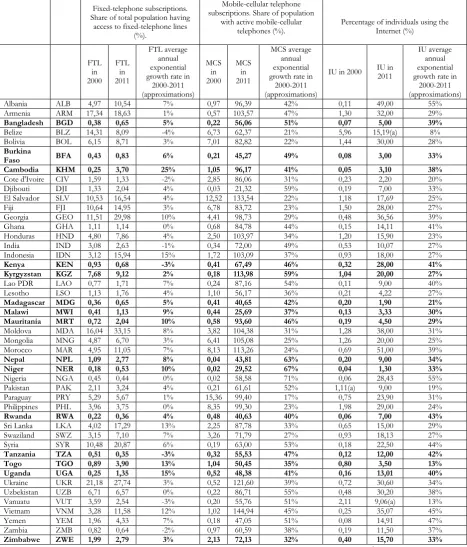
lower-middle-income ones. Full list of countries is available in the statistical appendix (see statistical Appendix
1). The applied time span is 2000-2011.
For the analysis purposes, we have selected 3 basic ICTs indicators, treated as proxy variables of
information and communication technologies. They are thought to reveal the average level of usage
and application of ICTs among society. In the study we use the following variables: share of total
3 World Bank classifies countries according to their per capita Gross National Income using Atlas Method as tool for
6
population using (having access) to fixed telephone lines (FTL – abbrev.); share of population using
mobile cellular phones (we use mobile cellular subscribers ratio; MCS – abbrev.); and share of
population (individuals) using Internet (Internet users ratio, IU – abbrev.). All statistical data referring
to the usage of ICTs were derived from World Telecommunication/ICT Indicators Database 2012
(16th edition) developed by ITU4. Internet Users ration data were derived directly from the ITU
statistics. In case of FTL and MCS data, we have drawn absolute numbers of given ICTs users in each
country and – in the next step – applying data on the absolute population number5, we have calculated
the shares of population using (having access) given ICTs tool6. Full, balanced panel dataset is put in
the statistical Appendix 1.
To get a general idea about the variables values in low and lower-middle-income countries, we run a
preliminary descriptive statistical analysis. For this purpose we use raw data for FTL, MCS and IU in
the period 2000 and 2011.
In the following Table 1 (see below), we present basic descriptive statistics of the ICTs variables.
Table 1. FTL (% of total population), MCS (% of total population) and IU (% of total population) –
descriptive statistics. Low and lower-middle-income countries – 46 economies. Years 2000 and 2011.
Variable Average
(%)
Min.Value (%)
Max.Value (%)
Lower(first) quartile (%)
Upper (third) quartile (%)
Gini coefficients
FTL2000 4,4 0,2 21,2 0,8 5,3 0,64
FTL2011 7,3 0,3 33,2 1,3 10,5 0,63
MCS2000 2,3 0,0 15,4 0,2 2,9 0,73
MCS2011 76,9 21,3 144,9 55,8 99,3 0,25
IU2000 0,7 0,0 6,0 0,2 1,0 0,68
IU2011 17,5 1,3 51,0 7,0 28,0 0,46
Source: own estimates based on data from World Telecommunication/ICT Indicators Database 2012
(16th edition)
In Table 1, each variable stands for share of total population using given telecommunication tool. As
can be easily concluded, changes in FTL adoption are slight, and do not present any crucial increases.
But, if we turn to the following 2 variables: MCS and IU, changes in their level of basis adoption and
usage are enormous. In 2000, the average share of population having adopted MCS in low and
4 International Telecommunication Union.
5 All data on population number were derived from World Development Indicators 2012 database.
6 In case of break in series, we have filled the missing values by estimating average annual exponential growth rate for given
7
middle-income countries was at 2,3%, while – after 11 years of dynamic growth7, the level is at 76,9%.
In 2000, the best performing country was Paraguay – with 15,3% of population using MCS, and in
2011 it was Vietnam – 144,9% of population using mobile phones8.
Similar conclusion can be drawn in case of IU. In 2000, the average level of population share defined as
Internet Users was at 0,7%, while in 2011 – 17,5%. In 2000 the best performer was Belize with 5,95%
of population (individuals) using Internet, and in 2011 – Morocco with the 51% of individuals using
Internet.
The lower/upper quartile analysis also reports on huge changes on the field. For MCS (in 2000) in the
25% of countries (lower quartile) the share of population using MCS was below 0,2%, while in 2011,
the analogous value reached the level of 55,8%. This, again, proofs highly dynamic diffusion and
increase in usage of basic ICTs tools in low and lower-middle-income countries.
Additionally, we report on Gini coefficients for each variable, separately in 2000 and 2011 (see Table 1).
For FTL variable, changes in value of Gini coefficients are not reported, and the degree of inequality
was not affected by the process of FTL diffusion in given years. Just the opposite situation is reported
in case of MCS and IU. For both variables, the process of ICT diffusion has affected significantly the
magnitude of concentration. After 11-year period of dynamic diffusion of ICT – especially for MCS –
the inequality in access to ICT has diminished, and the usage of basic ICT tools has become more
common for all society members (for additional evidence on changes in inequalities, see Lorenz curves
for FTL, MCS and IU in the Appendix 3).
4. Identifying ICTs diffusion patterns in low and lower-middle income countries.
The main aim of the study is to identify diffusion patterns of ICTs in low and lower-middle-income
countries. As stated by Jovanovic and Lach (1989), there exists wide empirical evidence that technology
diffusion patterns follow the logistic trajectories graphically approximated by S-shaped curve. Following
7 For detailed growth rates see Appendix 1.
8
the above, we expect to uncover the “classical” S-shaped diffusion curve in most of countries for ICTs
diffusion process. The empirical part encompasses 3 sections. In section 1, we aim to detect changes in
distribution of FTL, MCS and IU in all 46 economies, in the time framework 2000-2011. In the second
section, we investigate potentially distinct ICTs diffusion patterns (for variables FTL, MCS and IU)
across income levels. We base on the time-series data for FTL, MCS and UI in years 2000 and 2011.
Finally, in the third section, we estimate the ICTs diffusion patterns of FTL, MCS and IU in country
sub-samples: CL (low-income countries) and CLM (lower-middle-income countries), for the analogous
time span.
4.1. Distribution changes of ICTs in low and lower-middle-income countries.
In the first stage we seek for changes in the distribution of ICTs in the group of low and
lower-middle-income countries. To capture these we apply densities functions approach, we analyze distributions of
FTL, MCS and IU adoption in terms of per 100 inhabitants9, in years 2000-2011 (see Charts 1,2 and 3
below).
Chart 1. Changes in distribution of FTL (per 100 inhabit). Low and lower-middle-income countries. Years 2000 and 2011.
Source: own elaboration using data from World Telecommunication/ICT Indicators Database 2012.
9 On the axis, the values are expressed as natural logarithms of raw data.
.1
.15
.2
.25
-2 0 2 4
kdensity LnFTL2000 kdensity LnFTL2011
9
The evidence shown in Chart 1 presents hardly no changes in distribution and average level of
adoption on FTL, the solid line (standing for year 2000) and dash line (standing for year 2011) overlap.
Analogous conclusion could be derived from descriptive statistics in Table 1, where the only slight
growth in usage of fixed phones is detected.
A completely different picture presents Chart 2 (see below). In 2000, the average adoption/usage of
mobile phones was at relatively low level, and the level of adoption/usage in the countries in the
sample was highly uneven. In 2000, high diversification is evident10. After the 11 years (in 2011), the
distribution line (dash line) has “moved” to the right and is highly peaked. It proofs much higher
average level of MCS usage in the whole sample, and – on the other hand – decreases in inequalities. In
terms of MCS usage, in the analyzed period, the group of low and lower-middle-income countries has
become much more homogenous.
Chart 2. Changes in distribution of MCS (per 100 inhabit). Low and lower-middle-income countries. Years 2000 and 2011.
Source: own elaboration using data from World Telecommunication/ICT Indicators Database 2012.
Finally, moving to the Internet Users (% of individuals), again we identify (see Chart 3 below), changes
of high dynamics. In 2000 (solid line), the average share of individuals using Internet was significantly
lower than in 2011 (dash line), and the distributions suggest relatively high inequalities (in 2000). Like in
the case of MCS, the distribution line for the 2011, has “moved” to the right and one high peak has
10 Again for MCS.
0
.2
.4
.6
.8
-4 -2 0 2 4 6
kdensity LnMCS2000 kdensity LnMCS2011
10
emerged. It indicates diminishes in distributional disparities, and much higher average level of usage on
Internet.
Chart 3. Changes in distribution of IU (% of individuals). Low and lower-middle-income countries. Years 2000 and 2011.
Source: own elaboration using data from World Telecommunication/ICT Indicators Database 2012.
4.2. ICTs diffusion patterns in low and lower-middle-income countries.
The process of technology diffusion is widely discussed on the literature. Empirical works mainly
concentrate on Internet diffusion patterns, explaining rate of diffusion and the extent to which Internet
is adopted by potential users. Such analysis can be find in the works of Chong and Micco (2003),
Klobas and Clyde (1998), Quibria (2002) or i.e. Estache et al. (2002). There are also several authors
which intended to identify the S-shaped curve in technology adoption process in countries. The
empirical evidence on the existence of S-shaped diffusion path can be found in works of Mansfield
(1961), Jovanovic and Lach (1989), Comin et al. (2003), Andres (2008), Massenot (2008), Ania et al.
(2011), or Shimogawa et al. (2012).
Following the logic, we assume that the technology diffusion – in each country, shall follow
heterogeneous path, resulting in S-shaped curved as graphical illustration of the process. In early stages
of diffusion the rate of diffusion is relatively low. Later on, the adoption rates are growing
exponentially, finally achieving the inflection point. After passing the inflection point, the diffusion
0
.1
.2
.3
.4
-4 -2 0 2 4
kdensity LnIU2000 kdensity LnIU2011
11
process is slowing down again, aspiring to stabilization phase when the saturation11 (share of population
using the given technology/innovation) is high (reaching 100% or above).
Let us assume that technology diffusion rate is a function of time, where j(t), for j-country in year t.
Following the previous, the absolute technology saturation change for j-countryin the period12t, for
given T13-technology, can be formally expressed as:
j,t,T =
j,t,T-
j,t-1,T(1).
Now, let us assume 11 periods of growth14 (years 2000-2011), so the absolute cumulative technology
(T) saturation change () for n=11 periods in j-country, shall be expressed as:
j,T,(2000-2011)=
j1+
j2+
j3+ ...
jn=
(2),
where j1represents saturation level in year(1), and jnat the end of the period – year(n), in j country.
If j(2000) stands for the initial saturation level with ICT (technology –T) in year 2000 in j-country, then
the:
j,T,(2011)=
j,T,(2000)+
j,T,(2000-2011)(3),
can be identified as the final saturation level (
j,T,(2011))
with ICT in a j-country at the end of the period(in our study this shall be year 2011).
Finally we formulate the average absolute technology saturation change () for j-country in n-year
period. Again, assuming that n=11, this shall be formalized as:
j,T,(2000-2011)= {
j,T,(2011)-
j,T,(2000)}/n
(4).
11 The term „saturation” refers to the level of intensity, degree to which something is absorbed compared the maximum
possible (usually expressed as percentage). See http://oxforddictionaries.com (accessed on April 2013).
12 Assuming year-on-year estimates.
12
Following the formulas specified above, we estimate the cumulative absolute technology saturation
change (j,T,2000-2011), average absolute technology saturation change (j,T,2000-2011), and final saturation level
with ICT in 2011 (j,T,2011) for each economy separately in the group of low and lower-middle-income
countries (time span 2000-2011).
The evident inability of detailed analysis of all cases – on one hand, and – on the other hand – a danger
of oversimplification if all cases (countries) would be analyzed jointly, in the empirical part we are
forced to concentrates on four representative examples of countries. These are: Fiji15, El Salvador16,
Paraguay17, and Ukraine1819. For each country we develop 3 different ICT diffusion patterns (for FTL,
MCS and IU separately), along with basic quantification of diffusion process in each case. Charts 4-7
(see below), contain graphical approximation of country-specific FTL, MCS and IU diffusion curves
for Fiji, El Salvador, Paraguay and Ukraine.
To clarify the picture and achieve more comparability among selected economies, in Charts 8-10 (see
below), we apply mutually four diffusion curves strictly for one ICTs tool to see differences in spread
and dynamic of the process in selected economies.
The most important finding is that in each of them, the diffusion patterns of MCS (dash-lines in Charts
4-7), they form nearly the classical S-shaped diffusion curve. Analogous conclusion we draw analyzing
Chart 9. The process of MCS diffusion follows similar patterns in each country. In the period
2000-2004/2005, changes in saturation with MCS level are slow, which suggest that all four countries follow
the early diffusion phase. At the turn of years 2003/2004 or alternatively 2004/2005, all countries
experience the “take off”, passing to the next phase of diffusion, where annual changes tend to grow
exponentially. Fiji experienced the fast-growth phase in years 2004-2009 (in 2010 entering the
15 FJI – international country code. 16 SLV – international country code. 17 PRY – international country code. 18 UKR – international country code.
13
stagnation/slow growth phase), In case of Fiji the estimates show that Fiji,MCS(2004)=17,36%
20, and
Fiji,MCS(2007)=63,46%, which indicates that Fiji,MCS(2003-2007) = 46,1%p. In 2008 and finally in 2011, the
Fiji,MCS(2008)=71,12% and Fiji,MCS(2011)=83,72%. For El Salvador the fast growth phase starts in 2003 -
Salvador,MCS(2003)=19,14%, ending in 2009 - Salvador,MCS(2009)=122,82%, so - Salvador,MCS(2003-2009)=103,68%. In
year 2009/2010 the country passes the inflection point and diffusion rates slow down. In year 2010
Salvador,MCS(2010)=124,34%, finally in 2011 reaching Salvador,MCS(2011)=133,54% saturation level with MCS. In
Paraguay, the fast growth phase begins in 2005 when Paraguay,MCS(2005)=31,99%, and end in 2008 when
Paraguay,MCS(2008)=92,95%, which results in Paraguay,MCS(2005-2008)=60,26%p. In the final year 2011, the
saturation level with ICT is reported at Paraguay,MCS(2011)=99,4%. For Ukraine, respective values are as
follows: Ukraine,MCS(2003)=13,59%, Ukraine,MCS(2007)=118,77%, Paraguay,MCS(2003-2007)=105,18%p, and finally in
2011 - Paraguay,MCS(2011)=121,6%.
In four analyzed case, the MCS diffusion trajectory was similar and can identified with the theoretical
innovation diffusion curve explained as S-shaped one. In each country, early MCS diffusion phases
were characterized by relatively low absolute growths in saturation level (period 2000-2003/2004). In
2003 (El Salvador), 2004 (Fiji and Ukraine), and 2005 (Paraguay) the marginal increments in absolute
cumulative saturation level with MCS tend to grow. After approximately 4 years of exponential growth,
each country enters the stabilization phase experiencing diminishing marginal increments in absolute
cumulative saturation level.
We also need to note, that the case of Ukraine is very particular. In the period 2000-2011, the MCS
diffusion process has passed all “traditional” phases explained by S-shaped curve. In the initial period,
the Ukraine,MCS(2000)=0,54%, which proofs that adoption and usage of mobile phones was at extremely low
level – close to zero. While, after 11-year period of dynamic MCS diffusion, in 2011 the
20 All the following are author`s own estimates base on data from World Telecommunication/ICT Indicators Database 2012
14
Ukraine,MCS(2011)=121,6%, which can identified as full saturation (a whole country population has access to
MCS).
For the another two ICTs variables – FTL (solid-lines in Charts 4-7) and IU(dot-lines in Charts 4-7),
the diffusion patterns – when compared to the diffusion pattern of MCS – are close to flat, which
indicates that – in the years 2000-2011, changes in adoption of FTL and IU were relatively poor and
characterized by relatively low dynamics in time.
Chart 4. FTL, MCS, IU diffusion patterns in Fiji. 2000-2011.
Source: own elaboration.
Chart 6. FTL, MCS, IU diffusion patterns in El Salvador. 2000-2011.
Source: own elaboration.
Chart 5. FTL, MCS, IU diffusion patterns in Paraguay. 2000-2011.
Source: own elaboration.
Chart 7. FTL, MCS, IU diffusion patterns in Ukraine. 2000-2011.
Source: own elaboration.
0
20
40
60
80
%
2000 2005 2010
year
FJIftl FJImcs
FJIiu Fiji
0
50
100
150
%
2000 2005 2010
year
SLVftl SLVmcs
SLViu El Salvador
0
20
40
60
80
100
%
2000 2005 2010
year
PRYftl PRYmcs
PRYiu Paraguay
0
50
100
150
%
2000 2005 2010
year
UKRftl UKRmcs
15
Chart 8. FTL diffusion patterns in Fiji, El Salvador, Paraguay and Ukraine. 2000-2011.
Source: own elaboration.
Chart 10. IU diffusion patterns in Fiji, El Salvador, Paraguay and Ukraine. 2000-2011.
Source: own elaboration.
Chart 9. MCS diffusion patterns in Fiji, El Salvador, Paraguay and Ukraine. 2000-2011.
Source: own elaboration.
Giving a close look at specific diffusion trajectories of FTL and IU, we draw more detailed conclusions
on the process features. Chart 10, specifies diffusion trajectories of IU in the period 2000-2011.
Graphical analysis provides rather evident conclusion, that in 4 cases we deal with the early stages of IU
diffusion process. Intuitively, we can conclude that – in year 2010 – Fiji, Paraguay and Ukraine are
“taking-off” and enter path of exponential growth of IU. A common observation is that, in each
country in the period 2000-2011, the j,t,T values vary significantly year-to-year, resulting in no regularity.
Not surprising, in case of FTL diffusion we observe only minimal changes in saturation levels. For
analyzed economies, in the time span 2000-2011, the diffusion characteristics are specified as: for El
5
10
15
20
25
30
2000 2005 2010
year
FJIftl SLVftl PRYftl UKRftl
FTL diffusion patterns in Fiji, El Salvador, Paraguay, Ukraine. 2000-2011
0
10
20
30
2000 2005 2010
year
FJIiu SLViu
PRYiu UKRiu
IU diffusion patterns in Fiji, El Salvador, Paraguay, Ukraine. 2000-2011.
0
50
100
150
2000 2005 2010
year
FJImcs SLVmcs
PRYmcs UKRmcs
16
Salvador - Salvador,FTL(2000-2011)=6,01%p., Salvador,FTL(2011)=16,54%, and Salvador,FTL(2000-2011)=0,54%; for Fiji -
Fiji,FTL(2000-2011)=4,31%p., Fiji,FTL(2011)=14,95%, and Fiji,FTL(2000-2011)=0,39%; for Paraguay -
Paraguay,FTL(2000-2011)=0,38%p., Paraguay,FTL(2011)=5,67%, and Paraguay,FTL(2000-2011)=0,034%; and for Ukraine -
Ukraine,FTL(2000-2011)=6,56%p., Ukraine,FTL(2011)=27,74%, and Ukraine,FTL(2000-2011)=0,59%. Although these countries enjoy
different saturation levels with FTL, in the analyzed period changes on the values are visibly low. In 3
countries, in the 11-year period, approximately 6% of population gained access to fixed telephones
lines21. Fixed telephony is perceived as “old ICT”, and such low rates of growth are probably due to
substitution of this of form of mass communication by mobile telephony. This is especially evident in
low and lower-medium-income countries with poor infrastructure. Adoption of mobile telephony does
not require so high financial resources as in case of fixed telephiony, providing analogous
functionalities at a time.
In Table 2, (see below) we present summary estimates of the dynamics of ICT diffusion process in the
analyzed countries. Again, we see that in 2011, the saturation levels with MCS result to be much higher,
than in case of FTL and IU. For all 4 countries, the j,MCS(2011) reaches the level of almost 100% or even
higher. This implies that almost 100% of country`s population enjoys access to given ICT tool. Also,
solely in case of MCS, developed diffusion trajectories seem to be described by S-shaped pattern.
Table 2. Cumulative absolute technology saturation growth (j,T,2000-2011), average absolute technology
saturation growth (j,T,2000-2011), and final saturation level with ICT in 2011 (j,T,2011). Estimates for Fiji, El
Salvador, Paraguay and Ukraine. Time coverage 2000-2011.
Country j,T(2000-2011)[%p] j,T(2000-2011)[annually, %p] j,T(2011)[%]
Fiji FTL MCS IU FTL MCS IU FTL MCS IU
4,31 76,9 26,5 0,39 6,9 2,4 14,95 83,7 28
El Salvador FTL MCS IU FTL MCS IU FTL MCS IU
6,01 121 16,5 0,54 11 1,5 16,54 133,5 17,6
Paraguay FTL MCS IU FTL MCS IU FTL MCS IU
0,38 84 23,1 0,03 7,64 2,1 5,67 99,4 23,9
Ukraine FTL MCS IU FTL MCS IU FTL MCS IU
6,56 121 29,8 6,56 11 2,71 17,74 121 30,6
Source: own calculations.
[image:17.595.91.502.571.727.2]
17
4.3. ICTs diffusion patterns in country sub-samples.
In the final section, we investigate the ICT diffusion curves in 2 country sub-samples (sub-groups) – CL
(low-income) and CLM (lower-middle-income countries). Again we seek for S-shaped diffusion
trajectories revealed in time, but this applying average values for FTL, MCS and IU as variables. Chart
11 plots the evidence of the ICT diffusion paths in CL and CLM separately. Finally, we conclude on the
historical evolution of the ICTs diffusion in the 2 heterogeneous country groups. Despite the fact, that
growth rates of ICTs diffusion differ significantly, regarding differences among variables and among
countries, in both cases the ICT diffusion trajectories result to be quite similar in shape. In low-income
countries (15 countries in the group), the highest saturation level is reported for MCS (for
variable-specific diffusion patterns see Chart 12(b)) – in 2011, the average level of
(average share of population using MCS), with the average annual diffusion growth rate 43%. The 2
best performing economies were Kyrgyzstan and Cambodia, with the share of population using MCS
equivalent to MCS(2011)=113% and MCS(2011)=96% respectively.
Charts 11(a),11(b). ICT diffusion curves (FTL, MCS and IU) in low-income and lower-middle-income countries. 2000-2011.
Chart 11(a) Chart 11(b)
Source: own elaboration.
For the analogous variable, in lower-middle-income countries, the average saturation level equals for
, with the average annual diffusion growth rate at 30% (the 2 best
0
20
40
60
2000 2005 2010 Year
FTLavergL MCSavergL IUavergL
ICT Diffusion Curves in low-income countries. 2000-2011.
0
20
40
60
80
2000 2005 2010
Year
FTLavergLM MCSavergLM IUavergLM
18
performers are El Salvador and Ukraine, with MCS(2011)=133% and
MCS(2011)=121% respectively).
Charts 12(a), 12(b), 12(c). FTL, MCS and IU diffusion patterns low and lower-middle-income countries. 2000-2011.
Chart (12(s) Chart 12(b)
Chart 12 (c)
Source: own elaboration.
In case of IU, the diffusion trajectories stand for the initial “parts” of the theoretical S-shaped curve,
indicating that the IU diffusion, both on CL and CLM, refer to the early stages of diffusion process. For
the given variable, in low-income countries the , and in lower-middle-income
ones - . In low-income economies the Internet usage is still at
relatively low level, however in 2010 and 2011 the average absolute change in saturation level are:
, and respectively, which predicts entering the
exponential growth phase of diffusion process. In lower-middle-income countries, marginal increments
0
2
4
6
8
10
2000 2005 2010
Year
FTLavergL FTLavergLM
FTL diffusion curves. Low-income and lower-middle-income countries. 2000-2011.
0
20
40
60
80
2000 2005 2010
Year
MCSavergL MCSavergLM
MCS diffusion curves. Low and lower-middle-income countries. 2000-2011.
0
5
10
15
20
2000 2005 2010
Year
IUavergL IUavergLM
19
in total saturation level begin to grow slowly right in 2000, in 2008 and 2009 achieving the average level
of and respectively.
The FTL diffusion process is hardly visible in both country groups, revealing little higher dynamic in
lower-middle-income countries than in low-income ones. The average saturation level in 2011, for CL
and CLM, results as and . At a time, no
logistic curve is displayed. This again confirms the hypothesis on growing substitution of “old” ICTs by
“new” ones. In low-income and lower-middle-income economies the process of substitution can be
noticed by no difficulties. This is mainly due to special features of ICTs. Easiness for adoption and
usage, minimum financial and infrastructural requirements constitute them an attractive development
tool especially in low and lower-middle-income countries.
Summary findings
Diffusion is a process of spread of innovation over social system over time. Our empirical investigation
encompasses ICTs diffusion (Fixed Telephones Lines subscribers, Mobile Cellular Subscribers and
Internet Users) process in the sample of low and lower-middle-income countries (46), over the period
2000-2011. Most of countries applied for the study, have undergone massive digital revolution, where
ICTs have diffused at high pace. Concluding again from preliminary descriptive statistics, the average
adoption has increased significantly in case of MCS and IU, being rather stable for FTL. In the
graphical analysis, the process of ICT diffusion is relatively well characterized by an S-shaped trajectory.
The S-shape-like diffusion curve is particularly clearly identified in case of MCS diffusion in both
country groups. Most of countries in lower-middle-income group have already passed the “classical”
diffusion path stages, achieving close to maximum (100%) saturation level. This finding suggests that in
these countries almost 100% of country`s population enjoys access to mobile telephony. Such
extraordinary results in MCS implementation, explain why the fixed telephony network has hardly
diffused in the analogous period. The process of Internet spread, in most countries, still remains in
20
share of population identified as Internet users, was still at relatively low level. At a time, the process of
IU diffusion was not characterized by such high dynamics as in case of MCS.
Our analysis was not the long-term one (2000-2011), and was limited strictly to the analysis of low and
lower-middle-income countries. In a general view, it can be concluded that despite diversity in ICTs
diffusion paths in countries, the process is characterized by high dynamics and wide spread of new
technologies is observed. The finding is seminal, for further economic growth and development
perspectives in backward economies.
References:
Andrés, L., Cuberes, D., Diouf M.A., Serebrisky, T. (2007). Diffusion of the Internet: a cross-country
analysis. Policy Research Working Paper 4420, World Bank.
Baliamoune-Lutz, M. (2003). An analysis of the determinants and effects of ICT diffusion in
developing countries. Information Technology for Development 10 (2003), pp.151-169.
Billon, M., Lera-Lopez, F., Marco, R. (2010). Differences in digitalization levels: a multivariate analysis
studying the global digital divide. Review of World Economy (2010), 146, pp. 39-73.
Chong, A., Micco, A. (2003). The Internet and the ability to innovate in Latin America. Emerging
Markets Review 4, 53-72.
Comín, D., Hobijn, B. (2003). Cross-Country Technology Adoption: Making the Theories Face the
Facts. Paper prepared for the Carnegie Rochester Conference on Public Policy.
Darwin, C. (1859). The origin of species. John Murray, London.
Dasgupta, P., Stoneman, P. (2005). Economic Policy and Technological Performance”. Cambridge
University Press
De Guio, R., Kucharavy, D. (2007). Application of S-shaped curves. Published in “TRIZ-Future
Conference 2007: Current Scientific and Industrial Reality”, Frankfurt 2007.
Estache, A., Manacorda, M., Valletti, T. M. (2002). Telecommunications, Reform, Access Regulation,
21
Geroski, P.A., (2000). Models of technology diffusion. Research Policy 29 (2000), pp.603-625
Goldfarb A., Prince, J. (2008). Internet adoption and usage patterns are different: implications for the
digital divide. Information Economics and Policy 20 (2008), pp.2-15.
Gort, M., Klepper, S. (1982). Time paths in the diffusion of product innovation. The Economic Journal 92,
September, pp.630-653.
Gray, V. (1973). Innovation in the States. A Diffusion Study. The American Political Science Review, Vol.
67, No. 4, p.1174-1185.
Grazzi, M., Vergara, S. (2008). What drives ICT diffusion in developing countries? Evidence from
Paraguay. Division of Production, Productivity and Management, CEPAL, United Nations.
Hobijn, B., Comin, D. (2003). Cross-country technology adoption: making the theories face the facts.
Journal of Monetary Economics 51(2003), pp.39-83.
Jovanovic, B., Lach, S. (1989). Entry, Exit, and Diffusion with Learning by Doing. American Economic
Review, vol. 79, No. 4, September, pp. 690-699.
Karshenas, M., Stoneman, P. (1995). Technological diffusion. In Handbook of Economic of Innovation and
Technological Change (Stoneman ed.). Blackwell. Cambridge.
Keller, W. (2001). International technology diffusion. NBER Working Paper 8573.
Klobas, J. E., Clyde, L.A. (1998). Learning to use the internet in a developing country: validation of a
user model. Libri, Vol. 48, pp. 163-175.
Mansfield, E. (1961). Technical Change and the Rate of Imitation. Econometrica, Vol. 29, No. 4,
October, pp. 741-766.
Mansfield, E. (1968). The economics of technological change. W.W Norton&Company Inc., New
York.
Metcalfe, J.S. (1988). The diffusion of innovation: an interpretive survey. In Technological Change and
22
Modis, T. (2007). From my perspective. Strengths and weaknesses of S-curves. Technology Forecasting &
Social Change 74 (2007) 866-972.
Rogers, M.E. (1962). Diffusion of innovation. The Free Press, London.
Romero Ania, A., Alonso Neira, M.A., Blanco Jimenez, F.J., Fernandez-Cano, E.del A., (2012).
Modelling and prediction of Internet diffusion in the African continent: the s-shaped Internet
diffusion curve. Proceedings 25th European Conference on Modelling and Simulation ECMS, ed. Burczyński,
T., Kołodziej, J., Byrski, A., Carvalho, M. (2012).
Quibria, M. G., Ahmed, S.N., Tschang, T., Reyes-Macasaquit, M. L. (2002). Digital Divide:
Determinants and Policies with Special Reference to Asia. Economics and Research Department Working
Paper No. 27, Asia Development Bank, Manila.
Sahin, I. (2006). Detailed review of Roger`s diffusion of innovation theory and educational
technology-related studies based on Roger`s theory. The Turkish Online Journal of Educational Technology– TOJET
April 2006, Vol. 5, Issue 2, Article 3.
Sarkar, J. (1998). Technological diffusion: alternative theories and historical evidence. Journal of Economic
Surveys Vol.12, No.2
Schumpeter, J.A. (1934). Theory of economic development. Transaction Publishers
Schumpeter, J.A. (1947). The creative responses in economic history. Journal of Economic History 7,
pp.149-159.
Shimogawa, S., Shinno, M., Saito, H. (2012). Structure of S-shaped growth in innovation diffusion.
Physical Review E 85.056121(2012).
Soete, L., Verspagen, B. (1993). Technology and growth: the complex dynamics of catching-up, falling
behind and taking over. Explaining Economic Growth, Elsevier. Downloadable at:
http://ideas.repec.org/p/ner/maastr/urnnbnnlui27-6312.html.
Stoneman, P. (2001). The economics of technological diffusion. Blackwell. Oxford.
Udo, G., Bagchi, K.K., Kirs, P.J. (2008). Diffusion of ICT in developing countries: a qualitative
23
[image:24.595.53.521.136.684.2]Statistical Appendix 1.
Table 1. Basic ICTs statistics for low-income and lower-middle-income countries (47 countries. Low-income countries are put in bolds). Years 2000 and 2011.
Fixed-telephone subscriptions. Share of total population having
access to fixed-telephone lines (%).
Mobile-cellular telephone subscriptions. Share of population
with active mobile-cellular telephones (%).
Percentage of individuals using the Internet (%) FTL in 2000 FTL in 2011 FTL average annual exponential growth rate in
2000-2011 (approximations) MCS in 2000 MCS in 2011 MCS average annual exponential growth rate in
2000-2011 (approximations)
IU in 2000 IU in 2011
IU average annual exponential growth rate in
2000-2011 (approximations)
Albania ALB 4,97 10,54 7% 0,97 96,39 42% 0,11 49,00 55%
Armenia ARM 17,34 18,63 1% 0,57 103,57 47% 1,30 32,00 29%
Bangladesh BGD 0,38 0,65 5% 0,22 56,06 51% 0,07 5,00 39%
Belize BLZ 14,31 8,09 -4% 6,73 62,37 21% 5,96 15,19(a) 8%
Bolivia BOL 6,15 8,71 3% 7,01 82,82 22% 1,44 30,00 28%
Burkina
Faso BFA 0,43 0,83 6% 0,21 45,27 49% 0,08 3,00 33% Cambodia KHM 0,25 3,70 25% 1,05 96,17 41% 0,05 3,10 38%
Cote d'Ivoire CIV 1,59 1,33 -2% 2,85 86,06 31% 0,23 2,20 20%
Djibouti DJI 1,33 2,04 4% 0,03 21,32 59% 0,19 7,00 33%
El Salvador SLV 10,53 16,54 4% 12,52 133,54 22% 1,18 17,69 25%
Fiji FJI 10,64 14,95 3% 6,78 83,72 23% 1,50 28,00 27%
Georgia GEO 11,51 29,98 10% 4,41 98,73 29% 0,48 36,56 39%
Ghana GHA 1,11 1,14 0% 0,68 84,78 44% 0,15 14,11 41%
Honduras HND 4,80 7,86 4% 2,50 103,97 34% 1,20 15,90 23%
India IND 3,08 2,63 -1% 0,34 72,00 49% 0,53 10,07 27%
Indonesia IDN 3,12 15,94 15% 1,72 103,09 37% 0,93 18,00 27%
Kenya KEN 0,93 0,68 -3% 0,41 67,49 46% 0,32 28,00 41% Kyrgyzstan KGZ 7,68 9,12 2% 0,18 113,98 59% 1,04 20,00 27%
Lao PDR LAO 0,77 1,71 7% 0,24 87,16 54% 0,11 9,00 40%
Lesotho LSO 1,13 1,76 4% 1,10 56,17 36% 0,21 4,22 27%
Madagascar MDG 0,36 0,65 5% 0,41 40,65 42% 0,20 1,90 21% Malawi MWI 0,41 1,13 9% 0,44 25,69 37% 0,13 3,33 30% Mauritania MRT 0,72 2,04 10% 0,58 93,60 46% 0,19 4,50 29%
Moldova MDA 16,04 33,15 8% 3,82 104,38 31% 1,28 38,00 31%
Mongolia MNG 4,87 6,70 3% 6,41 105,08 25% 1,26 20,00 25%
Morocco MAR 4,95 11,05 7% 8,13 113,26 24% 0,69 51,00 39%
Nepal NPL 1,09 2,77 8% 0,04 43,81 63% 0,20 9,00 34% Niger NER 0,18 0,53 10% 0,02 29,52 67% 0,04 1,30 33%
Nigeria NGA 0,45 0,44 0% 0,02 58,58 71% 0,06 28,43 55%
Pakistan PAK 2,11 3,24 4% 0,21 61,61 52% 1,11(a) 9,00 19%
Paraguay PRY 5,29 5,67 1% 15,36 99,40 17% 0,75 23,90 31%
Philippines PHL 3,96 3,75 0% 8,35 99,30 23% 1,98 29,00 24%
Rwanda RWA 0,22 0,36 4% 0,48 40,63 40% 0,06 7,00 43%
Sri Lanka LKA 4,02 17,29 13% 2,25 87,78 33% 0,65 15,00 29%
Swaziland SWZ 3,15 7,10 7% 3,26 71,79 27% 0,93 18,13 27%
Syria SYR 10,48 20,87 6% 0,19 63,00 53% 0,18 22,50 44%
Tanzania TZA 0,51 0,35 -3% 0,32 55,53 47% 0,12 12,00 42% Togo TGO 0,89 3,90 13% 1,04 50,45 35% 0,80 3,50 13% Uganda UGA 0,25 1,35 15% 0,52 48,38 41% 0,16 13,01 40%
Ukraine UKR 21,18 27,74 3% 0,52 121,60 39% 0,72 30,60 34%
Uzbekistan UZB 6,71 6,57 0% 0,22 86,71 55% 0,48 30,20 38%
Vanuatu VUT 3,59 2,54 -3% 0,20 55,76 51% 2,11 9,06(a) 13%
Vietnam VNM 3,28 11,58 12% 1,02 144,94 45% 0,25 35,07 45%
Yemen YEM 1,96 4,33 7% 0,18 47,05 51% 0,08 14,91 47%
Zambia ZMB 0,82 0,64 -2% 0,97 60,59 38% 0,19 11,50 37%
Zimbabwe ZWE 1,99 2,79 3% 2,13 72,13 32% 0,40 15,70 33%
Source: Own estimates based on data derived from World Telecommunication/ICT Indicators
Database 2012 (16th edition) and World Development Indicators 2012. (a) – estimates based on
24
Appendix 2. Country-specific diffusion curves for FTL, MCS, IU. Low and lower-middle-income countries. 2000-2011.
0 20 40 60 80 1 0 0 %
2000 2005 2010 year ALBftl ALBmcs ALBiu Albania 0 50 100 150 %
2000 2005 2010 year ARMftl ARMmcs ARMiu Armenia 0 20 40 60 %
2000 2005 2010 year BGDftl BGDmcs BGDiu Bangladesh 0 20 40 60 %
2000 2005 2010 year BLZftl BLZmcs BLZiu Belize 0 20 40 60 80 %
2000 2005 2010 year BOLftl BOLmcs BOLiu Bolivia 0 10 20 30 40 50 %
2000 2005 2010 year BFAftl BFAmcs BFAiu Burkina Faso 0 20 40 60 80 100 %
2000 2005 2010 year KHMftl KHMmcs KHMiu Cambodia 0 20 40 60 80 %
2000 2005 2010 year
CIVftl CIVmcs CIViu
25 0 5 10 15 20 %
2000 2005 2010 year DJIftl DJImcs DJIiu Djibouti 0 50 100 150 %
2000 2005 2010 year SLVftl SLVmcs SLViu El Salvador 0 20 40 60 80 %
2000 2005 2010 year FJIftl FJImcs FJIiu Fiji 0 20 40 60 80 100 %
2000 2005 2010 year GEOftl GEOmcs GEOiu Georgia 0 20 40 60 80 %
2000 2005 2010 year GHAftl GHAmcs GHAiu Ghana 0 50 100 150 %
2000 2005 2010 year HNDftl HNDmcs HNDiu Honduras 0 20 40 60 80 %
2000 2005 2010 year INDftl INDmcs INDiu India 0 20 40 60 80 100 %
2000 2005 2010 year IDNftl IDNmcs IDNiu Indonesia 0 50 100 150 %
2000 2005 2010 year JORftl JORmcs JORiu Jordan 0 20 40 60 80 %
2000 2005 2010 year KENftl KENmcs KENiu Kenya 0 50 100 150 %
2000 2005 2010 year KGZftl KGZmcs KGZiu Kyrgyzstan 0 20 40 60 80 %
2000 2005 2010 year
LAOftl LAOmcs LAOiu
26 0 20 40 60 %
2000 2005 2010 year LSOftl LSOmcs LSOiu Lao P.D.R. 0 10 20 30 40 %
2000 2005 2010 year MDGftl MDGmcs MDGiu Madagascar 0 20 40 60 80 100 %
2000 2005 2010 year PRYftl PRYmcs PRYiu Paraguay 0 5 10 15 20 25 %
2000 2005 2010 year MWIftl MWImcs MWIiu Malawi 0 20 40 60 80 100 %
2000 2005 2010 year MRTftl MRTmcs MRTiu Mauritania 0 20 40 60 80 100 %
2000 2005 2010 year MDAftl MDAmcs MDAiu Moldova 0 20 40 60 80 100 %
2000 2005 2010 year MNGftl MNGmcs MNGiu Mongolia 0 50 100 %
2000 2005 2010 year MARftl MARmcs MARiu Morocco 0 10 20 30 40 50 %
2000 2005 2010 year NPLftl NPLmcs NPLiu Nepal 0 10 20 30 %
2000 2005 2010 year NERftl NERmcs NERiu Niger 0 20 40 60 %
2000 2005 2010 year PAKftl PAKmcs PAKiu Pakistan 0 20 40 60 %
2000 2005 2010 year
NGAftl NGAmcs NGAiu
27 0 20 40 60 80 100 %
2000 2005 2010 year PRYftl PRYmcs PRYiu Paraguay 0 20 40 60 80 100 %
2000 2005 2010 year PHLftl PHLmcs PHLiu Philippines 0 10 20 30 40 %
2000 2005 2010 year RWAftl RWAmcs RWAiu Rwanda 0 20 40 60 80 %
2000 2005 2010 year LKAftl LKAmcs LKAiu Sri Lanka 0 20 40 60 80 %
2000 2005 2010 year SWZftl SWZmcs SWZiu Swaziland 0 20 40 60 %
2000 2005 2010 year SYRftl SYRmcs SYRiu Syria 0 20 40 60 %
2000 2005 2010 year TZAftl TZAmcs TZAiu Tanzania 0 10 20 30 40 50 %
2000 2005 2010 year TGOftl TGOmcs TGOiu Togo 0 10 20 30 40 50 %
2000 2005 2010 year UGAftl UGAmcs UGAiu Uganda 0 50 100 150 %
2000 2005 2010 year UKRftl UKRmcs UKRiu Ukraine 0 20 40 60 80 %
2000 2005 2010 year UZBftl UZBmcs UZBiu Uzbekistan 0 20 40 60 80 %
2000 2005 2010 year
VUTftl VUTmcs VUTiu
28
0
50
100
150
%
2000 2005 2010 year
VNMftl VNMmcs VNMiu
Viet Nam
0
10
20
30
40
50
%
2000 2005 2010 year
YEMftl YEMmcs YEMiu
Yemen
0
20
40
60
%
2000 2005 2010 year
ZMBftl ZMBmcs ZMBiu
Zambia
0
20
40
60
80
%
2000 2005 2010 year
ZWEftl ZWEmcs ZWEiu
29
Appendix 3. Lorenz curves for FTL, MCS, IU. Years 2000 and 2011. Low and lower-middle-income countries.
Source: own elaboration.
Source: own elaboration.
Source: own elaboration.
0
.2
.4
.6
.8
1
0 .2 .4 .6 .8 1
Percentiles (p)
45° line FTL2000 FTL2011
Lorenz Curves for FTL2000 and FTL2011. Low and lower-medium-income countries.
0
.2
.4
.6
.8
1
0 .2 .4 .6 .8 1
Percentiles (p)
45° line MCS2000 MCS2011
Lorenz Curves fo MCS2000 and MCS2011. Low and lower-medium-income countries.
0
.2
.4
.6
.8
1
0 .2 .4 .6 .8 1
Percentiles (p)
45° line IU2000 IU2011