Applying MILP for 27-Level CMLIs to Obtain Low THD
Values over Wide Voltage Range
Mahmoud El-Bakry Electronics Research Institute, Giza, Egypt
Email: [email protected]
Received April 1,2013; revised May 2, 2013; accepted May 10, 2013
Copyright © 2013 Mahmoud El-Bakry. This is an open access article distributed under the Creative Commons Attribution License, which permits unrestricted use, distribution, and reproduction in any medium, provided the original work is properly cited.
ABSTRACT
The 27-level cascaded multilevel inverter (CMLI) is a popular CMLI, since it can produce an output voltage with nearly sinusoidal wave form and may be realized as a trinary asymmetric CMLI that consists of only three H-bridges. A new approach using a mixed integer linear programming (MILP) model is applied, that can determine the switching angles of this CMLI that minimize the values of any undesired harmonics. The model is applied first to determine the number of harmonics to be minimized to obtain least percentage total harmonic distortion (%THD) utilizing the 13 positive lev-els of the inverter. The obtained result is then included in the model and it is solved for different values of the output voltage. Single phase and three phase cases are investigated. The results show very low values of %THD and low order harmonics over wide voltage range till the 91st harmonic in both cases, which agree with the IEEE standards 519-1992 for voltage distortion limits till 161 kv.
Keywords: Cascaded Multilevel Inverters; Harmonic Elimination; Harmonic Values Minimization; Mixed Integer Linear Programming; Total Harmonic Distortion
1. Introduction
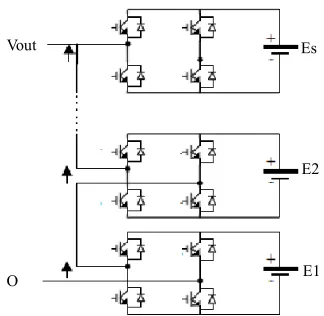
Cascaded multilevel inverter (CMLI) is the most recent and popular type of multilevel inverters, that synthesizes a desired sinusoidal voltage from several separate dc voltage sources. The general construction of the CMLI is shown per phase in Figure 1. It consists of S number of H-bridges fed with dc voltages sources 1 2 S.
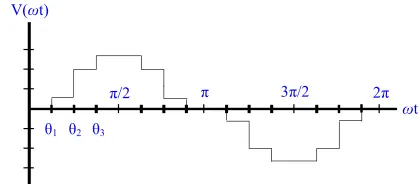
The output voltage is usually constructed in a stair case shape with quarter wave symmetry, in Figure 2, to ap-proach synthesizing a sinusoidal wave form, [1].
, , ,
E E E
, 2 , ,
E E SE
2
p p1, 2,
If all the dc sources are of equal value, say E, the CMLI is called symmetric. In this case the maximum number of the positive levels of the inverter is S and is obtained by switching on the dc sources sequentially, and these levels may take the values . While if the dc sources are of unequal values, the CMLI is re-ferred to as an asymmetric CMLI. In this case the maxi-mum number of the positive levels of the inverter can be increased greatly, since it could be possible to switch on some dc sources positively or negatively within the posi-tive half cycle of the output voltage, thus adding addi-tional positive levels. Generally, the possible positive levels of an asymmetric CMLI are all the positive values
of , where each of ,
and ps can take one of the values −1, 0 or +1. The
num-ber of all possible levels is (3)S, some of them may be
redundant. Increasing the number of levels of the inverter means that its staircase output wave form can approach more closely a sinusoidal wave form, which in turn means that the output voltage lower order harmonic val-ues and their total harmonic distortion could be reduced greatly, and this makes asymmetric CMLIs more popular for practical applications [2].
1 1 2
p E p E p ES S
Vout Es
E2
[image:1.595.341.503.560.718.2]E1 O
π
π/2 3π/2 2π
ωt
V(ωt)
[image:2.595.66.275.86.178.2]θ1 θ2 θ3
Figure 2. A staircase output voltage wave form with 3 posi-tive levels.
To obtain a staircase output voltage wave form with equal step heights in an asymmetric CMLI, the following uniform step sufficient conditions may be satisfied by the dc sources 1 2 . [3]:
, , , S
E E E
E E E
1) E1 E2 S , 1 S , and each of
, and ES is an integer multiple of E1.
2,
E
1 3,
E
2) J 1
1
2
J r
r
E
E E , and J2, , S
0, E, 2 ,E It is possible to obtain the maximum number of levels in an CMLI, i.e. (3)S non-redundant or different levels,
by replacing the inequality sign in the second condition with an equality sign. Thus considering three H-bridges with E1 = E we get E2 = 3E and E3 = 9E and the
associ-ated three H-bridges form the well known trinary asym-metric CMLI with the (3)3 = 27 levels:
3 ,E
and ±13E. Trinary asymmetric CMLIs can give better approximation of a sine wave than other asymmet-ric CMLIs, [4]. The 27-level asymmetasymmet-ric CMLI is thus recommended for many applications, such as for induc-tion motors and tracinduc-tion drives, [5-7].
In this paper the 27-level CMLI is considered, and a new approach depending on linear programming for de-termining the switching angles of this inverter that mini-mize the values of undesired harmonics is introduced and applied for single phase and three phase inverters.
2. A Proposed Approach for Determining
the Switching Angles of the Inverter
A fundamental issue for a CMLI is to find the switching angles (times) of the inverter H-bridges semiconductor power switches that produce the required fundamental voltage and at the same time eliminate or reduce the val-ues of undesired specific low order dominant harmon-ics .Many methods are given in the literature for obtain-ing the switchobtain-ing angles of symmetric as well as uniform step asymmetric CMLIs. These are mainly:
1) Using sinusoidal pulse width modulation, [8-12]. 2) Using a selective harmonic elimination technique, where the zero equations of the undesired harmonics with the equation of the desired amplitude of the main harmonic as functions of the switching angles are solved directly or by applying genetic algorithms, [1,13-17].
3) Using the method of minimizing the total harmonic distortion, [18,19].
However, all these methods are suitable mainly for CMLIs with small number of positive levels, and thus are not adequate for the 27-level inverter with 13 positive levels.
In addition, the author has introduced a method based on a general linear programming model that could be applied to minimize the values of the undesired harmon-ics, [20,21]. This linear programming (LP) model has the following advantages over other methods discussed in the literature, [22]:
1) This model is flexible. It allows minimizing the values of harmonics of any order and any number, inde-pendent of the number of inverter levels, under any re-quired reasonable value of the main harmonic.
2) LP constraints may be inequality constraints, so a feasible solution could be almost found, unlike harmonic elimination method which may give no feasible solution due to not satisfying the trigonometric equalities imposed.
3) LP constraints allow minimizing harmonics values with different weighting factors according to the har-monic order. Low order harhar-monics values could be mini- mized much more than higher order ones.
4) LP provides global optimal solution of the problem over the whole solution space, unlike some other optimi-zation methods that give a local optimal solution near an initial solution, which may not be a global optimal solu-tion.
5) Many software packages are available for solving LP models, even with huge number of variables and con-straints, in a moderate time. They are suitable for large problems that could not be easily solved with other methods.
6) The model can be applied even for asymmetric CMLIs with non uniform steps by adding additional con-straints, [23].
7) The model contains many parameters that could be selected arbitrarily. Many optimum solutions could be obtained for the same problem corresponding to different values of these parameters, and thus allowing for select-ing the best one.
The mathematical model of this approach is first given, and then applied for the single phase and the three phase 27-level CMLI. The model is applied first to determine the number of harmonics to be minimized that lead to least %THD. By including this result in the model and solving it for different amplitudes of the output main harmonic, the switching patterns that give minimum val-ues of undesired harmonics are obtained.
3. The Proposed Mathematical Model
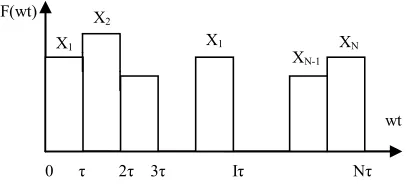
symmet-ric CMLI, is considered, where all the inverter levels are spaced equally with a step height E.. It is assumed, without loss of generality, that the inverter levels are equally spaced by 1 volt, i.e. normalized with respect to the dc voltage E. It is assumed also that the inverter out-put voltage wave form F(wt) has a quarter wave symme-try, as that shown in Figure 2. The pattern of this func-tion is generated by on and off switching of the inverter H-bridges semiconductor power switches, and is com-pletely determined by defining the switching pattern over the interval 0wtπ2
, I 1 ,
. The basic approach depends on dividing this interval into N equal small subintervals, starting at the angles 0, , 2 ,
1, 2, ,
, till (N − 1)τ., where τ = π/2N, Figure 3.
The positive integer values XI, I N are
de-fined over each subinterval, to represent the required instantaneous output voltage level value F(wt) of the inverter, so that F(wt) is defined over the interval
0wtπ 2 by: F wt
XI for
I–1
wtI 1, 2, ,and I N
n 2 1
The Fourier series expansion of F(wt) is an odd-sines series given by:
m 0 2m1siF wt
V m wt,where
2 2 1 0
1
4
sin 2 1 d
8 sin 2 1 sin 2
2 1 2
m
N I I
V F wt m w
X m
m 1 I 2
t wt
m
0,1, 2, ,
I 1
(1)where (2m + 1) is the order of the harmonic, , τ = π/2N, and
m I
1, 2, , .
The value of the amplitude of main harmonic corre-sponds to V1, and is obtained by substituting m = 0 in
Equation (1).
Equation (1) shows that V2m + 1 for any value of m is a
linear function of the integer values XI, I N.
Variations of the values of XI from a subinterval to a
next one determine the required switching angles of the inverter from one level to another.
It is required to find the values of XIthat minimize the
values of some undesired harmonics. A mixed integer linear programming (MILP) problem is formulated as
X1
X2
X1
X F(wt)
0 τ 2τ 3τ Iτ
N-1
XN
wt
Nτ
I1,2, , N
1 1 1
[image:3.595.71.276.617.709.2]V V V
Figure 3. Representation of F(wt) by XI,
over the interval 0 ≤wt≤π/2.
follows, [11]:
Minimize ε, subject to the constraints:
2 1 2 1 2 1, for each undesired
harmonic of order (2 1)
m Vm m
m
1
(2)
(3)
XI XI , for I1, 2, , N1, and XN L 0
I
X I1, 2, , N
V
V
(4) and integer for (5) In the main harmonic constraint (2) 1 is the required
amplitude of the main harmonic. Δ is a small incremental value, 1
V
, arbitrary chosen and included in the main harmonic constrain to ensure obtaining an optimum solution, since an equality constraint may give a high value of ε or even an unfeasible solution., due to the trigonometric nature of the constraints. The value of Δ is taken of the order of 1% of V1, so that the obtained
value of V1 does not differ practically from the required
value of 1.
In constraint (3) V2m + 1 is given by Equation (1), for V1
and the undesired harmonics, and α2m + 1 is a weighting
factor for the undesired harmonics, to enable reduction of harmonics with different upper bounds according to their order.
By constraints (4) the positive staircase wave form shape is assured with maximum height L, where L is the number of positive voltage levels of the inverter.
Constraint (5) is the integer constraint on XI.
Once all the parameters of this MILP model are given, an optimum solution could be obtained that gives the values of XI and ε using any of the well known operations
research software packages, e.g. “LINGO” software [24].
4. Selecting the Model Parameters
In the following sections this model is applied for the 27-level CMLIs, taking the number of subintervals N = 180, that corresponds to a subinterval angular width of 90˚/180 = 0.5˚, Figure 3.
The model is first solved with the constraint (2) re-placed by:
1
V L (2’) to minimize undesired harmonics for all amplitudes of the output voltage greater than L, normalized with re-spect to E, while utilizing all the levels of the inverter (L = 13).
The model is solved for the following two cases: 1) Minimizing all undesired harmonics equally, i.e. taking in constraint (3) the values of α2m+1 = 1 for all
un-desired harmonics.
For each of the above two cases the model is solved for minimizing low order harmonics till a harmonic of order k, for different values of k, then selecting the value of k that leads to least %THD, where the %THD is de-fined by:
2 0.51 100
V
3,5,7,
45
2 1 1
%THD m
m
V V
, (6)i.e. the %THD is calculated till the 91st harmonic. Then the model is solved, using this value of k, to minimize low order undesired harmonics till the kth harmonic for different values of the required output voltage between 7 and 15, using the constraint (2) and taking Δ = 0.1.
By this way the switching patterns of the inverter at different values of the output voltage that minimize the values of low order harmonics with least %THD are ob-tained. This procedure is carried out next for the single phase and three phase CMLIs.
5. Solution of the Model for the 27-Level
Single Phase CMLI
5.1. Solution for Different Values of the Undesired Harmonics
Figure 4 shows the %THD obtained by solving the model, with the voltage constraint (2’), to minimize the odd har- monics till the kth harmonic for different val- ues of k and for the two cases: equal weightings and in- creasing weightings of the undesired harmonics. The figure shows that the least %THD (= 2.67%) is obtained by minimizing the undesired harmonics equally till the 31st harmonic, and this is obtained at V1 = 13.21.
5.2. Solution for Different Amplitudes of the Output Voltage
The model is solved using the voltage constraint (2) for some values of V1 between 8 and 14 to obtain the
[image:4.595.317.524.218.807.2]switching angles of the inverter that minimize the odd harmonics equally from the 3rd till the 31st harmonic.
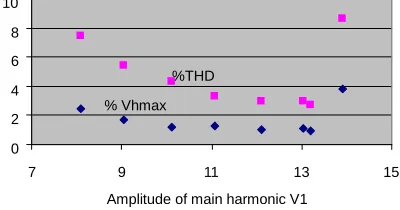
Figure 5 shows for each value of V1, that corresponds to
0 1 2 3 4 5 6
13 23 33
Upper order of minimized harm
% T
H
43
onics (k)
D INCREASING
Q EQUAL
Figure 4. The %THD for different minimized harmonics.
1 and 14, and for V1 = 13.21 the value of
%THD and the value %Vhmax ,which represents the maxi-
mum percentage absolute amplitude of the undesired harmonics relative to the main harmonic among all har-monics from the 3rd till the 91st harmonic. It is shown that the % THD is less than 5% and that the %Vhmax is
less than 3% over the wide voltage range. 8,9,
V
Some results obtained from the detailed solution of the model at V1 = 13.21 are given next. The value of %THD
= 2.67% and of %Vhmax = 0.9%. For this value of V1 Fig-ure 6 shows the obtained values of XI. The 13 switching
angles of the inverter are: 1.5˚, 4.5˚, 10.5˚, 15.5˚, 19˚, 25˚, 29˚, 35˚, 39.5˚, 46.5˚, 52.5˚, 60.5˚ and 71˚. Figure 7
shows the switching patterns of the three H-bridges of the inverter during the positive quarter cycle of the main harmonic, assuming a uniform step asymmetric CMLI. The 1E H-bridge is switched 9 times on and 8 times off. The 3E H-bridge is switched 3 times on and 2 times off and the 9E H-bridge is switched one time on. If the 27
0 2 4 6 8 10
7 9 11 13 15
Amplitude of main harmonic V1 % Vhmax
[image:4.595.323.523.329.434.2]%THD
Figure 5. The values of %THD and %Vhmax against V.
0 2 4 6 8 10 12 14
1 21 41 61 81 101 121 141 161
Subinterval X(I)
V
al
ue of
X
(I
[image:4.595.327.515.465.720.2])
Figure 6. Values of XI that gives V1 = 13.21.
-6 -3 0 3 6 9 12
1 21 41 61 81 101 121 141 161
Subinterval X(I)
S
w
it
c
h
in
g o
f
H-B
rid
g
e
s
3 E
E 9E
[image:4.595.70.276.601.718.2]level inverter is constructed as a symmetric CMLI it will need 13 H-bridges, that would be switched on conse-quently 13 times only during the positive quarter cycle of the main harmonic. This shows that asymmetric CMLIs suffer from more switching losses than symmetric CMLIs, but this does not represent a serious problem with recent developments of semiconductor power switches with low switching losses, [25].
Figure 8 shows the obtained percentage values of the harmonics relative to the main harmonic from the 3rd till the 91st harmonic, and a 5% of the main harmonic at V1
= 13.21.
Similar results could be obtained when solving the model at any value of the output voltage V1 between 8
and 14.
Noting that the values of V1 are normalized with
re-spect to the dc voltage E.
6. Solution of the Model for the 27-Level
Three Phase CMLI
In a balanced three phase operation the triplen odd har-monics, i.e. the 3rd, 9th, 15th··· and so on, are self can-celled in the output line voltage assuming a star con-nected three phase inverter. The procedure carried out in Section 5 with the single phase asymmetric CMLI is re-peated while excluding the triplen odd harmonics, as follows:
[image:5.595.321.525.340.437.2]6.1. Solution for Different Values of Undesired Harmonics
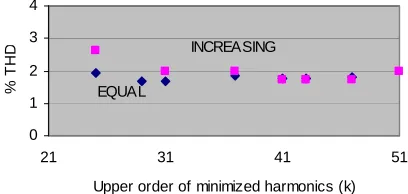
Figure 9 shows the %THD obtained by solving the model, with the voltage constraint (2’), to minimize the non- triplen odd harmonics till the kth harmonic for different values of k and for the two cases: equal weightings and increasing weightings of the undesired harmonics.
The figure shows that the least %THD (=1.67%) is obtained by minimizing the undesired harmonics equally till the 31st harmonic, and this is obtained at V1 = 13.87.
6.2. Solution for Different Amplitudes of the Output Voltage
The model is solved using the voltage constraint (2) for
-2 -1 0 1 2 3 4 5 6
-9 11 31 51
Harmonic order
% H
a
rm
o
n
ic
va
lu
e
71 91
V
Figure 8. % Values of harmonics for V1 = 13.21.
some values of 1 between 6 and 15.5 to obtain the
switching angles of the inverter that minimize the non-triplen odd harmonics equally from the 5rd till the
31st harmonic. Figure 10 shows for each value of V1,
that correspond to 1 and 15.5, and for V1
= 13.87 the values of % THD and %Vhmax, as defined in
Sections 4 and 5, for the non-triplen harmonics from the 5th till the 91st harmonic. It is shown that the % THD is less than 2.5% and that the %Vhmax is less than 1.5% over
the voltage range 13 ≤ V1 ≤ 15, noting that the values of
V1 are normalized w. r. t. E.
6,7, ,15
V
As a detailed solution example, the least values of % THD and % Vhmax are obtained at V1 = 13.87: % THD =
1.67% and % Vhmax = 0.69%. For this value of V1, Figure 11 shows the obtained values of XI.. The 13 switching
angles of the inverter are: 2˚, 3˚, 8.5˚, 13.5˚, 17˚, 20˚, 24.5˚, 28.5˚, 33.5˚, 39.5˚, 49.5˚, 52.5˚ and 69˚.
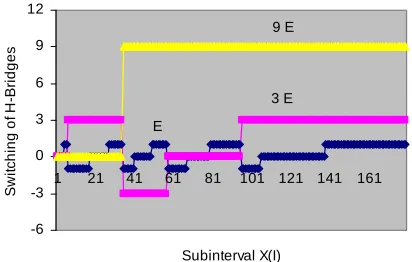
Figure 12 shows the corresponding switching patterns of the three H-bridges of the inverter during the positive quarter cycle of the main harmonic, assuming a uniform
0 1 2 3 4
21 31 41 51
Upper order of minimized harmonics (k)
% TH
INCREASING
EQUAL
D
Figure 9. The % THD for different minimized harmonics.
0 1 2 3 4 5 6
5 7 9 11 13 15
Amplitude of main harmonic V1
[image:5.595.312.535.471.574.2]% Vhmax
Figure 10. The values of % THD and %Vhmax against V1.
0 5 10 15
1 21 41 61 81 101 121 141 161 Subinterval X(I)
V
a
lu
e of
X
(I
[image:5.595.317.530.603.718.2])
[image:5.595.66.280.619.720.2]step asymmetric CMLI. The three H-bridges are switched as many times as for the single phase asymmetric CMLI, shown in Figure 7.
Figure 13 shows the obtained percentage values of the harmonics relative to the main harmonic from the 5th till the 91st harmonic, excluding the triplen harmonics, and of 5% of the main harmonic for V1 = 13.87.
7. Conclusions
This paper introduces a general approach for minimizing the values of the undesired harmonics produced by sym-metric or asymsym-metric uniform step CMLIs using a mixed integer linear programming (MILP) model. Using MILP for this problem has many advantages over other meth-ods given in the literature, and specially of being suitable for CMLIs with large number of levels. This approach is applied first to determine the number of harmonics to be minimized in order to obtain least percentage total har-monic distortion till the 91st harhar-monic, then the result is included in the model and it is solved for different values of the output voltage, to get the switching pattern that minimize the harmonics values. Solutions for single phase and three phase 27-level CMLIs are given.
It should be noted that the proposed approach could be applied for symmetric or uniform step asymmetric CMLIs. A 27-level symmetric CMLI needs 13 series connected H-bridges per phase, with equal dc sources. The corresponding asymmetric CMLI needs only 3 series connected H-bridges per phase. This will be at the cost of
-6 -3 0 3 6 9 12
1 21 41 61 81 101 121
Subinterval X(I)
S
w
it
c
hi
n
g of
H-B
ri
dge
s
3 E 9 E
E
141 161
Figure 12. Switching patterns of the H-bridges for V1 = 13.8.
-2 -1 0 1 2 3 4 5 6
-9 1 11 21 31 41 51 6
Harmonic order
% H
a
rm
o
n
ic
v
a
lu
e
[image:6.595.68.276.616.716.2]1 71 81 91
Figure 13. % values of harmonics for V1 = 13.87.
more switching losses, but this does not represent a seri- ous problem with the recent development of power semi- conductor switches with low switching losses. In addi- tion, asymmetric CMLIs need semiconductor power swit- ches with higher voltage ratings, and thus are more suit-able for medium voltage applications, while symmetric CMLIs are more suitable for high voltage applications, [1].
In all the cases discussed the applied MILP assumes dividing the quarter half cycle of the main harmonic in N = 180 subintervals to obtain reasonable results with moderate solution time that differs from few seconds to few minutes on a usual personal computer. Increasing the number of subintervals N may lead to solutions that have lower percentage values of the minimized undesired harmonics %Vhmax and their %THD. However, the
ob-tained values agree well with the IEEE standard 519- 1992 for voltage distortion limits in power systems, [26]. This standard puts upper limits of 5% and 3% for %THD and %Vhmax respectively for output voltages ≤ 69 kv, and
upper limits of 2.5% and 1.5% for %THD and %Vhmax for
output voltages between 69 and 161 kv. Thus using the results of this paper, the single phase 27-level CMLI could be used for output voltage values till 69 kv, and the 3 phase 27-level CMLI could be used for output voltage values till 161 kv.
REFERENCES
[1] M. N. Ben Nasr, A. Kebir and F. B. Ammar, “Cascaded H-Bridges Symmetrical 11-Level Optimization,” Pro- ceedings of 14th International Middle East Power Sys- tems Conference (MEPCON’2010), Cairo, 19-21 De- cember 2010, pp. 465-470.
[2] F. Khoucha, M. S. Lagoam, A. Kheloui and M. E. Ben- bouzid, “A Comparison of Symmetrical and Asymmetri-cal Three Phase H-Bridge MLI for DTC Induction Motor Drives,” IEEE Transactions on Energy Conversion, Vol. 26, No. 1, 2011, pp. 64-72.
doi:10.1109/TEC.2010.2077296
[3] J.Song-Manguell, S. Mariethoz, N. Veenstra and A. Ruter, “A Generalized Design Principle of a Uniform Step Asymmetric Multilevel Converter for High Power Con- version,” European Conferences on Power Electronics and Applications EPE’01, Graz, 27-29 August 2001, pp. 1-12.
[4] B. Sujanarko, M. Ashari and M. H. Parnoma, “Improved Voltage of Cascaded Inverters Using Sine Quantization Progression,” Indonesian Journal of Electrical Engineer- ing, Vol. 8, No. 2, 2010, pp. 123-130.
Fed Induction Motor Drive,” International Journal of Recent Trends in Engineering, Vol. 12, No. 5, 2009. [7] J. Dixon, J. Preda, C. Castillo and S. Bosch, “Asymmet-
rical Multilevel Inverters for Traction Drives Using Only One DC Supply,” IEEE Transactions on Vehicular Tech- nology, Vol. 59, No. 8, 2010, pp. 3736-3743.
doi:10.1109/TVT.2010.2057268
[8] R. Seyezhai and B. L. Mathur, “Implementation and Con- trol of Variable Frequency ISPWM Technique for an Asymmetric Multilevel Inverter,” European Journal of Scientific Research, Vol. 39, No.4, 2010, pp. 558-568. [9] B. Sujanarko, M. Ashri, M. H. Parnomo and O. Penang-
sang, “Advanced Carrier Based PWM in Asymmetric Cascaded Multilevel Inverter,” International Journal of Electrical & Computer Sciences, Vol. 10, No. 6, 2010, pp. 47-51.
[10] J. I. Leon, S. Kouro, S. Vazquez, R. C. Portillo, L. G. Franqueb, J. M. Carrsco and J. R. Rodriguez, “Multidi- mentional Modulation Technique for Cascaded Multil- revel Inverters,” IEEE Transactions on Industrial Elec- tronics, Vol. 58, No. 2, 2011, pp. 412-420.
doi:10.1109/TIE.2010.2048833
[11] S. Mekhilef and M. N. A. Kadir, “Novel Vector Control Method for Three Stage Hybrid Multilevel Inverter,” IEEE Transactions on Industrial Electronics, Vol. 58, No. 4, 2011, pp. 1339-1349. doi:10.1109/TIE.2010.2049716 [12] F. Carnielutti, H. Pinheiro and C. Rech, “Generalized
Carrier-Based Modulation Strategy Cascaded Multilevel Converters Operating under Faulty Conditions,” IEEE Transactions on Industrial Electronics, Vol. 59, No. 2, 2012, pp. 679-689. doi:10.1109/TIE.2011.2157289 [13] R. Taleb and A. Meroufel, “Control of Asymmetric Mul-
tilevel Inverter Using Artificial Neural Network,” Journal of Electronics and Electrical Engineering, No. 8(96), 2009, pp. 93-98.
[14] D. Ahmadi, K. Zou, l. Cong, Huang, J. Wang, “A Uni- versal Selective Harmonic Elimination Method for High Power Inverters,” IEEE Transactions on Power Elec- tronics, Vol. 26, No. 10, 2011, pp. 2743-2752.
doi:10.1109/TPEL.2011.2116042
[15] A. Kavousi, B. Vahidi, R. Salehi. M. Bakhshizadeh, N. Farokhnia and S. S. Fathi, “Application of the Bee Algo- rithm for Selective Harmonic Elimination Strategy in Multilevel Inverters,” IEEE Transactions on Power Elec- tronics, Vol. 27, No. 4, 2012, pp. 1689-1696.
[16] F. Filho, H. Z. Maia, T. H. A. Mateus, B. Ozpineci, L. M.
Tolbert and J. O. P. Pinto, “Adaptive Selective Harmonic Minimization Based on ANNs for Cascaded Multilevel Invetres with Varing DC Sources,” IEEE Transactions on Power Electronics, Vol. 60, No. 5, 2013, pp. 1955-1962. [17] J. Napoles, A. J. Watsen, J. J. Padilla, J. J. Leon, L. J.
Franquelo, P. W. Wheeler and M. A. Aguirre, “Selective Harmonic Mitigation Technique for Cascaded H-Bridge Converters with Nonequal DC Line Voltages,” IEEE Transactions on Industrial Electronics, Vol. 60. No. 5, 2013, pp. 1963-1971. doi:10.1109/TIE.2012.2192896 [18] J. Kumar, B. Das and P. Agarwal, “Harmonic Reduction
Technique for a Cascaded Multilevel Inverter,” Interna- tional Journal of Recent Trends in Engineering, Vol. 1, No. 3, 2009, pp. 181-185.
[19] N. Yousefpoor, S. H. Fathi, N. Farokhnia and H. A. Aby- aneh, “Total Harmonic Distortion Minimization Applied Directly on the Line-to-Line Voltage of Multilevel In- verters,” IEEE Transactions on Industrial Electronics, Vol. 59, No. 1, 2012, pp. 373-380.
doi:10.1109/TIE.2011.2143373
[20] M. El-Bakry, “Using Linear Programming Models for Minimizing Harmonics Values in Cascaded Multilevel Inverters,” Proceedings of 2010 IEEE/ASME Interna- tional Conference on Advanced Intelligent Mechatronics (AIM’2010), Montereal, 6-9 July 2010, pp. 696-702. [21] M. El-Bakry, “Selective Harmonic Minimization for Mul-
tilevel Inverters,” Proceedings of 2nd International Con- ference on Computer and Electrical Engineering, (IC- CEE), Dubai, 2009, pp. 341-346.
[22] D. R. Anderson, D. J. Sweeny and T. A. Williams, “In- troduction to Management Science, Quantitative Ap- proach to Decision Making,” Chapter 8, Integer Linear Programming, West Publishing Co., USA, 2002.
[23] M. El-Bakry, “Minimizing Harmonics Values in Non- Uniform Step Asymmetric CMLIs,” International Jour- nal of Emerging Technology and Advanced Engineering, Vol. 2, No. 10, 2012, pp.5-11.
[24] Lindo Systems Inc., “Optimization Modeling with LINGO,” 2004. www.lindo.com
[25] S. Sheklowat and B. Brockway, “The Application-Spe- cific Power Semi-Conductor,” Fairchild Semiconductor Inc., San Jose, 2009.