http://www.scirp.org/journal/jhrss ISSN Online: 2328-4870
ISSN Print: 2328-4862
DOI: 10.4236/jhrss.2017.51002 February 27, 2017
Study on the Effects of Work
Teams on Human
Resources Excellence
Ebrahim Kalani
1,2, Ehsan Kamrani
31Department of Industrial Engineering, Tarbiat Modarres University, Tehran, Iran 2Department of Industrial Engineering, Khatam Al-Anbiya University, Tehran, Iran 3Institute of Biomedical Science and Technologies, Shahid Beheshti University, Tehran, Iran
Abstract
The conception and use of work teams have been one of the main subjects of management researches for the last few decades and in the past years many developments have happened in the kinds and usage of them, which have im-proved the condition of organizations and human resources management. Our objective in this paper is to observe the formation of work teams and how they affect human resources excellence. Finding new and creative solutions for today’s intricate situations is becoming more and more difficult and em-ployees can’t solve them on their own anymore and this shows and bolds the importance of teamwork and forming work teams. The main objective how-ever in this paper is to evaluate the effect of 5 main characteristics of work teams (which are team structure, leadership, control, mutual support and communication) on the 3 main characteristics of human resources excellence (which are delegation, motivation and team work) in Torang Darya Shipping Company. To do so, 200 personnel at the department were randomly selected from 450 personnel by Cochran sample size formula and answered to the re-search made questionnaire derived from [1] [2] and [3]. The content validity of the questionnaire has been confirmed by the experts and academicians and the reliability has also been confirmed by Chornbach’s alpha. Its value was obtained as 84.0%. The data were analyzed by bi-variable linear regression test and the findings indicated that team structure, leadership, control and com-munication affect meaningfully on human resources excellence but mutual support doesn’t have meaningful effect on human resources excellence.
Keywords
Work Teams, Team Structure, Leadership, Mutual Support, Control, Communication, Human Resources Excellence
How to cite this paper: Kalani, E. and Kamrani, E. (2017) Study on the Effects of Work Teams on Human Resources Excel-lence. Journal of Human Resource and Sustainability Studies, 5, 12-20.
https://doi.org/10.4236/jhrss.2017.51002
Received: November 4, 2016 Accepted: February 24, 2017 Published: February 27, 2017
Copyright © 2017 by authors and Scientific Research Publishing Inc. This work is licensed under the Creative Commons Attribution International License (CC BY 4.0).
13
1. Introduction
Organizations have been going through drastic structural changes in the last two decades and been competing more to survive in the global market. Some cha-racteristics have been added to new organizations like decentralization, globali-zation, extensive use of information technology and most importantly extensive use of work groups and teams. As already mentioned by Anderson et al., in [4] [5], one of the most important changes is going from individual efforts to group efforts.
The concept of social group was first configured through the researches, stu-dies and observations in the 1970s and 1980s [6] [7]. This phrase was then used to describe and explore the interpersonal relations in the work place. All through 1990s many studies were done to make us better understand this phenomenon and a lot of researchers took the time to reach above goal. It is clear that the most important question to be considered is whether work groups and teams have positive, negative or no effect on organizations.
Many researchers have a positive view on this and believe that mechanisms in teams can improve efficiency and effectiveness in work places (Kozlowski, et al. [8] [9]).
More importantly the leading characteristic which rises to teams` support is the ability that they provide for companies whose environment is changing so fast that becoming conformed to it faces a big challenge. Teams in this environ-ment can make the response much faster because it uses the ideas of a group of experts in no time [4] [5].
Many factors in teamwork make it a good choice for management to consider using it; here however, five most important ones have been selected and ex-plained in this paper.
The rest of this paper is organized as follows: The main work team characte-ristics have been explained in Section 2. The applied methodology and the data collection tool have been introduced in Sections 3 and 4 respectively. Section 5 provides the research results followed by discussion and some final conclusions are in Sections 5 and 6.
2. Team Work Characteristics
Many factors in teamwork make it a good choice for management to consider using it. In this research, however we have picked out the five most important ones including: team structure, leadership, control, mutual support and com-munication. The level of social interdependence and members` mutual support has positive effect on higher sales [10]. The mutual support can be an important factor for measuring cooperation and correlation in organizations.
According to the series of interviews that Hambrick [11] did with a number of big corporates’ CEOs almost all of them agreed upon one important barrier on the way to a successful team which was lacking mutual support and correlation.
14
of managers is one of their most important roles, which has to be orchestrated very well.
The factors which have a leading role in the success of a team are:
1) Size: teams with members between 12 and 25 function better so the less members, the more successful the team will be.
2) Place: the closer the members (Physically) the better function they will have.
Regular meetings, the accessibility of information, focus on one task and etc., these characteristics are considered as team structure [12].
3) Leadership: leadership is an impartible part of management. Leadership is defined as the ability to influence on a group of people to reach a goal and has a leading role in management’s duties.
4) Control: the process of comparing what was meant to do and what is done and amending in case of the difference between the two. In Control, we compare musts with existents and desirable with available [13].
On the other hand, recently human resources excellence is one of the eminent characteristics of a successful manager. Empowering employees is distribution of legal authority amongst them in a way they feel effective in their environment [14]. Most administrators imagine they have realized the meaning of empower-ing employees but in fact, very few have grasped the meanempower-ing and even so among these very few know how to use it [15].
Researches show that empowered employees are happier, more satisfied with their jobs, more efficient, more innovative and produce and offer productions and services with a greater quality [16].
Many employees think of empowering employees as doing whatever they feel right freely but it means to release the inner forces in each human to reach ex-cellent results. It means to render power to help employees feel confident inside [17] [18].
3. Methodology
This study is a descriptive survey research. The study sample is consisted of staff Torang Darya Shipping Company. After compiling a list of all employees, for the object of determining the size of sample, we have used Cochran formula and as seen in below formula 207 of the staff were selected. The survey questionnaire was distributed among them and finally, 200 questionnaires were collected.
(
)
(
) (
)
2
2 2
450 1.96 0.5 0.5
0.05 450 1 1.96 0.5 0.5
n= ×
− + × (1)
4. Data Collection Tool
4.1. Work Teams Effects Questionnaire
1This questionnaire [19] consists of 20 items and five subscales which include: • Team Structure,
15 • Leadership,
• Control, • Mutual Support, • Communication.
Every item has a 5 degree of response, from “completely disagree” to “com-pletely agree” that it is graded from 1 to 5. The scope of the questionnaire is from 66 to 88% using both Cronbach’s alpha and split up methods, which shows appropriate validation.
4.2. Empowering Employees Questionnaire
2This questionnaire [3] consists of 22 items and three subscales which are in-cluded: Delegation, Motivation, Team work. Every item has a 5 degree of re-sponse, from “completely disagree” to “completely agree” that it is graded from 1 to 5. The Scope of the questionnaire is from 66 to 88% using both Cronbach’s alpha and split up methods, which shows appropriate validation.
5. Results
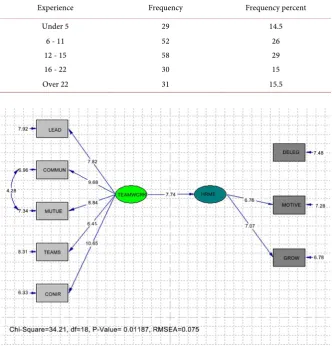
In order to analyze the survey data, both descriptive and inferential statistical methods were used. Table 1 shows the results of Kolmogorov-Smirnov test. Frequency distribution of variables based on the sex and age have been pre-sented in Table 2 & Table 3. Table 2 shows the descriptive characteristics of sex- variables. Table 3 shows the descriptive characteristics of age-variables.
Descriptive characteristics of variables-level of education are shown in Table 4. Table 5 shows the descriptive characteristics of Experience variables.
[image:4.595.208.539.498.633.2]Figure 1 depicts the standardized values in the final model achieved by LIS- REL structural equation modeling (SEM).
Table 1. Results of Kolmogorov-Smirnov Test.
Variable Kolmogorov-Smirnov value significance
Leadership 8% <5%
Communication 7% <5%
Mutual Support 7% <5%
Control 6% <5%
Team Structure 6% <5%
Motivation 6% <5%
Delegation 6% <5%
Teamwork 6% <5%
Table 2. Descriptive characteristics of variables-sex.
Sex Frequency Frequency percent
Male 191 95
Female 9 5
16
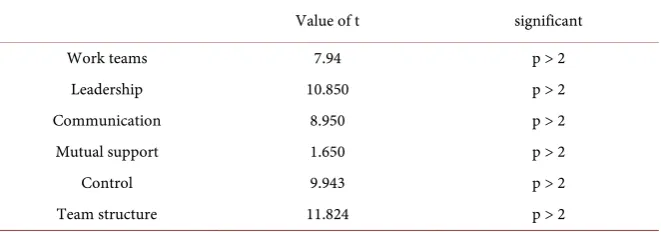
[image:5.595.207.540.135.230.2]Table 6 shows the results of the t student test of variables of work teams on HRE.
Table 3. Descriptive characteristics of variables—age.
Age Frequency Frequency percent
Under 25 17 8.5
25 - 35 48 24
35 - 45 95 47.5
45 - 55 37 18.5
[image:5.595.207.540.265.334.2]Over 55 3 1.5
Table 4. Descriptive characteristics of variables—level of education.
Level of education Frequency Frequency percentage
High school graduate 170 85
Bachelor graduate 25 12.5
[image:5.595.207.540.370.717.2]Master graduate and higher 5 2.5
Table 5. Descriptive characteristics of variables—experience.
Experience Frequency Frequency percent
Under 5 29 14.5
6 - 11 52 26
12 - 15 58 29
16 - 22 30 15
Over 22 31 15.5
17
Table 6. Results of the t student test of variables of work teams on HRE.
Value of t significant
Work teams 7.94 p > 2
Leadership 10.850 p > 2
Communication 8.950 p > 2
Mutual support 1.650 p > 2
Control 9.943 p > 2
Team structure 11.824 p > 2
6. Discussion
The purpose of this study was to determine the contribution of work teams (team structure, leadership, communication, mutual support and control in pre-dicting human resources excellence and empowerment in Torang Darya Ship-ping Company. Results of t student test showed that, there is a significant posi-tive relationship between work teams and HRE. The result of each test should be higher than 2 (p > 2) in order to be considered significant and as can be seen above all the criteria has the same significance except mutual support which means it cannot be said about this variable that has any kind of meaningful effect on HRE. The other variables have a meaningful contribution in predicting the HRE. These finding are consistent with the findings of Salas and colleagues [2] [19].
In explanation of the above findings, it can be stated that, when employees are put together as a team they can achieve the advantages in the team and improve their role both as a single member of an organization and also as a member of their own team so they will show better performance in the future due to the skills and knowledge that have learnt through their work team experience.
The increasing use of teams and group-works to answer to the requirements of environment flexibility has shown a great interest among academics and pro-fessionals [20]. Many research and studies have been done on this area including [20] [21] [22] [23]. It has been shown that the team working plays an important role in the organizational success in a global, changeable and client-oriented economy [24].
We began this article by highlighting the centrality and importance of team-work across a wide landscape of modern life. Yet, given the centrality of team-work teams, it is more than a bit remarkable that we have a strong individual-centric perspective in our culture. We school our children as individuals, we hire, train, and reward employees as individuals. And yet we have great faith that individu-als thrown together into a team with little thought devoted to team composition, training and development, and leadership will be effective and successful [25].
More over theorists and researchers have developed effective interventions centering on team design, team training, and team leadership that shape team processes and enhance team performance.
18
the paper is that we have numerable number of teams such as project teams, in-dependent teams, management teams, temporary teams, leadership teams and many others which in their own way have their special structure and effects on the members and are composed for a unique and different reason. By more en-tering this subject as the view of each special team, it is possible that we can even find out and explore more magic that can happen within them.
7. Conclusion
In summary, this paper has sought to review the literature on team effectiveness and compile variables and their measures and also their effects on human re-sources excellence. The results of this work can support future research on teams. Although considerable headway has been made in team effects studies, there is still research to be done.
Acknowledgements
The research was supported by Shahid Beheshti University of Tehran, Tarbiat Modarres University of Tehran and Khatam Al-anbiya University (KAU). We thank Mr. A. Soori and Mr. A. Karimi for their comments and assistance with preparing the earlier version of the manuscript.
References
[1] Kozlowski, S.W.J. and Salas, E. (1997) An Organizational Systems Approach for the Implementation and Transfer of Training. In: Ford, J.K., Kozlowski, S.W.J., Kraiger, K., Salas, E. and Teachout, M., Eds., Improving Training Effectiveness in Work Or-ganizations, LEA, Mahwah, 247-287.
[2] Salas, E., Dickinson, T.L., Converse, S.A. and Tannenbaum, S.I. (1992) Toward an Understanding of Team Performance and Training. In: Swezey, R.W. and Salas, E., Eds., Teams: Their Training and Performance), Ablex, Norwood, 3-29.
[3] Daft, R. (2012) Organization Theory and Design. Nelson Education, Scarborough. [4] Anderson, N. and Thomas, H.D. (1996) Work Group Socialization. Handbook of
Work Group Psychology, 423, 450.
[5] Anderson, N.R. and West, M.A. (1998) Measuring Climate for Work Group Inno-vation: Development and Validation of the Team Climate Inventory. Journal of Organizational Behavior, 19, 235-258.
https://doi.org/10.1002/(SICI)1099-1379(199805)19:3<235::AID-JOB837>3.0.CO;2-C [6] McGrath, J.E. (1997) Small Group Research, That Once and Future Field: An
Inter-pretation of the Past with an Eye to the Future. Group Dynamics: Theory, Research, and Practice, 1, 7. https://doi.org/10.1037/1089-2699.1.1.7
[7] McGrath, J.E. and Hollingshead, A.B. (1994) Groups Interacting with Technology: Ideas, Evidence, Issues, and an Agenda. Sage Publications, Inc., New York.
[8] Kozlowski, S.W.J. and Klein, K.J. (2000) A Multilevel Approach to Theory and Re-search in Organizations: Contextual, Temporal, and Emergent Processes. In: Klein K.J. and Kozlowski, S.W.J., Eds., Multilevel Theory, Research, and Methods in Or-ganizations: Foundations, Extensions, and New Directions,Jossey-Bass, San Fran-cisco, 3-90.
19
Implementation and Transfer of Training. In: Ford, J.K., Kozlowski, S.W.J., Kraiger, K., Salas, E. and Teachout, M., Eds., Improving Training Effectiveness in Work Or-ganizations, LEA, Mahwah, 247-287.
[10] Smith-Jentsch, K., Milanovich, D., Reynolds, A. and Hall, S. (1999) Fostering the Development of Shared Teamwork Knowledge Structure through Computer-Based Instruction. 14th Annual Conference of the Society for Industrial and Organiza-tional Psychology, Atlanta, 30 April-2 May 1999.
[11] Briscoe, F., Chin, M. and Hambrick, D.C. (2014) CEO Ideology as an Element of the Corporate Opportunity Structure for Social Activists. Academy of Management Journal, 57, 1786-1809. https://doi.org/10.5465/amj.2013.0255
[12] Hudson, B. and Henwood, M. (2002) The NHS and Social Care: The Final Count-down? Policy & Politics, 30, 153-166. https://doi.org/10.1332/0305573022501610 [13] Alvani, S.M. and Esgandari, K. (2013) Administrative Barriers of Performance-
Based Budgeting in State Organizations. Journal of Applied mathematics in Engi-neering, Management and Technology, 1, 305-314.
[14] Robbins, T.L. and Miller, J.L. (2004) Considering Customer Loyalty in Developing Service Recovery Strategies. Journal of Business Strategies, 21, 95-100.
[15] Greasley, K., Bryman, A., Dainty, A., Price, A., Naismith, N. and Soetanto, R. (2008) Understanding Empowerment from an Employee Perspective: What Does It Mean and Do They Want It? Team Performance Management, 14, 39-55.
https://doi.org/10.1108/13527590810860195
[16] Hur, M.H. (2006) Empowerment in Terms of Theoretical Perspectives: Exploring a Typology of the Process and Components across Disciplines. Journal of Community Psychology, 34, 523-540. https://doi.org/10.1002/jcop.20113
[17] Cohen, S.G. and Bailey, D.E. (1997) What Makes Teams Work: Group Effectiveness Research from the Shop Floor to the Executive Suite. Journal of Management, 23, 239-290. https://doi.org/10.1177/014920639702300303
[18] Cohen, S.G. and Ledford, G.E. (1994) The Effectiveness of Self-Managing Teams: A Quasi-Experiment. Human Relations, 47, 13-43.
https://doi.org/10.1177/001872679404700102
[19] Salas, E., Tannenbaum, S.I., Kraiger, K. and Smith-Jentsch, K.A. (2012) The Science of Training and Development in Organizations: What Matters in Practice. Psycho-logical Science in the Public Interest, 13, 74-101.
https://doi.org/10.1177/1529100612436661
[20] Delgado Piña, M.I., María Romero Martínez, A. and Gómez Martínez, L. (2008) Teams in Organizations: A Review on Team Effectiveness. Team Performance Management, 14, 7-21. https://doi.org/10.1108/13527590810860177
[21] Campion, M.A., Medsker, G.J. and Higgs, A.C. (1993) Relations between Work Group Characteristics and Effectiveness: Implications for Designing Effective Work Groups. Personnel Psychology, 46, 823-847.
https://doi.org/10.1111/j.1744-6570.1993.tb01571.x
[22] Gladstein, D.L. (1984) Groups in Context: A Model of Task Group Effectiveness.
Administrative Science Quarterly, 29, 499-517. https://doi.org/10.2307/2392936 [23] Kirkman, B.L. and Shapiro, D.L. (2001) The Impact of Cultural Values on Job
Satis-faction and Organizational Commitment in Self-Managing Work Teams: The Me-diating Role of Employee Resistance. Academy of Management Journal, 44, 557-569. https://doi.org/10.2307/3069370
20
91, 97-108. https://doi.org/10.1037/0021-9010.91.1.97
[25] Kozlowski, S.W. and Ilgen, D.R. (2007) The Science of Team Success. Scientific American Mind, 18, 54-61. https://doi.org/10.1038/scientificamericanmind0607-54
Submit or recommend next manuscript to SCIRP and we will provide best service for you:
Accepting pre-submission inquiries through Email, Facebook, LinkedIn, Twitter, etc. A wide selection of journals (inclusive of 9 subjects, more than 200 journals)
Providing 24-hour high-quality service User-friendly online submission system Fair and swift peer-review system
Efficient typesetting and proofreading procedure
Display of the result of downloads and visits, as well as the number of cited articles Maximum dissemination of your research work