t
l
I•
f.;
r
•
CONTROLLER
, CONCEPTS
VOLLJME .
SASIISCSI
,·'i:.:)::'::1
Imbedded
Contr,ollers ;';,'
IBM -PC/XT /
At'·):;,~~i.,. -.: .. '
. . .. : , : .\>-,( / . ,
"J";...;,=- . " .. ~ ." .. ~"\, .
,
Ho~t Ad~;nt~r~, "-' ~ .. ~..J} ~., ... ' .. . ~_ •• , ,a .. 'LSI Devices ' ...
:~.::'::~::~
Chip Sets' . . .;' .
,~..
::~. '.-'
~-:1985 CO.TROLLER CONCEPTS
VOLUME I
Peripheral Concepts, Inc. 18003-G2 Skypark Circle Irvine, California 92714
(714)250-9510
GD
1985 Peripheral Concepts, Incorporated. All Rights Reserved. Reproduction by any means,electronic or mechanical, is strictly prohibited. Disclosure to otherparties, in whole or in part, other than Peripheral Concepts original subscriber or
1
client requires prior written permission. All information is believed to be reliable but no guarantee is expressed or implied as to its accuracy and/or completeness.c
(
FOREWORD
The 1985 peripheral controller market has expanded into new areas, and so has this year's edition of Controller Concepts. New sections
included this year cover SCSI Host Adapters and Imbedded controllers.
The Host Adapter market is certainly going through a metamorphosis. As higher performance SCSI controllers and disk drives are coming of age, Host Adapters are no longer restricted to a simple "hardware
conversion". By the end of next year, we will likely see a totally new (and rapid growing) Host Adapter marketplace.
Imbedded controllers, or the use of controller chips in disk drives, made their debut in 1985. A lot of changes will occur as this new market begins to stru~ture itself. The development of new controller chips. specifically designed for drive use will be one of its segments. As these products become available, we will expand and structure
Controller Concepts in tune with changing market conditions.
We are grateful for the many suggestions we received concerning last year's report (our first edition) and have incorporated most of them in this year's report. As we neared completion, we realized that the book had to be split into two volumes. Rather than splitting i t by "Low-end vs. High-end" or "Micro vs. Mini", we looked at all of the suppliers and their product lines and essentially followed the same division as the industry. Volume two contains coverage of the
DEC-Compatible, Multibus
1/11,
VMEbus, and other minicomputer busses.We have changed some of our forecasting categories this ye.r. For example, SASI/SCSI is now forecasted by interface type (XSASI, Full SCSI, etc.) rather than the "old" method of winchester, tape, and multifunction. We have also added additional breakdowns of the
foreca~ts, specifically by drive ~nterface in the SCSI section( (i.e.,
forecasts of ST506/412, ESDI, SMD) and in the IBM-PC section (OEM vs. Captive vs. IBM shipments).
Please give us a call if you have any suggestions, questions, or need additional information. We can also provide "custom" reports or do further investigation into a particular niche market.
Joe Jaworski
o
Peripheral Concepts
-(
TABLE OF COITEITS
INTRODUCTION
How the Report is Organized •••••••••••••••••••••••••••••••
A Guide to Interpreting the Numbers •••••••••••••••••••••••
Market Trends •••••••••••••••••••••••••••••••••••••••••••••
• • • • • • • • • • • • • • • • • • • • • • • • • • • • • • • • • • •
Total
Total
Revenue Forecasts
Shipment Forecasts
• • • • • • • • • • • • • • • • • • • • • • • • • • • • • • • • • •Revenue Share ••••••••••••••••••••••••••••••••••••••••••••••
THE SASI/SCSI INTERFACE
In t r n.d u c t ion ••••••••••••••••••••••••••••••••••••••••••••••
Historical Background •••••••••••••••••••••••••••••••••••••
SASI vs SCSI
• • • • • • • • • • • • • • • • • • • • • • • • • • • • • • • • • • • • • • • • • • • • • •Technical Background ••••••••••••••••••••••••••••••••••••••
A Changing Market •••••••••••••••••••••••••••••••••••••••••
Product Definition ••••••••••••••••••••••••••••••••••••••••
Market Trends •••••••••••••••••••••••••••••••••••••••••••••
Technology Trends •••••••••••••••••••••••••••••••••••••••••
Key Assumptions •••••••••••••••••••••••••••••••••••••••••••
Revenue Forecasts •••••••••••••••••••••••••••••••••••••••••
Shipment Forecasts ••••••••••••••••••••••••••••••••••••••••
Revenues by Function ••••••••••••••••••••••••••••••••••••••
Revenues by Drive Interface •••••••••••••••••••••••••••••••
THE IBM-PC/XT/AT HOST INTERFACE
Introduction •••••.••••••••...••••••••••.•••••••••••••••..•
Historical Background ••••••••••
~••••••••••••••••••••••••••
Product Evolution ••••••••••••••••••••••••••••••••••••• ••
Speculation/Strategies ••••••••••••••••••••••••••••••••••••
Market Overview •••••••••••••••••••••••••••••••••••••••••••
Product Definition ••••••••••••••••••••••••••••••••••••••••
Market Trends •••••••••••••••••••••••••••••••••••••••••••••
Key Assumptions •••••••••••••••••••••••••••••••••••••••••••
Revenue Forecasts •••••••••••••••••••••••••••••••••••••••••
Shipment Forecasts ••••••••••••••••••••••••••••••••••••••••
Revenues by Destination •••••••••••••••••••••••••••••••••••
SCSI HOST ADAPTERS
Introduction ••••••••••••••••••••••••••••••••••••••••••••••
An Interim Market? ••••••••••••••••••••••••••••••••••••••••
Levels of Support •••••••••••••••••••••••••••••••••••••••••
Product Definition ••••••••••••••••••••••••••••••••••••••••
Market Trends •••••••••••••••••••••••••••••••••••••••••••••
INTRO-l
INTRO-3
INTRO-4
INTRO-7
INTRO-8
INTRO-9
SCSI-I
SCSI-4
SCSI-5
SCSI-7
SCSI-12
SCSI-16
SCSI-17
SCSI-18
SCSI-22
SCSI-23
SCSI-24
SCSI-25
SCSI-25
IBMPC-I
IBMPC-2
IBMPC-3
IBMPC-5
IBMPC-6
IBMPC-8
IBMPC-9
IBMPC-12
IBMPC-13
IBMPC-14
IBHPC-15
HOST-I
HOST-3
HOST-4
HOST-6
HOST-7
c
r
tey Assumptions ••••••••••••••••••••••••••••••••••••••••••• HOST-9
Revenue Forecasts ••••••••••••••••••••••••••••••••••••••••• HOST-IO
Shipment Forecasts •••••••••••••••••••••••••••••••••••••••• HOST-II
Revenues by Interface ••••••••••••••••••••••••••••••••••••• HOST-12
SEMICONDUCTOR CONTROLLERS
Introduction •••••••••..••.••••••••••.•.•.••.•..•••••••••••
Floppy Disk Controllers •••••••••••••••••••••••••••••••••••
Winchester Controllers ••••••••••••••••••••••••••••••••••••
SEMI-I
SEMI-2
SEMI-4
SEMI-6
SEMI-9
SEMI-IO
SEMI-II
SEMI-I4
SEMI-IS
SEMI-16
Single Chip vs Chip-Sets
• • • • • • • • • • • • • • • • • • • • • • • • • • • • • • • • • •Tape Controllers •••••••••••••••••••••••••••••••••••••••••• Product Definition ••••••••••••••••••••••••••••••••••••••••
Market Trends •••••••••••••••••••••••••••••••••••••••••••••
Key Assumptions •••••••••••••••••••••••••••••••••••••••••••
Revenue Forecasts •••••••••••••••••••••••••••••••••••••••••
Shipment Forecasts ••••••••••••••••••••••••••••••••••••••••
IMBED~ED
CONTROLLERS
Introduction ••••••••••••••••••••••••••••••••••••••••••
The Need For Imbedding ••••••••••••••••••••••••••••••••
Market Structure Analysis •••••••••••••••••••••••••••••
Product Definition ••••••••••••••••••••••••••••••••••
1.Market Trends •••••••••••••••••••••••••••••••••••••••••
Key Assumptions •••••••••••••••••••••••••••••••••••••••
Revenue Forecasts •••••••••••••••••••••••••••••••••••••
Shipment Forecasts ••••••••••••••••••••••••••••••••••••
PRODUCT MATRIX
Introduction
• • • • • • • • • • • • • • • • • • • • • • • • • • • • • • • • • • • • • • • • • •• • • • • • • • • • • • • • • • • • • • • • • • • • • • • • • • • • • • • • • • • • • • • • • • • •
SCSI
IBM-PC
• • • • • • • • • • • • • • • • ••
• • • • • • • • • • • • • • • • • • • • • • • • • • • • • ••
Host Adapters
• • • • • • • • • • • • • • • • • • • • • • • • • • • • • • • • • • • • • • • • •• • • • • • • • • • • • • • • • • • • • • • • • • • • • • • • • • • • • • • • • • • • • • • • • • • •
LSI
Manufacturers' Index
• • • • • • • • • • • • • • • • • • • • • • • • • • • • • • • • • •IMBEDDED-I
IMBEDDED-3
IMBEDDED-6
IMBEDDED-8
IMBEDDED-9
IMBEDDED-IO
IMBEDDED-II
IMBEDDED-12
PRODUCTS-I
PRODUCTS-3
PRODUCTS-22
PRODUCTS-31
PRODUCTS-39
PRODUCTS-56
MANUFACTURERS' PROFILES
• • • • • • • • • • • • • • • • • • • • • • • • • • • • • • • • • •MAN-I
IBM, IBM-PC, PC/IT, and PC AT are trademarks of International Business Machines
Corporation.
NOVA is a trademark of Data General Corporation.
XSASI is a trademark of Adaptive Data Systems, Inc.
(
Multibus, Multibus II are trademarks of Intel Corporation.
(
IRTKODUCTIOR
How the Report is Organized
Controller Concepts is partitioned by host interface. All controllers, regardless of the type of peripherals they control (i.e.', Winchester, Floppy, Tape, etc.) are grouped within a section by the type of
computer or host interface they support. Each chapter also presents its data independently, so you can skip around or start at any chapter without missing any pertinent information on the interface of
interest. The Total Forecast section contains a numerical and
analytical summary of all the chapters. Also included in this section are the total market numbers from Controller Concepts Volume 2, which contains Multibus, Multibus II, VMEbus, Qbus, Unibus, and other
minicpmputer controllers. In this way, the reader can get an idea of the total controller market as well as the impact of the individual
markets listed in this volume. .
The host interfaces covered in Controller Concepts (Vol 1) are:
SASI!SCSI-
IBM-PC!IT!AT-Host
Adapters-These peripheral controllers are board-level products which support the "older" SASI, ISASI, and SA1403 interfaces, as well as SCSI products adhering to
various levels of the SCSI specification developed by the ANSI I3T9 subcommittee. Controller Concepts
partitions SCSI products into three types:
1) ISASI!SASI 2)Basic SCSI and 3) Full SCSI (This partitioning method is described on page SCSI-6).
These peripheral controllers are board-level products which support IBM!s line of personal computers. Since IBM continues to buy controllers as an OEM, these
shipments are included along with other OEM purchases.
These board-level products convert a computer specific host interface (IBM-PC, Apple II, Multibus, VMEbus, etc.) into a SASI!SCSI interface. Although host
adapters are not technically controllers, they are an essential part of the integration of SCSI to many computer systems. This chapter contains host adapters for both microcomputer and minicomputer systems.
INTRO-l
Semiconductor Controllers- These controllers consist of single-chip,
chip-sets, and support devices sold on an OEM basis for
developing peripheral controller board-level products.
Imbedded Controllers- This new chapter of Controller Concepts
addresses semiconductors products intended for use
within the peripheral and are typically sold directly
to the peripheral vendor for use in manufacturing
intelligent drives. Today's controller chips used on
board-level )roducts are also used for imbedding.
Forecasts for this section includes conventional and
unique controller chips used for this purpose.
Most sections are then further divided into the types of peripherals
that the controller supports:
Winchester-
Floppy-C
Tape-Controller products supporting one or more winchester
or rigid disk drives of various form factors.
Controller products which support only floppy disk
interfaces of various capacities and form factors.
Controller products which support 1/4 inch, 1/2 inch,
data cassette, or any other sequential access streaming
or start/stop tape drive.
Multifunction- Controller products which support more than one type of
peripheral such as Floppy/Winchester, Winchester/ Tape,
and Winchester/Floppy/Tape controllers.
Some sections have further breakdowns unique to that interface. These
breakdowns are described in the associated chapters.
There are also two other sections:
Product Matrix- A detailed list of all controller products in
production or scheduled for production by the first
quarter of 1986. The products are again grouped by
host interface.
Manufacturers' Profiles- A brief description of each supplier and the
product lines manufactured.
INTRO-2
o
Peripheral Concepts_~"""'''''''''''''''''''''''''''''--'-'''_:oo'~''''~'..,.,., • ..,.. "",\~;u ... ""' . • ""'~"" ... ~, _"""'.,...""'!.<#i~ . ...,. ... ! ... P""'._, ~,~~-...:-.r~~ . . . .
r -
~ ~-, ~~---~-·"""~~;~!1.'iJ. ,):,;:w:;<. ;; J:Ii9W 11!~"'~'- -c
•
.
~
!
A Guide to Interpreting the Numbers
To save time in analyzing revenue and shipment numbers, keep the
following points in mind:
Constant Dollars- All revenues are. listed in 1985 Dollars with no
discount rates applied.
Calendar Years- All revenues/shipments are reported in calendar years,
not fiscal years. Make appropriate adjustments to your
situation.
Manufacturers- All revenues/shipments represent products manufactured
by U.S. companies for world-wide consumption, regardless
of the physical location of the manufacturing facility.
Included are imports by overseas manufacturers intended
for U.S. consumption. In other words, the destination of
product is always the U.S.
Market Shares- All market share data is listed in revenues for
calendar year 1984.
,
Captive Products- Captive products·listed are those controllers used
in other products manufactured by the same supplier for
internal consumption. For example, a board-level
controller supplier who also manufactures subsystems, will
ship some of their board-level production "buried" in the
subsystems. Likewise, an OEM semiconductor supplier who
also sells board-level products will ship some devices
captively, or on their own board-level products •
INTRO-3
Market Trends
Peripheral Concepts estimates the total controller market/all"
categories to be:
REVE"NUES
($)SHIPMENTS
1984
512.4M
12.1M
1985
581.9M
15.2M
1986
693.1M
18.6M
1987
826.3M
22.0M
1988
979.2M
26.1M
Revenues of the peripheral controller market are expected to produce a
compo~nd
annual growth of 17.6% from 1984 to 1988. From 1984 to 1985,
revenue growth was 13.6%, down significantly from the 1983-84 period.
The sluggish growth experienced in the computer industry certainly
affected the overall controller market growth, but their was also a
lag of 6-9 months before most suppliers experienced a downturn in new
~
and existing orders. With few exceptions, the second quarter of 1985
""
revealed the strongest decline. Flat growth is now occuring during the
third quarter, so it is likely that the worst is over.
A
mode~~terecovery is expected during the second and third quarters
~
of 1986, with an estimated 19.1% annual growth rate from 1985 levels.
Year-to-year revenue growth is expected to stabilize within the 19.0%
to 19.5% range through 1987. Unit shipments are a different story. An
impressive 22.8% increase over 1984 levels are projected for 1985,
increasing to 36.4% annually by 1988. The main driving factor is the
introduction of many new semiconductor controller products. both in
OEM and imbedded controller segments. Compound unit growth rate for
INTRO-4
I
\.
the forecast period is estimated at 19.4% for chips, 29.6% for
board-level products. By 1989, total revenues for all controller
products will break the Billion Dollar mark.
The IBM-PC controller segment will account for 37.1% of all revenues
generated in 1985, or roughly $216.1 Million. The second strongest
market is expected to be semiconductors at 18.9%, with revenues of
$109.9 Million. In third place is the SASI/SCSI board-level market,
which will actually decline in overall revenue share from 1984 to
1985~
from 15.0% to 14.4%. The strong growth of IBM shipments and
semiconductors will account for SCSI's loss of share. But actual
;;.
~
revenues for this market will increase from $76.7 Million to $83.7
.
I
Million during this period.
The two .ignificant growth markets over the forecast (1984 to 1988)
are Host Adapters and SASI/SCSI controllers. Host Adapters will
experience a strong compound annual growth in revenues of 69.2%, but
the total market is relatively small; remaining below the $50 Million
mark in 1988. SASI/SCSI products will grow at.a compound rate of
•
20.8%, from 1984 revenues of $76.7 Million to 1988's projected $163.1
Million. Semiconductor peripheral controllers are becoming more of an
OEM product rather than mostly captive (shipped on board-level
controllers), as traditional microprocessor and merchant-market
suppliers introduced new products during 1985. There is also some
indication that the "build vs buy" decision is reverting back to a
"build" status (over the last three years, this market has seen many
OEMs 'specifying complete board products instead of purchasing
INTRO-5
(
controller chips). However, a strong shift from captive to OEM will
not occur until late 1986, when volume production and second-sources
are established for these new suppliers. The compound growth rate for
all semiconductors over the forecast period is expected to be 17.0%,
from $89.7 Million in 1984 to $168.1 Million in 1988. Approximately
62.6% of 1984's chip revenues came from shipments of floppy controller
devices. By 1988, only 51.7% of revenues will be derived from this
source, indicating almost a double growth rate for LSI winchester
controllers. Nevertheless, over 11 million floppy controller chips
will ship in 1985.
The imbedded controller market is a new segment for the industry. This
market, with virtually no shipments in 1984, is expected to increase
to 817,000 units by 1988. Reienues (which are on an "if-sold" basis,
since product is really shipped within a disk or tape drive) are
( expected to be $33.2 Million by 1988, primarily coming from purchases
L __
--by drive manufacturers.
Finally, the markets covered in this volume (SASI/SCSI, IBM-PC, Host
Adapters, Semiconductor, and Imbedded) will account for 70.3% of the ,
controller market in 1985, or $360.26 Million. the remaining 29.7%
($152.14 Million) is shared among the DEC-compatible, Multibus,
VMEbus, Data General NOVA, Perkin-Elmer, and Texas Instruments
minicomputer controller markets. And like most other markets in the
electronics industry, IBM will remain the largest customer in the
foreseeable future.
INTRO-6
I
I
~i
788A.
I
se8
.88 3.8 CI)CONTROlJ.ER TYPE:
WI/SCSI I!M-PC
HOST ADAPTERS
288
188
SlHICO!IlJUcrOR [1]
DGEDDED 0'l'BER [2]
'l"OTAL REVE!Ill!S ($000)
AllNUAL GROWTH lATE
••••••••••••••••••••••••••••••••••• ""n,;.rmjojojojii"
~~~~
...
.
... .
(
lCruAL
TOTAL CXlNTROU.EIIS -ALL CATPmRIES IIEVEN\JE SUIIWIY
IEVEIIIJES BY PRODUCT TYPE ($000)
~ POU:AST
1984 1985 1986 1987 1988
REV(s() (%) lEV(n) (X) IEV(Sl) (X) lEV(n) (%) REV(St) (%) 76,689 15.0 83,714 14.4 108,613 15.7 139,984 16.9 163,076 16.7 188,720 36.8 216,170 37.1 234,5'P.l 33.8 255,350 30.9 279,900 28.6 5,151 1.0 7,027 1.2 13,080 1.9 24,280 2.9 42,250 4.3
89,704 17.5 109,998 18.9 135,800 19.6 153,984 18.6 168,055 17.2 0 0.0 937' .2 3,425 .5 12,910 1.6 33,lSO 3.4 152,141 29.7 164,086 28.2 197,569 28.5 239,840 29.0 292.716 29.9
S512,405 100% $581.932 100% $693,057 100% $826,348 100% 5979,177 100%
13.6% " 19.1X 19.2% 18.5%
> > :984-88 CAGR: 20.8% 10.4% 69.2% 17.0% 17.8% 17.6%
SOURCE: PERIPIIERAL CONCEPTS. nrc. [1) a.y.au •• frae aoa-capti •• Ihi,..ntl.
(2) tIIIltibtul. z:..ca.p.tibl., VMEba" aDd otber tliAicaaputll" (Vol II).
INTRO-7
(9
Peripheral Concepts
'--(
BO~ PROOOC'lSt
SASI/SCSI IIlM-PC HOST ADAPTDS
OTHER [2J
TOTAL SHIPtIEIITS (000)
AIOOIAL GIOImI RAT!
SEMICOIfDIX."l'OI PRODUC'1'S:
CHIPS/CHIP sm
D!BEDDED
TOTAL SRIPtIEIITS (000)
ANHUAL GIOImI RAT!
ALL PRODOCl'S:
<
ACl'UAL
TOTAL COIrI'ROu.ERS -ALL CATPmRIBS SIIIl'HI!II'1' SUIMAIY
SllIPtIEIITS Bf PRODUCT TYPE (000)
< PUBCAST
1984 1985 1986 1987 1988
lIfITS(l) (%) IIIIITS(r) (%) IIIII'I'S(I) (%) IIIII'I'S{r) (I) UNITS{r) (I)
338.7 18.9 404.8 18.6 579.4 21.4 834.2 24.4 1,107.5 26.1 1,325.2 74.0 1,625.5 74.6 1,910.8 70.6 2,241.2 65.6 2,577.6 60.8
22.4 1.3 29.4 1.3 64.2 2.4 141.2 4.1 295.4 7.0 105.2 5.9 119.6 S.S IS2.4 5.6 199.6 5.8 259.0 6.1
1,791.5 1001 2.179.3 100% 2.706.8 1001 3,416.2 100% 4,239.5 100%
21.6% 24.2% 26.2% 24.1%
UIfITS(I) e%) mrITS(I) (%) UNITS(I) (%) IIIIITS(I) , (%) UNITS(I) (%) 10,339.1 100.0 13,006.0 99.8 15,740.7 99.5 18,271.7 98.4 21,014.3 96.3 0.0 0.0 19.8 .2 71.7 .5 290.9 1.6 817.5 3.7
10,339.1 1001 13,025.8 100% 15,812.4 100% 18,562.6 100% 21,831.8 100%
26.0% 21.41 17.41 17.6%
tIII'l'S(I) (I) 1lIfITS(1) (%) UNITS (I) (%) UNITS (I) (%) UNITS(I) (%)
SEMICOtIDUCmI 10,339.1 85.2 13,025.8 as.7 15,812.4 as.4 18,562.6 84.5 21,831.8 83.7 BOARD-LE'IIL 1,791.5 14.8 '2.179.3 14.3 2.706.8 14.6 3,416.2 15.5 4,239.5 16.3
TOTAL MAID'l' (000) 12,130.6 100% 15,205.1 100% 18,519.2 100% 21,978.8 100% 26,071.3 1001
.ooru.u. GROWTH RAT! 25.3% 21.8% 18.7% 18.6%
> > 1~ CACR: 34.5% 18.1% 90.6% 25.3% 24.0% CACR: 19.4% 20.5% CAGR: 20.5% 24.0% 21.1%
[lJ lfol1~pt1Ye ah1,..ate. SOURCE: PERIPHERAL CONC!PTS, life.
[21 IN1Ubas, DI!C-c:.,aUb1e, 'lMEbua,
and other Min1ca.putara (Vol II).
( )
Peripheral Concepts
INTRO-8
'.-I
I
.(
t
IIJS'l' ADAPl'ERS
(1.4\)
DEI'DlED
(4.8\)
IIM-PC
(52 .• 4\)
SASI/SCSI
(21.3\)
1984 MIu:tcet &bare
'1'otal ReY8meez $360.311
o
IIM-PC
(40.8\)
"~---~.r
to
1988 MIu:tcet b r e
'1'otal RevwlU88I $686. SM
INTRO-9
2D
10
1984-88 CAGRI
17.5\ .
THE SASI/SCSI IKTERFACE
Introduction
The SCSI (Small Computer Systems Interface) is an attempt to
standardize a generic, dedicated I/O (Input/Output) bus for small
systems.
The concept of the I/O bus is not new. Minicomputer and mainframe
manufacturers have been using I/O busses for at least ten years. The
most prominent example is the IBM I/O Channel, which is really where
SCSI got its start.
The need for I/O busses stems from the unique characteristics of
peripherals. Minicomputer and mainframe manufacturers, long-time users
of I/O busses, realized long ago that large peripherals (such as an
SMD disk drive or a reel-to-reel tape unit) have unique operating
requirements relative to the other CPU oriented system functions. The
internal host busses of these larser computers were designed for use ,
by memory boards, DMA controllers, co-processors, etc. They did not
operate efficiently with the serial, sector block protocols of .
peripherals. The high-end manufacturer found that by creating a
separate I/O bus, based upon the requirements of these peripherals,
data transfers between computer and peripheral could be done more
efficiently. As an added bonus, future systems (which normally used an
advanced but incompatible CPU bus) could still use the same
-peripherals as its previous model, saving development time. Even
SCSI-l
today, the most costly and time consuming development phase of a new
l
computer design remains in peripheral support and efficient I/O
(
handling.
SCSI goes one step further than the older I/O bus designs. On larger
systems, the I/O bus was captive (i.e., the computer manufacturer
developed the bus for use only on their own machines). SCSI is an I/O
bus that is designed to be generic. That is, it operates in the same
manner independent of the type of computer or host connected to it.
Although SCSI certainly enjoys the benefits of I/O bus efficiencies,
~
this was not the motive for its creation.
SCSI was originally developed by peripheral and controller
manufacturers, not by anyone computer maker. Even in its early days,
the goal of SCSI was to ultimately use it as a disk drive bus. These
"intelligent" or SCSI bus peripherals would be sold directly to the
computer manufacturer on an OEM basis. However, this assumes that
computer manufacturers will adopt and implement SCSI, regardless of
the maka or model of computer. Such universal standards do exist
today, like the RS-232 interface.
~owever,so far, SCSI has not been
widely accepted by the major computer OEMs. Until it does, SCSI will
be limited to the systems integrator and the add-on market. But there
is "evaluation" activity occuring at many computer OEMs .including
Apple, AT&T, Data General, Datapoint, Digital Equipment, NCR, Sperry,
and Texas Instruments.
SCSI-2
1
i
I
!
!
I
k
~,
"
Obviously, many factors will determine the long-range success of SCSI.
Probably the most important is the availability of controller products
which meet the ANSI specification for SCSI. Odd as i t may seem, the
t
majority of products shipped today (called "ISASI" or "SASI") are not SCSI at all. While i t is true that these products represent adetriment to the growth of SCSI, they are also the cause of
standardization efforts by ANSI and the industry. Most controller
companies now have "SCSI-compliant" products available, which now
offer ~ better price/performance than the older ISASI/SASI c·ontro11ers.
SCSI-3
l
c
(
/
Historical Background
The original SCSI, called SASI (Shugart Associates Systems Int~rface)
was developed as a way to interface winchester disk drives (of varying
device-level interfaces) to computers. In a sense, SASI was intended
as a "cushion" to the rapid changes expected in winchester disk
technology. In particular, changes in data transfer rates.
In 1979, floppy disk manufacturer Shugart Associates, in conjunction
with controller manufacturer Data Technology Corporation, developed
the first SASI product. This effort was prompted by Shugart's entry
into the small winchester business. The interface requirements for
Shugart's new winchester drive, the model SA1000, could not be
satisfied by using the standard a-inch floppy interface (from a
technical standpoint), and the traditional SMD interface was
considered too costly. Follow-on products would also feature
significant increases in capacity (the original SA1000 offered five
megabytes, unformatted). A new interface was developed for the SA1000,
which was a modification of the existing a-inch .floppy protocol. Data
i
Technology had already developed an I/O channel interface similar to
SASI, and could manufacture controllers for use with the SAlOOO.
Without controllers, potential customers for the drive could not even
perform the simplest evaluation. Hence, the SASI interface was born. A
year later, the SAlOOO interface was slightly modified by Seagate
Technology to form the now popular ST506 interface.
SCSI-4
\
During 1980 and 1981, NCR Corporation had developed a proprietary I/O
interface called the Byte Serial Interface (BSI) for use on their next
generation machines. The BSI had many of the characteristics of SASI,
but of course, since the two interfaces were developed independently,
they were incompatible. NCR's desire to use an industry-standard
interface resulted in a joint effort with Shugart AssoCiates to
produce an enhanced version of SASI called SASI-B or SASI-II. To help
further promote the market for SASI, both Shugart and NCR brought the
SASI-B specification to the American National Standards Institute
(ANSI) for approval. ANSI formed the task group ANSC X3T9.2 to develop
the specification. The ANSC group wou1d not allow a vendors name in
the title of the document, and changed the title from SASI to SCSI
: ( (Small Computer Systems Interface). Many new additions, including a
general expansion of the spec (to include other devices besides
I
I
winchesters and floppies), were incorporated into the document.
SASI vs. SCSI
From 1980 through the early part of 1983, there were no single chip
controllers available for SCSI, SA1000, or even ST506. As a result,
winchester controllers were implemented as add-on board-level
products. Consisting of semi-custom chip sets and off-the-shelf
devices, these controllers either mounted inside the computers'
chassis or on the drive itself. The most popular winchester controller
board_became Xebec Corporations's S1410, a SASI to ST506 controller
designed to mount on a 5 1/4 inch winchester drive. Many systems
SCSI-5
c
(
houses used the S1410 to evaluate and integrate their first
winchesters into new systems. Unfortunately, the S1410 implemented the
original SASI specifications with some minor differences in command
and status protocols. The controller product inherently became
non-compliant with the ANSC-revised SCSI specification.
These differences have caused the industry to split into two camps:
one being SI410-compatible, and the other being SCSI-compatible. The
Sl410-compatible controllers are called "ISASI" or SASI, while the
others use the SCSI name. Without a clear nomenclature- established,
many manufacturers are now referring to their ANSC-compatible SCSI
products as being "Basic-SCSI" or "Full-SCSI". Although these
descriptions are somewhat nebulous, "Full-SCSI" usually means that the
product implements the reconnect/disconnect and arbitration protocol
options in the SCSI spec. The "Basic-SCSI" products are compliant with
SCSI, but do not implement reconnect/disconnect or arbitration
options. Because of industry acceptance of these terms, forecasts and
trends in this chapter will be referenced by Basic SCSI, Full SCSI,
and ISASI/SASI.
The main difference between the older ISASI and the newer SCSI
controllers is that ISASI typically operates with only one controller
or device on the bus, while SCSI has the option to work with multiple
devices and/or multiple computers. The key word in the previous
sentence is "option". A manufacturer can correctly call a product
SCSI-compatible, even though i t delivers the same (or even less)
performance than an older ISASI/SASI controller. Hence, the terms
SCSI-6
(
Basic SCSI and Full SCSI say little about the performance of a
particular product.
Because of the momentum of the installed base of XSASI controllers,
they. still represent a significant portion of 1984's shipments. But
things have changed. Many controller manufacturers have been working
on SCSI gate-array! semi-custom devices for the past 18 months. Many
or XSASI controller products.
Technical Background
The move from XSASI to SCSI is more than
~conomic.The growing
popularity of SCSI can also be attributed to its "device
independence". There are basically two types of interfaces used on
storage devices, 1) device-level and 2) intelligent. Device-level
interfaces consist of many signal lines, each dedicated to perform a
single, somewhat primitive function. A controller is installed between
the computer and peripheral to convert the device-level signals to
SCSI-7
computer-compatible (serial) data and control. The controller must
apply different types of signals to these lines, sometimes in
sequence, to instruct the peripheral to perform a task. For example,
to instruct a disk drive to read a desired file, the controller must
first seek the head to the appropriate cylinder. This function alone
requires many separate electrical pulses. The controller must then
find the desired data within the current cylinder, extract the
applicable sectors which make up the file, check for errors (sometimes
correct them and/or retry), convert the serial data from the disk into
paralrel form, then give the data to the computer for further
processing.
It sounds complicated, and i t is, but a device-level interface is
still the most cost-effective way to integrate a winchester disk drive
( into a system. Some of the more popular device-level interfaces are
ST506/412, SMD, and most recently, ESDI. These types of winchester
drives are price competitive, multi-sourced', and available in a wide
variety of capacities and performance levels. But they all share two
major problems: 1) The computer must know where each sector of data is
located as well as how many there are, and 2) The controller must
know the electrical parameters (in great detail) of each signal line.
As winchester techn010gy continues to change, so will these
parameters. The computer OEM or system integrator cannot take
advantage of a new, higher performance disk drive without rewriting
software and/or changing the hardware when a more efficient
device-level interface is available. Similarly, the peripheral
SCSI-8
,
(.
manuf.cturer cannot offer better performance
o~
higher capacities in
the new drive under the constraints of the current interface. This
situation has probably been the biggest detriment to the introduction
of high capacity, high performance winchesters.
On the other hand, an "intelligent" interface such as SCSI, solves
these two problems. SCSI contains a standard set of commands, each
performing a complex function. In the above example, in order to read
a file via SCSI, the computer simply sends the address of the data and
issues a "Read" command to the SCSI bus. The SCSI controller (or
SCSI-based peripheral) finds ihe data and presents it on the bus,
ready to be received by the computer in parallel form. Aside from the
~
simplicity, the significant advantage here is that the computer
C'
specifies a "logical" block as an addresS of the data, rather than a
"physical" sector and cylinder location. Problem 1 above is solved:
the disk capacity and its organization of sectors/cylinders can change
(
with little or no impact on software.
Rather than being composed of individual signal lines, SCSI uses a
common 8-bit bus (with optional Parity) for data, commands, and
status. Problem
2 is solved: The data rate or functionality of
individual control lines can change without any effect on the SCSI
bus. In fact, the computer does not even know such a device-level bus
exists, since all communications are handled via the SCSI protocol.
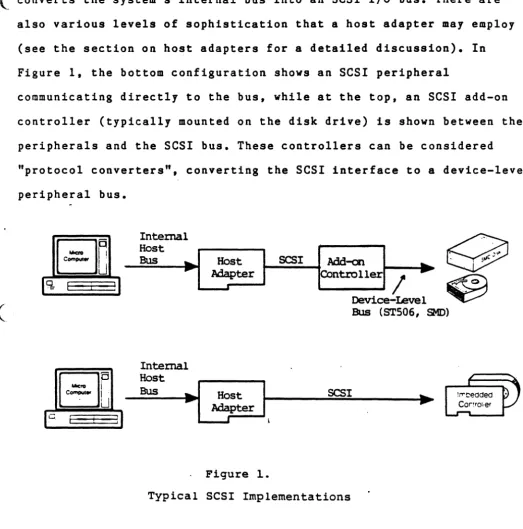
Figure
1illustrates the two popular ways that SCSI is used. Both
configurations use a "host adapter" or a computer-specific board which
SCSI-9
(9
Peripheral Concepts
l
converts the system's internal bus into an SCSI I/O bus. There are also various levels of sophistication that a host adapter may employ(
(
(see the section on host adapters for a detailed discussion). In
Figure 1. the bottom configuration shows an SCSI peripheral
communicating directly to the bus. while at the top, an SCSI add-on
controller (typically mounted on the disk drive) is shown between the
peripherals and the SCSI bus. These controllers can be considered
"protocol converters". converting the SCSI interface to a device-level
peripheral bus.
1~lu
lc;j,·
I:
ET
_10
i
Comoul.. I .
.
U
Ie
i !!
I
!
I
Intemal
_~_o_s_t_·~:I_Ad_Ho.ra=_~_r--,t--_SCS.;..;..;;.I--+~l~
I •
Intemal Host
Bus Host
[image:24.618.38.561.93.622.2] [image:24.618.69.553.315.596.2]Adapter
Figure 1.
SCSI
Typical SCSI Implementations
Device-Level
Bus (STS06, SMD)
!rT'cedded Cor!rOI,er
The lack of SCSI peripherals, winchester or otherwise, keeps the
independent controller/peripheral configuration the most popular in
use today. Even as SCSI peripherals become widely available, separate
o
Peripheral Concepts
!t
controllers will continue to be popular. The .low cost of device-level
;
winchester drives, the ability to "mix and match" controller and
peripheral, the availability of multifunction controllers (i.e., tape
and winchester controller on a single board), and the higher level of
sophistication available in dedicated controllers will all contribute
to the long-term board-level controller market. In other words, at any
given point in time, it is likely that there will be a controller with
more performance/sophistication than can fit "imbedded" in the disk
drive. There will always be two co-existing applications: High
performance and low cost.
The cost of the host adapter keeps the SCSI system (host
adapter/controller/drive) at a price disadvantage when compared to
other alternatives such as a bus-specific controller. But that
additional cost buys expansion capability. As these systems truly
implement multiple peripherals on the SCSI bus (a situation that is
virtually non-existent today), the price of the host adapter can also
be amortized over the number of peripherals,
r~ducingthe total system
I
cost. But host adapters which support multiple peripherals (or
"targets" as the ANSC spec calls them) will require increased
functionality and hence, increased cost. Semiconductors for SCSI
become the critical path for the future success of this interface, as
these chips can be used in host adapter, drive, and controller.·
SCSI's multiple peripheral/multiple host capability is its most
attractive feature. As the office systems market continues to mature,
many new and older machines are being adapted for networking. SCSI is
SCSI-II
@periPheral Concepts
~~~--~---~.-=-==~=---~.-... ,
well suited for this application, either as a file server or a local
(
shared resource.
A Changing Market
As mentioned earlier, the cost of an SCSI system today is more
expensive than traditional alternatives. The price of the the host
adapter, controller, or SCSI peripheral is more costly than a
dedicated bus-specific controller coupled to a device-level winchester
disk drive. This alternative does not support the expansion
.
capabilities of SCSI, but in some applications, particularly a
single-user personal computer market, cost outweighs these expansion
benefits. Add-on board products available for these computers now
perform multiple functions, thereby preserving the available number of
C
slots for system expansion.
(
XSASI and host-specific controllers which feature multiple peripheral
support (winchester/tape, winchester/floppy, etc.) compete with SCSI
implementations in the single host/multiple peripheral configuration •
•
Many of these products perform peripheral-to-peripheral communications
internally, keeping the bus free. Unfortunately, it is at this level
that most computer OEM's"and system integrators begin to see the
benefits of SCSI.
An SCSI floppy disk drive or an SCSI floppy controller has an
extremely limited market. Today's pricing of floppy disk drives and
LSI floppy controllers enable the computer OEM to integrate a floppy
SCSI-12
i r I
,
i
into the base system at very low cost (in some cases, for less than
$50). One must question the advantage of a second floppy disk drive on
the SCSI bus, even if supported by a multifunction controller. In
fact, the low recurring costs of a floppy controller/drive has made
this peripheral "standard" on all but the lower-end home machines, a
market that is clearly not SCSI territory.
SCSI peripherals, or those peripherals containing an imbedded SCSI
controller, will compete with the SCSI controller board-level market.
But most peripheral manufacturers will initially purchase standard and
custom controller chips for integration into their drives, at least
until
in-h~usecontroller
~xpertiseis developed. A controller company
which supplies both chips and board-level products can take advantage
of this new market. By 1988, over 30% of all winchester controller
chips will be sold via this channel. In the short term, many SCSI
buyers will continue to prefer separate controller and drive
procurement to retain maximum price and performance flexibility.
The majority of SCSI devices avaiiable today have been limited to
winchester and tape peripherals simply because it was these
manufacturers who were responsible for the development and promotion
of SCSI. Both the printer and communications market has not
experienced much interest. The popular Centronics-parallel and RS-232
interfaces are low in cost, supported by virtually all computer
manufacturers, and present stiff competition on a price-basis with
~.
SCSI. The communications market generally finds SCSI quite limited,
'f
particularly in terms of its data rate and contention protocol when
SCSI-13
@periPheral Concepts
(
compared with traditional data communications alternatives. Both these
markets will grow, but not until a major computer OEM chooses SCSI as
a "standard" port on the back of the system. There is much speculation
this year of such an event happening at IBM, Digital Equipment, AT&T,
and Apple. We believe Apple will be the first major user, followed
closely by AT&T. Don't expect too much activity before the second
quarter of '86. DEC's renewed interest in QBUS may have positive
connotations for SCSI, but not in the near term. In the case of IBM,
the use of a generic interface doesn't make sense. Despite strong
speculation, any company with the clout to set industry standards has
little to gain by adopting an interface used by its much smaller
competitors.
The "vendor unique" and "optional" commands in the SCSI specification
C
has caused many of today's products to be ·software-incompatible. There
are no guidelines or levels of SCSI supported in the ANSC
specification. The "mandatory" command
set~which all devices must
recognize, is too limited to allow even the simplest firmware or host
adapter to support only those commands. The end result is the SCSI
designer must modify firmware and/or driver routines each time a
different vendors' product is qualified. This problem continues to
slow the growth of SCSI. A low cost, high-volume controller chip for
SCSI may stabilize these command choices in the future, but these
devices will probably be available from a variety of vendors with
slightly different command support, or simply allow any command to be
passed along the bus. Another possibility, and one that holds the most
(
o
Peripheral Conceptse
( promise, may be a de facto solution. One manufacturer becomes a
dominant supplier of SCSI controllers, forcing all others to
manufacture command-compatible products. This would not be the first
(or last) time that an industry standard became established in this
way.
(
SCSI-IS
c
Product Definition
Products and forecasts within this group refer to XSASI/SASI, Basic
SCSI (non-arbitrating) and Full SCSI (reconnect-disconnect)
board-level controllers of various form factors. These controllers
interface to a variety of peripherals including winchesters, tapes,
and floppies. During Calendar year 1984, there were 11 manufacturers
shipping 54 products. Examples of products and manufacturers in this
group are:
Adaptec, Inc.
Adaptive Data Systems, Inc.
Data Technology Corporation
Emulex Corporation
NCR Corporation
Scientific Micro Systems
Sysgen Corporation.
Western Digital Corporation
Xebec Corporation
o
Peripheral Concepts
SCSI-16
ACB-4000
ACB-5500
PYTHON-II
COMBO-I
802C
510D
MEDALIST MDOI
TITLEIST MT02
ADP-41-04
ADP-44-02
FWD5001
5100
SC3000
SI536
WDI002-SHD
WDI036R-SHD
,
t
•
•
II
i
I
t
I
,
I
•
Market Trends
Peripheral Concepts estimates the total SASI/SCSI market to be:
1984
1985
1986
1987
1988
REVENUES
($)76,6891
83,7141
108,6131
139,9841
163,0761
SHIPMENTS
338.71
404.81
579.41
834.21
1107.51
Revenues for this market are expected to produce a compound annual
growth rate of 20.8% from 1984 through 1988. Revenues from 1984 to
1985 will experience a
gr~wthof 9.2%,
whil~shipments for the same
period will increase 19.5% from 338,600 to 404,700 units. The slower
short-term growth in the computer industry is partly responsible for
this near term slowdown, which is expected to recover during the
second half of 1986.
The shift from XSASI to SCSI is occuring ahead of our 1984
predictions. It is evident now that 17% of the ISASI business will
I
give way to SCSI before the end of 1985. A proliferation of
semiconductor products for SCSI (Both custom and semi-custom) will
allow Basic and Full SCSI controllers to compete on a price and
form factor basis with XSASI. Over the 5-year period from 1984 to
1988, XSASI/SASI will experience a negative compound annual. growth
rate of -26.0% in revenues.
Part
o~the SCSI controller board-level business is also shifting to
imbedded controllers and intelligent drives. This new market is almost
SCSI-17
(9
Peripheral Concepts
(
Co
(
•
exclusively chips and chip-sets sold directly to peripheral vendors.
It is estimated that the SCSI board-level controller market will lose
12-15% share to imbedded controllers by 1986. However, a grow1rig need
"for higher performance controllers (especially in the Basic SCSI
configuration) will prevent this share from increasing substantially
in future years. The lower performance level SCSI controllers and SASI
type controllers will be the first markets to deteriorate, being
displaced by imbedded controllers.
Optical disk drives represent a prime candidate for SCSI, more so than
ESDI. The characteristics of optical data storage are different than
winchesters. SCSI can "hide" these differences from existing operating
systems and applications software. The first products will likely be
board-level controllers, particularly multifunction units capable of
controlling both optical and winchester disk drives on the same board.
It is expected that by the end of 1986, major OEM commitments will
materialize for SCSI. This boost to the market will result in a
"second-wind" for SCSI, causing a much sharper growth rate towards the
end of 1986 and beyond. This
dema~dshould also diversify SCSI into
non-storage related products.
Technology Trends
The SCSI controller market has been primarily dominated by
winchester-only controllers, representing 73.3% of revenues, or $56.2
Million in 1984. Multifunction products accounted for only $13.5
SCSI-18
Million or 17.6% of 1984's market. We expect a definite shift to
.ult\Iunction controllers over the next several years, particularly in
the Tape/Winchester combination. The need for back-up of higher
capacity winchesters coupled with the wide acceptance of the QIC-36
tape interface will allow multifunction controllers to reach 27%
revenue share or $44.0 Million by 1988.
rhe QIC-02 interface, dominating tape-only and multifunction revenues
by 61.7% or $12.5 Million in 1984, will dwindle down to approximately
10.1% by 1988. The
highe~price tag of QIC-02 drives as well as the
~dup1ication"
of intelligence in both the drive and controller, is
Jharp1y increasing the use of the QIC-36 tape interface in new
lpp1ications. By the end of
~986,over half of all the
:ape/mu1tifunction controllers shipped (62.1%) will use the QIC-36
LnteC ace. The only event which could cause a contingency to QIC-36's
iominance, is the acceptance of the IBM 3480 tape cartridge for use in
microcomputer systems. We believe the 3480 will eventually penetrate
:his market, but not until late 1987-88, and will most likely utilize
:he SCSI interface rather than a
"native~environment
~uchas QIC-36.
~he
traditional ST506/412 controller, though not declining on an
lbsolute revenue basis, will make way for ESDI products. Less than .2%
~evenue
share in 1984, ESDI controllers will account for 19.6% of all
linchester controllers shipped in 1988, representing $19.8 Million in
~evenues.
The ST506/412 controller will still retain 80.2% revenue
Jhare in 1988, down slightly from the 93.9% share or $52.8 Million in
~984.
ESDI products will have the most effect on SMD winchester-only
(
SCSI-19
Q
Peripheral Concepts
f
---"---r
controllers, declining from its 5.9% share in 1984 to less than .2% by
(
1988.
The Basic SCSI configuration will continue in a strong growth mode as
the need for Full SCSI is circumvented by the growth in multifunction
controllers. Likewise, new designs will continue to find the higher
performance, Basic SCSI controllers more than adequate to meet design
goals. Basic SCSI, which represents 34.9% of the 1984 market, will
grow to 52.0% by 1988. But by 1987, it is expected that Full SCSI will
begin to gain a foothold, capturing 25% of the 1988 marketplace.
Imbedded controllers and chips will present significant competition to
the overall SCSI board-level controller market. These drives will at
least be equal in price to discrete controller and drive purchases.
Likewise, the price differential between the older SASI controllers
~.
and most basic SCSI products will be less than 10% by the end of 1985.
(
Co~troller
products will have to rely on
hi~herperformance and
advanced functions to maintain market share. Basic SCSI interfaces
will be·available on many disk drives in the near future. But advanced
L
controller features such as caching, synchronous transfers, advanced
error" correction," file-serving, etc., will remain in the controller.
An often overlooked characteristic of SCSI is its performance range. A
computer system costing $2500 and one costing $25,000 can both use
SCSI effectively because of its wide range of performance options.
Personal computers, Supermicro's, low-end CAD/CAM, and engineering
workstations are all excellent markets for SCSI. Some limitations do
SCSI-20
o
Peripheral Concepts
•
{ exist at the very high-end of the market (i.e., Unibus and other
\.
t
r
.,
.
,
minicomputer interfaces) when SCSI is used in an emulating
environment. Performance degradation occurs when several levels of
protocol conversions have to be made from SCSI to the host bus.
The potential number of SCSI "sockets" has yet to influence the true
merchant semiconductor suppliers to develop dedicated silicon for
SCSI. In fact, microprocessor suppliers are just now beginning to ship
ST506/412 winchester controller chips, usually as part of their
microprocessor family of support devices. If the same were done for
SCSI, every microprocessor design would have the potential to contain
an SCSI port, and that would have 8 very positive impact on the size
of this market.
SCSI-21
Key Assumptions
o XSASI/SASI controllers will continue to lose market share to Basic and Full SCSI products.
o Major OEM commitments will be made towards SCSI in the second half o£
1986.
o Multifunction controllers (Winchester/Tape) will gain significant
acceptance and boost the Basic SCSI configuration.
o SCSI is a strong contender for optical disk drives, both in the imbedded and board-level marketplace.
o Higher performance Basic SCSI products will be adequate for most applications, slowing the short-term growth of Full SCSI.
CALENDAR 1984 MARIET SHARES
REVENUES BY MANUFACTURER
Xebec Corporation
Western Digital
Adaptec, Inc.
Scientific Micro ~ystems
Data Technology Corporation
Adaptive Data Systems
Sysgen Corporation
Other
SCSI-22
o
Peripheral Concepts
26.5%
18.0%
13.8%
13.6%
9.8%
5.9%
4.4%
8.0%
•
\..
211
181
~
lSI
~
121
N
91
CS)
61
38
CONTROLLER mE
XSASI/sASI
BASIC SCSI
FIILl. SCSI
CAPTIVE
ITm
LiJJI
D
lID
CAPTIVE
...••...•.•••.•••...•..•...•...•...•.••...•..
....•...•....•••••••.••..••.••...•.•.•••..•..•.•...•....•...•.•.••...•..••
<
SASI/SCSI CONTROU.ERS
REVENUE StHtARY
REVENIJFS BY PRODUCT TYPE (SOOO)
->
ACJUAL < FORECAST
--->
1984 1985 1986 1987 1988 1984-88
CAGR:
REV(SK) (I) REV(SI) (I) REV($K) (I) REV($K) (I) REV($K) (%)
33,950 44.3 28,182 33.7 21,600 19.9 14,308 10.2 10,154 6.2 -26.0%
26,790 34.9 34,920 41.7 54,OS3 49.8 75,179 53.7 84,866 52.0 33.4%
7,43'; 9.7 11,164 13.3 18,536 17.1 30.114 21.5 40.820 25.0 53.1%
8.514 11. J
.
9,448 11 .3 14.394 13.3 20,383 14.6 27,236 16.7 33.7%WAf. REVENUES (SOOO) $76.68CJ ·100% $83.714 100% $IOS,fiJ3 ,100% 5139.984 100% 5163,0;6 100% 20.8%
ANN\'Al. GROWTH RATF. 9.2% 29.7% 28.9% 16.5%
SOllRC'E: PERIPHE